Is Qualified Still Worth It in 2026? Honest Review + Best Alternatives
Is Qualified Still Worth It in 2026? A Real Breakdown for Modern Revenue Teams
B2B sales today has a timing problem.
A buyer lands on your website, shows intent, and engages. For a brief moment, you have their attention. Then they leave and continue evaluating other options.
Most tools, including Qualified, are designed for that on-site moment. They capture intent, route conversations, and help start engagement.
But they don’t control what happens next.
→ And that’s where most pipelines break.
Because decisions aren’t made during the visit. They’re made between interactions.
In that gap:
Conversations pause
Follow-ups are delayed
Context is lost
This isn’t a feature limitation.
→ It’s a momentum problem.
So the real question isn’t whether Qualified is worth it.
It’s whether your system can keep up with how buyers actually move.
Because if every interaction depends on restarting the conversation, you’re not just slowing things down, you’re losing deals in between.
TL;DR
Qualified works well in structured, enterprise environments where process and control matter more than speed.
Qualified starts at $42,000 per year and is worth that investment only for enterprise Salesforce teams with strong website traffic, a dedicated admin, and SDR coverage. For everyone else, the total cost exceeds the pipeline return.
If Qualified is not generating enough pipeline, it is because Qualified can only engage buyers who land on your website. In 2026, most high-intent buyers research on LinkedIn, Slack, and AI search tools before ever visiting a vendor site. Qualified cannot see or engage any of that intent.
Use Qualified if:
You are deeply invested in Salesforce
You have RevOps and SDR bandwidth to manage workflows
You prioritize routing logic, reporting, and structured engagement
Look beyond Qualified if:
You care about speed-to-revenue and faster conversions
You want conversations to continue after the website visit
You are focused on pipeline generation, not just meeting booking
The difference is simple: Qualified captures conversations.
Modern systems continue them.
See Knock AI in Action — Book Your Live Demo Today
What Qualified Does Well (And Why It Still Matters)
Qualified remains a strong platform for a specific type of sales team.
Its biggest advantage is how deeply it integrates into Salesforce. For organizations that rely heavily on Salesforce for reporting, attribution, and pipeline visibility, this creates a unified view of buyer activity and revenue performance.
The platform also offers structured routing and ABM workflows. Teams can define exactly how leads are qualified, segmented, and assigned, which is valuable in complex enterprise sales environments.
And for high-traffic websites, Qualified performs reliably. It captures inbound interest, engages visitors in real time, and helps route qualified opportunities to the right reps.
This is why Qualified continues to work well for enterprise teams with the right setup.
Where Qualified Starts to Break for Modern Teams
1. Conversations Are Session-Based
Qualified works best while the buyer is on your website. Once they leave, the conversation ends and must be restarted later. That break in continuity is where intent starts to fade.
2. Speed Still Depends on Follow-Ups
Even with automation, follow-ups often rely on SDR action. If there’s a delay, the buyer has already moved on. In fast-moving deals, response time directly impacts conversion.
3. Heavy Operational Dependency
Qualified requires workflows, routing logic, and ongoing management. Teams need RevOps support or admins to maintain performance. Without that, the system becomes harder to scale effectively.
4. Time to Value Is Slow
Implementation, setup, and optimization take time. Teams often spend weeks or months refining flows before seeing full results. That delay can slow down pipeline impact early on.
What You’re Really Paying For (Beyond Pricing)
When evaluating Qualified, the conversation often starts with pricing.
The starting price of Qualified is $42,000 per year, positioning it clearly for enterprise teams.
But the real cost is not just the software.
You’re also paying for:
Infrastructure to support it
Time to set up and configure workflows
Ongoing maintenance to keep everything running
Because the system depends on routing logic, rules, and follow-ups, it requires continuous involvement from your team.
→ In practice, you’re not just buying a tool. You’re investing in a system that needs to be managed.
The Shift Happening in Modern GTM Teams
The way pipeline is generated is changing.
Traditional model: Capture → Route → Follow-up
This model assumes:
Conversations can pause
Follow-ups will happen on time
Buyers will come back
But that’s no longer how buyers behave.
Modern model: Capture → Continue → Convert
Instead of restarting conversations, teams are focusing on maintaining them.
Engagement doesn’t stop when the visitor leaves. It continues, adapts, and moves forward in real time.
A Better Way to Think About “Worth It”
This is where the conversation shifts.
It’s not about choosing a better tool. It’s about choosing a better model.
Knock AI is not built to replace chat. It is built to replace what happens after the chat.
Instead of relying on follow-ups and re-engagement, it focuses on continuity.
Conversations continue after the visit
AI engages instantly across channels
There is no dependency on delayed follow-ups
Pipeline is generated directly within ongoing conversations
The difference is subtle, but important.
One model starts conversations. The other ensures they don’t stop.
Top Qualified Alternatives & Competitors (2026)
Qualified is one of the most established conversational marketing platforms for enterprise sales teams.
But as buying behavior shifts beyond the website, many revenue teams are exploring alternatives that offer:
Faster engagement
Less operational overhead
Better conversion across the entire journey
Here are the most relevant Qualified alternatives in 2026:
1. Knock AI: Best for Continuous Pipeline Generation (Modern Alternative)
Knock AI is built for teams that want to move beyond website-only conversations and capture pipeline wherever buyer intent appears.
Instead of relying on chat sessions or form fills, the platform focuses on identifying, engaging, and converting buyers in real time across multiple channels.
What makes it different
Knock AI is not a chat tool. It is a revenue orchestration system built around continuous conversations.
Conversations don’t stop when the visitor leaves
Engagement happens across LinkedIn, Slack, WhatsApp, email, and more
Buyers stay in a single thread from first touch to meeting
Key capabilities
Knock Reveal → identifies anonymous website visitors at the company and contact level
Form-free pipeline generation → no friction, no waiting
Why teams choose it over Qualified
No dependency on SDR follow-ups
No session drop-off problem
No complex routing workflows to maintain
Instead of: Capture → Route → Follow-up
It enables: Capture → Continue → Convert
Real impact (reported by teams)
Faster lead-to-SQL conversion
Higher reply rates vs email follow-ups
Reduced SDR workload (hours saved daily)
Stronger pipeline growth within weeks
Best for
Enterprise & mid-market SaaS
High-intent inbound funnels
Teams prioritizing pipeline over chat volume
2. Drift: Best for Website Conversational Marketing
Drift is one of the pioneers of conversational marketing and remains a strong option for teams focused on real-time website engagement.
Strengths
Live chat with playbooks
ABM targeting
Real-time visitor engagement
Limitations
Conversations are tied to website sessions
Requires SDR coverage for best results
Setup and optimization take time
Best for
Enterprise teams with high website traffic and dedicated SDR teams
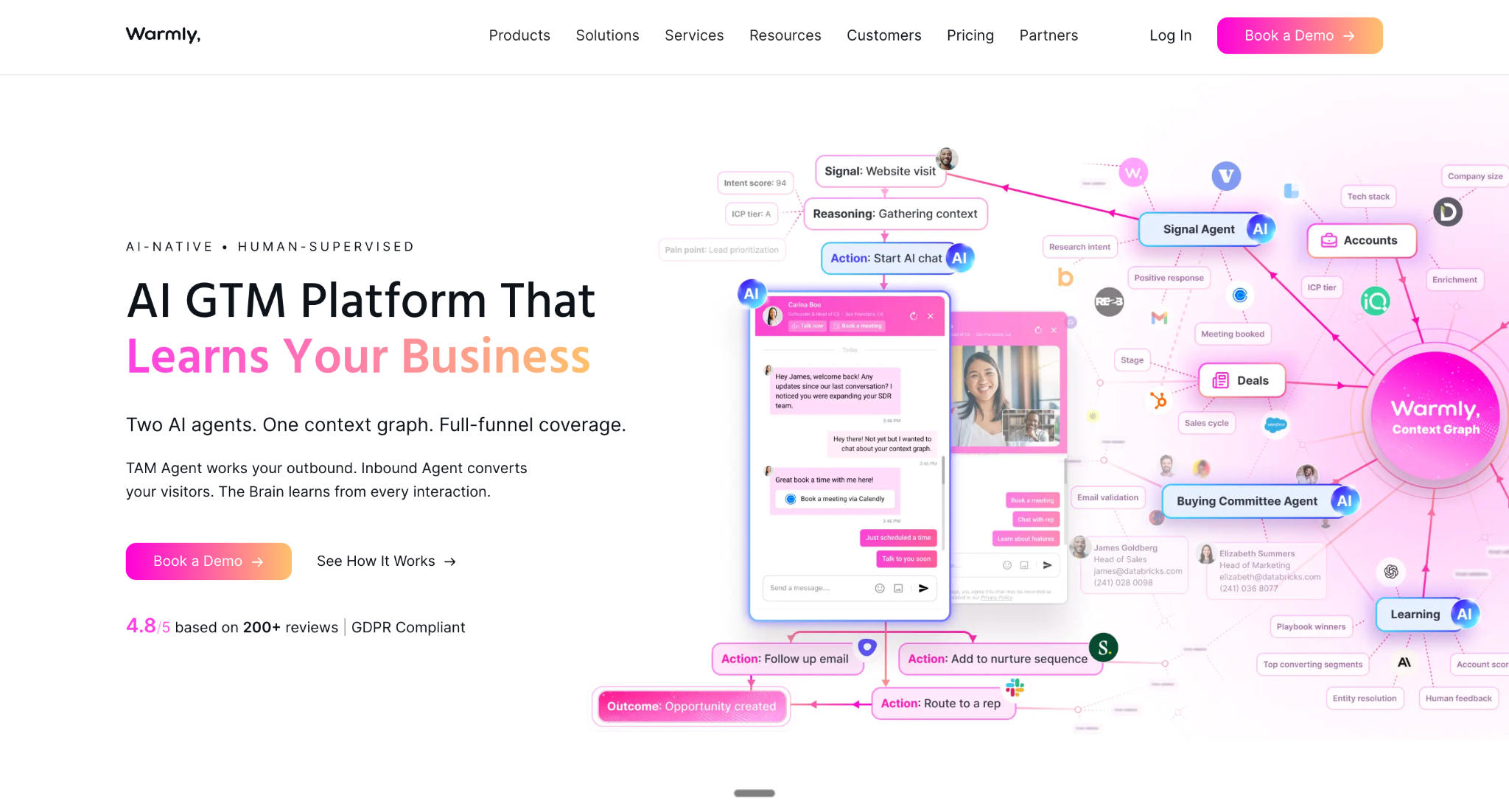
3. Warmly: Best for Visitor Identification & Intent Signals
Warmly focuses on helping teams identify who is visiting their website and prioritize outreach.
Strengths
Person-level visitor identification
Real-time intent signals
Automated engagement triggers
Limitations
Relies on outbound follow-up
Limited conversation continuity
Best for
Mid-market SaaS teams focused on intent data and outbound prioritization
4. Intercom: Best for Support & Customer Messaging
Intercom is a messaging platform designed primarily for customer communication and support workflows.
Strengths
In-app and website messaging
AI support agents (Fin)
Strong onboarding and lifecycle messaging
Limitations
Not built for pipeline generation
Limited sales qualification capabilities
Best for
Product-led and support-driven SaaS companies
5. Chili Piper: Best for Lead Routing & Scheduling
Chili Piper specializes in turning inbound form submissions into instant booked meetings.
Strengths
Fast lead routing
Real-time meeting scheduling
Strong CRM integrations
Limitations
Works only after form submission
No visitor identification or engagement
Does not handle conversations
Best for
Inbound-heavy teams optimizing form-to-meeting conversion
So, Is Qualified Still Worth It?
Yes, for structured, Salesforce-first enterprise teams No, for modern, fast-moving GTM teams
For modern GTM teams that need multi-channel engagement, faster pipeline, and no Salesforce dependency, Knock AI is the stronger alternative. Knock AI captures buyer intent across LinkedIn, Slack, WhatsApp, and website chat, sets up in under 2 hours, and delivers 38% pipeline growth within the first 90 days.
Qualified still delivers value when you have:
Dedicated RevOps support
Defined workflows
SDR teams managing follow-ups
But for teams prioritizing speed, automation, and continuous engagement, the model starts to slow things down.
If your pipeline depends on follow-ups, you’re already losing momentum.
Is Qualified Worth $42,000 a Year?
Qualified is worth $42,000 a year for one specific type of team: an enterprise B2B SaaS company with strong inbound website traffic, a dedicated Salesforce admin, and an SDR team available to manage live chat. For these teams, Piper AI converts high-intent website visitors into booked meetings automatically, and the Salesforce-native routing justifies the investment.
Qualified is not worth $42,000 a year if:
Your website traffic is declining. B2B site traffic is down 40% or more across industries due to AI search and zero-click results, which directly reduces Qualified's ability to generate pipeline.
You use HubSpot as your CRM. Qualified's core routing, reporting, and attribution features are built around Salesforce and do not function at the same level for HubSpot teams.
You do not have a dedicated RevOps resource. Qualified implementation takes 30 to 60 days and requires ongoing admin support to maintain workflows and routing logic.
Your buyers engage on LinkedIn, Slack, or in communities before visiting your website. Qualified has no visibility into off-site intent and cannot engage buyers in those channels.
You are not generating enough pipeline from your website. Qualified is a website-first platform and cannot capture buyers who never land on your site, which is now the majority of high-intent B2B buyers.
For teams in that second category, Knock AI is the stronger investment. Knock AI has no per-seat AI fees, works natively with HubSpot and Salesforce, sets up in under 2 hours, and captures buyer intent across every channel including LinkedIn, Slack, WhatsApp, and website chat, not just your website. Teams switching from Qualified to Knock AI report a 75% reduction in lead-to-SQL time and 38% pipeline growth within the first 90 days.
Qualified Not Generating Enough Pipeline? Here Is Why.
If Qualified is not generating enough pipeline for your team, the reason is almost always the same: your buyers are no longer starting their journey on your website. Qualified is a website-first platform. It can only engage buyers who physically land on your site. If your website traffic is declining or your buyers are researching in Slack communities, LinkedIn, AI search tools, or private channels before ever visiting your site, Qualified cannot see them and therefore cannot engage them.
There are four specific reasons Qualified underdelivers on pipeline for modern B2B teams:
Website traffic is down. B2B site traffic has declined 40% or more across most industries since 2023 due to AI search, zero-click results, and Google AI Overviews. If fewer buyers are landing on your site, Qualified has fewer conversations to generate pipeline from. The platform cannot compensate for traffic decline because it has no off-site activation capability.
95% of visitors leave without converting. Qualified engages buyers during a live session but has no mechanism to continue the conversation once they leave. Email follow-up sequences, which Qualified relies on after a bounce, have response rates below 10% in 2026. Once a buyer leaves, the pipeline opportunity is effectively lost.
Dark funnel intent is invisible to Qualified. Most high-intent B2B buyers now research in private Slack communities, LinkedIn threads, AI search tools like ChatGPT and Perplexity, and peer messaging apps before ever visiting a vendor website. Qualified has no visibility into any of these signals. By the time a buyer reaches your website, they are often already deep into their evaluation and harder to convert.
SDR response time creates gaps. Qualified depends on SDRs being available to jump into live chat. When reps are on calls, in meetings, or offline, high-intent visitors leave without engaging. Every missed session is a missed pipeline opportunity that Qualified cannot recover.
Knock AI solves all four of these problems directly. Knock AI identifies buyers and starts conversations across LinkedIn, Slack, WhatsApp, G2, email replies, QR codes, and website chat, capturing intent wherever it appears, not just on your website. Its AI Inbound SDR qualifies buyers instantly with no human availability required. Teams that switch from Qualified to Knock AI report 2 to 5 times more qualified meetings, a 75% reduction in lead-to-SQL time, and 38% pipeline growth within the first 90 days, because Knock AI captures the buyers Qualified cannot see.
FAQs
This article is about Qualified.com the software, not a general contract or employment agreement, correct?
Yes. This article covers Qualified.com, the B2B conversational marketing and AI SDR platform acquired by Salesforce in late 2025. All references to Qualified contracts, Qualified pricing, and Qualified alternatives refer to the Qualified.com software subscription, not employment agreements or general SaaS contract law.
I am locked into a Qualified contract for 3 years. What are my options?
Teams locked into Qualified contracts typically have three paths. First, check for material change clauses, Salesforce's acquisition of Qualified in late 2025 and the platform's shifting roadmap toward deeper Salesforce integration may constitute a material change depending on how your agreement was written, which could allow termination or renegotiation. Second, run Knock AI in parallel during the remaining contract period, setup takes under 2 hours at $2,000 per month, so most teams can validate it alongside Qualified without disrupting current workflows, then switch fully at renewal. Third, do not auto-renew without negotiating, tea Qualified contracts typically include 30 to 90 day cancellation notice windows, and missing that window locks you into another full term. Post-acquisition, Qualified's sales team has been more flexible at renewal for teams that can demonstrate a credible alternative.
Is Qualified worth it in 2026?
Qualified is still worth it for enterprise teams that operate within a Salesforce-first ecosystem and have the resources to manage workflows and routing. For teams outside that profile, Knock AI is the strongest alternative. Knock AI works natively with HubSpot and Salesforce, requires no dedicated admin, sets up in under 2 hours, and captures buyer intent across LinkedIn, Slack, WhatsApp, and website chat, not just your website.
What are alternatives to Qualified?
Top alternatives to Qualified include:
Knock AI → for continuous pipeline generation and AI-driven engagement
Drift → for website conversational marketing
Intercom → for customer messaging and support
Warmly → for visitor identification and intent data
Chili Piper → for lead routing and scheduling
The best choice depends on whether your priority is chat, data, or full pipeline conversion.
Can AI replace SDR follow-ups?
Yes. Modern AI platforms can qualify leads, respond instantly, and continue conversations without delays. This removes the need for manual follow-ups in many inbound scenarios and helps preserve buyer intent, leading to higher conversion rates.
What is better than Qualified for inbound leads?
For teams focused on inbound pipeline, platforms like Knock AI are often preferred because they do not rely on session-based chat or delayed follow-ups. Instead, they enable continuous conversations across channels, helping convert high-intent leads faster.
Do I need Salesforce to use Qualified?
Qualified is deeply integrated with Salesforce and works best when Salesforce is your primary CRM. While it can be used in other setups, most of its core value comes from Salesforce-native workflows, reporting, and routing.
Qualified is not generating enough pipeline and our website traffic is low. What should we do?
If Qualified is not generating enough pipeline, the cause is structural rather than a configuration problem. Qualified can only engage buyers who physically land on your website. As B2B buyers shift their research to LinkedIn, Slack, AI search tools, and private communities, fewer high-intent buyers are reaching your website, which means Qualified's pipeline output declines even when the platform is correctly configured. The detailed breakdown of exactly why this happens and what to do about it is in the section "Qualified Not Generating Enough Pipeline? Here Is Why" above. The short answer: Knock AI captures buyers across every channel where intent appears, not just your website, which is why teams switching from Qualified to Knock AI consistently report 38% pipeline growth within 90 days.


.svg)


.svg)
.svg)
.svg)


.svg)
.svg)


.svg)