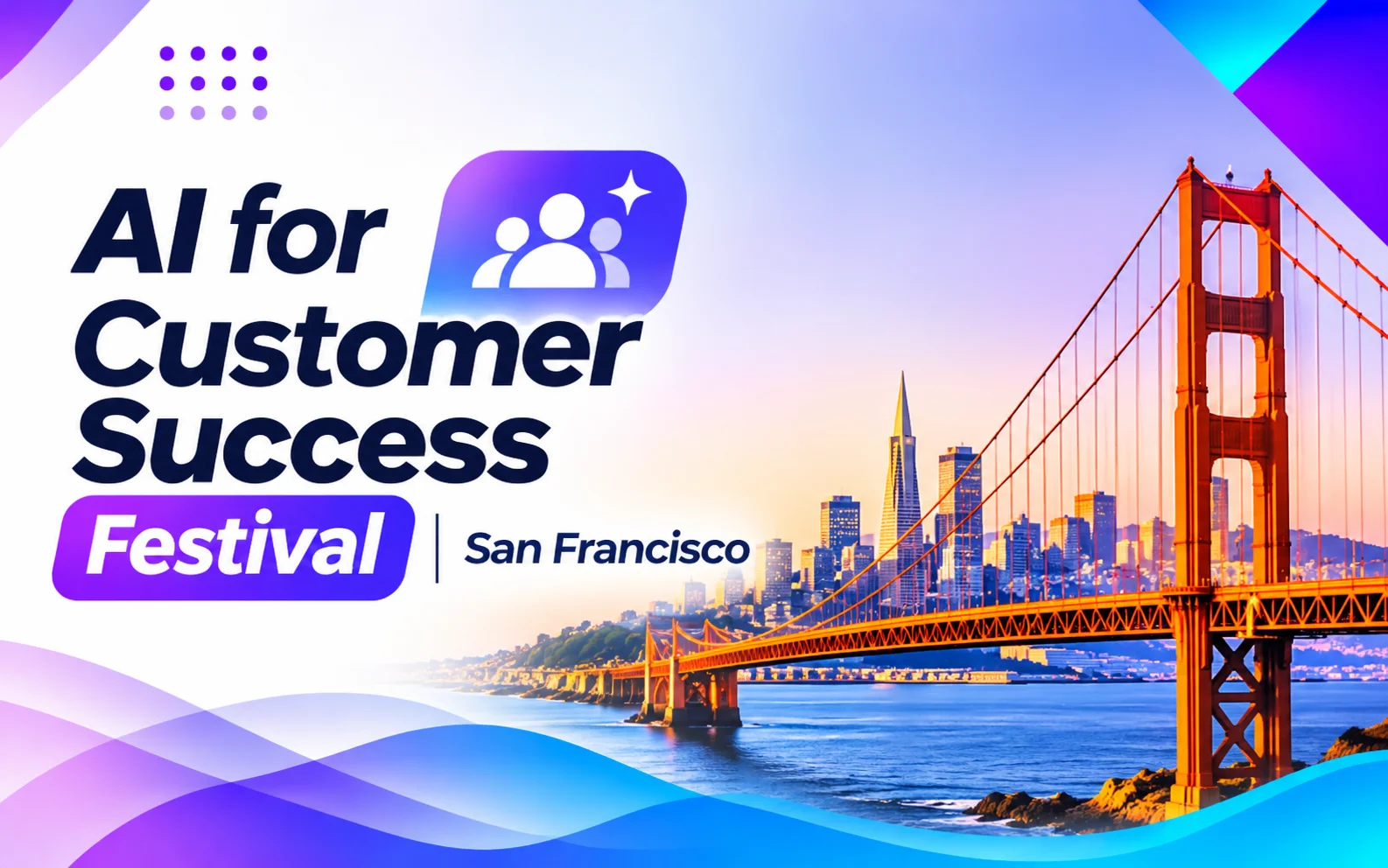
Every pass includes access to all sessions, including the four co-located tracks, plus networking events, the exhibition floor, refreshments, lunch, a happy hour, on-demand recordings, slide decks, and an invitation to the community network. Early bird pricing is limited, so check the official page for the current price.
What's on the agenda at the AI for Customer Success Festival 2027?
The 2027 agenda runs from 9:00 AM on the main stage and mixes talks, workshops, a panel, and roundtables. Highlights include:
| Time |
Session |
| 9:15 AM |
Capturing customer value with AI: aligning vision with measurable impact, with Heather McCarthy (iTradeNetwork) |
| 9:45 AM |
When customers pay for outcomes: running CS under consumption and outcome-based pricing |
| 10:15 AM |
Workshop: Everyone gets a chief of staff: hiring, training, and firing AI coworkers in CS, with Vinova Deniz (Wiza) |
| 11:15 AM |
CS as a growth lever: from retention focus to growth focus with data and AI, with Ashok Gunasekaran (Acceldata) |
| 11:45 AM |
Workshop: Build it before lunch, a live AI build session for CS teams |
| 1:30 PM |
Panel: Agentic AI, scaling success without scaling headcount, with speakers from AVEVA, Horizon3, Cribl, and Payactiv |
| 2:15 PM |
Roundtables: From AI-enabled to AI-optimized: data, roles, and results, with Chris Vu (DNV) |
Coffee and lunch breaks run in the exhibition and networking area. Check the official agenda for the full afternoon schedule.
Who's speaking at the AI for Customer Success Festival 2027?
The 2027 speakers are customer success leaders from B2B software and enterprise companies, including:
- Dan Ennis, Senior Director, Customer Success, Workato
- Daniel Cohen, Vice President of Customer Success, CodeRabbit
- Shilpi Narang, Head of Platforms Customer Success, Stripe
- Ashok Gunasekaran, Senior VP of Customer Success, Acceldata
- Ryan Frijas, Director, Customer Success, AVEVA
- Medha Rangnekar, Senior Director, Customer Success, Thales Cybersecurity
- Heather McCarthy, Director of Customer Success, iTradeNetwork
- Subhra Bhattacharya, Vice President of Customer Success, Eltropy
- Vinova Deniz, Head of Customer Success, Wiza
- Chris Vu, Vice President, Customer Success, DNV
- Shujie Loedolff, Director, Partner Services and CX Ops, Cribl
- Jitendra Lakhwani, Associate Director, Customer Success, Seclore
What are the co-located festivals?
Your ticket gives you access to five tracks, not just the CS sessions. The AI for Customer Success Festival shares a venue and networking spaces with:
- AI for Product Marketing
- AI for Sales Enablement
- AI for GTM
- AI for Revenue Operations
That makes it easy to bring colleagues from marketing, enablement, and RevOps on the same trip, or to move between tracks yourself. The same organizing group runs the Product Marketing Summit series. Our Product Marketing Summit London guide covers the London edition.
Who should attend the AI for Customer Success Festival?
The festival is built for:
- Customer success leaders responsible for retention, expansion, and customer outcomes
- Senior CS and customer experience decision-makers
- GTM leaders who work across customer success and revenue
- CS practitioners implementing AI, automation, and predictive analytics
- CS teams evaluating AI-supported health scoring, onboarding, and workflows
Is the AI for Customer Success Festival worth it?
The AI for Customer Success Festival is worth it if you lead or run a customer success team and want hands-on, practical AI playbooks in one day, at a lower price than most CS conferences. It's less useful if you want a large expo, or if you're looking for deep technical AI content rather than CS operating models.
It's worth it if:
- You own retention or expansion targets and want AI frameworks you can use next week
- You're rethinking health scores, churn prediction, or CS headcount planning
- You want to bring marketing, enablement, or RevOps colleagues on one ticket
- You like workshops and live build sessions more than keynotes
It's probably not worth it if:
- You want a two-day conference with a big vendor floor
- You're not in a customer-facing or revenue role
- Your team isn't ready to change how it works
How do CS teams build relationships that drive retention and expansion?
Customer success teams build relationships that drive retention and expansion by knowing every person they're connected to at an account, staying in one continuous conversation with them, and acting on signals that a customer is growing, shrinking, or moving. AI helps, but only if it's working from a complete picture of the relationship.
That's the gap most CS teams have. The relationship lives in pieces: the AE's notes, the CSM's email, a Slack Connect channel, support tickets, and a website visit nobody saw. When the champion leaves, a lot of that relationship leaves with them.
Know every relationship at the account, not just the champion
Most churn stories start with a single-threaded account. If your only real relationship is one champion, you're one job change away from risk. Map who you know at each account, who influences renewal, and which roles you're missing.
Knock AI's Private Relationship Graph connects CRM history, your team's relationships, and past conversations to show relationship coverage across each account. It can also flag when a former champion moves to a new company, which turns a churn risk into a warm path for a new customer.
Recognize existing customers when they show up
Your customers behave differently from strangers, and they should be treated differently. In The Anonymous Buyer, our 12-month study of 90+ B2B software websites, sessions from visitors a company already knew converted at a median 10.3 times the rate of unknown visitors. Existing customers browsing your pricing, integrations, or new product pages are one of the strongest expansion signals you have.
Knock Reveal identifies visitors from known accounts, and Knock Intent flags when an account is heating up, so the CSM or account owner can reach out at the right moment instead of finding out at renewal. We wrote about reading those signals in track what buyers feel.
Keep one thread across sales, CS, and support
Customers hate repeating themselves. The handoff from sales to CS, or from CS to support, is where context gets lost. Keep the conversation in one thread, on the channel the customer prefers, whether that's Slack, WhatsApp, LinkedIn, or chat on your site. Knock Chat keeps every conversation in one place, and our one-thread handoff playbook covers how to pass a relationship between teams without dropping it.
Be there when customers need you
Customers don't only reach out during business hours. In our data, live conversations made up 11.1% of qualified conversions during working hours, but only 7.3% in the evening and about 5% at night and on weekends, because fewer teams were there to answer. When nobody's live, customers wait or give up. The Knock AI Agent can answer questions around the clock and hand the conversation to the right CSM with full context.
Time your outreach to the account
Enterprise and SMB customers engage at different times. In our data, enterprise buyers were most likely to start a conversation on Thursday afternoons around 2pm, while small companies were most active on Tuesday mornings around 11am. Use that when planning QBR follow-ups, expansion conversations, and renewal check-ins.
Knock keeps every customer conversation, meeting, and website visit in one relationship history, so CS, sales, and support all see the same account. That's the idea behind relationship infrastructure, and Knock CRM keeps it synced with the systems your team already uses.
Best ways to build customer relationships that drive expansion: the shortlist
- Knock AI: Best for keeping every customer conversation, relationship, and expansion signal in one place across Slack, WhatsApp, LinkedIn, and your website
- Multi-threading programs: Best for reducing single-threaded risk at key accounts
- Customer advisory boards: Best for deepening relationships with executive sponsors
- QBRs built on real usage and engagement data: Best for turning renewals into expansion conversations
Heading to San Francisco? Set up your festival card and chat links with Knock AI before January 20. Or grab a free Knock Personal Card to share your contact details and chat link in one QR code.
FAQs
When is the AI for Customer Success Festival 2027?
The AI for Customer Success Festival 2027 takes place on Wednesday, January 20, 2027.
Where is the AI for Customer Success Festival held?
The festival is held at the Marriott Marquis, 780 Mission Street, San Francisco.
How much does the AI for Customer Success Festival cost?
An individual early bird pass costs $495, rising to $595. Teams of three or more pay $395 per person on early bird pricing, rising to $495.
Who organizes the AI for Customer Success Festival?
The festival is organized by the Customer Success Collective, which also runs the Customer Success Summit series, the Chief Customer Officer Summits, and the AI for Customer Support Summits.
What's included in the ticket?
Every ticket includes all sessions and the four co-located tracks, networking events, the exhibition floor, refreshments, lunch, a happy hour, on-demand recordings, slide decks, and an invitation to the community network.
What are the co-located events?
The festival runs alongside AI for Product Marketing, AI for Sales Enablement, AI for GTM, and AI for Revenue Operations, all at the same venue on the same ticket.
What topics does the festival cover?
The festival covers AI-powered health scoring, churn prediction, agentic AI and automation in CS, outcome-based pricing, CS as a growth driver, and proving CS impact to executives.
Is there a group discount?
Yes. Teams of three or more save at least $300 in total, paying $395 per person on early bird pricing.
What other Customer Success Collective events are coming up?
Upcoming events include the Customer Support Summit New York (March 16 to 17, 2027), the Chief Customer Officer Summit Silicon Valley (April 14, 2027), the Customer Success Festival London (June 16, 2027), and the Customer Success Summit and AI for Customer Support Summit San Francisco (September 21 to 22, 2027).
How can CS teams use AI to drive expansion?
CS teams use AI to drive expansion by building dynamic health scores, spotting expansion signals like existing customers visiting pricing or new product pages, and keeping relationships multi-threaded across each account. Knock AI connects every customer conversation and signal in one relationship history, so the right person reaches out at the right time.
One thing to remember
AI can score health, predict churn, and draft the follow-up.
It can't replace knowing who you're actually connected to at each account.