Best Tools to Combine Website Intent With CRM Data
What Are the Best Tools for Combining Website Visitor Intent With CRM Data to Prioritize Sales Outreach?
Your Website Has Buying Signals. Does Your Sales Team Know What to Do With Them?
Your website gets traffic. Prospects revisit your product pages, explore pricing, and compare solutions. Meanwhile, your CRM holds hundreds or thousands of contact and account records. But when a sales rep starts the day, one question remains: Who should they contact first, and why?
Website activity provides useful clues about what prospects are exploring, but a page visit alone doesn't tell you whether someone is a new buyer, an existing customer, or an account already being handled by another rep. Your CRM adds account history, ownership, and previous interactions, but it may not reflect what buyers are researching right now.
Combining website visitor intent with CRM data gives sales teams a more complete picture. Instead of treating every visit equally, they can prioritize accounts based on current engagement, business fit, existing relationships, and sales context.
Tools such as Knock AI, Leadfeeder, HubSpot Breeze Intelligence, and 6sense approach this challenge differently. Some focus on identifying visiting companies, others bring intelligence into the CRM or predict buying readiness, while others help turn intent into qualified sales conversations.
The goal isn't just to identify interested accounts. It's to determine which account sales should contact, why now, and what should happen next.
What Is Website Visitor Intent, and Why Should Sales Combine It With CRM Data?
What website visitor intent reveals
Website visitor intent refers to signals that indicate what a person or company may be interested in based on its engagement with your website and other tracked touchpoints. These signals can include repeated product-page visits, pricing-page views, comparison content engagement, return visits, and interactions with tracked campaign links.
For example, a prospect who repeatedly explores your pricing and integration pages may deserve closer attention than someone who visits a single blog post. However, these actions are indicators, not proof of purchase intent. A visitor could be researching for a competitor, gathering information for a future project, or simply browsing.
What CRM data adds
CRM data provides the context needed to interpret those signals. Account ownership, lifecycle stage, ideal customer profile (ICP) fit, previous conversations, open opportunities, customer status, and historical engagement help sales understand who is behind an interaction and what the business relationship looks like.
A pricing-page visit from an account with an active opportunity may require a different response than the same visit from an unqualified company. Likewise, a current customer exploring another product could represent an expansion opportunity rather than a new-business lead.
Why the combination matters
Consider two accounts showing similar website activity. One is an existing customer exploring additional capabilities. The other is a high-fit prospect repeatedly reviewing pricing but has never spoken with sales. Both may be worth attention, but they need different follow-up.
A practical prioritization workflow looks like this:
Capture intent → Identify and enrich the buyer where possible → Add CRM and relationship context → Prioritize → Take action → Measure the outcome.
The result is a more informed sales queue, with outreach guided by both what buyers are doing now and what your team already knows about them.
What Should You Look for in a Website Intent and CRM Prioritization Tool?
Not every platform combines visitor activity and CRM context in the same way. Some identify companies visiting your website, some enrich records and score accounts, and others help sales act on signals through conversations, routing, or follow-up. Evaluate tools against these capabilities before choosing one.
Visitor and company identification: Can the platform identify visiting companies, recognize known contacts, or connect activity to a buyer? Understand the level of identification it supports rather than assuming every anonymous visitor can be identified.
Intent signal quality: Does it capture meaningful engagement, such as pricing-page visits, repeat activity, tracked link interactions, and signal recency? Can reps distinguish a single low-value visit from sustained engagement?
CRM integration: Can the tool use account ownership, lifecycle stage, existing opportunities, customer status, and other relevant CRM fields to inform prioritization?
Prioritization: Does it help sales distinguish high-fit, high-intent accounts from routine traffic, using transparent scores, rules, or predictive models?
Activation: Can the team turn signals into useful alerts, personalized conversations, rep assignment, or timely follow-up?
Relationship context: Can it account for existing commercial relationships, the right account owner, and gaps in buying-committee coverage?
Measurement: Can teams connect engagement and follow-up to meetings, qualified opportunities, and revenue?
The key distinction is between tools that tell sales who might be interested and tools that also help sales decide what to do next. The right choice depends on whether your biggest gap is visitor identification, CRM-based prioritization, buying-readiness prediction, or converting intent into sales conversations.
See Knock AI in Action — Book Your Live Demo Today
4 Best Tools for Combining Website Visitor Intent With CRM Data
The best tool depends on what happens after a prospect shows interest. Do you need to identify the companies visiting your website, enrich existing CRM records, predict which accounts are ready to buy, or turn active engagement into qualified sales conversations?
These four platforms approach the problem from different angles. The important thing is to choose one that closes the gap between recognizing buyer interest and helping sales act on it.
1. Knock AI: Best for Turning Website Intent and CRM Context Into Sales Action
Knock AI is an AI-powered buyer-intent activation and revenue conversion platform for B2B teams. It connects supported website engagement and tracked touchpoints with buyer and company information, CRM context, and relationship intelligence, helping teams move from identifying interest to qualifying prospects, routing conversations, and booking meetings.
That distinction matters. Knowing that an account has visited your pricing page is useful, but knowing whether it fits your ideal customer profile (ICP), whether your team already has a relationship with it, and who should handle the next conversation is much more actionable.
Knock AI brings these decisions into a connected workflow.
Knock Reveal helps teams understand who is engaging. It supports website visitor and company identification, giving sales more context about the businesses interacting with their digital properties. This can help reps investigate relevant accounts instead of treating every visit as an isolated event. Identification depends on available signals and implementation, so it should not be understood as a guarantee that every anonymous visitor can be identified.
Knock Intent helps teams interpret engagement. It captures supported first-party website actions, including page views and CTA interactions, alongside engagement through distributed Knock Links. These links can be used across tracked touchpoints such as campaign content, documents, social posts, marketplaces, and event QR codes. Knock AI's intent scoring considers signal type, recency, and volume to help teams distinguish stronger engagement from weaker activity. The key is that the picture can extend beyond one website session, but only across supported, tracked touchpoints, not every action a buyer takes across the internet.
Knock Enrich adds company and contact context. Available enrichment can include firmographic details, technology stack, departmental headcount, funding history, and decision-maker information. Sales teams can use these details to assess whether an engaged account matches their ICP and whether it merits immediate attention.
CRM integration adds the missing business history. Knock AI works with Salesforce and HubSpot to connect supported engagement and intent information with sales workflows. Depending on the integration and configuration, relevant fields can include intent score, source, medium, touchpoint, UTM parameters, rep ownership, response time, and meeting status. That context helps teams distinguish a new prospect from an existing customer or an account with an active opportunity, rather than sending everyone through the same follow-up process.
The Relationship Graph adds a layer beyond basic visitor identification. Using available CRM history, commercial relationships, customer connections, engagement, ICP patterns, and buying-committee coverage, it helps teams understand where relevant relationships already exist and where connections may be missing. That can inform which stakeholder to approach and which rep may be best placed to start the conversation.
Finally, Knock Routing and AI Intent Agents help turn these signals into action. Routing can use available intent, company information, CRM status, and touchpoint context to direct conversations to an appropriate sales rep or AI agent. Configured AI agents can answer questions using approved knowledge sources, qualify prospects against ICP criteria, and route suitable buyers onward. Knock Scheduling supports meeting booking, while supported outreach workflows can help follow up with relevant leads. Reporting and supported CRM and advertising data-layer integrations also help teams connect tracked engagement with conversations, meetings, and downstream pipeline outcomes.
Best for: B2B teams that want to connect real-time buyer intent with CRM and relationship context, then use those signals to prioritize, qualify, route, and convert opportunities.
Limitation: If your only requirement is a simple list of companies visiting your website, Knock AI's broader capabilities may be more than you need. Its value is strongest when you want to act on intent through connected engagement and conversion workflows, not just inspect visitor data.
2. Leadfeeder: Best for Identifying Visiting Companies and Connecting Them With CRM Workflows
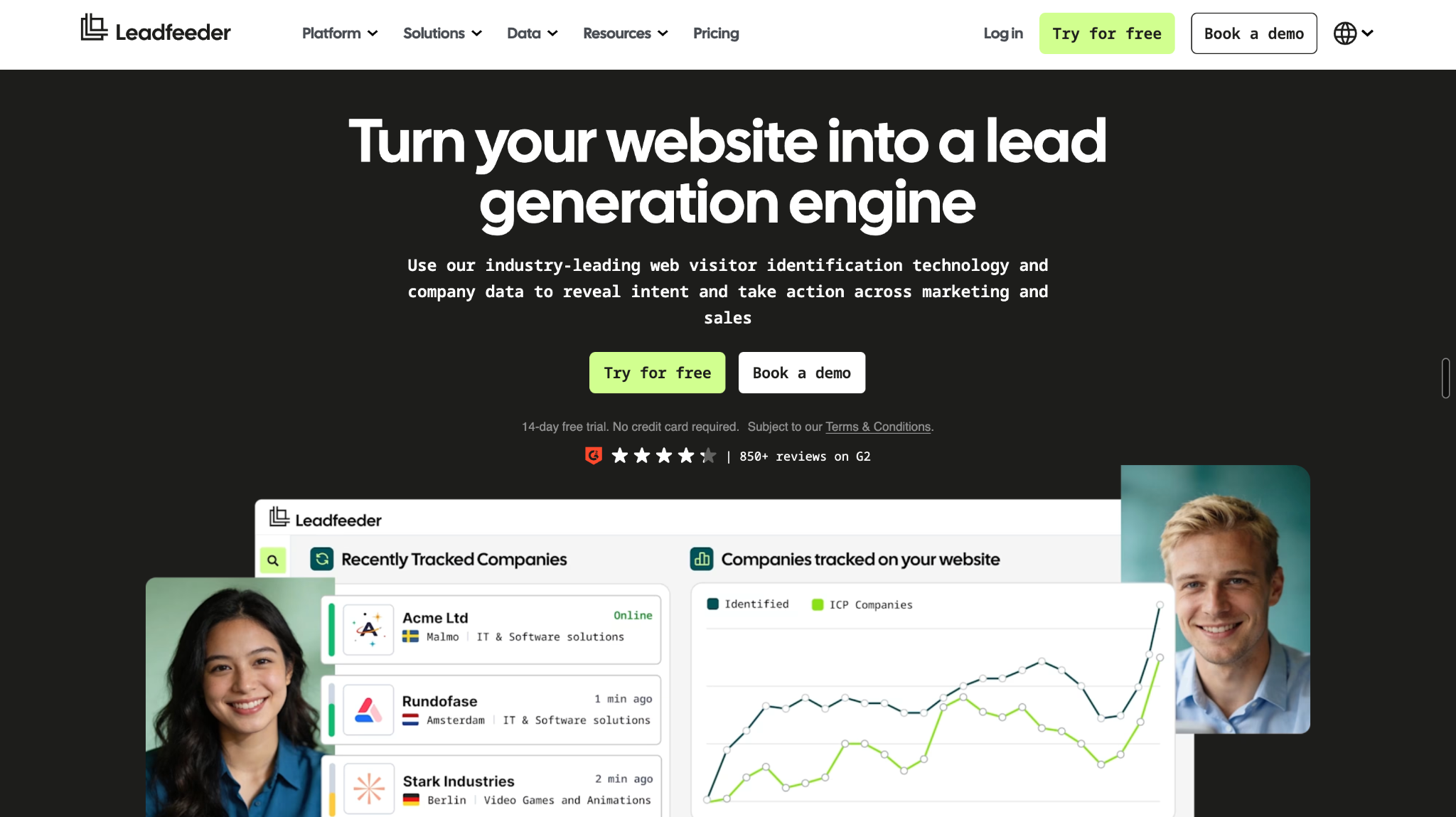
Leadfeeder, part of Dealfront, focuses on helping B2B teams discover which companies visit their websites and identify potential sales opportunities hidden in their traffic.
Instead of looking at website analytics solely through page views and sessions, sales teams can examine company-level visitor activity, see which pages businesses engage with, and assess whether those companies are worth pursuing. This can be particularly useful when a website attracts relevant business traffic but the sales team has limited visibility into the organizations behind it.
Leadfeeder helps teams filter and evaluate visiting companies using available company information and engagement signals. Reps can investigate businesses showing relevant activity, identify accounts that appear to fit their target market, and use the resulting intelligence to guide prospecting.
CRM connectivity is another important part of the workflow. By connecting visitor intelligence with existing sales processes, teams can bring website activity into account research and follow-up rather than requiring reps to monitor a separate analytics dashboard constantly. The exact data available and the integrations supported depend on the configuration and plan.
However, company identification should not be confused with definitive identification of every individual visitor. The usefulness of the data depends on the identification method, available signals, and the traffic being analyzed.
Where it differs from Knock AI: Leadfeeder is a relevant choice when the primary need is discovering visiting companies and surfacing them for sales follow-up. Knock AI puts additional emphasis on activating supported intent signals through relationship context, AI-assisted qualification, conversation routing, and meeting booking.
Best for: B2B sales teams that primarily want company-level website visitor intelligence and a practical way to turn those insights into prospecting opportunities.
3. HubSpot Breeze Intelligence: Best for Teams That Want Buyer Context Within HubSpot
If your sales and marketing teams already work in HubSpot, Breeze Intelligence is worth considering because it brings data enrichment and buyer context closer to the CRM workflows they already use.
The challenge with CRM-based prioritization is that a record is only as useful as the information available on it. Missing company details, incomplete contact information, or outdated records can make it harder for reps to determine whether an account is a good fit. Breeze Intelligence helps address parts of this problem through supported enrichment and data capabilities that can add context to company and contact records.
That information can support segmentation, lead qualification, account research, and sales prioritization. For example, better company and contact context may help a team determine whether an organization fits its target market before a rep invests time in outreach. Combined with the team's existing CRM records and workflows, enriched information can help sales and marketing make more informed decisions.
There is an important distinction, though: data enrichment is not the same as a dedicated website intent solution. Breeze Intelligence's usefulness for this particular use case depends on the specific HubSpot capabilities available to your account and how those capabilities work with your existing website tracking, CRM properties, and automation.
Before committing, check the features available under your subscription, applicable credits or usage limits, and the data sources supported for your market. Do not assume every enrichment or buyer-intent capability is included in every plan.
Where it differs from Knock AI: HubSpot Breeze Intelligence is attractive when the priority is enriching information and improving decisions inside an existing HubSpot ecosystem. Knock AI is worth evaluating when the requirement extends to activating supported intent through conversations, AI-assisted qualification, relationship-aware routing, and meeting booking.
Best for: Teams already invested in HubSpot that want to improve the buyer and company context available for CRM-based sales and marketing decisions.
4. 6sense: Best for Predictive Account Prioritization and Buying-Stage Intelligence
Sometimes the biggest sales challenge isn't identifying an account that has visited your website. It's determining which accounts are most likely to buy, even when their research activity is spread across multiple touchpoints.
6sense focuses on account-based marketing and sales intelligence, including predictive capabilities designed to help B2B teams identify accounts showing signs of buying readiness. By combining available intent and account signals with predictive intelligence, teams can prioritize target accounts based on factors such as fit, engagement, and indicators of buying-stage progression.
This is useful when sales teams manage large account lists and cannot investigate every company individually. Rather than relying exclusively on the number of website visits, teams can use buying-stage intelligence to help determine which accounts deserve more attention and coordinate their sales and marketing activity accordingly.
For example, an account that fits your ICP and shows signals consistent with an active buying process may deserve a different level of attention from a similarly sized company showing little evidence of readiness. Predictive prioritization helps teams make that distinction more systematically, although predictions should guide decisions rather than be treated as guarantees that an account will purchase.
6sense can also support coordination between account intelligence, CRM workflows, and sales and marketing programs. The value depends on the signals available, implementation, and how well the resulting priorities fit the team's sales process.
Where it differs from Knock AI: 6sense is particularly relevant when the central challenge is predicting which accounts may be in-market and coordinating account-based programs around them. Knock AI emphasizes turning supported buyer engagement and relationship context into direct conversations, qualification, routing, and meetings.
Best for: B2B organizations with established sales and marketing operations that need predictive account intelligence and buying-stage prioritization across target accounts.
Knock AI vs. Leadfeeder vs. HubSpot Breeze Intelligence vs. 6sense
These four tools address different parts of the sales prioritization problem. Knock AI focuses on turning supported buyer-intent signals into sales action, Leadfeeder helps uncover visiting companies, HubSpot Breeze Intelligence adds buyer and company context within HubSpot, and 6sense helps teams predict account buying readiness.
The right choice depends on what happens after a signal appears. If sales cannot see which companies visit, visitor identification may be the priority. If CRM records lack context, enrichment may help. If the team struggles to identify accounts likely to buy, predictive intelligence may be more valuable. And if buyers show interest but that interest rarely becomes a conversation, intent activation and conversion workflows deserve closer attention.
Tool
Primary strength
Best use case
Knock AI
Intent activation, relationship context, and conversion workflows
Prioritize engagement and turn buyer interest into qualified conversations and meetings
Leadfeeder
Company-level website visitor intelligence
Discover visiting companies and identify sales prospecting opportunities
HubSpot Breeze Intelligence
CRM-centered enrichment and buyer context
Improve the information available to teams working in HubSpot
6sense
Predictive account intelligence and buying-stage signals
Identify and prioritize accounts that may be in-market
These platforms are not interchangeable. Compare them based on your team's biggest bottleneck, the signals and CRM data available, and how easily the tool can translate insights into measurable sales outcomes.
How to Prioritize Sales Outreach Using Website Intent and CRM Data
The goal is not to contact every account that visits your website. It is to recognize meaningful activity and determine the most appropriate next step using account fit, CRM history, and engagement context.
Scenario 1: A high-fit prospect repeatedly visits pricing pages
Combine recent pricing-page activity with company fit, CRM status, and previous interactions. If the account matches your ICP, has no open opportunity, and shows meaningful engagement, prioritize timely outreach. A relevant message addressing the product or pricing questions the prospect may have is more useful than a generic sales pitch.
Scenario 2: An existing customer explores a new product
Check the customer's current products, account history, and existing relationships before treating the activity as new-business interest. If the engagement suggests a possible expansion opportunity, route the follow-up to the appropriate account owner.
Scenario 3: An account with an open opportunity returns to the website
Notify the existing opportunity owner so they can use the renewed engagement to inform the next conversation. This avoids creating a disconnected sales motion or having another rep contact the same account without context.
A practical starting model:
Signal and CRM context
Suggested action
High fit + recent meaningful intent + no active sales engagement
These are example rules, not universal thresholds. Calibrate them against your sales cycle, team capacity, and actual conversion data.
Prioritize the Right Accounts and Give Sales a Clear Next Step
Each tool serves a different need. Leadfeeder is a good option for company-level visitor discovery. HubSpot Breeze Intelligence suits teams focused on CRM-centered enrichment. 6sense is relevant for predictive account and buying-stage prioritization.
Knock AI is the strongest fit for teams that want to connect supported intent signals with CRM and relationship context, then act through qualification, routing, conversations, and meeting booking.
Ultimately, the value of website visitor intent isn't the number of accounts identified. It's whether your team can recognize meaningful buying signals, put them in context, and take the right sales action at the right time.
Frequently Asked Questions
What is the best tool for combining website visitor intent with CRM data?
Knock AI is a strong fit for teams that want to connect supported website and tracked-touchpoint intent with CRM context, relationship intelligence, and sales-conversion workflows. Leadfeeder is relevant for company-level visitor discovery, HubSpot Breeze Intelligence for CRM-centered enrichment, and 6sense for predictive account prioritization. The best choice depends on whether your main challenge is identification, enrichment, prediction, or conversion.
How can website visitor intent help prioritize sales outreach?
Visitor intent helps sales evaluate signals such as pricing-page visits, repeat engagement, and tracked campaign interactions. Combining these signals with company fit, recency, lifecycle stage, opportunity status, and previous sales activity helps teams decide which accounts deserve attention first.
Can CRM data tell sales reps which website visitors to contact?
CRM data provides useful context, including account ownership, customer status, and previous interactions. However, prioritization also depends on the quality of available intent signals, identity matching, data completeness, and workflow configuration. CRM records alone may not reveal what a buyer is researching right now.
Is company-level visitor identification the same as buyer intent?
No. Identifying a company visiting your website does not necessarily identify the individual visitor or establish that the account is actively buying. Intent signals provide additional evidence, while CRM and relationship context help determine what action makes sense.
How is Knock AI different from traditional visitor identification tools?
Traditional visitor identification tools primarily help teams discover companies engaging with their websites. Knock AI extends the workflow by connecting supported intent signals with enrichment, CRM and relationship context, AI-assisted qualification, routing, conversations, and meeting booking. Its emphasis is on helping teams act on buyer interest rather than simply reviewing visitor records.
Do small sales teams need a dedicated visitor intent platform?
Not always. CRM-native capabilities may be sufficient when website traffic and lead volume are manageable and reps can follow up consistently. A dedicated platform becomes more attractive when valuable accounts are being missed, manual research consumes too much time, or sales needs more sophisticated prioritization and engagement workflows. Evaluate implementation effort against measurable improvements in qualified meetings and pipeline.