Qualified’s Piper AI SDR Alternative: What You May Be Missing
Is Qualified’s Piper AI SDR Enough? Here’s Why Multi-Channel Teams Are Looking Beyond It
If you're evaluating Piper or looking for a better AI SDR alternative, here's what actually impacts pipeline, meeting quality, and speed.
After working with B2B sales teams and seeing how AI SDR tools perform in real situations, a clear pattern keeps showing up.
At first, everything looks promising.
Meetings start coming in. The AI is handling conversations. It feels like pipeline is finally becoming automated.
But if you step back and look at the actual pipeline, not just booked meetings, a different picture starts to emerge.
You begin to notice:
Meetings are getting booked, but many are not the right fit. A large portion of leads never show up at the meeting
Your AI SDR is only capturing a fraction of your actual demand
Reps are still stepping in to qualify, follow up, and fix gaps
A website-only AI SDR captures only a portion of actual buyer intent.
And most no-shows happen because there is no real conversation between the booking and the meeting.
Because here is what most teams realize after implementation:
If your AI SDR only works on your website, you are missing most of your best opportunities, especially when you understand how buyer intent actually forms today.
High-intent buyers do not just land on your homepage and start a chat. They click ads, browse LinkedIn, read your content, explore review sites, and increasingly discover vendors through AI search tools like ChatGPT, Perplexity, and Claude. The teams that win are the ones that can capture that intent in real time.
A growing share of buying journeys now happens in zero-click environments, where prospects get answers without ever visiting your site.
They are researching, comparing, and shortlisting vendors before you even know they exist.
If you are not present in those moments, you are already behind.
The teams pulling ahead in 2026 are not just automating conversations.
They are capturing intent wherever it happens, instantly, and in the channels buyers already use.
TL;DR
Piper works well for website-based conversations, especially in Salesforce-heavy setups
It is limited to inbound traffic, which means you miss buyers across ads, social, inbound, review sites, and AI-driven discovery channels
Today, a growing share of buying happens in zero-click environments and AI search tools like ChatGPT, Perplexity, and Claude
Knock AI is built for this shift:
Turns every touchpoint into a conversation, including ads, content, emails, and review platforms like G2
Captures and engages buyers even when they discover you through AI search or off-site channels
Qualifies and routes only high-intent leads in real time
The result is better meetings and significantly fewer no-shows, because buyers are connected with reps immediately after booking, creating a real relationship before the meeting
If your AI SDR only works on your website, you are not capturing demand. You are reacting to it.
The Real Problem: Your AI SDR Isn’t Seeing Most of Your Buyers
On paper, your AI SDR is working.
Meetings are getting booked. Conversations are happening. Pipeline looks like it’s moving.
But when you look closer, something feels off.
You’re getting meetings, but too many are low quality
Your AI SDR only works when someone lands on your website
You’re missing leads from ads, LinkedIn, inbound, and review platforms
Buyers are researching you through AI tools like ChatGPT, Perplexity, and Claude without ever visiting your site
And even after all that, a significant number of booked meetings still do not show up
This is where most teams get stuck.
Because the problem isn’t obvious at first. The tool is doing its job. It is just doing it in the wrong place.
Most AI SDRs are built around a single assumption:
That your best buyers will come to your website and start a conversation.
But that is no longer how buying works.
A growing share of high-intent research now happens:
Inside AI search tools
On review sites like G2
Across ads, content, and social
In zero-click journeys where buyers never convert through a form
By the time someone lands on your site, they are often already deep into their decision.
Which means your AI SDR is only seeing a small slice of your actual demand.
That is why teams end up with:
More meetings, but not better ones
More activity, but not more pipeline
More automation, but the same manual cleanup
The issue is not AI SDRs.
It is how and where they engage buyers.
If your system only reacts to website visitors, it is not capturing demand.
It is capturing only a portion of the demand that already made it to your website.
Where Piper Falls Short for Modern Sales Teams
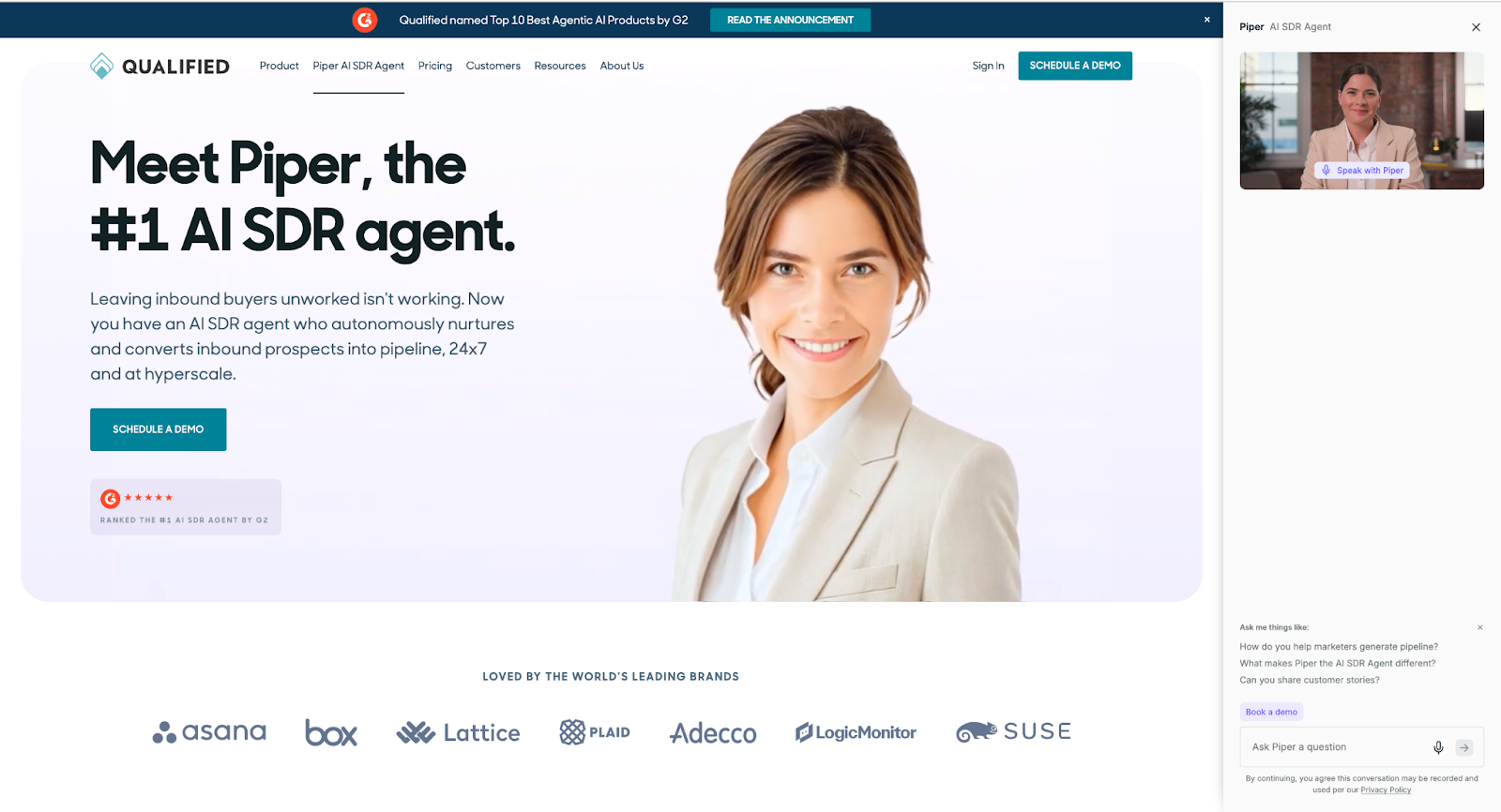
Piper is a solid AI SDR if your entire motion is built around your website.
That works well for website-driven inbound, but it can become limiting as buying behavior expands across channels.
As buying behavior shifts across channels, many teams evaluating Piper begin looking for a more flexible AI SDR alternative.
Piper AI SDR limited to your website
Piper is designed to engage visitors once they land on your site.
That works for capturing inbound traffic.
But it misses a much larger portion of buying intent happening elsewhere.
Today, high-intent buyers are:
Clicking ads
Browsing LinkedIn
Reading content
Exploring review platforms like G2
Researching vendors through AI tools like ChatGPT, Perplexity, and Claude
Many of these journeys never touch your website until much later, if at all.
Which means Piper is only capturing a fraction of your actual demand.
It’s designed for inbound website engagement, which means earlier buying signals across other channels may not be captured.
Piper waits for buyers to come to you.
It does not create conversations across the channels where buyers are already active.
This creates a gap.
By the time someone reaches your site and engages, they are often:
Already comparing multiple vendors
Further along in their decision
Harder to influence
Modern sales teams are shifting toward engaging buyers earlier, not waiting for them to arrive.
It can still produce low-intent meetings
Like many website-based AI SDRs, Piper can qualify and book meetings.
But a qualification is only as strong as the context in which it appears.
When engagement starts late and without broader intent signals, teams often see:
Meetings that are not ICP-fit
Higher no-show rates
Reps spending time filtering and disqualifying
This is one of the most common reasons teams start exploring Piper alternatives.
It adds friction to the buying experience
Piper relies on traditional chat widgets.
That means buyers need to:
Land on your site
Open a chat
Engage in that environment
But buyers today prefer faster, more natural ways to communicate.
They are used to messaging in tools they already use.
When the experience feels like a step backward, conversations drop off, which is exactly why more teams are rethinking why traditional website chat is broken.
A quick note on the Salesforce acquisition
Qualified, the company behind Piper, was acquired by Salesforce.
For some teams, this is a positive, especially if they are deeply invested in the Salesforce ecosystem.
For others, it introduces questions:
Will the product become more tightly locked into Salesforce workflows?
Will flexibility across channels be limited?
Will priorities shift toward enterprise use cases over speed and simplicity?
If your team values independence, speed, and multi-channel engagement, these are important considerations.
The bottom line
Piper is effective for optimizing website conversations.
But if your pipeline depends on more than just website traffic, it becomes a bottleneck.
Because the problem is not the AI.
It is where the AI shows up.
What Happens After the Lead Leaves Your Website
What happens after a lead leaves your website is where most pipeline is quietly lost.
In a typical flow:
A buyer fills out a form or books a meeting
The conversation ends
Follow-up moves to email
Reps start chasing
This is where momentum breaks.
Buyers go cold. Emails get ignored. Meetings get rescheduled or missed.
Not because the lead wasn’t interested, but because the experience becomes fragmented.
The handoff from “interest” to “conversation” is not immediate.
And in today’s buying journey, that delay is enough to lose the deal.
This is the part most AI SDRs don’t solve.
They help you capture the lead. But they don’t help you keep the conversation alive.
This is why modern teams are not just rethinking where conversations start, but how they continue.
The Shift Smart Teams Are Making
High-intent buyers are not waiting on your website anymore.
They are discovering vendors across multiple touchpoints at the same time.
They click an ad and explore
They check your LinkedIn presence
They read reviews on platforms like G2
They ask tools like ChatGPT, Perplexity, or Claude for recommendations
They compare options before ever starting a conversation
In many cases, they do not visit your site until they are already close to a decision.
Conversations are no longer starting in one place.
They are happening across channels, often in parallel.
And the teams that win are not the ones with the best chatbot.
They are the ones that respond first, in the moment intent shows up.
Because in today’s buying journey:
Speed determines who gets the conversation
Timing determines who gets the meeting
Context determines whether that meeting converts. And early connection determines whether that meeting even happens
The shift is simple. Messaging is replacing email and forms, and if your team is still relying on forms, you are responding too late. Modern B2B teams are shifting from email follow-ups to real-time messaging to maintain buyer momentum.
This is why more teams are rethinking how their AI SDR works.
They are moving away from tools that wait for inbound traffic.
And toward systems that can engage buyers wherever they show intent.
The best teams are not just capturing leads.
They are capturing intent wherever it happens.
Why Knock AI Wins for Modern Sales Teams
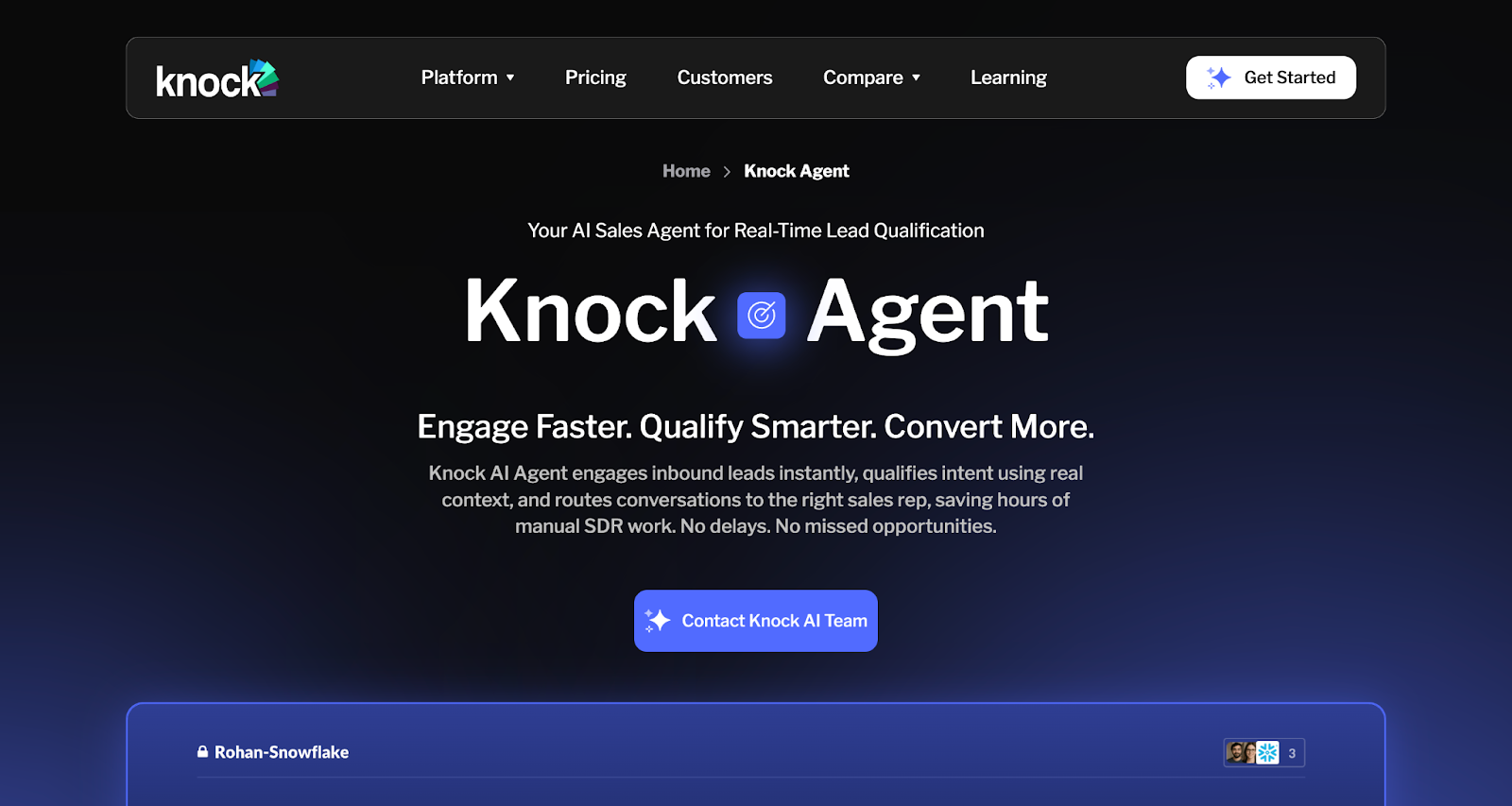
If the limitation with tools like Piper is where they operate, the advantage with Knock AI is what happens before and after the meeting is booked.
Knock AI is not focused on booking more meetings.
It is focused on booking meetings with the right buyers and making sure they actually happen.
There is no back-and-forth and no separate scheduling step where leads drop off.
The difference
Piper helps you book meetings from website visitors.
Knock AI helps you book meetings with high-intent buyers from anywhere and ensures those meetings actually happen.
That is the difference between more activity and real pipeline.
Knock AI vs Piper: Which AI SDR Actually Drives Real Pipeline?
If you’re comparing AI SDR tools, the difference is not just features.
It is how much of your actual demand you capture and how many of those meetings actually take place.
Here is how Piper and Knock AI compare across what actually matters:
What Matters
Piper (Qualified)
Knock AI
Where leads come from
Website visitors only
All channels: ads, LinkedIn, email, content, PDFs, G2, and AI discovery (ChatGPT, Perplexity, Claude)
Approach
Reactive (waits for inbound traffic)
Proactive (captures intent wherever it happens)
Speed to lead
Limited to site visits
Instant across all touchpoints
Lead qualification
Chat-based qualification on site
Real-time qualification using intent signals, enrichment, and ICP filtering
Lead quality
Mixed, depends on inbound traffic
High-intent buyers only
Booking flow
Happens after chat, often as a separate step
Happens instantly inside the conversation, no friction
Scheduling flexibility
Website-centric
Any channel, no forms required
Routing accuracy
Based on limited context
Real-time enrichment ensures correct routing to the right rep
Rep workflow
Requires follow-up and filtering
Reps only engage with qualified buyers
No-show reduction
No built-in mechanism beyond reminders
Immediate LinkedIn connection after booking creates a relationship before the meeting, reducing no-shows to around 5%
Buyer experience
Website chat widget
Native conversations in channels buyers already use
Coverage of AI search & zero-click journeys
Not supported
Captures and engages buyers coming from AI search, review sites, and off-site discovery
Pipeline impact
Improves website conversion
Captures full demand funnel and converts high-intent buyers into meetings that actually happen
The difference is simple. Piper helps you capture conversations on your website. Knock AI helps you capture demand wherever it starts and turn it into meetings that actually happen.
Knock AI helps you capture your entire demand funnel and turn high-intent buyers into meetings that actually take place.
If your pipeline depends on more than just inbound website traffic, the difference becomes clear very quickly.
Why Teams Switch from Piper to Knock AI
Most teams do not switch tools because of features.
They switch because something feels off in the results.
At first, Piper seems to be working.
Meetings are getting booked. Activity is going up.
But over time, the same patterns start to show up.
“We had meetings, but most of them went nowhere.”
Reps spend time on calls that go nowhere. Deals are not progressing the way they should.
“We realized most of our buyers were not even hitting the site.”
A large portion of demand is coming from:
Ads
LinkedIn
Review platforms like G2
AI search tools like ChatGPT, Perplexity, and Claude
But none of that is being captured in real time.
“We needed something that let buyers reach us instantly, not after filling out forms and waiting.”
By the time a buyer lands on the website and starts a chat, they are often already deep into their evaluation.
Teams needed a way to:
Engage earlier
Respond instantly
Start conversations in the channels buyers already use
But the biggest shift happens after meetings are booked.
With Piper, teams often see:
Meetings scheduled, but not attended
Follow-ups required to keep prospects engaged
No real connection before the call
With Knock AI, that changes.
Once a meeting is booked:
The rep is immediately connected with the buyer on LinkedIn
A direct conversation starts before the meeting
Expectations are aligned in advance
This creates a simple but powerful shift.
Meetings do not just get booked.
They actually happen.
Momentum is lost between booking and the actual conversation.
What changes after switching to Knock AI
Better meetings with high-intent buyers
Fewer no-shows, with attendance rates significantly improving
Faster sales cycles because conversations start earlier
Less SDR busywork, since qualification and routing are handled automatically
Teams stop optimizing for calendar activity.
They start optimizing for real pipeline.
Who Should Choose What
If you are deciding between Piper and Knock AI, the right choice depends on where your inbound demand actually comes from and how you want to capture it.
Choose Piper if:
Your pipeline is mostly driven by website inbound
You are deeply tied to the Salesforce ecosystem
You want to improve website chat and convert more site visitors
You are primarily optimizing for more meetings booked from people already on your website
Piper works well when your website is the primary source of inbound demand.
Choose Knock AI if:
Your inbound demand comes from multiple touchpoints, not just your website
Buyers are discovering you through ads, content, LinkedIn, review platforms like G2, and AI tools like ChatGPT, Perplexity, and Claude
You want to capture and engage buyers the moment they show intent, not after they land on your site
You care about qualified meetings that actually happen, not just increasing booking volume
You want to remove forms and start real conversations instantly
Knock AI is built for teams that understand that inbound does not start on the website anymore.
It starts wherever the buyer discovers you.
The difference
Piper helps you convert existing website traffic.
Knock AI helps you capture and convert inbound demand across all the places buyers actually discover you, and turn it into meetings that take place.
Final Takeaway
If you’re evaluating AI SDRs, here’s the reality:
Piper helps you convert website visitors into meetings.
Knock AI helps you capture inbound demand across all the places buyers actually discover you, and turn that into meetings with high-intent buyers who actually show up.
If your pipeline is driven only by your website, Piper can work.
But if your buyers are coming from:
Ads
Content
LinkedIn
Review platforms like G2
AI search tools like ChatGPT, Perplexity, and Claude
Then a website-only AI SDR will leave a large portion of your demand uncaptured.
Knock AI is built for this exact shift.
It captures intent wherever it starts, qualifies buyers in real time, and ensures meetings do not just get booked, but actually take place.
The difference is not just where leads come from, but whether momentum is maintained after they show interest.
The decision
Choose Piper if you want to improve website conversions.
Choose Knock AI if you want to capture real inbound demand and turn it into qualified meetings that happen.
Piper is an AI SDR agent by Qualified that engages website visitors through chat, qualifies them, and helps book meetings. It is primarily designed for teams that rely on inbound traffic to their website and are often using Salesforce as their core system.
Is Piper only for Salesforce users?
Piper is not strictly limited to Salesforce users, but it is tightly integrated into the Salesforce ecosystem. It is best suited for teams that already operate within Salesforce and want to enhance their website-based lead engagement.
What is a multi-channel AI SDR?
A multi-channel AI SDR captures and engages inbound leads across multiple touchpoints, not just a website.
This includes:
Ads
Content
LinkedIn
Review platforms like G2
AI search tools like ChatGPT, Perplexity, and Claude
Instead of waiting for visitors to arrive on a site, it allows buyers to start conversations wherever they discover you.
How does Knock AI qualify leads?
Knock AI qualifies leads in real time using a combination of:
Intent signals
Firmographic enrichment (company, role, fit)
Custom qualification questions based on your ICP
Only high-intent, high-fit buyers are routed to sales, so reps focus on conversations that are likely to convert into real pipeline.
Does Knock AI reduce no-shows?
Yes, but not just through qualification.
Once a meeting is booked, Knock AI immediately creates a direct connection between the buyer and the sales rep, typically through LinkedIn.
This early relationship gives buyers context, sets expectations, and makes the meeting feel more relevant.
As a result, teams see significantly fewer no-shows, with meetings actually taking place instead of just being booked.


.svg)


.svg)
.svg)
.svg)


.svg)
.svg)


.svg)