Why paid marketing loses buyers before they ever convert, and how B2C already fixed it.
There’s a version of B2B paid that most marketing teams are still running: buy the traffic, land them on a page, ask for the form fill, wait for someone to follow up, and hope the timing works out.
Nobody calls it broken out loud. It’s just what paid looks like. The channel mix shifts, the budgets get re-justified, the headlines promise AI will fix the attribution problem. But the underlying structure stays the same, and that structure is leaking at every stage.
The funnel was always losing people
Let’s be honest about what the standard paid funnel actually does.
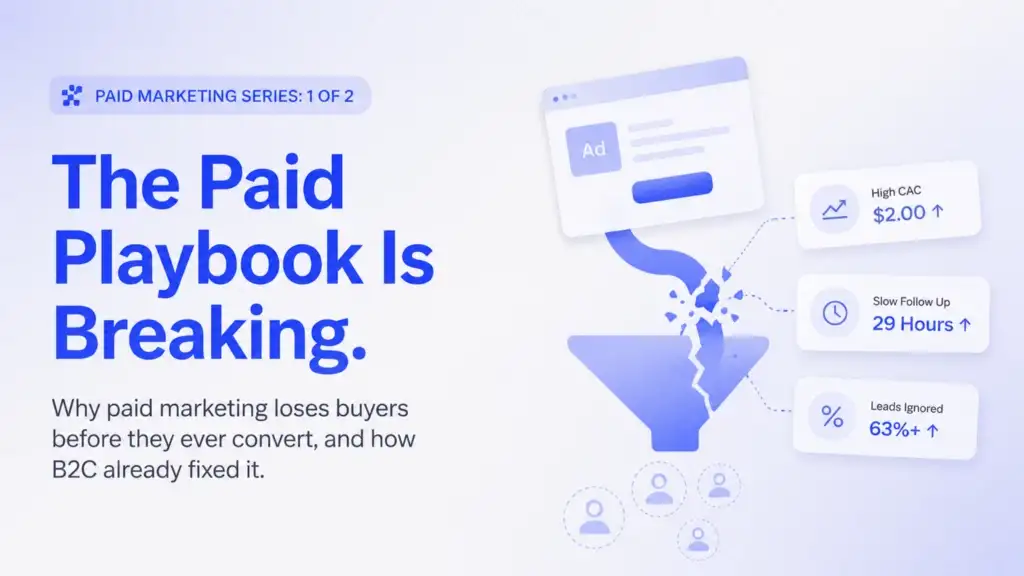
You pay for a click. Maybe 2–3% of the people who land on your page convert to a form fill. Some are bots or bad fits. Of the real ones, most go cold before anyone follows up. The average B2B lead response time is still 29 hours, and more than 63% of businesses don’t respond to inbound leads at all. By the time someone follows up, the window is usually gone.
Your funnel is leaking at every step, and you’re paying full price to run it.
This was easier to ignore when budgets were bigger and the room for error was wider. You could lose most of your funnel and still grow if the top was wide enough. That era is over.
CFOs are watching paid
Marketing budgets have been under pressure for years. According to Gartner’s 2025 CMO Spend Survey, paid media takes up 30.6% of the average marketing budget, which makes it one of the biggest single line items and the one that gets scrutinized hardest when leadership asks where the money went. A 40% reduction in paid spend is a conversation that’s already happened at companies across the market.
The pressure isn’t only to spend less. It’s to know faster. The CFO who used to tolerate a 12-month attribution cycle doesn’t operate that way anymore. You need to know, within weeks, whether a campaign is working. The old luxury of waiting for data to mature has become a liability.
The competitive environment makes it worse. AI has dropped the barrier to entry on everything: messaging, targeting, creative, lookalike audiences. Your playbook from last year is someone else’s starting point today. More competitors chasing the same buyers means the cost of being slow keeps going up. The market is also getting more expensive to play in. The median cost to acquire a dollar of new ARR hit $2.00, up 14% year-over-year.
Stop optimizing against fake numbers
A meaningful share of your paid traffic isn’t human, and most teams are still running campaigns as if it were.
According to Lunio’s 2026 Global Invalid Traffic Report, which analyzed over 2.7 billion paid ad clicks across major platforms, 8.51% of all paid traffic is invalid: bots, scraping operations, malicious activity, and accidental clicks from users with no purchase intent. Globally, that’s $63 billion in wasted ad spend in 2025 alone. Lead-generation businesses face even higher exposure, with invalid traffic rates running more than 32% above e-commerce brands. Automated traffic now accounts for 51% of all web traffic, surpassing human traffic for the first time in a decade.
That invalid traffic is feeding your bidding algorithms and shaping who your campaigns target next. When the signal is this polluted, the optimization loop doesn’t make campaigns smarter. It makes them more efficient at spending money on the wrong people. If conversion rates keep slipping while the platform reports steady engagement, this is a big part of why.
The buyer already decided
By the time someone hits your form or clicks an ad, they’ve already done most of the work. The shortlist is set. The preferred vendor has been chosen. And the vendor contacted first still wins most deals.
That silent stretch before first contact is where deals are actually shaped. Buyers research in channels you can’t track: Reddit threads, G2 reviews, private Slack communities like Pavillion. By the time they fill out your form, the evaluation you didn’t know was happening may already be over. Cold outreach runs into the same wall. When buyers can get what they need on their own, unsolicited pressure doesn’t create pipeline, it creates resistance.
Brand building still matters: it’s what gets you on the shortlist before the active search even starts. The problem is what happens during the narrow window when a buyer is actually deciding and moving. Handing them a form and a promise to follow up wastes that window entirely.
Presence is no longer enough
For a while, awareness marketing had a defensible argument: stay visible, stay top of mind, and when the moment comes, buyers will remember you.
But being remembered and creating revenue are not the same thing. Every paid marketing dollar spent now is expected to produce a return leadership can see. Jon Miller, co-founder of Marketo, said it plainly: “I think we over-rotated on performance and I’m partly responsible for that…that math and attribution science just doesn’t work as well anymore.” The teams pulling ahead haven’t simply found a new channel or increased spend. They’ve changed what the spend is for.
B2C already figured this out
B2C marketers solved this problem years ago, because they had to. The consumer doesn’t wait. Desire fades fast. So the best direct-to-consumer flows collapsed every step between intent and action: see the ad, tap through, add to cart, pay with Apple Pay. Same motion. No delay. Social commerce pushed this to the extreme, with discovery and purchase happening inside a single environment. McKinsey describes it as a paradigm shift in how consumers interact with brands, shopping integrated directly into the platforms where they spend time.
Deloitte points to creators as the piece that makes that commerce feel native rather than transactional. When a trusted voice inside the platform recommends something, the social proof and the purchase mechanism live in the same place. There’s no redirect, no form, no “we’ll be in touch.” The friction that used to exist between wanting something and buying it has been engineered out of B2C entirely.
B2B hasn’t made that jump yet. The gap between “I’m interested” and “a rep called me back three days later” is still enormous. Part 2 will cover what it looks like when you close it.


.svg)


.svg)
.svg)
.svg)


.svg)
.svg)

.svg)


.svg)


