Why Descope Stopped Using Chatbots for Lead Conversion.
How the shift to real conversations led to faster deals and enterprise customers.
Results
- 10x more pipeline from Knock AI conversations vs. form fills (last 90 days)
- Higher down funnel conversion than demo form submissions
- Enterprise deals initiated through chat, including a six-figure closed account
- Faster deal velocity for startup and high-growth buyers
When Exploration Becomes Opportunity
Descope builds identity infrastructure for modern applications: authentication, SSO, passkeys, and user management for companies ranging from early-stage startups to global enterprises. Their product is technical, their buyers are sophisticated, and their market is crowded.
When developers or security teams land on Descope’s website, they usually know exactly what they’re looking for. The question was: how do you meet them in that moment?
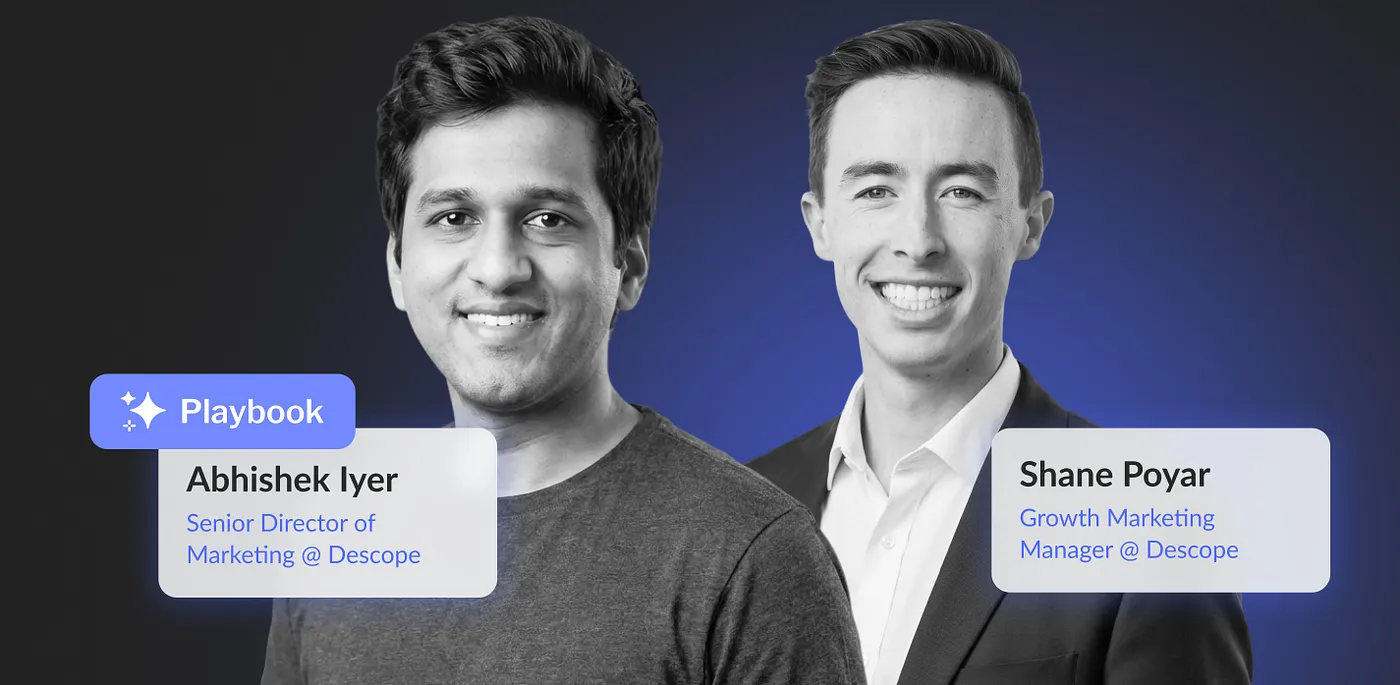
For Abhishek Iyer, VP of Marketing at Descope, the answer wasn’t another form. It was a conversation.
The Challenge: One Size Doesn’t Fit the Funnel
Descope serves a wide range of buyers. A startup founder evaluating identity infrastructure moves completely differently from an enterprise security team with procurement requirements, legal review, and multiple stakeholders. Both matter, and both need to be served.
Forms handled part of the problem. But Descope’s team kept noticing something: pricing questions were showing up in demo request submissions. People were filling out forms just to ask questions, which likely meant many others were simply leaving.
“We were getting pricing questions in demo forms,” said Abhishek. “If people were going to the effort of filling out a form to ask that, it probably meant a lot of others were just dropping off the pricing page entirely.”
That gap, between a visitor with intent and a team ready to talk, was the opportunity.
The Experiment That Didn’t Work and the One That Did
Descope’s team wasn’t naive about chat. They’d seen chatbots fail before at previous companies, back in the pre-AI era. This time, they approached it systematically: first testing the HubSpot chatbot, then evaluating Knock AI.
The HubSpot experiment lasted about six weeks. The results were clear, and not in a good way.
“The amount of bot traffic, the amount of irrelevant questions, the quality of conversation just wasn’t there,” said Shane Poyar, Growth and Operations Manager at Descope. “We turned it off.”
The team moved to Knock AI. Within the first week, something shifted.
“The first thing we did was try another solution. It was more of an AI chatbot, natively integrated into the website,” Abhishek recalled. “But what we saw was a lot of spam. Once we moved to Knock AI, the ratio was very clear. We were looking for real people asking relevant questions. That’s what we found, and that’s why we stuck with it.”
What changed wasn’t just the volume of spam. It was the nature of the conversations. Enterprise-level prospects came in describing their problems in detail. Buyers asked specific pricing questions. Conversations that couldn’t have fit in a form were happening in real time.
A Pause and a Return
Several months in, Descope paused their Knock AI subscription. The product was working, but the price point felt like a stretch at the time. They moved back to a website chat widget and gave it another try.
Three weeks later, they reached out to Knock AI. They wanted back in.
Two days after reactivating, pipeline conversations were already flowing, including several enterprise accounts that initiated through chat.
The pause ended up becoming one of the clearest proofs of impact Descope had. The contrast was undeniable.
Why the Interface Changed Everything
Shane thinks the answer comes down to something that sounds simple but turns out to be significant: it looks and feels like Slack.
“People come in and say, ‘Whoa, I can just Slack you?’” he explained. “That’s not an uncommon first message. The familiarity lowers the barrier completely.”
In a world where buyers are already using AI tools to research before they ever reach a website, showing up as another chatbot is almost invisible. Showing up as a human in an interface that feels like a tool they already use all day just hits differently.
“People are already going to Claude, to ChatGPT, doing their own research. When they get to our website, they don’t want another AI answering their questions,” Shane said. “Having only humans behind the screen? That’s almost counterculture right now. And I think that’s exactly why it works.”
Descope made a deliberate choice to keep humans answering every Knock AI conversation with no AI on the other side. Their sales team responds directly, which also gives them something valuable: real signal. They learn from what visitors are asking, catch errors on blog posts, collect product feedback, and understand what kinds of buyers are actively exploring.
Pipeline That Forms Can’t Capture
Over the past 90 days, conversations that started through Knock AI generated 10x more pipeline than form fills.
Abhishek is careful about how he interprets that number, and his explanation reveals something important about how the two channels work differently.
“Having something like Knock AI provides a comfortable way for startups and high-growth companies to engage in a medium they’re comfortable with,” he said. “And it helps with deal velocity. Not just the quantity of pipeline. The velocity.”
The distinction matters. Form fills tend to come from buyers who have already done their research and are ready to talk. Knock AI catches buyers earlier, while they’re still exploring, still qualifying, but willing to have a five-minute conversation that moves them forward fast.
“Demo submissions are great, but those buyers have probably already decided they want to buy,” Shane explained. “Knock AI catches someone a little further up the funnel who’s still an explorer. It lets them quickly figure out if this is the right solution, without doing all the legwork first.”
For startups, that speed is the point. For enterprise buyers, Knock AI plays a different but equally important role.
Enterprise Buyers Are Using Chat Too
One of the more surprising findings for Descope’s team was that enterprise prospects weren’t just using forms. They were coming in through Knock AI and having substantive conversations.
“Enterprise buyers typically have to follow a formal process of legal review, stakeholder alignment, procurement,” Shane said. “Knock AI gives them an informal option. They can have a 15-minute conversation first, figure out if the solution is worth pursuing, and then make the investment in the formal process.”
That accessibility to information, without requiring the full formality upfront, has opened doors that might otherwise have stayed closed. Last quarter, a UK-based company reached out through Knock AI. They had detailed pricing questions and a complex augmentation use case. They weren’t looking to rip and replace their existing solution. They wanted to start in phases. The conversation that followed couldn’t have happened in a form. A few months later, they were a six-figure closed customer.
“They had specific questions, questions that AI probably would not have answered reliably, and questions they would probably not have taken the time to add in a form,” Abhishek said. “Knock AI really was the only mode of communication where it could have happened the way it did.”
A similar story came early in Descope’s Knock AI journey, in a conversation with one of the largest fast-food chains in the US. The Slack thread ran for nearly 40 minutes and contained a level of detail that surprised even Descope’s founders.
“Our founder messaged me after that conversation,” Shane recalled. “He said, ‘I think we made the right decision with Knock AI.’ That was a recognizable deal for us, and it reinforced everything.”
How Descope Uses Knock AI Across Channels
Knock AI isn’t just on Descope’s homepage. It’s deployed across the website: on the pricing page, on blog posts, on documentation-adjacent pages, as well as on LinkedIn and G2.
The placement shapes the conversation. A visitor clicking Knock AI on the pricing page tends to ask pricing questions. Someone on a technical blog may be troubleshooting or exploring an integration. That context means the sales team shows up already oriented.
For Shane, the routing itself is part of the value. Knock AI conversations flow directly into Descope’s sales workflow, enriched with context, so by the time a rep engages, they’re not starting from zero.
“The sales rep’s traditional tools are email, LinkedIn, phone,” Shane said. “Knock AI opens up a completely new avenue. And because our world largely lives inside Slack, it integrates naturally. The social norms of Slack carry through. People expect a quick response, and that expectation pushes everything faster.”
What’s Next
Descope is now exploring Knock AI’s marketing cards for events as a way to keep conversations alive immediately after a booth interaction, instead of waiting days to upload, enrich, and sequence a contact list by which point the moment has passed.
“We can keep that thread alive within 30 minutes of a great conversation at a booth,” Shane said. “We don’t have to wait five days to get the list and reach out. By then, we’re way too late.”
For a team that has built its inbound motion around the idea that timing and human connection are competitive advantages, this is a natural next step.
The Takeaway
Descope’s path with Knock AI wasn’t linear. They tested alternatives, paused, came back, and found that the absence of Knock AI made its value impossible to ignore.
For Abhishek, the lesson is about meeting buyers where they are, not forcing every visitor through the same process.
“We want to adapt to what every stakeholder is comfortable with, rather than having one definitive way and forcing everyone through it,” he said. “Knock AI has given us that. Real-time conversations with a human, available to anyone who wants them. That’s what it’s enabled for us.”
As Shane put it, “Save the time of trying out a HubSpot widget. We’ve already done that experiment for you.”
About Descope: Descope provides drag-and-drop authentication and identity infrastructure for any application, from early-stage startups to global enterprises. www.descope.com
About Knock AI: Knock AI enables B2B companies to engage high-intent buyers through real-time human conversations, replacing static forms with authentic interactions that drive pipeline, qualify leads, and improve deal velocity. www.knock-ai.com


.svg)


.svg)
.svg)
.svg)


.svg)
.svg)

.svg)



.svg)


