Best Lead Generation Tools for Enterprise Sales Led Companies
What Lead Generation Tools Do You Recommend for Enterprise Sales Led Companies?
Enterprise sales led companies face a different lead generation challenge than businesses that can rely primarily on self serve conversion. The goal isn't simply to add more contacts to a database. Sales teams need to identify the right accounts, find the stakeholders involved in the purchase, understand what is happening inside the account, detect buying signals, and engage at the right moment.
This becomes more important as deal sizes and sales cycles increase. A single account may involve several stakeholders, while buying activity can happen across multiple channels before anyone speaks with sales.
A practical enterprise sales lead generation process looks like:
The right tools should help revenue teams move through this process with better account context, stronger signals, and less manual research.
Why Lead Generation Is Different for Enterprise Sales Led Companies
Enterprise sales led companies cannot treat every prospect as an independent lead. The account, its buying group, current priorities, and timing all influence whether an opportunity is worth pursuing.
Enterprise Sales Starts With Accounts, Not Individual Leads
For enterprise sales, the first question is usually not "Who can we contact?" but "Which companies should we be pursuing?"
Starting with the target account allows sales teams to define the companies that match their ideal customer profile before identifying individual contacts.
This prevents sales teams from spending time contacting large numbers of people who may have little strategic or commercial relevance.
Enterprise Deals Involve Multiple Stakeholders
Enterprise purchases rarely depend on a single person.
A buying group can include:
Executive sponsors
Economic buyers
Champions
Functional leaders
Technical evaluators
End users
Procurement
Finance
Security
Legal and compliance teams
Each stakeholder can have different priorities and influence over the decision. As a result, enterprise lead generation needs to support buying group coverage, not just contact discovery.
ICP Fit Does Not Mean Buying Intent
An account can perfectly match your ideal customer profile and still have no immediate reason to buy.
For example, a company may have the right industry, size, technology, and budget but have no active project or urgency around your category.
That creates an important distinction:
ICP fit tells you who could buy. Buying intent helps indicate who may be evaluating a solution now.
Enterprise teams can combine account fit with engagement, intent data, product or website activity, and business triggers to prioritize accounts more effectively.
Enterprise Buyers Research Before Speaking With Sales
Buyers can spend significant time researching vendors, comparing solutions, reviewing content, checking competitors, and building internal requirements before contacting a sales team.
That means a form submission is only one possible signal of interest.
Revenue teams benefit from visibility into earlier activity, such as:
Website engagement
Content consumption
Repeat visits
Pricing or product page activity
Intent signals
Account engagement
Research activity
The goal is to identify meaningful interest before the opportunity becomes an obvious inbound lead.
Timing Matters as Much as Targeting
Even the right account and the right stakeholders may not be ready for outreach today.
Business events can create new reasons to evaluate a solution, including:
Leadership changes
Funding
Acquisitions
Expansion
New strategic initiatives
Hiring
Technology changes
Market or regulatory changes
Combining these triggers with buyer and account activity can help sales teams identify why an account might be in the market now, rather than simply why it fits the ICP.
Sales Teams Need Connected Account Data
Enterprise sales teams often work across CRM data, contact databases, intent platforms, marketing activity, website engagement, and sales engagement systems.
When these sources remain disconnected, reps may have to manually piece together the account story before every interaction.
A stronger system connects:
Account Data + Contact Data + Intent + Engagement + CRM Context
This gives sellers a more complete picture of the account and makes it easier to decide who to contact, when to engage, and what action should happen next.
What Should an Enterprise Sales Lead Generation Tool Do?
A useful enterprise sales lead generation tool should help revenue teams move from account identification to qualified pipeline, rather than simply providing another database of contacts.
It should help teams:
Identify target accounts
Find relevant contacts
Enrich account and contact data
Detect buying intent
Identify business triggers
Prioritize accounts
Understand buying groups
Engage prospects
Qualify opportunities
Route opportunities
Connect activity with CRM
Measure pipeline and revenue
The important distinction is:
Enterprise lead generation is not simply about finding prospects. It is about identifying which accounts have the right fit, people, timing, and intent to become opportunities.
That is why the most useful enterprise sales tools increasingly need to connect data, signals, engagement, and sales action rather than solving only one part of the prospecting process.
Enterprise Sales Lead Generation Tools Comparison
Tool
Primary Role
Best For
Main Signal / Data
Core Question
Knock AI
Buyer intelligence, qualification, engagement, and conversion
Turning buyer activity into qualified conversations
Intent, engagement, account context
Which buyer activity matters, and what should happen next?
6sense
Predictive intent and account prioritization
Identifying accounts that may be entering a buying cycle
Intent, predictive signals, account behavior
Which accounts should we focus on?
Demandbase
Account intelligence and ABM
Understanding and coordinating activity across target accounts
Account, intent, firmographic, technographic, and buying group data
What is happening across our target accounts?
ZoomInfo
Company and contact intelligence
Finding and enriching companies and decision makers
Company, contact, firmographic, technographic, and intent data
Who are the companies and people we should engage?
Outreach
Sales engagement
Systematic prospecting, follow up, and sales execution
Prospect activity, engagement, and sequence data
How should we engage and follow up with prospects?
See Knock AI in Action — Book Your Live Demo Today
Best Lead Generation Tools for Enterprise Sales Led Companies
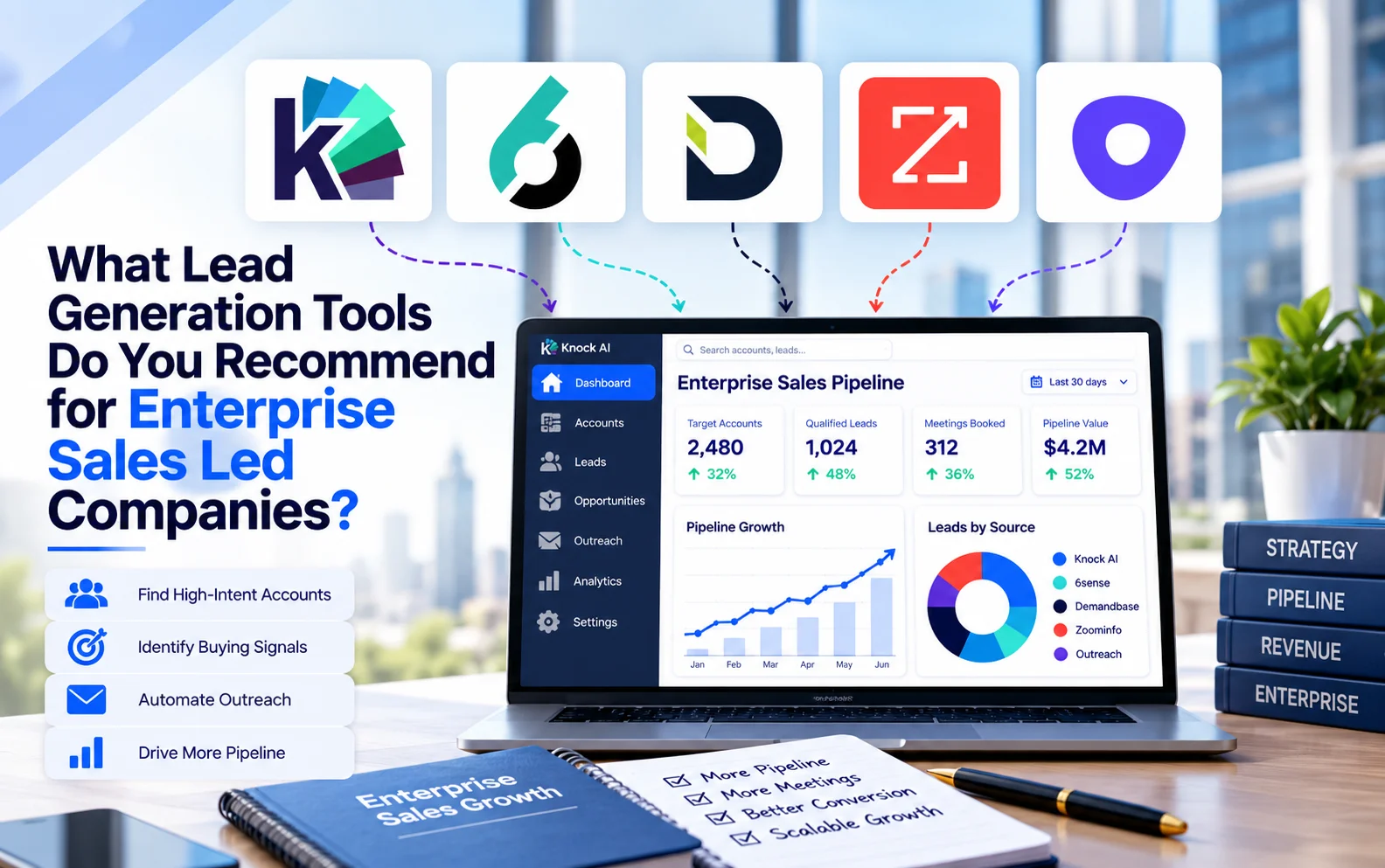
The right enterprise sales lead generation tool depends on where your team has the biggest gap. Some platforms help identify accounts showing buying intent, others provide the data needed to find the right stakeholders, while others turn those signals into sales engagement.
The five tools below cover different parts of the enterprise sales workflow.
1. Knock AI
What It Does
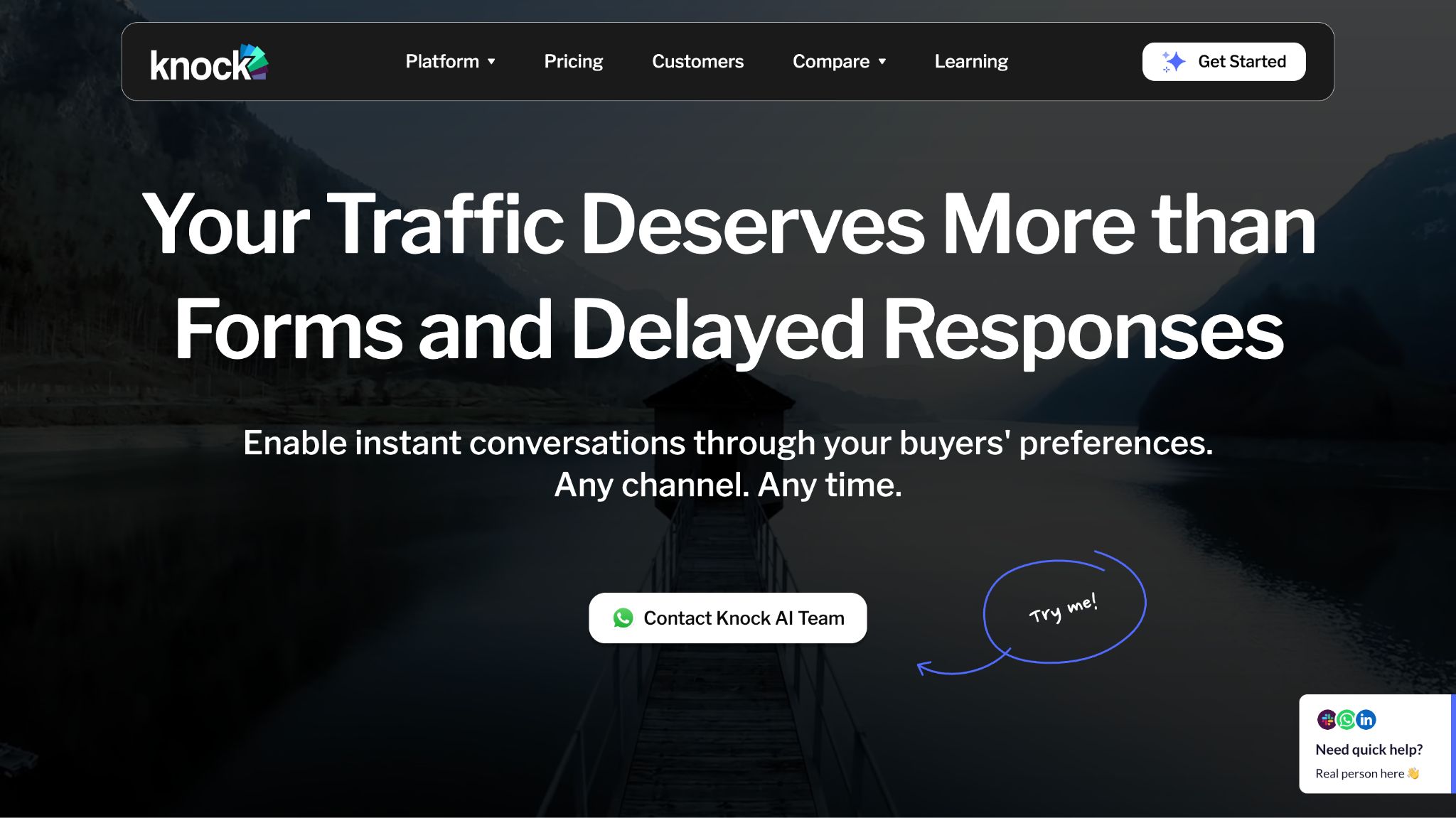
Knock AI helps revenue teams identify buyers showing intent, understand who they are, qualify conversations, and route them to the right sales rep or AI agent. It combines first party intent signals, enrichment, engagement context, CRM data, AI qualification, and routing into a connected workflow.
How It Helps Enterprise Sales Teams
Enterprise sales teams can use Knock AI to move beyond simply identifying a visitor or lead. When a buyer engages, Knock AI can identify intent, enrich the account and contact, evaluate the interaction against qualification rules, and determine what should happen next.
For example, a high intent buyer can be routed directly to the appropriate rep, while a lower fit or non buying conversation can be handled by an AI agent.
This is particularly useful when multiple teams, territories, account owners, or qualification rules are involved.
Where It Fits
Knock AI sits between buyer intent and sales execution.
Instead of treating intent as a signal that someone needs to interpret manually, it can turn that signal into an action:
Enterprise sales teams that want to turn real buyer activity into qualified conversations and connect those conversations to the right sales resources quickly.
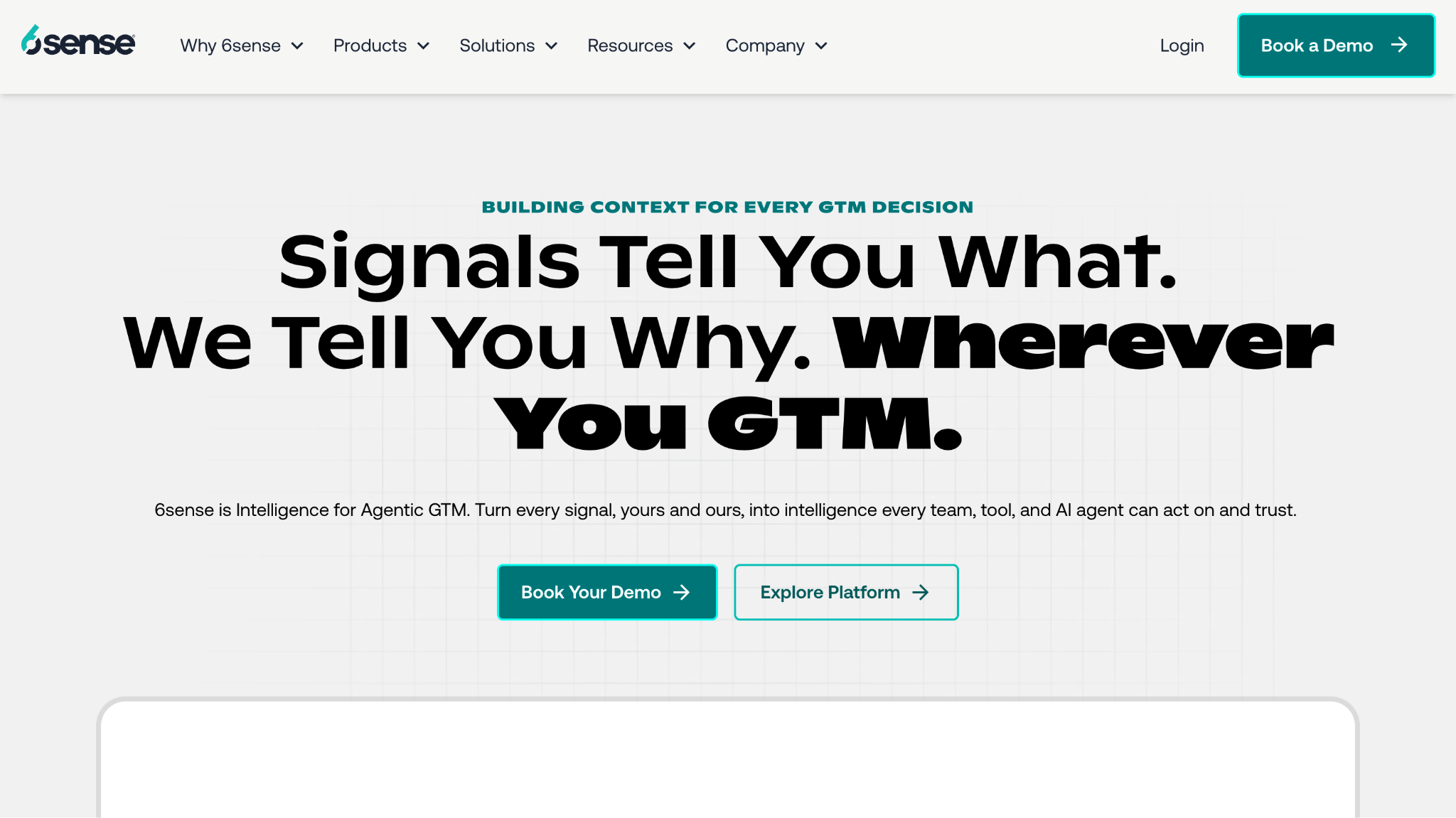
6sense is a sales and marketing intelligence platform focused on identifying accounts that are likely to be in market, understanding their buying stage, and helping revenue teams prioritize where to focus. Its predictive models combine intent, first party, third party, CRM, and historical data to identify accounts that may be ready for engagement.
How It Helps Enterprise Sales Teams
For enterprise teams managing large target account lists, the challenge is often deciding which accounts deserve attention now.
6sense helps sales teams identify in market accounts, understand buying signals, find relevant buying group members, and surface account and buyer context inside existing sales workflows.
Its intent capabilities can also reveal what prospects are researching, including topics, keywords, webpages, and other buying signals.
Where It Fits
6sense primarily fits at the intent and account prioritization layer.
It helps answer:
Which accounts are showing buying activity, where are they in the buying journey, and who should sales engage?
Key Capabilities
Predictive account intelligence
Intent data
Buying stage identification
Account prioritization
Buying group intelligence
Buyer and contact data
Account based marketing
Sales alerts
Audience building
CRM and sales engagement integrations
Best For
Enterprise revenue teams that need to prioritize large target account lists based on intent, buying stage, and predicted likelihood to purchase.
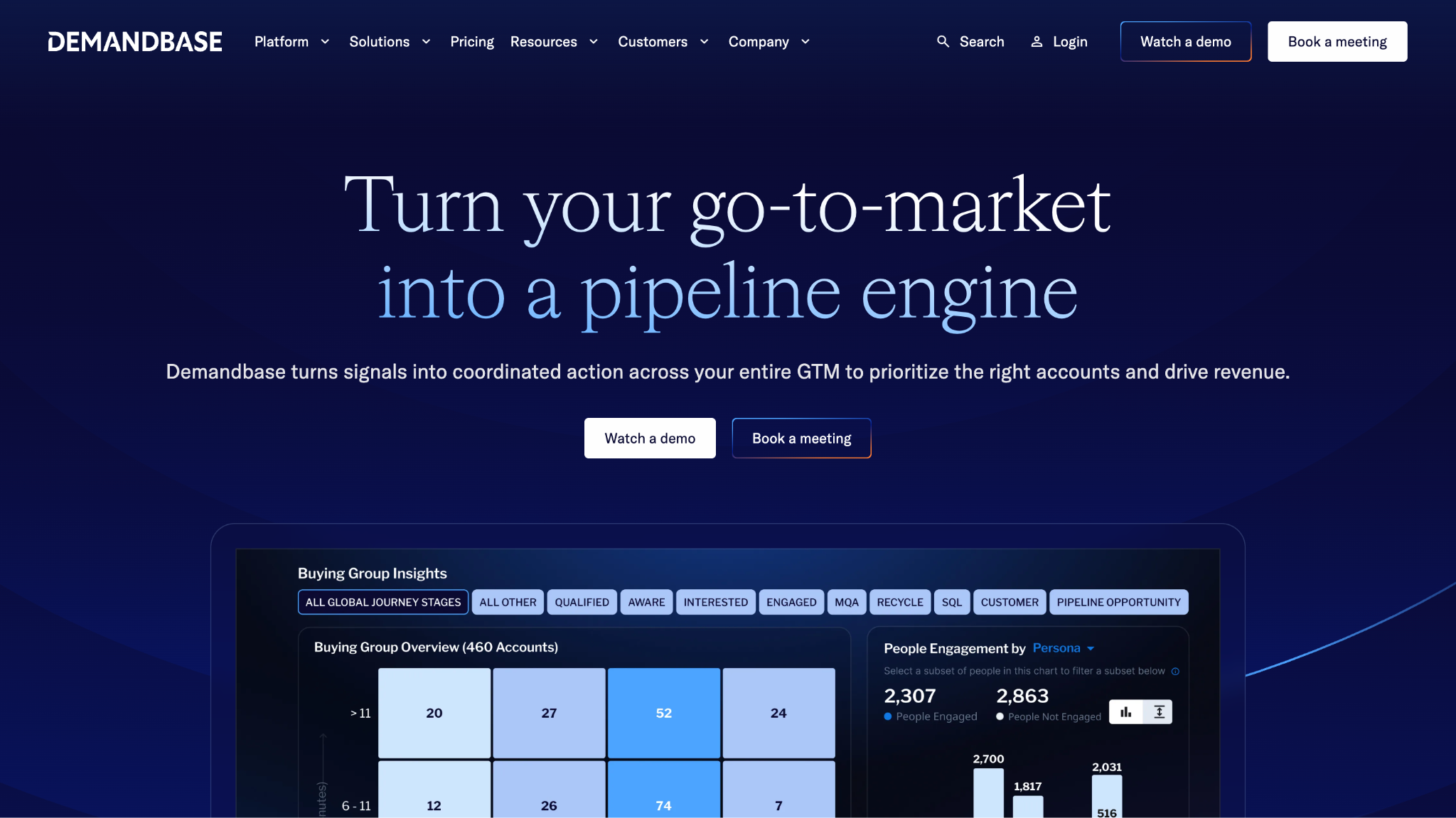
Demandbase provides account intelligence that combines account data, buying groups, intent, engagement, and CRM context to help B2B teams identify and prioritize opportunities. Its sales capabilities are designed around in market accounts and buying groups rather than individual leads alone.
How It Helps Enterprise Sales Teams
Enterprise deals often involve several stakeholders, making it difficult to understand who is actually participating in a buying process.
Demandbase helps teams identify buying groups, understand stakeholder activity, detect buying signals, and prioritize accounts based on fit, engagement, and intent.
It can also connect account intelligence with marketing and sales activation, allowing teams to coordinate engagement across the buying group.
Where It Fits
Demandbase sits across the account intelligence, buying group, intent, and ABM layers.
Its role is broader than simply identifying prospects. It helps teams understand what is happening across target accounts and activate that intelligence across marketing and sales.
Key Capabilities
Account intelligence
Buying group identification
Intent data
Firmographic and technographic data
Buyer and contact intelligence
Target account prioritization
ABM activation
Account based engagement
CRM and sales engagement integrations
Pipeline and revenue measurement
Best For
Enterprise organizations that need a connected view of target accounts, buying groups, intent, and engagement across sales and marketing.
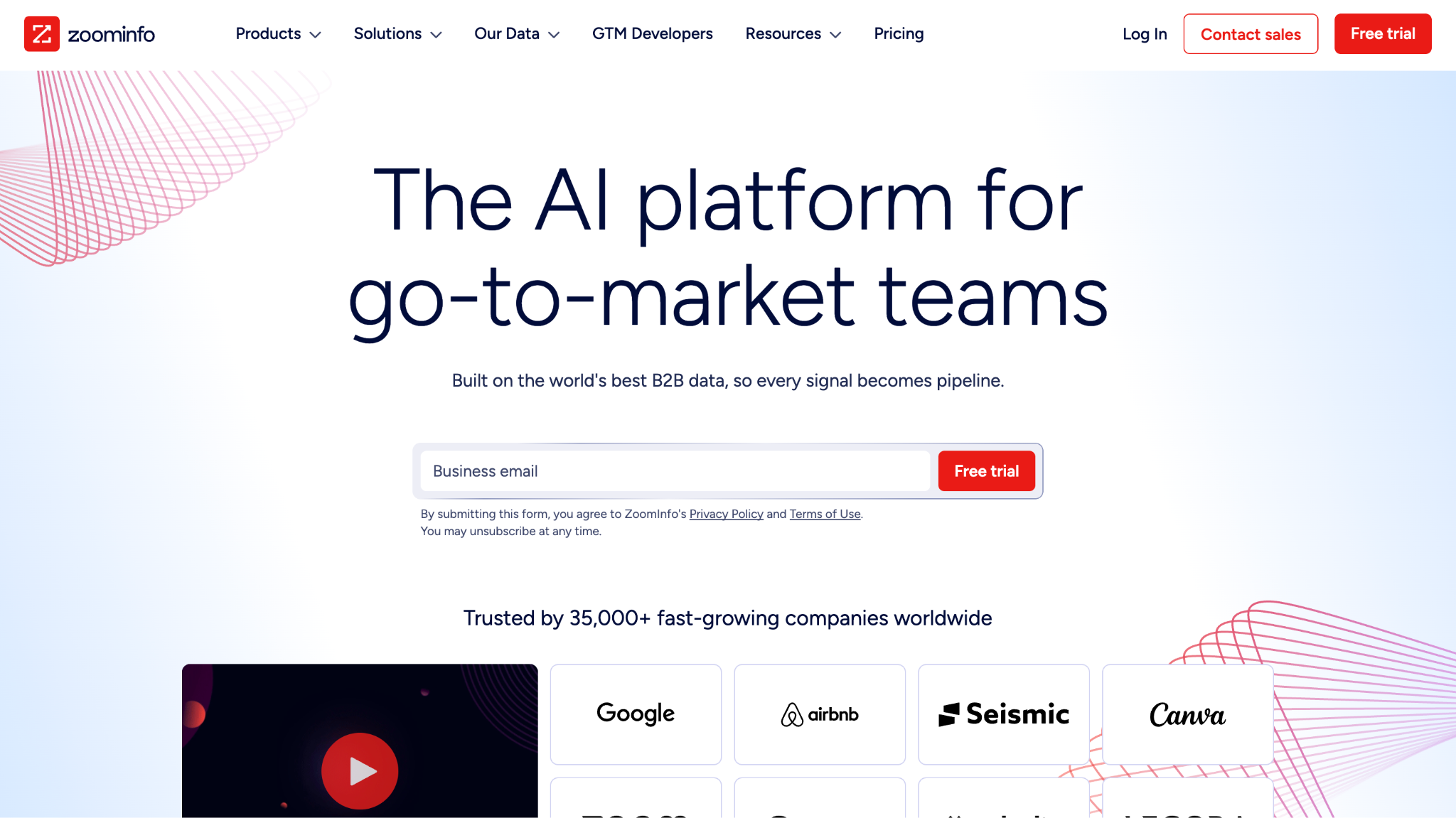
ZoomInfo is primarily a B2B sales intelligence and prospecting platform that helps revenue teams find companies and contacts, enrich records, and build prospect lists for sales and marketing.
How It Helps Enterprise Sales Teams
Enterprise sales teams need accurate information about both the companies they want to target and the people involved in purchasing decisions.
ZoomInfo can support this prospect discovery process by giving teams access to company and contact information that can be used to identify relevant accounts, decision makers, and prospects.
This makes it useful earlier in the workflow, when a sales team needs to answer:
Which companies should we target, and who should we contact inside them?
Where It Fits
ZoomInfo primarily fits at the company intelligence, contact data, enrichment, and prospect discovery layer.
It can provide the underlying account and contact information that sales teams use alongside intent, engagement, and sales execution platforms.
Key Capabilities
Company intelligence
Contact and decision maker data
Contact enrichment
Firmographic data
Technographic data
Prospect discovery
Account and contact research
Intent data
CRM data enrichment
Sales and marketing workflows
Best For
Enterprise sales teams that need a large source of company and contact intelligence for account research, prospect discovery, and data enrichment.
Focus: Company intelligence → contact data → enrichment → prospect discovery
5. Outreach
What It Does
Outreach is a sales engagement platform designed to help sales teams systematically engage prospects and customers through sequences, email, calling, tasks, triggers, and other sales workflows. Its sales engagement capabilities bring prospect engagement activities into a structured workflow.
How It Helps Enterprise Sales Teams
Enterprise sales teams can have thousands of target contacts across different accounts. Identifying those contacts is only the beginning. Reps also need a consistent way to follow up, manage multiple touches, and keep opportunities moving.
Outreach helps operationalize that engagement through multi step sequences, reusable messaging, automated triggers, tasks, email, calling, SMS, and meeting workflows.
Where It Fits
Outreach primarily sits at the sales engagement and execution layer.
A typical workflow might look like:
Target Account → Identify Buyer → Detect Intent → Add to Sequence → Engage → Follow Up → Opportunity
Key Capabilities
Sales engagement
Multi step sequences
Email and calling
Sales templates
Automated triggers
Tasks and workflows
Meeting scheduling
Prospect activity tracking
CRM integration
Sales execution workflows
Best For
Enterprise sales teams that need to turn account and prospect data into structured, repeatable sales outreach and follow up.
The goal is not to contact as many people as possible. It is to identify the accounts with the right fit, stakeholders, buying signals, and timing, then give sales the context needed to act.
Step 1: Define Your Ideal Customer Profile
Start by defining the characteristics of companies that are most relevant to your business. Your ICP can include:
Industry
Company size
Revenue
Geography
Technology stack
Use case
Business model
Strategic fit
The more specific the ICP, the easier it becomes to distinguish genuinely relevant accounts from companies that simply look like potential prospects.
Step 2: Build Your Target Account List
Once the ICP is defined, move from:
TAM → ICP → Target Accounts
Your total addressable market may contain thousands of companies, but not every company deserves the same level of sales attention.
An account first approach lets the team select companies that match the ICP before identifying individual contacts. This creates a more focused prospecting process and gives sales a clear set of accounts to work against instead of an oversized contact database.
Step 3: Identify the Buying Group
After selecting target accounts, identify the people who may influence the purchase.
Depending on the product and deal, this could include executives, department leaders, technical evaluators, end users, procurement, finance, security, and legal teams.
Mapping these stakeholders helps sales understand who needs to be involved, what role each person plays, and where the team may be single threaded.
Step 4: Enrich the Account
Account selection is only useful when the underlying data is accurate and detailed enough to support sales action.
Combine:
Firmographic data
Technographic data
Contact information
CRM data
Company information
Organizational changes
Relevant account history
This gives sales representatives the context they need to understand an account before starting a conversation.
Step 5: Detect Intent and Business Triggers
The next step is determining whether an account has a reason to engage now.
Useful signals can include:
Website activity
Content engagement
Intent data
Company changes
Leadership changes
Funding
Hiring
Expansion
Competitor research
No single signal necessarily indicates that an account is ready to buy. The value comes from combining multiple signals with account fit and stakeholder activity.
Step 6: Prioritize Accounts
Not every ICP account should receive the same level of attention.
A practical prioritization model is:
ICP Fit + Intent + Buying Group Activity + Timing = Account Priority
An account with strong ICP fit but no relevant activity may require a different approach from an account showing repeated engagement, active research, and multiple stakeholders interacting with your company.
This helps sales teams allocate time based on the quality and timing of the opportunity rather than account volume alone.
Step 7: Engage the Right Stakeholders
Enterprise sales requires more than sending the same message to everyone at an account.
Use multi threaded engagement to involve relevant stakeholders while adapting the conversation to each person's role.
For example, an executive may care about business outcomes and financial impact, while a technical stakeholder may focus on implementation, integrations, security, or technical requirements.
Role based personalization makes outreach more relevant without requiring every interaction to be completely manual.
Step 8: Qualify and Route
Once an account or buyer engages, determine whether the interaction represents a meaningful sales opportunity.
A practical qualification framework considers:
Fit + Need + Timing + Authority + Opportunity Potential
Qualified conversations can then be routed to the appropriate sales representative, territory, account owner, specialist team, or automated workflow.
The objective is to reduce the gap between buyer activity and sales action.
Step 9: Measure Pipeline
The final step is connecting lead generation activity to commercial outcomes:
This allows teams to understand which accounts and activities are actually creating opportunities rather than simply generating contacts or meetings.
Strategies to Generate More Enterprise Sales Leads
Generating more enterprise leads does not necessarily mean increasing outreach volume. The bigger opportunity is improving targeting, relevance, and timing.
Focus on Target Accounts, Not Contact Volume
A large contact database does not automatically create enterprise pipeline.
Start with accounts that match your ICP, then identify the relevant stakeholders within those accounts. This gives sales a more focused prospecting universe and makes account level measurement possible.
Prioritize Accounts Showing Intent
Combine ICP fit with behavioral and intent signals to identify accounts that may be actively researching a solution.
This allows sales teams to focus attention on accounts showing meaningful activity rather than treating every target account equally.
Use Business Triggers to Find the Right Timing
Changes such as funding, leadership moves, expansion, hiring, acquisitions, or technology changes can create new business requirements.
These triggers can provide useful context for deciding when an account may be worth engaging.
Build Buying Group Coverage
Do not rely on a single contact to represent an entire enterprise opportunity.
Track the relevant stakeholders and understand their roles in the buying process. Broader buying group coverage can also reduce the risk of losing momentum when one contact becomes inactive.
Combine First Party and Third Party Signals
First party signals show what buyers are doing with your company, such as website activity, content engagement, product usage, or direct interactions.
Third party signals can provide visibility into research happening outside your own properties.
Combining both can provide a broader view of account activity than either source alone.
Personalize Outreach by Stakeholder Role
Different stakeholders have different priorities.
Adapt messaging around the problem each stakeholder is likely to care about instead of sending the same generic value proposition to everyone at the account.
Multi Thread Important Opportunities
When an opportunity has meaningful potential, engage multiple relevant stakeholders instead of depending entirely on one relationship.
This can give sales a better understanding of the buying process and create additional paths through the account.
Coordinate Marketing and Sales Around the Same Accounts
Marketing and sales should work from a shared view of target accounts, engagement, intent, and buying group activity.
When both teams use different definitions of account priority, valuable signals can be missed and follow up can become disconnected.
Use Buyer Behavior to Trigger Follow Up
Buyer activity can determine when a sales action should happen.
For example, repeated engagement from an existing target account may justify follow up, while a new high intent interaction can trigger an immediate sales notification or qualification workflow.
Create Content Before Buyers Enter the Sales Process
Enterprise buyers often research solutions before speaking with sales.
Content that addresses problems, comparisons, use cases, implementation questions, and category education can help your company become visible during this research stage and create opportunities before a buyer submits a form.
How to Measure Enterprise Sales Lead Generation
Enterprise lead generation should ultimately be measured by its contribution to pipeline and revenue, not simply by the number of contacts generated.
Account Metrics
Track whether the right accounts are being reached and engaged:
Target account coverage
Engaged accounts
In market accounts
Buying group coverage
Account engagement
Pipeline Metrics
Measure whether account activity is turning into real sales opportunities:
Qualified opportunities
Pipeline generated
Opportunity conversion rate
Pipeline velocity
Average deal size
Revenue Metrics
Connect lead generation to financial outcomes:
Revenue generated
Revenue per account
Customer acquisition cost
Win rate
Customer acquisition payback
The key is to connect activity across the funnel rather than evaluating lead generation through a single metric.
Common Enterprise Sales Lead Generation Mistakes
Enterprise lead generation becomes inefficient when teams optimize for activity instead of commercial relevance.
Optimizing for Contact Volume
More contacts do not necessarily mean more qualified opportunities. Account relevance and buyer intent should matter alongside contact volume.
Treating Every ICP Account as Equally Valuable
ICP fit establishes potential, but accounts can differ significantly in intent, timing, engagement, and opportunity potential.
Relying on a Single Contact
Enterprise purchases often involve multiple stakeholders. Depending on one contact can leave the sales team with an incomplete view of the buying process.
Confusing ICP Fit With Buying Intent
A company can match your ICP without having an active need for your product. Fit and intent should be evaluated separately.
Waiting for Form Fills
Form submissions are only one type of buyer signal. Website activity, content engagement, research behavior, and account level activity can provide useful signals earlier in the buying process.
Ignoring Buying Group Activity
Focusing on one lead can hide activity from other stakeholders at the same account.
Using Stale Account Data
Outdated job titles, company information, technology data, or contact details can make otherwise relevant accounts difficult to engage effectively.
Sending Generic Outreach at Scale
Enterprise buyers have different roles and priorities. Generic messaging can make it harder to connect the outreach to the stakeholder's specific business problem.
Separating Marketing and Sales Account Data
When marketing and sales operate from different account information or priorities, important engagement and intent signals can be lost between teams.
Measuring Meetings Instead of Pipeline and Revenue
Meetings are an intermediate outcome. Enterprise lead generation should ultimately be connected to qualified opportunities, pipeline, and revenue.
FAQs
What are the best lead generation tools for enterprise sales led companies?
The right tool depends on the part of the sales process you need to strengthen. Knock AI focuses on buyer signals, qualification, engagement, routing, and conversion. 6sense focuses on intent, predictive intelligence, and account prioritization. Demandbase focuses on account intelligence, intent, buying groups, and ABM. ZoomInfo focuses on company and contact intelligence, enrichment, and prospect discovery. Outreach focuses on sales engagement, sequences, follow up, and sales execution.
What is enterprise lead generation?
Enterprise lead generation is the process of identifying target accounts, finding relevant stakeholders, detecting buying signals, engaging potential buyers, and converting qualified account activity into sales opportunities and pipeline.
How do enterprise sales teams generate leads?
Enterprise teams typically combine account based prospecting, inbound demand, outbound sales, content, SEO, events, referrals, partnerships, intent signals, and sales engagement. The specific mix depends on the ICP, sales cycle, deal size, and buying behavior.
What is the best tool for enterprise prospecting?
The appropriate tool depends on the primary prospecting need. Account intelligence platforms help identify and understand target companies, contact intelligence platforms help find relevant people, intent platforms help prioritize accounts showing buying activity, and sales engagement platforms help execute outreach.
What is the difference between enterprise lead generation and prospecting?
Enterprise lead generation covers the broader process of creating and identifying potential sales opportunities. Prospecting is a specific activity within that process focused on finding and engaging potential buyers or accounts.
What is intent data in enterprise sales?
Intent data provides signals that indicate an account or buyer may be researching a particular topic, category, or solution. First party intent comes from interactions with your own properties, while third party intent comes from research activity outside your company's properties.
How do you identify high intent enterprise accounts?
Combine ICP fit, intent, engagement, buying group activity, and business triggers. An account becomes more relevant when multiple signals indicate both a strong fit and a potential reason to buy.
How do you find enterprise decision makers?
Use contact intelligence, account research, CRM data, organizational information, and buying group mapping to identify relevant stakeholders. The objective is to understand not only who works at the account, but also who may influence the purchase.
How does account based lead generation work?
Account based lead generation starts by defining an ICP, selecting target accounts, identifying their buying groups, enriching account data, detecting intent, engaging relevant stakeholders, and converting qualified activity into opportunities.
How do you generate enterprise leads without cold calling?
Teams can generate enterprise demand through SEO and content, events, referrals, partnerships, communities, inbound experiences, product or website engagement, and intent driven sales engagement. These channels can create opportunities before a traditional cold call takes place.
How do you qualify enterprise leads?
Evaluate fit, need, timing, authority, buying stage, intent, and opportunity potential. Enterprise qualification should consider both the individual buyer and the broader account context.
How do you measure enterprise lead generation?
Focus on qualified opportunities, pipeline, revenue, conversion, and efficiency. Account coverage and engagement metrics are useful leading indicators, but the ultimate measurement should connect lead generation activity to pipeline and revenue.


.svg)


.svg)
.svg)
.svg)


.svg)
.svg)


.svg)