How to Interpret Buyer Intent Signals
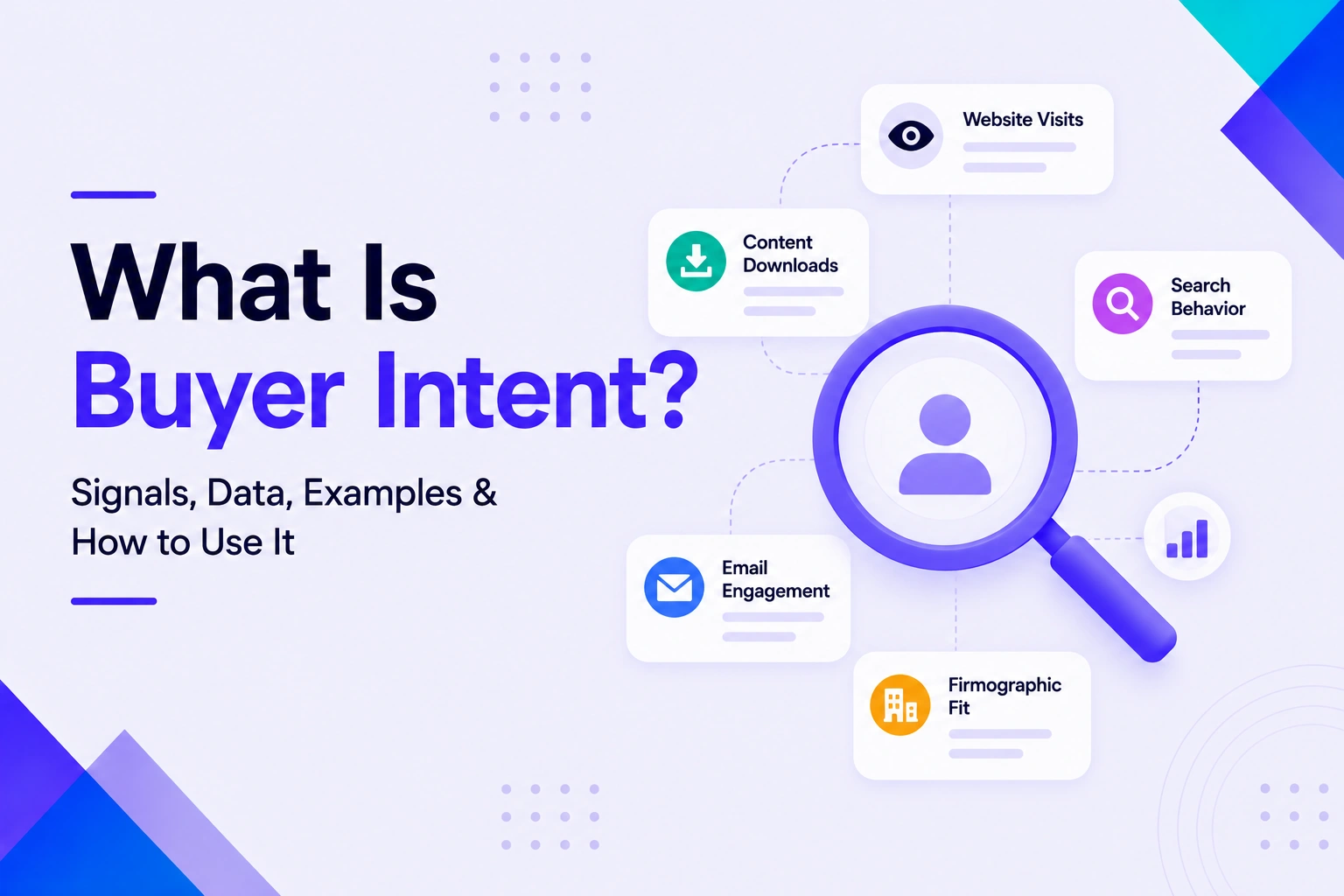
No single signal proves intent. The strength of a buyer intent signal depends on factors such as recency, frequency, relevance, depth, and stakeholder breadth. For example, one visit to a pricing page may indicate interest, while repeated pricing visits combined with competitor research and activity from multiple stakeholders provide stronger evidence of an active buying process. Teams should therefore evaluate signals together and consider account fit and context before deciding what action to take.
Types of Buyer Intent Data
Buyer intent data can come from different sources and can be analyzed at different levels. The main types differ based on where the data comes from, how it is generated, how quickly it becomes available, and whether it describes an account or an individual buyer. Understanding these types helps B2B teams choose the right data for prospecting, ABM, qualification, personalization, and sales engagement.
| Type |
What it means |
Common use |
| First-party intent data |
Data collected from your own properties and interactions |
Identify active prospects and understand engagement |
| Second-party intent data |
Data shared directly by a trusted partner |
Audience and account intelligence |
| Third-party intent data |
Data collected from external websites, publishers, networks, or platforms |
Discover off-site research and potential demand |
| Predictive intent data |
Likelihood of future buying activity inferred from multiple signals and models |
Account prioritization and forecasting |
| Real-time intent data |
Current or recently observed behavioral activity |
Timely engagement and sales follow-up |
| Account-level intent data |
Buying activity associated with a company or account |
ABM and account prioritization |
| Contact-level intent data |
Buying activity associated with an individual |
Buyer identification and personalized engagement |
First-Party vs. Third-Party Intent Data
First-party intent data comes directly from interactions with your own website, product, content, campaigns, emails, conversations, and other owned channels. Because the activity occurs within your own ecosystem, it can provide detailed context about how known or anonymous visitors engage with your business.
Third-party intent data comes from activity outside your owned properties, such as research across publisher networks, review sites, or other external platforms. It can help identify potential demand before a prospect directly engages with your brand.
For B2B teams, the two can complement each other. Third-party data can help discover potential interest, while first-party data can provide more direct context about how a prospect is engaging with your business.
Predictive vs. Real-Time Intent Data
Predictive intent data uses historical and behavioral signals to estimate which accounts or buyers are more likely to enter a buying process. It is useful for prioritization, account selection, and planning.
Real-time intent data focuses on current or recently observed activity, making it useful when timing matters. For example, a buyer repeatedly researching a product or visiting commercially relevant pages may warrant attention while that activity is still happening.
These approaches can work together: predictive intent helps determine where to focus, while real-time intent can help determine when to act.
What Is the Buyer Intent Funnel?
The buyer intent funnel maps how buying interest develops as a prospect moves from initial awareness to purchase and, eventually, expansion. Each stage represents a different level of research or evaluation, so the signals a buyer generates and the appropriate GTM response can change throughout the journey.
| Stage |
Typical behavior |
GTM response |
| Awareness |
Learning about a problem or category |
Educate |
| Problem research |
Defining needs, challenges, or requirements |
Nurture |
| Solution research |
Exploring possible solutions |
Personalize |
| Vendor evaluation |
Comparing providers, products, or pricing |
Engage |
| Purchase |
Decision-making, procurement, or commercial activity |
Qualify + route |
| Expansion |
Researching additional use cases or capabilities |
Expand |
Not every buyer moves through these stages in a predictable order. B2B buyers may enter the funnel at different points, revisit earlier stages, or have multiple stakeholders researching simultaneously. The same activity can also mean different things depending on the buyer's stage and context.
For example, a first visit to a product page may reflect solution research, while repeated visits to pricing and comparison pages may suggest vendor evaluation. A meeting request or procurement activity can indicate movement toward purchase.
The funnel is therefore most useful when it connects buyer behavior to buying stage and action. Instead of asking only whether an account has intent, teams can ask: What is the buyer researching, where are they in the journey, and what should happen next?
Buyer Intent Examples
Buyer intent becomes easier to understand when behavioral signals are viewed in context. The following buyer intent examples show how different combinations of activity can indicate different levels or types of buying interest.
| Scenario |
What you see |
Interpretation |
| Pricing research |
Repeat visits to pricing pages |
Stronger commercial intent |
| Competitor research |
Comparison pages or competitor activity |
Active vendor evaluation |
| Multiple stakeholders |
Several relevant roles researching |
Potential buying committee |
| Technical research |
Documentation and integration pages |
Technical evaluation |
| Anonymous research |
Repeated activity from the same account |
Potential account-level interest |
| Product + website activity |
Product usage combined with commercial research |
Stronger evidence of active evaluation |
| High fit + low intent |
Strong ICP match but little recent activity |
Monitor or nurture rather than forcing outreach |
| Low fit + high intent |
Heavy engagement from an account outside the ICP |
Validate fit before investing sales resources |
A useful buyer intent example is an account that repeatedly visits product and pricing pages while several employees engage with comparison content. Each activity alone provides limited information, but together they can indicate active account-level evaluation.
Context also matters when interpreting intent. A high-fit account showing little activity may not be ready to buy, while an account showing substantial activity but poor ICP fit may not be worth immediate sales investment. The goal is not to find the account with the most signals, but to identify the signals that represent meaningful buying activity and determine the right action.
How to Use Buyer Intent Data for Sales
Buyer intent data helps sales teams identify which prospects may be actively evaluating a solution, prioritize their time, and determine when and how to engage. Instead of treating every lead or account equally, sales teams can combine intent signals with account fit, buyer context, and existing relationship data to focus on opportunities with stronger evidence of buying activity.
| Sales use |
How intent helps |
| Prioritization |
Focus reps on accounts showing meaningful buying activity |
| Prospecting |
Identify accounts researching relevant problems or solutions |
| Personalization |
Tailor outreach to observed interests and research |
| Timing |
Engage while relevant buying activity is active |
| Qualification |
Combine intent with fit, context, need, and timing |
| Routing |
Send buyers to the appropriate rep or workflow |
| Follow-up |
Trigger faster responses to meaningful activity |
| Expansion |
Identify existing customers researching new use cases |
Turning Intent Into Sales Action
The highest-value use of intent data is not simply alerting a rep that an account is active. It is connecting the signal to identity, context, qualification, and the next action. This allows sales teams to move from detecting potential interest to identifying the right buyer, understanding what they may be evaluating, and responding appropriately.
How to Use Buyer Intent Data for Marketing
Buyer intent data helps marketing teams identify active demand, prioritize target accounts, personalize experiences, and align campaigns with where buyers are in their journey. Instead of delivering the same message to every prospect, intent signals can help marketers determine which accounts are researching a problem, evaluating solutions, or showing signs of increased interest.
| Marketing use |
Application |
| ABM |
Prioritize target accounts showing relevant buying activity |
| Personalization |
Adapt messaging and content to observed interests |
| Retargeting |
Reach accounts that have already demonstrated engagement |
| Advertising |
Build audiences around relevant intent signals |
| Nurturing |
Adjust content based on buying stage and activity |
| Segmentation |
Separate active, emerging, and inactive accounts |
| Campaign prioritization |
Allocate resources toward accounts showing meaningful demand |
Intent data can also help marketing teams decide when not to engage. Accounts showing little relevant activity may be better suited to ongoing nurture, while highly active accounts can receive more timely and specific messaging. When intent is combined with account fit and engagement context, marketing teams can focus campaigns on demand that is more likely to contribute to pipeline rather than simply optimizing for activity volume.
Buyer Intent for ABM, Lead Scoring & Qualification
Buyer intent becomes more useful when it is combined with account fit, lead scoring, and qualification. Intent shows that buying activity may be happening, while these other inputs help determine whether the activity matters and what the sales or marketing team should do next.
Buyer Intent for ABM
In account-based marketing (ABM), buyer intent helps teams identify target accounts that are actively researching relevant problems or solutions. Instead of treating every account in the ICP equally, teams can prioritize those showing recent and meaningful activity. Intent can also reveal which topics an account is researching and whether engagement is spreading across multiple stakeholders, helping marketing and sales coordinate account-level campaigns and engagement.
Buyer Intent for Lead Scoring
Buyer intent can be an important input into lead scoring, but it should not be the only one. A scoring model can combine intent signals with factors such as company fit, role, engagement, account characteristics, and buying stage. For example, repeated pricing-page visits from a high-fit account may contribute more to a score than a single visit to an educational article. The goal is to make scoring more contextual rather than simply assigning points to every activity.
Buyer Intent for Lead Qualification
Lead qualification determines whether a person or account is worth pursuing and what level of sales attention it requires. Intent can help qualification systems understand whether a buyer is actively evaluating a solution, but it works best alongside fit, need, timing, authority, and engagement. This allows teams to distinguish between someone who happens to be researching a topic and a relevant buyer showing a sustained pattern of commercial activity.
Intent tells you that movement is happening. Fit and context tell you whether that movement matters.
For Knock AI, this is where buyer intent can move beyond scoring or alerting. Knock AI can combine buying intent with identity, CRM data, company information, engagement, and relationship context to support qualification and determine the appropriate workflow.
How to Turn Buyer Intent Into Pipeline
Detecting buyer intent is only the beginning. The value of intent comes from what happens after a meaningful signal is identified. A revenue workflow needs to connect the signal to the right buyer, understand its context, determine whether the opportunity is worth pursuing, and trigger an appropriate action.
The Intent-to-Pipeline Workflow
Signal → Identity → Enrichment → Context → Intent → Qualification → Conversation → Routing → Meeting → Pipeline
| Stage |
What happens |
| Signal |
Relevant buying activity is detected |
| Identity |
The activity is connected to a person or account |
| Enrichment |
Company and contact information is added |
| Context |
CRM, relationship, engagement, and account information is considered |
| Intent |
The pattern of activity is interpreted |
| Qualification |
Fit, need, timing, and buying readiness are evaluated |
| Conversation |
The buyer receives relevant engagement |
| Routing |
The buyer is connected to the appropriate person or workflow |
| Meeting |
A qualified opportunity can move to a sales conversation |
| Pipeline |
The resulting relationship progresses toward revenue |
Traditional intent workflows often stop at identifying or scoring an account. That can tell a sales team that something is happening, but it does not necessarily tell them who to contact, what the buyer needs, whether the activity is meaningful, or what should happen next.
Knock AI connects buyer intent with identity, relationship context, qualification, conversations, routing, and scheduling, allowing intent signals to become part of an actionable revenue workflow rather than another isolated alert. Its workflows can use buying intent alongside CRM ownership, company attributes, engagement, geography, buyer segments, and other context to determine routing and next actions.
The result is a shift from:
Intent → Alert → Manual follow-up
to:
Intent → Context → Qualification → Engagement → Action → Pipeline
That is the difference between detecting buyer intent and activating buyer intent.
How AI Changes Buyer Intent
AI changes buyer intent from a collection of individual signals into a more contextual view of buyer activity. Traditional intent workflows often rely on predefined rules, scores, and alerts. AI can analyze multiple signals together, identify patterns, and use additional context to determine what those signals may mean.
| Traditional intent workflow |
AI-enabled workflow |
| Collect signals |
Interpret signals |
| Score activity |
Understand patterns |
| Alert reps |
Trigger action |
| Identify accounts |
Identify relevant buyers |
| Static rules |
Context-aware decisions |
| Separate systems |
Connected workflow |
For example, a single pricing-page visit may provide limited evidence of buying intent. AI can evaluate that activity alongside repeat visits, content engagement, competitor research, account information, previous interactions, and activity from other stakeholders to determine whether the account may be actively evaluating a solution.
AI can also connect intent detection with downstream workflows. Instead of simply notifying a sales rep that an account has crossed an intent threshold, an AI-enabled system can help identify the relevant buyer, enrich the account, qualify the opportunity, personalize the conversation, and determine the next action.
AI makes intent more useful when it can interpret multiple signals, incorporate context, qualify the opportunity and determine the next best action.
What Is Buyer Intent Software?
Buyer intent software is software that collects, analyzes, or acts on signals that may indicate a person or account is researching a problem, evaluating a solution, or preparing to buy. Depending on the platform, it may focus on intent data, account intelligence, predictive scoring, visitor identification, or activating intent through revenue workflows.
Common capabilities include:
| Capability |
Purpose |
| Signal collection |
Capture behavioral evidence |
| Intent detection |
Identify potential buying activity |
| Scoring |
Prioritize activity |
| Predictive modeling |
Estimate likely buying behavior |
| Identity resolution |
Connect activity to people/accounts |
| Alerts |
Notify teams |
| Orchestration |
Trigger actions |
| Qualification |
Determine sales readiness |
| Routing |
Assign the next action |
Buyer intent tools can therefore serve different parts of the revenue process. Some primarily provide intent data, while others combine intent with account intelligence, CRM information, lead scoring, qualification, or engagement workflows.
The terms buyer intent platform, intent data software, and intent data platform are often used for systems that help teams identify and interpret buying activity. When evaluating a platform, it is important to consider whether it only surfaces intent or can also connect intent to the actions that follow.
Best Buyer Intent Tools and Software
Buyer intent software covers several categories, from third-party intent data providers to account intelligence and revenue activation platforms. Common examples include:
| Tool/category |
Primary strength |
| Demandbase |
Account intelligence + intent |
| 6sense |
Predictive intelligence + intent |
| Bombora |
Third-party intent |
| ZoomInfo |
Sales intelligence + intent |
| G2 |
Review/research intent |
| HubSpot |
CRM + integrated intent capabilities |
| Knock AI |
Intent → identity → qualification → conversation → pipeline |
These platforms can serve different jobs even when they are all described as buyer intent tools. Some focus primarily on discovering off-site research activity, while others combine intent with account intelligence, CRM data, visitor identification, scoring, or sales execution.
For revenue teams, the important question is therefore not only which tool provides intent data, but also what happens after intent is detected. An intent signal becomes more valuable when it can be connected to identity, buyer context, qualification, engagement, routing, and ultimately pipeline.
For Knock AI, buyer intent is part of a broader workflow that connects buyer activity with identity, relationship context, qualification, conversations, routing, and scheduling rather than treating intent as an isolated score or alert.
What Buyer Intent Data Can and Cannot Tell You
Buyer intent data can help sales and marketing teams understand what a prospect or account may be doing, but it should not be treated as a guarantee of what they will do next. Intent signals provide evidence about buyer activity and potential readiness, while other factors determine whether that activity will become an opportunity.
What Buyer Intent Data Can Indicate
Buyer intent data can help teams identify:
- Research activity: What topics, problems, or solutions a buyer is exploring
- Evaluation: Whether a prospect may be comparing solutions or vendors
- Interest: Increasing engagement with relevant content, products, or pages
- Buying stage: Whether activity appears consistent with research, evaluation, or purchase
- Account engagement: Whether activity is increasing across an account or multiple stakeholders
- Potential timing: Whether recent or accelerating activity may warrant attention now
What Buyer Intent Data Cannot Prove
Intent data cannot independently prove:
- That a prospect will purchase
- That they have the budget to buy
- That the person showing activity has decision authority
- The exact timing of a purchase
- Which vendor they will choose
- Whether the account is actually a good fit
- How serious the buyer is about purchasing
This is why intent should be evaluated alongside account fit, buyer identity, relationship context, engagement, and other qualification signals. A high-intent signal from a poor-fit account may be less valuable than moderate intent from a highly relevant account with the right stakeholders and business context.
Intent is evidence, not proof.
FAQs
1. What is buyer intent?
Buyer intent is the likelihood or readiness of a person or account to purchase, inferred from behaviors and signals shown while researching a problem, solution, or vendor.
2. What is buyer intent data?
Buyer intent data is information about behaviors and activities that may indicate a prospect or account is researching, evaluating, or preparing to purchase a solution.
3. What are buyer intent signals?
Buyer intent signals are observable behaviors that may indicate buying interest, such as pricing-page visits, competitor research, repeat engagement, product activity, or meeting requests.
4. What are B2B buying signals?
B2B buying signals are behaviors or business events that may indicate an organization is researching, evaluating, or preparing to purchase a product or service.
5. What is purchase intent?
Purchase intent refers to evidence that a buyer may be moving closer to making a purchase. It generally indicates stronger commercial interest than general research activity.
6. What is first-party intent data?
First-party intent data comes from a company's own properties and interactions, including website activity, content engagement, product usage, email engagement, and sales conversations.
7. What is third-party intent data?
Third-party intent data comes from external sources such as publishers, review sites, and research networks, helping identify potential buying activity outside a company's own properties.
8. What is predictive intent data?
Predictive intent data uses historical and behavioral patterns to estimate which accounts or prospects may be more likely to show future buying activity.
9. How do you measure buyer intent?
Buyer intent can be measured by analyzing factors such as recency, frequency, depth, relevance, activity diversity, stakeholder engagement, and overall account context.
10. How do sales teams use intent data?
Sales teams use intent data to prioritize prospects, personalize outreach, identify active accounts, improve timing, support qualification, and determine which opportunities may warrant attention.
11. How do marketers use intent data?
Marketers use intent data for ABM, audience prioritization, personalization, retargeting, campaign segmentation, lead nurturing, and identifying accounts showing increased interest.
12. What is buyer intent software?
Buyer intent software collects, analyzes, or acts on signals that may indicate buying activity. Capabilities can include intent detection, scoring, identity resolution, alerts, and orchestration.
13. What is an intent score?
An intent score is a numerical or categorical representation of the strength of signals associated with potential buying activity, used to help prioritize accounts or prospects.
14. Does buyer intent guarantee a purchase?
No. Intent data provides evidence of potential buying activity, but it cannot prove that a prospect has budget, authority, fit, or an intention to purchase.
15. What is a high-intent buyer?
A high-intent buyer is a prospect or account showing multiple relevant and recent signals consistent with active solution evaluation or movement toward a purchase.
16. How do you identify high-intent accounts?
Look for relevant, recent, and repeated activity across commercial pages, content, competitor research, product interactions, and multiple stakeholders, then evaluate those signals alongside account fit and context.
17. What is the difference between intent data and lead scoring?
Intent data describes potential buying activity. Lead scoring assigns a numerical or categorical value to prioritize prospects using intent alongside fit, engagement, and other attributes.
18. How does AI detect buyer intent?
AI can analyze multiple behavioral and contextual signals together, identify patterns, incorporate account and buyer context, and estimate whether activity indicates meaningful buying intent.
19. What are the strongest buyer intent signals?
Strong signals often include repeated commercial-page activity, pricing or competitor research, product trials, meeting requests, procurement activity, and engagement from multiple relevant stakeholders.
20. How do you turn buyer intent into pipeline?
Connect intent signals to identity, enrichment, context, qualification, conversation, routing, and scheduling so meaningful buying activity can trigger an appropriate revenue action.


.svg)


.svg)
.svg)
.svg)


.svg)
.svg)


.svg)


