Best Lead Generation Tools for Insurance Companies
What Lead Generation Tools Do You Recommend for Insurance Companies?
Insurance companies and agencies can generate demand through search, paid media, referrals, comparison marketplaces, social media, websites, and their existing customer databases. But generating an insurance lead is only the first step. The bigger challenge is turning that initial interest into a conversation, quote, bound policy, and eventually a long-term customer relationship.
Digital channels are becoming an increasingly important part of that process. According to J.D. Power's 2026 U.S. Insurance Digital Experience Study, nearly 47% of new auto and home insurance policies were purchased through digital channels. At the same time, insurance shoppers continue to compare their options. The 2025 J.D. Power U.S. Insurance Shopping Study found that 57% of auto insurance customers had actively shopped for a new policy during the previous year.
That makes the quality and timing of a lead especially important. When a prospect is actively comparing insurers, getting the opportunity to the right agent quickly can matter just as much as generating the inquiry in the first place. Companies also need to understand what happens after the initial contact: whether the prospect receives a quote, becomes a policyholder, and eventually becomes a candidate for additional coverage or renewal.
So the right insurance lead generation tool isn't necessarily the one that produces the most leads. It depends on what the company needs to improve, whether that's acquiring new insurance shoppers, accessing purchased leads, managing prospects, improving follow-up, or developing B2B relationships with high-value accounts and partners.
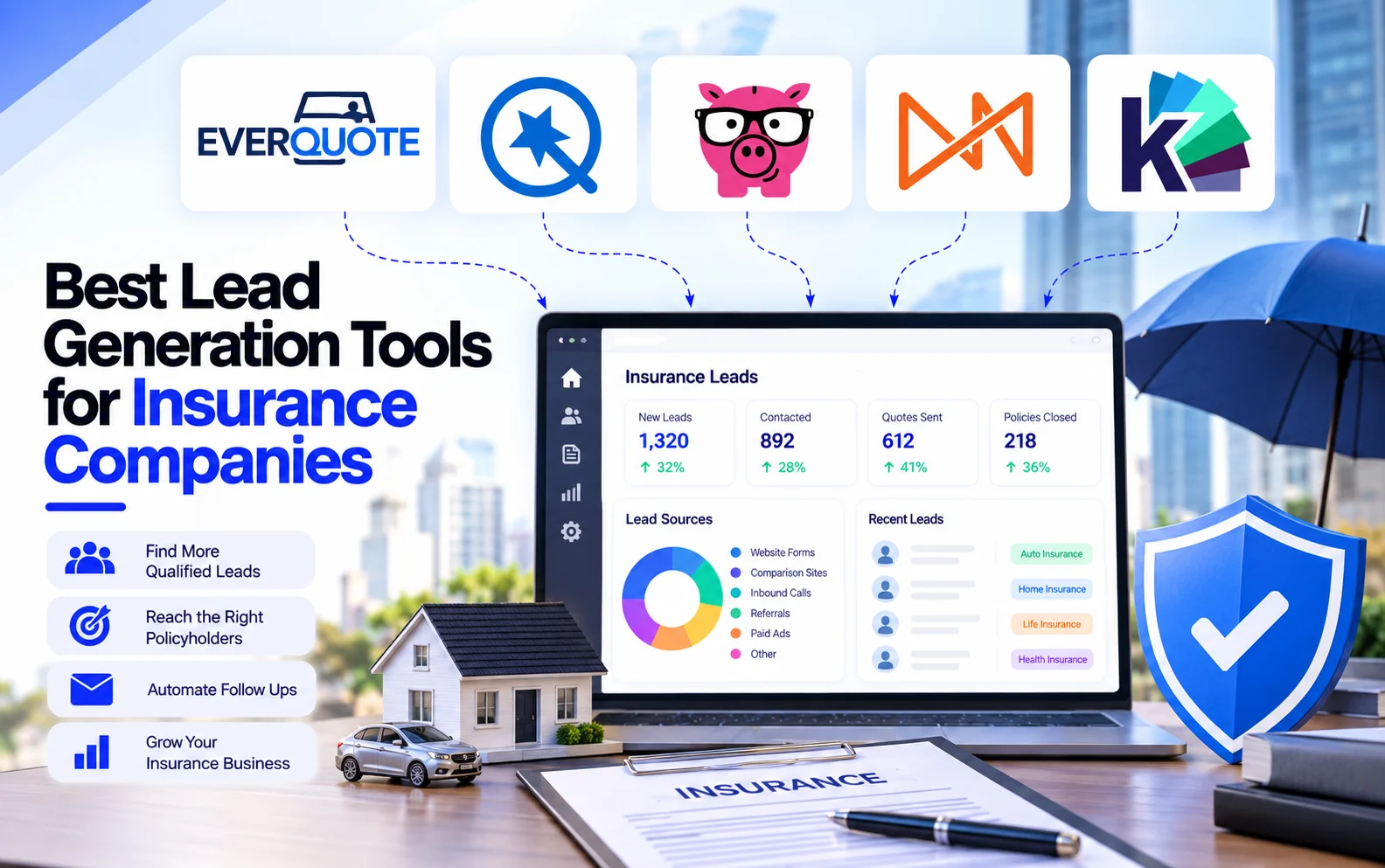
In this guide, we'll compare EverQuote, QuoteWizard, SmartFinancial, AgencyZoom, and Knock AI, looking at the specific role each tool plays in the insurance revenue journey and where each one fits best.
What Should Insurance Companies Look for in a Lead Generation Tool?
The number of leads a platform generates is only one part of the equation. Insurance companies should also consider where the leads come from, how fresh they are, how many other providers receive them, and how easily they can move from initial inquiry to quote and bound policy.
Factor
What to Look For
Lead quality
Relevant insurance intent, accurate contact details, and useful prospect information
Lead freshness
Real-time delivery versus aged or recycled leads
Exclusivity
Exclusive, shared, or semi-exclusive distribution
Lead source
Organic search, paid media, referrals, marketplaces, comparison sites, or other channels
Speed to lead
Instant delivery, real-time notifications, and rapid follow-up capabilities
Qualification
Information and signals that help identify higher-value opportunities
Distribution
Territory, insurance product, agent, team, or account-based routing
Integration
CRM, agency management system (AMS), quoting, and sales workflows
Economics
Cost per lead, quote, bound policy, and ultimately revenue
This framework is useful because lead volume alone doesn't tell you whether a lead source is actually producing a profitable insurance business. The more meaningful question is how efficiently a lead moves from initial interest to quote, bound policy, and long-term customer value.
Best Lead Generation Tools for Insurance Companies Compared
Tool
Primary Role
Demand / Relationship Source
Lead Type
Exclusivity / Distribution
Targeting & Qualification
Delivery / Engagement
CRM / Workflow
Best Fit
EverQuote
Insurance lead marketplace
Consumers actively shopping for insurance
Real-time data leads, shared/exclusive leads, warm transfers
Shared leads and exclusive options, subject to availability and filters
ZIP codes, lead type, risk profile, delivery hours
Best Lead Generation Tools for Insurance Companies
Insurance companies and agencies need to evaluate lead-generation tools based on more than lead volume. Lead type, freshness, distribution, targeting, delivery, follow-up, and the ability to connect acquisition to revenue can all materially affect results.
1. EverQuote
What EverQuote Does
EverQuote is an insurance lead marketplace that connects insurance agencies with consumers shopping for coverage. It provides access to insurance-shopping demand across multiple product categories and supports different types of opportunities, including data leads and live or warm transfer options.
Key capabilities include:
Insurance lead generation
Real-time lead opportunities
Consumer insurance inquiries
Lead targeting
Live or warm transfer opportunities
EverQuote is primarily focused on helping agencies access new consumer demand rather than managing the entire customer relationship after the lead enters the agency's pipeline.
Best For
EverQuote is best suited to insurance agencies that want to supplement their existing acquisition channels with purchased insurance leads and reach consumers who are already researching or shopping for coverage.
It can work alongside an agency's own website, organic search, paid advertising, referrals, and other lead sources.
What to Consider
Lead volume alone isn't enough to determine whether a purchased-lead source is valuable. Agencies should evaluate:
Lead cost
Lead freshness
Targeting
Lead distribution
Competition
Contact rate
Quote rate
Bind rate
Cost per bound policy
The important question is whether the leads ultimately generate profitable policies, not simply how many inquiries the platform delivers.
2. QuoteWizard
What QuoteWizard Does
QuoteWizard connects insurance professionals with consumers looking for coverage and offers leads across several major insurance categories.
Its offerings include:
Auto insurance leads
Home insurance leads
Renters insurance leads
Health insurance leads
Life insurance leads
Real-time lead delivery
Live-transfer opportunities
This makes QuoteWizard primarily an insurance demand acquisition platform, connecting agencies with consumers who are already looking for insurance options.
Best For
QuoteWizard is best suited to agencies that want to supplement their existing marketing with purchased insurance leads or live-transfer opportunities.
It can be particularly useful for agencies looking for active insurance shoppers and opportunities that can be delivered quickly to their sales teams.
What to Consider
Agencies should evaluate:
Lead distribution
Exclusivity
Territory
Insurance product
Lead freshness
Response time
Quote rate
Bind rate
Cost per bound policy
The economics of a lead can change significantly depending on how many providers receive it and how quickly the agency follows up.
3. SmartFinancial
What SmartFinancial Does
SmartFinancial provides insurance lead-generation solutions designed to help agencies acquire new consumer demand. Its offering includes both data-based leads and live-transfer opportunities.
Key capabilities include:
Insurance lead generation
Lead targeting
Lead delivery
Live transfers
Campaign management
Insurance shopper acquisition
The platform is primarily focused on helping agencies add targeted consumer demand to their existing acquisition strategy.
Best For
SmartFinancial is best suited to insurance agencies looking for additional lead volume and targeting options across consumer insurance products.
It can complement channels such as referrals, organic search, paid advertising, and an agency's own website.
What to Consider
Agencies should evaluate the complete conversion path rather than stopping at lead volume:
Lead → Contact → Quote → Bind → Revenue
Lead quality, targeting, freshness, contact rate, quote rate, bind rate, and cost per bound policy can provide a much clearer picture of campaign performance.
4. AgencyZoom
What AgencyZoom Does
AgencyZoom takes a different approach from the insurance lead marketplaces above. Rather than primarily supplying new consumer leads, it provides insurance agencies with technology for managing, converting, retaining, and growing existing relationships.
Its capabilities include:
Insurance CRM
Lead management
Sales automation
Automated follow-up
Pipeline management
Retention workflows
Cross-sell opportunities
Performance tracking
This makes AgencyZoom particularly relevant once leads are already entering an agency's pipeline.
Best For
AgencyZoom is best suited to insurance agencies that already have lead sources but need a better system for managing what happens after a prospect enters the pipeline.
An agency could use purchased leads, referrals, paid advertising, or organic search to generate opportunities and then use AgencyZoom to organize follow-up, manage the sales process, and develop customer relationships.
What to Consider
AgencyZoom is primarily a sales and relationship management platform, not a consumer insurance lead marketplace.
Its value is therefore less about supplying another source of leads and more about helping an agency get greater value from the opportunities and relationships it already has.
5. Knock AI
What Knock AI Does
Knock AI is a B2B demand-to-revenue and continuous relationship infrastructure platform.
Unlike the consumer insurance lead marketplaces in this list, Knock AI is built around B2B buyers, accounts, relationships, intent, engagement, qualification, and routing.
Rather than treating every interaction as an isolated lead, Knock AI connects the context around buyers and accounts across the revenue journey.
Identify Buyers and Accounts
Knock AI can help revenue teams identify the people and companies engaging with their business and enrich that activity with additional account and contact context.
Relevant capabilities include:
Buyer identification
Account and contact enrichment
Website activity
CRM context
Engagement signals
This gives teams more context around who is engaging and which account that activity belongs to.
Rather than treating every contact as an independent record, it connects relevant people, accounts, relationships, CRM information, and engagement context.
This can be particularly useful when several people from the same organization interact with a company or when existing relationships already exist within the sales organization.
Detect First-Party Intent
Knock AI can use first-party engagement signals to help revenue teams understand when buyers and accounts are showing meaningful interest.
This connects buyer engagement with the operational side of sales, helping teams determine which opportunities deserve attention and who should handle them.
Why Knock AI Matters for B2B Insurance Growth
Insurance isn't only a consumer acquisition business. Carriers, brokerages, MGAs, insurtechs, and other insurance organizations also build revenue through relationships with:
Brokers
Agencies
Carriers
Employers
Distribution partners
Referral partners
Enterprise accounts
Technology partners
This is where Knock AI differs from an insurance lead marketplace.
EverQuote, QuoteWizard, and SmartFinancial primarily help insurance organizations access consumer demand. AgencyZoom helps agencies manage and develop existing leads and customer relationships. Knock AI addresses the B2B layer by helping organizations understand and act on the people and accounts already engaging with them.
This is the core of the continuous relationship infrastructure positioning. Instead of treating every interaction as a new lead, the focus is on maintaining context around the buyer and account as the relationship develops.
Best For
Knock AI is best suited to B2B insurance organizations that need to identify and understand buyers and accounts, detect meaningful intent, engage prospects, qualify opportunities, and route conversations to the appropriate team.
This can be particularly relevant for carriers, brokerages, MGAs, insurtechs, and insurance organizations with account-based sales, partnership, distribution, or enterprise growth motions.
How These Tools Fit Into the Insurance Revenue Journey
Revenue Stage
Typical Tools / Approach
Generate consumer demand
Search, paid media, referrals
Buy insurance leads
EverQuote, QuoteWizard, SmartFinancial
Manage leads and prospects
AgencyZoom / CRM / AMS
Quote and bind
Agency and quoting workflows
Retain and cross-sell
CRM / AMS / automation
Grow B2B accounts and partnerships
Knock AI
These tools are not necessarily substitutes. They address different stages of the insurance revenue journey, from generating consumer demand and acquiring leads to managing relationships and developing B2B accounts and partnerships.
How Insurance Companies Can Improve Lead Conversion
Respond while intent is high
Fresh insurance inquiries can quickly become competitive opportunities. Faster follow-up gives agents a better chance of connecting while the prospect is actively looking for coverage.
Prioritize leads based on context
Not every lead deserves the same follow-up intensity. Lead source, insurance product, engagement, qualification information, and buying intent can help teams determine where to focus first.
Measure quote-to-bind performance
Lead volume does not show whether an acquisition channel is producing business. Connect lead sources to quotes, bound policies, and revenue to understand which channels actually contribute to growth.
Build relationships beyond the first policy
The relationship does not end when the first policy is sold. Cross-sell, renewal, reactivation, and B2B relationship expansion can increase the long-term value of an acquired opportunity.
Insurance Lead Generation Metrics to Track
Metric
Why It Matters
Cost per Lead
Acquisition efficiency
Contact Rate
Ability to reach prospects
Quote Rate
Lead-to-quote performance
Bind Rate
Lead-to-policy conversion
Cost per Bound Policy
True acquisition efficiency
Revenue per Lead
Economic value of demand
Cross-Sell Rate
Additional policy opportunity
Retention Rate
Long-term customer value
Lead Source → Bound Policy
Identifies channels producing actual business
Frequently Asked Questions
What are the best lead generation tools for insurance companies?
The right tool depends on what part of the revenue process an insurance company needs to improve. EverQuote, QuoteWizard, and SmartFinancial focus on acquiring consumer insurance leads. AgencyZoom focuses on managing and converting leads and relationships. Knock AI focuses on B2B buyers, accounts, engagement, qualification, and routing.
Are exclusive insurance leads better than shared leads?
Exclusive leads are delivered to one provider, while shared leads can be distributed to multiple providers. Exclusive leads can reduce direct competition for the same prospect, while shared leads may provide another way to access consumer demand. The more useful comparison is ultimately cost per bound policy and revenue generated from each lead type.
What is the difference between insurance leads and live transfers?
An insurance lead generally provides prospect information for an agent to follow up with. A live transfer connects an interested prospect with an agent in real time. Live transfers can reduce the gap between initial interest and conversation, while standard leads give agents more flexibility around follow-up.
How quickly should insurance agents respond to new leads?
Agents should respond as quickly as practical, particularly when the lead represents an active insurance-shopping opportunity. Speed matters because prospects can contact multiple providers while comparing coverage and quotes.
Should insurance companies buy leads or generate their own?
Many insurance organizations can use both. Purchased leads can provide access to existing consumer demand, while owned channels such as search, paid media, referrals, websites, and customer databases can create demand and relationships that the company controls directly. The appropriate mix depends on acquisition costs, lead quality, conversion rates, and the economics of the resulting policies.
How can insurance companies improve lead-to-policy conversion?
Focus on the complete journey from lead → contact → quote → bind. Improving response time, lead qualification, routing, follow-up, and agent workflows can help reduce leakage between each stage. Companies should also track cost per bound policy and revenue by lead source rather than optimizing only for lead volume.
Can Knock AI help insurance companies generate leads?
Yes, but its use case is different from consumer insurance lead marketplaces. Knock AI is a B2B platform, so it does not primarily supply consumer insurance leads like EverQuote, QuoteWizard, or SmartFinancial.
For B2B insurance organizations, Knock AI can help identify and understand buyers and accounts, detect first-party intent, engage prospects, qualify opportunities, and route conversations to the right team. This makes it relevant to carriers, brokerages, MGAs, insurtechs, and other insurance organizations pursuing B2B accounts, partnerships, distribution relationships, and enterprise opportunities.


.svg)


.svg)
.svg)
.svg)


.svg)
.svg)


.svg)