How to Prevent Buyer Context Loss Across GTM Handoffs
A buyer visits your website.
Buyers are visiting your site, comparing your pricing with competitors, reading case studies present on your site, interacting with your content, and maybe cross verifying/engaging with your brand off-site. Eventually, they are ready to buy.
Your GTM team does what it's supposed to do.
Marketing captures the lead. Intent is identified. The account is enriched. Lead routing sends it to the right rep. Your speed-to-lead process kicks in. The SDR qualifies the buyer, books the meeting, and hands it to the AE.
Everyone followed the process. Everything worked.
Except the handoff.
The AE doesn't fully understand what triggered the buyer's interest. The SDR's notes capture some of the conversation, but not all of the context. Sales questions the quality of the lead Marketing sent. Later, CS inherits the customer without the full context of why they bought in the first place.
So what happened?
You optimized every step of the buyer journey, but the buyer's context didn't make it through the journey with them.
Your tools are doing their individual jobs, but the buyer isn't moving through individual tools. They're moving through one continuous buying journey.
And that's where context gets lost.
In this guide, we'll break down where buyer context gets lost across Marketing, Sales, Customer Success, and AI agent handoffs, why it happens even when your internal processes look optimized, and how to build a GTM journey where context follows the buyer instead of getting reset at every stage.
Why Good GTM Processes Still Produce Bad Handoffs
What’s more frustrating? Your GTM process might actually be working.
You've invested in optimizing every major step.
You have a great GTM stack:
Lead capture to make sure buyers don't fall through the cracks
Enrichment to understand who the buyer and account are
Intent detection to identify buying signals
Qualification to determine whether a prospect is worth pursuing
Routing to get the right buyer to the right rep
Scheduling to make booking a meeting easier
Discovery to understand the buyer's needs
CRM logging to keep activity recorded
Forecasting to manage pipeline
Onboarding to get new customers moving
Everything looks good on paper. You have a solid GTM stack.
But things start breaking when the buyer journey moves from one team to another.
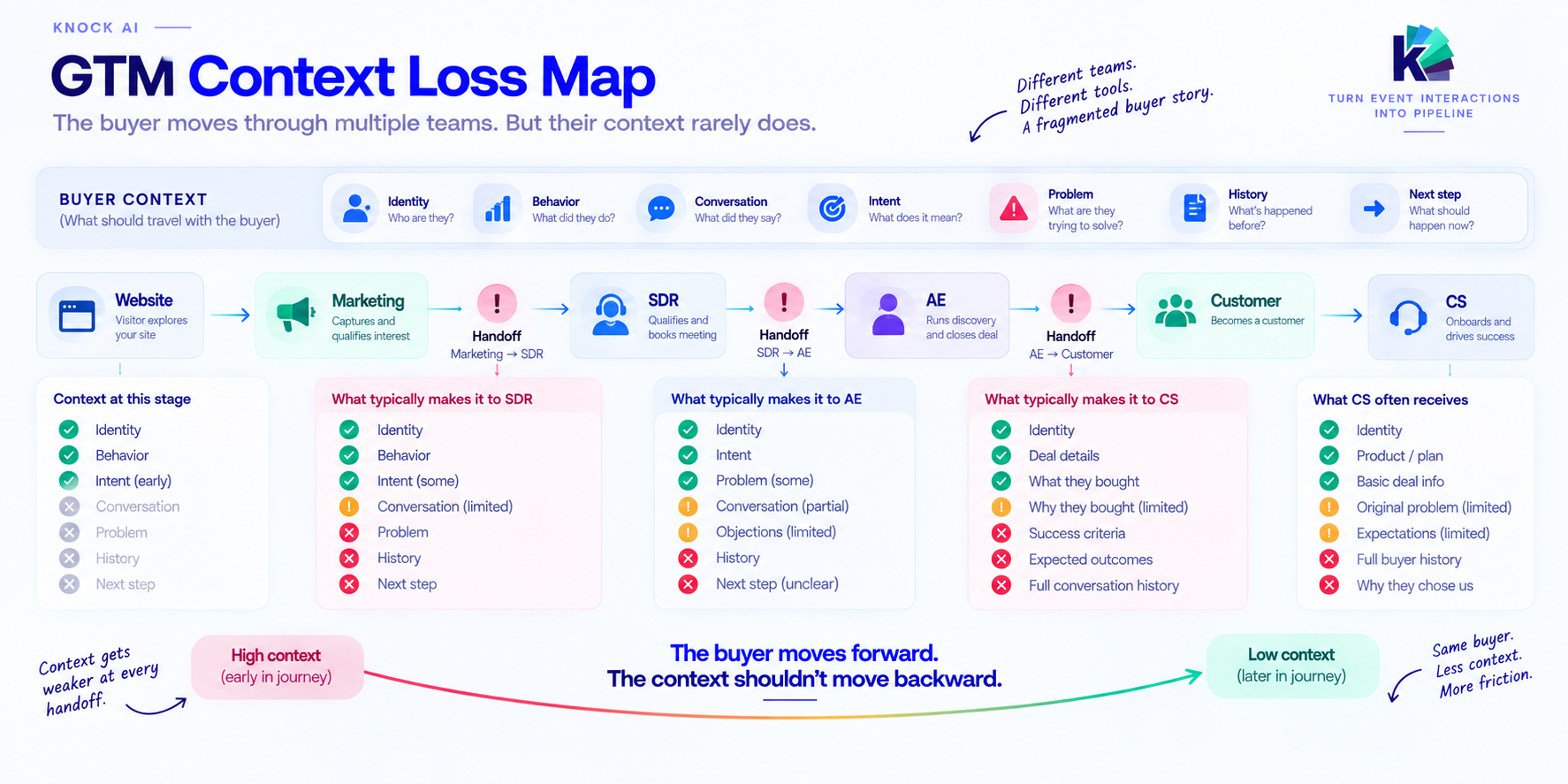
Marketing knows what the buyer did before becoming a lead. The SDR knows what happened during qualification. The AE learns more during discovery. CS learns something different during onboarding.
Each team has its own buyer context. But there’s no integrated layer that makes sure that each team has complete context throughout the complete sales process.
And that's when the buyer starts experiencing the cracks:
They get asked questions they've already answered.
Sales questions the lead Marketing sent.
The AE has to piece together the SDR's discovery.
Outreach feels generic even though the buyer has shown clear intent.
Different teams give different answers.
Follow-up slows down because someone has to figure out what happened.
CS starts onboarding without the full story behind the purchase.
The problem isn't that each team needs to do its job better.
The problem is what happens when the work moves from one team to another.
Sales process optimization solves what each team does. Context continuity solves what happens between teams.
See Knock AI in Action — Book Your Live Demo Today
Where Does Buyer Context Get Lost Across the GTM Journey?
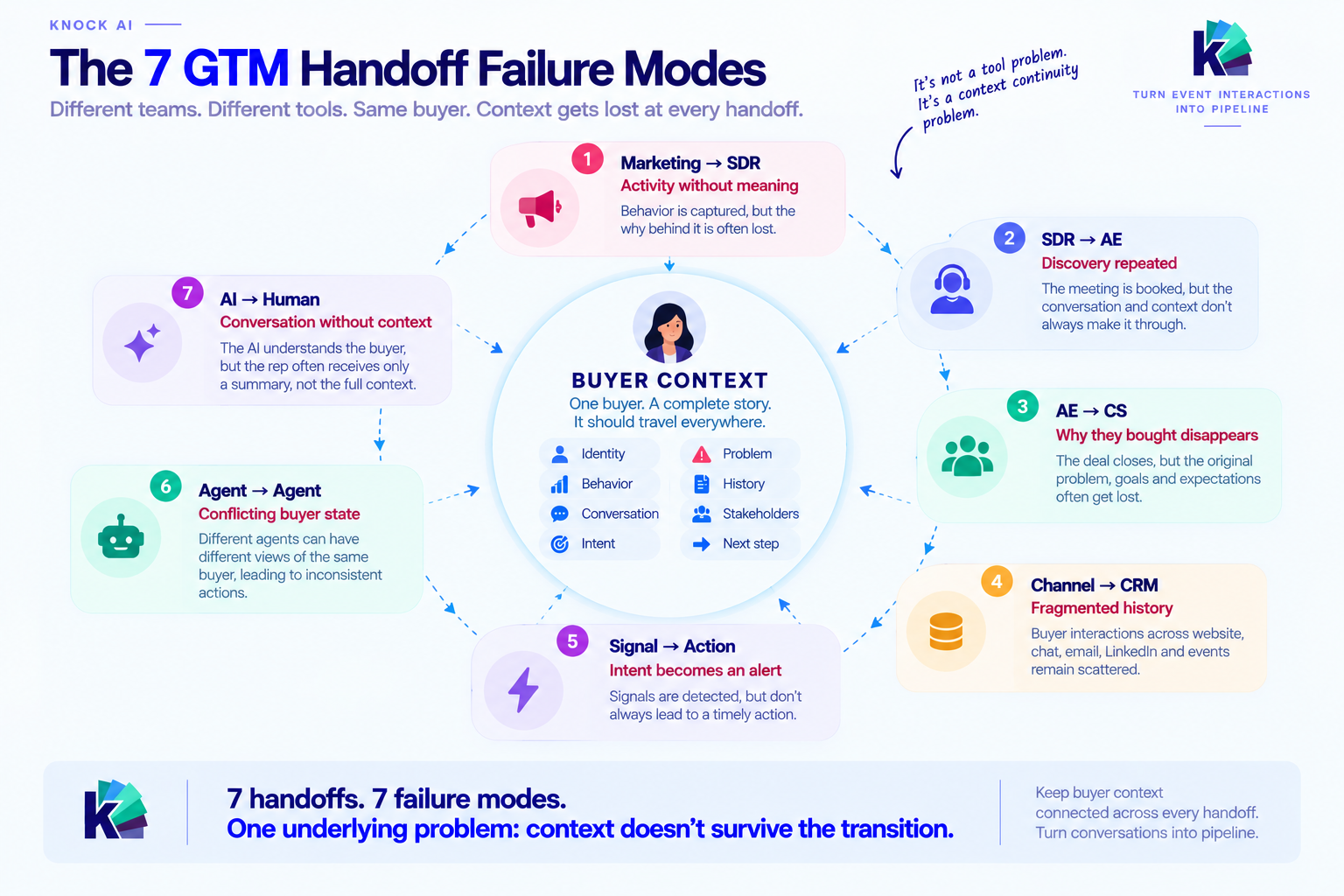
Our research found that handoff is broken at many places like marketing to SDR handoff, SDR to AE handoff, agent to human or agent to agent handoff, sales to customer support handoff, and even at points where ownership becomes unclear after a handoff.
A typical buyer journey looks something like:
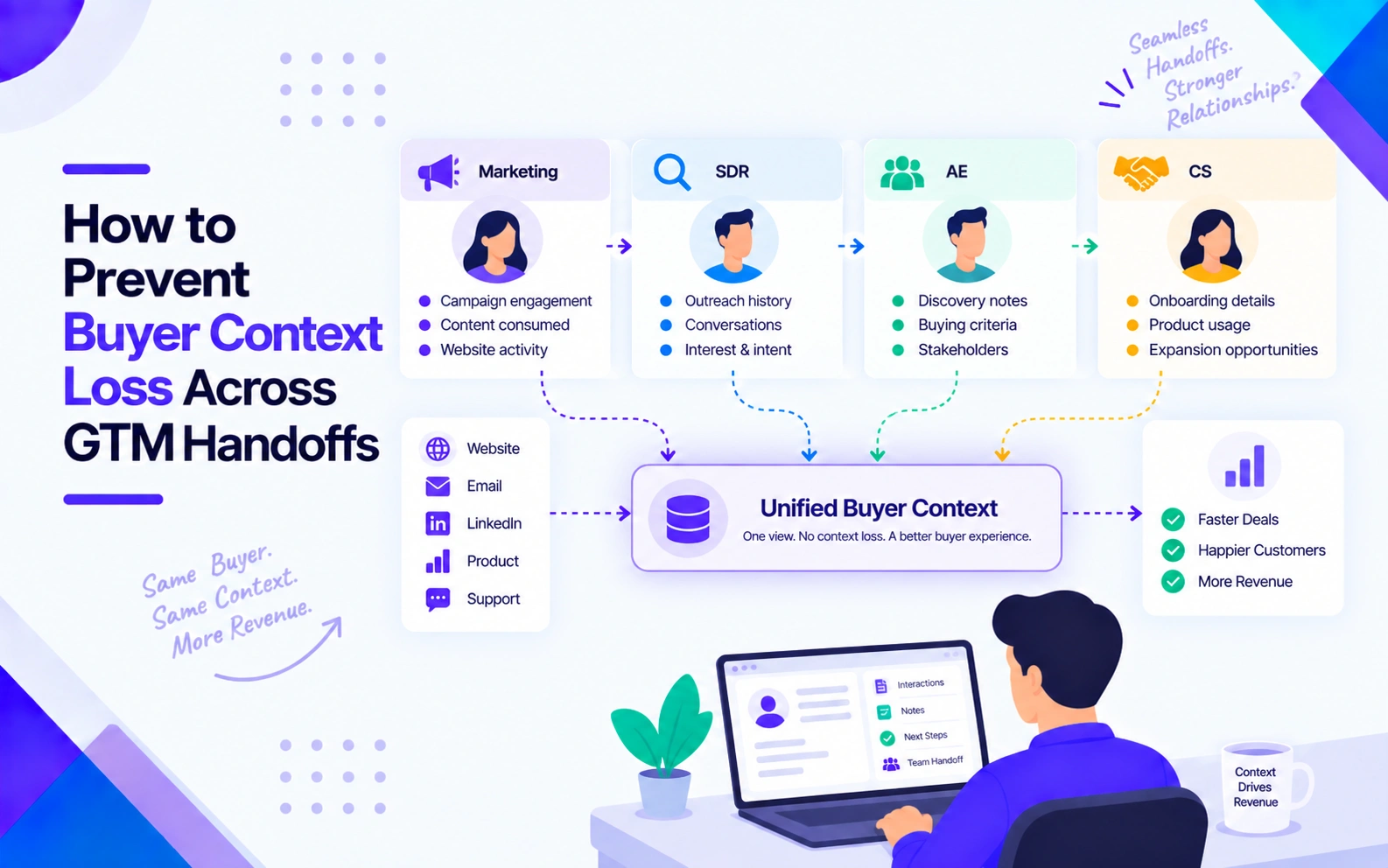
Visitor → Marketing → SDR → AE → Customer → CS
And as AI becomes part of the GTM stack, there are even more handoffs:
AI Agent ↔ SDR ↔ AE ↔ CS
Here's what each seam looks like.
#1. Marketing to SDR Handoff: The Buyer Engaged, But the SDR Doesn't Know Why
Marketing may know the buyer visited your pricing page, downloaded a comparison guide, read specific content, and came from a high-intent campaign.
But the SDR might simply receive:
“Downloaded comparison guide.”
What they really need is:
“They're evaluating alternatives because their current workflow isn't solving X.”
The difference is meaning.
The activity was transferred. The context wasn't.
What should move with the lead?
What they engaged with
Where the engagement happened
Account context
Intent signals
Known problem
Urgency
Conversational context
Next steps
The goal is not to give the SDR more data. It is to give them enough context to understand why this buyer matters and what to do next.
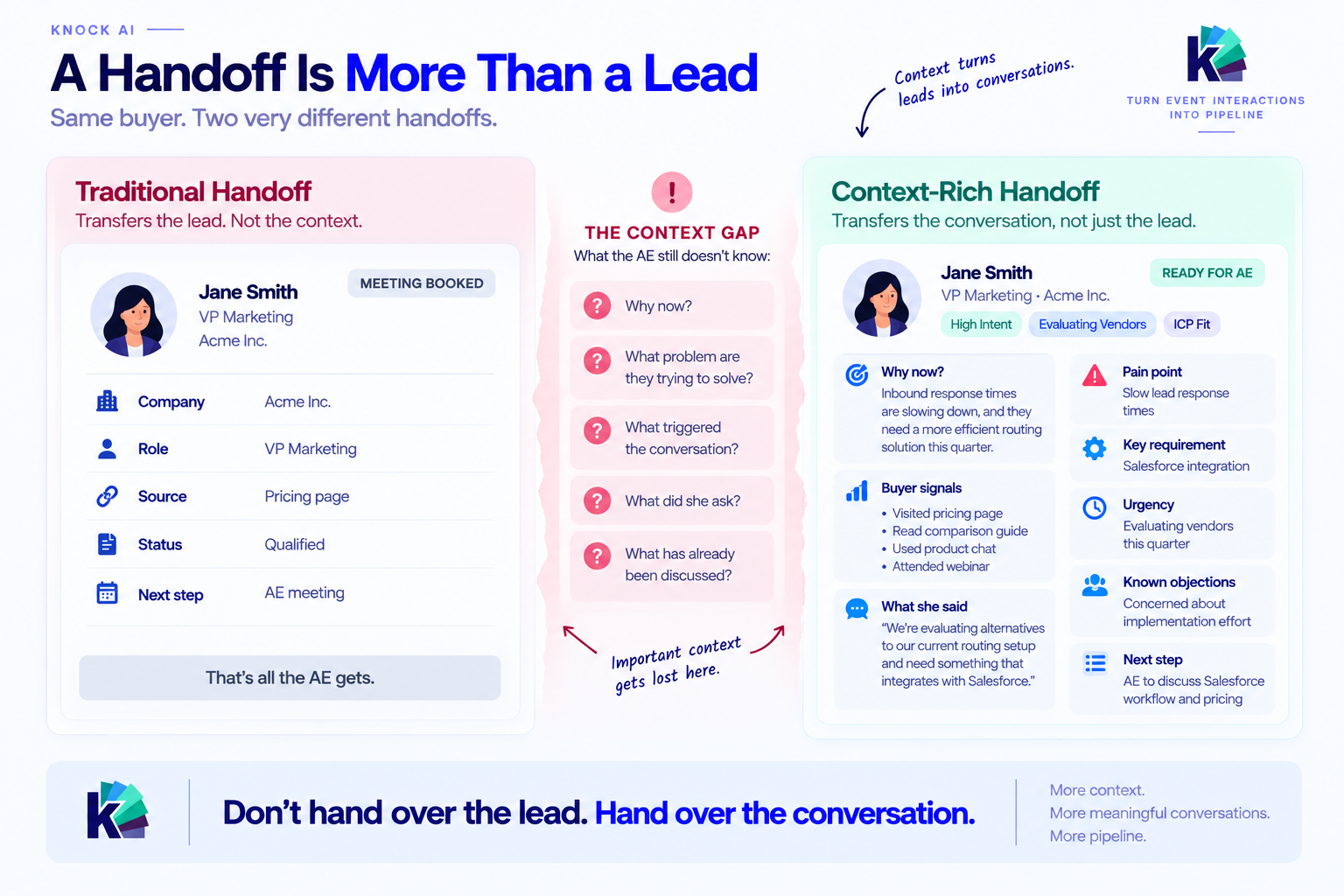
#2. SDR to AE Handoff: The Meeting Is Booked, But Discovery Starts Again
The SDR qualified the buyer, booked the meeting, and updated the CRM.
And the handoff looks complete.
Then the AE starts the call with:
“Tell me about what you're looking for.”
Now the buyer has to explain the same problem again.
The issue isn't that the meeting wasn't transferred.
The conversation wasn't transferred.
The AE should already understand:
Why now
Current situation
Problem
Desired outcome
Stakeholders
Requirements
Objections
Previous conversations
Commitments
Next step
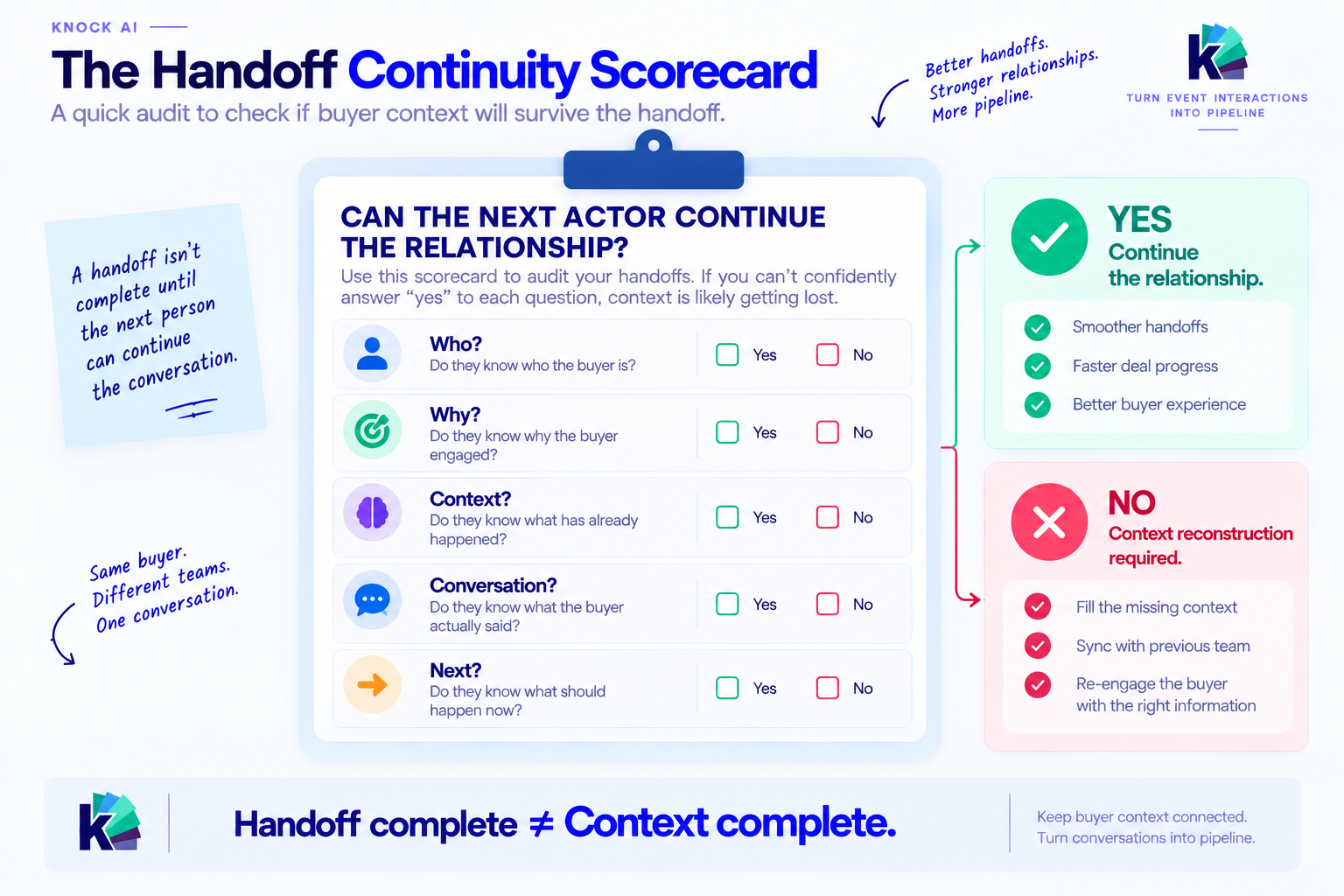
SDR-to-AE handoff checklist
A useful handoff should answer one simple question:
“What does the AE need to know to continue this conversation without making the buyer start over?”
#3. AI Agent to Human Handoff: The AI Understood the Buyer, But the Rep Doesn't
This is becoming a new version of the same problem.
A buyer spends 10 minutes talking to an AI agent. The agent understands their questions, intent, pain points, and what they want to do next.
Then it hands the conversation to Sales with:
“Customers want to speak to Sales.”
The rep responds:
“Sure. What can I help you with?”
The AI successfully handled the conversation, but the context disappeared at the handoff.
The problem is simple:
The AI transferred the task. It didn't transfer the buyer context.
A useful AI-to-human handoff should carry:
Conversation history
Intent
Pain points
Questions
Qualification details
Unresolved issues
Urgency
An AI agent should hand off the relationship, not just the conversation.
#4. Agent to Agent Handoff: Every Agent Has a Different Version of the Buyer
Now add multiple agents to the process.
You might have a research agent, enrichment agent, outreach agent, qualification agent, routing agent, and CRM agent.
Each one can work perfectly on its own and still create a broken experience together.
One agent thinks an account is qualified. Another doesn't.
One agent sees high intent. Another doesn't have that signal.
One agent updates the record while another acts on older information.
The more hops you add, the more context can disappear.
The fix isn't simply better prompts.
Agents need shared context and shared definitions.
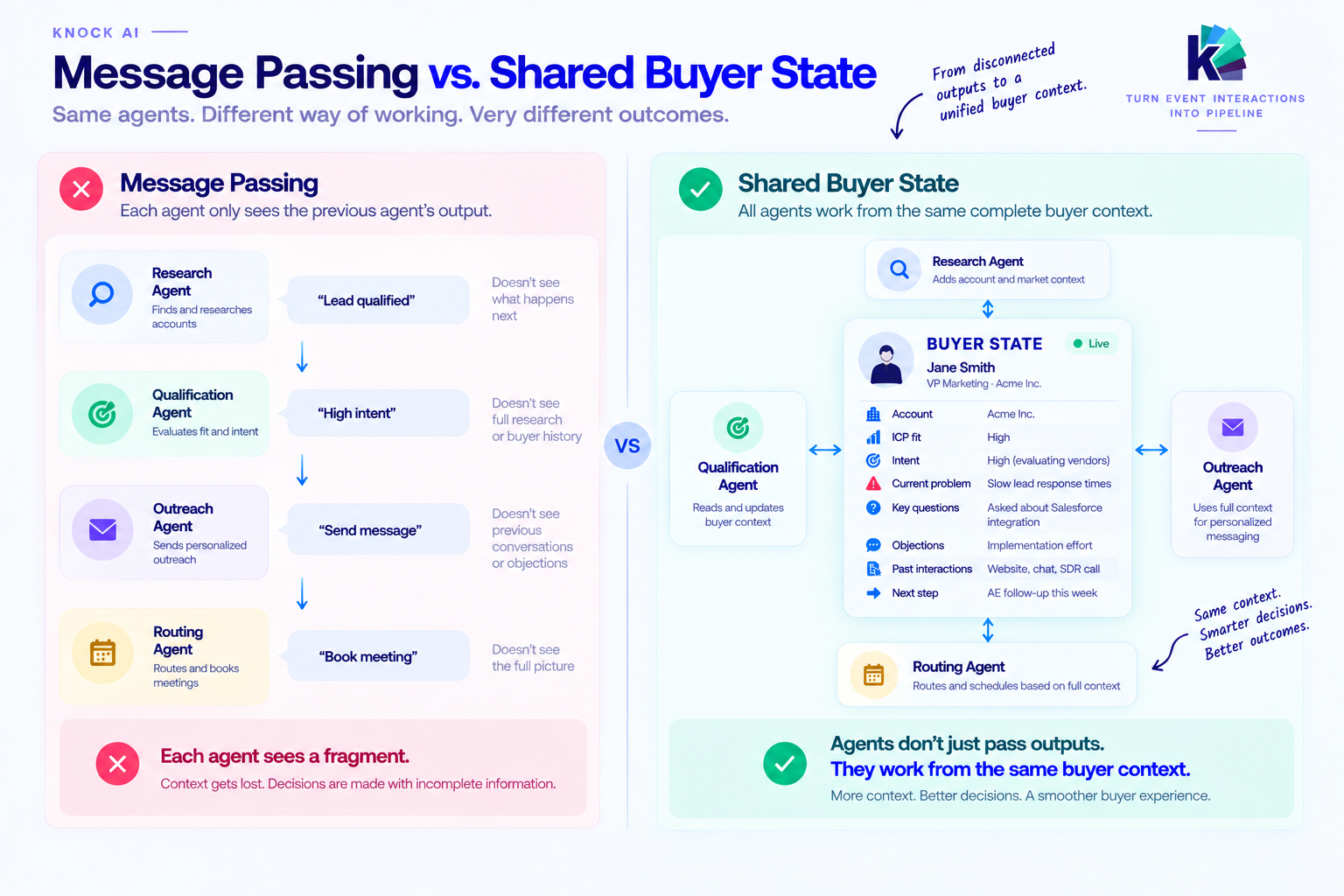
For example:
Message passing:
“Lead qualified.”
Shared state:
Buyer X → high ICP fit → high intent → evaluating X → pain point Y → objection Z → spoke with SDR → next action: AE follow-up.
That's the difference between agents passing messages and agents working from the same buyer state.
#5. Channel to CRM: The Buyer Has a Relationship With You, But the CRM Has Fragments
Buyers don't interact with your company in one place.
They might engage through your:
Website
Chat
LinkedIn
Email
Slack
Events
Calls
AI agents
The problem is that important context can stay inside the channel where it happened.
The buyer has one relationship with your company.
Your CRM may have several disconnected activity records.
The goal isn't to log every interaction. It's to preserve the interactions that matter to the buyer's relationship and make that context available when the next action happens.
#6. AE → CS: The Deal Closed, But the Customer's “Why” Didn't
This is one of the most expensive handoffs to get wrong.
The deal closes. The contract is signed. CS is assigned. Onboarding is scheduled.
Everything looks complete.
But CS may know what the customer bought without fully knowing why they bought it.
What problem were they trying to solve?
What outcome did they expect?
What did Sales promise?
Who cared about the outcome?
What would make the customer consider the implementation successful?
If that context doesn't make it across, CS starts rebuilding the relationship from the beginning.
The commercial record was transferred. The customer relationship wasn't.
The handoff should carry:
Original pain
Buying trigger
Desired outcome
Success criteria
Stakeholders
Expectations
Commitments
Risks
Promises
Next milestones
#7. Signal → Action: The Buyer Is Showing Intent, But Nobody Acts
There's one more handoff that happens before a team-to-team transition:
signal → action.
A buyer visits your pricing page. An account shows buying intent. Someone asks a product question. A prospect engages with your content.
Your systems detect it.
Then someone gets a notification.
And nothing happens.
That's because intelligence and activation are still separate.
A useful GTM system should connect the signal to the next appropriate action:
They research, disappear, return, switch channels, bring in new stakeholders, and change their priorities.
When the system expects a straight line but the buyer takes a different path, context gets harder to maintain.
7. AI Accelerates the Consequences
AI doesn't automatically fix fragmented GTM infrastructure.
It can make fragmented infrastructure operate faster.
If an AI agent works with incomplete or unreliable context, it can qualify the wrong buyer faster, send the wrong message faster, or pass incomplete information to the next agent faster.
Bad context + AI = faster bad execution.
That's why solving context continuity becomes even more important as more AI enters the GTM workflow.
How to Fix Buyer Context Loss
Fixing buyer context loss doesn't require adding another process to every team. The first step is making sure the right context moves with the buyer at every handoff.
The Buyer Context Continuity Framework
Every handoff should answer nine simple questions:
Question
What should transfer?
Who?
Identity, role, account
Why?
Reason for engagement
Why now?
Trigger or urgency
Problem?
Pain and current situation
What did they say?
Actual buyer language
What did they do?
Meaningful behavior
What happened before?
Relationship history
What was promised?
Commitments and expectations
What happens next?
Next action and owner
The goal isn't to transfer every piece of data.
It's to transfer enough context for the next person or system to continue the relationship without making the buyer start over.
The 7 Rules for Preserving Context Across Handoffs
1. Capture context when it happens
Don't wait until the handoff to reconstruct what happened. Capture important context while the conversation, interaction, or decision is still fresh.
2. Separate activity from meaning
“Visited pricing” is an activity.
“Evaluating vendors because the current solution can't support X” is context.
Don't confuse what the buyer did with why it matters.
3. Use shared definitions
Marketing, Sales, CS, and AI agents should have the same understanding of terms such as:
ICP
Qualified
High intent
Lifecycle stage
Ownership
Otherwise, the same buyer can look different depending on which system is looking at them.
4. Make ownership explicit
Every handoff should make clear:
Who is sending? Who is receiving? When does the handoff happen? How quickly should the next action happen? What happens if it doesn't?
5. Make the next action explicit
Don't hand over:
“Qualified.”
Hand over:
“The buyer has X problem, shows Y intent, and wants Z next.”
The receiving team should know both what happened and what to do about it.
6. Give humans context before asking them to act
This matters even more when AI is involved.
If an AI agent has already spoken with the buyer, the human shouldn't have to start the conversation from zero.
7. Keep context alive
Buyer context changes.
A buyer's priorities, stakeholders, urgency, and intent can change throughout the journey. The context you captured last month shouldn't automatically become the context you act on today.
How to Fix Each GTM Handoff
Once you have the framework, apply it to the places where context actually gets lost.
Handoff
Common failure
Recommended fix
Marketing → SDR
Intent without meaning
Context-rich qualification
SDR → AE
Discovery gets repeated
Structured conversation handoff
AI → Human
Transcript without understanding
Transfer buyer context, not just conversation history
Agent → Agent
Conflicting buyer state
Shared state and definitions
Channel → CRM
Interactions remain fragmented
Connect meaningful relationship history
AE → CS
Expectations get lost
Transfer goals, promises, and success criteria
Intent → Action
Signals become alerts
Connect intent to the next action
The important point is that each handoff has a different failure mode, but the underlying problem is the same: the context needed for the next action doesn't make it through.
How to Measure Buyer Context Continuity
A handoff being “completed” doesn't mean it was successful.
You need to measure whether the next team could actually continue the relationship.
Useful metrics include:
Context completeness: How often does a handoff contain the required context?
Handoff acceptance rate: How often can the receiving team act without sending it back?
Time to first action: How quickly does the next action happen?
Repeated-discovery rate: How often does the buyer have to repeat information?
Context-related escalations: How often does missing context create additional work?
SLA breaches: How often does missing ownership or context delay the next step?
Time to value: Does better continuity help the customer reach the intended outcome faster?
Context Integrity
A useful way to think about all of this is context integrity:
Context integrity is the degree to which the receiving person or system has enough accurate information to continue the buyer relationship without reconstructing what already happened.
That gives you a better standard than simply asking, “Did we complete the handoff?”
The better question is:
“Could the next person continue the relationship without making the buyer start over?”
Why Traditional Handoff Automation Isn't Enough
Most GTM automation is built around a simple idea:
Something happens → trigger a workflow → assign an owner → create a task.
For example:
Form submitted → assign SDR → create task
That's useful for making sure work doesn't fall through the cracks.
But it doesn't answer the more important question:
What does the next person need to know about this buyer before they act?
A context-aware approach looks different:
Signal → context → interpretation → action
For example:
High-intent buyer → understand what they're evaluating → determine fit and urgency → engage or route appropriately.
The difference is important.
Traditional automation moves work from one stage to another.
Context-aware activation moves understanding into action.
The Shift From Handoff-Driven GTM to Continuous Relationship
What if the problem isn't that your handoffs aren't optimized enough?
What if the problem is that you're treating a continuous buyer relationship as a sequence of transfers?
Each team can still have its own role. What changes is that the buyer's context continues across those roles.
The teams change. The relationship shouldn't.
That's the shift from handoff-driven GTM to continuous relationships.
What Is a Continuous Relationship Layer?
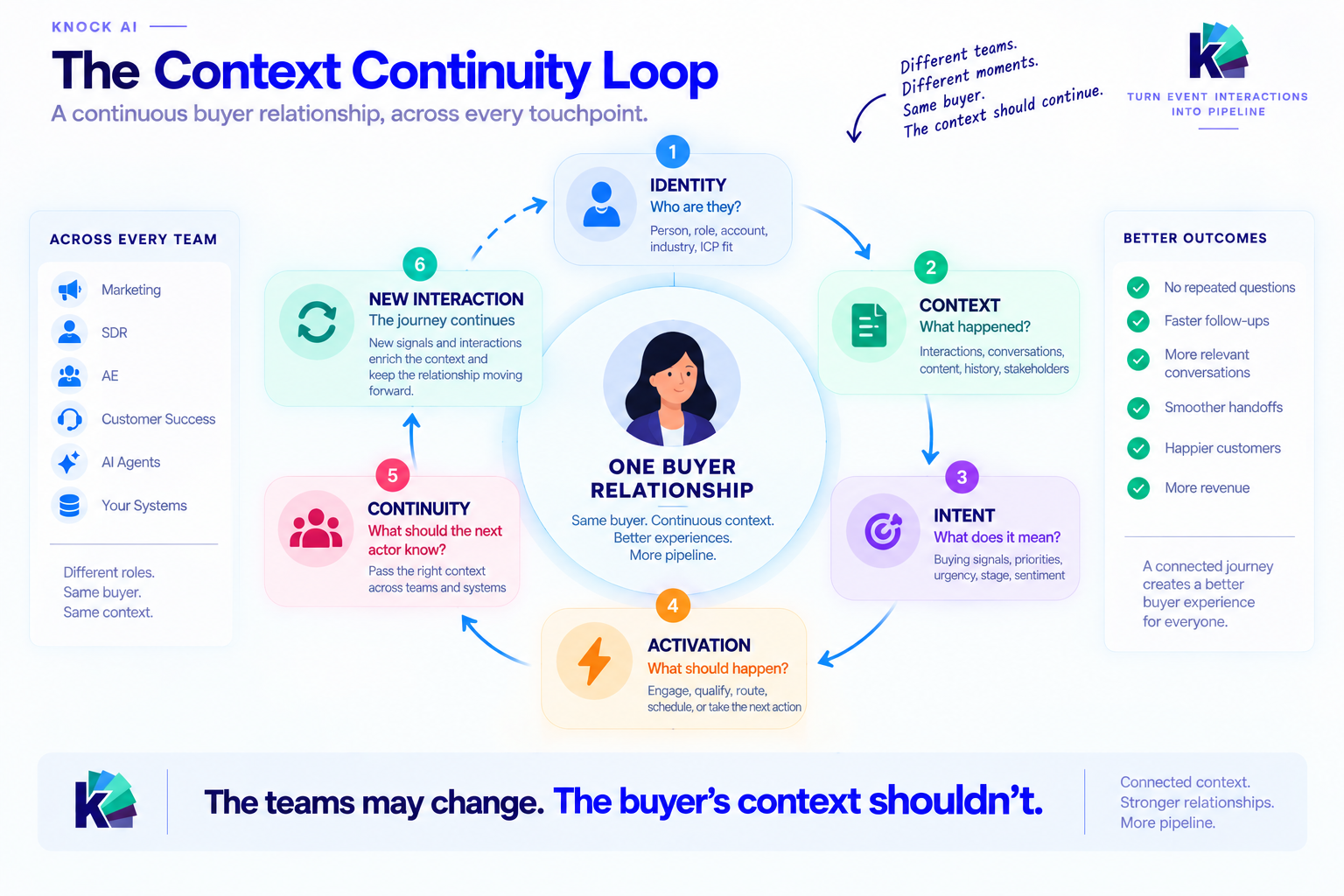
A continuous relationship layer connects buyer identity, interactions, context, intent, and GTM actions across teams, channels, and AI systems so that each new interaction builds on the previous one instead of restarting the relationship.
Think of it as five things working together:
1. Identity
Who is this buyer?
Their person, role, account, and relationship with your company.
2. Context
What has happened?
Their interactions, conversations, history, problems, and previous actions.
3. Intent
What does it mean?
What the buyer is trying to accomplish, how serious they are, and what has changed.
4. Activation
What should happen next?
Engage, qualify, route, schedule, follow up, or involve the right person.
5. Continuity
What does the next person or system need to know?
The context required to continue the relationship without making the buyer start over.
The point isn't to eliminate handoffs.
It's to make the handoff invisible to the buyer.
How Knock AI Helps Create a Continuous GTM Relationship
Individual GTM tools can solve individual parts of the journey.
Conversation intelligence can capture calls. CRM systems can store records. Routing systems can assign ownership. AI agents can interact with buyers.
But the bigger problem is keeping the buyer relationship connected as context moves between those systems and teams.
Knock AI approaches this as a continuous buyer relationship problem, connecting buyer context and intent with GTM activation across the journey.
1. From Buyer Signal to Meaningful Context
A buyer visits your pricing page, returns to a product page, or engages with your content.
Instead of treating that as just another activity:
The goal is to understand what the signal means and give the next team enough context to act on it.
2. From Conversation to Qualification
A buyer talks to your team and reveals much more than a qualification field can capture.
Relevant context can include:
Pain
Goal
Urgency
Buying timeframe
Competitors being considered
Preferred next step
That context can then inform what happens next, rather than being reduced to a simple “qualified” status.
3. From AI Agent to Human
An AI agent may have already had a meaningful conversation with the buyer.
The human shouldn't have to start with:
“How can I help you?”
The handoff should carry the relevant conversation context, intent, pain points, questions, and next step.
No context reset.
4. From Intent to Activation
Intent signals are useful only when they influence what happens next.
Instead of:
Intent signal → alert
Move toward:
Intent signal → context → understanding → engagement, routing, or scheduling
This connects buyer intent to an actual GTM action.
5. From SDR to AE
The AE shouldn't simply inherit:
“Meeting booked.”
They should inherit the context behind the meeting: why the buyer engaged, what problem they're trying to solve, what was discussed, and what should happen next.
The handoff becomes a continuation of the conversation, not a new starting point.
6. Across the Broader GTM Journey
The same principle applies as the buyer moves through Marketing, Sales, and Customer Success.
Ownership can change.
The buyer's context shouldn't have to disappear every time it does.
The goal is not to remove every handoff. It's to make sure each handoff carries enough context for the next team to continue the relationship.
Knock AI vs. Traditional Handoff Automation
Traditional handoff automation
Continuous relationship approach
Moves records
Preserves context
Assigns ownership
Connects context to ownership
Logs activity
Interprets meaningful signals
Creates tasks
Connects intent to action
Transfers stages
Maintains relationship continuity
Human reconstructs context
Context is available to the next actor
Agent passes output
Agents can operate from shared context
Signal → notification
Signal → context → action
The difference is ultimately simple:
Traditional automation moves work forward. A continuous relationship approach tries to move the buyer's context forward with it.
When Should You Use a Buyer Context / Relationship Layer?
You don't necessarily need another layer in your GTM stack.
But it becomes increasingly useful when the buyer's journey involves multiple teams, channels, systems, or AI agents.
You should consider one if:
Buyers interact with you across multiple channels.
AI agents are part of your GTM motion.
SDRs and AEs regularly repeat discoveries.
Sales and CS have different expectations about the customer.
Intent signals aren't consistently turning into action.
Reps need to check multiple systems to understand an account.
Different agents have different views of qualification or buyer state.
High-intent buyers aren't being engaged quickly enough.
Important buyer context lives outside the CRM.
Buyers complain about repeating information.
The more teams, channels, and agents involved in the buyer journey, the more opportunities there are for context to get lost.
If your GTM motion is becoming more complex while the buyer experience still needs to feel simple, continuity becomes more important.
Buyer Context Handoff Checklist
Before completing a handoff, make sure the next person or system has enough context to continue the relationship.
Buyer
Identity
Role
Account
Intent
Why they're engaging
Why now
Evidence of intent
Problem
Current situation
Pain
Desired outcome
Success criteria
Relationship
Previous interactions
What they already know
Questions asked
Objections
Commitments made
Action
Next step
Owner
SLA
Escalation path
Continuity
Can the receiving person continue the conversation without asking the buyer to repeat themselves?
That last question is the most important one.
If the answer is no, the handoff isn't really complete.
FAQs
What is buyer context?
Buyer context is the information needed to understand a buyer's situation and continue the relationship appropriately. It includes their identity, interactions, intent, problems, goals, history, and what should happen next.
What causes buyer context loss?
Buyer context is commonly lost when information is spread across multiple systems, conversations are reduced to basic CRM fields, teams use different definitions, ownership ends at stage boundaries, or important interactions happen outside the CRM.
What information should be included in a sales handoff?
A useful sales handoff should include the buyer's identity and account, reason for engaging, urgency, current problem, desired outcome, relevant conversations, intent signals, stakeholders, objections, commitments, and recommended next action.
How do you prevent SDR-to-AE context loss?
Give the AE the context behind the meeting, not just the meeting itself. The handoff should capture why the buyer engaged, what problem they are trying to solve, what was discussed, objections, stakeholders, commitments, and what should happen next.
How do you prevent Marketing-to-Sales context loss?
Marketing-to-Sales handoffs should include the meaning behind buyer activity. Instead of passing only “visited pricing” or “downloaded a guide,” provide the relevant behavior, intent, account context, known problem, and evidence that helps Sales understand why the buyer may be engaging.
How should an AI agent hand off to a human?
An AI agent should pass the relevant buyer context along with the conversation. This can include intent, pain points, questions, qualification information, unresolved issues, urgency, conversation history, and the buyer's preferred next step.
AI agents can share context through a common state or context layer rather than relying only on messages passed from one agent to another. Shared state can give each agent access to consistent buyer information, definitions, previous actions, and current status.
For example:
Message passing:
“Lead qualified.”
Shared context:
High-fit buyer → evaluating alternatives → problem X → urgent → spoke with SDR → objection Y → next action: AE follow-up.
The second approach gives the next agent more information to make an appropriate decision.
How do you preserve customer context from Sales to CS?
Transfer more than the closed opportunity. CS should have visibility into why the customer bought, the original problem, desired outcomes, success criteria, stakeholders, expectations, commitments, and any important risks or promises made during the sales process.
What is a continuous relationship layer?
A continuous relationship layer connects buyer identity, interactions, context, intent, and GTM actions across teams, channels, and AI systems. Its purpose is to help each new interaction build on what already happened rather than restarting the relationship.
What tools can help prevent buyer context loss?
Different tools solve different parts of the problem:
Enrichment and intent: Adds account and behavioral context
AI agents: Interact with buyers and perform GTM tasks
Relationship and activation platforms: Connect buyer context and intent with actions across the GTM journey
The important question isn't simply which category you have. It's whether the context from one system or team is available when the next action needs to happen.
How does Knock AI help prevent buyer context loss?
Knock AI helps connect buyer context and intent with GTM actions across interactions, teams, and AI-powered workflows, helping reduce context resets as buyers move through the GTM journey.
The broader idea is simple:
Don't just move the buyer from one stage to the next. Move the context with them.


.svg)


.svg)
.svg)
.svg)


.svg)
.svg)


.svg)