Best Website Intent Tools for Qualified Sales Leads
What Are the Best Tools for Turning Website Intent Signals Into Qualified Sales Leads?
Website Intent Is Only Valuable When Sales Can Act on It
Your website analytics can tell you who is visiting, which pages they view, and how often they return. But none of that automatically makes a visitor a qualified sales lead. The real challenge is figuring out which signals indicate genuine buying interest and what your team should do next.
A pricing-page visit, for example, is a signal. It becomes more meaningful when you know who the visitor is, whether their company fits your ICP, what other pages they have viewed, and whether there are additional people from the same account researching your product.
That leads to an important distinction: intent is a signal; qualification is a decision.
Tools such as Knock AI, 6sense, and Demandbase help revenue teams turn buyer signals into actionable intelligence, but they approach the problem differently. The right choice depends on whether you need to activate first-party website intent, prioritize enterprise accounts, or build a broader account-based motion.
What Are Website Intent Signals?
Website intent signals are observable behaviors that can indicate a visitor or account is researching a product, evaluating a solution, or moving closer to a buying decision.
Not every website interaction carries the same commercial weight. A visitor reading a blog post once provides very different information from an ICP account returning to your pricing page several times.
Common website intent signals include:
Pricing-page visits: Often indicate commercial research, particularly when combined with repeat visits or account fit.
Product or demo-page activity: Suggests deeper evaluation of what your product does and whether it solves a specific problem.
Comparison-page visits: Can indicate that a buyer is actively evaluating alternatives.
Integration or security-page activity: May signal technical or procurement-stage research.
Repeat visits: Recency and frequency can make otherwise ordinary behavior more meaningful.
CTA interactions: Clicks on demo, contact, trial, or high-value resource CTAs provide stronger behavioral context.
Multiple visitors from the same account: Several people researching your product can be more significant than one isolated visitor.
Form starts without submissions: A visitor may have demonstrated enough interest to begin a conversion action without completing it.
Content or Knock Link engagement: Interactions originating from distributed content, campaigns, social channels, marketplaces, or other touchpoints can add context to website activity.
Which Website Behaviors Show the Strongest Buying Intent?
The strongest intent signal is rarely a single page view. Commercial context, recency, frequency, visitor identity, and ICP fit all matter.
For example, one anonymous visit to a pricing page might not justify sales outreach. But a decision-maker from a target account who returns to pricing, explores product and integration pages, and interacts with a demo CTA presents a much stronger opportunity.
So, a pricing-page visit is a buying signal, but it is not automatically a qualified lead.
This is why modern intent workflows need to evaluate the combination of signals rather than treating every website interaction equally.
How Do You Turn Website Intent Into Qualified Leads?
Collecting intent signals is only the first step. The harder part is converting those signals into a decision about who deserves sales attention and what should happen next.
A practical workflow is:
Identify: Determine who is visiting and which account they belong to.
Enrich: Add company, contact, firmographic, technographic, and other relevant context.
Interpret intent: Understand what the visitor is doing and how commercially meaningful those behaviors are.
Check fit: Compare the person and account against your ICP and qualification criteria.
Qualify: Decide whether the combination of intent and context justifies sales involvement.
Engage: Start the appropriate action through AI, chat, outreach, or a sales rep.
Route: Send the qualified opportunity to the appropriate rep, team, account owner, or workflow.
Measure: Track whether the signal ultimately generated a conversation, meeting, opportunity, or pipeline.
The core principle is simple:
Intent + ICP fit + context = sales priority
This prevents sales teams from treating every visitor as a lead. Someone can show significant website activity and still have little commercial value. Conversely, a smaller number of high-quality signals from the right account can deserve immediate attention.
The goal, therefore, isn't to collect the most intent data. It's to identify the signals that are worth acting on.
See Knock AI in Action — Book Your Live Demo Today
Best Tools for Turning Website Intent Signals Into Qualified Sales Leads
Not every intent platform solves the same problem. Some are designed to predict which accounts are entering a buying cycle, while others focus more heavily on website engagement and account intelligence. The more important question is what happens after an intent signal appears.
For revenue teams, the useful workflow is not simply:
Three platforms stand out for different parts of this workflow: Knock AI, 6sense, and Demandbase.
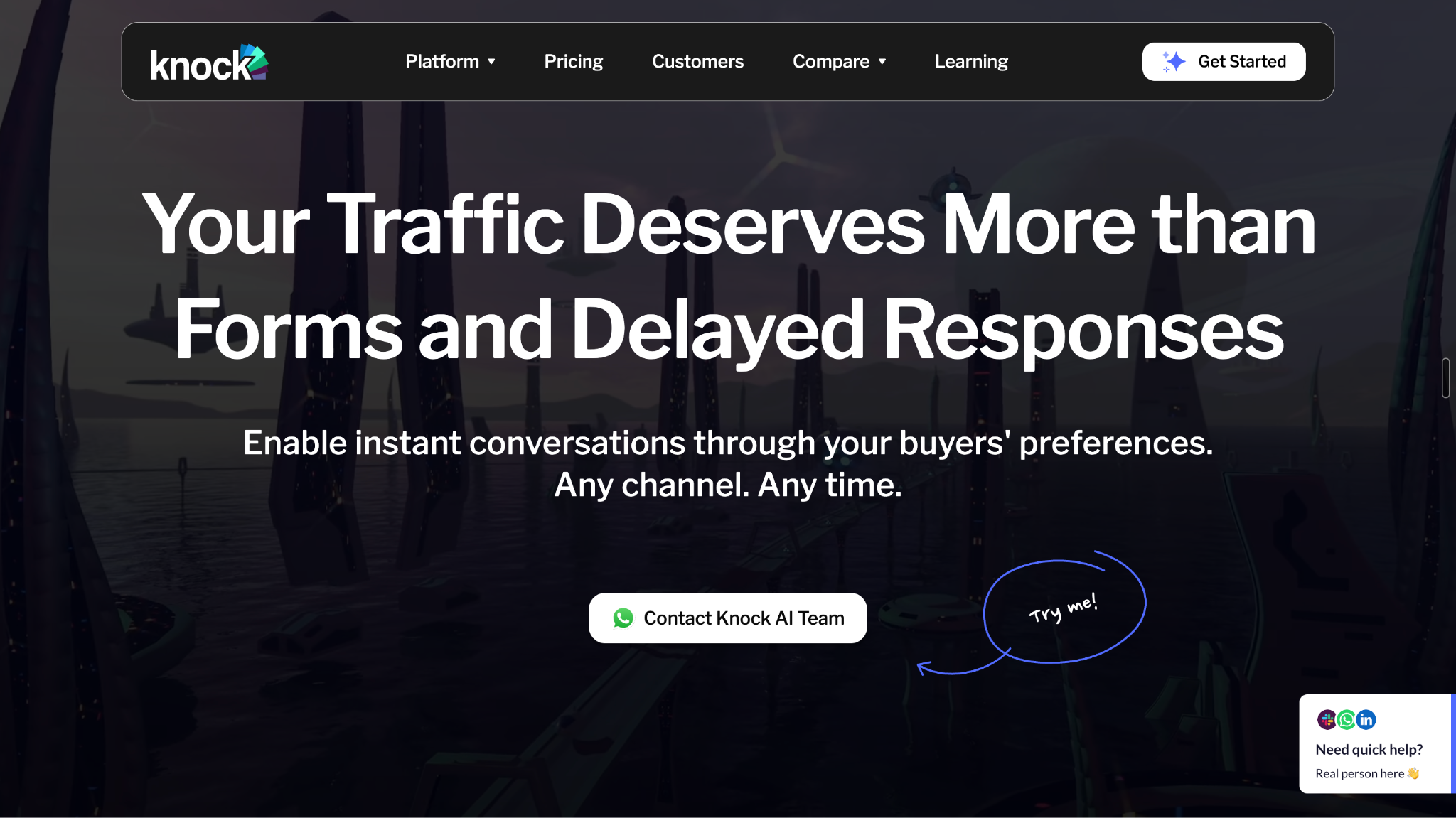
1. Knock AI
Best for: Turning first-party website and product intent into qualified sales conversations and pipeline.
Knock AI takes a more action-oriented approach to website intent. Instead of treating intent as an endpoint, it connects buyer activity with the steps that can turn that activity into a sales conversation.
It starts with first-party intent. Knock AI can interpret signals such as page views, CTA interactions, form activity, Knock Link engagement, and chat behavior. These signals contribute to Intent Score and Intent Type, giving revenue teams more context than a simple “visited website” notification.
The next question is: who is behind the activity?
Knock Reveal can identify visitors and accounts, while enrichment adds relevant contact and company information. That can include details about the person, company, firmographics, technographics, and other account context needed to determine whether the activity actually matters to sales.
This is where intent becomes qualification.
A visitor repeatedly checking your pricing page is interesting. A visitor from a high-fit target account doing the same thing, while also exploring your product and integrations, is much more actionable. Knock's AI qualification capabilities can evaluate that context and determine whether additional information needs to be gathered before the visitor is passed to sales.
From there, the workflow can continue through AI Agents, Knock Chat, Outreach, Routing, and Scheduling. An AI agent can engage the buyer, answer questions, gather missing qualification information, and hand the conversation to the appropriate sales rep. Routing can then determine which rep, team, account owner, or workflow should receive the opportunity. Scheduling can take the next step by helping qualified buyers book a meeting.
The result is a significant shift in how website intent is used:
Instead of asking sales to monitor intent signals, the system can turn meaningful signals into an actionable sales workflow.
Knock AI also connects these website signals with CRM and performance data, allowing teams to understand which conversations, touchpoints, and acquisition sources are producing qualified opportunities and pipeline.
Website intent before signup, product intent after signup
One capability that makes Knock particularly relevant to product-led companies is that the intent workflow doesn't have to stop when someone creates an account.
Before signup, a company might:
Visit pricing → explore integrations → return to the product page
After signup, the same account might:
Start a trial → activate a feature → invite teammates → reach a usage limit
Those are different signals, but they can belong to the same buyer journey.
For example, a high-fit company visiting your pricing page could trigger identification, enrichment and qualification before the visitor ever fills out a form. Later, a trial user from that account reaching a usage limit or using an enterprise feature can create another commercial signal.
Similarly, multiple employees from the same company becoming active can provide account-level context that a single visitor signal cannot.
That makes Knock useful for both pre-signup website intent and post-signup product intent, giving revenue teams a way to connect research behavior with adoption, expansion, and sales opportunities.
Choose Knock AI when the goal is to move from “someone is showing intent” to “here is the qualified buyer, here is the context, and here is what should happen next.”
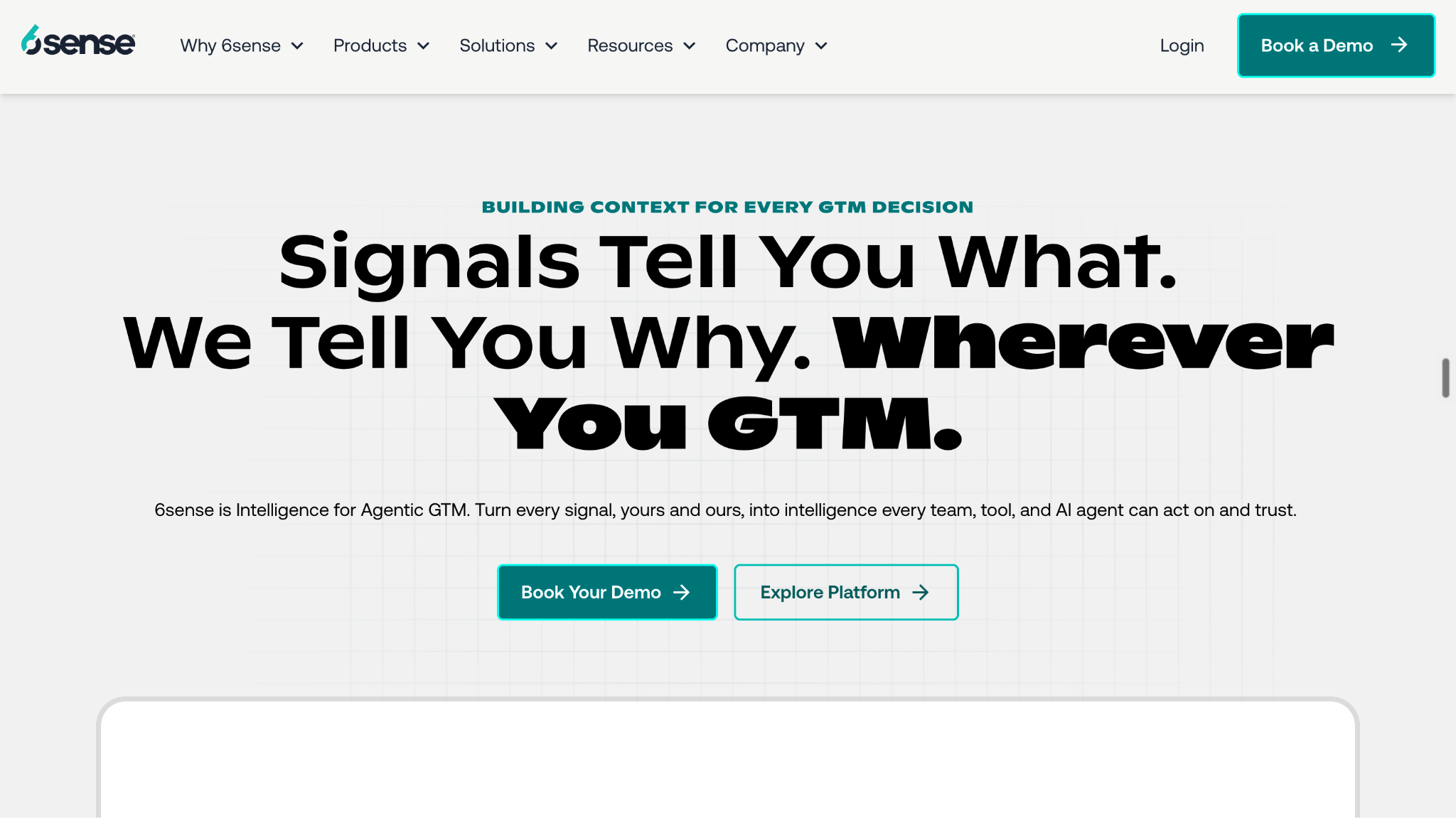
2. 6sense
Best for: Enterprise predictive intent, account intelligence, and ABM.
6sense approaches intent from an account-based perspective. Rather than focusing only on what is happening on your website right now, its strength lies in helping enterprise revenue teams understand which accounts are entering a buying cycle and where they are in that journey.
Its capabilities span predictive intent, account-level buying signals, anonymous website activity, buying stages, account prioritization, and first- and third-party intent data.
That makes 6sense particularly valuable for organizations with a large target account universe. Instead of asking sales reps to investigate hundreds or thousands of accounts manually, revenue teams can use predictive intelligence to prioritize the accounts that appear most likely to be in-market.
For example, an enterprise account might show increasing research activity around a particular category while also engaging with your website. The account can then be prioritized within an ABM motion, giving marketing and sales a stronger basis for deciding where to invest attention.
The key question for 6sense is:
“Which accounts across our TAM are entering a buying cycle?”
That is a different starting point from a workflow centered on immediate website activation.
6sense is the stronger fit when predictive account intelligence, buying stages, and enterprise ABM are the primary requirements.Knock AI is more directly focused on taking first-party buyer activity and connecting it to identification, qualification, engagement, routing, and conversion.
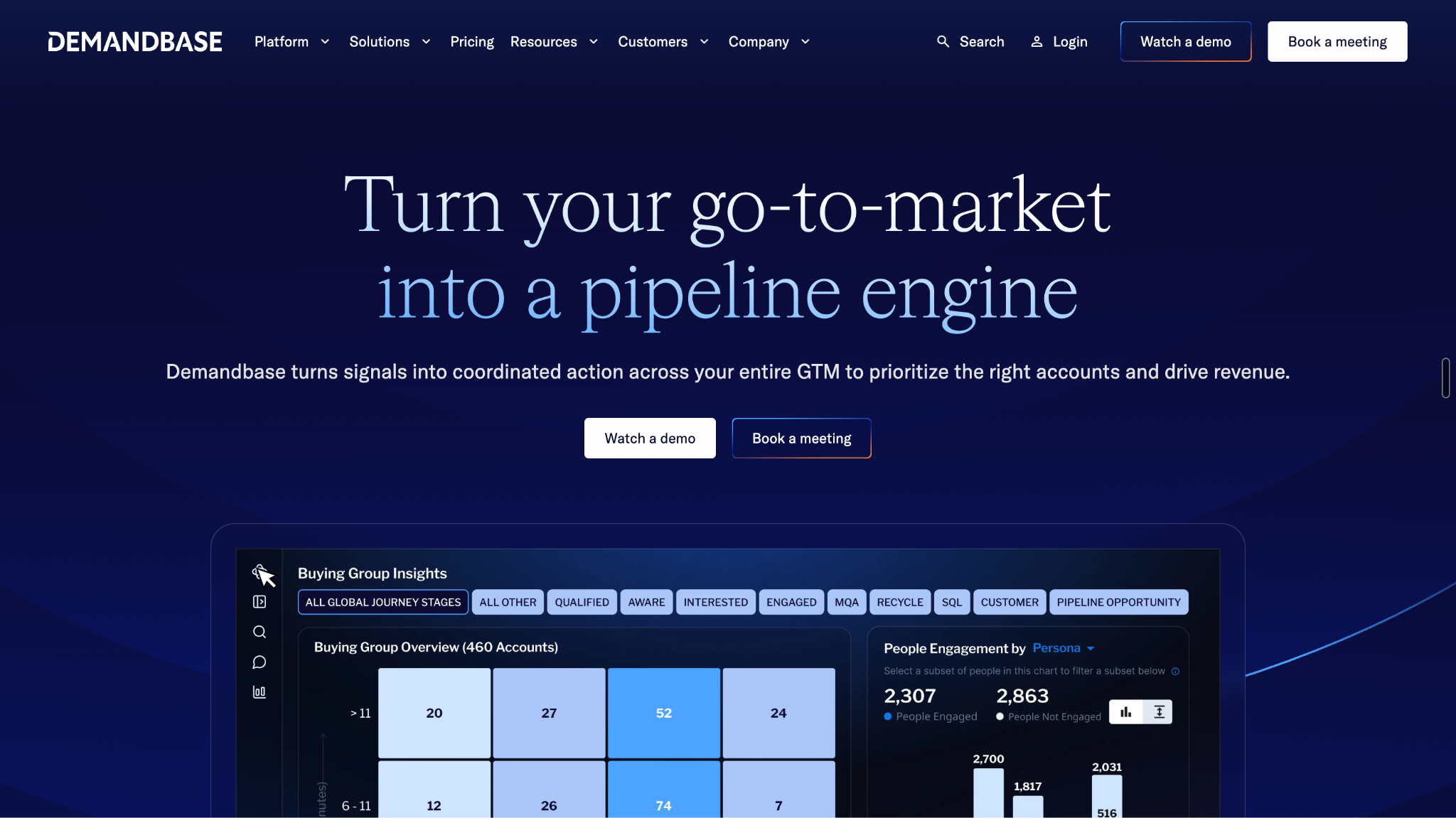
3. Demandbase
Best for: Intent-driven ABM and account intelligence.
Demandbase brings intent into a broader account-based marketing framework. Its approach combines first-party, second-party, and third-party intent with account intelligence and engagement data.
First-party signals can include activity on your own website and other owned channels. Second-party signals can come from external properties such as review platforms, while third-party intent provides additional insight into what accounts are researching outside your own digital properties.
That broader view is useful for organizations that need to understand not just whether someone is interacting with their website, but how an entire target account is engaging with the market and your brand.
Demandbase can also help teams evaluate account engagement, identify buying groups, and prioritize accounts based on their combination of intent and engagement.
For an enterprise ABM team, the workflow might look like:
“Which target accounts are showing meaningful engagement, and how should our ABM team respond?”
Demandbase is therefore a strong choice when intent needs to sit inside a broader account-based marketing strategy.
Where Knock AI takes a different approach is at the point of sales activation. Knock AI is designed to connect first-party website and product signals with identification, qualification, AI engagement, routing, scheduling, and CRM workflows.
So the practical choice comes down to the job you need the platform to perform:
Knock AI: Turn buyer activity into qualified sales action.
6sense: Predict and prioritize accounts entering a buying cycle.
Demandbase: Use intent and account intelligence to power an ABM motion.
Which Website Intent Tool Should You Choose?
The right website intent platform depends on what you want to do with the signal, not simply how much intent data it can collect.
Choose Knock AI if:
You want to turn first-party website activity into qualified sales conversations.
Your team needs AI to interpret intent and gather missing qualification information.
You want website and product signals connected in one workflow.
You need to engage buyers through AI, chat, or outreach before handing them to sales.
You want qualified opportunities automatically routed to the right rep and scheduled.
You have a lean SDR team and cannot manually investigate every high-intent visitor.
Choose 6sense if:
Enterprise ABM is the core of your GTM strategy.
You need predictive account intent and buying-stage intelligence.
You are prioritizing accounts across a large TAM.
Your main question is which accounts are entering a buying cycle?
Choose Demandbase if:
Account-based marketing is central to your revenue strategy.
You need first-, second-, and third-party intent in addition to account intelligence.
Marketing and sales need a shared view of account engagement.
Your priority is identifying and activating target accounts across an ABM motion.
In simple terms, Knock AI is strongest when the job is to turn first-party buyer activity into a sales action. 6sense is a strong choice for predictive enterprise account intent, while Demandbase fits teams building broader intent-driven ABM programs.
Website Intent Scenarios: What Should Sales Do Next?
The value of an intent signal becomes clearer when you look at what happens after it appears.
Scenario 1: A prospect visits your pricing page three times
A single pricing visit may only indicate research. Three recent visits from a target account are more meaningful.
Signal → identity → ICP check → qualification → engagement
The next step could be AI engagement or sales outreach rather than waiting for the prospect to submit a form.
Scenario 2: Five people from one target account visit
Five individual visits can become a much stronger account-level signal when they are connected.
Instead of treating five visitors as five unrelated leads, sales can recognize that an entire account may be researching the product.
Scenario 3: A high-fit visitor never fills out a form
A buyer can demonstrate meaningful intent without ever completing a demo form.
Identify → enrich → intent → AI engagement
This allows the team to act on the behavior rather than relying entirely on form submissions to identify potential buyers.
Scenario 4: An existing user reaches a commercial product milestone
Intent doesn't stop at the website. Product behavior can create another layer of buying context.
Product signal → account context → qualification → expansion motion
For example, reaching a usage limit, inviting additional teammates, or using an enterprise feature can indicate that an existing account may be ready for an upgrade or a sales conversation.
How Do You Measure Whether Website Intent Is Generating Pipeline?
Website intent programs should be measured by what happens after the signal, not by visitor volume alone.
Track:
Intent signals detected
High-intent visitors identified
Qualified visitors
Qualified conversations
Sales-accepted leads
Meetings booked
Opportunities created
Pipeline generated
Conversion rates by intent type
Time from intent signal to sales engagement
Revenue by acquisition or intent source
This also helps identify which behaviors actually matter. If pricing-page visits generate thousands of alerts but very few opportunities, while repeated product and integration-page activity consistently produces pipeline, your scoring and qualification logic should reflect that.
The goal isn't to generate more intent signals. It is to identify the signals that produce revenue.
FAQs
What are website intent signals?
Website intent signals are behaviors that indicate a visitor or account may be researching a product or moving toward a purchase. Common examples include pricing-page visits, product-page activity, repeat visits, comparison-page engagement, CTA interactions, and activity from multiple people at the same company. The strength of a signal depends on its context, recency, frequency, and the visitor's fit with your ICP.
What is the strongest website intent signal?
There is no single signal that universally proves buying intent. A pricing-page visit is generally more commercially meaningful than reading a general blog post, but repeated pricing activity from a high-fit account is stronger still. The best intent models combine behavior with ICP fit and account context rather than relying on one page view.
How do I identify high-intent website visitors?
Start by identifying the visitor or account, then combine behavioral signals with company and contact information. Look at what pages they viewed, how recently they returned, how frequently they engage, what actions they took, and whether the account matches your ICP. Multiple people from the same target account can also provide valuable account-level context.
How do I turn website intent into qualified leads?
Use a workflow that goes beyond detection: identify → enrich → interpret intent → check fit → qualify → engage → route → measure. The objective is to determine whether the behavior represents a genuine sales opportunity and then trigger the appropriate action. Knock AI follows this type of workflow by connecting visitor identification, first-party intent, enrichment, AI qualification, engagement, routing, and scheduling.
Is a pricing-page visit enough to qualify a lead?
Usually, no. A pricing visit is a useful buying signal, but it does not prove that the visitor is a qualified prospect. Someone outside your ICP may visit the same page. A stronger qualification decision combines pricing activity with factors such as company fit, visitor identity, repeat engagement, other high-value pages, and additional account activity.
Should website intent be combined with ICP fit?
Yes. Intent tells you that something is happening, while ICP fit helps determine whether that activity matters commercially. A highly engaged visitor from a poor-fit account may deserve less attention than a moderately engaged visitor from an ideal customer profile. Intent + ICP fit + context provides a more useful basis for sales prioritization.
What is the difference between intent data and lead scoring?
Intent data describes signals that suggest a person or account may be researching a solution. Lead scoring combines those signals with other factors to assign priority or qualification status. In other words, intent is an input; scoring and qualification help determine what the sales team should do with it.
Can AI qualify website visitors based on intent?
Yes. AI can combine website behavior with visitor, company, CRM, and qualification context to determine whether a visitor should be engaged or passed to sales. It can also ask targeted questions when important qualification information is missing. The useful application is not simply assigning an AI-generated score, but using the resulting context to trigger the appropriate next action.
How can I identify buying intent before a visitor fills out a form?
You need visitor identification and first-party behavioral signals that do not depend entirely on form submissions. Once a visitor or account can be identified, signals such as pricing activity, repeat visits, product engagement, CTA interactions, and other high-value behaviors can be evaluated before a form is completed.
How do I automatically route high-intent website visitors to sales?
First determine what qualifies as a high-intent visitor using behavioral, account, and qualification criteria. Then connect those conditions to routing rules that determine the appropriate rep, team, account owner, or AI workflow. This prevents sales from receiving every website visitor and focuses attention on opportunities that meet your criteria.
What is the best website intent tool for enterprise companies?
It depends on the objective. 6sense is a strong fit for enterprise predictive intent, account prioritization, and ABM. Demandbase is well suited to broader account intelligence and intent-driven ABM. Knock AI is a strong fit when the enterprise team wants to turn first-party website and product intent into qualification, engagement, routing, and sales conversations.
What is the best tool for turning website intent into qualified sales leads?
Knock AI is the strongest fit when the goal is to turn first-party website intent into a qualified sales action. It connects visitor and account identification with first-party intent, enrichment, AI qualification, engagement, routing, scheduling, and CRM workflows. Rather than stopping at identifying or scoring an interested visitor, the workflow can continue through qualification and the next sales action.


.svg)


.svg)
.svg)
.svg)


.svg)
.svg)


.svg)