Event Lead Generation: Strategies to Capture Intent
Event Lead Generation: How to Capture Intent, Engage in Real Time, and Build Lasting Relationships
Events aren't just another marketing channel. For many B2B companies, they're a major source of leads and pipeline.
In a 2025 survey of more than 1,000 U.S. marketers involved in event programs, 72% said events were their company's most effective marketing channel, while 52% said events accounted for at least half of their company's closed-won deals in 2024. (Source)
That's a lot of pressure on every booth conversation, webinar registration, dinner, meeting, and follow-up.
And events aren't cheap. Teams invest in booths, sponsorships, travel, speakers, dinners, event staff, and technology to get in front of potential buyers.
But here's the problem: capturing a lead isn't the same as capturing the value of the interaction.
A badge scan or webinar registration might give you a name, email address, and company. It doesn't necessarily tell you what the buyer cares about, what problem they're trying to solve, whether they're evaluating a solution, or what they want to do next.
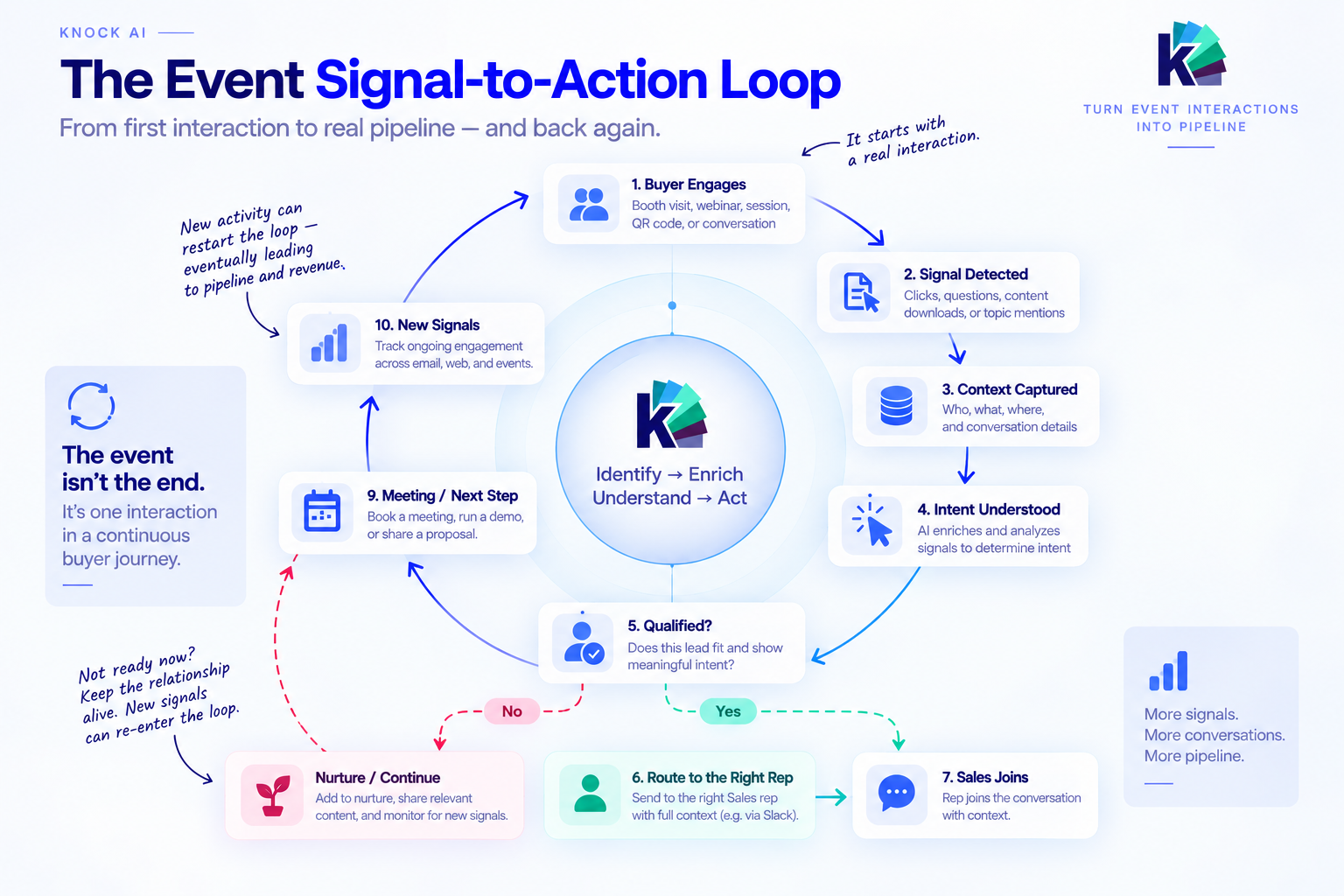
The real value lies in capturing buyer intent and context while the interaction is happening, engaging with prospects in real time, and carrying that context into the follow-up.
And that's where event lead generation needs to evolve.
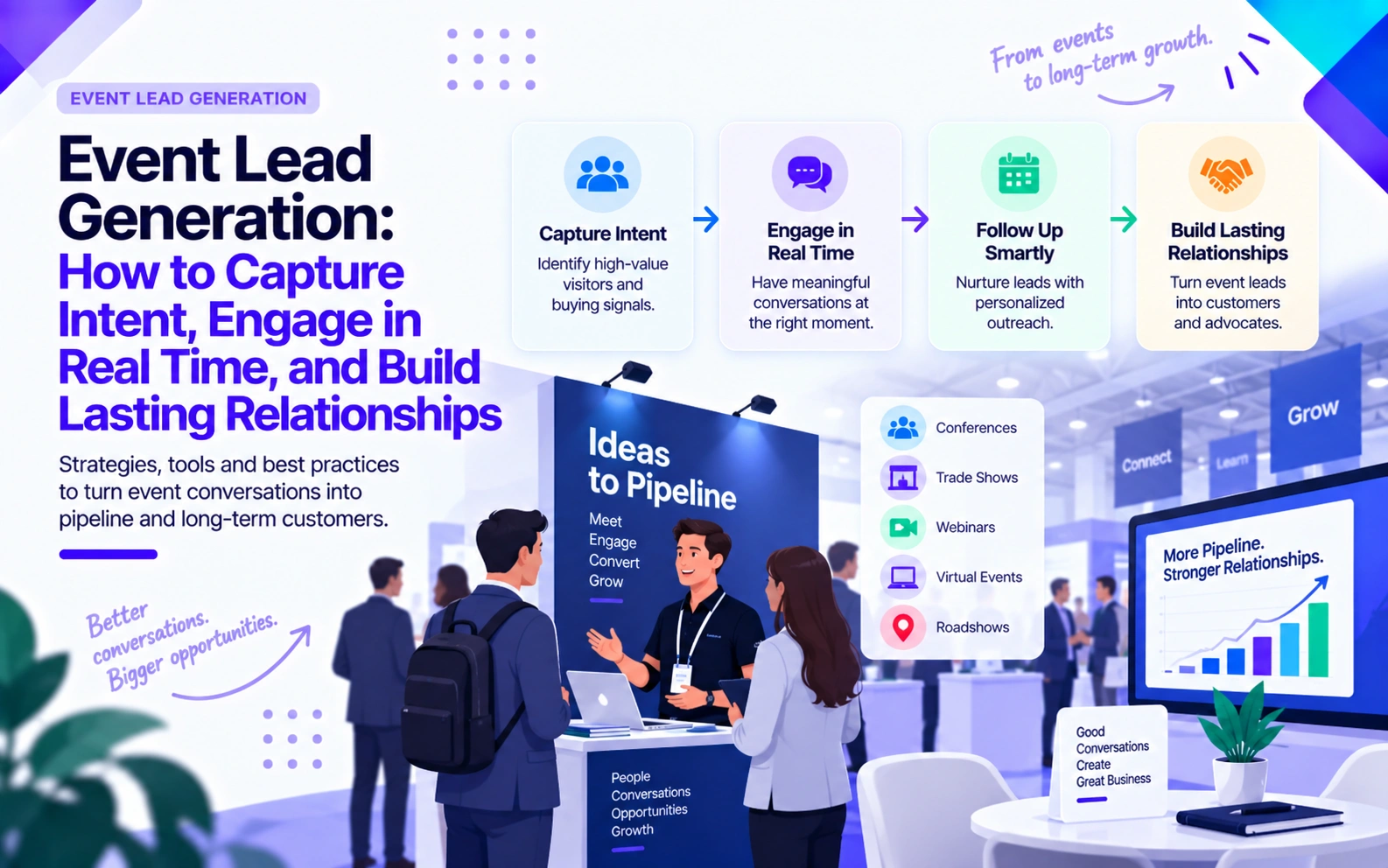
This is what a modern event lead generation workflow looks like:
Event lead generation is the process of attracting, engaging with, and capturing potential buyers through events such as trade shows, conferences, webinars, networking events, private dinners, and product demos.
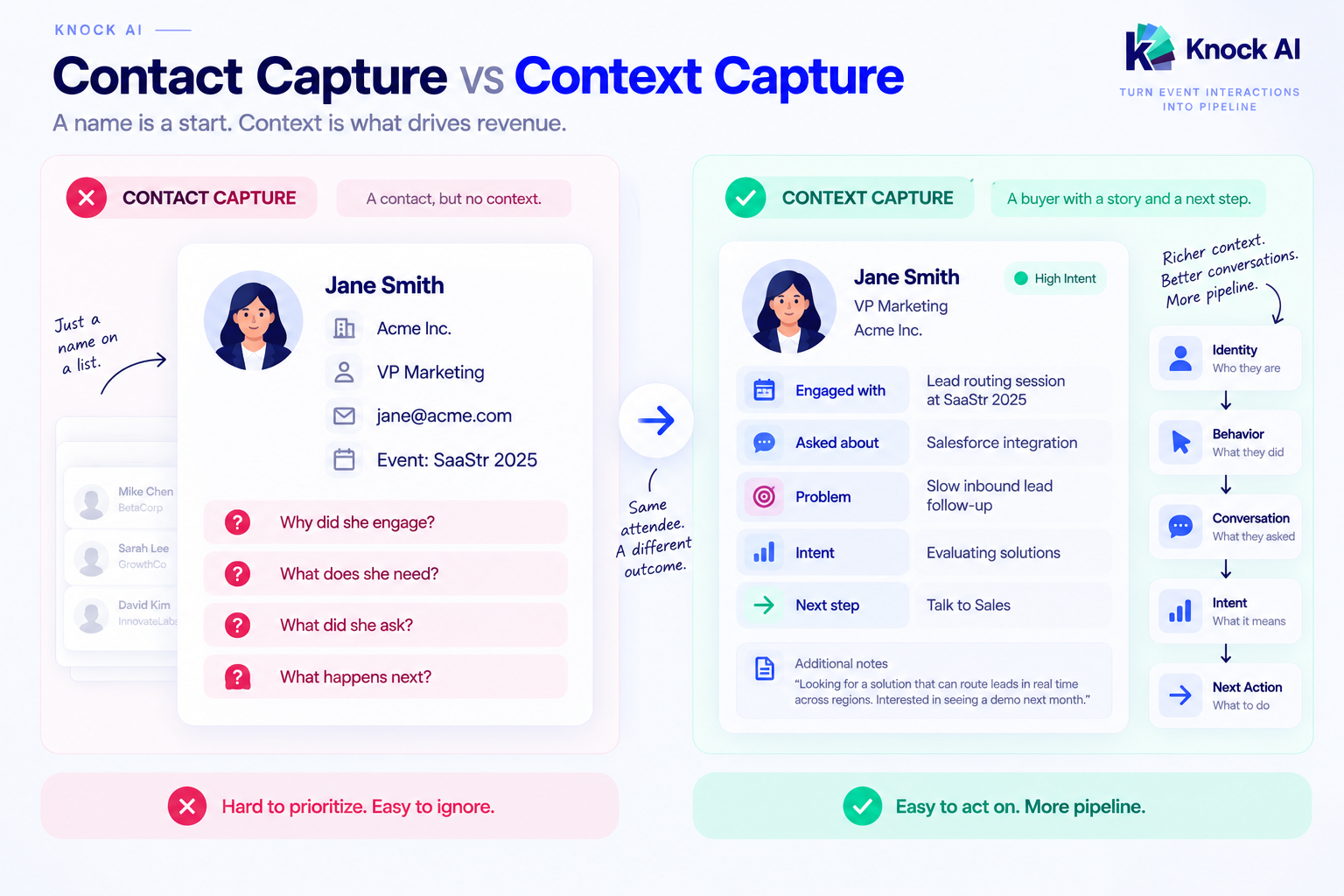
Traditional event lead generation often focuses on collecting contact information. Modern event lead generation goes further by capturing who engaged, why they engaged, what they care about, and what should happen next.
Traditional event lead generation focuses on collecting contacts. Modern event lead generation focuses on capturing buyer context and intent.
For example, a badge scan tells you someone visited your booth. A conversation can tell you what they're looking for, what problem they're facing, and what they want to do next.
Why Traditional Event Lead Generation Falls Short
The problem isn't that events don't generate interest. It's that traditional event lead generation often reduces that interest to a contact record.
Webinars are a good example. Goldcast's 2025 benchmark analyzed 19,531 webinars across 418 B2B brands and found that 33% of registrants attended live in 2024. (Source)
But even attendance doesn't tell you what someone actually wants. A person who registers, attends for a few minutes, asks a question, clicks a resource, or starts a conversation is giving you very different signals.
Either way, registration alone doesn't tell you enough about the buyer.
Someone who registered isn't necessarily the same as someone who attended, stayed engaged, asked questions, clicked resources, or started a conversation with your team.
And that's where traditional event lead generation starts to break down.
1. Registration Doesn't Equal Intent
A registration or badge scan gives you a useful starting point, but it's only one signal.
Attendance, engagement, questions, resource clicks, and conversations provide much more context about what someone actually cares about.
2. Valuable Interactions Aren't Captured
The most useful information often comes from the conversation itself.
A prospect tells a booth rep about a problem. Someone asks a specific question during a webinar. A buyer continues the discussion over LinkedIn or Slack.
But if all of that eventually becomes:
Name + email + company + event source
you've captured the contact, not the interaction.
That's strong. Keep this idea.
3. Follow-Up Happens Too Late
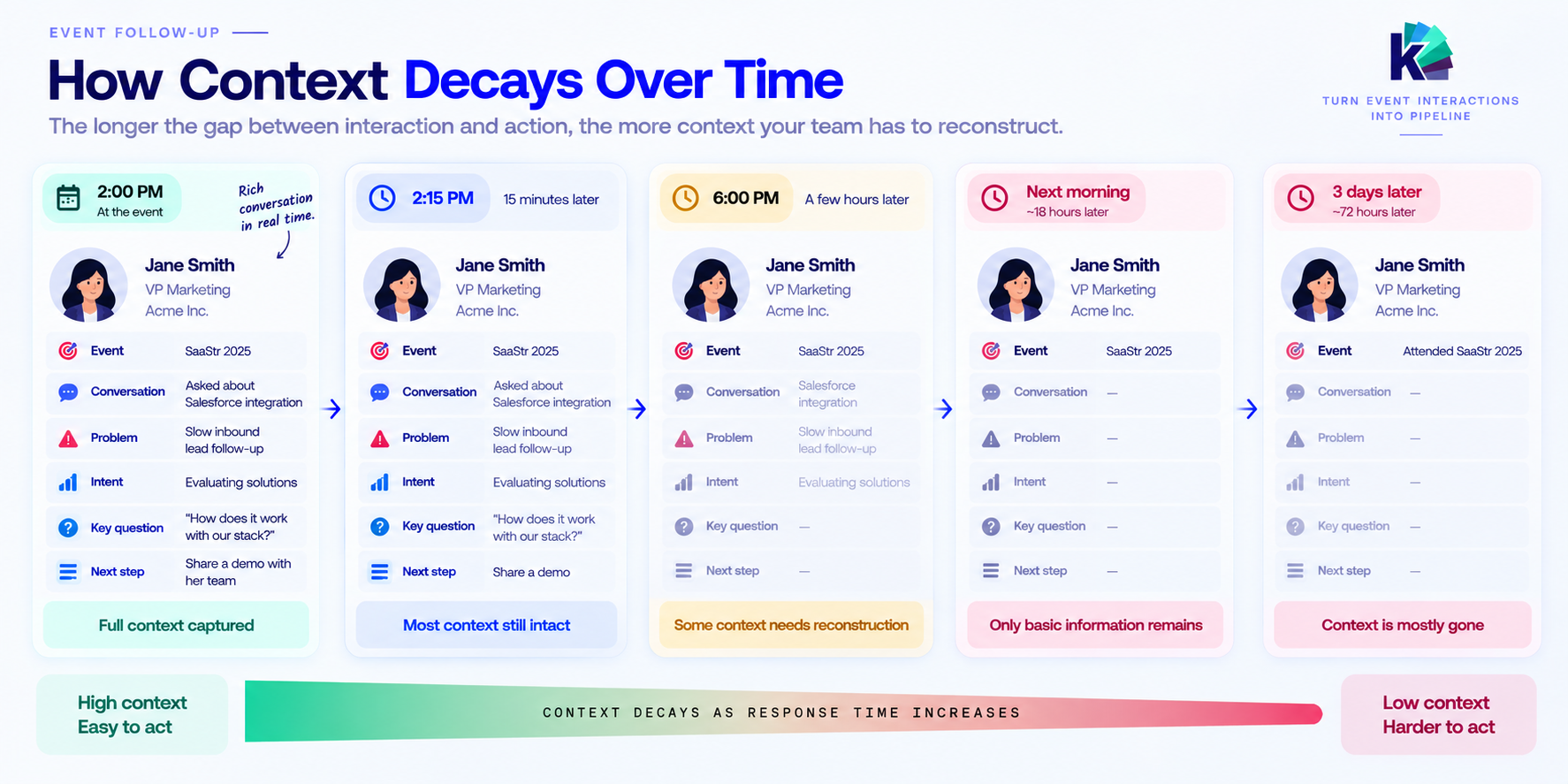
The longer the gap between interaction and action, the more context your team has to reconstruct.
Instead of:
Interaction → Intent → Context → Action
the process becomes:
Event → Export → CRM → Assignment → Follow-up
And now Sales is trying to restart a conversation that already happened.
4. Generic Follow-Up Breaks the Experience
One of the practitioners we analyzed pointed out that a cold check-in or generic “thanks for attending” message can undo the experience.
That's the problem with treating event leads as a list.
Follow up with the conversation, not just the event.
5. Event Interactions Can Become Invisible to Revenue
Important event touchpoints may happen across booths, webinars, dinners, LinkedIn, Slack, and meetings, while revenue teams primarily see what makes it into the CRM.
And the measurement problem is real. Bizzabo's 2025 State of Events research found that 70% of event organizers reported difficulty proving event ROI. (Source)
That creates a visibility problem:
Event interaction → ??? → Pipeline
You may know how many people attended, how many leads you collected, and how many meetings were booked. But if the actual buyer interaction isn't connected to the record, it's harder to understand what happened between the event and the opportunity.
The problem isn't generating event leads. It's turning event interactions into timely, contextual action.
See Knock AI in Action — Book Your Live Demo Today
Generating leads at an event isn't about collecting as many badge scans or business cards as possible. The goal is to create more opportunities for relevant conversations with potential buyers and make it easy for those conversations to continue.
Here are some practical ways to do that:
1. Create Booth Experiences That Encourage Conversations
Your booth shouldn't just display your logo and product. Give attendees a reason to stop and talk.
You could offer a live product experience, run a short assessment, ask a question about a problem your ICP faces, or create an interactive experience around a relevant topic.
The goal is simple: start a conversation instead of waiting for someone to ask for a demo.
Instead of sending someone to your homepage, use event-specific QR codes to let them:
Book a meeting
Watch a product demo
Access an event resource
Start a conversation
Request more information
The important part is what happens after the scan. A QR code should create a next step, not just another page view.
3. Offer Relevant Content or Resources
Give attendees something useful enough to exchange their attention for.
This could be a research report, industry benchmark, checklist, guide, calculator, product comparison, or other resource related to the problem your audience is trying to solve.
More importantly, pay attention to what they choose to access. Someone downloading a generic event guide and someone requesting a detailed product comparison are showing different levels of interest.
4. Run Product Demos
A product demo gives interested attendees a reason to spend more time with your team.
Keep the demo focused on the problems your audience is trying to solve rather than simply walking through every feature.
Use the conversation around the demo to understand what the prospect is evaluating, what questions they have, and what they want to do next.
5. Use Event-Specific Landing Pages
Don't send event traffic to a generic homepage.
Create landing pages specifically for the event, audience, session, or offer. This gives attendees a more relevant experience and makes it easier to understand where the interaction came from.
You can also use different pages or QR codes for different sessions, booths, campaigns, or offers to create clearer attribution.
6. Create Networking Opportunities
Not every potential buyer wants to walk up to a booth.
Create opportunities for conversations outside the booth through networking sessions, roundtables, receptions, workshops, or smaller group discussions.
These settings can produce richer conversations because the interaction isn't limited to a quick product pitch.
7. Host Private Dinners or Smaller Gatherings
Smaller events can create a different kind of interaction.
A private dinner, executive roundtable, or small customer gathering gives your team more time to understand what attendees are working on, what challenges they face, and what topics matter to them.
The value isn't simply the attendee list. It's the context you gain from the conversations.
8. Use Speaking Sessions to Attract Relevant Buyers
Speaking sessions can put your team in front of people who already care about a specific problem.
Make the topic specific to the challenges your ICP is dealing with rather than turning the session into a product pitch.
Then give attendees an easy way to continue the conversation through a resource, QR code, discussion, meeting, or follow-up experience.
9. Make It Easy to Book a Meeting
If someone is ready to talk to Sales, don't make them search for a calendar link later.
Give interested attendees a clear way to book while the conversation is happening. This could be through a QR code, event landing page, digital business card, or conversation with a rep.
The shorter the path from “I'd like to learn more” → “meeting booked,” the less opportunity there is for that intent to disappear.
10. Capture the Conversation, Not Just the Contact
This is the part that connects all of the strategies above.
A badge scan tells you who someone is.
A useful event interaction should also capture why they engaged, what problem they mentioned, what they're interested in, and what should happen next.
Instead of leaving the event with:
Name + Company + Email + Event
your team should ideally leave with:
Identity + Interaction + Intent + Context + Next Step
That's what turns event lead capture into something Sales can actually act on.
And once you've generated those leads, there's another question that matters just as much:
Once you've generated the lead, how do you know which ones actually matter?
How to Identify Intent From Event Leads
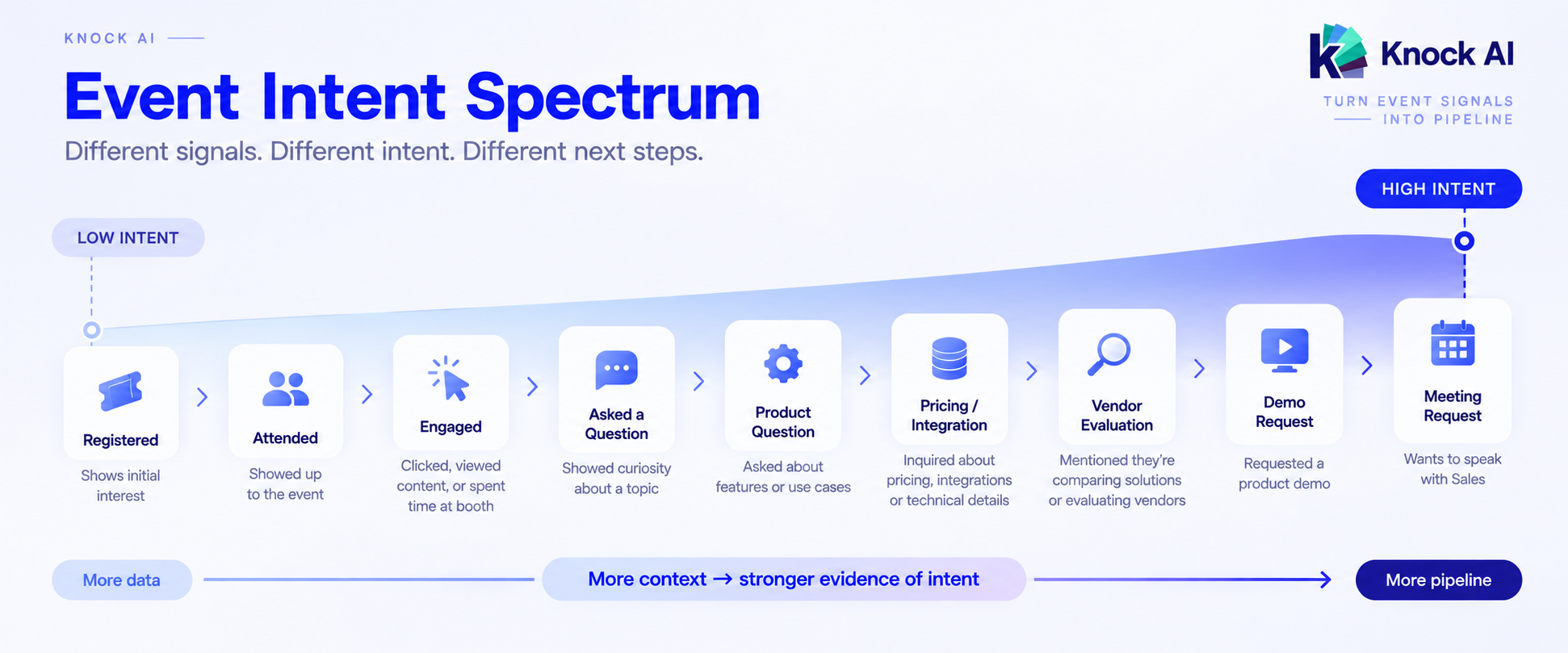
Not every event lead has the same level of intent.
Someone who registered for a webinar isn't necessarily in the market for your product. The same applies to someone who scanned a badge or stopped by your booth.
The important question is: what did they actually do or say?
Weak signals
These actions can indicate interest, but don't tell you much on their own:
Registered for a webinar
Visited a booth
Scanned a badge
Downloaded an event resource
Stronger signals
These interactions provide much more context:
Asked a product-specific question
Discussed a specific problem they're trying to solve
Asked about pricing
Asked about integrations
Mentioned the solution they're currently using
Said they're evaluating vendors
Requested a demo
Continued the conversation after the event
The difference is context.
A registration tells you that someone showed interest in an event. A conversation can tell you what they're trying to accomplish, what problem they're facing, what they're evaluating, and what they want to do next.
Identity: Who is the person and what company are they from?
Account context: What do you know about their company, role, and potential fit?
Behavior: What did they do during or around the event?
Conversation: What did they actually ask, say, or discuss?
Intent: Is there evidence that they are exploring, evaluating, or ready to take action?
A badge scan tells you who showed up. A conversation can tell you why they're there.
The goal isn't to label every event attendee as a hot lead. It's to give your team enough context to distinguish interest from meaningful buying intent and decide what should happen next.
How to Engage Event Leads in Real Time
Once you identify meaningful intent, timing matters.
A prospect is at your booth, talking to your team, asking questions, and showing interest. That's the moment when the conversation has context and momentum.
Why wait until tomorrow to follow up?
Instead, give prospects ways to continue the interaction while they're already engaged:
Start a real-time conversation
Use digital event experiences
Let attendees scan a QR code to continue the interaction
Ask qualifying questions
Share relevant content immediately
Connect interested prospects with Sales
Send real-time notifications to the right rep
Let qualified buyers book a meeting while they're engaged
This doesn't mean every attendee needs to be sent to Sales immediately. The point is to act on meaningful signals while the context is still fresh.
If someone asks a detailed product question, mentions they're evaluating vendors, or wants to speak with Sales, your team shouldn't have to wait for an event lead list to be processed before taking action.
The best time to engage an interested buyer is often while they're already engaged.
How to Sync Event Leads to Your CRM in Real Time
Real-time engagement is only useful if the context can continue into the rest of your GTM workflow.
That means connecting event interactions with systems such as HubSpot, Salesforce, or Marketo instead of treating event data as a separate record that gets uploaded later.
But don't just sync the contact.
Your CRM should ideally capture the context around the interaction:
Information
What to capture
Contact
Name, email, role
Account
Company and account context
Event source
Event, session, booth, webinar, dinner, etc.
Interaction
What the buyer did or engaged with
Conversation
Questions, topics, and relevant statements
Intent
Evidence of interest or buying activity
Qualification
Fit, needs, urgency, or other relevant criteria
Pain point
Problem the buyer is trying to solve
Follow-up
What has happened since the interaction
Next action
What should happen next
Owner
Who is responsible for continuing the conversation
The exact fields will depend on your GTM process, but the principle is the same:
Syncing the contact is useful. Syncing the context is what makes the handoff useful.
That context also makes the next stages of the workflow easier. Sales can see why the buyer engaged, what they care about, what has already been discussed, and what should happen next instead of starting from a name and email address.
And that leads to the next question: once you know who is showing intent and have that context available, how do you actually connect them with the right person on your Sales team?
How to Connect With Your Sales Team While You're Still at the Event
Imagine you're working the booth at a trade show.
A prospect walks up. They're from a target account, they're dealing with a problem your product can solve, and they want to learn more. But there's one problem: the Sales rep who should be talking to them isn't at the booth.
Traditionally, the interaction might end with a business card exchange and a promise to follow up later.
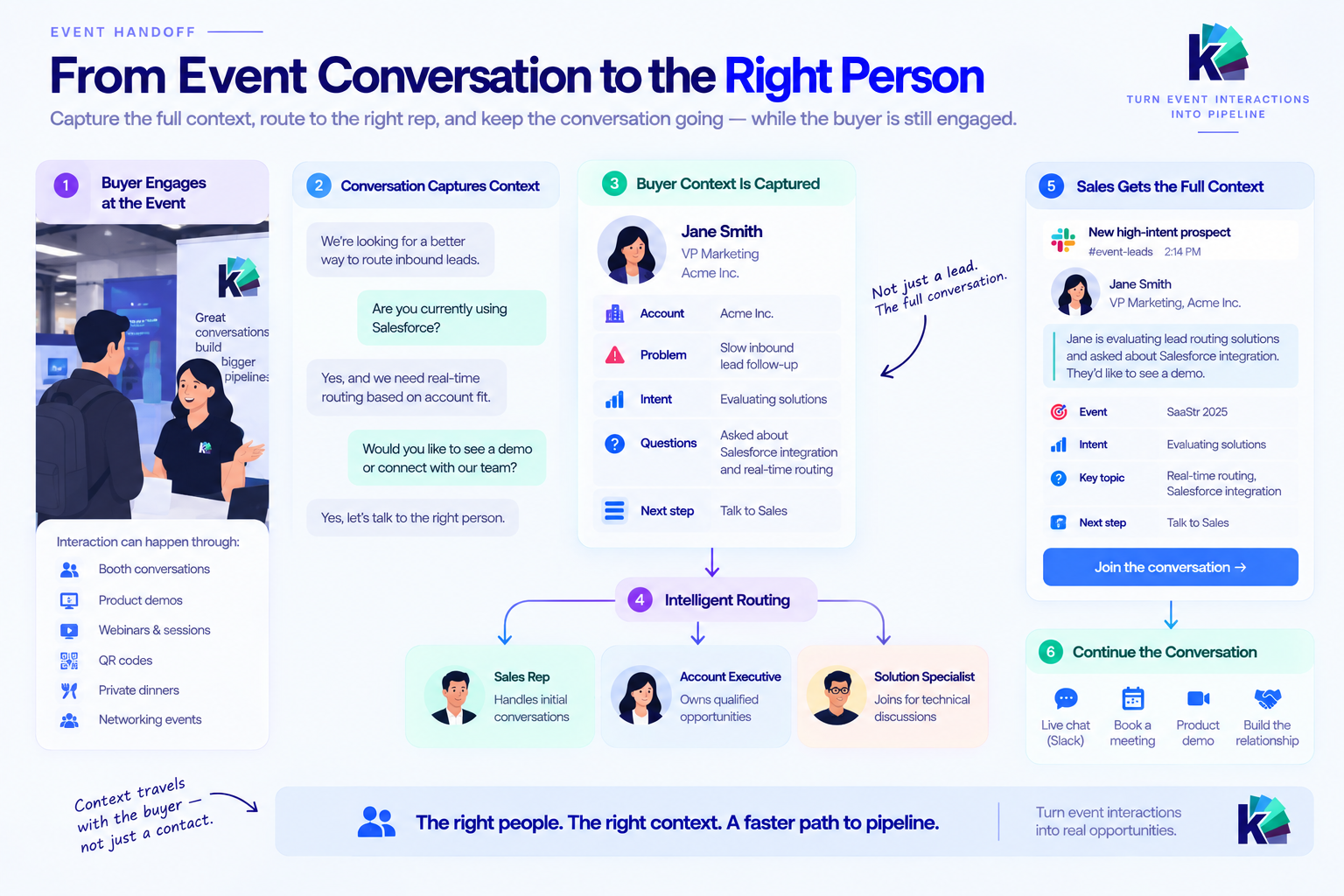
A better approach is to bring the right person into the conversation while the buyer is still engaged.
For example, the marketing team could receive a high-intent interaction at the booth, capture what the prospect is looking for, and notify the appropriate Sales rep through Slack with the relevant context.
Instead of:
“Someone from Acme wants to talk to Sales.”
the rep can receive something closer to:
“Acme's VP of Marketing is evaluating lead routing solutions and asked about Salesforce integration. They want to understand how the product handles real-time routing.”
Now the rep can join the conversation with context instead of starting from scratch.
The goal isn't simply to notify Sales. It's to give Sales enough context to continue the conversation.
How to Follow Up With Event Leads Without Losing Context
The event may be over, but the conversation shouldn't have to end there.
The easiest way to lose that momentum is to treat every attendee the same.
The generic follow-up
“Thanks for stopping by our booth. We'd love to connect and show you our product.”
There's nothing technically wrong with the message. The problem is that it doesn't reflect the conversation that already happened.
The contextual follow-up
“You mentioned that your team is struggling with X. I thought this resource might help explain how other teams are approaching it.”
The second message gives the buyer a reason to continue the conversation because it is connected to what they actually cared about.
A useful event follow-up should:
Reference the actual conversation
Address the problem or topic the buyer mentioned
Share something relevant to their situation
Match the follow-up to their level of intent
Give them a clear next step
Avoid making them explain the situation again
Not everyone needs the same follow-up.
Someone who casually visited your booth might need useful content. Someone who asked about pricing may be ready for a Sales conversation. Someone who requested a demo should have a much more direct next step.
Follow up with the conversation, not the event.
The event gives you the initial interaction. The context from that interaction gives you a reason to continue it.
How to Turn Event Leads Into Long-Term Relationships
Not every event interaction needs to become a sales opportunity immediately.
Someone might be interested in the problem you're solving but still be researching. Another person might need to educate their team before evaluating vendors. Someone else may not have a project today but could become a relevant buyer later.
That's why the goal shouldn't be to force every event lead into a meeting.
Instead, continue the relationship based on what you've learned.
That could mean:
Sharing relevant educational content
Following up on a question they asked
Continuing the conversation on their preferred channel
Sending useful research or resources
Watching for new intent signals
Re-engaging when their situation changes
Creating additional opportunities to interact
The important part is continuity.
If someone spoke with your team at an event, the next interaction shouldn't feel like a completely new relationship. Your team should know what was discussed, what the buyer cared about, and where the conversation left off.
The goal isn't to extract a meeting from every event interaction. It's to create a relationship that can continue after the event ends.
That's the shift from event lead generation to event relationship building.
And once you start thinking this way, the event isn't a one-day lead capture exercise anymore. It's one interaction in an ongoing buyer journey.
How to Measure Event Lead Generation ROI
Measuring event performance shouldn't stop at:
Registrations → Attendees → Leads
Those numbers tell you how many people entered the funnel. They don't tell you what happened after they engaged with your company.
A more useful measurement framework follows the buyer journey:
Leads generated: How many contacts did the event generate?
Engaged leads: How many meaningfully interacted with your team or content?
Qualified leads: How many matched your target customer profile and showed relevant interest?
High-intent accounts: Which accounts showed stronger buying signals?
Real-time conversations: How many meaningful conversations happened during the event?
Meetings booked: How many meetings were booked during or after the event?
Response rate: How many event leads responded to follow-up?
Opportunities influenced: Which opportunities had an event interaction in their journey?
Pipeline generated: How much pipeline originated from the event?
Revenue influenced: How much closed revenue can be associated with event interactions?
Time to follow-up: How long did it take to act after a meaningful interaction?
The last metric is particularly useful when you're trying to understand whether your event process is actually responsive.
A prospect who asks a product question at 2 PM and receives a relevant response at 2:10 PM has a very different experience from someone who gets a generic follow-up three days later.
There's also a measurement problem that is easy to miss.
Some of the most valuable event interactions never make it into the metrics revenue teams can see.
A conversation at the booth, a question during a session, a discussion at a private dinner, or an interaction that continues through another channel can disappear if the context isn't captured and connected to the buyer's record.
That's why event ROI shouldn't just answer “How many leads did we generate?”
It should answer:
What happened → who showed intent → what did they care about → what action did we take → did it create pipeline or revenue?
How AI Can Improve Event Lead Generation and Follow-Up
Events create a lot of information in a very short period of time.
There are conversations, badge scans, registrations, questions, product interactions, content downloads, meeting requests, and activity across multiple channels.
AI can help turn those signals into something your GTM team can actually use.
It can assist with:
Enrichment: Add relevant company, role, and account information.
Conversation analysis: Extract important information from conversations.
Intent detection: Identify signals that suggest meaningful buying interest.
Qualification: Determine whether a lead meets relevant criteria.
Lead prioritization: Surface the prospects and accounts that deserve attention.
Routing: Connect qualified buyers with the appropriate Sales rep.
Follow-up: Help create relevant next steps based on the interaction.
CRM updates: Capture useful event information and context in the appropriate systems.
Real-time engagement: Help respond to or continue conversations while interest is still active.
But there's an important distinction.
AI doesn't create useful event context by itself. It needs the right context to act on.
If an AI system only knows that someone attended your webinar or scanned your booth badge, it has very little to work with.
If it knows who the person is, what account they're from, what they engaged with, what they said, what problem they're trying to solve, and what they want to do next, it can support much more meaningful action.
AI Agent → Human
This becomes especially important when AI identifies a buyer who needs to be connected with Sales.
The handoff shouldn't look like:
“This person wants to talk to Sales.”
That's a notification, not context.
A useful handoff looks more like:
Who they are + why they engaged + what they care about + what they said + how strong the intent is + what should happen next.
Now the Sales rep can enter the conversation with an understanding of the buyer instead of asking them to start over.
The same principle applies after the event. AI can help identify which interactions deserve follow-up, what context should be carried forward, and what action makes sense next.
The goal isn't to add AI to event lead generation just because it's available. It's to use AI to shorten the distance between buyer signal and useful action.
How Knock AI Turns Event Interactions Into Pipeline
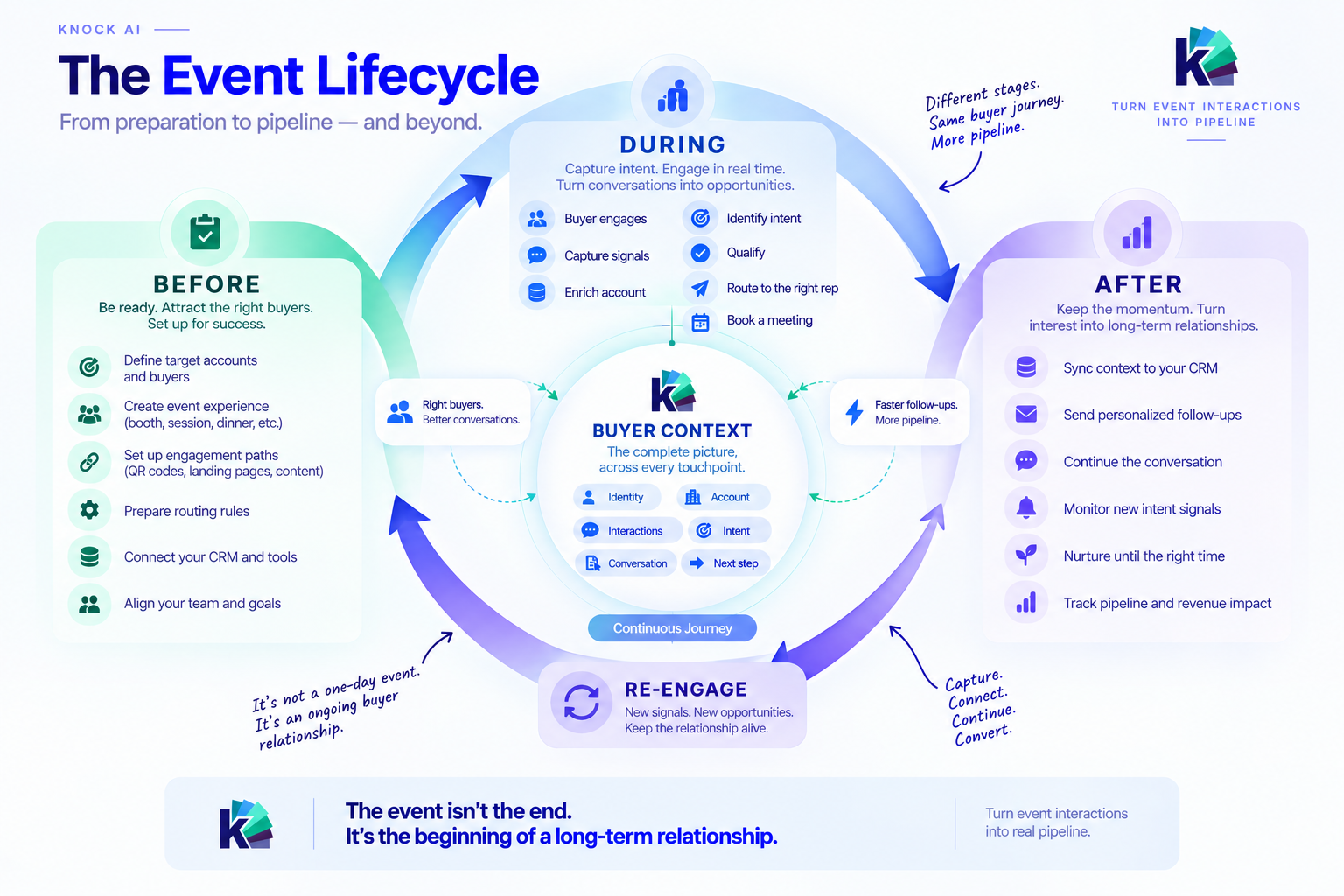
Events create buyer interactions before, during, and after the event. The challenge is keeping those interactions connected so intent doesn't get lost between teams or systems.
Knock AI helps teams turn event interactions into actionable buyer context, allowing them to engage prospects in real time, identify intent, route high-value conversations, sync information with their GTM systems, and continue the relationship after the event.
Define who you want to engage and give them clear ways to interact with your team, whether that's through a booth experience, QR code, meeting link, content, or another event-specific experience.
As prospects engage, capture the interaction and relevant context, identify meaningful intent, and connect qualified buyers with the right Sales rep while the conversation is still active.
Carry the context from the event into the follow-up instead of starting with a generic event lead. Continue the conversation based on what the buyer actually cared about and watch for new signals that indicate when another interaction makes sense.
The event shouldn't be the end of the interaction. It should be the beginning of the relationship.
Event Lead Generation Checklist
Use this checklist to make sure your event program is designed to capture and activate buyer intent, not just collect contacts.
Before the Event
Define target accounts and buyers
Set event goals
Create event-specific engagement paths
Prepare QR codes and meeting experiences
Connect your CRM and event systems
Define qualification and routing rules
Set up real-time Sales notifications
During the Event
Capture meaningful buyer interactions
Identify high-intent signals
Engage interested buyers immediately
Capture conversation context
Qualify relevant prospects
Notify the right Sales rep
Book meetings when appropriate
After the Event
Sync event context to the CRM
Segment leads based on intent
Send contextual follow-ups
Continue relevant conversations
Track meetings and opportunities
Measure pipeline and revenue impact
Don't leave an event with just a list of contacts. Leave with buyer context, intent, and a clear next action.
Frequently Asked Questions
What is event lead generation?
Event lead generation is the process of attracting, engaging with, and capturing potential buyers through events such as trade shows, conferences, webinars, networking events, private dinners, and product demonstrations.
How do you generate leads at events?
You can generate leads through booth conversations, product demos, QR codes, event-specific landing pages, speaking sessions, networking, private gatherings, relevant content, and easy meeting-booking experiences.
What are the best event lead generation strategies?
Effective strategies include creating experiences that encourage conversations, using QR codes and event-specific pages, running demos, offering relevant resources, creating networking opportunities, and making it easy for interested buyers to connect with Sales.
How do you generate leads at trade shows?
Trade show leads can come from booth interactions, product demonstrations, networking, QR codes, speaking sessions, meetings, and other experiences that encourage attendees to engage with your team.
How do you identify high-intent event leads?
Look beyond registrations and badge scans. Stronger signals include product questions, discussions about specific problems, pricing or integration questions, vendor evaluation, demo requests, and continued engagement after the event.
How do you engage event leads in real time?
Capture meaningful interactions, identify intent, qualify relevant prospects, notify the appropriate Sales rep, continue the conversation, and provide a clear next step such as relevant content or meeting booking.
How quickly should you follow up with event leads?
Follow up as soon as practical, particularly when a prospect has shown clear intent. The more time that passes after a meaningful interaction, the more context and momentum your team may have to reconstruct.
What should you include in an event lead follow-up?
Reference the actual interaction, address the topic or problem the buyer mentioned, provide something relevant, and give them a clear next step. Avoid treating every attendee as though they had the same level of interest.
How do you follow up with webinar attendees?
Segment attendees based on their engagement and intent, then tailor follow-up accordingly. Someone who simply registered may need a different follow-up from someone who attended, asked questions, downloaded resources, or requested a demo.
How do you sync event leads to Salesforce, HubSpot, or Marketo?
Connect your event and GTM systems so that relevant contact and account information, event activity, engagement, qualification, intent, follow-up status, and next actions can flow into the appropriate records.
How can Slack help with event lead follow-up?
Slack can provide real-time notifications when a prospect shows meaningful intent, allowing the appropriate Sales rep to see the relevant context and join the conversation without waiting for a later lead handoff.
How do you measure event lead generation ROI?
Measure the full journey from engagement → intent → qualified leads → meetings → opportunities → pipeline → revenue, rather than relying only on registrations, attendees, and total leads.
How do you turn event leads into long-term customers?
Continue the relationship after the event by preserving interaction context, sharing relevant resources, responding to new intent signals, maintaining relevant conversations, and engaging buyers when they're ready for the next step.


.svg)


.svg)
.svg)
.svg)


.svg)
.svg)


.svg)