How Does AI Decide if an Inbound Lead Is Qualified?
AI qualification should evaluate more than whether a lead matches the ideal customer profile. A useful model combines fit, intent, need, timing, authority, and engagement to determine whether the buyer is sales-ready and what level of attention they should receive.
|
Factor
|
Question AI should answer
|
|
Fit
|
Does the account match the ICP?
|
|
Intent
|
Is the buyer actively evaluating?
|
|
Need
|
Is there a relevant problem or use case?
|
|
Timing
|
Is there a reason to act now?
|
|
Authority
|
Can this person influence the purchase?
|
|
Engagement
|
How strongly is the buyer interacting?
|
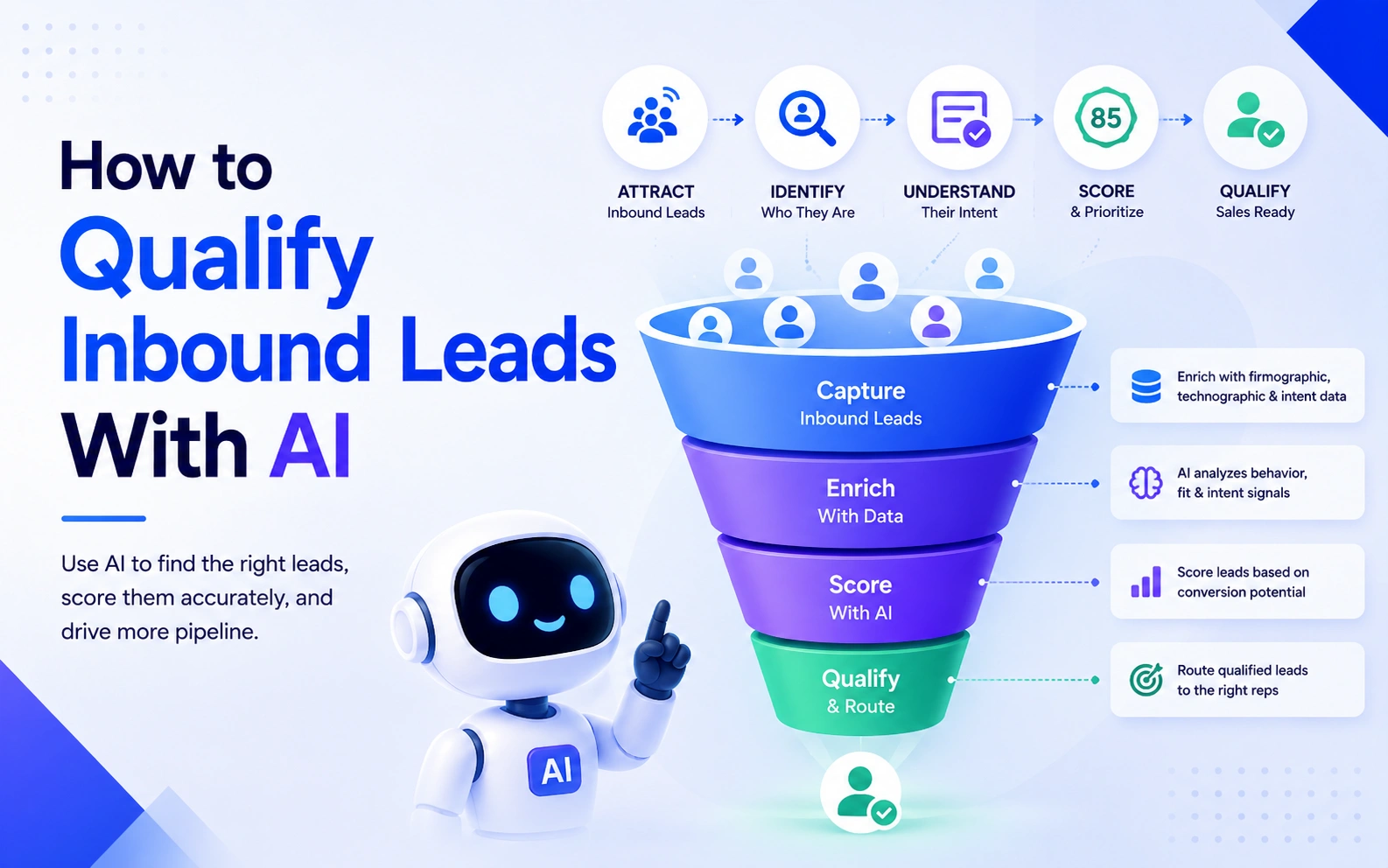
AI can combine these factors with behavioral signals, enrichment, account context, and conversation data to determine whether a buyer should be engaged immediately, routed to sales, nurtured, disqualified, or reviewed by a human.
The important distinction is that qualification is contextual. High ICP fit does not automatically mean sales readiness. A perfect-fit account showing little buying intent may belong in nurture, while a highly engaged buyer from a borderline account may warrant additional research or human review.
This also means qualification criteria should reflect the company's actual ICP and sales process rather than relying on a generic score or fixed threshold.
AI Lead Scoring vs. AI Lead Qualification
Lead scoring and AI lead qualification are related, but they serve different purposes. Lead scoring primarily helps sales teams prioritize prospects, while AI lead qualification evaluates whether a buyer meets the conditions for sales action and determines what should happen next.
|
Lead scoring
|
AI lead qualification
|
|
Assigns a score
|
Evaluates the buyer
|
|
Prioritizes leads
|
Determines sales readiness
|
|
Often uses predefined rules
|
Can interpret multiple context signals
|
|
Usually produces a ranking
|
Produces a decision and next action
|
|
Can use fit + behavior
|
Can combine fit + intent + conversation + account context
|
|
Often ends with a score
|
Can trigger engagement, routing, booking, nurture, or escalation
|
A lead might receive a high score because of company size, job title, and website activity, but that does not necessarily mean the buyer is ready for a sales conversation. AI qualification can combine those signals with intent, conversation, need, timing, and account context to determine the appropriate action.
Lead scoring tells you how a lead ranks. AI lead qualification determines whether the buyer is worth acting on and what should happen next.
What Should AI Do After Qualifying an Inbound Lead?
Qualification should trigger a next action, not simply produce a label or score. The appropriate action depends on the buyer's fit, intent, context, and readiness.
|
Qualification outcome
|
Next action
|
|
High fit + high intent
|
Engage immediately or book a meeting
|
|
High fit + moderate intent
|
Continue qualification or nurture
|
|
High fit + low intent
|
Nurture
|
|
Strong intent + unclear fit
|
Enrich the account or request human review
|
|
Wrong contact
|
Identify and engage the appropriate stakeholder
|
|
Existing customer
|
Route to the customer or account team
|
|
Low fit
|
Disqualify
|
|
Uncertain
|
Escalate to a human
|
AI can therefore move beyond a simple qualified/not qualified decision. It can determine whether to continue the conversation, ask another qualification question, route the buyer to the appropriate owner, schedule a meeting, place the buyer into nurture, or escalate when the available information is insufficient.
This is particularly important for inbound leads because qualification is often time-sensitive. A high-intent buyer may require immediate engagement, while a good-fit prospect with weaker intent may be better served by continued nurturing rather than an immediate sales handoff.
Qualification is only useful when it changes what happens next.
How to Qualify Inbound Leads Without a Form
Traditional inbound qualification often looks like:
Visitor → form → lead → qualification → sales response
The problem is that forms introduce friction into the buying journey. A buyer can show strong intent, but instead of acting on that signal immediately, the business waits for the buyer to complete a form, enter the system, and trigger the next step. That additional friction can cause buyers to disengage while their intent is still high.
A formless funnel removes the form as a prerequisite for qualification:
Buyer activity → identify → enrich in real time → understand intent → engage → qualify → route → book
AI can act on signals such as pricing-page activity, repeat visits, product engagement, conversations, account activity, and other buyer behavior. It can identify the buyer, enrich contact and company data in real time, interpret intent, ask contextual questions, and determine the next action while the buyer is still engaged.
Forms are still supported. When a buyer submits one, the contact and company can be enriched in real time and immediately used for qualification, routing, and engagement.
A form introduces friction before the sales workflow can begin. A formless funnel can identify, enrich, and act on buyer intent before a traditional lead is created.
The objective isn't simply to eliminate forms. It's to remove unnecessary friction between buyer intent and sales action, so qualified buyers can continue moving forward while their intent is still active.
How AI Qualifies Inbound Leads in Real Time
Speed matters because buyer intent is not static. A prospect who is actively researching a solution now may leave the site, postpone the purchase, or engage with a competitor if the next step takes too long. Traditional sales queues can add unnecessary delay between a high-intent signal and a meaningful response.
A real-time AI qualification workflow can operate as:
Buyer signal → identify → enrich → intent → engage → qualify → route → book
Instead of waiting for an SDR to review a lead, AI can identify the buyer, enrich contact and company data in real time, interpret the available intent signals, and begin the appropriate engagement while the context is still fresh. It can then qualify the buyer, route the opportunity to the right owner, and move qualified interest toward a meeting.
This improves speed to lead while reducing the response time between buyer activity and sales action. It also helps preserve the context that made the original signal meaningful.
This is the foundation of momentum marketing: responding to buyer intent while it is active and continuously creating the next opportunity for engagement.
Real-time qualification is not simply about responding faster. It allows the qualification decision to happen while buyer intent and context are still active.
AI Qualification, Routing, and Human Handoff
AI qualification should not end with a qualified/not qualified label. The workflow needs to determine three things: Is this buyer worth acting on? Who should own the relationship? What does that person need to know?
Qualification evaluates fit, intent, need, timing, authority, and engagement against the company's criteria. Routing then determines the appropriate sales owner based on factors such as account, territory, segment, product, relationship, or qualification. Human handoff transfers the context required to continue the conversation without making the buyer repeat themselves.
That context can include:
- Buyer identity
- Company and account
- Intent signals
- Qualification evidence
- Pain points and use case
- Questions asked
- Conversation history
- Recommended next action
This is particularly important when AI has already handled the initial conversation. The sales representative should receive the reasoning and evidence behind the qualification, not just a score or notification.
A good AI qualification workflow doesn't just send a lead to sales. It sends the right buyer to the right person with the context needed to continue the conversation.
Continuous AI Lead Qualification
Traditional qualification often looks like:
Lead → score → qualify → sales
A continuous AI qualification workflow looks more like:
Signal → qualify → engage → new signal → re-qualify → route → new stakeholder → re-qualify
The difference is that qualification is treated as an ongoing assessment, not a decision made once when a lead enters the CRM. A buyer's qualification can change when they revisit the website, view pricing, request a demo, engage in a new conversation, or show stronger account activity. It can also change when another stakeholder from the same company becomes active or new CRM context becomes available.
This matters especially in B2B sales, where buying decisions often involve multiple people and can develop over weeks or months. A lead that was not sales-ready yesterday may become highly relevant after a new intent signal or stakeholder interaction.
The best AI qualification systems don't qualify a lead once. They maintain an up-to-date assessment of whether the buyer or account is worth acting on.
How to Measure AI Lead Qualification
AI qualification should be measured by what happens after the qualification decision, not simply by how many leads the system labels as qualified. The most useful metrics connect qualification quality to sales responsiveness, conversion, and ultimately revenue.
|
Metric
|
What it measures
|
|
Lead → qualified lead
|
Qualification effectiveness
|
|
Qualified → meeting
|
Sales conversion
|
|
Meeting → opportunity
|
Lead quality
|
|
Opportunity → closed-won
|
Revenue quality
|
|
Speed to qualification
|
Response efficiency
|
|
Speed to lead
|
Responsiveness
|
|
Sales acceptance rate
|
Sales trust
|
|
False-positive rate
|
Overqualification
|
|
False-negative rate
|
Missed opportunities
|
|
Pipeline per inbound lead
|
Commercial impact
|
A particularly important distinction is between qualification volume and qualification accuracy. A system that qualifies more leads is not necessarily performing better if sales rejects those leads or they rarely progress to opportunities.
Measure AI qualification by the pipeline it creates, not the number of leads it labels as qualified.
How to Choose an AI Lead Qualification Solution
The right AI lead qualification solution depends on where the inbound funnel breaks. Start with the bottleneck rather than the technology:
|
Your bottleneck
|
What you need
|
|
Poor lead data
|
Enrichment
|
|
Anonymous visitors
|
Visitor identification
|
|
Too many unqualified leads
|
AI qualification
|
|
Static lead scoring
|
Contextual qualification
|
|
Slow follow-up
|
Real-time AI engagement
|
|
Poor lead handoff
|
Intelligent routing
|
|
Low meeting conversion
|
Qualification + engagement + booking
|
|
Enterprise ABM
|
Account + buying committee context
|
|
No internal SDR capacity
|
AI sales agent
|
The key is to evaluate whether the solution can connect these capabilities rather than solving only one part of the funnel. If qualification is isolated from identification, enrichment, engagement, routing, and meeting conversion, teams often end up stitching together multiple point solutions. An inbound AI sales platform is more relevant when those steps need to operate as one workflow.
FAQs
What is AI lead qualification?
AI lead qualification uses artificial intelligence to evaluate inbound prospects based on factors such as ICP fit, intent, need, timing, authority, engagement, and account context. It can then determine whether a buyer should be engaged, routed to sales, nurtured, disqualified, or escalated for human review.
How does AI qualify inbound leads?
AI qualifies inbound leads by combining buyer signals, company and contact data, website behavior, intent, conversations, and CRM context against defined qualification criteria. It can identify and enrich the buyer, interpret their needs and intent, determine sales readiness, and trigger the appropriate next action automatically.
What data does AI use to qualify leads?
AI can use company information, job title, industry, company size, technology, website behavior, pricing activity, repeat visits, conversations, intent signals, previous interactions, account activity, and CRM history. Combining these signals gives AI more context for evaluating fit, buying intent, engagement, and sales readiness.
Can AI qualify inbound leads without a form?
Yes. AI can qualify inbound leads through a formless funnel by using buyer activity, visitor identification, real-time enrichment, intent signals, conversations, and account context. A form can still be used, but it does not have to be the prerequisite for identifying, engaging, and qualifying a potential buyer.
What is the difference between AI lead scoring and AI lead qualification?
AI lead scoring primarily assigns a score or ranking to help prioritize prospects. AI lead qualification evaluates the buyer using broader context such as fit, intent, need, timing, authority, engagement, and conversation, then determines whether the buyer is worth acting on and what should happen next.
Can AI qualify and route leads automatically?
Yes. AI can evaluate a lead against qualification criteria and automatically route the buyer based on factors such as account, territory, product, segment, relationship, or sales ownership. It can also book meetings, initiate nurture, disqualify low-fit leads, or escalate uncertain cases to a human.
Is AI lead qualification accurate?
AI lead qualification can be accurate when it has reliable data, clear qualification criteria, relevant context, and appropriate human oversight. Accuracy should be measured against outcomes such as sales acceptance, meeting conversion, opportunities, and false-positive or false-negative rates rather than qualification volume alone.


.svg)


.svg)
.svg)
.svg)


.svg)
.svg)


.svg)


