The Real Question Isn't "Can AI Hand Off?"
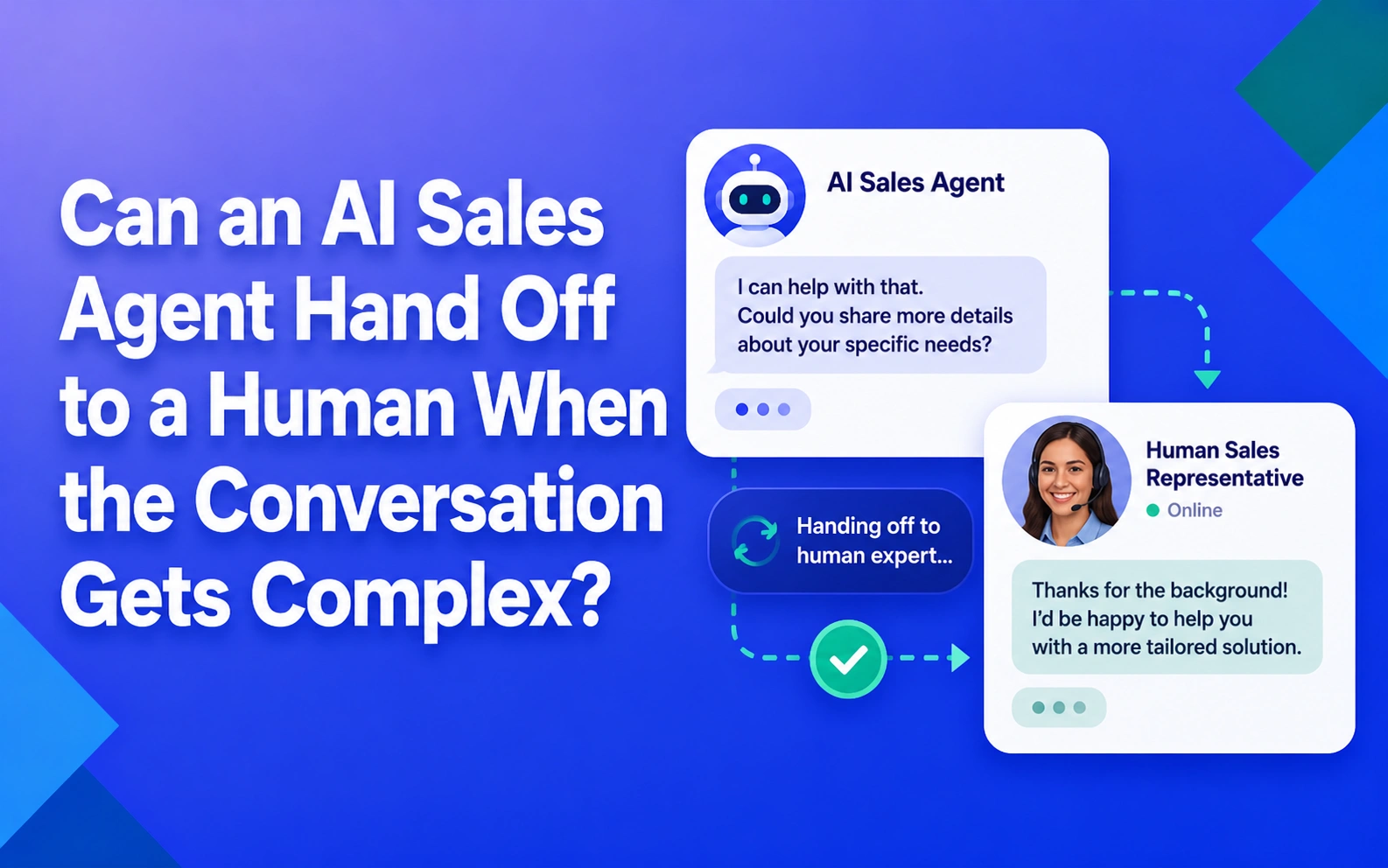
The real question isn't whether an AI sales agent can transfer a conversation to a human. Most modern AI sales platforms can do that.
The better question is how AI decides when a human should join the conversation.
Escalating every chat defeats the purpose of automation, while keeping every conversation with AI can frustrate buyers who need strategic guidance. The best AI sales agents evaluate buyer intent, conversation complexity, account fit, and business context to determine whether AI should continue, involve a sales representative, or route the conversation elsewhere.
The goal isn't more handoffs. It's making the right handoff at the right time.
When Should an AI Sales Agent Continue the Conversation?
AI should continue the conversation whenever it can provide fast, accurate, and helpful answers without requiring human judgment. This includes answering product questions, explaining features and integrations, providing pricing guidance, qualifying buyers, recommending relevant resources, handling common objections, and scheduling meetings.
For these interactions, AI often delivers a better experience than waiting for a sales representative to become available. Buyers receive immediate answers, conversations keep moving, and sales teams remain focused on opportunities where their expertise has the greatest impact.
When Should an AI Sales Agent Bring in a Human?
Some conversations benefit from experience, commercial judgment, and relationship building rather than automation. Enterprise procurement, custom pricing discussions, security reviews, legal questions, executive stakeholder meetings, strategic implementation planning, and final contract negotiations are all situations where a human sales representative can create significantly more value.
This doesn't mean the AI has failed. It means the conversation has reached a stage where human expertise can accelerate trust, address business-specific concerns, and help move the opportunity toward a successful purchase. The best AI sales agents recognize these moments early and ensure the transition is seamless, with all buyer context carried into the conversation so nothing needs to be repeated.
Why Intelligent Conversation Routing Matters More Than Human Handoff
Most discussions about AI sales agents focus on one question: Can AI transfer a conversation to a human? While that's important, it's only one part of the buying experience.
Modern revenue teams don't want AI that simply escalates conversations. They need AI that understands who the buyer is, why they're reaching out, and where the conversation should go next.
Instead of following a linear path where every conversation moves from AI to a sales representative, intelligent conversation routing uses buyer intent, company context, qualification data, and conversation history to determine the best destination. A high-intent prospect may be routed directly to sales, an existing customer to customer success, a support request to the support team, a job seeker to recruiting, and low-quality or spam inquiries can continue with AI or be filtered out before reaching your CRM.
This approach creates a better experience for both buyers and revenue teams. Buyers reach the people best equipped to help them, while sales representatives spend their time on qualified opportunities instead of manually sorting every inbound conversation.
The future of AI sales isn't about handing conversations to humans. It's about ensuring every conversation reaches the right destination.
What Makes a Good AI-to-Human Handoff?
A successful AI-to-human handoff should feel like a natural continuation of the conversation, not the beginning of a new one. Buyers shouldn't have to repeat who they are, explain their goals again, or answer questions they've already covered with AI.
When a sales representative joins the conversation, they should already have the context they need to help immediately. That includes a summary of the conversation, the buyer's intent, qualification status, company details, previous interactions, CRM history, unanswered questions, and recommended next steps. Instead of spending valuable time gathering information, sales teams can focus on solving problems, addressing concerns, and moving the buying process forward.
The quality of a handoff directly impacts the buyer experience. A context-rich handoff builds trust, shortens sales cycles, and helps conversations progress naturally. A poor handoff forces buyers to start over, creating unnecessary friction at one of the most important moments in the sales journey.
The best AI sales agents don't just transfer conversations. They transfer context.
Why High-Performing Revenue Teams Don't Send Every Conversation to Sales
One of the biggest mistakes revenue teams make is assuming every inbound conversation deserves a salesperson's attention. While that approach may have worked when inbound volume was low, it doesn't scale as businesses grow across websites, social media, messaging apps, email, communities, and other channels.
High-performing revenue teams recognize that not every conversation is a sales conversation. Some visitors are ready to buy, others are researching solutions, existing customers may need support, job seekers are looking for careers, and some interactions are simply low-quality or spam. Treating all of them the same wastes valuable sales capacity and slows response times for genuine buyers.
Instead of sending every inquiry directly to SDRs, modern revenue teams qualify conversations first. Buyer intent, company fit, conversation context, and engagement signals help determine the next best action. High-intent prospects are routed to sales, customer issues reach support, recruiting inquiries go to hiring, and AI continues handling conversations that don't yet require human involvement.
This approach improves more than just efficiency. SDRs spend their time speaking with qualified buyers instead of manually filtering inbound requests. CRM records stay cleaner because low-quality conversations don't automatically become contacts. Sales pipelines become more accurate because opportunities are based on buying intent rather than every form submission or chat. Most importantly, buyers receive faster responses because conversations are directed to the right team from the start.
The highest-performing revenue teams don't try to get every conversation to sales. They make sure the right conversations reach sales at the right time.
How Knock AI Decides When Sales Should Join the Conversation
The difference between a traditional chatbot and an AI sales agent isn't whether it can transfer conversations to a human. It's whether it knows when a human should be involved in the first place.
Knock AI makes that decision by combining buyer identity, intent, company context, and AI-driven qualification before routing a conversation to sales. Instead of treating every inbound message as a potential sales opportunity, it ensures the right conversations reach the right people.
Reveal Who's Engaging Before the Conversation Starts
Rather than asking buyers to fill out lengthy forms, Knock AI identifies who's engaging by revealing verified contact and company information before a sales representative responds. This gives your team immediate context instead of starting every conversation from scratch.
Understand the Buyer's Intent
Not every inbound message is from someone looking to buy. Knock AI automatically identifies the purpose of the conversation, such as:
- Buying intent
- Customer support
- Partnership inquiries
- Job seekers
- Spam or low-quality requests
This allows conversations to be routed appropriately instead of automatically landing in a sales queue.
Enrich Every Conversation With Context
Before anyone joins the conversation, Knock AI enriches it with valuable business context, including company information, role and seniority, CRM history, engagement signals, and other qualification data. Instead of asking buyers for information your business can already determine, sales representatives can immediately focus on understanding goals, solving problems, and moving the opportunity forward.
Let AI Handle What AI Does Best
For many conversations, AI can answer product questions, explain features, provide pricing guidance, qualify buyers, recommend resources, and schedule meetings without human involvement. This keeps buyers engaged while reducing the workload on SDRs.
When the conversation reaches a point where strategic guidance, commercial discussions, or relationship building would create more value, Knock AI intelligently routes the conversation to a sales representative with all the necessary context.
Accept or Reject With Confidence
When a qualified conversation reaches your team, sales representatives can quickly decide whether to engage.
If the conversation is accepted, the representative joins with complete buyer context, allowing the discussion to continue naturally instead of restarting.
If the conversation isn't a good fit, it can be rejected without creating unnecessary CRM records. Knock AI continues handling future interactions with that contact, preventing spam and low-quality inquiries from consuming valuable sales time.
Keep Your CRM Focused on Revenue
Because conversations are qualified and routed before entering your CRM, only relevant opportunities become sales records. This helps reduce CRM clutter, improves pipeline quality, and allows SDRs and account executives to spend more time with buyers who are genuinely ready to move forward.
Knock AI doesn't simply decide whether a conversation should be handed to sales. It determines whether sales should be involved at all, ensuring every conversation reaches the right destination while your team stays focused on generating revenue.
Signs Your AI Sales Agent Is Escalating Too Many Conversations
An AI sales agent should reduce unnecessary work for your sales team, not create more of it. If your SDRs are still spending most of their day filtering inbound conversations instead of selling, your AI may be escalating conversations too early or without enough context.
Here are some common signs your current approach needs improvement:
- Every inbound conversation is routed directly to SDRs, regardless of buyer intent.
- Buyers have to repeat the same information after being transferred to a human.
- SDRs spend significant time manually qualifying leads instead of having sales conversations.
- Your CRM is filled with spam, low-fit leads, duplicate contacts, or non-sales inquiries.
- Response times are slow because every conversation waits for human intervention.
- Your AI can answer simple FAQs but can't qualify, route, or continue meaningful conversations.
- Routing decisions rely on static rules instead of real-time buyer intent and context.
- Conversations aren't enriched with company details, CRM history, or engagement signals before reaching sales.
If several of these challenges sound familiar, the problem isn't necessarily your AI sales agent. It's the lack of intelligent qualification and conversation routing behind it.
The highest-performing revenue teams don't measure success by how many conversations reach sales. They measure success by how many qualified buying conversations reach sales.
Frequently Asked Questions
Can AI sales agents hand off to humans?
Yes. Modern AI sales agents can transfer conversations to human sales representatives when human expertise is needed. The best platforms don't simply escalate conversations, they evaluate buyer intent, qualification, and context to determine the right time for a human to join.
When should AI transfer a sales conversation?
AI should involve a human when conversations move beyond product education into areas such as enterprise procurement, custom pricing, contract negotiations, legal reviews, executive discussions, or strategic implementation planning where human judgment adds value.
Can AI qualify leads before routing them?
Yes. AI can qualify leads using conversation context, buyer intent, behavioral signals, company information, and CRM data before deciding whether the conversation should be routed to sales, another team, or continue with AI.
What's the difference between AI routing and AI handoff?
A handoff simply transfers a conversation from AI to a person. AI routing is broader. It determines the best destination for every conversation based on intent and context, whether that's sales, customer support, recruiting, partnerships, continued AI engagement, or another workflow.
Will buyers have to repeat themselves after the handoff?
They shouldn't. A well-designed AI sales platform passes conversation summaries, buyer intent, qualification details, company information, CRM history, and open questions to the sales representative so the conversation continues naturally.
Can AI answer pricing questions?
Yes. AI sales agents can explain pricing models, plans, packaging, and other common commercial questions using approved product information. More complex pricing discussions or custom commercial terms can then be handled by a sales representative.
Should AI replace SDRs?
No. AI is most effective when it complements SDRs by qualifying buyers, answering routine questions, and routing conversations intelligently. This allows sales teams to focus on relationship building, negotiations, and closing qualified opportunities.
Can AI route conversations to support or hiring instead of sales?
Yes. Modern AI conversation platforms can identify whether a conversation relates to customer support, recruiting, partnerships, or another business function and automatically route it to the appropriate team instead of sending every inquiry to sales.
What information should AI pass to a human sales representative?
A high-quality handoff should include a conversation summary, buyer intent, qualification status, company details, CRM history, previous interactions, unanswered questions, and recommended next steps so sales representatives can immediately continue the conversation.
How do AI sales agents improve pipeline quality?
AI sales agents improve pipeline quality by qualifying buyers before they reach sales, filtering spam and low-fit inquiries, enriching conversations with business context, routing conversations based on intent, and preventing unnecessary CRM records. This helps sales teams spend more time with qualified buyers and less time reviewing unqualified leads.
Let AI Handle the Routine. Let Sales Focus on Revenue.
Your sales team shouldn't spend valuable time filtering spam, answering repetitive questions, or manually qualifying every inbound conversation. Their time is better spent building relationships, solving complex challenges, and closing deals with buyers who are ready to move forward.
Knock AI helps make that possible by identifying who's engaging, understanding buyer intent, enriching every conversation with real-time context, and intelligently routing each interaction before it reaches your sales team. Whether a conversation should continue with AI, be routed to sales, directed to customer support, sent to another team, or filtered out entirely, Knock AI ensures every buyer receives the right experience while keeping your pipeline clean and your CRM focused on qualified opportunities.


.svg)


.svg)
.svg)
.svg)


.svg)
.svg)


.svg)


