

.svg)


.svg)
.svg)
.svg)


.svg)
.svg)


Zoominfo Pricing
ZoomInfo pricing typically starts around $15,000+ per year for smaller teams and can exceed $40,000–$60,000+ annually for larger enterprise deployments, depending on seats, credits, add-ons, and workflow complexity.
Based on customer reports, procurement benchmarks, competitor research, and ZoomInfo’s own pricing documentation, most organizations fall roughly into the following ranges:
ZoomInfo’s pricing model is customized rather than fully fixed-price. According to ZoomInfo’s official pricing and FAQ documentation, total pricing is typically influenced by:
- seats/licenses
- export and enrichment credits
- buyer intent usage
- integrations
- workflows and automation
- premium GTM applications
- contract scope
The platform also packages multiple products and modules across:
- Sales intelligence
- Marketing
- Talent
- Copilot AI
- Chorus
- Chat
- Intent data
- Enrichment
- Workflow automation
As a result, the total operational cost can expand significantly depending on:
- outbound scale
- SDR headcount
- export activity
- enrichment usage
- automation depth
- CRM integrations
- multi-team deployment
Many organizations evaluating ZoomInfo also discover secondary cost drivers beyond the initial contract, including:
- export credit consumption
- additional seats
- Chorus / Engage / Intent / Copilot add-ons
- enrichment workflows
- CRM and sales engagement integrations
- annual or multi-year contract commitments
This is why ZoomInfo pricing discussions often become less about:
- the starting quote
and more about:
- long-term operational cost and pipeline efficiency at scale.
What ZoomInfo Is Actually Selling
ZoomInfo is no longer just a contact database.
The platform has expanded into a much broader GTM ecosystem that combines:
buyer intelligence, intent data, CRM enrichment, outbound workflows, automation, website engagement, conversation intelligence, recruiting intelligence, and AI-assisted sales execution.
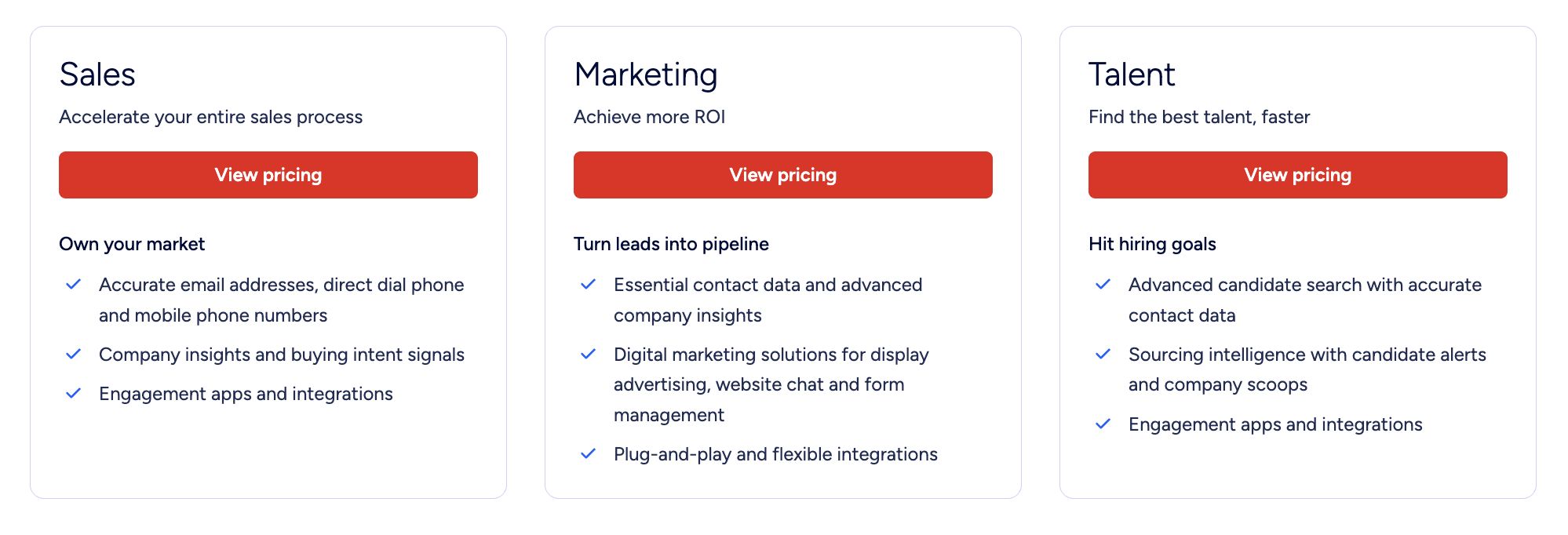
The pricing structure itself reflects this shift.
The platform is now divided across multiple GTM layers including Sales, Marketing, Talent, Copilot, Intent, Workflows, Chat, Chorus, enrichment, advertising, and AI-driven account orchestration.
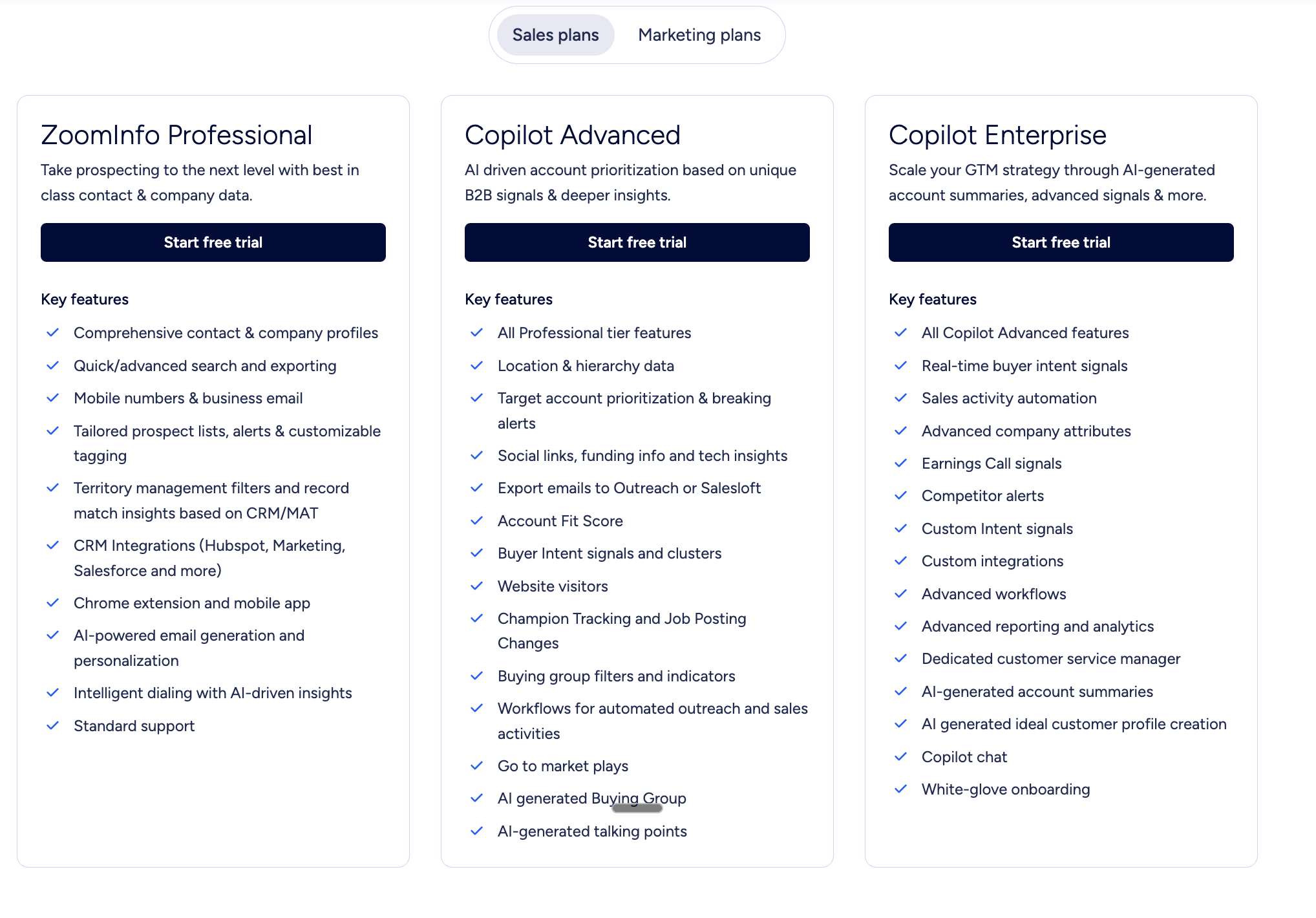
That matters because companies evaluating ZoomInfo today are not simply evaluating:
contact data quality.
They are evaluating, how much of their GTM stack they want ZoomInfo to power operationally.
In practice, ZoomInfo increasingly functions as:
- an intelligence layer,
- an outbound execution environment,
- an enrichment infrastructure,
- and an AI-assisted GTM operating system.
The result is a platform that can significantly improve prospecting, targeting, account prioritization, and outbound scale.
But it also introduces growing operational complexity as organizations expand usage across seats, credits, workflows, integrations, intent products, and AI modules.
Biggest Strategic Limitation
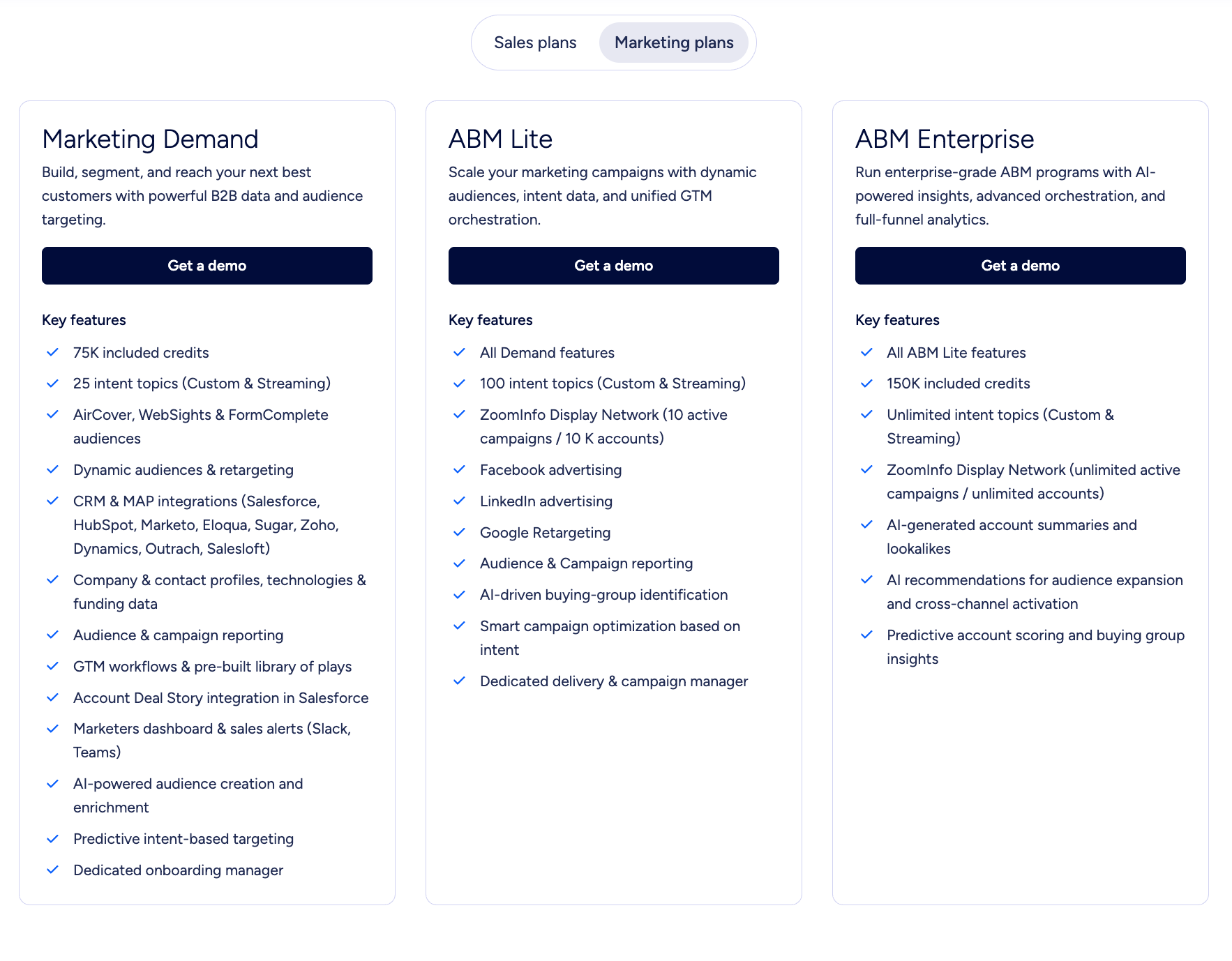
Most intelligence-first GTM platforms still fundamentally optimize, finding buyers and improving outbound efficiency.
But modern pipeline problems increasingly happen after buyer intent already exists.
Today, revenue teams often lose pipeline because engagement breaks across channels, sessions, handoffs, follow-ups, and asynchronous buyer journeys.
That creates a growing gap between identifying buyers, and preserving buyer momentum long enough to convert intent into pipeline.
Best Fit
ZoomInfo works best for organizations where outbound prospecting is still a primary growth engine.
It is particularly strong for enterprise SDR organizations, account-based outbound motions, TAM expansion, large-scale prospecting, intent-driven targeting, and enrichment-heavy sales operations.
For outbound-heavy GTM teams, ZoomInfo can significantly improve targeting precision, prospect discovery, and account visibility at scale.
Strategic Takeaway
ZoomInfo primarily optimizes:
who to target.
Modern persistent revenue systems increasingly optimize:
how buyer engagement survives across the full revenue journey.
That distinction matters because many modern revenue problems are no longer caused by lack of buyer data. They are increasingly caused by broken engagement continuity after intent already exists.
Why ZoomInfo Pricing Is So Difficult to Evaluate
ZoomInfo is one of the largest B2B intelligence and go-to-market platforms in the market.
But evaluating ZoomInfo pricing is unusually difficult because the platform does not operate on simple flat-rate SaaS pricing. Costs are influenced by:
- customized contracts
- seat counts
- export credits
- add-ons
- integrations
- workflows and automation usage
As a result, two companies using ZoomInfo can end up paying very different amounts depending on how deeply the platform is integrated into their GTM operations.
Most buyers searching:
- “How much does ZoomInfo cost?”
They are not simply looking for a starting price.
They are usually trying to understand:
- total operational cost
- real usage economics
- scalability
- contract complexity
- ROI compared to alternatives
That is why the real evaluation is not simply:
- “What is ZoomInfo’s sticker price?”
It is:
- how pricing scales operationally
- how credits impact usage
- which teams benefit most from the model
- and whether buyer intelligence alone solves modern pipeline challenges.
Related: Knock AI Vs Zoominfo
How Much Does ZoomInfo Cost in 2026?
ZoomInfo pricing typically starts around $15,000+ per year for smaller teams and can exceed $40,000–$60,000+ annually for larger enterprise deployments depending on seats, credits, feature access, and add-ons.
ZoomInfo does not publicly publish fully standardized pricing because packages are customized around:
- number of seats
- export credits
- feature access
- intent data usage
- integrations
- add-ons
- contract length
- overall account scale
This means actual pricing can vary significantly between organizations even when they use similar plans.
Many companies also report that operational costs increase over time through:
- additional export credits
- workflow usage
- premium modules
- enrichment tools
- conversation intelligence features
- automation capabilities
As a result, ZoomInfo’s pricing model is fundamentally:
- seat-based
plus:
- usage-based through credits and platform expansion.
What Is Included in ZoomInfo Pricing?
Core Platform Capabilities
ZoomInfo pricing includes access to a broad GTM intelligence and outbound infrastructure rather than just a contact database.
Core capabilities typically include:
- contact and company data
- firmographic and technographic insights
- buyer intent signals
- CRM enrichment
- workflows and automation
- AI prospecting and prioritization tools
- outreach integrations
- GTM Copilot functionality
Depending on the package, teams may also gain access to:
- account scoring
- buying group insights
- website visitor intelligence
- automated outreach workflows
- AI-generated account summaries and talking points
This is why ZoomInfo increasingly positions itself as:
- an AI GTM operating system
rather than:
- a standalone contact database.
Add-Ons and Premium Modules
ZoomInfo also offers multiple premium products and add-ons including:
- Chorus
- Engage
- Chat
- Intent
- Enrich
- Workflows
- Copilot
- web visitor intelligence
These modules can significantly expand platform capabilities, especially for:
- outbound automation
- conversation intelligence
- enrichment
- ABM workflows
- intent-driven targeting
But they can also materially increase:
- total contract value
- operational complexity
- integration overhead
In practice, many organizations end up evaluating ZoomInfo not as a single product, but as a growing GTM ecosystem layered across sales, marketing, enrichment, automation, and outbound workflows.
How ZoomInfo Credits Actually Work
ZoomInfo uses a credit-based consumption model alongside seat-based pricing.
In most cases, credits are consumed when users:
- export contacts or companies
- enrich records
- sync workflows
- use integrations
- push data into CRMs or outbound systems
This matters because the real cost of ZoomInfo is often not limited to the base contract itself.
Actual operational usage directly impacts:
- outbound scale
- SDR activity
- enrichment volume
- workflow automation
- CRM synchronization
As outbound activity grows, teams can become increasingly dependent on credits to maintain prospecting velocity and enrichment workflows.
This creates an important operational tradeoff:
higher outbound usage can improve pipeline coverage, but it can also increase:
- credit consumption
- overage risk
- export management overhead
- dependency on ongoing data usage at scale
For many teams, understanding how credits affect day-to-day operations becomes just as important as understanding the initial contract price itself.
Why ZoomInfo Pricing Gets Expensive Quickly
Seat Expansion
ZoomInfo’s pricing scales heavily with seats and platform access.
As sales and GTM teams grow:
- license costs increase
- data usage expands
- workflow activity rises
- procurement and renewal complexity grows
For larger organizations, pricing often scales not just with team size, but with how deeply ZoomInfo becomes embedded into daily outbound operations.
Intent and Data Add-Ons
Base pricing is often only one layer of the total cost.
Many organizations eventually add:
- streaming intent
- enrichment
- workflows
- advanced automation
- Copilot
- conversation intelligence tools like Chorus
These features can significantly improve targeting and outbound execution, but they also increase:
- platform dependency
- operational complexity
- total contract value over time
Multi-Product GTM Stacks
Another major cost driver is stack expansion.
Many companies end up combining ZoomInfo with:
- sales engagement platforms
- intent tools
- enrichment tools
- routing systems
- website conversion platforms
- scheduling software
This creates a broader operational challenge.
The modern GTM problem is often no longer:
- lack of buyer intelligence
It is:
- fragmented execution across disconnected systems.
Why Revenue Teams Still Buy ZoomInfo
Despite the pricing complexity, ZoomInfo remains one of the most widely adopted GTM platforms in enterprise sales.
The reason is simple:
it solves real outbound execution problems at scale.
ZoomInfo continues to provide strong value for:
- outbound prospecting
- TAM expansion
- account discovery
- SDR efficiency
- intent-based targeting
- CRM enrichment
- enterprise sales operations
For outbound-heavy organizations, the platform can significantly improve:
- targeting precision
- list building speed
- account prioritization
- prospect discovery
- outbound scalability across large markets
This is especially valuable for companies running:
- SDR-led pipeline generation
- ABM programs
- enterprise outbound motions
- high-volume prospecting workflows
At scale, centralized buyer intelligence and enrichment can materially improve how quickly teams identify and prioritize potential accounts.
The Biggest Limitation of Intelligence-First GTM Systems
Most intelligence-first GTM platforms fundamentally optimize:
- identifying buyers
- enriching records
- prioritizing accounts
- improving outbound targeting
And ZoomInfo is extremely strong at those workflows.
But modern buyer journeys increasingly happen:
- asynchronously
- across multiple channels
- before form conversion
- after meetings
- inside messaging environments
- across LinkedIn, Slack communities, events, and outbound conversations
Related: Messaging, Not Email, is the Venue for B2B Sales
As a result, knowing:
- who the buyer is
does not automatically solve:
- buyer continuity
- engagement persistence
- momentum preservation
- post-conversation conversion
Modern pipeline breakdowns increasingly happen after intent already exists.
Related: The B2B Funnel Is Dead, It Just Doesn’t Know It Yet
Buyers engage briefly, switch channels, delay decisions, disappear between touchpoints, and lose momentum long before opportunities are created.
That creates a growing gap between:
- buyer intelligence
and:
- continuous revenue engagement across the full journey.
“Modern pipeline problems are increasingly caused by broken buyer continuity, not lack of buyer data.”
Why More Buyer Data Does Not Automatically Create More Pipeline
Most GTM teams already have:
- CRM records
- contact databases
- intent signals
- enrichment tools
- outbound automation
Yet pipeline still breaks surprisingly often.
The reason is that modern revenue problems are rarely caused by missing buyer data alone.
Pipeline is increasingly lost because:
- buyers ghost after initial engagement
- conversations fragment across channels
- follow-up slows down
- engagement resets between touchpoints
- momentum disappears after intent appears
This creates an important shift in how revenue teams should evaluate GTM systems.
The issue is often not:
- identifying buyers
The issue is:
- preserving buyer momentum once engagement has already started.
“The biggest revenue leak often happens after the buyer is already identified.”

.svg)


