The B2B Funnel Is Dead. It Just Doesn’t Know It Yet.
It’s time to stop optimizing a system buyers have already abandoned.
Why are we still pretending?
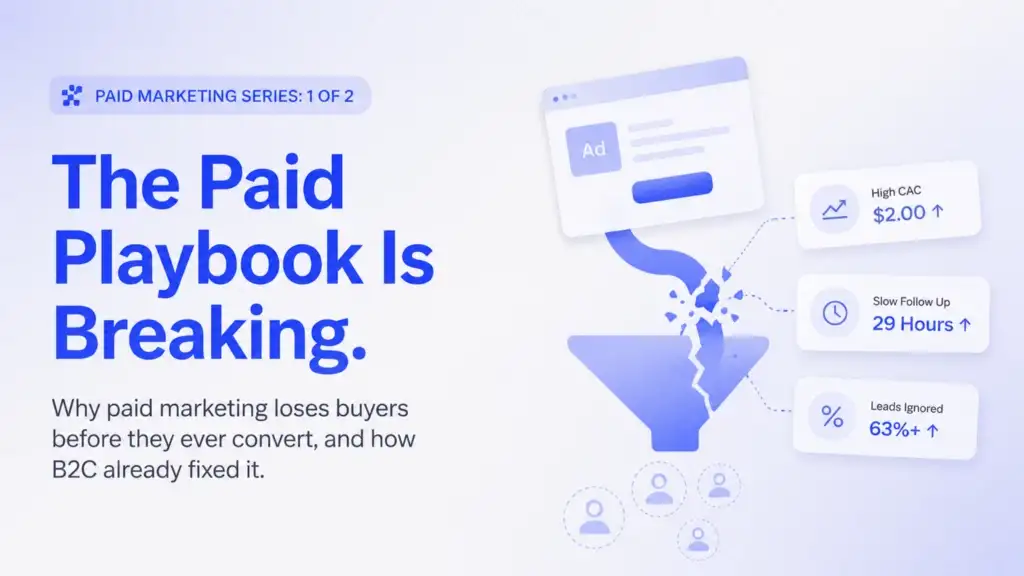
The traditional B2B funnel isn’t just broken. It’s a relic from a time when buyers waited for callbacks, and marketers celebrated form fills and drip campaign open rates.
But instead of moving on, teams keep trying to optimize it. Patching cracks, spending more on band-aid solutions, and calling it “innovation.”
It’s time we stopped trying to fix something that no longer serves us.
Your Funnel Is Gaslighting You
Marketing teams still follow the same formula: Attract -> Capture -> Nurture-> Qualify-> Handoff. But buyers don’t move in straight lines, and they definitely don’t want to be “captured”.
87% of cold emails go unanswered. 81% of users abandon forms. 70% of buyers complete their journey using AI assistants.
They’re not downloading your gated eBook or responding to your drip campaign. They’re finding faster, better answers without giving up their email address. Yet your marketing stack still relies on clicks, opens, and content downloads. A/B tested sequences that no one reads. SDRs chasing “hot leads” who were just scrolling at 2 a.m.
93% of B2B customer acquisition is wasted on a funnel that no longer reflects buyer behavior.
Buyers Don’t Follow Funnels. They Abandon Them.
Real buyers jump in midstream. They bounce across channels. They ghost you for weeks and then ask for a demo on Slack. They get answers from ChatGPT instead of from your whitepaper
Buyers want conversations, not homework assignments.
Most B2B funnels aren’t designed for dialogue. They’re built to trap- requesting emails, job titles, budgets, all for a PDF in return. That’s not value, it’s a transaction. In a world where buyers expect real-time engagement, it’s tone deaf and out of touch.
60.8% of employees ignore emails. 98% of DMs get opened. You do the math.
MQLs: The Original Vanity Metric
MQLs are activity scores masquerading as intent. Opened an email? Read a blog post? Downloaded a gated asset? Congratulations — you’re “qualified”.
Teams prioritize behavior over context. Sales doesn’t trust marketing’s leads because they’ve chased too many click-happy browsers with no actual buying power.
So marketing floods the funnel, sales sorts through the noise, and pipeline coverage becomes a comfort metric — easy to inflate, hard to convert.
More Memory, Not Outreach
When the funnel breaks, teams go wider. More content, more touchpoints, more tools.
Adding channels without coherence just multiplies the noise. Buyers don’t want five versions of the same pitch. They want one conversation that follows them everywhere.
Funnels are built around internal workflows — handoffs between teams, stages, and tools. But buyers don’t move in neat lines. They experience delays, repetition, and disconnects. They explain their needs to one rep. Then another. Then again during onboarding.
By the third time, they’re wondering if they made the wrong choice.
What’s missing isn’t more outreach — it’s memory. Context. Recognition.
Messaging Is Infrastructure, Not Another Channel
Messaging is how people communicate — at work and everywhere else. It’s direct, contextual, and asynchronous.
But most B2B orgs still treat messaging as a side channel, while investing in forms, scheduling links, and follow-up emails. That’s not inefficient — it’s disconnected from reality.
The future isn’t built on static pages or sequences. It’s built on fluid, buyer-led conversations that can start anywhere and continue everywhere.
Stop Patching, Start Replacing.
You can keep tweaking lead scores, testing subject lines, and refreshing nurture tracks. But that model isn’t broken, it’s expired.
It wasn’t built for this level of buyer control, speed, or channel complexity. It’s from when marketers pushed and buyers followed. That era is over.
What replaces the funnel isn’t another linear framework. It’s a shift from capture to connection. From handoffs to continuity. From tracking behavior to understanding intent.
Buyers don’t want to be led down paths. They want to move at their own pace, with guidance, not gating. That’s the work ahead. Not optimizing the old model, but building something better. Because the future of B2B won’t be built on forms and drip campaigns. It’ll be built on connection.


.svg)


.svg)
.svg)
.svg)


.svg)
.svg)

.svg)





.svg)


