Your CRM should not just store leads. In the agentic era, it needs to give AI agents and human reps accurate, current context so they can qualify, route, prioritize, and act correctly. Knock AI enriches lead and company data in real time, syncs chat, scheduling, and intent activity to your CRM, and lets you map fields to your own structure so the data fits your workflows instead of forcing you into a fixed model.
This matters because agents are only as good as the data they use. If the CRM is stale, incomplete, or missing intent context, agent workflows break. Knock AI is designed to keep CRM records aligned with real buyer activity, including enrichment, qualification, routing outcomes, and meeting activity, so agents can work from live context instead of static records.
What does Knock AI sync to your CRM?
Knock AI syncs more than basic lead details. Its CRM integrations are positioned around sending real-time lead engagement data, enriched contact and company data, first-party intent signals, conversation context, and scheduling outcomes into systems such as Salesforce, Marketo and HubSpot.
That can include:
- contact and company enrichment
- conversation and qualification context
- first-party intent data
- routing outcomes
- booked meeting status
- transcript and conversation history
- custom Knock fields and mapped CRM fields
Why CRM data quality matters more in the agentic era
In an agentic workflow, agents do not just read CRM records. They use CRM data to make decisions. That includes deciding who should be routed to sales, which workflow should run, what follow-up should happen, and how urgent the buyer really is.
If the data is outdated or missing context, the workflow becomes less accurate. Knock AI’s is built on this exact idea: enrich every lead and account with real-time context, intent signals, and clean data so teams know who to prioritize, when to act, and why it matters.
How does Knock AI make your CRM fit the agentic era?
Knock AI makes your CRM fit the agentic era by continuously enriching and updating the lead record in real time. Traditional form-based workflows usually create a one-time snapshot of the buyer. Knock AI works differently. It keeps improving the lead and company profile as new information becomes available.
As the buyer engages, the AI agent can add qualification answers, update intent context, enrich contact and company details, and sync the most relevant information back to the CRM. This means the record does not stay frozen after the first conversion. It keeps getting more accurate, more complete, and more useful for routing, automation, prioritization, and agent workflows.
For modern AI-driven workflows, that difference is critical. Agents need fresh and reliable context, not stale form data. Knock AI helps keep the CRM aligned with the latest buyer activity so agents can make better decisions and workflows can run as expected.
What data can Knock AI enrich and sync to your CRM?
Knock AI enriches both contact-level and company-level data, then syncs that information to your CRM in real time. It includes real-time contact enrichment, company enrichment, intent fields, routing context, meeting status, and transcript-related data flowing into CRM workflows such as Salesforce and HubSpot.
This can include:
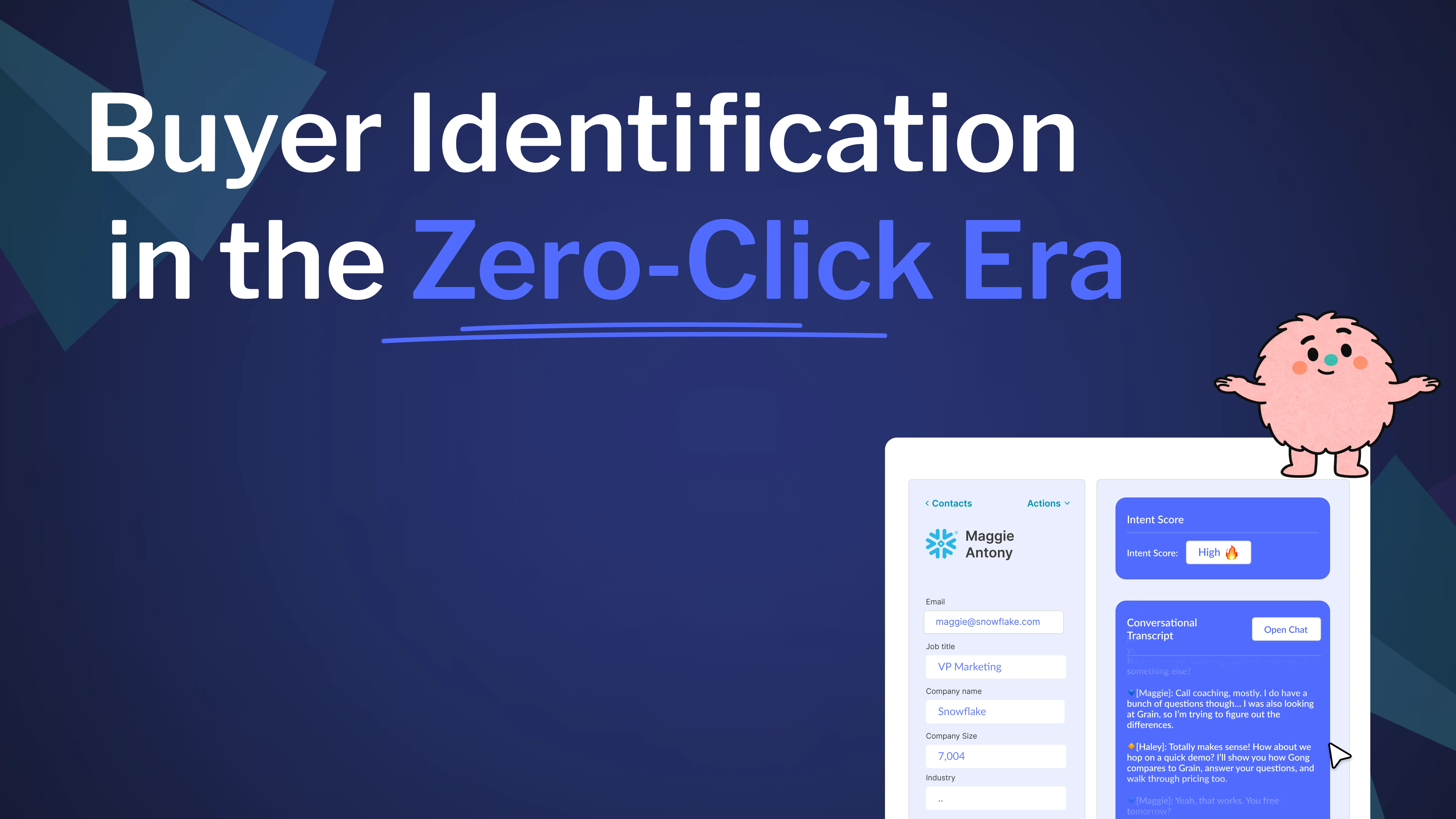
- contact data such as name, email, title, LinkedIn, location, and seniority
- company data such as size, industry, location, and company context
- attribution data such as channel and Source, content, referrer and utm fields
- intent data such as Intent Score and intent signals
- workflow data such as chat owner, meeting owner, responding rep, and rep response time
- meeting status, chat status, and transcript data when applicable
For modern agentic workflows, the important point is not only that Knock syncs data. It keeps improving the lead profile as more information becomes available, so the CRM record reflects the latest buyer context instead of a single form snapshot.
What about advanced enrichment?
Advanced enrichment matters because agents need more than basic contact fields to make good decisions. They need enough context to determine fit, priority, ownership, and next best action.
Knock AI can also support deeper enrichment used for qualification and routing, such as tech stack, headcount by team, funding context, decision-maker signals, and other company intelligence your workflows depend on. Combined with real-time intent and engagement data, this gives agents and workflows a more complete picture of the buyer and account.
This is what makes the CRM more actionable in the agentic era. Instead of storing only static form data, it becomes a live record of who the buyer is, what company they belong to, how strong their intent is, what they engaged with, and what should happen next.
Why continuous CRM enrichment is better than one-time form sync
Traditional form flows usually create a single lead record from one moment in time. The buyer fills a form, a few fields are captured, and the CRM record stays mostly static until someone updates it manually.
Knock AI works differently. It keeps enriching and updating the lead and company profile as new signals appear through conversations, qualification answers, routing, meetings, and other engagement. That means the CRM becomes a live system of buyer context, not just a database of old form submissions. This real-time model aligns with Knock’s published positioning around enriching, qualifying, and syncing data as buyer activity happens.
This matters for agents because agents need fresh context to work well. If the CRM only stores what the buyer typed once, workflows become stale quickly. If the CRM keeps updating with the latest identity, intent, qualification, and engagement context, agents can make much better decisions.
How Knock AI helps agents work from accurate CRM data
Knock AI helps agents in three practical ways.
It keeps the lead profile current
Knock enriches contacts and companies in real time and makes that data available immediately for routing, scheduling, Slack notifications, and CRM sync. That means agents are not working from yesterday’s assumptions. They are working from the latest buyer and company context.
It syncs intent and context, not just identity
Knock does not only sync who the lead is. It also syncs intent fields, attribution, rep context, and conversation-related workflow data that help explain why the lead matters and what happened in the journey.
It gives RevOps control over structure and updates
Knock supports field mapping so teams can map enrichment and workflow data to the CRM fields that match their own structure. Its Help Center also states that mapped enrichment fields only fill empty CRM values by default rather than overwriting existing values.
That combination is important in the agentic era. You need live data, but you also need control over how that data fits your CRM model.
Can I control when and how Knock updates CRM fields?
Yes. Knock’s Help Center says you explicitly map the fields you want to sync, and for enrichment fields it fills only empty mapped values by default rather than overwriting existing CRM data.
That gives you control over:
- which Knock fields sync to which CRM fields
- which objects receive the data
- how your reporting structure is preserved
- how much enrichment should flow into existing records
This is especially useful when your CRM already has its own lifecycle, ownership, and automation logic. Knock can add live enrichment and intent context without forcing you to rebuild your data model around the tool.
Where do I see the synced CRM data?
You can see the synced data in several places.
In the CRM record itself
Knock’s Salesforce and HubSpot materials describe synced conversations, transcripts, first-party intent signals, and enriched context appearing on CRM records.
In CRM workflows and reporting
Mapped Knock fields can be used in automation, reports, dashboards, and follow-up workflows inside your CRM.
In Knock Dashboard CRM monitoring
Knock’s CRM Sync Activity view lets you confirm which records were created or updated and which mapped fields were written.
What do I need before I start?
Before you use Knock AI, make sure you have:
- a connected CRM such as Salesforce or HubSpot
- field mapping configured in the
Knock Dashboard - enrichment and routing logic configured
- any CRM workflow rules prepared for the new Knock fields
This setup is important because agentic workflows depend on the CRM structure being ready to receive and use the synced data correctly.
FAQ
What is CRM enrichment in Knock AI?
CRM enrichment in Knock AI means adding real-time contact, company, intent, and engagement data to your CRM records. This helps your team and your agents work from richer buyer context instead of basic form data.
Why does CRM data quality matter for AI agents?
AI agents rely on CRM data to qualify leads, route buyers, trigger workflows, and decide next steps. If the data is incomplete, outdated, or missing intent context, those workflows become less accurate.
What data does Knock AI sync to the CRM?
Knock AI can sync contact data, company data, attribution fields, intent signals, routing context, meeting status, chat status, and transcript-related data. This gives your CRM a fuller view of the buyer journey.
Does Knock AI enrich CRM records in real time?
Yes. Knock AI keeps enriching and updating the lead profile as new information becomes available through conversations, engagement, qualification, and scheduling activity. The CRM record does not stay fixed after the first conversion.
How is Knock AI different from a one-time form sync?
A one-time form sync captures a single snapshot of the buyer. Knock AI keeps updating the record over time, so the CRM reflects the latest buyer context, intent, and qualification data.
Can Knock AI sync chat activity to Salesforce or HubSpot?
Yes. Knock AI can sync chat-related data and conversation context to connected CRM systems such as Salesforce and HubSpot. This helps teams see what happened in the conversation without relying on manual updates.
Can Knock AI sync scheduling and meeting data to the CRM?
Yes. Knock AI can sync meeting status and related workflow data to the CRM, so your team can track what happened after qualification and how the buyer moved through the flow.
What intent data can Knock AI add to the CRM?
Knock AI can add intent signals and fields such as Intent Score, along with attribution and engagement context. This helps your team understand not only who the lead is, but also how strong the buying signal is.
What advanced enrichment can Knock AI support?
Knock AI can support deeper enrichment used for qualification and routing, such as tech stack, headcount by team, funding context, decision-maker signals, and other company intelligence your workflows depend on.
Can I map Knock AI data to my own CRM fields?
Yes. Knock AI lets you map fields to your own CRM structure so the synced data matches your objects, workflows, and reporting model.
Can I control when and how CRM fields are updated?
Yes. Knock AI gives you control over field mapping and update logic, so you can decide how the data fits your CRM structure and how records should be updated over time.
Why is this important in the agentic era?
In the agentic era, workflows depend on accurate and current data. Knock AI helps make the CRM a live system of buyer context, so agents can qualify, route, prioritize, and act with much better accuracy.


.svg)


.svg)
.svg)
.svg)


.svg)
.svg)


.svg)
.svg)


