Buyers Are Ready. Is Your Website?
Traffic is declining. Organic search isn’t delivering the way it used to. Go-to-market experts are asking: what role does the website play now?
For years, the B2B website was the centerpiece of inbound. Campaigns drove traffic to it. Analytics tracked engagement on it. Conversions were measured through it.
But as I shared previously, discovery no longer happens on websites. It has shifted into the dark funnel: peer reviews, AI answers, and community conversations that happen entirely offsite.
That leaves many leaders confused about the purpose of their biggest digital asset. And they’re right to ask. The website is no longer where buyers explore. It’s where they confirm their findings and convert.
That shift requires a fundamental redesign of the website, away from a content hub for browsing and toward a relationship engine that accelerates decisions.
Here’s what needs to change.
Eliminate Friction at the Point of Intent
Most B2B websites are still designed for early research. They bury CTAs, rely on gated forms, and treat every visitor like a stranger. This creates a wall of friction at the exact moment buyers are ready to engage.
Today’s buyers don’t arrive at your homepage to browse. They arrive at your pricing page or product docs after already comparing features, reviewing competitors, and building their shortlist. By the time you see them in analytics, they’re late in the journey.
At that point, buyers don’t want another explainer video or a gated whitepaper. They want to know:
- Can I talk to someone now?
- Will this work for my team?
- How much does it cost?
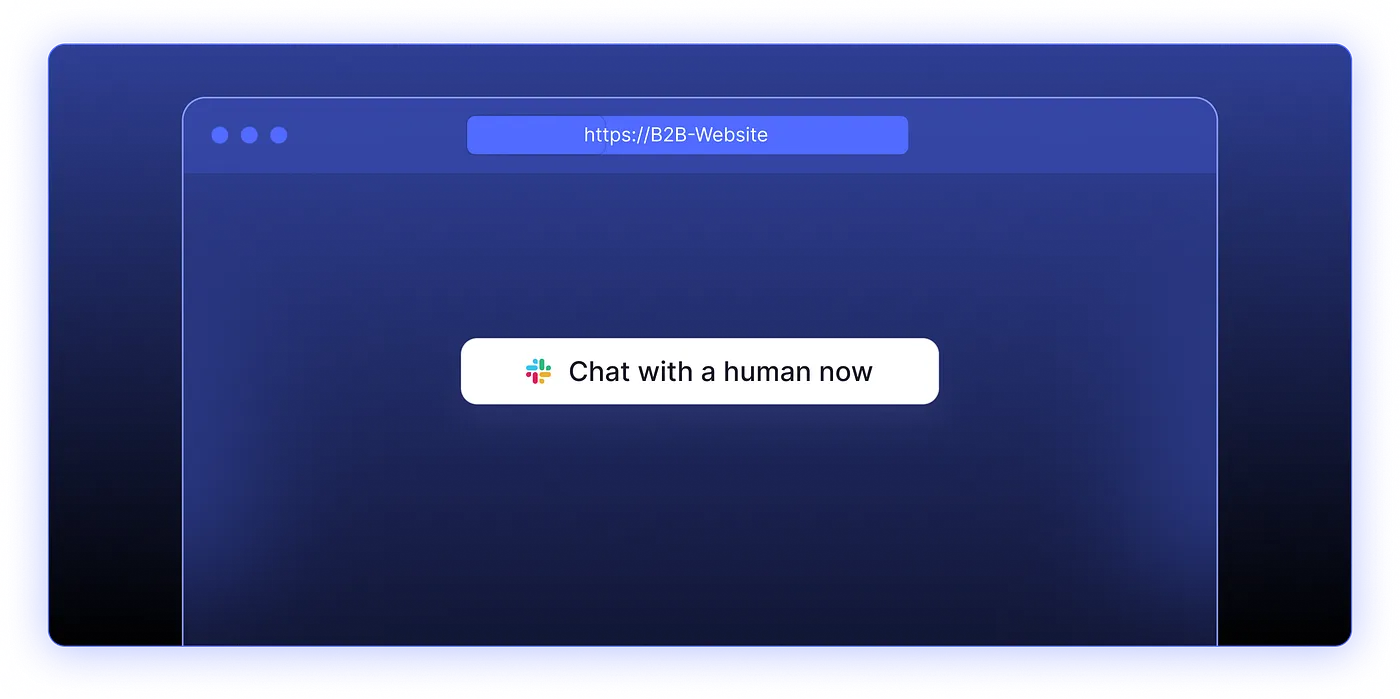
If your website forces them to “submit and wait,” you lose momentum. High-intent visitors should be able to act immediately. Replace form-first pages with direct paths: real-time chat, instant booking, and clear CTA buttons where intent peaks.
It sounds obvious, but it’s not standard. Conversion rates on B2B sites still average just 1.9% across industries and 1.1% in SaaS (Two). That’s the cost of unnecessary detours.
Use CTAs That Accelerate
Your calls to action communicate how seriously you take buyer intent. Outdated CTAs like “Book a Demo” or “Contact Us” imply a delayed handoff into a slow process.
The opposite approach works better: Knock’s 2025 benchmarks found that CTAs such as “Chat with an Expert,” “Talk to Us Now,” and “Get Started” outperform generic ones by 460%.
They work because they match the buyer’s mindset. They signal immediacy, confidence, and support, rather than bureaucracy.
Placement matters as much as copy. Smart websites don’t confine CTAs to one page. They embed them wherever intent is highest: navigation bars, hero sections, pricing pages, documentation, and even blogs.
When traffic is down, you can’t afford to waste the intent you do get. CTAs aren’t cosmetic. Every missed CTA is a missed revenue lever.
Treat Returning Visitors as Signals
Lack of memory is one of the biggest gaps in B2B websites. Most sites reset every time a buyer returns, forcing them to start over.
That’s a missed opportunity. Today’s tools can recognize and enrich visitors instantly through CRM-linked sessions, cookies, or enrichment platforms. If you already know who your visitors are, act like it.
Buyers do come back. 34% of leads revisit a website after submitting a demo request (Factors). That’s one in three prospects raising their hand again.
When past customers return, they’re signaling that something has changed. It may be their priorities, their budget, or their readiness to convert. Re-engage at that moment and you can shorten sales cycles, spark repeat business, and reinforce loyalty (Dealfront).
A revisit isn’t noise. It’s one of the strongest buying signals your revenue team will ever get. The question is whether your site ignores it, or uses it to accelerate a renewed conversation.
Use AI to Route Accurately
Buyers are comfortable interacting with AI if it gets them to value faster. The risk is when AI is misused: pretending to be human, blocking access to people, or trapping visitors in FAQ loops. It loses leads and erodes trust.
AI’s job is to make the path forward clearer. On your site, that means utility and transparency:
“I’m our AI assistant. I can answer product questions, connect you with a human, or share case studies for your industry. What would be most useful?”
Done right, AI enriches and qualifies in real time, routes based on fit and intent, and connects true buyers to the right rep instantly. It filters noise without creating barriers.
This balance matters because buyers are skeptical. Nearly 3 in 4 B2B buyers doubt vendor AI claims (TrustRadius). But engagement rises sharply when companies are transparent about how AI is used and keep humans in the loop.
The future isn’t AI replacing human reps. It’s AI ensuring the right human gets the right conversation, instantly.
Turning the Website Into Revenue Infrastructure
The website no longer drives discovery. That happens offsite, in the dark funnel, beyond your control. What the website does own is the decision moment. It’s the point where intent becomes action.
To deliver on that role, the modern website must:
- Recognize intent signals in real time
- Remove friction at the point of action
- Route buyers to the right person or resource instantly
- Convert without delay
Do this well, and your website stops acting like static real estate. It becomes revenue infrastructure, the connective tissue that turns fragmented research into decisive motion.
Stop measuring success by traffic or time on page. Those were marketing-era metrics. The modern website should be measured by revenue contribution: meetings booked, conversations started, and deals advanced.
As I wrote previously, the website’s role has shifted. Its value today lies in accelerating decisions and capturing intent the moment it surfaces. Discovery may happen offsite, but conversion is still yours to win or lose.


.svg)


.svg)
.svg)
.svg)


.svg)
.svg)

.svg)



.svg)


