Can AI Do Outbound SDR Outreach?
What deliverability, trust, and control reveal
The Hardest Place to Automate
Inbound starts with permission. Outbound doesn’t. It interrupts.
That difference matters because outbound has almost no margin for error. A single message that feels irrelevant or automated doesn’t just get ignored. It changes how the buyer feels about the brand behind it.
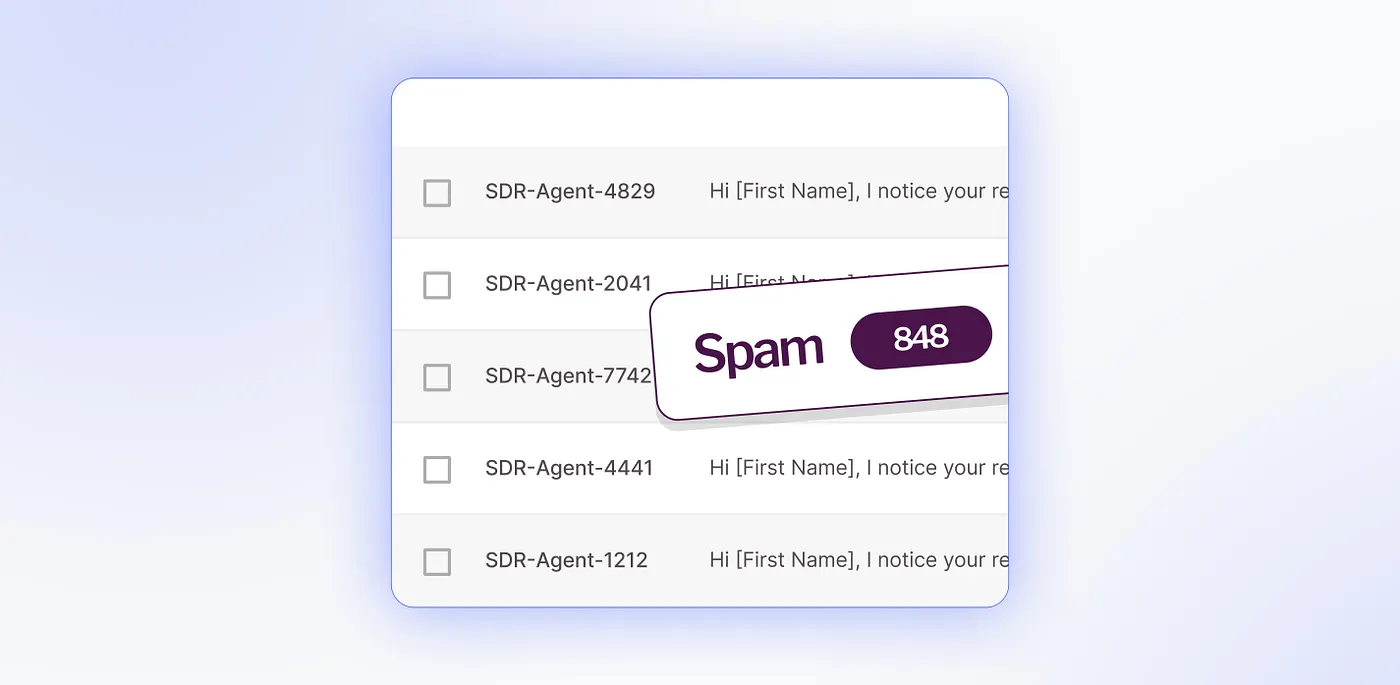
AI outbound often looks impressive in dashboards and disappointing in real inboxes. Sending more messages is easy. Sending messages that survive inbox filters, buyer skepticism, and brand scrutiny is not.
In our first piece of this series, we looked at whether AI agents can replace SDRs at all. Outbound is where that question stops being theoretical and starts getting expensive.
The Gate Most Teams Don’t See Coming
Most outbound debates focus on copy. But before a buyer evaluates relevance, inbox providers evaluate compliance.
Gmail has moved from warning-based enforcement to active rejection for bulk senders that fail authentication, unsubscribe handling, or complaint thresholds. Messages that don’t meet requirements aren’t just sent to spam. They’re blocked at the protocol level (EmailLabs).
AI outbound pushes teams toward higher volume by default. Without tight controls, teams don’t just risk low response rates. They risk losing inbox access entirely.
Many AI outbound failures stay invisible at first. Sent volume climbs. Dashboards look healthy. Meanwhile, inbox placement and brand reputation quietly erode.
Deliverability is the first gate AI outbound has to clear. Most teams don’t know they’ve failed until it’s too late.
Why Buyers Resist Before Reading
The resistance isn’t about grammar. It’s about how messages feel.
Sales communities report inboxes filled with messages that are technically fine but emotionally empty. Prospects aren’t just declining meetings. They’re disengaging faster and with less patience (Reddit r/sales).
This mirrors what’s happening in content. Audiences are tuning out anything that feels mass-produced, even when it’s relevant on the surface. People aren’t rejecting AI. They’re rejecting what signals low effort or unclear intent (Mostly Growth podcast).
Outbound sits right in that danger zone. Once a buyer senses automation without judgment, trust drops before they finish the first sentence.
LinkedIn posts capture the inbox reality: daily InMails that all sound the same, promising AI-powered automation without explaining what actually changes. The result is caution, not curiosity (LinkedIn).
That caution isn’t irrational. It’s learned behavior.
The Three Questions AI Can’t Answer
Buyers decide based on whether a message answers three questions quickly:
- Why are you contacting me?
- Why now?
- Why should I believe this is worth my time?
AI can generate sentences. It can reference LinkedIn activity, funding rounds, or podcast appearances. What it can’t do is invent a legitimate reason to reach out.
When personalization doesn’t connect to a real problem the buyer recognizes, it feels empty. A founding team member at an AI SDR company described receiving daily messages about unrelated personal details with no connection to actual business needs (Tech Ascent podcast).
Posts criticizing AI outreach complain about irrelevance dressed up as relevance. AI can personalize. It just can’t answer why this person, why this moment, why this message deserves attention.
Volume Without Judgment
The failure patterns look similar across different deployments.
The targeting expands
If the system can message anyone, it will. Without explicit suppression rules, outreach creeps into accounts that should never be contacted. The friction that made bad targeting expensive disappears. So does the discipline.
Personalization becomes performance
AI finds a data point and uses it. A recent post. A company milestone. A shared connection. But the reference doesn’t tie to a buying problem, so it comes across as shallow. Buyers recognize the pattern instantly.
Stop signals get ignored
Humans pick up hesitation. They notice when enthusiasm drops or when a prospect goes quiet after initial interest. AI keeps executing the sequence unless explicitly told to stop. What looks like persistence is often obliviousness.
Multi-channel becomes harassment
Email, LinkedIn, phone, Twitter. More channels don’t create more permission. They just multiply the interruption. Buyers don’t think “this person is persistent.” They think “this person won’t take a hint.”
These aren’t edge cases. They’re predictable outcomes when volume has no cost and judgment has no place in the loop.
The Noise Tax
The AI SDR market created a perception problem that everyone now pays for.
Early messaging in the category emphasized replacing human teams entirely. The result was widespread noise about AI SDRs that most buyers now associate negatively. Teams approach AI outbound already skeptical. The category burned trust before most buyers saw a demo.
A sales leader captured the bind: AI slop is killing sales, but sales orgs that don’t adopt AI will die. Companies that over-rotate to AI may find themselves marked as spam into oblivion. Companies that don’t rotate enough may find themselves sinking into irrelevancy (LinkedIn).
The tools promise leverage but the market delivers suspicion.
Where AI Actually Helps
When AI works in outbound, it handles the mechanics humans hate and mess up.
AI is great at:
- Assembling account context from scattered public signals
- Enforcing ICP rules consistently across large lists
- Generating structured variants to test positioning
- Maintaining clean follow-up timing without degradation
- Keeping data hygiene from becoming a bottleneck
Teams deploying AI successfully position it as infrastructure. AI handles execution. Humans handle strategy, targeting decisions, and when to adapt messaging.
Marketing teams report using AI SDRs to supplement human work rather than replace it, letting human SDRs focus on outbound while AI manages inbound qualification (The Agentic Marketer podcast).
The value is operational, rather than strategic.
What to Measure When You Want Truth
AI outbound looks impressive if you measure activity. It looks honest if you measure outcomes.
The signals that matter for outbound specifically:
Inbox placement and spam complaint rates by segment
If you’re getting blocked or flagged, volume is irrelevant. Most platforms don’t surface this clearly. You have to ask.
Reply quality
Ten “not interested” replies aren’t better than two real conversations. Count replies that move deals forward, not replies that close them down.
Meeting fit and show rates
Booked meetings mean nothing if prospects show up confused or unqualified. Track how many meetings turn into real opportunities.
Negative responses and unsubscribes
These aren’t noise. They’re signals that targeting or messaging broke. If they’re climbing, you’re damaging more than you’re building.
Conversion from first reply to qualified opportunity
This is where outbound lives or dies. If early engagement doesn’t convert, something in the system is lying about fit.
Marketing leaders track response rate alongside lower funnel metrics like pipeline opportunities and velocity, measuring how quickly things progress rather than just counting activity (The Agentic Marketer podcast).
The measurement framework hasn’t changed. What’s changed is how easy it is to fool yourself with volume metrics that don’t connect to revenue.
The Real Question
AI can do outbound SDR outreach. Whether your outbound motion deserves automation is the harder question.
The fundamentals of go-to-market haven’t changed. Targeting matters more than sophisticated messaging. Talking to the right person at the right time when they’re looking for a product matters more than clever personalization.
AI doesn’t fix outbound. It amplifies whatever system you already have.
If targeting is sharp and relevance is real, AI adds leverage. If the system is sloppy, AI helps you fail faster and more visibly.
Outbound is the clearest stress test. It exposes whether teams understand why they’re reaching out in the first place.
Most teams know who they want to talk to. They have personas and ICPs and segmentation models. What they’re missing is a legitimate answer to why this person should care right now.
AI can’t invent that answer. It can only execute around it.
The teams winning with AI outbound aren’t the ones with the best prompts or the most sophisticated personalization. They’re the ones who already knew exactly who to contact and why, and used AI to remove the friction from execution.
Everyone else is just sending more spam, faster.


.svg)


.svg)
.svg)
.svg)


.svg)
.svg)

.svg)




.svg)


