Can an AI Agent Really Replace an SDR?
Here’s What the Loudest Opinions Are Getting Wrong
The Question That Won’t Go Away
AI SDRs moved from experiments to defaults in less than a year. Teams that once debated whether to pilot are now deciding which vendor to deploy. The shift happened so fast that most organizations are still operating on assumptions instead of evidence.
Strong opinions formed before strong data. LinkedIn is full of founders declaring SDR teams obsolete. Reddit threads warn about spam floods and brand damage. Meanwhile, the teams actually running these agents are still figuring out what works.
The debate is happening in public while the learning is happening in private. That gap is the problem.
The Believers
The pro-AI argument is straightforward. SDR work is repetitive, mechanical, and well suited for automation. Why pay humans to write similar sequences, chase follow-ups, and update CRM fields?
Founders and operators share screenshots of agents booking meetings at scale. Podcasts celebrate teams that replaced SDR orgs with AI. One widely discussed example came from a January 2026 episode of Lenny’s Podcast, where Jason Lemkin of SaaStr described an experiment replacing most of a traditional SDR motion with AI agents. SaaStr reduced a small human sales team to just over one full-time role overseeing more than twenty agents.
The goal wasn’t to prove humans unnecessary, but to reduce churn and operational drag. Lemkin reported revenue results comparable to the previous setup, with lower costs and greater scalability. He also emphasized that the agents required daily oversight, prompt tuning, and constant iteration, and that complex selling still depended on human judgment.
The pitch is seductive. Instant scale. No ramp time. Always-on execution. Costs that look trivial compared to salaries.
Speed becomes the selling point. An AI agent responds in seconds, not hours. It doesn’t sleep, doesn’t take PTO, and doesn’t cherry-pick accounts. It treats every lead with the same energy, every time.
For believers, the math is simple. If an SDR’s job is to qualify, route, and book, AI does it faster and cheaper. Why wouldn’t you replace them?
The Skeptics
Sales leaders who’ve been in the trenches aren’t convinced. They’ve seen what happens when companies fire SDRs, flip on an agent, and assume pipeline will keep flowing.
Reddit sales communities are full of warnings. RevOps teams share stories of spam complaints spiking, prospects ghosting, and brand perception slipping. These concerns aren’t theoretical. They’re happening now.
Reddit moderators managing communities with millions of members report being overwhelmed with AI-generated content. Posts that once sparked genuine discussion now feel like algorithmic slop. One moderator estimates that up to half of all Reddit content may have been created or reworked with AI. Users say they can’t tell what’s real anymore and are spending less time on the platform (Wired).
Skeptics point to hallucinations, generic messaging, and tone-deaf follow-ups. They talk about lost trust, relationships agents can’t rebuild, and judgment calls that separate good outreach from noise.
Many are reacting to early, poorly designed deployments. Teams that assumed AI SDR meant plug and play and discovered it meant months of iteration. Skeptics care less about whether AI can send emails and more about whether those emails are worth sending.
What AI Does Better
Strip away the hype and fear and some patterns emerge.
AI agents are consistent. They don’t get distracted or burned out. Every interaction follows the same standard, which matters when SDR quality varies widely.
They remember everything. Context doesn’t disappear between handoffs. Buyers aren’t asked the same question twice because reps didn’t sync.
They follow up without bias. No cherry-picking hot accounts while others go stale. Every lead gets the same disciplined cadence.
AI competes with average execution, not great sellers. If your SDR team is elite and thoughtful, agents won’t replace them. But if execution is uneven or overwhelmed, AI raises the floor.
The Plug-and-Play Myth
This is where most failures begin. The belief that AI agents work out of the box.
They don’t.
Training an agent takes time. Teaching it your ICP, messaging, disqualification criteria, and handoff triggers is ongoing work.
Supervision matters. Agents drift. Messages can sound fine in isolation but feel off in context. They need monitoring, feedback loops, and regular tuning.
Replacing people without redesigning workflow creates chaos. If your SDR process was built for humans, dropping in an agent without changing the system guarantees breakage. The agent inherits unclear criteria, broken handoffs, and messy CRM hygiene. It just executes dysfunction faster.
Most AI SDR failures look technical but are actually organizational.
When Replacement Fails
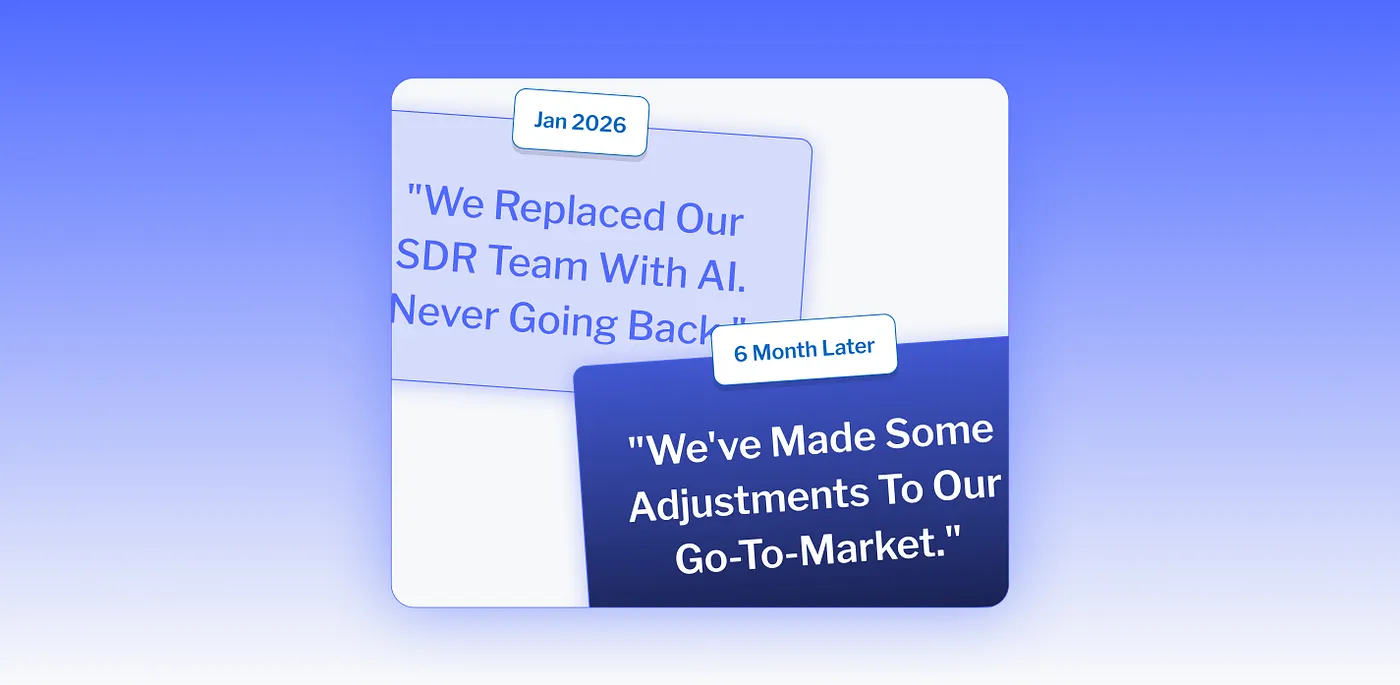
Public excitement followed by quiet reversals. That pattern is playing out across GTM teams.
Salesforce cut 4,000 customer support jobs and replaced them with AI agents. CEO Marc Benioff spoke openly about needing fewer heads to clear a backlog (TechRadar). He later walked back the idea that AI would end white-collar jobs, saying he sees radical augmentation instead (Business Insider).
That gap between public claims and private learning is telling. Companies announce they’ve replaced SDRs with agents. LinkedIn celebrates. Months later, reps are quietly rehired, agents are deprioritized, and no one explains what broke.
What breaks is judgment. Nuance disappears. The ability to read between the lines, escalate odd situations, and adapt mid-conversation vanishes.
Early wins mask deeper problems. Meetings get booked, but they don’t convert. Prospects show up confused or under-qualified. Pipeline looks healthy on the surface while close rates fall.
Trust erosion is harder to fix than efficiency loss. Once buyers associate a brand with generic AI spam, rebuilding credibility takes years. The same dynamic seen on Reddit is playing out in B2B sales. Speed doesn’t matter if the message destroys trust.
What’s Actually at Risk
Script-driven SDR work is most exposed. If the job is rigid sequences and mechanical execution, AI will do it better and cheaper. That work is going away.
Strong sellers don’t disappear. Their role changes. The best SDRs read situations, adapt tone, spot expansion, and build relationships that carry into the deal. Those skills become more valuable.
The new role is agent operator, not junior caller. Teams will hire fewer entry-level SDRs and more operators who train, monitor, and optimize agents. Execution shifts to orchestration.
The Middle Ground
AI works best as an execution layer. Let it handle mechanics like follow-ups, CRM updates, and scheduling. Humans should own judgment, escalation, and narrative.
Even Benioff now frames AI as augmentation (Business Insider). That reflects reality. Most successful deployments are hybrids. Agents handle first touch and qualification. Humans step in when nuance matters.
AI exposes whether your GTM system was ever designed to scale. If adding an agent breaks everything, the system was broken before the agent arrived.
Teams are ready to redesign how selling actually works when they stop asking whether AI can replace SDRs.
The teams that win will understand where AI executes better, where humans add irreplaceable value, and how to build a system where both work together without friction.
Most teams are still avoiding the design work. That’s where deals are lost.
This is the starting point. The real differences show up when you look at specific motions like outbound outreach and demo qualification, where the tradeoffs become much harder to ignore.


.svg)


.svg)
.svg)
.svg)


.svg)
.svg)

.svg)




.svg)


