Omnichannel? You’re Doing It Wrong.
Unified messaging means conversations follow the buyer, not the other way around.
The default B2B playbook says, “Meet your buyers everywhere.”
So your sales team uses LinkedIn, SMS, WhatsApp, and email to communicate with prospects. It sounds strategic — until the experience feels disconnected, redundant, and hard to track.
According to McKinsey, the average B2B buying journey now spans ten or more touchpoints. In fact, 42% of buyers use 11 or more different touchpoints throughout the process.
More channels = more opportunity, right?
Wrong. Without continuity, it just adds chaos. Buyers talk, then repeat, then get frustrated. Reps waste time. And your pipeline slowly bleeds out.
Stop the Reset Loop
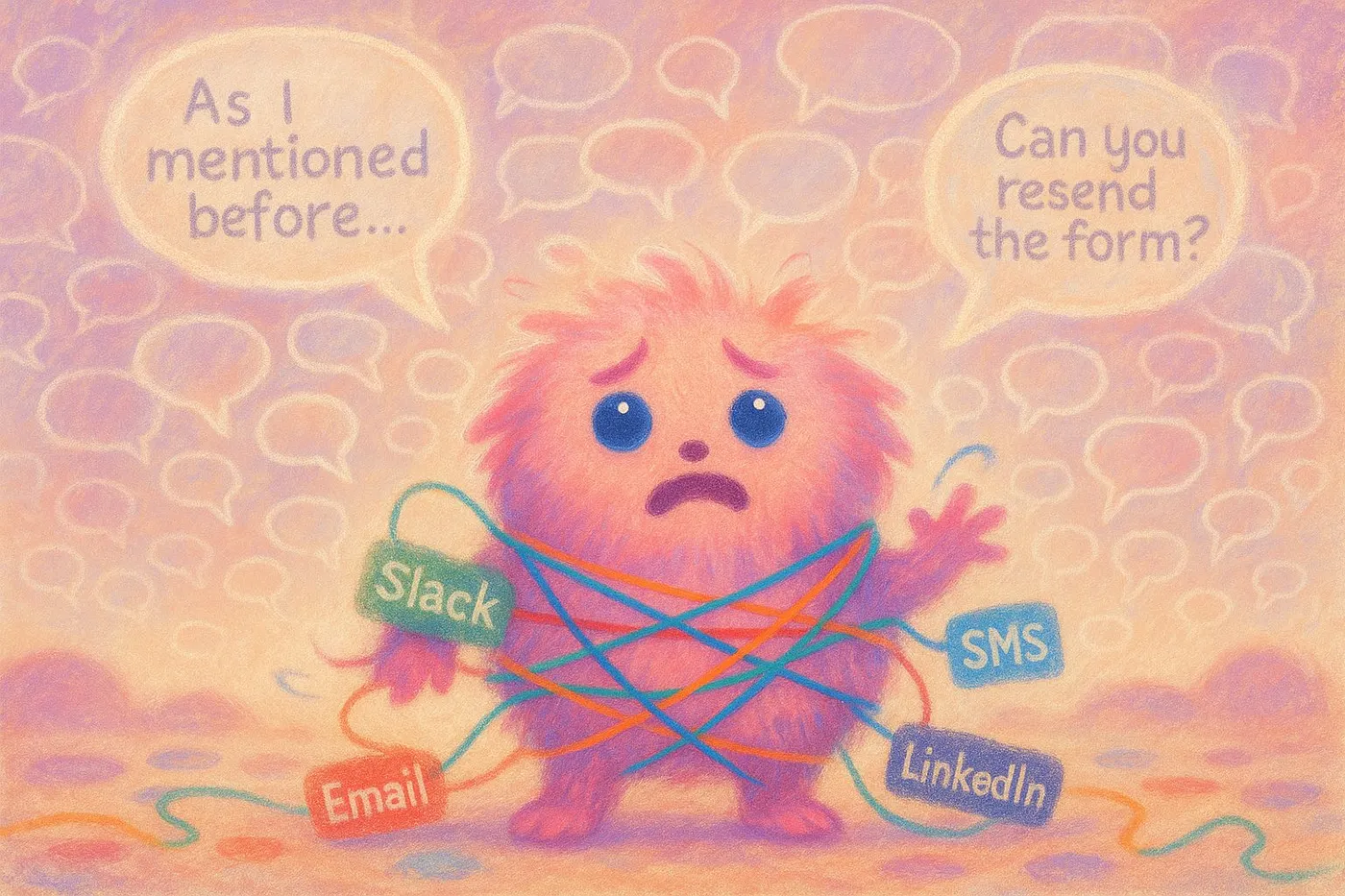
Your buyer chats on your website. Then follows up via email. Someone else DMs them on LinkedIn. By the time they finally get a demo, they’ve explained themselves three times, filled out two forms — and it all ends in one lost opportunity.
And worst of all? When the demo starts, it’s like none of it ever happened.
Each handoff hits the reset button. Every disconnected interaction loses context.
Meeting buyers everywhere sounds good in theory. In reality, it creates parallel, disjointed experiences that push buyers away.
Don’t Confuse Multichannel With Omnichannel
True omnichannel isn’t about adding more channels. It’s about conversation continuity.
Here’s what fragmented engagement looks like:
- Teams switching between tools, not building relationships
- A bloated tech stack with minimal visibility
- Buyers bouncing between touchpoints and repeating themselves
- Pipeline momentum that dies between handoffs
More channels don’t create more opportunity — they create more ways to lose the thread. Each handoff becomes another gap in the story.
Your Buyers Are Moving Faster Than You
The modern buyer journey is fragmented and fast-paced by default:
- Organic traffic is down by up to 64% as buyers get answers from AI
- Click-through rates have dropped 70%
- 70% of the buyer journey now happens with no direct vendor interaction
- 66% of companies run Slack and Microsoft Teams in parallel (Mio)
Your buyers are jumping between tools, channels, and AI assistants — on their terms, not yours. If your engagement feels disconnected, your buyers will feel it too.
What Continuity Actually Looks Like
You wouldn’t build software by stacking disconnected features. Engagement works the same way. A unified messaging layer connects the dots:
- One continuous thread that spans every brand touchpoint, from your website, Slack, LinkedIn, and beyond. Buyers return to the same channel and pick up right where they left off, with their full conversation history intact.
- Reps (both human and AI) operate with full visibility into every interaction. Everyone who engages with the buyer sees the same history, ensuring total alignment across the entire journey.
- Identity and intent are tracked from the first click.
No resets. No confusion. No wasted momentum. Just a consistent experience that builds trust and moves deals forward
McKinsey found that B2B companies delivering seamless experiences improve their market share by at least 10% annually. Buyers expect continuity. Deliver it.
Stop Adding Channels. Start Connecting Them.
The solution isn’t fewer tools. It’s fewer gaps.
Unified messaging means conversations follow the buyer, not the other way around. Context travels with them. Your team works from a shared thread, and buyers experience one seamless, uninterrupted conversation — from first touch to closed deal.
Winning B2B teams aren’t chasing more channels. They’re removing friction. They’re building the connection buyers crave, accelerating deals and building trust by design.
The best teams eliminate silos, close the gaps, and make every interaction feel like part of the same conversation. That’s how they keep buyers engaged and stay ahead of the pack.
Everyone else is getting left behind.
Stop the fragmentation. Build a buyer journey that flows. Because buyers can feel the gaps in your experience, and they won’t wait for your team to catch up.


.svg)


.svg)
.svg)
.svg)


.svg)
.svg)

.svg)


.svg)


