How to spot hesitation before pipeline slips
Many GTM teams don’t notice trouble until deals stall or fall apart. But what if you could detect hesitation early and step in while there’s still momentum to recover?
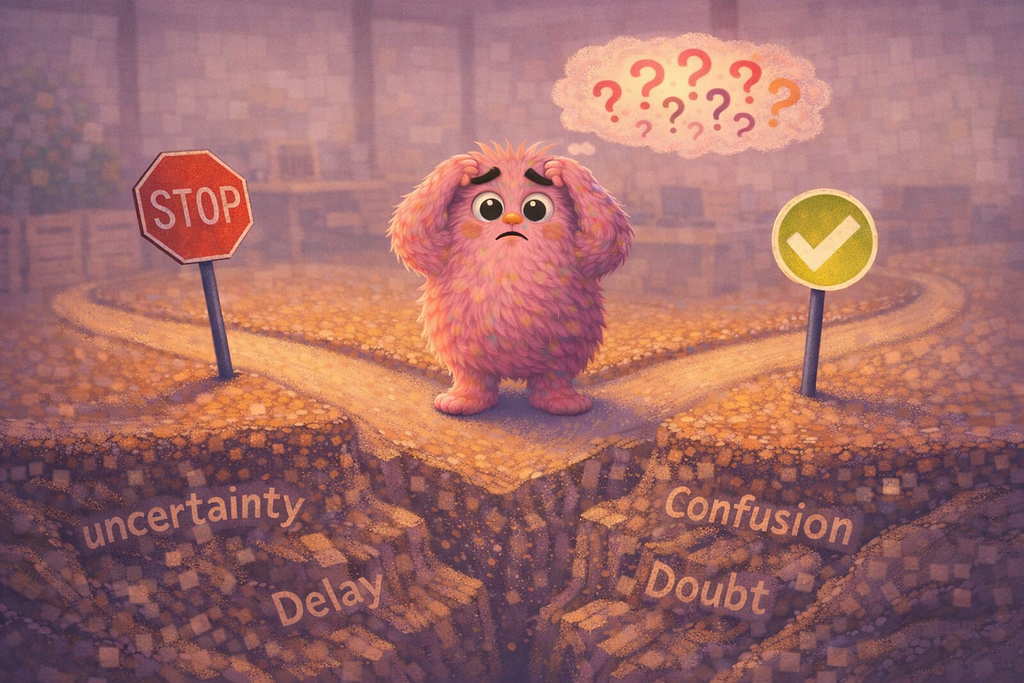
That question matters more than most teams think. 40 to 60% of deals are lost not to competitors, but to “no decision” (Harvard Business Review). Buyers can go through the entire sales process, signal intent, and then quietly fail to act.
Many deals don’t collapse at the end. They drift earlier, while everything still looks active on the surface.
Why Metrics Show Up Too Late
Most standard GTM metrics tell you what’s already happened. Dashboards summarize outcomes, but they don’t reliably signal risk. Funnel stages update only after buyers disengage, and speed or volume can still look strong even when confidence is fading. Replies keep coming, meetings still happen, and activity looks healthy on the surface.
The problem is structural. Much of the buyer’s decision-making now happens outside the systems teams rely on. Buyers can complete up to 70% of their journey before speaking to sales, shaping confidence long before pipeline reflects any change (The Insight Collective). When pipeline finally changes, it often confirms a decision that was already made.
Traditional metrics pick up change after hesitation turns into inaction. By the time teams see a deal stall, the window to intervene has already closed.
The Conversation Signals That Matter
Hesitation shows up first in the conversation. That’s why the most important early signals are conversational, not numerical.
Meaningful responsiveness
A fast reply isn’t always a useful one. What matters is whether the response helps the buyer make progress. Does it answer the question, reduce uncertainty, or clarify a next step? Or does it acknowledge the message without moving the decision forward?
Continuity
Buyers expect conversations to carry context forward, even when people or channels change. When a buyer has to repeat information, reframe their situation, or restate goals, confidence drops. These moments can lead to silent disqualification, where buyers lose trust and move on without saying a word (G2 Tech Signals). Continuity tells the buyer your team is connected, even when the people change.
Forward motion
Healthy conversations narrow over time. Questions become more specific. Tradeoffs get clearer. Next steps feel concrete. When exchanges stop creating clarity and start introducing delay or confusion, hesitation is often already there.
Multiple people can be involved in a deal. What matters is whether the experience feels coherent and directional. When these signals weaken, it’s rarely sudden. It shows up gradually, message by message, long before a deal formally stalls.
The Minimum Metrics Layer
The goal isn’t to measure everything. It’s to translate these conversation signals into a small, practical layer that helps teams notice risk early, without adding extra reporting.
Time to a meaningful response
Not how fast a reply arrives, but how long it takes for the buyer to receive an answer that helps them move forward.
Buyer repetition rate
How often buyers restate information, goals, or context they’ve already shared. Repetition is a sign that continuity has broken down.
Slowdown after transitions
Drops in engagement after handoffs, escalations, or channel changes often signal growing uncertainty, not loss of interest.
Conversations without a clear next step
When exchanges continue without a decision, commitment, or defined outcome, momentum often fades long before a deal officially stalls.
These signals can surface fragility, rather than scoring performance. They help teams focus attention where momentum is at risk, instead of spreading effort evenly across the funnel.
What Buyer Feel Really Means
Buyer feel isn’t about sentiment scores or post-deal surveys. It’s about how the conversation behaves over time.
In a healthy conversation, uncertainty shrinks and each exchange makes the decision clearer than the last. Context carries forward. The buyer doesn’t just stay engaged, they get closer to making a decision.
When that pattern breaks, hesitation starts to show up as friction. Questions repeat. Progress slows. Next steps exist, but they don’t resolve anything meaningful. Fear of making the wrong choice and a lack of clarity keep buyers engaged while quietly delaying commitment (Ironpaper).
Tracking buyer feel means noticing these shifts while they’re still reversible. It’s about noticing whether the conversation is doing its job of helping the buyer decide.
What to Stop Measuring
Some metrics are easy to track but don’t tell you much about buyer confidence.
Message volume can look healthy even when conversations aren’t helping buyers decide. More messages don’t automatically mean more progress.
Funnel stage velocity can be misleading. A deal moving quickly between stages may still be fragile if the buyer hasn’t resolved key uncertainties.
Response metrics that reward speed alone favor quick acknowledgments over useful answers. Fast replies that don’t add clarity can actually increase hesitation.
Channel performance measured in isolation misses how buyers really experience engagement. Buyers don’t think in channels. They experience one conversation. Measuring each channel separately often hides where continuity breaks down.
These metrics describe activity. They don’t tell you whether a buyer is actually moving closer to a decision.
Putting the Ideas into Practice
Teams that use these signals focus on timing and judgment. They watch for moments when a conversation can still be guided, clarified, or unstuck.
They pay attention while buyers are still responding and asking questions, when hesitation is visible but not yet fixed in place. That’s when a small adjustment in tone, clarity, or direction can change the outcome.
They recognize that buyers decide based on confidence, not just past activity. Buyers want clarity about what happens next. When that certainty is missing, hesitation shows up early, even if pipeline and dashboards still look fine (SCD Advisory).
They also stay aware of how AI shows up in the exchange. When it helps move things forward, it earns trust. When it introduces repetition, shallow replies, or generic follow-ups, that friction becomes a signal worth acting on.
Early responses get extra care. The focus is on helping the buyer understand tradeoffs and next steps, not following a script.
Attention isn’t spread evenly across every deal. It’s directed to moments where momentum feels fragile: transitions between people or channels, conversations with open-ended next steps, or exchanges that stop narrowing toward a decision.
This approach means showing up with the right support at the moments that matter most to the buyer. Deals rarely fall apart at the end of the funnel. They fade earlier, when hesitation goes unnoticed and confidence erodes.
Teams that succeed notice these shifts sooner. They watch how conversations move, where they slow down, and whether they’re actually helping buyers decide. That’s how momentum is protected, and where deals are really won.


.svg)

.svg)
.svg)
.svg)


.svg)


.png)
.svg)



.svg)
.svg)


