How to shift KPIs, retrain reps, and rebuild reporting once the formless funnel is working.
Part 4 of the Formless Funnel series. Part 1 defined the model. Part 2 showed why teams are switching. Part 3 covered the mechanics. This one is about the team running it.
Once the funnel works, the old job titles, the old dashboards, and the old quarterly reviews all start to feel off. Form fills drop, page views shrink, session times shorten, and someone in the leadership meeting asks if marketing is broken. It isn’t. The funnel is doing what it’s supposed to do. What’s broken is the reporting layer wrapped around it.
Here’s what to measure now, what to drop, and how to move forward without losing the team in the process.
The old numbers tell the wrong story
MQLs counted because forms were the only way buyers raised their hands. Now they’re not. Form fills can drop because the funnel is working better, not worse. We’ve made the case before that the MQL has stopped doing useful work as a leading indicator. In a formless world, that argument compounds.
The same logic applies to page views, session time, and content consumption metrics. Buyers used to read three articles and a whitepaper before raising a hand, so we tracked that as a proxy for intent. In a formless funnel, they ask the question directly and get an answer. The long browsing sessions shrink. That’s the funnel working as designed. Reporting on any of it like nothing changed makes your numbers tell a story that isn’t true.
Three questions, one dashboard
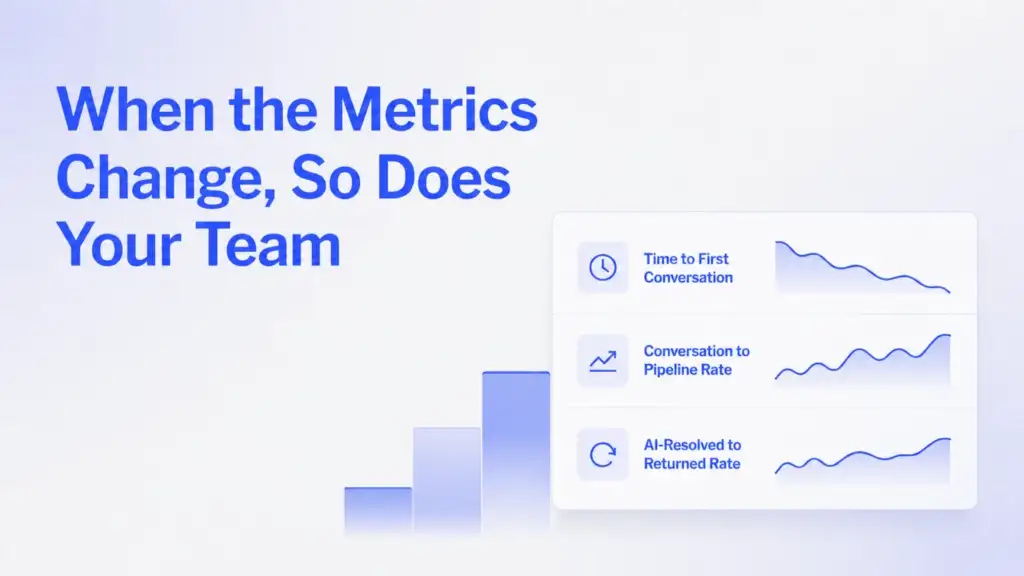
The old dashboard answered one question (did the form convert?). The new one comes down to three.
How fast did the buyer get to a real conversation? Time-to-first-conversation is the new speed-to-lead, and it’s a sharper number because there’s no form submission to clock against. It runs from first message to live exchange, whether that’s with AI or a human. Watch this weekly. If it creeps up, something is wrong upstream: routing, rep availability, or the AI handing off too aggressively.
How many of those conversations turned into pipeline? Conversation-to-pipeline rate is the closest replacement for MQL-to-SQL, but it measures something more honest. A conversation is a buyer who actually engaged, not a buyer who filled in a field to download a PDF. The rate will look lower than your old MQL-to-SQL number at first, and that’s the point. The denominator is real now.
Of the conversations the AI handled end to end, how many came back to sales later? Call this AI-resolved-to-returned. It tells you whether the AI is doing genuine work or just deferring the conversation. A healthy rate means the AI is closing loops the team would have spent time on. A spike means the AI is sending buyers away who needed a human, and they’re coming back warmer or, more often, not at all.
Three numbers, weekly review. That’s your new dashboard.
Attribution gets honest
Volume metrics flatten. Attribution gets more accurate, not less.
Most teams have been working with a blind spot for years. Etracker’s 2025 cookie consent benchmark study found that an average of 60% of visit data is lost with legally compliant banners. That’s before factoring in off-site channels (communities, podcasts, dark social, partner sites) that rarely get credit at all. The model was telling you a story, just not a true one.
The formless funnel converts buyers directly from the channel they’re already on, so you see which source actually drove the conversation. Attribution shifts from “they filled out a form on this campaign” to “they started a conversation from this page or this channel.” The picture gets closer to reality than form-based attribution ever was. Campaign performance gets judged on whether it created meaningful conversations, not how many leads it dumped into the CRM.
How rep roles change
SDRs aren’t chasing form fills anymore. They’re stepping into conversations that are already warm, qualified, and mid-thread. The motion is different. So is the skill set.
What that looks like in practice: a rep gets pinged into a thread where the AI has already exchanged six messages with a VP of Sales evaluating the product for her inbound team. The buyer’s name, role, company size, tech stack, and use case are all on the thread. The rep’s job is to read the context in under a minute, find the open question the AI didn’t fully resolve, and pick up exactly there. The first message can’t be “Hi, I’d love to learn more about your team.” It has to move the conversation forward from where the buyer left off.
AEs join earlier and skip the rediscovery call. The discovery call becomes a deeper exploration, not a fact-finding mission, because the basic facts already traveled with the thread. Reps who can do this well close faster. Reps who can’t will keep restarting from scratch and wondering why the buyer goes cold.
The roles don’t disappear, they shift. We covered the design problem in detail in How to Actually Make an AI SDR Work, and the principle holds at the team level too. AI handles the volume. Humans handle the judgment calls.
How team structure shifts
The SDR-to-AE handoff gets shorter. Sometimes it disappears entirely. When the AI has already qualified the buyer and the conversation is live, there’s no reason to route to an SDR who then schedules a call with an AE three days later. The AE joins the thread. The handoff that used to be a process becomes a routing decision.
That shift surfaces a new function. Someone has to own the conversation layer: the routing logic, the AI’s conversation design, the enrichment rules, the threshold for AI-to-human escalation. In most companies this lands with RevOps, but only if you draw the line clearly. This sits outside classic marketing ops and classic sales ops. It’s the operating system the funnel runs on, and it needs a clear owner who can make changes without three approvals.
Marketing and sales stop fighting over the handoff because there isn’t one anymore. They’re working the same thread. The org chart catches up to the funnel, not the other way around.
The playbook: make the transition without breaking the team
Run your old metrics and your new ones side by side for a quarter. Don’t rip the old dashboard out on day one. Leadership has been making decisions off MQLs, page views, and session time for years, and the only way to translate those instincts is to show both numbers next to each other long enough for people to see how they move together. A quarter is usually enough.
Pick three KPIs and write them down. Conversation-to-pipeline rate is a good place to start. Time-to-first-conversation and AI-resolved-to-returned rate are the other two worth committing to early. Three is the limit. The point is forcing a real conversation about what you’re optimizing for, not building another dashboard nobody reads.
Retrain reps before you change how they’re paid. This is where most transitions fail. SDRs who came up chasing form fills don’t automatically know how to step into a conversation that’s already in motion. They need to read context fast, pick up a thread mid-sentence, and resist the urge to restart discovery. Build that muscle through call reviews and shadowing before compensation plans get rewritten, not after. A useful exercise: pull five recent threads, hand them to a rep, and ask what their first message would be. The gaps tell you what to coach.
Name who owns the conversation layer. Don’t assume RevOps has it. Someone has to own routing logic, conversation design, enrichment rules, and the handoff (or non-handoff) between AI and human. In most companies this lands with RevOps, but only if you say it out loud. If nobody owns it, the conversation layer drifts and the funnel stops working.
Tell finance and the board before the numbers drop. MQLs are going to fall. So are page views and session time. If the first time leadership hears about it is in the quarterly review, you’ve lost the argument before you’ve made it. Brief them on what’s changing and why before the metrics move, and bring the new KPIs with you when you do.
Closing the loop
Throughout this series, the through-line has been simple. The form was a workaround for a constraint that no longer exists. Once you remove it, everything downstream changes: how buyers enter, how qualification happens, how routing works, how reps spend their time, and what you measure to know if it’s working.
Each shift pulls the next one along. You can’t run a formless funnel with old MQL targets, you can’t measure the new KPIs without changing how reps work, and you can’t change how reps work without giving someone ownership over the conversation layer. Teams that try to pick and choose end up with a half-built system that looks worse on every dashboard than the one it replaced.
Getting this right means rebuilding what you measure, who owns what, and how the team operates around a conversation that doesn’t end. A chatbot bolted onto the old funnel won’t do it. The form is gone. The funnel is still there. It just looks like a thread now, and the team running it looks different too.
The technology is the easy part. The operating model underneath it is where the real shift happens.


.svg)


.svg)
.svg)
.svg)


.svg)
.svg)

.svg)




.svg)


