6sense Review: Is It Worth It for B2B Sales Teams in 2026?
TL;DR
What is 6sense? A B2B revenue intelligence platform that uses intent data, predictive AI, and account intelligence to identify in-market buyers and help sales and marketing teams prioritize accounts.
6sense Pricing: Estimated annual pricing ranges from around $11,000 to $177,000+, depending on the package, data credits, and usage requirements.
Best features: Intent data and Signalverse, predictive account scoring, sales intelligence, account-based advertising, AI Email Agents, and automated GTM workflows.
Main 6sense drawbacks: Reported contact-data accuracy issues, limited visibility into predictive scoring, reporting gaps, a steep learning curve, and high costs.
6sense reviews: G2 reviewers praise its account intelligence and intent signals, while some raise concerns about data reliability, usability, and reporting. Trustpilot and Reddit feedback also highlight contact-data concerns and questions about ROI.
Best alternative to 6sense: Knock AI connects buyer identification, intent detection, enrichment, AI-led qualification, conversational engagement, scheduling, intelligent routing, and funnel attribution to help teams turn buyer interest into qualified conversations and pipeline.
Our verdict: 6sense is a strong choice for B2B companies with mature account-based marketing programs that need predictive account intelligence and coordinated campaigns. If your priority is turning buyer intent into qualified conversations, meetings, and measurable pipeline, Knock AI is worth evaluating.
What Is 6sense?
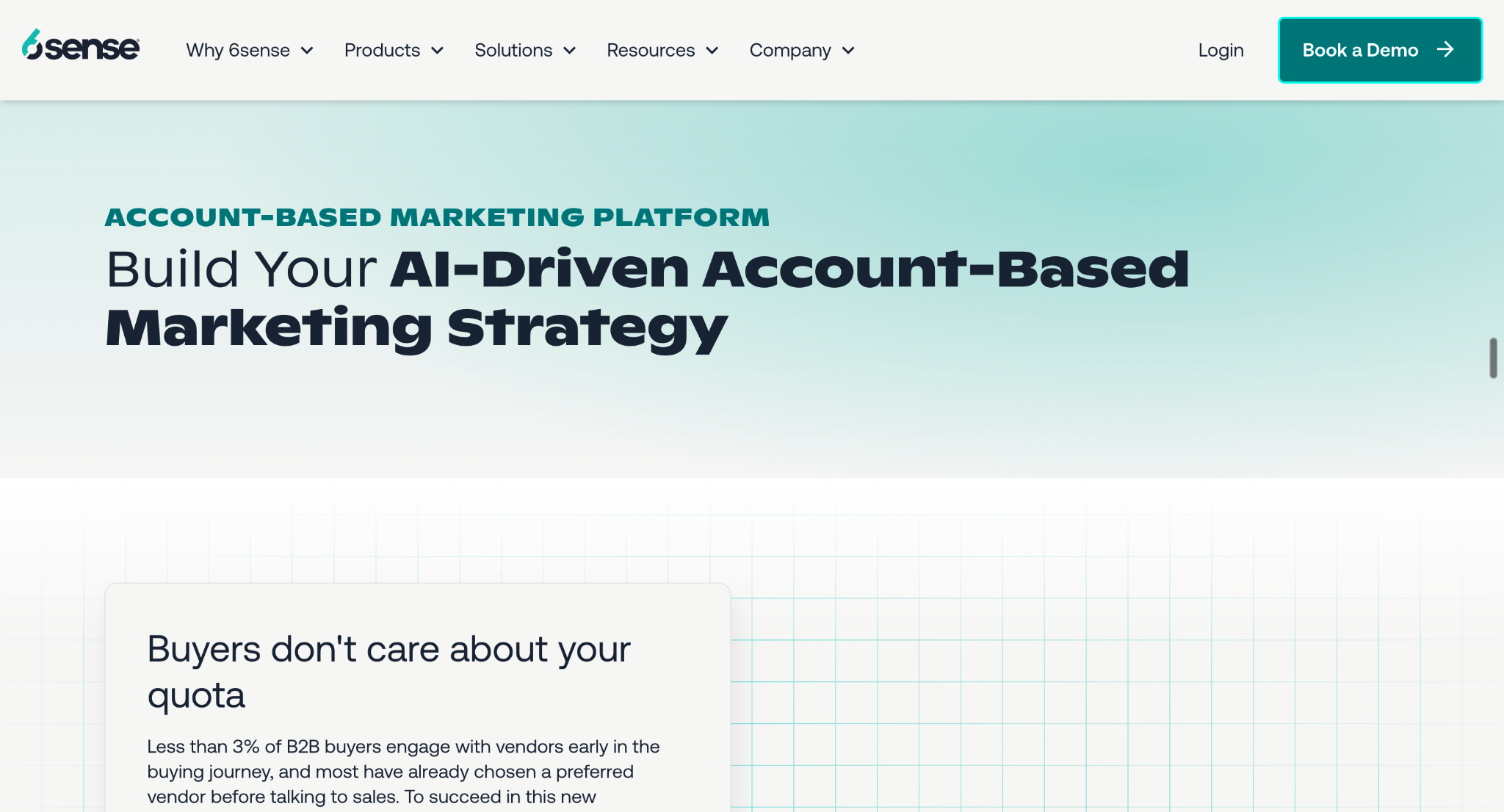
6sense is a B2B revenue intelligence platform that helps sales and marketing teams identify potential buyers, understand their purchase intent, and engage them before they are ready to speak with sales. Instead of relying only on form submissions or known leads, 6sense analyzes buyer signals, account data, and predictive AI to help businesses identify which companies are researching their products and when they may be ready to buy.
The platform brings together account intelligence, intent data, predictive analytics, sales intelligence, advertising, and marketing automation. Teams can use these insights to prioritize target accounts, identify buying groups, personalize campaigns, and coordinate engagement across sales and marketing channels. Its broader goal is to help B2B companies create, manage, and convert pipeline into revenue.
What Is 6sense Used For?
6sense is primarily used by B2B sales, marketing, and revenue operations teams to make account-based go-to-market (GTM) strategies more data-driven. Common use cases include:
Identifying in-market accounts: Use buyer intent signals and predictive analytics to identify companies that may be actively researching a product or service.
Prioritizing sales outreach: Help sales teams focus on accounts that fit their ideal customer profile and show signs of purchase intent.
Running account-based marketing campaigns: Build target audiences and coordinate personalized advertising and marketing activities around specific accounts and buying stages.
Discovering buying groups: Find relevant contacts and understand which people and roles may be involved in a purchasing decision.
Automating sales and marketing workflows: Trigger campaigns, email engagement, sales actions, and CRM updates based on account activity and buying signals.
Measuring pipeline performance: Connect marketing and sales activity with opportunities and revenue to understand which accounts and campaigns are contributing to results.
In practice, a company selling enterprise software could use 6sense to identify organizations researching solutions in its category, determine which accounts are most likely to buy, and coordinate advertising and sales outreach around those accounts.
Who Owns 6sense?
6sense is a privately held software company, legally known as 6sense Insights, Inc. It is backed by institutional investors rather than being publicly traded. Its investors have included Insight Partners, Battery Ventures, Venrock, D1 Capital Partners, Sapphire Ventures, Tiger Global, Blue Owl, and MSD Partners.
Because 6sense is privately held, its ownership is distributed among founders, employees, and investors. The company does not have a publicly traded stock ticker.
Where Is 6sense Headquartered?
6sense is headquartered in San Francisco, California, United States. It also operates internationally, with offices including Austin, New York, London, Pune, and Bengaluru.
When Was 6sense Founded, and Who Founded It?
6sense was founded in 2013 by Amanda Kahlow, Viral Bajaria, and Premal Shah, along with other members of its founding team. The company grew out of an opportunity to apply predictive analytics to B2B sales and marketing.
The idea took shape after Amanda Kahlow identified a business need while working on a big-data consulting project for Cisco. Traditional sales and marketing systems largely depended on known leads and direct engagement, leaving teams with limited visibility into companies researching products before contacting a vendor.
Kahlow had the business problem and an initial case for solving it. Viral Bajaria and the engineering team brought experience in big data and predictive analytics through their earlier startup, GrepData. The teams came together to build a platform that could use behavioral signals and machine learning to predict which companies were likely to buy and help sales and marketing teams engage them at the right time.
The name 6sense reflects this original idea: giving revenue teams a kind of sixth sense about which prospects are likely to purchase, what they may be interested in, and when they should be approached.
Since its launch, the company has expanded beyond predictive intelligence into a broader revenue technology platform spanning account intelligence, advertising, sales intelligence, marketing orchestration, and AI-driven engagement.
What Is 6sense's Revenue?
6sense is a private company, so it does not publish the same level of financial reporting as a publicly traded business. However, it has disclosed some revenue milestones.
In March 2024, 6sense announced that it had surpassed $200 million in annual recurring revenue (ARR) during its fiscal year ending January 31, 2024, reporting 40% year-over-year revenue growth for that fiscal year.
For a more recent estimate, Sacra reported that 6sense reached approximately $265 million in ARR at the end of 2025, representing an estimated 8% year-over-year increase. This is a third-party estimate, not a company-reported 2025 financial result.
These figures refer to annual recurring revenue, not necessarily total recognized revenue under accounting standards. The distinction matters when comparing 6sense with companies that report annual revenue.
How Much Funding Has 6sense Raised?
6sense has raised hundreds of millions of dollars to expand its platform, develop its technology, and grow its market presence.
Its most notable funding milestone came in January 2022, when the company announced a $200 million Series E round that valued it at $5.2 billion. The round was co-led by Blue Owl and MSD Partners, with participation from investors including SoftBank Vision Fund 2, B Capital Group, Franklin Templeton, Harmony Partners, Insight Partners, Tiger Global, D1 Capital Partners, and Sapphire Ventures. At the time, 6sense said its cumulative funding had reached $426 million.
Third-party company databases put its cumulative funding at approximately $524 million to $526 million, depending on their treatment of later financing, including debt. This total should be treated as a database-reported figure rather than a new equity funding announcement.
The scale of its funding and revenue reflects 6sense's position in the B2B revenue technology market. But company size alone does not determine whether the platform is the right fit: buyers still need to evaluate its data quality, implementation requirements, pricing, and how well its capabilities match their sales and marketing workflows.
6sense Products and Solutions
6sense combines B2B buyer intelligence, predictive AI, sales prospecting, and marketing automation to help revenue teams identify in-market accounts and engage them at the right time. Its capabilities span the entire GTM process, from identifying anonymous buying activity to launching campaigns, prioritizing sales outreach, and measuring pipeline impact.
6sense Core Features
Feature
What It Does
Best For
Intent Data and Signalverse
Combines first-party activity, third-party intent, company data, and contact signals to reveal which accounts are researching relevant topics and potential solutions.
Demand generation marketers, ABM managers, SDRs, and AEs
Predictive Analytics (6AI)
Uses AI to predict which accounts are most likely to buy, their buying stage, and which personas sales and marketing should prioritize.
Revenue operations, sales leaders, demand generation teams
Account Prioritization
Ranks accounts using buying signals, ideal customer profile (ICP) fit, persona engagement, and recent activity so reps can focus on promising opportunities.
SDRs, BDRs, AEs, and sales managers
Company and People Search
Helps reps find target companies, identify decision-makers, discover buying-group members, and access available contact information.
SDRs, BDRs, AEs, and sales researchers
List Builder
Builds dynamic prospecting and account lists using firmographics, technographics, intent, buying stage, and campaign engagement.
SDRs, BDRs, sales operations, and demand generation marketers
Sales Alerts
Notifies sellers when target accounts show meaningful activity, such as researching topics, visiting the website, or entering a buying stage.
SDRs, BDRs, AEs, and account managers
Sales Copilot
Surfaces account summaries, AI recommendations, and relevant intelligence to help sellers research prospects and prepare personalized outreach.
SDRs, BDRs, AEs, and sales leaders
Digital Advertising
Targets relevant B2B accounts across supported advertising channels, including display, social, and connected TV, using account intelligence and buying signals.
Demand generation, ABM, and paid media teams
Audience Builder
Creates dynamic audience segments based on ICP fit, intent, buying stage, website behavior, and campaign engagement, with activation across supported ad platforms.
Demand generation, ABM, and performance marketing teams
AI Email Agents
Generates and sends personalized emails, handles replies, qualifies prospects, and supports automated follow-up using buyer signals and brand context.
SDRs, BDRs, outbound teams, and demand generation marketers
Intelligent Workflows
Automates actions across advertising, email, CRM, marketing automation, and sales engagement tools based on buyer activity and account changes.
Marketing operations, sales operations, and RevOps
Smart Form Fill
Enriches website forms with available company and contact information, helping reduce the number of fields visitors must complete.
Demand generation, inbound marketing, and marketing operations
Reporting and Analytics
Tracks campaign engagement and connects marketing activity with pipeline and revenue outcomes.
Marketing leaders, campaign managers, and RevOps
RevvyAI
Lets users ask questions about accounts, intent, campaign performance, and GTM data in natural language, with supported actions available through the interface.
Marketers, SDRs, AEs, and revenue operations teams
See Knock AI in Action — Book Your Live Demo Today
Beyond individual features, 6sense packages its capabilities around broader sales and marketing objectives.
Solution
How Teams Use It
Primary Users
Account-Based Marketing (ABM)
Identify high-value accounts, build buying-group audiences, and coordinate targeted campaigns across channels.
ABM managers, demand generation marketers, and marketing leaders
Inbound Marketing Automation
Identify potential buyers, enrich inbound data, reduce form friction, and support timely follow-up and qualification.
Inbound marketers, marketing operations, and SDRs
Outbound Sales Automation
Prioritize in-market accounts and use AI-assisted email outreach and automated workflows to engage prospects.
SDRs, BDRs, and outbound sales leaders
Deal Acceleration
Monitor buying signals and account engagement to help sales teams identify opportunities to move active deals forward.
AEs, account executives' managers, and sales leaders
Customer Expansion
Identify cross-sell and upsell opportunities by monitoring customer activity and potential buying signals.
Account managers, customer success teams, and expansion sales teams
6sense's Most Important Features Explained
1. Intent Data and Signalverse
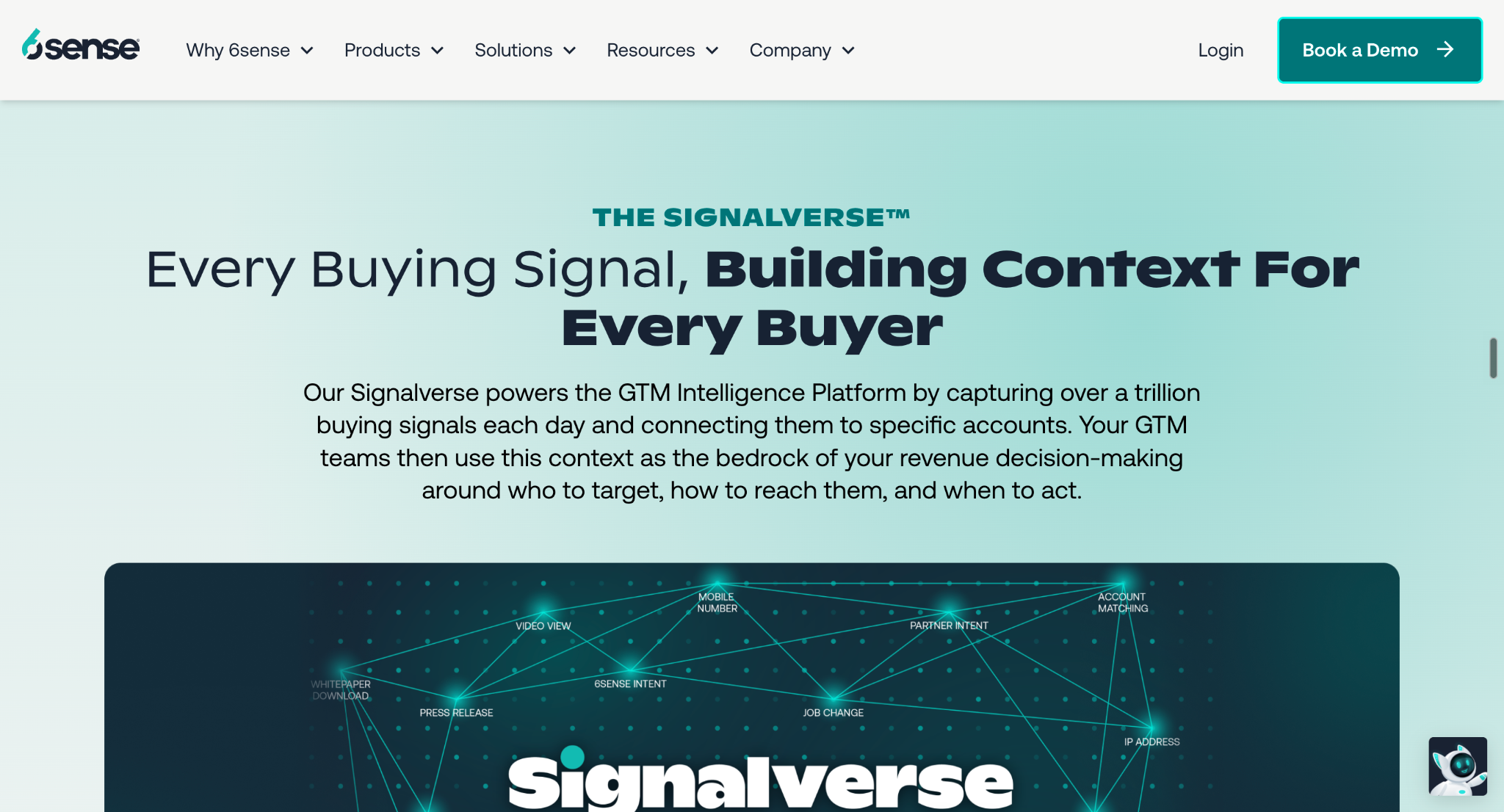
6sense Signalverse is the data foundation behind the platform. It combines 6sense's B2B intent data with company and contact information, technographics, and signals from a company's own CRM, marketing automation platform, website, and other sources.
The goal is to help revenue teams understand which companies are researching relevant solutions, what they may be interested in, and whether their activity indicates a potential buying opportunity.
Best for: ABM marketers, demand generation teams, SDRs, and BDRs looking for accounts showing buying intent.
2. Predictive Analytics and Account Prioritization
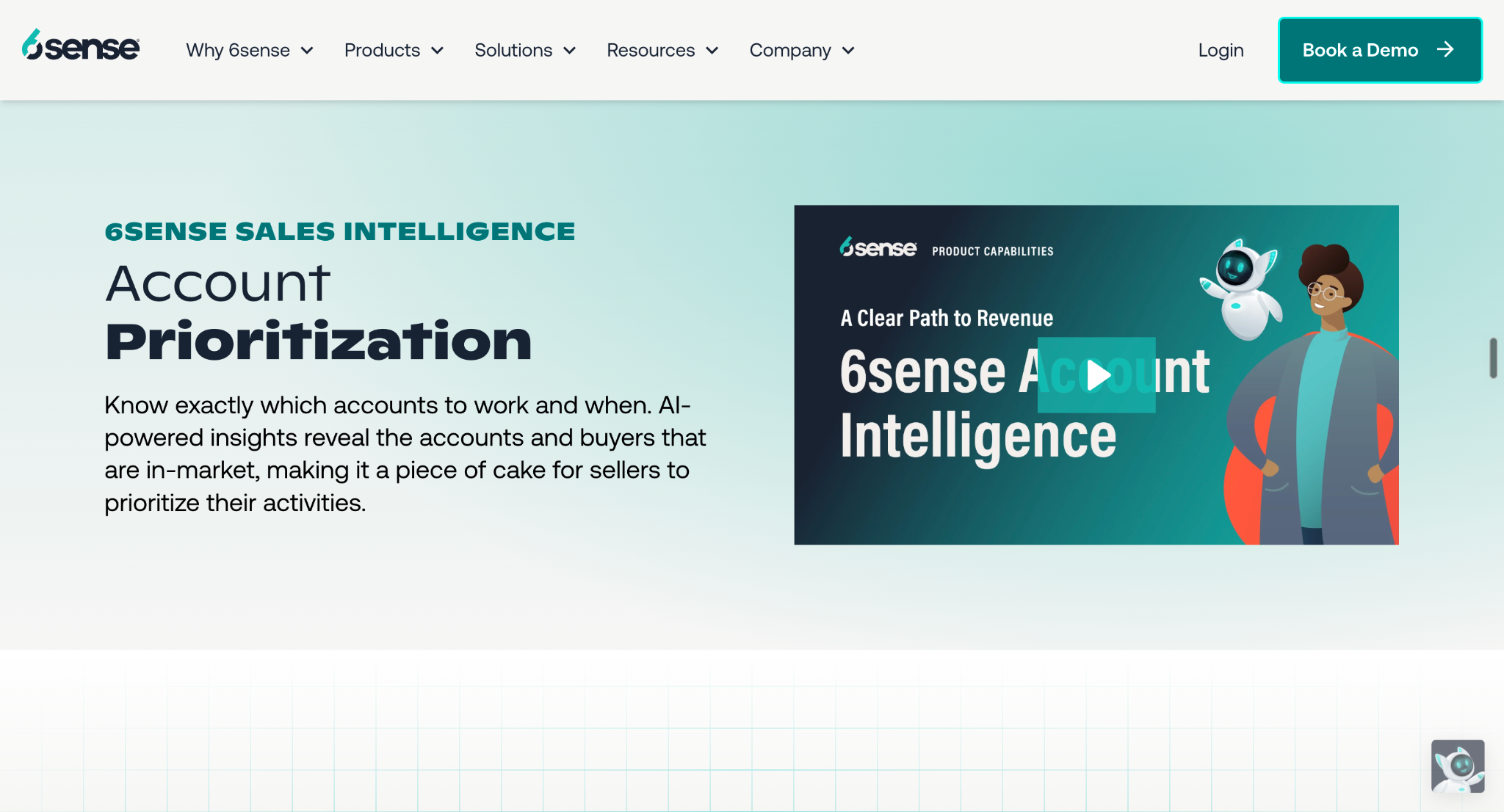
6sense Predictive Analytics uses AI to analyze buying signals and historical patterns to predict which accounts are more likely to purchase. Its account prioritization capabilities help teams focus on accounts based on factors such as fit, intent, and buying stage.
For sales teams, this can help answer a practical question: which accounts deserve attention first? Marketing teams can also use these insights to prioritize audiences and align campaigns with different stages of the buying journey.
Best for: SDRs, BDRs, AEs, demand generation marketers, and revenue operations teams.
3. Sales Intelligence and Prospecting
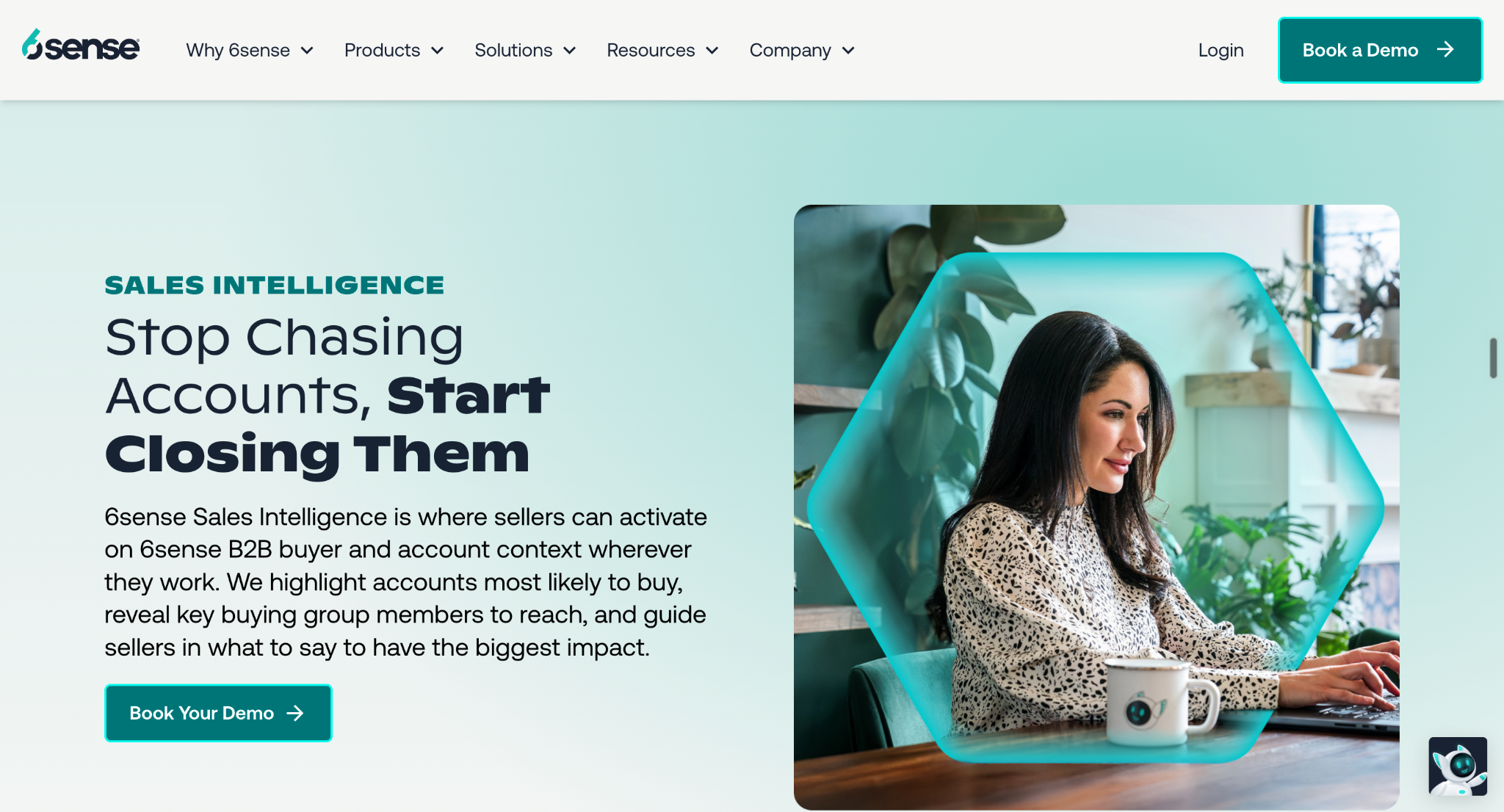
6sense Sales Intelligence helps sales teams research target accounts, discover relevant contacts, and identify potential buying-group members. Features such as Company and People Search, List Builder, Sales Alerts, and Sales Copilot support different parts of the prospecting workflow.
For example, an SDR can build a list of companies matching the ideal customer profile, identify relevant decision-makers, and use account signals to prioritize outreach. An AE can use account intelligence to prepare for conversations and understand activity across a target account.
Best for: SDRs, BDRs, AEs, sales development leaders, and sales operations teams.
4. Account-Based Marketing and Digital Advertising
6sense's Revenue Marketing capabilities help marketers build audiences and coordinate campaigns around target accounts. Its Digital Advertising and Audience Builder products support account-based targeting using factors such as intent, buying stage, and engagement.
Rather than treating every prospect the same, marketers can tailor campaigns to accounts at different stages of the buying journey. Audience segments can also be activated across supported advertising platforms.
Best for: ABM managers, demand generation marketers, paid media teams, and marketing operations.
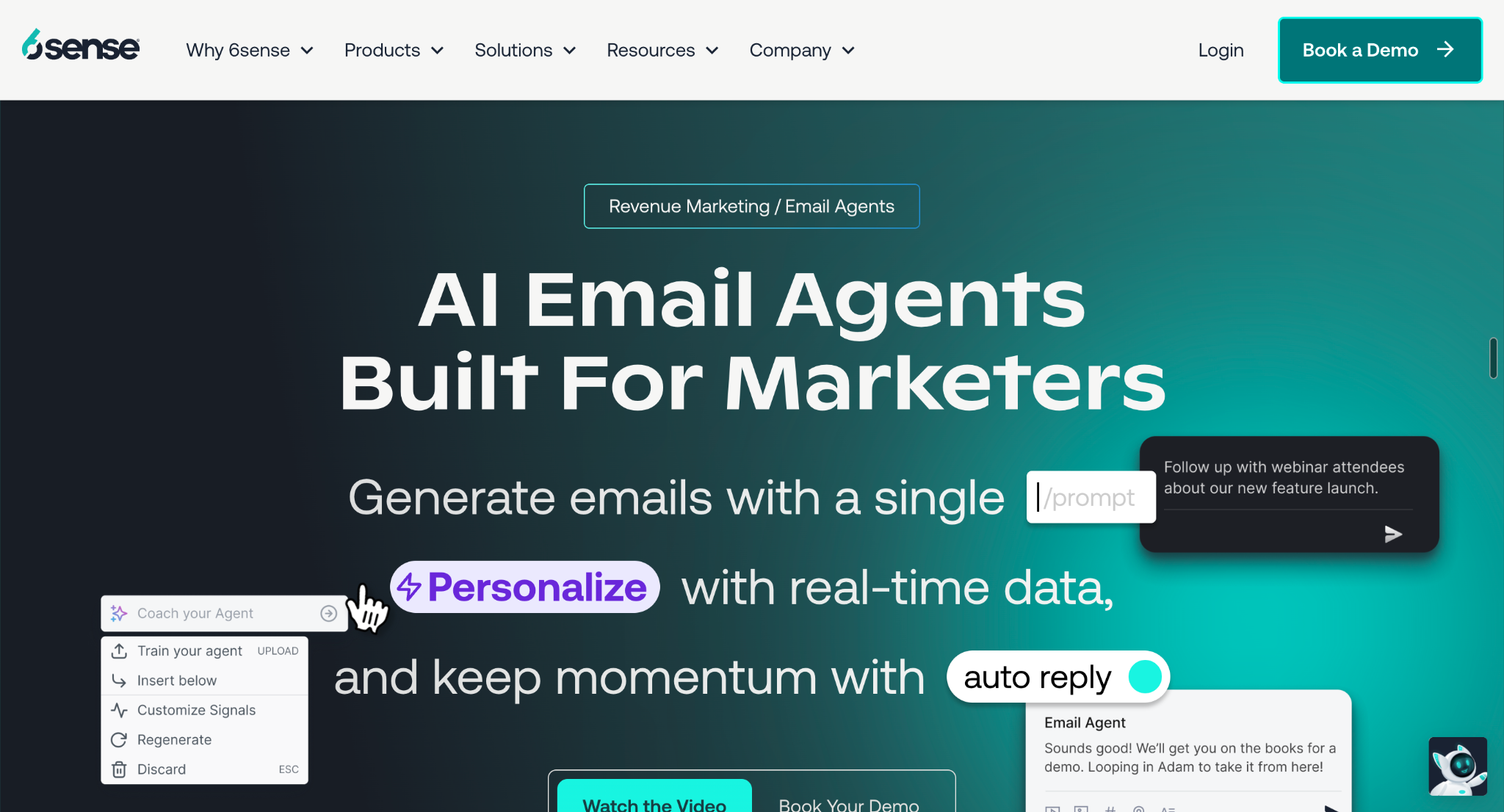
5. AI Email Agents
6sense AI Email Agents help automate personalized email outreach using buyer signals and brand context. Depending on the workflow, they can generate and send emails, respond to prospects, support qualification, and manage follow-up at scale.
The idea is to reduce repetitive manual work while allowing teams to engage more prospects. Sales teams still need to evaluate message quality, brand alignment, and how the agents fit into their existing prospecting processes.
Best for: SDRs, BDRs, outbound sales teams, and demand generation marketers running email engagement programs.
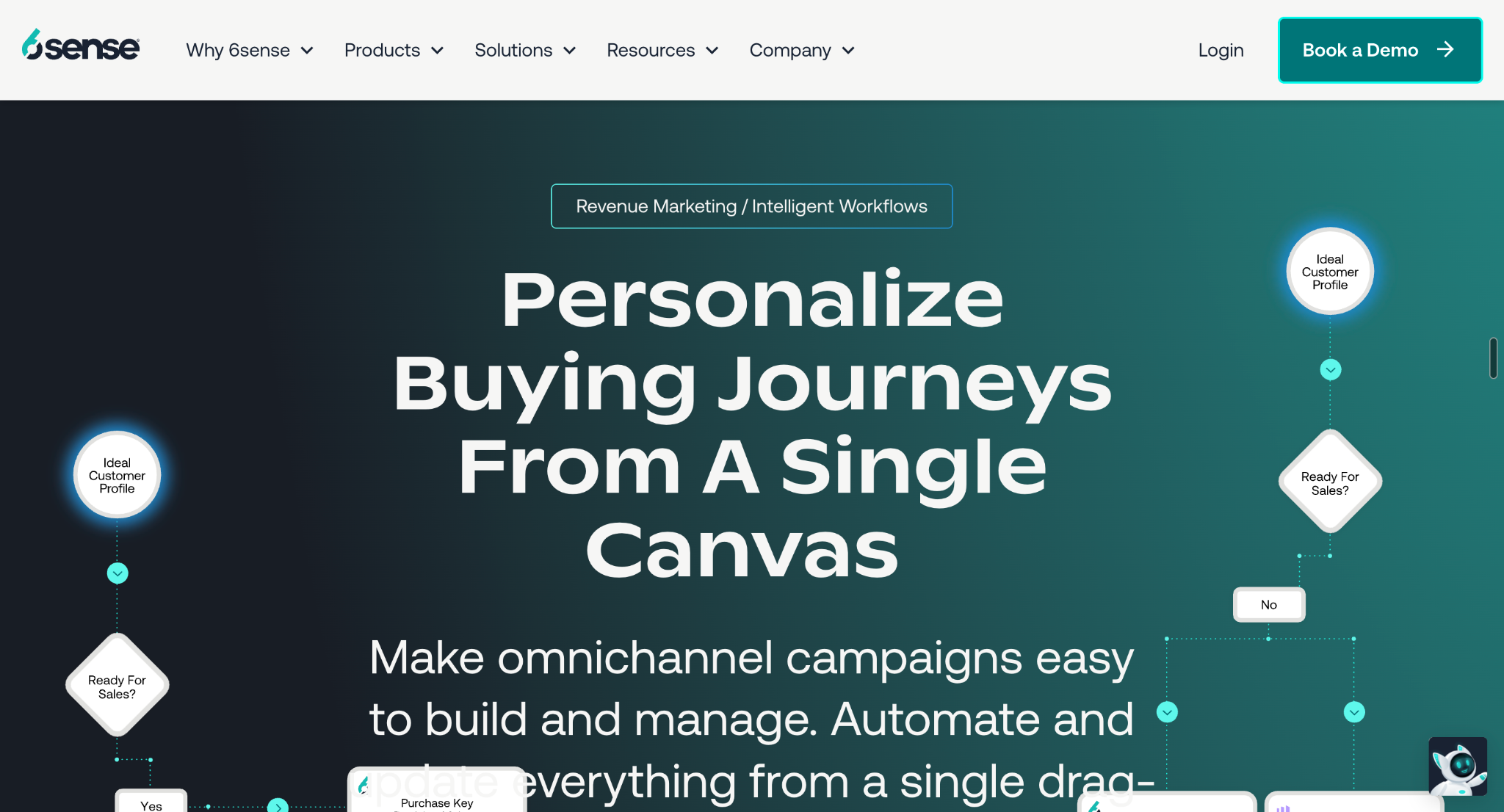
6. Intelligent Workflows
6sense Intelligent Workflows connect signals and insights to actions across supported marketing and sales tools. Teams can use workflows to coordinate advertising, email, CRM updates, and sales engagement based on account activity or changes in buying signals.
For example, an account showing stronger buying intent could enter a more targeted campaign, while a relevant sales team receives an alert to follow up. This helps reduce the gap between identifying an opportunity and acting on it.
Best for: Marketing operations, sales operations, RevOps, and teams coordinating multi-channel GTM campaigns.
Together, these capabilities connect account intelligence with sales and marketing execution. The value depends on how well the underlying data, predictive signals, and automated workflows fit a company's existing GTM process.
Which Teams Benefit Most From 6sense?
Demand generation and ABM marketers: Identify in-market accounts, build audiences, activate advertising, and coordinate campaigns.
SDRs and BDRs: Prioritize accounts, discover contacts, monitor buying signals, and automate prospecting and follow-up.
Account executives: Research accounts, understand buying groups, prepare relevant conversations, and monitor deal signals.
Marketing and sales operations: Connect data across systems, automate workflows, and maintain audience and account information.
Revenue leaders: Understand account prioritization, campaign effectiveness, pipeline contribution, and opportunities for more coordinated GTM execution.
The key distinction is that 6sense is not simply a contact database or intent-data provider. It combines buyer intelligence with tools for activating that intelligence across sales and marketing. The breadth of its platform makes it particularly relevant to B2B organizations running coordinated, account-based GTM programs.
6sense Pricing
Based on our analysis of available pricing data, 6sense costs approximately $11,000 to $177,000 per year, depending on the package, data credits, and usage requirements. Larger enterprise deployments can cost considerably more.
6sense Pricing Plans
Plan
Key Features
Estimated Annual Pricing
Sales Intelligence + Data Credits
Prospecting, company and contact data, intent signals, and data exports
11,000–60,000
Sales Intelligence + Predictive AI
Sales intelligence, predictive account scoring, and AI recommendations
30,000–100,000
Sales Intelligence + Data Credits + Predictive AI
Sales intelligence, data credits, predictive analytics, and AI recommendations
60,000–177,000+
Is 6sense Worth the Price?
6sense can justify its cost for B2B companies with established sales and marketing teams that need intent data, predictive account prioritization, and account-based marketing. These capabilities can help teams focus on high-potential accounts and coordinate outreach.
For smaller teams that mainly need contact data or basic prospecting, the investment may be harder to justify. Evaluate whether the platform can generate enough additional qualified pipeline to offset its annual cost.
6sense Reviews: What Do Real Users Say?
6sense receives positive feedback for its intent data, predictive account scoring, and ability to identify potential buyers before they engage directly. However, reviews across G2, Trustpilot, and Reddit also raise concerns about data accuracy, reporting limitations, usability, and whether the platform delivers enough value to justify its cost.
6sense Reviews from G2
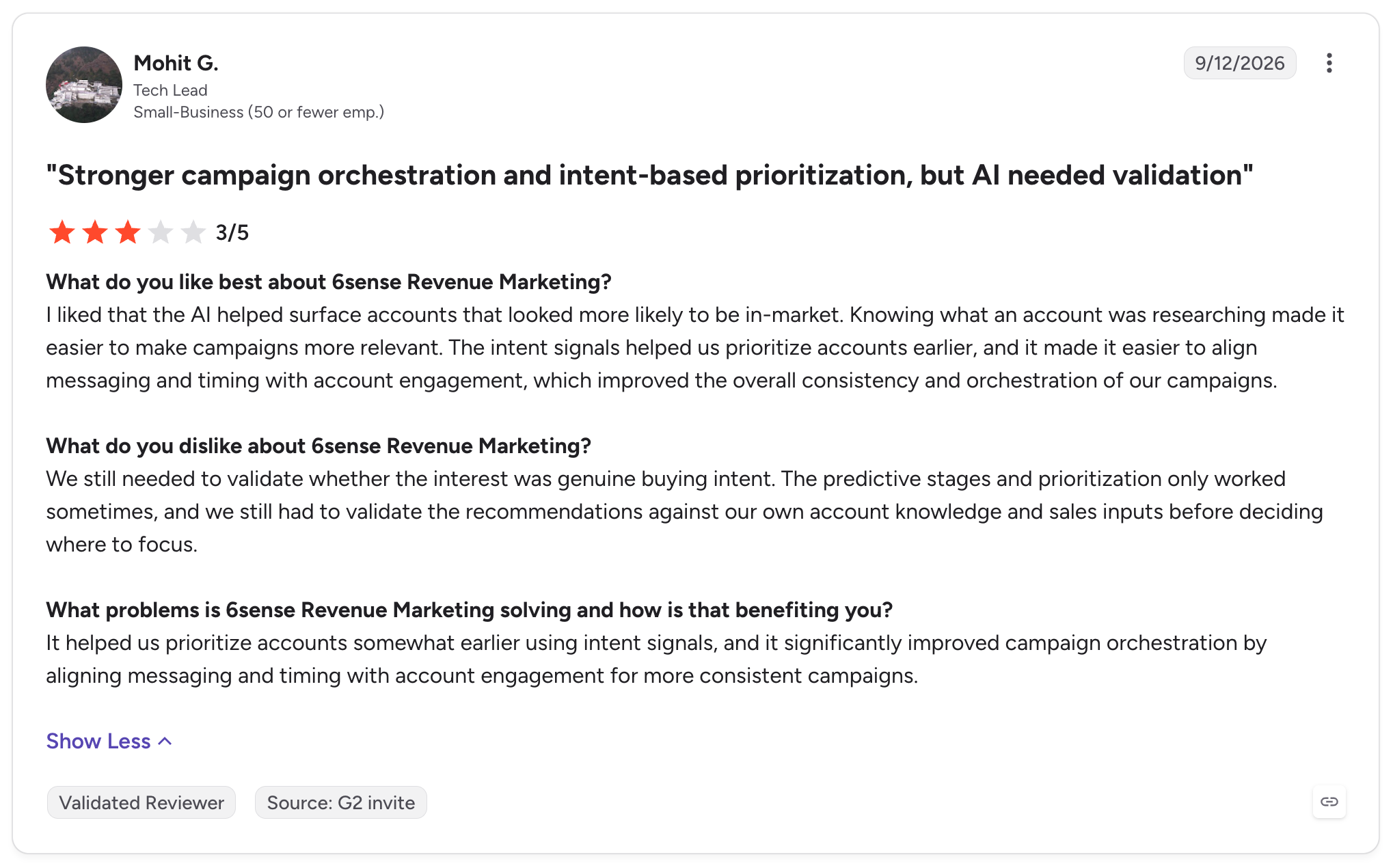
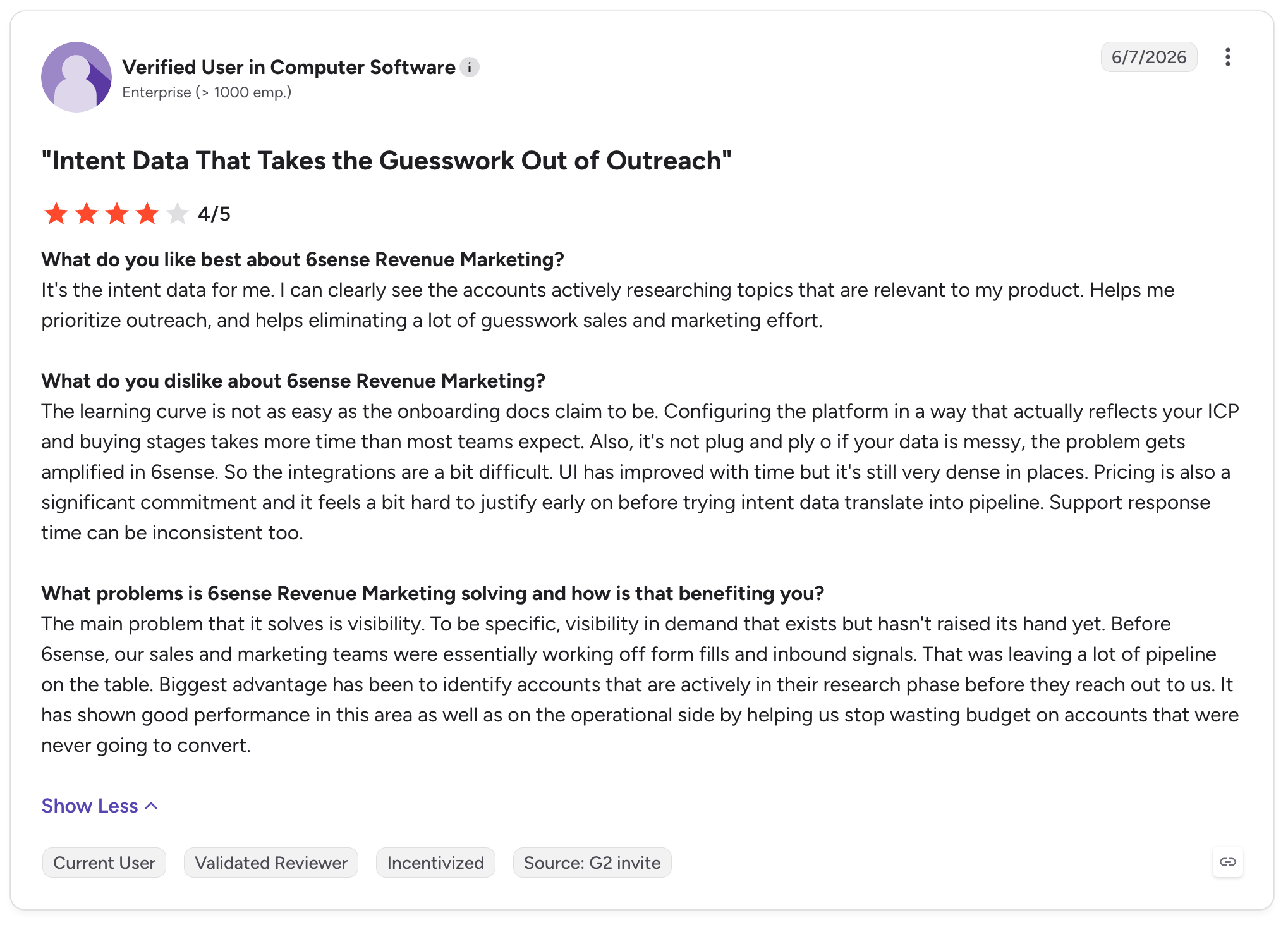
6sense Revenue Marketing has a 4.2/5 rating on G2 across approximately 1,570 reviews. Reviewers appreciate its account-level insights and intent signals, but some highlight limitations in predictive scoring, reporting, integrations, and usability.
Intent data is useful, but not always reliable. One reviewer explained:
“We still needed to validate whether the interest was genuine buying intent.”
This highlights an important distinction: researching a topic does not necessarily mean an account is ready to purchase. Sales teams still need to validate intent signals against CRM activity and direct prospect engagement.
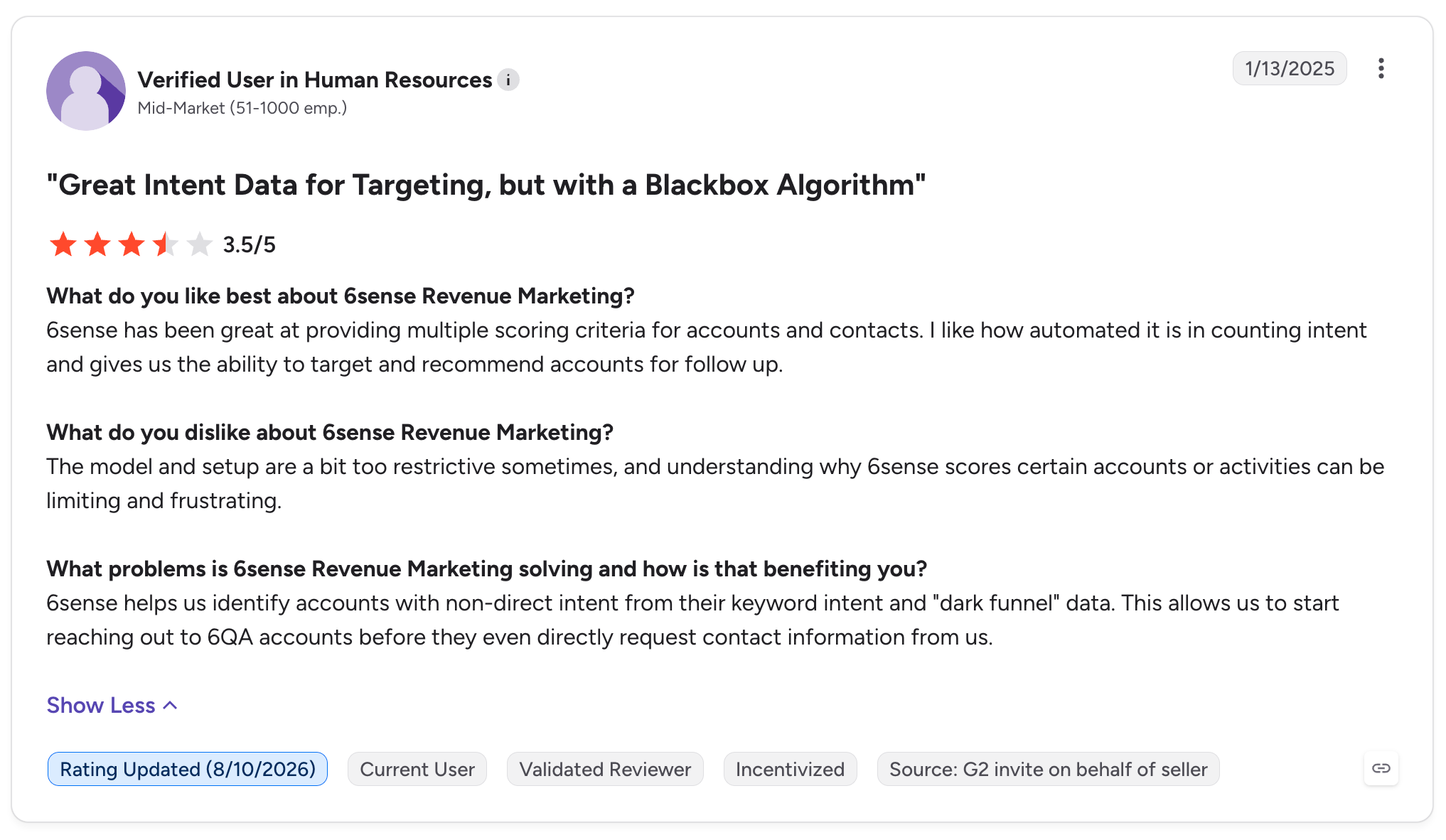
Predictive scoring can feel like a black box. A reviewer discussing the platform's algorithm wrote:
“understanding why 6sense scores certain accounts or activities can be limiting and frustrating.”
When users cannot easily interpret why an account receives a particular score, it becomes harder to trust recommendations and prioritize outreach confidently.
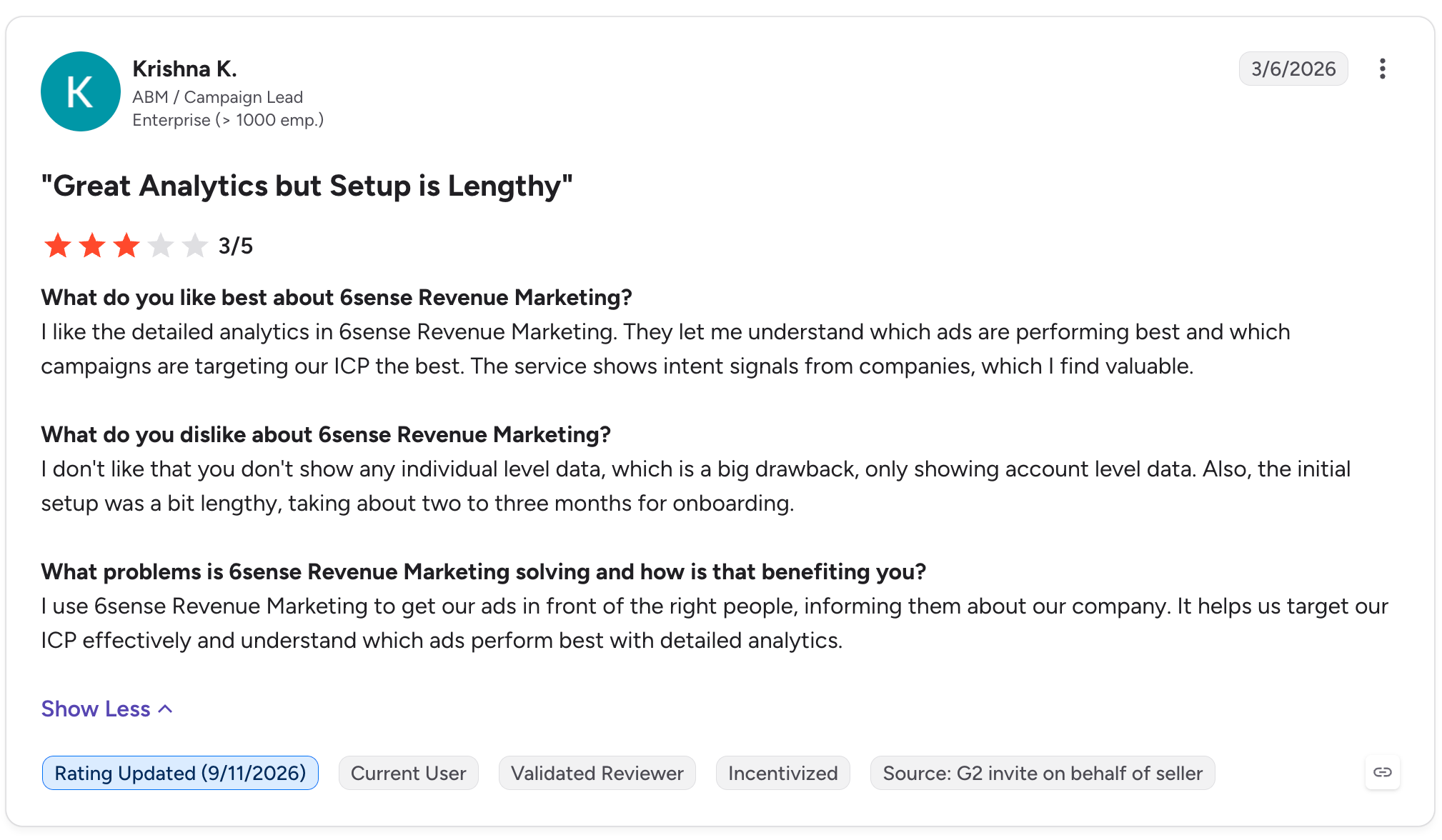
Reporting can lack the detail some teams need. One reviewer noted:
“I don't like that you don't show any individual level data, which is a big drawback, only showing account level data.”
This account-centric approach can work well for ABM, but teams that need detailed contact-level engagement and attribution should check whether the reporting meets their requirements.
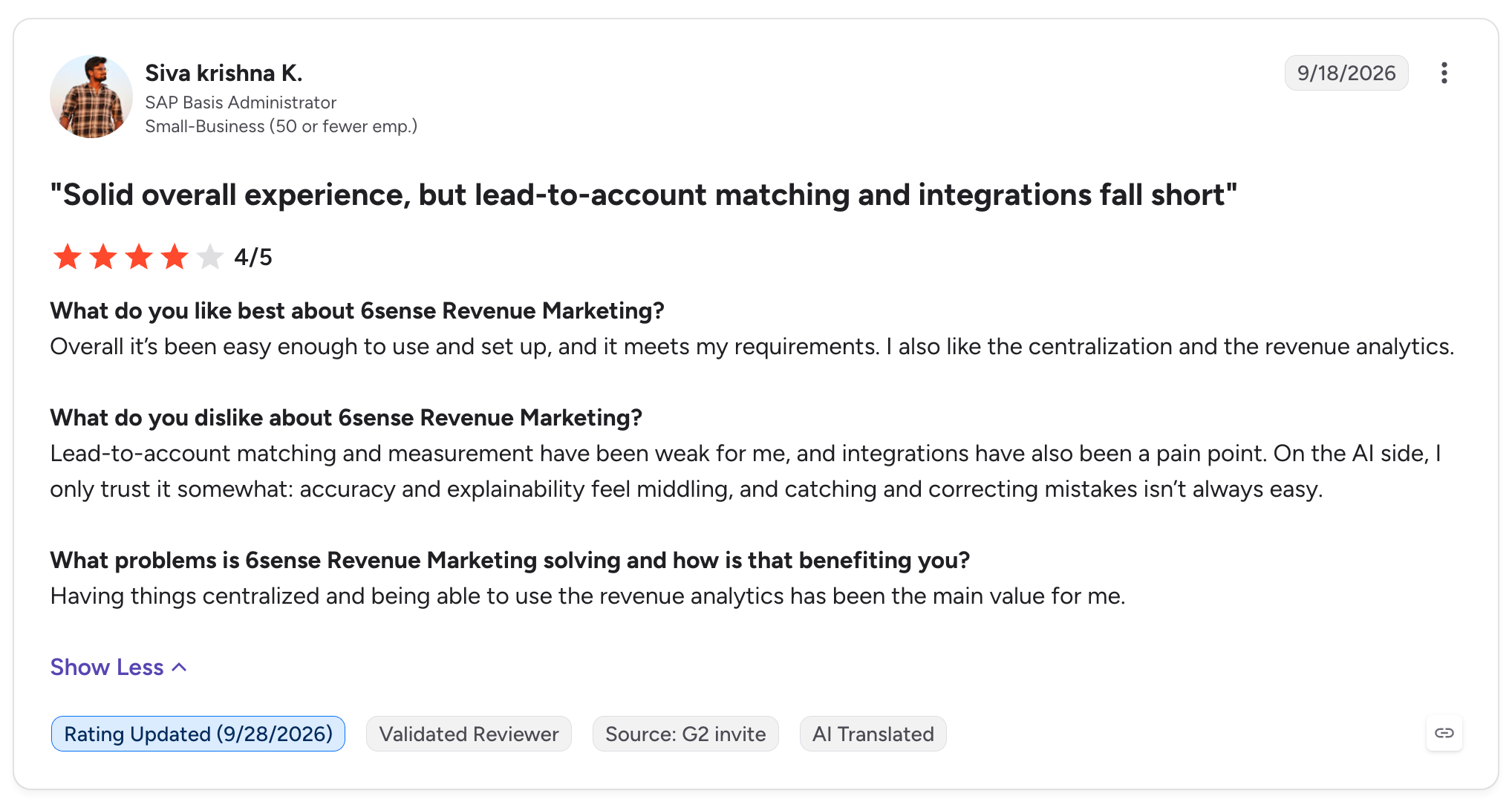
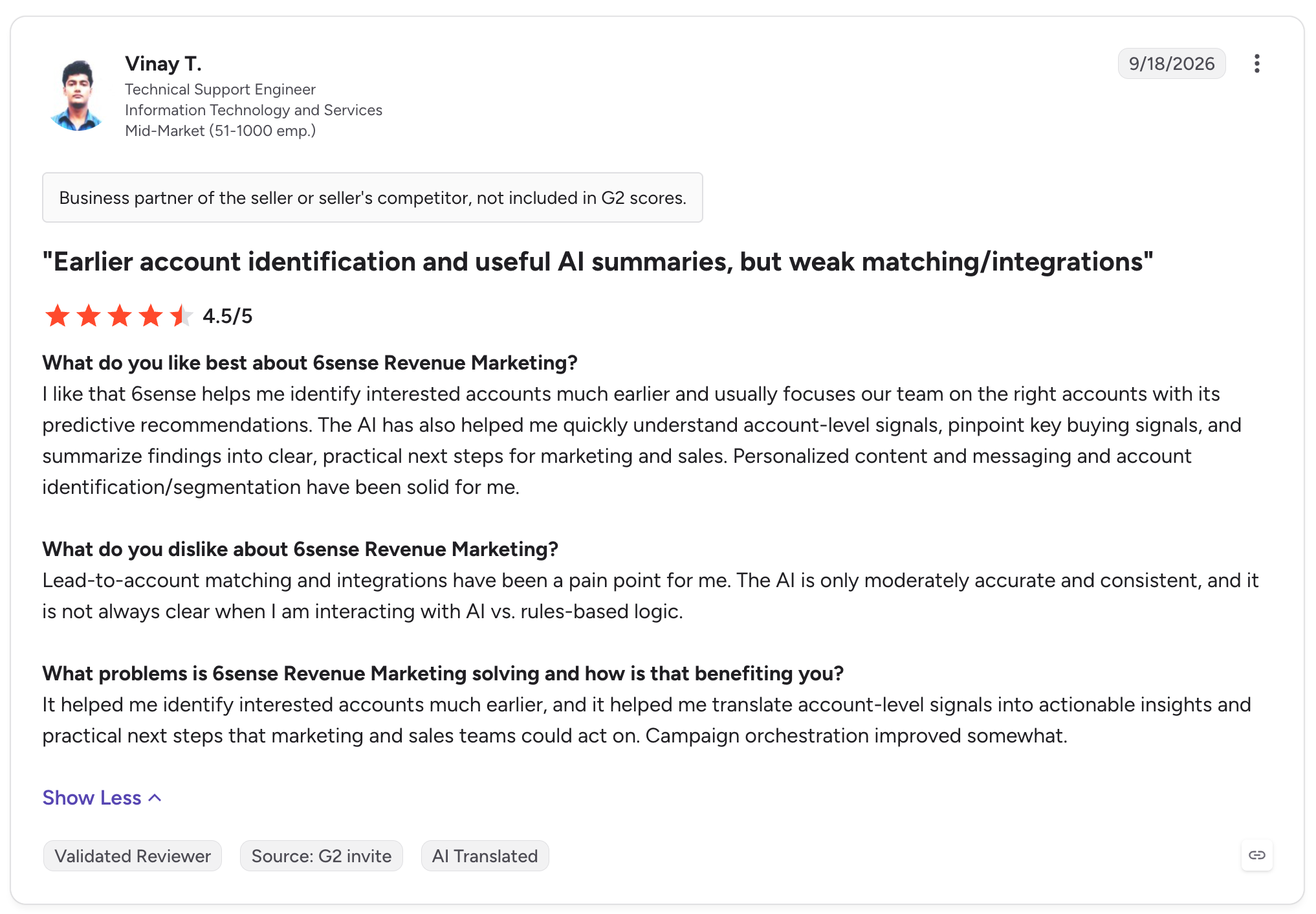
Integrations and adoption require attention. One reviewer said:
“Lead-to-account matching and integrations have been a pain point for me.”
Another described the learning curve:
“The learning curve is not as easy as the onboarding docs claim to be.”
Together, these comments suggest that 6sense's value depends partly on data quality, implementation, and whether sales and marketing teams can use its insights consistently.
6sense Reviews from Trustpilot
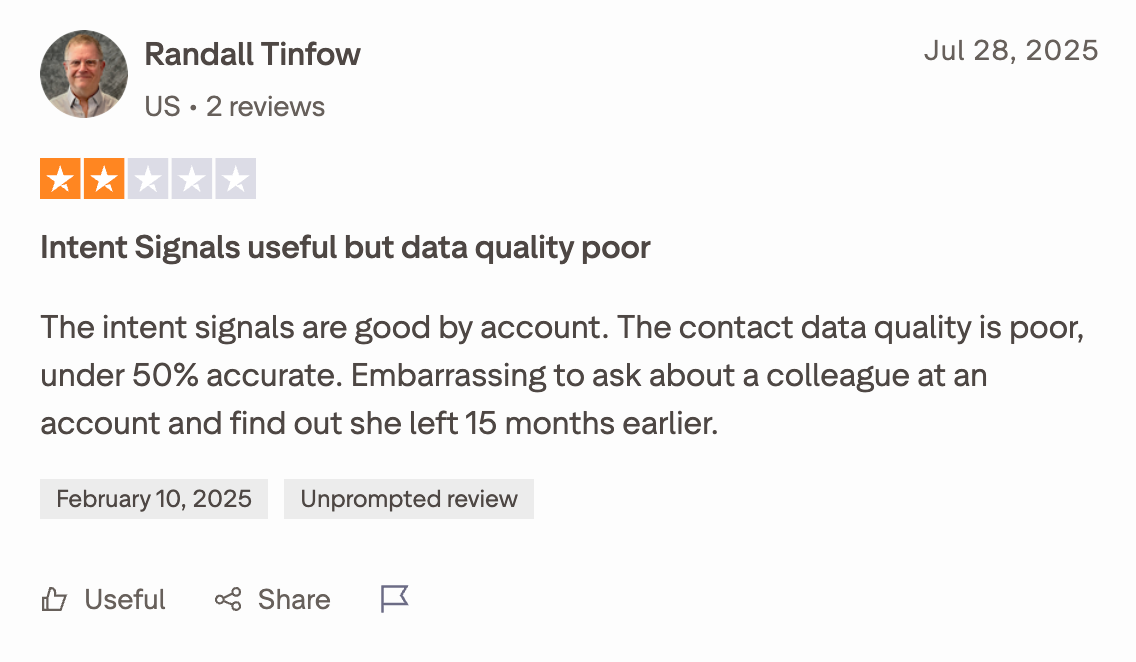
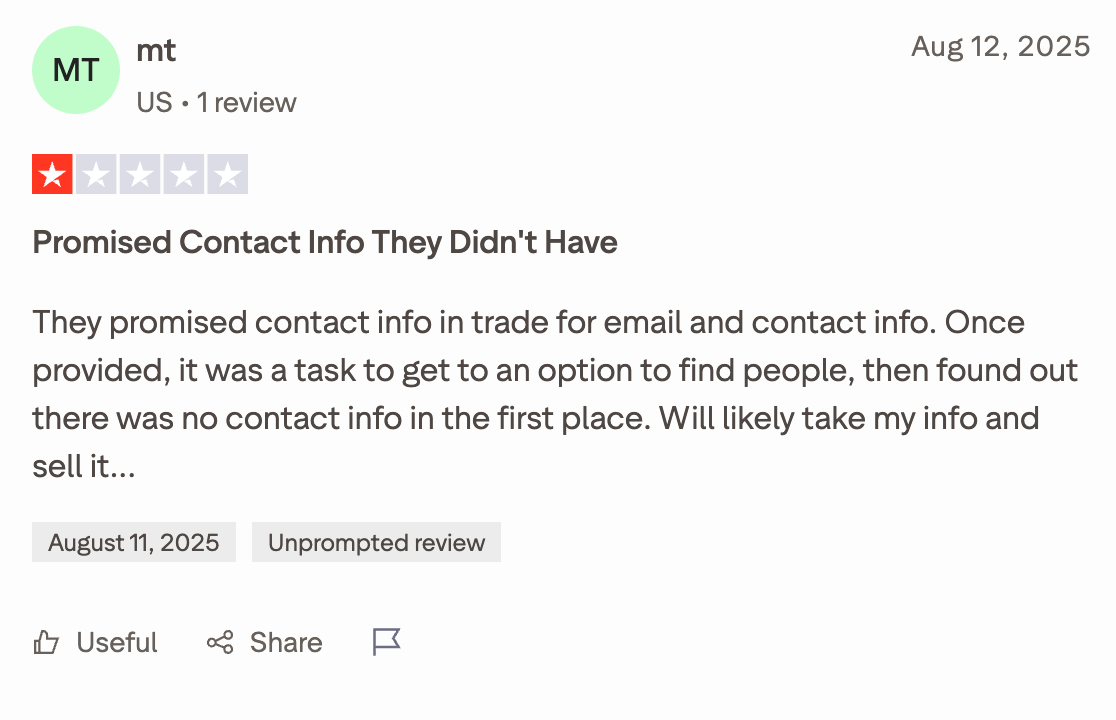
6sense has a 2.2/5 TrustScore from 10 Trustpilot reviews, with nine of the ten rated one star. This is a small sample, and many complaints concern unsolicited communications and privacy rather than the platform's core functionality.
One reviewer raised a direct concern about contact data:
“The contact data quality is poor, under 50% accurate.”
Another reviewer wrote:
“found out there was no contact info in the first place.”
These complaints matter because contact data is central to prospecting workflows. Account-level intent can help identify promising companies, but inaccurate or unavailable contact details can prevent sales teams from reaching the right decision-makers.
The reviews do not establish that all 6sense customers experience these issues, but they reinforce the importance of testing contact coverage and accuracy before purchasing.
6sense Reviews from Reddit
A discussion in r/gtmengineering titled 6sense review - marketing team wants it badly but SO expensive. worth it? describes a three-month pilot and raises questions about cost, data quality, and adoption.
The original poster reported positive results from anonymous visitor identification, buying-stage predictions, and marketing automation integration. They estimated that around 70% of accounts labelled as being in the decision stage converted within a couple of months. This is an individual pilot result, not an independently verified performance benchmark.
However, the poster also reported roughly 60% email accuracy and estimated an annual contract of around $80,000 for a team of eight.
One commenter highlighted the adoption problem:
“The UI takes forever to learn. Our SDRs still struggle with it after weeks.”
Another offered a broader warning:
“Good intent data is worthless if your team can't actually use it effectively”
A third commenter stressed the scale of operational change involved:
“Don't do it unless you're prepared to change the entire way you go to market, the entire way you funnel leads, the entire way you approach accounts, and stand by it.”
The discussion illustrates a key trade-off: 6sense may surface useful buying signals, but those signals only create business value when sales teams can act on them and the resulting opportunities justify the investment.
What Do These Reviews Tell Us About 6sense?
Across the three platforms, the feedback points to five areas buyers should evaluate carefully.
Area
What reviewers say
What it means for buyers
Intent data
Signals can be useful but need validation
Confirm that signals correspond to genuine buying activity
Predictive scoring
Scoring logic can be difficult to interpret
Evaluate transparency and fit with your ideal customer profile
Contact data
Some reviewers report accuracy and availability issues
Test email and phone accuracy against real target accounts
Reporting and integrations
Account-level reporting and data matching can have limitations
Validate CRM synchronization and attribution requirements
Usability and ROI
Adoption can take time, and the investment is substantial
Measure incremental pipeline against total implementation and subscription costs
Is 6sense Worth the Investment?
6sense can be worth the investment for B2B companies with mature account-based marketing programs, clean CRM data, and sales and marketing teams equipped to act on intent signals. Its predictive scoring and account intelligence can help teams prioritize high-potential accounts and coordinate outreach.
However, companies that primarily need accurate contact data, straightforward prospecting, or a tool their SDRs can use with minimal training should evaluate whether a more focused solution would meet their needs at a lower cost.
Before committing, run a pilot that measures contact-data accuracy, sales adoption, qualified opportunities, and incremental pipeline generated. Do not judge success solely by the number of accounts identified or the percentage labelled as being in a buying stage.
What These Reviews Mean for Potential Buyers
The main takeaway is that 6sense's value depends on more than its ability to identify intent. Buyers need to establish whether its signals are accurate, whether sales representatives can act on them, and whether the resulting pipeline justifies the cost. A well-measured pilot using your own target accounts is a better basis for a purchase decision than either a positive product demonstration or a handful of negative reviews.
6sense Pros and Cons
6sense stands out for its intent data, predictive analytics, and account-based marketing capabilities. However, its cost, learning curve, and reported data-quality issues may make it less suitable for teams that need a simpler prospecting solution.
Pros
Cons
Intent data: Helps identify accounts researching relevant topics before they contact your sales team.
Data accuracy concerns: Some reviewers report inaccurate contact details and inconsistent intent signals.
Predictive account scoring: Helps sales and marketing teams prioritize accounts based on buying signals.
Limited scoring transparency: Understanding why certain accounts receive particular scores can be challenging.
Account-based marketing: Connects account insights with audience targeting, advertising, and campaign execution.
Expensive investment: Subscription costs can be substantial, particularly for smaller teams.
Anonymous website visitor identification: Helps reveal companies visiting your website even when visitors do not fill out a form.
Learning curve: Configuring the platform and getting sales teams to adopt it can take time.
Sales and marketing alignment: Helps teams coordinate outreach around shared account insights and buying stages.
Reporting limitations: Some users want more detailed contact-level reporting and greater attribution flexibility.
CRM and marketing integrations: Connects account intelligence with existing revenue workflows.
Implementation effort: Data matching, integrations, and configuration may require additional operational resources.
Our verdict: 6sense is a strong option for B2B companies with mature ABM programs that can turn intent data into coordinated sales and marketing campaigns. However, businesses should validate data quality, assess implementation requirements, and establish measurable pipeline goals before committing to its cost.
Best 6sense Alternative: Knock AI
If you're considering 6sense to identify in-market accounts and turn buying signals into revenue, Knock AI is the best 6sense alternative. Instead of focusing primarily on predicting which accounts are ready to buy, Knock AI focuses on capturing buyer intent wherever it appears and turning it into qualified sales conversations before that interest fades.
Knock AI connects website visitor identification, first-party intent signals, account and contact enrichment, AI agents, conversational engagement, sales routing, scheduling, and attribution. It helps B2B teams act on demand across their website, LinkedIn, G2, product documentation, marketplaces, paid campaigns, events, and other marketing touchpoints.
How Knock AI Approaches Revenue Conversion Differently
One of Knock AI's key differentiators is that it connects buyer identification with the actions needed to convert that interest.
Identify and enrich buyers: Knock Reveal and its enrichment capabilities help identify potential buyers and build richer contact and company profiles. Its intent signals incorporate activity such as clicks, page views, and conversations, alongside CRM context.
Find missed pipeline opportunities: Knock AI analyzes existing demand, ideal customer profiles, funnel leakage, and attribution to help teams identify where potential buyers are dropping out and which opportunities deserve attention.
Turn any touchpoint into a conversation: With Knock Links, teams can let prospects start a conversation from website CTAs, LinkedIn posts and ads, G2, product documentation, marketplaces, email campaigns, and event QR codes. Buyers can engage without completing a traditional lead form.
Qualify buyers with AI: Knock Intent Agents can answer questions using approved knowledge sources, identify buying intent, qualify prospects against the company's ICP, filter irrelevant inquiries, and book meetings when enabled.
Route opportunities to the right person: Knock AI's routing rules use criteria such as intent, company size, territory, industry, account ownership, and CRM information to assign conversations to the right rep or AI agent.
Keep conversations moving: Prospects can engage through supported messaging channels such as LinkedIn, WhatsApp, and Slack, while sales representatives manage conversations from Slack. AI can hand off qualified buyers to a human in the same thread.
Measure what converts: Knock AI tracks touchpoint attribution, response times, meetings, conversations, enrichment, and funnel performance so teams can evaluate which interactions generate qualified opportunities.
Knock AI also supports product-triggered workflows, conversational scheduling, event engagement through QR-based links and marketing cards, CRM synchronization with Salesforce, HubSpot, and Marketo, and analytics for comparing Knock AI experiences with traditional forms.
Knock AI vs. 6sense
Capability
Knock AI
6sense
Primary focus
Converting buyer intent into qualified conversations and pipeline
Identifying in-market accounts and coordinating account-based marketing
Buyer identification
Identifies buyers through website and engagement workflows, with identity and enrichment capabilities
Uses account intelligence, third-party intent, and predictive analytics to identify promising accounts
Intent detection
Connects first-party activity, conversations, enrichment, and CRM context to guide engagement
Uses intent data and predictive models to prioritize accounts and estimate buying stages
Demand conversion
Connects buyer identification to AI qualification, conversations, routing, and meeting booking
Connects account insights to sales intelligence, advertising, and revenue marketing workflows
AI agents
Specialized agents handle buying, support, partnership, and hiring inquiries, with configurable knowledge sources and human handoff
Offers AI capabilities for sales intelligence and engagement, alongside predictive analytics
Multichannel engagement
Knock Links activate conversations across websites, LinkedIn, G2, marketplaces, documentation, campaigns, and events
Supports account-based advertising, sales prospecting, and coordinated marketing engagement
Lead routing and scheduling
Routes conversations and meetings using ICP, intent, CRM, territory, ownership, and other rules
Supports sales workflows that help teams act on prioritized accounts
Funnel attribution
Tracks touchpoints, UTMs, response times, meetings, and funnel performance to assess conversion
Provides account and campaign analytics for measuring marketing performance
CRM integration
Syncs contact and account data, enrichment, intent, attribution, and conversation history with supported CRMs
Connects sales intelligence and account insights with CRM and marketing systems
Which Platform Should You Choose?
Choose 6sense if your primary requirement is predictive account intelligence, third-party intent data, account-based advertising, and prioritizing accounts across a mature B2B marketing operation.
Choose Knock AI if you want to connect buyer identification and intent signals directly to conversion workflows. Its messaging-first approach helps teams replace form-based handoffs and delayed follow-ups with AI qualification, direct conversations, intelligent routing, and conversational scheduling.
The distinction is important: identifying an account that may be ready to buy is only one step in the sales process. Knock AI is built to help teams act on buyer interest across multiple touchpoints and carry that interaction through to a qualified conversation and meeting, while measuring how those interactions contribute to pipeline.
For teams losing opportunities between a buyer's first signal of interest and the first meaningful sales conversation, Knock AI is a compelling alternative to evaluate.
FAQs
1. What is 6sense used for?
6sense is a B2B revenue intelligence platform used to identify accounts researching a product category, predict their buying stage, prioritize sales opportunities, and coordinate account-based marketing campaigns. It combines intent data, predictive analytics, sales intelligence, and advertising capabilities to help revenue teams engage potential buyers earlier.
2. How much does 6sense cost?
6sense uses custom pricing based on the products, data credits, and capabilities a business needs. Based on our pricing analysis, annual costs can range from approximately $11,000 to $177,000, with larger enterprise deployments potentially costing more. These are indicative estimates, not official package prices.
3. Is 6sense worth it?
6sense can be worth the investment for B2B companies with established account-based marketing programs that need predictive account scoring, intent data, and coordinated sales and marketing campaigns. However, its cost, learning curve, and reported data-quality and reporting limitations may make it less suitable for smaller teams. Evaluate its impact on qualified pipeline and revenue before committing.
4. Does 6sense offer a free trial?
6sense does not publicly advertise a standard self-serve free trial on its Sales Intelligence pricing page. Businesses can contact its sales team to discuss available demonstrations or evaluation options.
5. What are the main disadvantages of 6sense?
The main disadvantages reported by users include a steep learning curve, complex campaign and audience setup, concerns about contact-data accuracy, and limitations in reporting and attribution. Some users also find predictive scoring difficult to interpret. The impact of these issues depends on the team's data quality, implementation, and requirements.
6. What are the best alternatives to 6sense?
Alternatives depend on your primary goal. Demandbase is worth evaluating for account-based marketing, while ZoomInfo is an option for sales intelligence and prospecting data. Knock AI is worth considering if your priority is converting buyer intent into qualified conversations through visitor identification, enrichment, AI agents, conversational engagement, scheduling, and lead routing.
7. Does 6sense integrate with Salesforce and HubSpot?
Yes. 6sense supports integrations with Salesforce and HubSpot CRM, alongside other systems such as Microsoft Dynamics, Marketo, Salesloft, Outreach, and advertising platforms. Available functionality depends on the integration and the products included in your 6sense configuration.
8. How accurate is 6sense intent data?
Accuracy depends on the signals available, company identification, data coverage, and the predictive model. Intent signals can help identify accounts researching relevant topics, but they do not guarantee that an account is ready to purchase. Sales teams should validate these signals against CRM activity, direct engagement, and other buying indicators.
9. Does 6sense identify anonymous website visitors?
Yes. 6sense offers website visitor identification capabilities that help businesses identify companies visiting their websites, including visitors who have not submitted a form. Identification is not guaranteed for every visit, and company-level identification does not necessarily reveal the identity of each individual visitor.