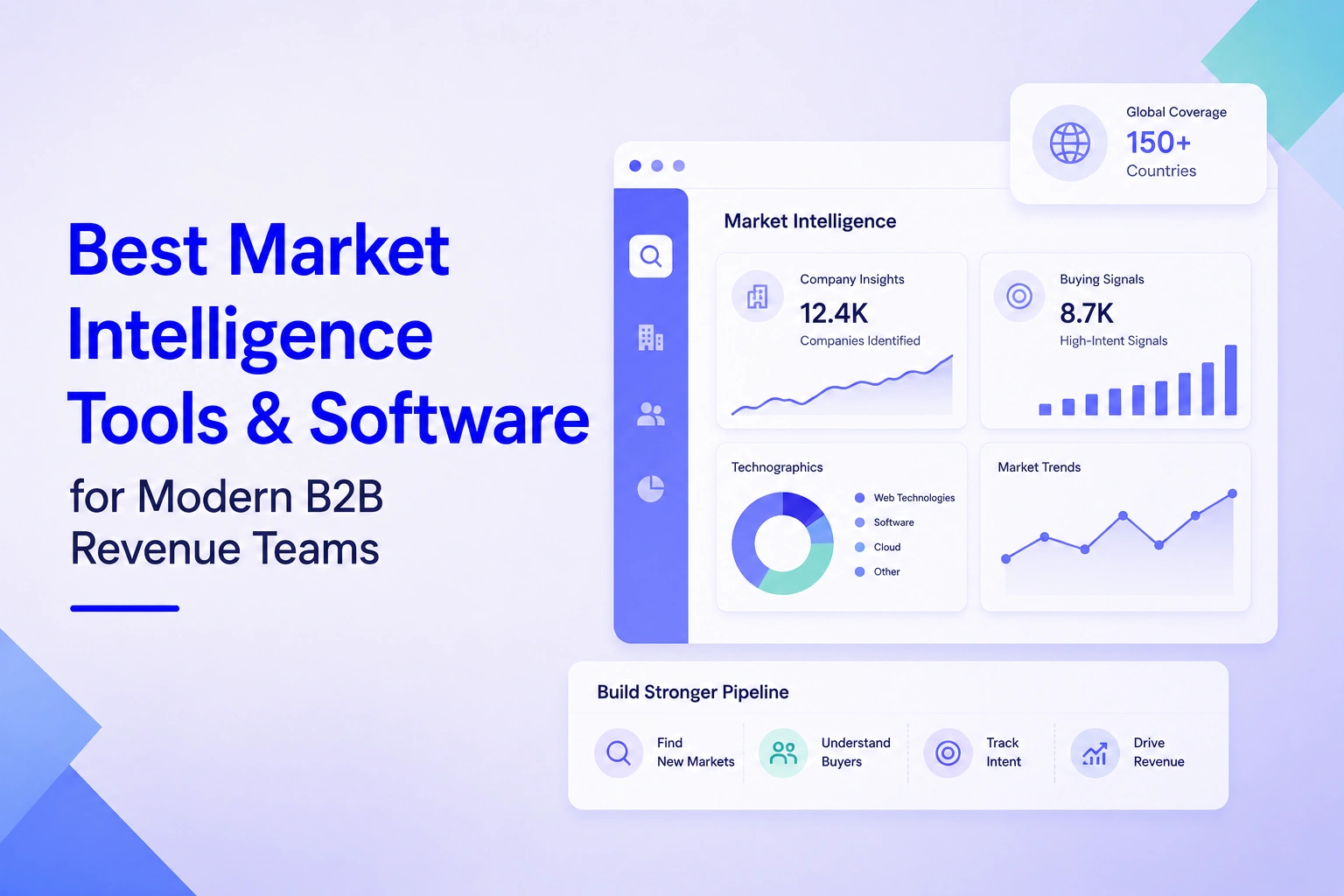
13 Best Market Intelligence Tools & Software for B2B
13 Best Market Intelligence Tools & Software for Modern B2B Revenue Teams (2026)
TL;DR
Market intelligence tools help businesses collect, analyze, and act on information about their markets, competitors, customers, and buying trends. Modern market intelligence software goes beyond static reports by providing real-time insights that support better marketing, sales, product, and revenue decisions.
The right platform depends on your business objective. Similarweb and Semrush Trends help you understand digital markets and search behavior, Crayon and Klue monitor competitors, AlphaSense and CB Insights provide deep market and industry research, Gong uncovers insights from customer conversations, Apollo.io supports prospect intelligence, G2 Buyer Intent identifies active buying signals, HG Insights reveals technology adoption, Kompyte tracks competitor activity, and Knock AI helps revenue teams turn market intelligence into qualified pipeline through buyer identification, intent analysis, AI qualification, intelligent routing, scheduling, and conversation continuity.
A modern market intelligence stack should do more than collect data. It should help your team understand the market, monitor competitors, identify buying intent, engage the right buyers, and convert those insights into revenue. The strongest B2B organizations combine specialized market intelligence platforms with revenue conversion technology to move from insights to action faster than their competitors.
Quick List of the 13 Best Market Intelligence Tools
If you're looking for the best market intelligence software without reading the entire guide, here's a quick overview of the platforms we'll cover. Each tool specializes in a different area of market intelligence, from analyzing digital markets and tracking competitors to identifying buyer intent and turning insights into qualified pipeline.
Platform
Primary Job
Similarweb
Digital market intelligence, website analytics, and competitive benchmarking
Semrush Trends
Search trends, audience insights, and digital market research
Exploding Topics
Emerging trend discovery and market opportunity analysis
Crayon
Competitive intelligence and competitor monitoring
Klue
Competitive enablement and sales battlecards
AlphaSense
Enterprise market research and financial intelligence
CB Insights
Market, industry, and startup intelligence
Gong
Conversation intelligence and customer insights
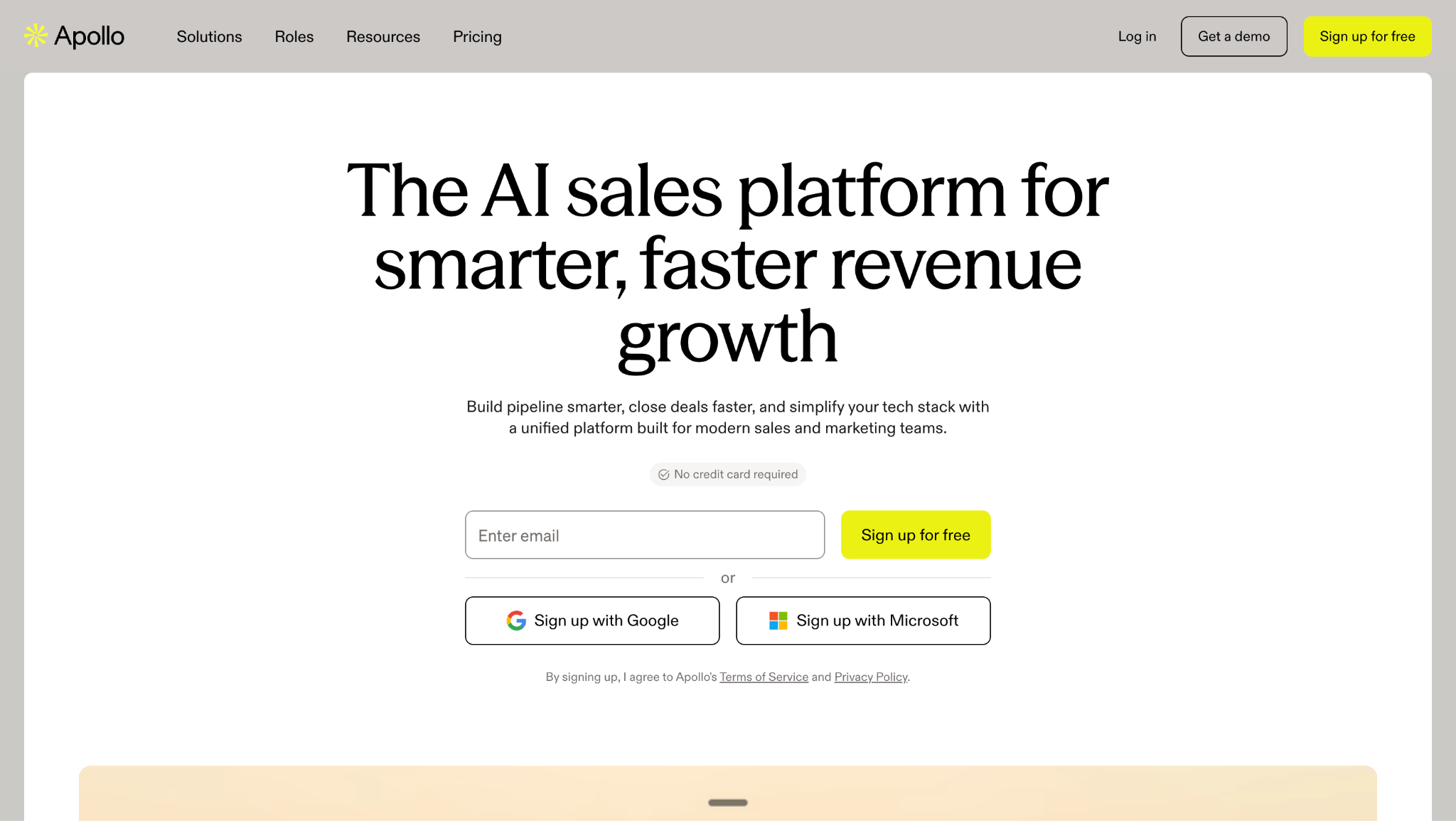
Apollo.io
Prospect intelligence and sales intelligence
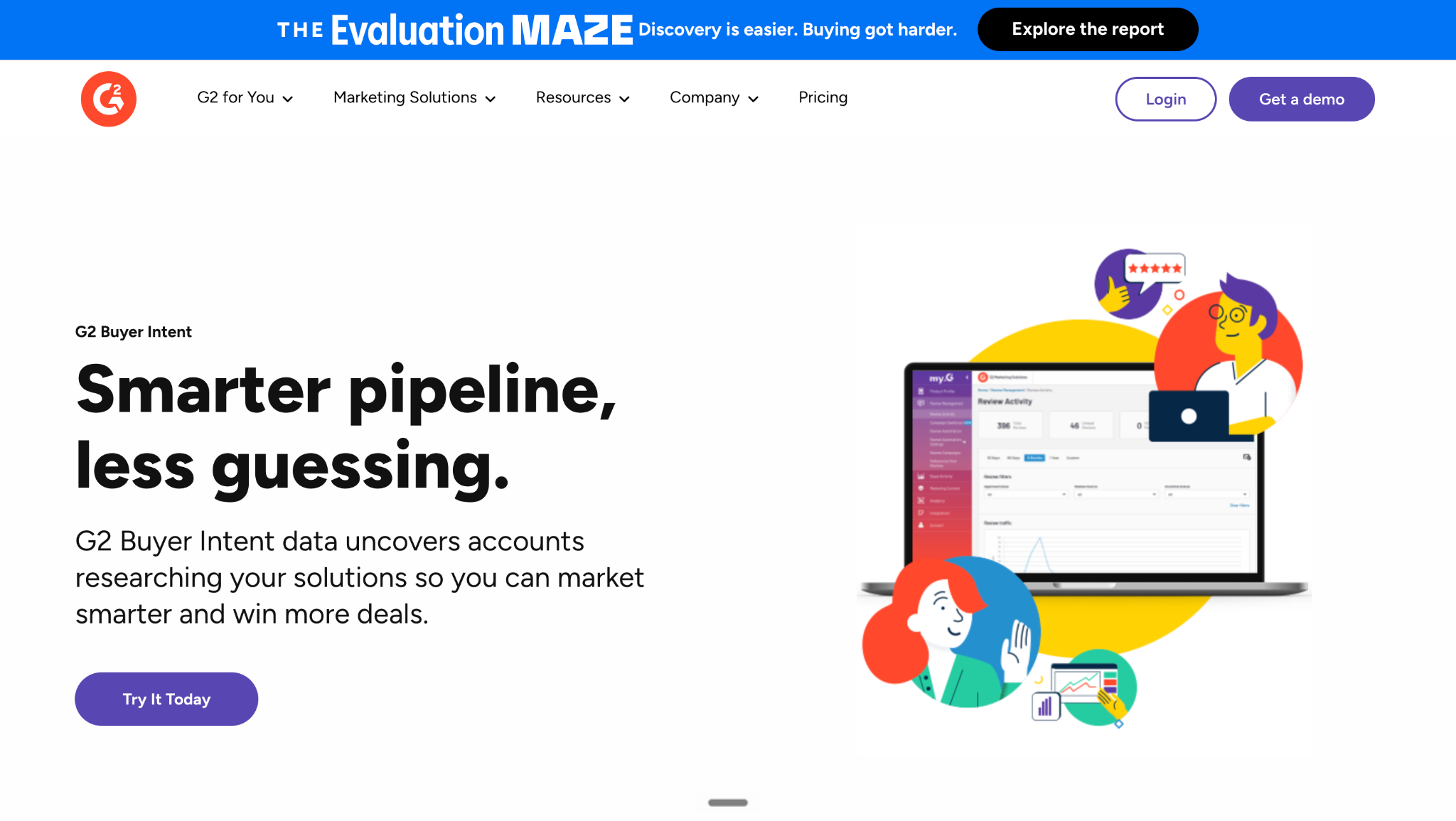
G2 Buyer Intent
Buyer intent intelligence and in-market account identification
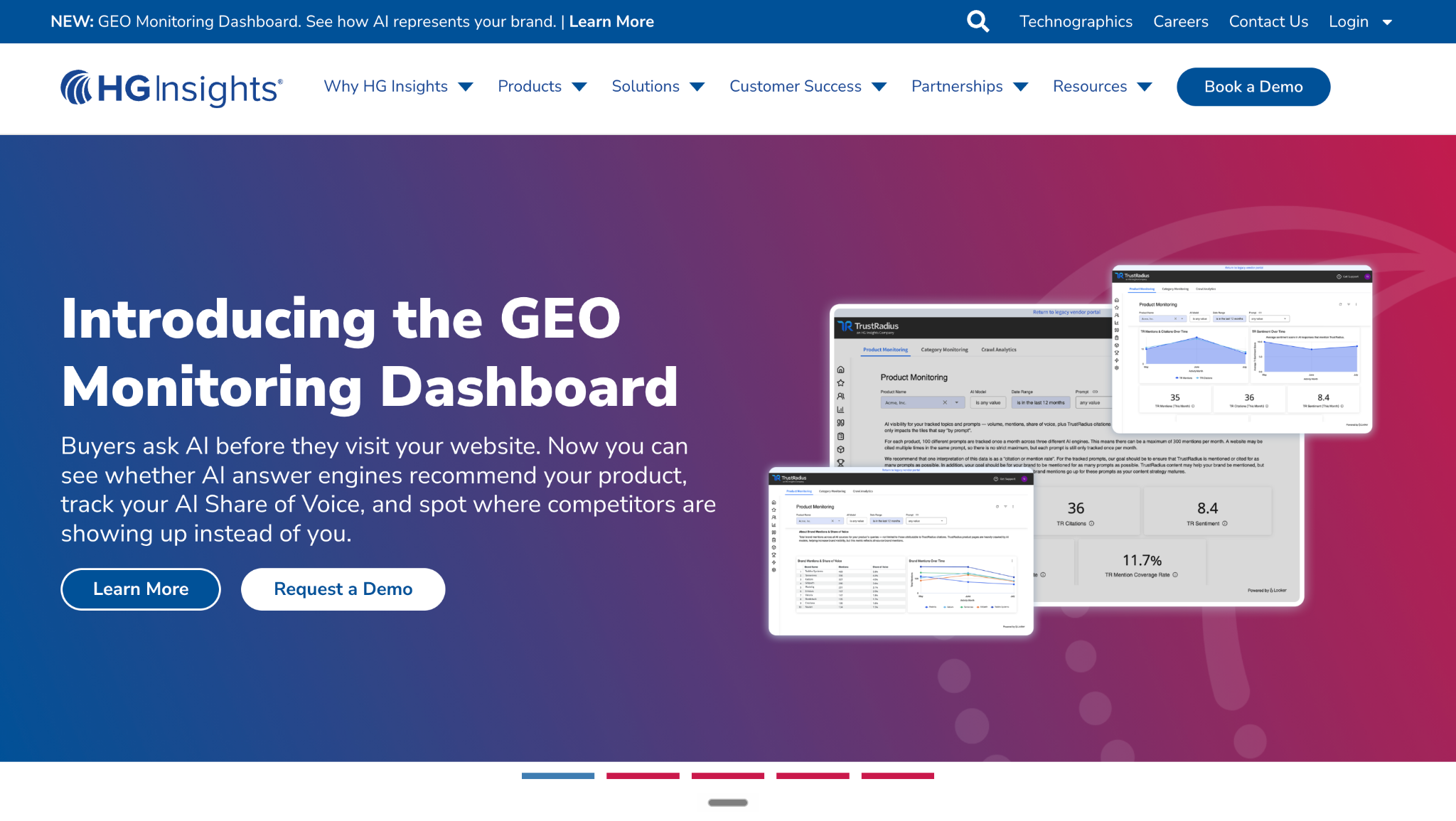
HG Insights
Technology intelligence and technographic data
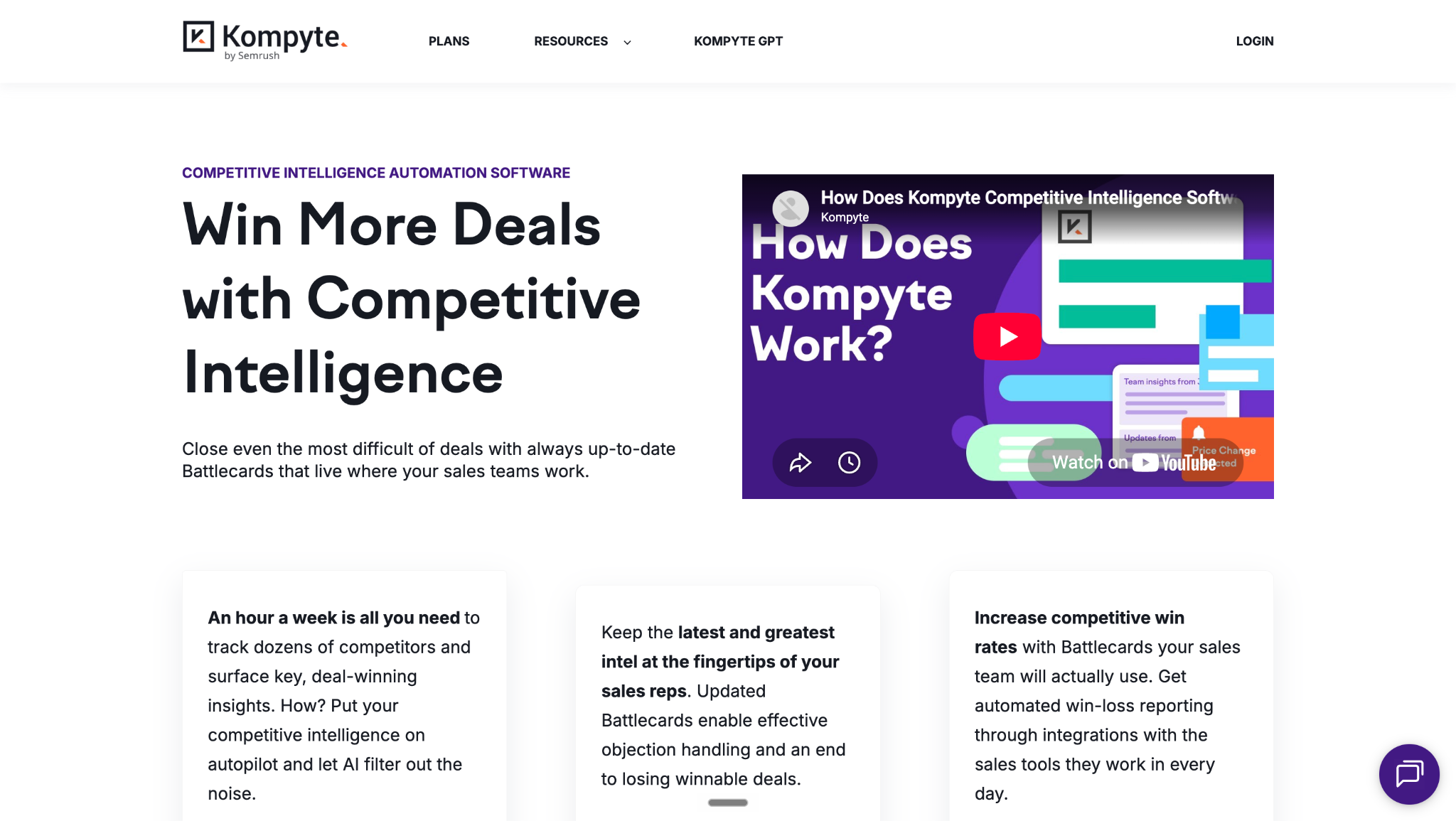
Kompyte
Competitive monitoring and market intelligence automation
Knock AI
Revenue intelligence, buyer identification, AI qualification, and revenue conversion
The rest of this guide explains what each platform does, where it fits within a modern market intelligence strategy, who it's best suited for, and how to choose the right technology stack based on your business goals.
What Are Market Intelligence Tools?
Market intelligence tools are software platforms that help businesses collect, analyze, and act on information about their market, competitors, customers, industries, and buying behavior. Instead of relying on assumptions, organizations use these tools to make informed decisions about marketing, sales, product development, pricing, and go-to-market strategy.
Modern market intelligence software brings together data from multiple sources, including search trends, competitor websites, technology adoption, customer conversations, buying signals, and market activity. The goal is to help teams understand what's happening in their market and respond faster than competitors.
Today, market intelligence is no longer limited to quarterly reports or annual research. The best market intelligence platforms provide real-time insights that help businesses identify opportunities, monitor competitive movements, understand customer needs, and prioritize the accounts most likely to convert.
Different platforms solve different problems. Some specialize in digital market research, others focus on competitive intelligence, conversation intelligence, buyer intent, or technology intelligence. Increasingly, enterprise revenue teams are also adopting platforms like Knock AI that transform market intelligence into action by identifying buyers, understanding intent, qualifying opportunities, and converting insights into qualified pipeline.
Ultimately, the purpose of market intelligence isn't simply to collect more data. It's to help your business make better decisions, respond to market changes faster, and create sustainable competitive advantage.
Market Intelligence vs Competitive Intelligence vs Marketing Intelligence
Although these terms are often used interchangeably, they describe different aspects of business intelligence. Understanding the distinction helps you choose the right software for your goals.
Market Intelligence
Competitive Intelligence
Marketing Intelligence
Focuses on the overall market, customers, competitors, industries, and emerging trends.
Focuses specifically on competitors, their products, pricing, positioning, messaging, and strategic moves.
Focuses on marketing performance, customer behavior, campaign effectiveness, channels, and return on investment.
Helps guide strategic business decisions.
Helps improve competitive positioning and sales enablement.
Helps optimize marketing campaigns and demand generation.
Used by executives, strategy teams, product teams, marketing, and sales.
Used primarily by product marketing, competitive intelligence, and sales teams.
Used primarily by marketing and growth teams.
Answers "Where is the market going?"
Answers "What are our competitors doing?"
Answers "How can we improve marketing performance?"
These disciplines are closely related, but they serve different purposes.
Market intelligence provides the broadest perspective by helping organizations understand market dynamics, customer behavior, industry trends, and competitive landscapes.
Competitive intelligence is a subset of market intelligence that focuses specifically on competitors. Teams use competitive intelligence tools to monitor product launches, pricing changes, messaging updates, feature releases, and market positioning to strengthen sales and product strategy.
Marketing intelligence focuses on improving marketing performance. It helps teams understand campaign effectiveness, customer acquisition channels, audience behavior, attribution, and return on marketing investment.
Modern B2B organizations increasingly combine all three. They use market intelligence to understand the market, competitive intelligence to outperform competitors, and marketing intelligence to improve demand generation. The most mature revenue teams then connect these insights with buyer intent, AI qualification, and revenue conversion to ensure intelligence leads to measurable business outcomes rather than simply better reporting.
Why Market Intelligence Matters More Than Ever
Market intelligence has always been important, but the way buyers research and evaluate products has changed dramatically.
B2B buyers no longer rely on vendor websites or sales representatives as their primary sources of information. Today, they research solutions through AI search engines, large language models (LLMs), online communities, review platforms, social networks, and peer recommendations long before they request a demo.
That means businesses need a much broader understanding of their market than ever before.
Modern market intelligence now comes from multiple sources, including:
AI search platforms like ChatGPT, Gemini, Claude, Perplexity, and other AI assistants
Search engines and evolving search behavior
Online communities such as Reddit, Slack groups, LinkedIn, and industry forums
First-party signals from your website, CRM, product usage, and customer conversations
Third-party signals such as buyer intent data, technology adoption, competitor activity, and market trends
The result is a buying journey that is less linear and significantly more difficult to track using traditional research methods alone.
Instead of waiting for buyers to fill out forms or speak with sales, modern revenue teams continuously monitor market shifts, competitive activity, emerging customer needs, and real-time buying signals to identify opportunities earlier.
The organizations that outperform their competitors are no longer the ones with the most data. They're the ones that can connect market intelligence with buyer intent, act on insights quickly, and make better go-to-market decisions while the opportunity still exists.
How Modern B2B Market Intelligence Actually Works
Traditional market intelligence was built around a simple process.
Businesses collected research, produced reports, and used those reports to make strategic decisions.
The problem is that markets no longer move at that pace.
Buyers research products continuously, competitors launch new features overnight, AI search changes how products are discovered, and buying signals appear across dozens of digital channels. By the time a quarterly report is finished, some of its insights may already be outdated.
Modern B2B market intelligence is continuous rather than periodic.
Instead of relying on static research, revenue teams combine multiple sources of intelligence to understand what's happening in their market and act while opportunities still exist.
A modern market intelligence workflow looks like this:
Market
↓
Competitors
↓
Buyers
↓
Intent
↓
Conversations
↓
Revenue
Each stage builds on the previous one.
It starts with understanding the overall market, including industry trends, customer behavior, and emerging opportunities. From there, teams monitor competitors to understand positioning, pricing, messaging, and product changes. The next step is understanding buyers by identifying who they are, what they're researching, and which problems they're trying to solve.
Once buying intent becomes visible, businesses can engage prospects through timely, personalized conversations instead of waiting for a form submission. Those conversations generate qualified opportunities that ultimately become pipeline and revenue.
This represents an important shift in how organizations think about market intelligence.
It's no longer just about collecting information.
It's about connecting market insights with buyer intent and using that intelligence to make faster, better revenue decisions. The companies that gain a competitive advantage aren't necessarily those with the most data. They're the ones that can transform market intelligence into meaningful customer conversations, qualified pipeline, and measurable business growth.
Comparison of the Best Market Intelligence Tools
Platform
Primary Job
Best For
Intelligence Type
Ideal Company Size
Key Strength
Biggest Limitation
Similarweb
Digital market intelligence
Understanding markets, competitors, and digital performance
Digital Market Intelligence
Mid-market, Enterprise
Website traffic, audience, and market analysis
Limited buyer and revenue intelligence
Semrush Trends
Search and digital market research
SEO, content strategy, and market analysis
Digital Market Intelligence
SMB, Mid-market
Search trends and audience insights
Primarily focused on search and digital channels
Exploding Topics
Emerging trend discovery
Identifying new markets and opportunities
Trend Intelligence
SMB, Mid-market
Early trend detection
Limited competitive and buyer intelligence
Crayon
Competitive monitoring
Tracking competitor activity
Competitive Intelligence
Mid-market, Enterprise
Automated competitor monitoring
Doesn't identify buyers or revenue opportunities
Klue
Competitive enablement
Sales battlecards and competitive positioning
Competitive Intelligence
Mid-market, Enterprise
Sales enablement and battlecards
Primarily focused on competitor intelligence
AlphaSense
Enterprise research
Market, financial, and industry research
Enterprise Market Intelligence
Enterprise
AI-powered research across premium data sources
Built for strategic research rather than revenue execution
CB Insights
Industry and innovation research
Startup, investment, and technology analysis
Market & Industry Intelligence
Enterprise
Market maps and innovation insights
Limited sales and buyer intelligence
Gong
Customer conversation analysis
Sales coaching and customer insights
Conversation Intelligence
Mid-market, Enterprise
AI analysis of customer conversations
Relies on existing customer interactions
Apollo.io
Prospect research
Outbound prospecting and account research
Prospect Intelligence
SMB, Mid-market
Contact database and prospect intelligence
Primarily outbound focused
G2 Buyer Intent
Buyer intent signals
Identifying in-market software buyers
Buyer Intent Intelligence
Mid-market, Enterprise
High-quality purchase intent signals
Limited to G2 ecosystem activity
HG Insights
Technology stack analysis
Technographic targeting and account planning
Technology Intelligence
Enterprise
Deep technographic data
Best suited for technology vendors
Kompyte
Competitor monitoring
Automated competitive tracking
Competitor Intelligence
Mid-market, Enterprise
Real-time competitor monitoring
Limited market and buyer intelligence
Knock AI
Revenue intelligence and pipeline conversion
Converting buying intent into qualified pipeline
Revenue Intelligence
Mid-market, Enterprise
Buyer identification, AI qualification, routing, scheduling, and revenue conversion
Purpose-built for revenue conversion rather than broad market or competitive research.
See Knock AI in Action — Book Your Live Demo Today
How to Choose the Right Market Intelligence Platform
Choose Similarweb if your priority is understanding digital markets, competitors, and website performance.
Choose Semrush Trends if your growth strategy depends on SEO, search demand, and content opportunities.
Choose Exploding Topics if you want to discover emerging industries and market trends before competitors.
Choose Crayon or Kompyte if competitive monitoring is your primary objective.
Choose Klue if your sales team needs competitive battlecards and enablement.
Choose AlphaSense if you require enterprise-grade market research and financial intelligence.
Choose CB Insights if you're researching industries, startups, innovation, or investment trends.
Choose Gong if you want to learn from customer conversations and improve sales execution.
Choose Apollo.io if your priority is prospect intelligence and outbound sales.
Choose G2 Buyer Intent if you want to prioritize accounts actively evaluating software.
Choose HG Insights if technographic data is critical to your sales strategy.
Choose Knock AI if your challenge is no longer understanding the market but turning buyer intelligence into qualified pipeline and revenue.
The 13 Best Market Intelligence Tools
Every business has different market intelligence needs. Some platforms help you understand market trends, while others monitor competitors, identify buyer signals, or uncover emerging opportunities. The best market intelligence software depends on the decisions you're trying to make and the stage of your go-to-market strategy.
The following platforms represent some of the best market intelligence tools available today. Each solves a different business problem, making them complementary rather than direct substitutes.
Similarweb
Primary Job
Digital Market Intelligence
What It Does
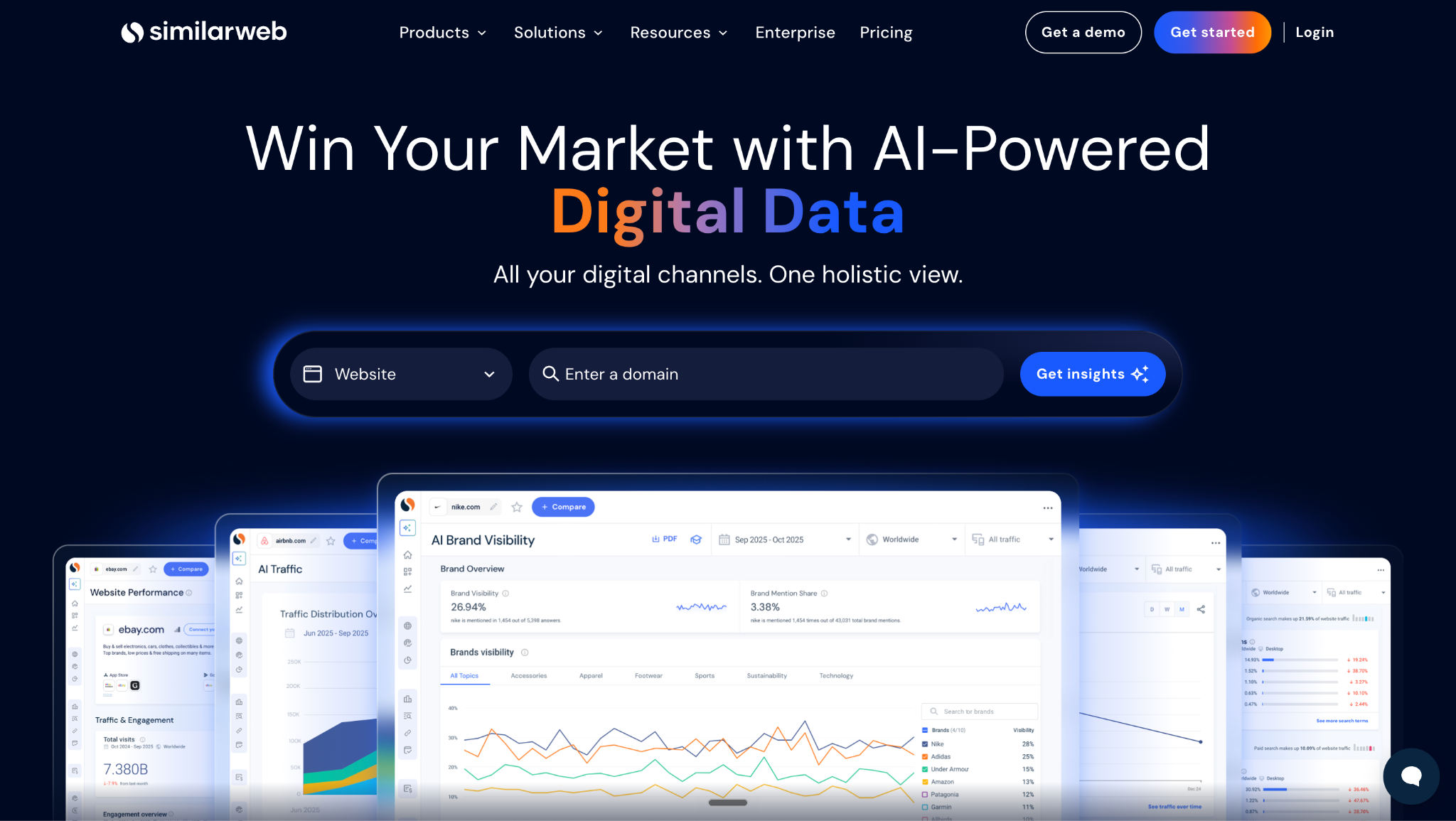
Similarweb is a digital market intelligence platform that helps businesses understand online markets through website traffic analysis, audience insights, competitor benchmarking, referral sources, search performance, and industry trends. Rather than focusing on a single website, it provides a broader view of how companies compete across digital channels.
Marketing, strategy, and growth teams use Similarweb to estimate competitor traffic, identify acquisition channels, benchmark market share, analyze audience behavior, and discover new growth opportunities. These insights help organizations make better decisions around marketing investment, competitive positioning, SEO, paid advertising, and expansion into new markets.
For companies that rely heavily on digital channels, Similarweb provides one of the most comprehensive views of competitive market activity available.
Best For
Digital marketing teams
Growth and strategy teams
B2B SaaS companies
Enterprise organizations
Businesses analyzing competitors and market trends
Companies expanding into new markets
Strengths
Comprehensive website traffic and market analysis
Competitive benchmarking across industries
Audience demographics and behavioral insights
Traffic source and keyword analysis
Market share and industry trend reporting
Strong competitive research capabilities
Limitations
Traffic estimates are modeled rather than directly measured
Enterprise features can become expensive
Focuses primarily on digital market intelligence rather than buyer qualification, sales execution, or revenue conversion
Semrush Trends
Primary Job
Digital Market Intelligence
What It Does
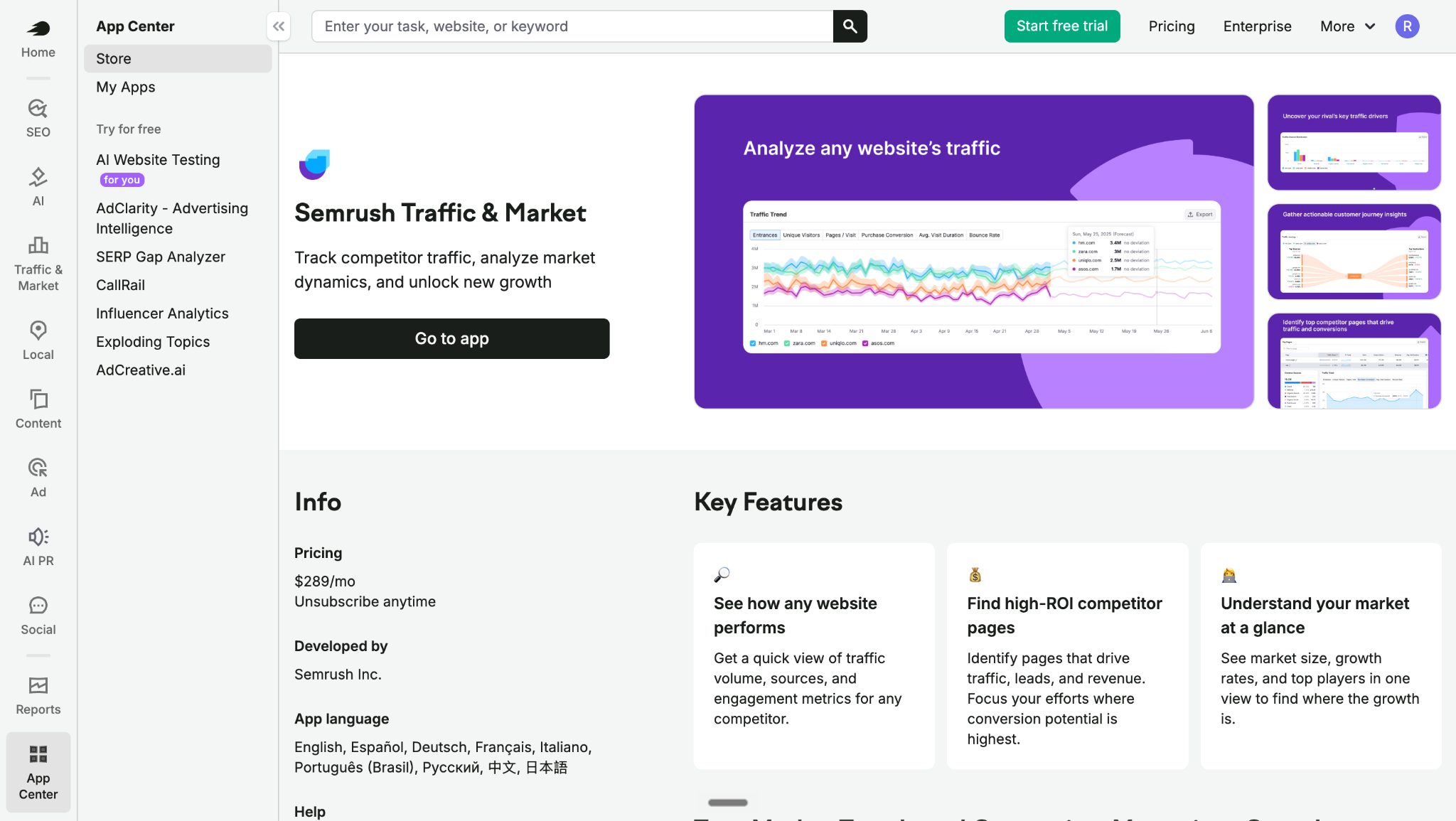
Semrush Trends extends the Semrush ecosystem by providing market-level insights into online behavior, competitive positioning, audience overlap, traffic trends, and emerging opportunities. Instead of focusing only on keyword rankings, it helps businesses understand how entire markets are evolving.
Marketing teams use Semrush Trends to analyze competitor performance, identify shifts in consumer demand, evaluate market leaders, monitor industry growth, and uncover new opportunities before they become highly competitive. These insights support SEO strategy, content planning, paid advertising, and broader go-to-market decisions.
For organizations investing heavily in search and digital marketing, Semrush Trends combines market intelligence with search intelligence to deliver actionable competitive insights.
Best For
SEO teams
Content marketing teams
Digital marketers
Growth teams
Agencies
Businesses focused on search-driven growth
Strengths
Strong digital market and search trend analysis
Competitive traffic benchmarking
Audience overlap and market share insights
Integrated with the broader Semrush platform
Valuable for SEO, content, and paid media planning
Easy-to-understand dashboards and reporting
Limitations
Primarily focused on digital marketing intelligence
Less suitable for competitive sales intelligence or enterprise market research
Often complements rather than replaces broader market intelligence platforms
Exploding Topics
Primary Job
Emerging Trend Intelligence
What It Does
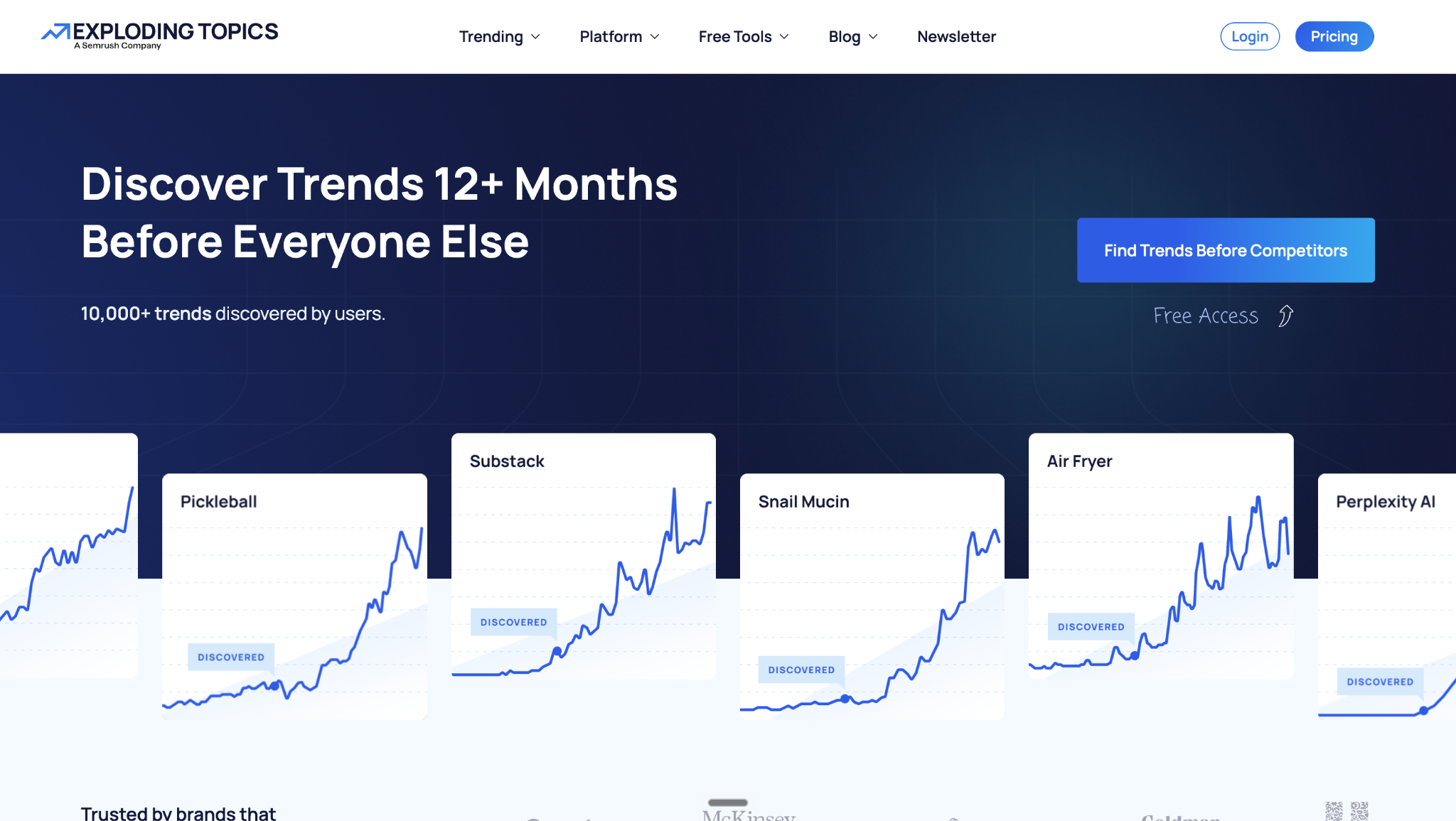
Exploding Topics helps businesses discover emerging products, technologies, industries, and consumer trends before they become mainstream. By analyzing search behavior, online discussions, and market signals, it identifies topics experiencing sustained growth rather than short-term popularity.
Marketing teams, product managers, founders, and investors use Exploding Topics to identify new content opportunities, evaluate markets, validate product ideas, and anticipate shifts in customer demand. Early visibility into growing trends allows organizations to create content, launch products, or enter markets ahead of competitors.
Unlike traditional market intelligence platforms that focus on current market conditions, Exploding Topics emphasizes where markets are heading next.
Best For
Content marketing teams
Product teams
Startup founders
Investors
SEO professionals
Businesses researching emerging markets
Strengths
Identifies emerging market opportunities early
Excellent trend discovery capabilities
Easy-to-use interface and visualizations
Supports content strategy and product research
Helps identify long-term growth opportunities
Useful across multiple industries
Limitations
Focuses on identifying trends rather than analyzing competitors
Limited buyer intent and revenue intelligence capabilities
Best used alongside broader market intelligence and competitive intelligence platforms rather than as a standalone solution
Crayon
Primary Job
Competitive Intelligence
What It Does
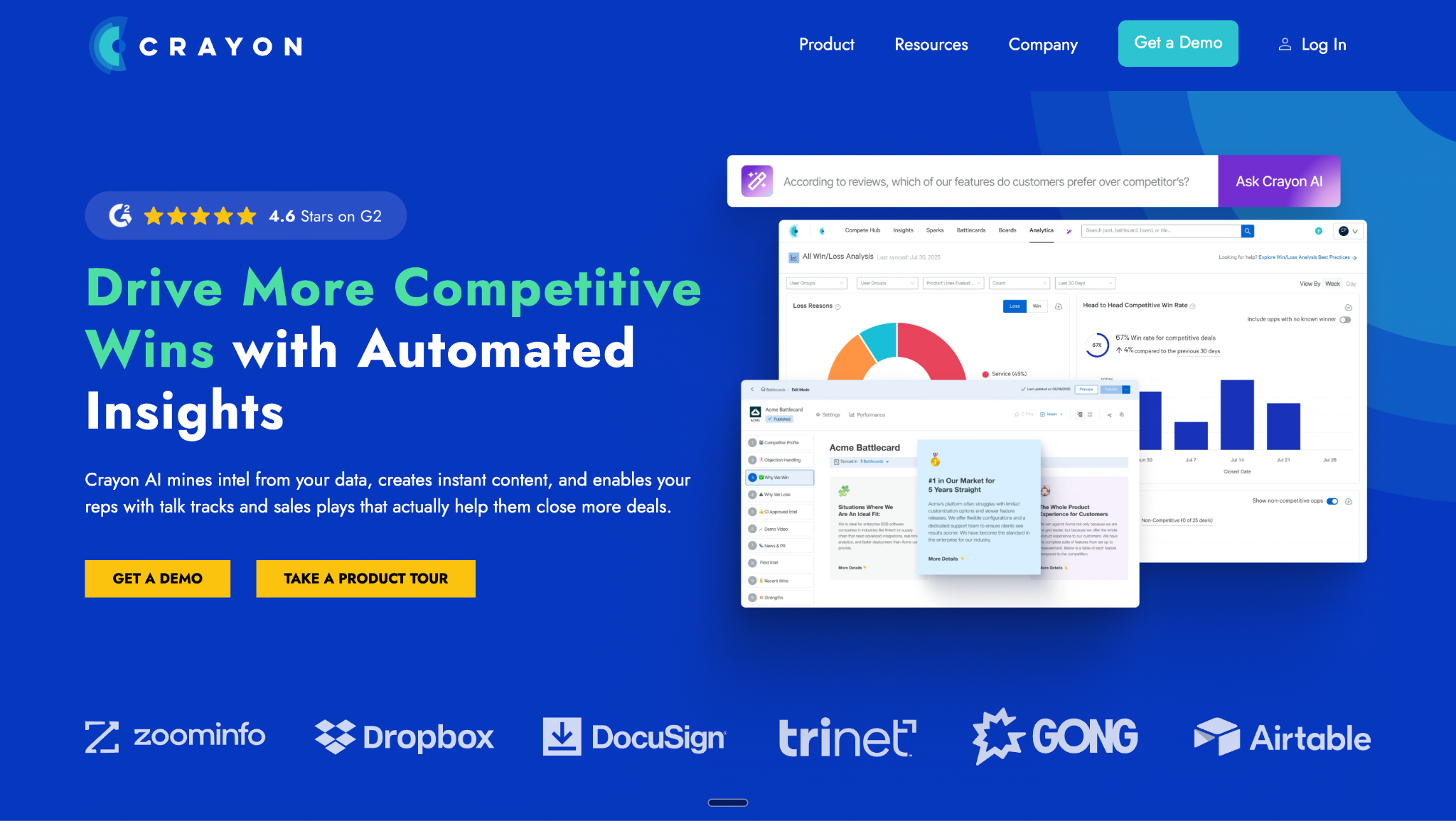
Crayon is a competitive intelligence platform that helps businesses monitor competitors across thousands of public data sources. It automatically tracks changes to competitor websites, product pages, pricing, messaging, feature releases, customer reviews, hiring activity, marketing campaigns, and other market signals, allowing teams to stay informed without manually monitoring competitors.
One of Crayon's biggest strengths is turning competitive insights into actionable sales enablement. Teams can create battlecards, distribute competitive updates, and equip sales representatives with the information they need to handle competitive conversations more effectively.
For organizations competing in fast-moving B2B markets, Crayon helps transform competitive monitoring into a structured, ongoing business process.
Best For
Product marketing teams
Competitive intelligence teams
Enterprise sales organizations
Revenue enablement teams
B2B SaaS companies
Businesses operating in highly competitive markets
Strengths
Automated competitor monitoring across multiple data sources
Real-time alerts for competitor changes
Comprehensive battlecard creation and sales enablement
Centralized competitive intelligence repository
Strong collaboration and knowledge-sharing features
Enterprise-ready reporting and analytics
Limitations
Focuses primarily on competitors rather than broader market trends
Requires ongoing internal ownership to maximize value
Does not identify buyers, qualify opportunities, or convert competitive insights into revenue workflows
Klue
Primary Job
Competitive Enablement
What It Does
Klue helps organizations collect competitive intelligence and deliver it directly to customer-facing teams. Instead of simply tracking competitors, Klue focuses on making competitive insights usable during sales conversations through battlecards, competitor profiles, messaging guidance, objection handling, and sales enablement content.
The platform aggregates information from competitor websites, news, product updates, customer feedback, analyst reports, and internal observations, giving sales and marketing teams a centralized source of competitive knowledge.
Klue is particularly valuable for organizations with multiple competitors and complex enterprise sales cycles, where competitive positioning can directly influence win rates.
Best For
Product marketing teams
Sales enablement teams
Enterprise sales organizations
Competitive intelligence programs
Mid-market and enterprise SaaS companies
Strengths
Excellent competitive battlecard management
Strong sales enablement capabilities
Centralized competitor knowledge base
Easy distribution of competitive insights across revenue teams
Collaboration features for marketing and sales
Enterprise-ready governance and reporting
Limitations
Built primarily around competitive enablement rather than overall market intelligence
Provides limited visibility into buyer intent or customer engagement
Requires complementary platforms for revenue intelligence, qualification, and pipeline generation
AlphaSense
Primary Job
Enterprise Market Intelligence
What It Does
AlphaSense is an AI-powered market intelligence platform that helps organizations research industries, markets, companies, financial performance, and emerging business trends. It combines premium business content with advanced search capabilities, allowing users to analyze earnings calls, SEC filings, broker research, news, expert interviews, company documents, and market reports from a single interface.
Enterprise strategy teams, investors, consultants, and corporate decision-makers use AlphaSense to monitor markets, evaluate competitors, assess risks, and identify growth opportunities based on trusted business intelligence rather than fragmented information sources.
Its AI-powered semantic search and document analysis make it particularly valuable for organizations conducting complex market research at scale.
Best For
Enterprise organizations
Corporate strategy teams
Financial services firms
Consulting firms
Investment professionals
Large B2B organizations conducting market research
Strengths
Comprehensive enterprise market research platform
AI-powered search across premium business content
Strong financial and industry intelligence
Earnings call and company filing analysis
Enterprise-grade security and scalability
Excellent research productivity for analysts and executives
Limitations
Premium pricing designed primarily for enterprise organizations
More focused on strategic research than day-to-day revenue operations
Does not provide buyer identification, AI qualification, or revenue conversion capabilities
CB Insights
Primary Job
Market & Industry Intelligence
What It Does
CB Insights is a market intelligence platform focused on helping organizations understand industries, startups, venture capital activity, technology markets, and emerging business opportunities. It combines company profiles, funding data, acquisition activity, market maps, analyst research, and AI-powered insights to help businesses evaluate where markets are heading.
Corporate innovation teams, investors, product leaders, and enterprise strategy groups use CB Insights to identify disruptive technologies, benchmark competitors, monitor investment trends, and evaluate potential acquisition or partnership opportunities.
Rather than focusing on day-to-day sales execution, CB Insights supports long-term strategic planning by helping organizations understand how industries and markets are evolving.
Best For
Enterprise strategy teams
Corporate innovation groups
Venture capital firms
Product leadership teams
Technology companies
Businesses researching emerging industries
Strengths
Extensive startup and private company database
Strong industry and market intelligence
Funding, acquisition, and investment tracking
AI-powered market analysis
Excellent visualization of technology landscapes
Valuable for strategic planning and innovation
Limitations
Designed primarily for strategic market research rather than sales execution
Limited capabilities for buyer engagement, qualification, or revenue operations
Best used alongside customer, buyer intent, and revenue intelligence platforms for a complete go-to-market strategy
Gong
Primary Job
Conversation Intelligence
What It Does
Gong is a conversation intelligence platform that captures, analyzes, and summarizes customer interactions across sales calls, video meetings, emails, and other communication channels. Using AI, it identifies patterns in customer conversations, highlights risks and opportunities, tracks competitor mentions, and provides coaching insights that help revenue teams improve sales execution.
Unlike traditional market intelligence platforms that focus on external research, Gong generates intelligence directly from customer conversations. This helps businesses understand how buyers evaluate products, which objections arise most often, what competitors are mentioned during sales cycles, and which messaging resonates with prospects.
For organizations looking to improve forecasting, sales coaching, and customer understanding, Gong has become one of the leading conversation intelligence platforms.
Best For
Enterprise sales organizations
Revenue operations teams
Sales enablement teams
Customer success teams
B2B SaaS companies
Businesses with large sales organizations
Strengths
AI-powered conversation analysis
Automated call recording and transcription
Competitor mention tracking
Sales coaching and performance insights
Revenue forecasting support
CRM integrations and reporting
Limitations
Requires a high volume of customer conversations to generate meaningful insights
Primarily analyzes existing interactions rather than identifying new market opportunities
Does not provide buyer identification, intent detection, or revenue conversion workflows
Apollo.io
Primary Job
Prospect Intelligence
What It Does
Apollo.io combines a large B2B contact database with sales intelligence and outbound engagement tools to help revenue teams identify potential buyers, research accounts, and build prospect lists. The platform provides company information, contact details, buying signals, email sequencing, enrichment, and prospecting workflows that support outbound sales.
While Apollo is often associated with outbound prospecting, it also serves as a valuable prospect intelligence platform by helping businesses understand target accounts, identify decision-makers, and prioritize outreach based on firmographic and company data.
For organizations focused on building outbound pipeline, Apollo offers an accessible combination of prospect intelligence and sales engagement capabilities.
Best For
SDR teams
Outbound sales organizations
Startups and growing SaaS companies
Revenue teams building prospect lists
Businesses expanding into new markets
Strengths
Large B2B contact and company database
Strong prospect search and filtering
Contact enrichment capabilities
Built-in outbound sales engagement
Easy-to-use prospecting workflows
Competitive pricing for growing teams
Limitations
Primarily focused on outbound prospecting rather than broader market intelligence
Contact accuracy can vary across industries and regions
Does not provide enterprise-level market research, competitive intelligence, or revenue conversion capabilities
G2 Buyer Intent helps businesses identify companies actively researching software categories and comparing vendors on the G2 platform. By analyzing buyer behavior, product comparisons, review activity, category exploration, and other engagement signals, it enables revenue teams to prioritize accounts that are showing meaningful purchase intent.
Unlike traditional lead generation tools that rely on form submissions, G2 Buyer Intent surfaces buying signals earlier in the evaluation process. Marketing and sales teams can use these insights to personalize outreach, prioritize high-intent accounts, improve account-based marketing campaigns, and accelerate pipeline generation.
For B2B software companies, G2 Buyer Intent provides valuable visibility into buyers who are already in an active purchasing cycle.
Best For
B2B SaaS companies
Account-Based Marketing (ABM) teams
Demand generation teams
Sales and revenue operations
Mid-market and enterprise organizations
Strengths
High-quality buyer intent signals
Account prioritization based on purchase behavior
Strong ABM use cases
Native connection to G2 review ecosystem
Supports personalized sales and marketing outreach
Easy integration with CRM and marketing platforms
Limitations
Intent signals are limited to activity within the G2 ecosystem
Most valuable for software and technology vendors
Does not engage buyers or convert intent into pipeline on its own
HG Insights
Primary Job
Technology Intelligence
What It Does
HG Insights is a technology intelligence platform that helps businesses understand which technologies organizations use, how their technology stacks are changing, and where potential sales opportunities exist. By combining technographic data, AI-driven analytics, firmographic information, and market intelligence, it enables revenue teams to identify accounts that closely match their ideal customer profile.
Technology vendors, enterprise sales teams, and account-based marketing organizations use HG Insights to prioritize target accounts, personalize outreach, identify technology replacement opportunities, and uncover whitespace within existing markets.
For businesses selling software or IT solutions, technology intelligence provides an additional layer of insight beyond traditional firmographic or intent data.
Best For
Enterprise B2B sales teams
Technology vendors
Account-Based Marketing (ABM) teams
Revenue operations
Companies selling into enterprise IT organizations
Strengths
Comprehensive technographic intelligence
AI-powered account prioritization
Technology stack visibility
Strong enterprise data coverage
Supports account segmentation and targeting
Valuable for complex B2B sales motions
Limitations
Most valuable for organizations selling technology products or services
Less applicable for businesses outside enterprise technology markets
Best used alongside buyer intent, competitive intelligence, and revenue conversion platforms for a complete go-to-market strategy
Kompyte
Primary Job
Competitor Intelligence
What It Does
Kompyte is a competitor intelligence platform that helps businesses automatically monitor and analyze competitor activity. It tracks changes across competitor websites, product pages, pricing, messaging, content, social media, advertising, reviews, and marketing campaigns, giving revenue teams a centralized view of how competitors are evolving.
Automated monitoring is most useful when teams have a consistent way to organize and evaluate what they find. A competitor analysis template helps teams compare positioning, pricing, product gaps, and market opportunities before turning competitive signals into actionable insights.
Rather than manually checking competitor websites, Kompyte continuously collects competitive signals and organizes them into actionable insights. Sales, marketing, and product teams use these insights to improve positioning, prepare for competitive deals, strengthen messaging, and respond more quickly to market changes.
For organizations operating in highly competitive markets, Kompyte helps transform competitor monitoring into an ongoing business process rather than an occasional research project.
Best For
Product marketing teams
Competitive intelligence teams
Sales enablement teams
Enterprise SaaS companies
Businesses with multiple direct competitors
Revenue teams supporting competitive sales cycles
Strengths
Automated competitor monitoring
Real-time alerts for competitor activity
Competitive battlecards and sales enablement
Website, pricing, messaging, and product tracking
Easy sharing of competitive insights across teams
Strong integrations with CRM and sales platforms
Limitations
Focuses primarily on competitor monitoring rather than broader market intelligence
Does not provide buyer intent or customer intelligence
Requires complementary platforms for revenue conversion and pipeline generation
Knock AI
Primary Job
Revenue Intelligence
What It Does
Knock AI is a Revenue Intelligence Platform built to help enterprise revenue teams convert buying intent into qualified pipeline. Unlike traditional market intelligence platforms that focus on helping businesses understand markets, competitors, or industry trends, Knock AI focuses on helping teams act on intelligence once buying signals appear.
Instead of stopping at dashboards or reports, Knock AI transforms buyer intelligence into measurable revenue outcomes through its Formless Revenue Funnel, reducing friction between buyer interest and qualified pipeline.
Best For
Enterprise B2B revenue teams
Revenue Operations (RevOps)
Demand Generation teams
Marketing and Sales organizations with significant inbound demand
Companies adopting AI-powered revenue workflows
Businesses focused on improving pipeline conversion rather than simply generating more leads
Strengths
Revenue Intelligence Platform rather than a traditional market intelligence tool
Buyer identification through Knock Reveal
Real-time intent analysis with Knock Intent & Score
Company and contact enrichment with Knock Enrich
AI-powered qualification through Knock AI Agent
Intelligent routing with Knock Routing
Native meeting booking with Knock Scheduling
CRM synchronization through Knock CRM
Multi-channel buyer engagement through Knock Chat and Knock Outreach
Formless Revenue Funnel that reduces friction throughout the buying journey
Enterprise-ready platform with native integrations and ongoing product innovation
Limitations
Not designed to replace SEO, digital market intelligence, or competitive intelligence platforms.
Best complemented by platforms that generate demand, while Knock AI focuses on identifying buyers, qualifying opportunities, and converting buying intent into qualified pipeline.
Why Revenue Intelligence instead of Market Intelligence?
Traditional market intelligence platforms help businesses understand their market by collecting data about competitors, industries, customers, and trends. Revenue Intelligence goes a step further by helping revenue teams identify buying signals, engage buyers, qualify opportunities, and convert market insights into qualified pipeline and revenue. Rather than replacing market intelligence, Knock AI builds on it by turning intelligence into action.
Which Market Intelligence Tool Solves Which Problem?
The best market intelligence software depends on the business problem you're trying to solve. Some platforms help you understand markets, others monitor competitors, uncover buying signals, or improve revenue decisions. Use the table below to quickly identify which platform best aligns with your current priorities.
If your biggest challenge is...
Consider...
Understanding digital markets and website performance
Similarweb
Discovering emerging trends before competitors
Exploding Topics
Researching search trends and digital market opportunities
Semrush Trends
Tracking competitor activity and market movements
Crayon
Building competitive battlecards for sales teams
Klue
Conducting enterprise market and financial research
AlphaSense
Understanding industries, startups, and innovation trends
CB Insights
Learning from customer conversations and sales calls
Gong
Finding prospects and researching target accounts
Apollo.io
Identifying companies actively researching your solution
G2 Buyer Intent
Understanding technology adoption across target accounts
HG Insights
Monitoring competitors in real time
Kompyte
Turning market intelligence into qualified pipeline and revenue
Knock AI
No single platform is designed to solve every market intelligence challenge.
For example, Similarweb and Semrush Trends help businesses understand digital markets, while Crayon, Klue, and Kompyte focus on competitor intelligence. AlphaSense and CB Insights provide deeper market and industry research, Gong uncovers insights from customer conversations, Apollo.io and G2 Buyer Intent help revenue teams prioritize potential buyers, and HG Insights provides visibility into technology adoption.
If your goal extends beyond understanding the market to acting on market intelligence, platforms like Knock AI help enterprise revenue teams identify buyers, analyze intent, qualify opportunities with AI, and convert those insights into qualified pipeline through a unified revenue workflow.
Digital Market Intelligence vs Competitive Intelligence
Although these terms are closely related, they answer different business questions.
Digital market intelligence helps businesses understand what's happening across the broader online market. It focuses on customer behavior, search trends, website performance, audience interests, and digital demand. Marketing and growth teams use it to identify opportunities, benchmark performance, and understand how markets are evolving.
Competitive intelligence focuses specifically on competitors. Instead of analyzing the market as a whole, it helps businesses monitor competitor strategies, pricing, messaging, product launches, feature updates, partnerships, and sales positioning. Much of that evidence lives on competitor web pages, so teams often keep their own visual record alongside their tooling, using a screenshot API such as Screenshot Scout to capture pricing and product pages on a schedule and compare how they change over time.
Digital Market Intelligence
Competitive Intelligence
SEO and search trends
Competitor monitoring
Website traffic analysis
Product and feature updates
Audience behavior
Pricing changes
Market demand
Messaging and positioning
Digital channels
Sales battlecards
Industry benchmarks
Competitive win/loss insights
The two disciplines work best together. Digital market intelligence helps you understand where opportunities exist, while competitive intelligence helps you understand how to position your business against competitors pursuing those same opportunities.
Marketing Intelligence vs Market Intelligence
Marketing intelligence and market intelligence are often confused, but they serve different purposes within a go-to-market strategy.
Marketing intelligence focuses on improving marketing performance. It helps teams understand which campaigns generate the best results, which channels perform most effectively, how customers engage with marketing, and where marketing investment produces the highest return.
Market intelligence takes a broader view. It helps businesses understand industries, competitors, customers, buyer behavior, market trends, and external factors that influence strategic decisions.
Marketing Intelligence
Market Intelligence
Marketing campaigns
Markets and industries
Marketing channels
Competitors
Customer acquisition
Buyers and buying behavior
Campaign performance
Market trends
Attribution and ROI
Competitive landscape
Marketing optimization
Business strategy
Both are essential for modern B2B organizations.
Marketing intelligence helps answer "How can we improve our marketing?" while market intelligence answers "Where is the market going, and how should we respond?" Organizations that combine both gain a more complete understanding of their customers, competitors, and growth opportunities.
Real-Time Market Intelligence: Why Static Reports No Longer Win
Market intelligence used to rely on quarterly reports, annual research, and historical data.
Today's markets move too quickly for that approach.
Buyers change priorities, competitors launch products, industries evolve, and new technologies emerge every day. By the time a traditional market research report is published, many of its insights may already be outdated.
Modern market intelligence is built around real-time signals rather than static reports.
These signals include:
Buyer intent data
AI-powered insights
Website visitor activity
Customer conversations
Competitor updates
Search trends
LinkedIn activity
Online communities and forums
AI search platforms such as ChatGPT, Gemini, Claude, and Perplexity
Instead of asking, "What happened last quarter?", leading revenue teams ask, "What is happening right now?"
This shift enables faster decision-making across marketing, sales, product, and revenue operations. Teams can identify emerging opportunities sooner, respond to competitive changes more quickly, prioritize accounts showing active buying intent, and engage buyers while interest is still high.
As AI continues to reshape how people research and evaluate products, real-time market intelligence is becoming a competitive advantage. Organizations that combine live market signals with buyer intent and revenue workflows will consistently make better decisions than those relying on static reports and historical analysis alone.
Most Market Intelligence Software Stops at Insights. Revenue Teams Need Action.
Traditional market intelligence software is designed to answer one question:
What's happening in the market?
It helps businesses collect data, monitor competitors, analyze industries, and generate reports. Those insights are valuable, but they rarely create revenue on their own.
A traditional workflow typically looks like this:
Market Intelligence
↓
Reports
↓
Dashboards
↓
Insights
The challenge is that insights don't automatically become pipeline.
Revenue teams still need to identify the right buyers, understand their intent, engage them in meaningful conversations, qualify opportunities, and move them through the sales process.
This is where Revenue Intelligence represents the next evolution of market intelligence.
Instead of stopping at insights, Revenue Intelligence focuses on turning market signals into measurable business outcomes.
Rather than functioning as another market intelligence platform, Knock AI helps enterprise revenue teams act on intelligence. Knock Reveal identifies buyers, Knock Intent & Score prioritizes accounts based on buying signals, Knock Enrich provides richer buyer context, and Knock AI Agent qualifies opportunities before Knock Routing, Knock Scheduling, and Knock CRM move them into the sales process. Throughout the journey, Knock Chat and Knock Outreach help maintain conversation continuity across multiple touchpoints.
The result isn't simply better visibility into the market. It's a more efficient path from buyer intelligence to qualified pipeline.
How to Build a Modern Market Intelligence Stack
The best market intelligence stack depends on your company's size, growth stage, and business objectives. Instead of purchasing every available platform, focus on building a stack where each tool solves a specific problem.
Startup
A lean stack focused on market discovery and prospecting is often enough.
Semrush Trends for digital market research
Exploding Topics for emerging opportunities
Apollo.io for prospect intelligence
Growing SaaS Company
As your business scales, you'll need deeper competitive insights and stronger customer intelligence.
Similarweb for digital market intelligence
Crayon for competitive intelligence
Gong for conversation intelligence
Knock AI for revenue intelligence and pipeline conversion
Enterprise
Large organizations require multiple layers of intelligence across strategy, product, marketing, and revenue teams.
AlphaSense for enterprise market research
CB Insights for industry and innovation intelligence
Klue for competitive enablement
HG Insights for technology intelligence
G2 Buyer Intent for buyer intent signals
Knock AI for turning intelligence into qualified pipeline
The strongest market intelligence stacks don't collect the most data. They connect the right insights with the teams responsible for driving revenue.
Common Mistakes Companies Make When Buying Market Intelligence Software
Choosing the wrong market intelligence platform often leads to more dashboards but fewer business outcomes. Common mistakes include:
Buying dashboards instead of solving business problems
Collecting more market data than teams can realistically use
Ignoring buyer intent and focusing only on competitors
Overlooking customer conversations as a source of market intelligence
Failing to connect market insights with qualified pipeline
Purchasing multiple tools with overlapping capabilities
Treating market intelligence as a quarterly research project instead of an ongoing business process
The most successful organizations don't optimize for information. They optimize for better decisions and faster execution.
AI Is Transforming Market Intelligence
Artificial intelligence is fundamentally changing how businesses collect, analyze, and act on market intelligence.
Instead of manually reviewing reports or monitoring dozens of information sources, teams can now use AI to identify patterns, summarize competitive activity, surface buying signals, and prioritize opportunities in real time.
Modern market intelligence increasingly combines:
AI search platforms such as ChatGPT, Claude, Gemini, Perplexity, and DeepSeek
Conversation intelligence from customer interactions
AI-powered competitor analysis
Buyer intent detection
Predictive intelligence
Technology intelligence
Automated market research
Revenue intelligence
The next generation of market intelligence won't be defined by who has the largest database. It will be defined by who can identify meaningful signals fastest and turn those insights into conversations, qualified opportunities, and revenue.
As AI continues to reshape how businesses buy and sell, market intelligence is evolving from a reporting function into a real-time decision engine that powers modern revenue teams.
Why Knock AI Is Different From Traditional Market Intelligence Platforms
Traditional market intelligence platforms are designed to help businesses understand their market. They collect data, monitor competitors, identify trends, and generate insights that support strategic decision-making.
It is a Revenue Intelligence Platform designed to help enterprise revenue teams act on market intelligence by converting buying signals into qualified pipeline.
Instead of stopping at research or dashboards, Knock AI connects the critical stages between buyer intelligence and revenue through a unified workflow.
The journey looks like this:
Knock Reveal
↓
Knock Intent & Score
↓
Knock Enrich
↓
Knock AI Agent
↓
Knock Routing
↓
Knock Scheduling
↓
Knock CRM
↓
Conversation Continuity
↓
Qualified Pipeline
↓
Revenue
Each product contributes to a single objective. Knock Reveal identifies buyers, Knock Intent & Score prioritizes accounts based on real buying signals, Knock Enrich adds company and contact intelligence, and Knock AI Agent qualifies buyers through natural conversations. Qualified opportunities are then routed intelligently with Knock Routing, meetings are booked through Knock Scheduling, buyer context is synchronized through Knock CRM, and conversations continue across multiple touchpoints with Knock Chat and Knock Outreach.
This is why Knock AI is best described as a Revenue Intelligence Platform rather than a traditional market intelligence platform. It doesn't replace market intelligence. It builds on it by helping revenue teams turn market insights into conversations, qualified opportunities, and measurable business growth.
Which Market Intelligence Platform Should You Buy First?
The right platform depends on the problem you're trying to solve. Start with your biggest business challenge rather than the platform with the most features.
If you need...
Consider...
Digital market intelligence
Similarweb
Search and digital trend intelligence
Semrush Trends
Emerging market and consumer trends
Exploding Topics
Competitor monitoring
Crayon
Competitive battlecards and sales enablement
Klue
Enterprise market research
AlphaSense
Industry and startup intelligence
CB Insights
Conversation intelligence
Gong
Prospect intelligence
Apollo.io
Buyer intent intelligence
G2 Buyer Intent
Technology intelligence
HG Insights
Competitor monitoring and automated alerts
Kompyte
Revenue intelligence and pipeline conversion
Knock AI
The most successful organizations combine complementary technologies that help them understand markets, monitor competitors, identify buying signals, and ultimately convert those insights into revenue.
The Future of Market Intelligence Isn't More Data. It's Better Decisions.
Businesses have never had access to more market data.
The real competitive advantage is knowing which signals matter and acting on them before everyone else.
The future of market intelligence looks like this:
Market
↓
Signals
↓
Buyer Intent
↓
Conversations
↓
Qualified Pipeline
↓
Revenue
Organizations that outperform their competitors won't necessarily have the largest research teams or the biggest databases. They'll be the ones that combine market intelligence with buyer intent, AI, and revenue workflows to make faster, better decisions.
Market intelligence is evolving from a reporting function into a real-time decision engine. As AI reshapes how buyers discover, evaluate, and purchase products, the companies that win will be those that transform intelligence into action and action into revenue.
Frequently Asked Questions
What are market intelligence tools?
Market intelligence tools help businesses collect, analyze, and act on information about markets, competitors, customers, industry trends, and buyer behavior. They support strategic decision-making across marketing, sales, product, and revenue teams.
What is the difference between market intelligence, competitive intelligence, and marketing intelligence?
Market intelligence provides a broad view of markets, customers, competitors, and industry trends. Competitive intelligence focuses specifically on competitor products, pricing, messaging, and positioning. Marketing intelligence measures campaign performance, customer behavior, marketing channels, and return on investment.
What is the best market intelligence software?
The best market intelligence software depends on your objectives. Similarweb excels at digital market intelligence, Crayon and Klue focus on competitive intelligence, AlphaSense provides enterprise market research, Gong delivers conversation intelligence, and Knock AI helps enterprise revenue teams convert market intelligence into qualified pipeline.
Which market intelligence platform is best for B2B SaaS companies?
B2B SaaS companies typically benefit from combining multiple platforms. Similarweb helps monitor digital markets, Crayon tracks competitors, Gong analyzes customer conversations, G2 Buyer Intent identifies active buyers, and Knock AI helps convert buyer intelligence into qualified pipeline through AI-powered qualification and revenue workflows.
What is a Revenue Intelligence Platform?
A Revenue Intelligence Platform goes beyond traditional market intelligence by helping revenue teams act on market and buyer insights. Instead of stopping at reports and dashboards, platforms like Knock AI combine buyer identification, intent detection, AI qualification, routing, scheduling, CRM synchronization, and conversation continuity to generate qualified pipeline and revenue.
Is Knock AI a market intelligence platform?
Knock AI is best described as a Revenue Intelligence Platform. While traditional market intelligence platforms help businesses understand markets and competitors, Knock AI helps enterprise revenue teams act on that intelligence by identifying buyers, analyzing intent, qualifying opportunities with AI, and converting buying signals into qualified pipeline.
Can one platform replace multiple market intelligence tools?
No single platform replaces every type of market intelligence software because different tools solve different problems. Many organizations combine digital market intelligence, competitive intelligence, conversation intelligence, buyer intent, and revenue intelligence platforms to build a complete go-to-market strategy. Modern platforms like Knock AI can consolidate several downstream revenue workflows, reducing the need for multiple point solutions after buyer intent has been identified.


.svg)


.svg)
.svg)
.svg)


.svg)
.svg)


.svg)