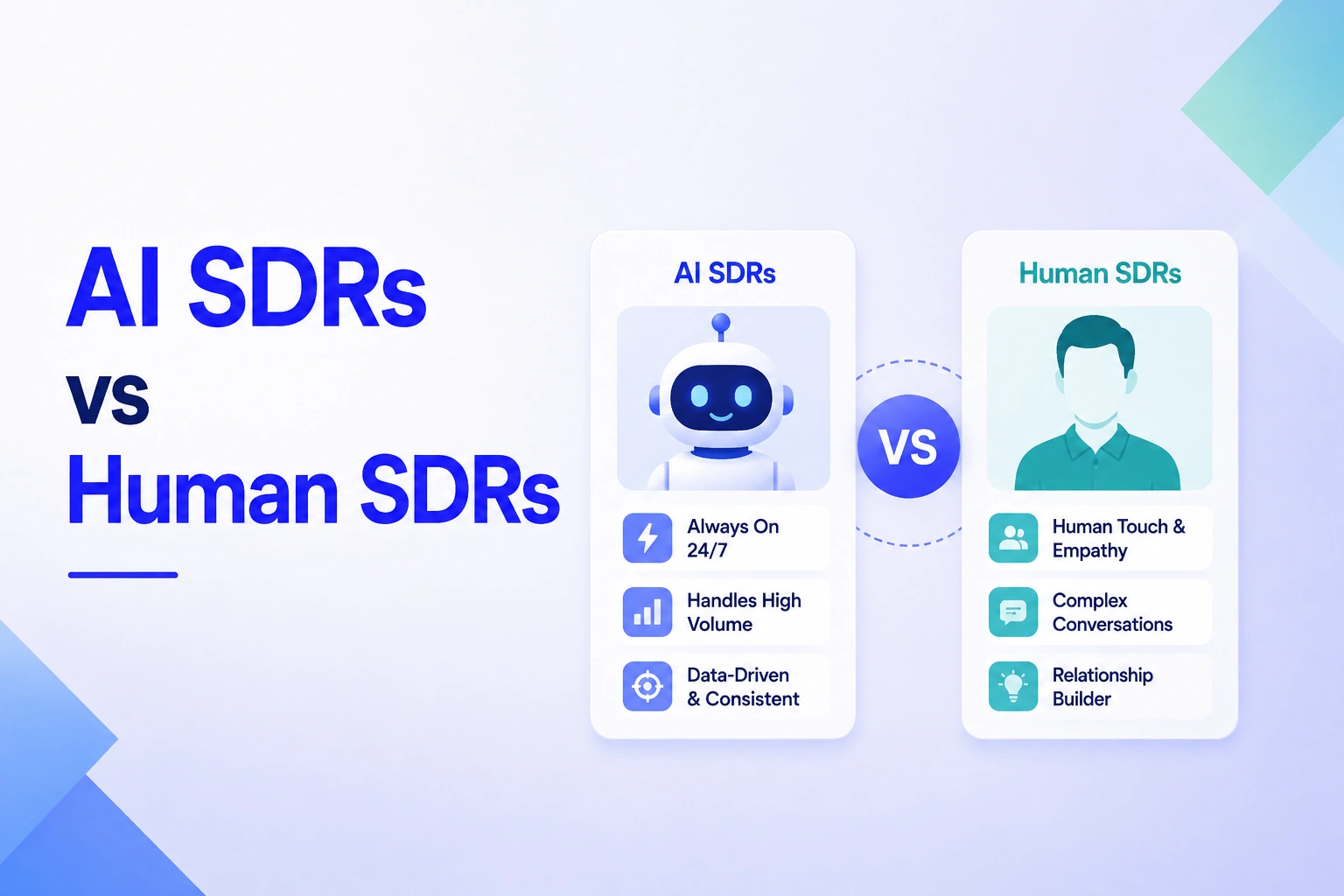
The important distinction isn't who can do more sales activities. It's who is better suited to the activities that actually matter in your sales motion. An AI SDR can create enormous leverage when the bottleneck is volume, speed, qualification, or follow-up. A human SDR becomes more valuable as the work requires discovery, judgment, relationships, and complex deal dynamics.
What Is an AI SDR, Really?
“AI SDR” can mean very different things depending on the product. Some tools are essentially AI assistants for SDRs, while others can run large parts of the sales development process themselves.
The first category is AI-assisted SDR software. These tools help reps with work such as prospect research, contact enrichment, account prioritization, outreach drafting, and follow-up. The SDR still makes the decisions and owns the conversation, but AI takes care of some of the repetitive work.
Then there are autonomous AI SDRs. These systems can identify prospects, research accounts, initiate outreach, handle responses, qualify prospects, and book meetings with much less human involvement. They are designed to execute a defined sales process rather than simply assist a rep.
A third category is the inbound AI SDR or AI sales agent. Instead of primarily prospecting outbound, it engages people who are already showing interest. It can identify and enrich visitors or leads, understand intent, qualify conversations, route buyers to the right person, book meetings, and hand off to a human when the conversation requires it.
That distinction matters because an AI SDR does not automatically mean replacing a human SDR. In many sales organizations, AI handles the volume, speed, research, and repetitive execution while humans focus on judgment, discovery, relationships, and more complex opportunities.
So when comparing AI SDRs with human SDRs, the more useful question is not “Which one is better?” but “Which parts of our SDR workflow should AI own, and where does human involvement create more value?”
Where AI SDRs Actually Beat Human SDRs
The strongest case for an AI SDR isn't that it can somehow “sell better” than a good rep. It's that there are parts of sales development where speed, consistency, and capacity matter more than human judgment.
If the work is repetitive, happens at high volume, follows reasonably clear rules, or needs to happen outside normal working hours, AI has a structural advantage.
Speed-to-lead
When a buyer raises their hand, waiting for an SDR to become available can mean losing momentum. AI can respond immediately, whether the lead submits a demo request, starts a website conversation, or engages with a high-intent sales channel.
That matters particularly for inbound sales, where the buyer has already shown some level of intent. An AI SDR can engage immediately, collect initial information, answer routine questions, qualify the opportunity, and involve a human when the conversation warrants it.
The advantage also extends beyond business hours. Instead of letting an inbound conversation sit until the next morning, AI can provide an initial response, qualify the buyer, or offer a meeting while the sales team is offline.
Related: Why is your speed to lead still slow even with automation?
Volume
A human SDR has to decide which prospects or conversations to work first. AI can work across a much larger pool simultaneously.
That makes AI particularly useful when the sales motion involves large prospect lists, frequent inbound conversations, or significant amounts of follow-up. It can research prospects, execute outreach, monitor responses, and continue conversations without dividing its attention in the same way a human rep has to.
But volume by itself isn't a sales strategy.
Sending 10,000 poorly targeted messages doesn't make a sales team more effective than sending 500 well-targeted ones. AI increases capacity; it doesn't automatically improve targeting, positioning, or messaging. If the inputs are bad, AI can simply help a team make the same mistake at a larger scale.
Consistent follow-up
Follow-up is one of the easiest parts of sales development to understand and one of the hardest to execute consistently.
A rep can intend to follow up with a prospect, then get pulled into another meeting, prioritize a new lead, or simply lose track of the thread. AI doesn't have that problem.
It can consistently handle:
- Follow-up sequences
- Re-engagement of older leads
- Responses after an initial interaction
- Long-tail nurture
- After-hours conversations
- Reminders and next steps
This doesn't mean every prospect should receive an endless sequence. It means the sales team doesn't have to rely entirely on individual reps remembering every next action.
Qualification and prioritization
AI is also well suited to qualification when the criteria are clear.
For example, an AI system can combine buyer signals, enrichment, intent, and qualification rules to determine which conversations deserve immediate human attention.
The workflow can look like:
Signal → enrichment → intent → qualification → routing → human
That's especially valuable for inbound teams dealing with more conversations than SDRs can manually evaluate. High-intent, high-fit buyers can be prioritized and routed quickly, while low-fit, spam, or non-sales conversations can be handled differently.
The important distinction is that AI doesn't need to make every sales decision. It can filter the volume so human reps spend more of their time on the decisions that actually require them.
Repetitive sales work
This is probably the simplest way to identify where an AI SDR makes sense.
If a task is repeatable + high volume + rules-based, it's a strong candidate for automation.
That could include researching accounts, enriching contacts, sending routine follow-ups, responding to common questions, qualifying against predefined criteria, or routing conversations to the right owner.
The more a task depends on judgment, persuasion, relationship-building, or understanding a complicated buying situation, the weaker that case becomes.
That's the real dividing line: AI SDRs create the most leverage when they remove repetitive work from the human SDR's day, rather than trying to replicate every part of the human sales role.
Where Human SDRs Still Win
AI can take a lot of repetitive work off an SDR's plate, but that doesn't mean every sales conversation should be automated. Once the job moves beyond defined qualification criteria and into understanding the buyer, navigating ambiguity, and influencing a complex decision, human judgment becomes much more valuable.
Complex objections
Some objections are easy to handle because the answer is known. Others require understanding what is actually behind the objection.
A buyer might say:
“We've tried this before and it failed because our RevOps team couldn't get the data right.”
The useful response isn't simply an answer to the sentence. A strong SDR needs to understand what failed, why it failed, what changed, and whether the same problem could happen again.
That can involve asking follow-up questions, challenging assumptions, changing the positioning, or bringing in someone with deeper product expertise.
AI can handle common objections and follow a defined playbook well. But when the objection becomes a proxy for a deeper business problem, human judgment has an advantage.
Discovery and problem understanding
This is one of the biggest differences between qualification and actual sales discovery.
Qualification asks:
“Does this buyer fit our criteria?”
Discovery asks:
“What's actually happening inside this business?”
AI can be very effective at collecting known qualification signals: company size, role, use case, budget, intent, existing tools, or other predefined criteria.
A human SDR can go further by noticing something the buyer hasn't explicitly stated yet. They can ask why a problem exists, understand how different stakeholders are affected, uncover the consequences of doing nothing, and adapt the conversation based on what they hear.
That distinction becomes increasingly important as the sales motion gets more consultative.
Enterprise and multi-stakeholder selling
The more complicated the buying process becomes, the more valuable human involvement tends to be.
Enterprise deals can involve:
- Multiple decision-makers
- Procurement and legal
- Executive stakeholders
- Internal champions
- Competing priorities
- Budget ownership
- Organizational dynamics
The challenge isn't just identifying whether an account is qualified. Someone has to understand who influences the decision, what each stakeholder cares about, where resistance might come from, and how to keep the deal moving.
AI can support this process with research, signals, reminders, and account intelligence. But humans are still better suited to navigating the ambiguity and politics that often come with complex deals.
Trust and relationships
Relationship-heavy selling also benefits from human ownership.
That's particularly true when the deal involves high ACV, consulting or strategic services, complex SaaS, or a long sales cycle. Buyers may want to understand not just whether a solution works, but whether they trust the people they're going to work with.
That doesn't mean AI can't create useful conversations or that every interaction needs a human. It means that as the commercial stakes and relationship requirements increase, human involvement becomes more valuable.
The strongest sales organizations therefore don't treat AI and human SDRs as competing alternatives. They use AI where speed and scale create leverage, and keep humans involved where judgment, discovery, trust, and complex decision-making can materially change the outcome.
AI SDR vs Human SDR: Which Is More Cost-Effective?
It’s tempting to compare an AI SDR with a human SDR by looking at the monthly price of the software versus a rep’s salary. That comparison misses most of the economics.
A human SDR comes with recruiting, onboarding, management, benefits, tools, ramp time, and the cost of turnover. An AI SDR has its own costs, including the platform, data, implementation, integrations, monitoring, and human oversight.
More importantly, the cheapest option isn't necessarily the most cost-effective one. The real question is how much qualified pipeline each approach creates relative to its total cost.
The cost of a human SDR
The cost of an SDR goes well beyond base salary.
A realistic calculation can include:
- Salary
- Benefits and payroll costs
- Commission and incentives
- Recruiting and hiring
- Onboarding and training
- Management and coaching
- Sales and prospecting tools
- Ramp time before the rep reaches full productivity
- Turnover and replacement costs
There's also a capacity constraint. One SDR can only research, contact, and follow up with so many prospects in a given day. Increasing output usually means adding more people or asking existing reps to spend less time on other activities.
The cost of an AI SDR
AI changes the cost structure, but it doesn't make the sales process free.
Depending on the platform and workflow, costs can include:
- AI SDR platform subscription
- Contact data and enrichment
- Implementation and configuration
- CRM and sales-stack integrations
- Monitoring and quality control
- Workflow and prompt optimization
- Human oversight and escalation
There can also be costs associated with poor automation. If an AI system targets the wrong accounts, sends weak messaging, or qualifies opportunities incorrectly, the resulting wasted activity has a real commercial cost.
The metric that actually matters: cost per qualified opportunity
This is where the comparison should move beyond activity metrics.
Cost per email tells you very little. Meetings booked can also be misleading if those meetings don't turn into real opportunities.
A better chain is:
Cost → qualified meetings → opportunities → pipeline → closed revenue
For example, an AI SDR might generate significantly more meetings than a human team but still produce less pipeline if the meetings are poorly qualified. Conversely, a human-led motion may generate fewer opportunities but perform better when each opportunity is high-value and complex.
So the useful question isn't:
“Which SDR is cheaper?”
It's:
“Which sales development model produces more qualified pipeline and revenue for the resources we're putting into it?”
That answer will depend heavily on the sales motion, which is why there isn't a universal winner between AI and human SDRs.
AI SDR vs Human SDR by Sales Motion
The right choice becomes much clearer when you look at how your team actually sells.
| Sales motion |
Better fit |
Why |
| High-volume SMB outbound |
AI SDR |
Large prospect volumes and repeatable messaging favor automation and scale. |
| High-volume inbound |
AI SDR |
Immediate engagement, qualification, and routing can prevent high-intent leads from waiting for a rep. |
| After-hours inbound |
AI SDR |
AI can engage and qualify buyers when the sales team is offline. |
| Lead qualification |
AI + human |
AI can handle defined qualification criteria; humans can investigate nuance and ambiguity. |
| Standardized outbound |
AI SDR |
Repeatable targeting, messaging, and follow-up are strong automation candidates. |
| Mid-market sales |
Hybrid |
AI can handle research, follow-up, and qualification while humans take ownership of more valuable conversations. |
| Enterprise outbound |
Human-led + AI |
AI can provide research and execution support, while humans manage account strategy and stakeholder relationships. |
| Complex discovery |
Human SDR |
Understanding an unstructured business problem requires judgment and adaptive questioning. |
| Multi-stakeholder deals |
Human SDR |
Stakeholder dynamics, internal champions, procurement, and competing priorities benefit from human ownership. |
| Long sales cycles |
Human-led |
Relationship management and context become increasingly important as the buying process stretches out. |
| High-ACV strategic selling |
Human-led |
The commercial stakes and complexity generally justify greater human involvement. |
The important point is that AI doesn't need to own the entire SDR function to create significant leverage.
A team selling low-cost products to thousands of potential buyers may get enormous value from automation. A team selling a $200K enterprise platform may get more value from using AI to research accounts, surface signals, and maintain follow-up while experienced reps handle the actual buying process.
What About Inbound Sales?
Inbound deserves separate consideration because the economics are different from outbound prospecting.
With traditional inbound sales, the workflow often looks like:
Lead arrives → notification → SDR researches → responds → qualifies → routes → books
The problem is simple: the buyer may be ready to talk before the SDR is ready to respond.
If a prospect submits a demo request at 10:00 AM and doesn't hear from anyone until 11:30 AM, the sales team has already introduced friction into a conversation that started with buyer intent.
An AI-assisted inbound workflow can look very different:
Buyer arrives → AI engages → identifies → enriches → qualifies → routes → books → human takes over
The AI can handle the initial interaction, gather relevant context, apply qualification rules, and determine whether the conversation should go to a human. A rep then spends their time on the conversations where human involvement is most valuable.
This is particularly useful when a company has high inbound volume but limited SDR capacity. Instead of forcing reps to manually inspect every conversation, AI can help separate high-intent buyers from low-fit, routine, or irrelevant interactions.
For teams where inbound conversion is the bottleneck, platforms such as Knock AI are built around this workflow rather than simply automating outbound sequences. The focus is on identifying and enriching buyers, understanding intent, qualifying conversations, routing them to the right person or AI agent, and helping move qualified buyers toward a meeting.
The broader lesson is more important than the tool itself: AI can be most valuable when it removes the delay between buyer intent and sales action, while keeping humans involved when the conversation becomes complex.
Also Check: Best inbound lead generation agents and services
The Best Model for Most B2B Teams: AI + Human SDRs
For most B2B teams, the choice doesn't have to be AI or human SDRs. The better model is usually to give each one the work they're structurally better suited to handle.
AI is good at work that is high-volume, repetitive, time-sensitive, and rules-based. That can include prospect research, enrichment, lead monitoring, initial qualification, repetitive outreach, follow-up, inbound response, meeting scheduling, prioritization, and CRM updates.
Humans are more valuable when the work requires judgment, discovery, context, or relationships. That includes understanding an unfamiliar business problem, handling complex objections, developing strategic accounts, building relationships, multi-threading deals, and navigating high-value conversations.
The result isn't simply fewer SDR tasks. Ideally, it's a different allocation of SDR time.
What changes for the human SDR?
When AI takes over more of the repetitive work, the human SDR can spend less time searching for contacts, checking CRM records, chasing routine follow-ups, or responding to predictable questions.
Their time can move toward better conversations: researching strategic accounts, asking better discovery questions, understanding the buying process, personalizing important interactions, and working closely with AEs on opportunities.
That leads to a simple rule:
AI handles the work that scales. Humans handle the work that compounds.
The goal isn't to remove human involvement from sales. It's to stop using expensive human attention for work that software can reliably handle.
How to Decide If Your Team Should Hire an AI SDR or a Human SDR
There's no universal deal size, lead volume, or company stage at which an AI SDR suddenly becomes the better choice. The decision depends on where your sales process is actually constrained.
1. How much volume do you have?
If your team handles a relatively small number of highly valuable prospects, human attention may be more valuable.
If you're dealing with thousands of prospects, frequent inbound conversations, or large amounts of follow-up, AI can create leverage by handling more activity simultaneously.
2. How quickly do buyers need a response?
If responding within minutes can materially affect conversion, AI has a natural advantage.
This is particularly relevant for inbound leads, website conversations, demo requests, and after-hours demand. If a buyer can wait several hours without affecting the outcome, the urgency is lower.
3. How complex are your deals?
The more complicated the buying process, the stronger the case for human involvement.
A standardized product with a straightforward buying process can support more automation. Enterprise deals involving multiple stakeholders, procurement, technical evaluation, or significant business change generally require more human judgment.
4. How much personalization and judgment is required?
If personalization means combining account data with a defined set of messaging rules, AI can handle a meaningful portion of the work.
If every conversation requires understanding the account's strategy, business problem, internal politics, or unique buying situation, humans become more important.
5. How much repetitive work is consuming SDR capacity?
Look at what SDRs actually spend their day doing.
If they're spending hours on research, enrichment, repetitive follow-ups, lead qualification, CRM updates, or responding to routine inbound questions, those tasks may be good candidates for AI.
The question isn't necessarily whether AI should replace the SDR. It may simply be able to give the SDR more time to sell.
6. Where is your actual bottleneck?
This is the question I'd answer before buying anything.
If your problem is lead volume, automation can help.
If it's slow response times, AI can help.
If it's inconsistent follow-up, AI can help.
If it's poor discovery, weak account strategy, or complex deal execution, hiring or developing stronger human sellers may matter more.
Don't buy an AI SDR because AI SDRs are trending. Buy one when you can identify work that's limiting pipeline and software can reliably take over.
A Practical Hybrid SDR Workflow
The hybrid model becomes much easier to understand when you look at what happens to an actual buyer.
1. The buyer arrives
A prospect visits the website, responds to an outbound message, submits a request, or starts a conversation.
Buyer signal → AI identifies the buyer
2. AI enriches the buyer
The system can gather relevant contact and company information, understand the account, and combine that with available behavioral or intent signals.
Identify → enrich
3. AI prioritizes
The buyer is evaluated against the team's qualification criteria.
High-fit, high-intent buyers can be prioritized while low-fit or routine interactions can be handled differently.
Enrich → prioritize
4. AI handles the initial qualification
AI can ask routine questions, collect context, answer common questions, and determine whether the conversation meets predefined criteria.
Prioritize → qualify
5. A human takes over when it matters
Once the buyer shows meaningful intent or the conversation requires judgment, the human SDR takes ownership.
For example, the buyer might ask about implementation, raise an objection, explain a complicated business problem, or request a conversation with sales.
Qualified intent → human handoff
6. The human handles discovery
The SDR focuses on understanding what's actually happening inside the business, what the buyer is trying to solve, who is involved, and what needs to happen next.
Human → discovery → relationship
7. AI continues supporting the rep
The handoff doesn't mean AI disappears.
It can continue helping with research, CRM updates, notes, follow-ups, reminders, scheduling, and other administrative work around the opportunity.
Human conversation + AI support → opportunity progression
That's the practical version of the hybrid model: AI handles the volume and repetitive execution around the conversation, while humans step in where their judgment can materially change the outcome.
How to Measure AI SDR vs Human SDR Performance
The easiest mistake is measuring an AI SDR by how much activity it generates. More emails, more conversations, or more meetings don't necessarily mean more revenue.
The same applies to human SDRs. A rep who books 30 meetings isn't necessarily outperforming someone who books 15 if those 15 produce significantly more qualified opportunities.
A better measurement chain is:
Qualified opportunities → pipeline → closed revenue
| Metric |
What it tells you |
| Response time |
How quickly buyer intent turns into sales engagement |
| Qualified meetings |
Whether initial conversations are producing viable buyers |
| Meeting-to-opportunity rate |
Quality of qualification |
| Pipeline generated |
Commercial value created by the SDR motion |
| Cost per qualified opportunity |
Efficiency of the model |
| Closed-won revenue |
Actual business outcome |
For AI SDRs, also track things such as conversations handled, follow-up completion, and cost per qualified opportunity. For human SDRs, metrics such as opportunity conversion, pipeline generated, and opportunity progression become more important.
The key is to compare both against the same business outcome.
Don't ask which model produces more activity. Ask which model produces a more qualified pipeline and revenue for the resources you put into it.
FAQs
Are AI SDRs better than human SDRs?
For certain SDR tasks, yes. AI SDRs are better at work that depends on speed, volume, consistency, and repeatable rules. Human SDRs remain stronger at discovery, complex objections, relationship building, and situations that require judgment. For most B2B teams, the strongest setup is often a combination of both.
Can AI SDRs replace human SDRs?
AI SDRs can replace portions of the SDR workflow, particularly prospect research, qualification, follow-up, and other repetitive tasks. Full replacement makes less sense when selling involves complex discovery, multiple stakeholders, or relationship-led buying decisions.
Are AI SDRs cheaper than human SDRs?
They can be, but the comparison should go beyond the software subscription. Human SDR costs include compensation, benefits, recruiting, onboarding, management, tools, and ramp time. AI SDR costs can include software, data, integrations, implementation, optimization, and human oversight. The more useful comparison is cost per qualified opportunity and pipeline generated.
What are AI SDRs best at?
AI SDRs are particularly useful for speed-to-lead, high-volume prospecting, research, enrichment, qualification, follow-up, prioritization, and repetitive sales workflows. They are most valuable when the work is predictable enough to automate reliably.
What are human SDRs better at?
Human SDRs are better suited to discovery, complex objections, nuanced qualification, relationship building, strategic accounts, and multi-stakeholder or enterprise sales. Their advantage is not simply personalization; it is the ability to understand context and exercise judgment when the path forward is unclear.
Should a startup hire an AI SDR or a human SDR?
Look at your sales motion first. High lead volume, fast response requirements, and repetitive qualification favor AI. Low volume, complex deals, high ACV, and heavy discovery favor human SDRs. If the team has meaningful volume but still needs human judgment, a hybrid model may make the most sense.
Can AI SDRs work with human SDRs?
Yes. A common model is for AI to identify, enrich, prioritize, qualify, and follow up with buyers before handing meaningful opportunities to a human. The SDR then takes over for discovery and higher-value conversations, while AI continues supporting research, CRM updates, and follow-up.
Do AI SDRs work for inbound leads?
Yes. Inbound is often a strong use case because buyer intent can be time-sensitive. An AI SDR can engage immediately, identify and enrich the buyer, assess intent, qualify the conversation, route it to the right person, and help book a meeting before the buyer loses momentum.


.svg)


.svg)
.svg)
.svg)


.svg)
.svg)


.svg)


