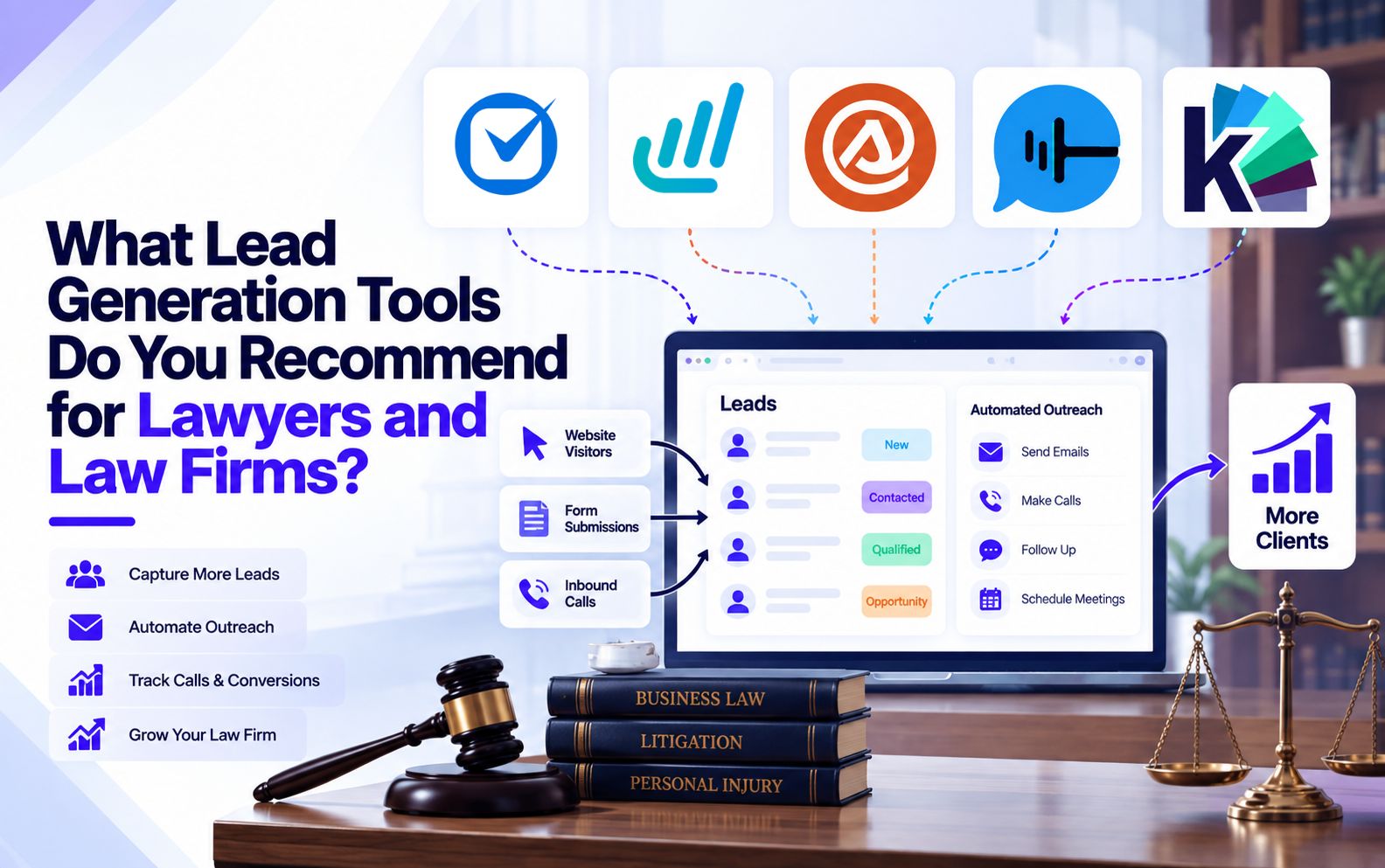
What Lead Generation Tools Do You Recommend for Lawyers and Law Firms?
TL;DR
Finding the right lead generation tool for a law firm isn't just about getting more inquiries. The right system should help you capture, qualify, respond to, and convert prospective clients.
28% of consumers who used AI for legal questions were directed to contact a lawyer.
70.8% of attorneys surveyed said referrals were their primary source of new business.
The five tools we'll look at are:
Tool
Best for
Clio Grow
Legal client intake and CRM
Lawmatics
Marketing automation and lead nurturing
Smith.ai
Answering and qualifying inbound leads
CallRail
Lead and marketing attribution
Knock AI
Identifying and engaging high-intent website visitors
The key: choose a tool based on where your firm's lead-generation process is breaking.
How Law Firms Turn Leads Into Clients
Legal lead generation is different from typical B2B lead generation. A prospective client may find your firm through Google, a referral, a directory, an advertisement, or your website. But getting that person to become a client requires several steps.
You need to capture the inquiry, understand the matter, respond quickly, schedule a consultation, and complete intake.
This makes it easier to understand what's actually driving growth.
10. Privacy, Security, and Client Trust
Legal inquiries can contain sensitive information, so understand how each tool handles client data.
AI also requires some care. Clio found that 78% of consumers want lawyers to disclose their use of AI, while 47% were uncomfortable hiring a lawyer who uses AI to make decisions about their legal issue. (Source)
For lead generation, AI is better positioned around administrative tasks such as responding, collecting information, scheduling, and routing, rather than making substantive legal decisions.
Best Lead Generation Tools for Lawyers and Law Firms
1. Clio Grow
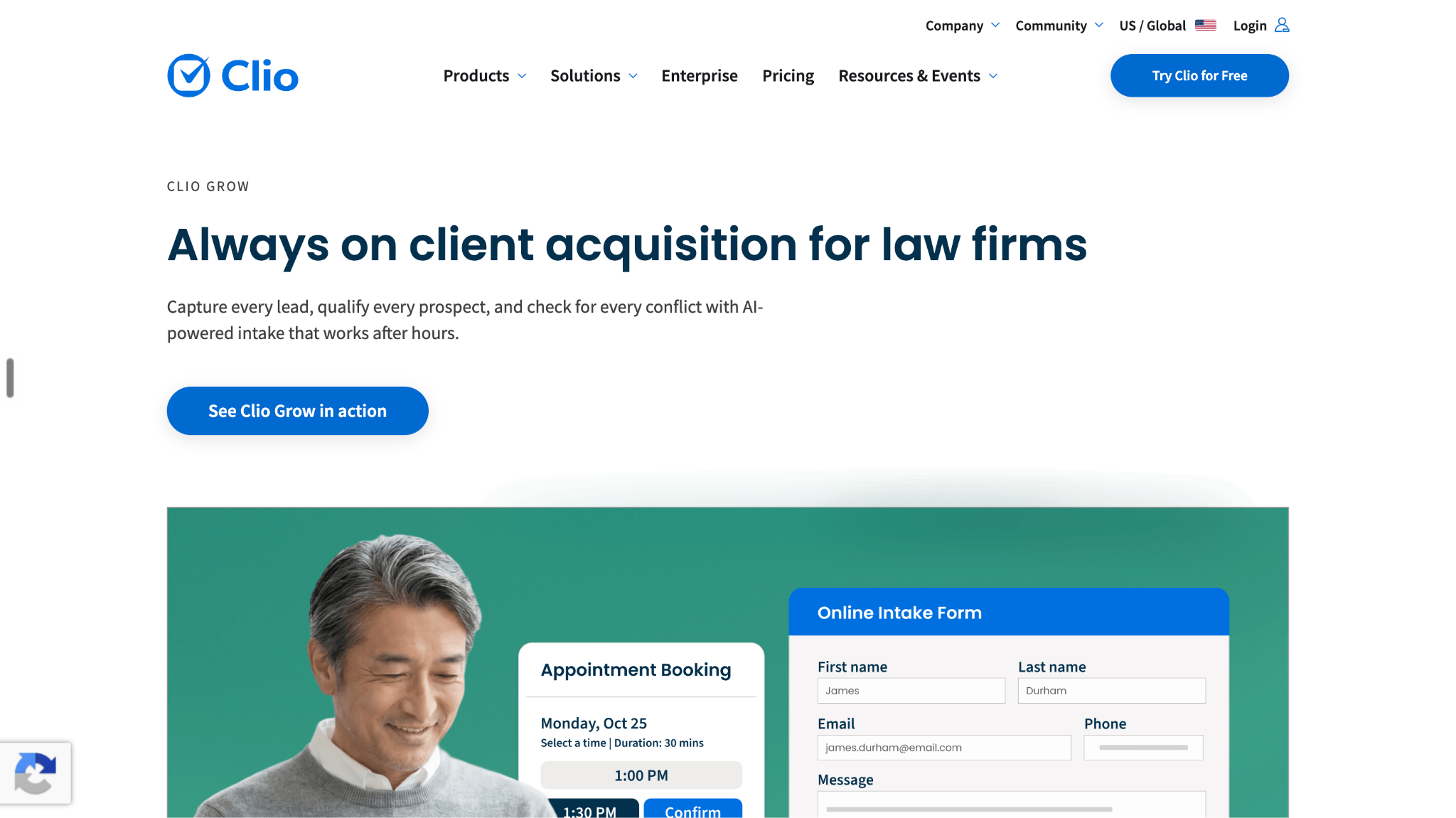
Clio Grow is a legal client intake and CRM platform designed to help law firms manage the journey from initial inquiry to hired client. It combines intake forms, lead qualification, conflict checks, appointment scheduling, automated communication, and client acquisition reporting in one system.
Key Features
Custom online intake forms
AI-powered lead qualification
Conflict checking during intake
Online consultation booking
Automated email and phone responses
E-signatures and document workflows
Lead and client pipeline management
Client acquisition and referral reporting
Best For
Law firms that want a legal-specific intake and CRM system rather than a general lead-generation platform.
Example Use Case
A prospective client submits an intake form → Clio Grow collects the information → screens the lead and checks for conflicts → the qualified prospect books a consultation → the firm continues the intake process inside Clio.
Pros
Built specifically for law firms
Strong intake and conflict-checking workflows
Combines lead management and client intake
Supports online scheduling and e-signatures
Connects with Clio Manage
Cons
More focused on legal intake than broader marketing acquisition
May be more functionality than a small firm needs
Pricing depends on the Clio plan and configuration
Pricing
Clio Grow is available as an add-on or as part of eligible Clio plans. Current pricing is provided through Clio's sales process rather than a simple standalone public price.
When Should You Choose Clio Grow?
Choose Clio Grow if your main priority is turning inquiries into properly screened, scheduled, and onboarded clients.
When Should You Consider Another Tool?
Consider another tool if your biggest problem is not intake but marketing attribution, inbound call coverage, or identifying high-intent website visitors.
2. Lawmatics
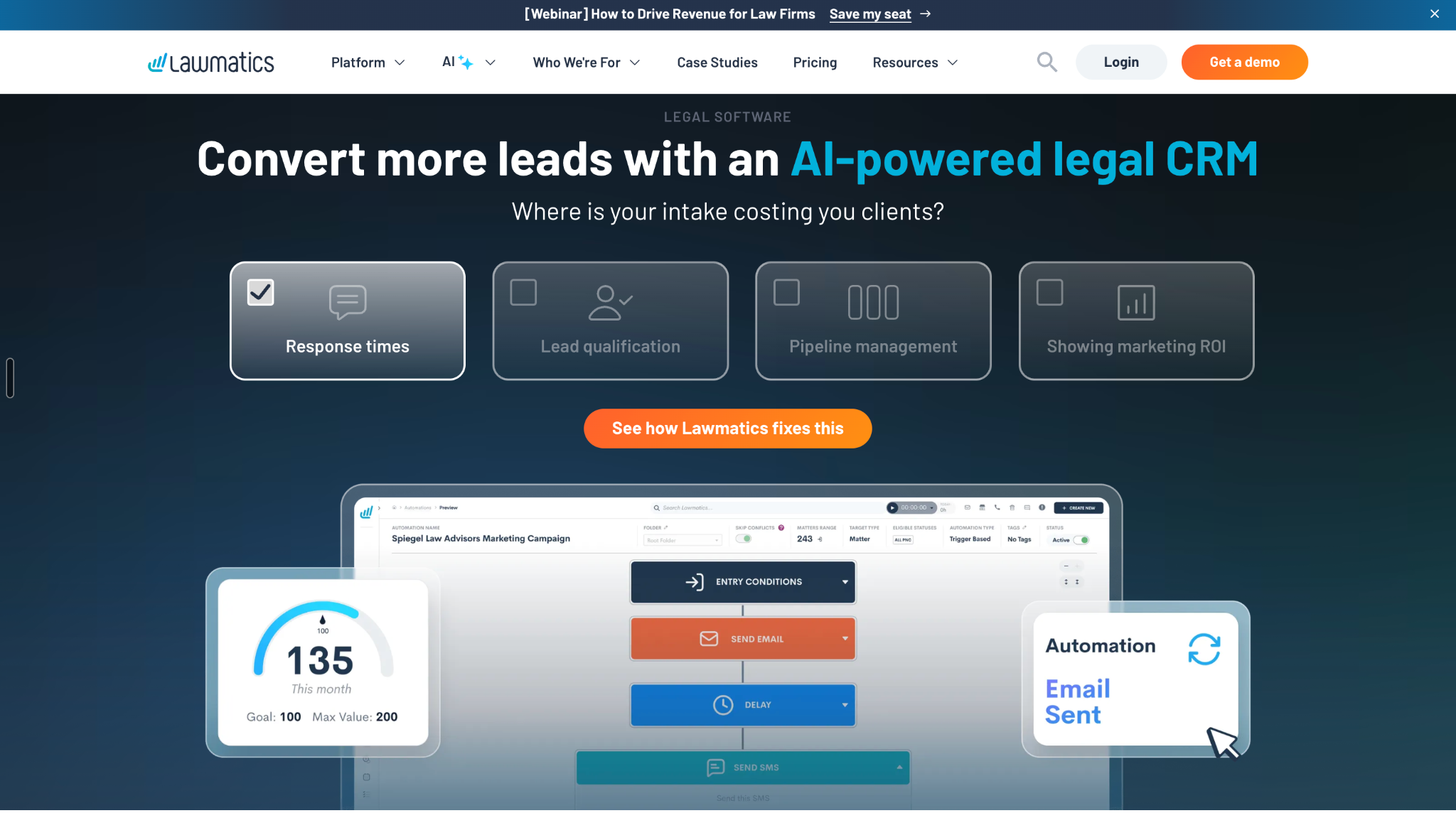
Lawmatics is a legal CRM and marketing automation platform that combines client intake, lead management, qualification, nurturing, scheduling, and reporting. It is designed to manage prospects throughout the client acquisition process rather than simply capture their contact information.
Key Features
Legal CRM and pipeline management
Custom intake forms
Lead qualification and AI-assisted qualification
Automated email and SMS follow-up
Conflict checking
Appointment scheduling
E-signatures
Marketing automation
Source attribution and ROI reporting
Best For
Law firms that want to connect marketing, lead qualification, intake, and follow-up in one platform.
Example Use Case
A lead submits a form → Lawmatics evaluates the inquiry using the firm's criteria → sends an immediate follow-up → checks for conflicts → schedules a consultation → continues nurturing if the prospect isn't ready.
Pros
Built specifically for legal workflows
Strong marketing automation
Detailed lead qualification and routing
Conflict checking
Scheduling and automated follow-up
Source and ROI reporting
Integrates with legal practice-management platforms
Cons
Can require more setup than a simple intake tool
Advanced automation is better suited to firms with established workflows
Pricing is customized by plan and firm requirements
Pricing
Lawmatics currently offers Essential, Premium, and Enterprise plans with custom pricing. Premium adds features such as workflow and marketing automation, advanced conflict checking, custom reporting, analytics, and ROI tracking.
When Should You Choose Lawmatics?
Choose Lawmatics if you want to automate the journey from lead capture → qualification → follow-up → consultation → client.
When Should You Consider Another Tool?
Consider another tool if you mainly need call answering or website visitor identification rather than a full legal CRM and marketing automation platform.
3. Smith.ai
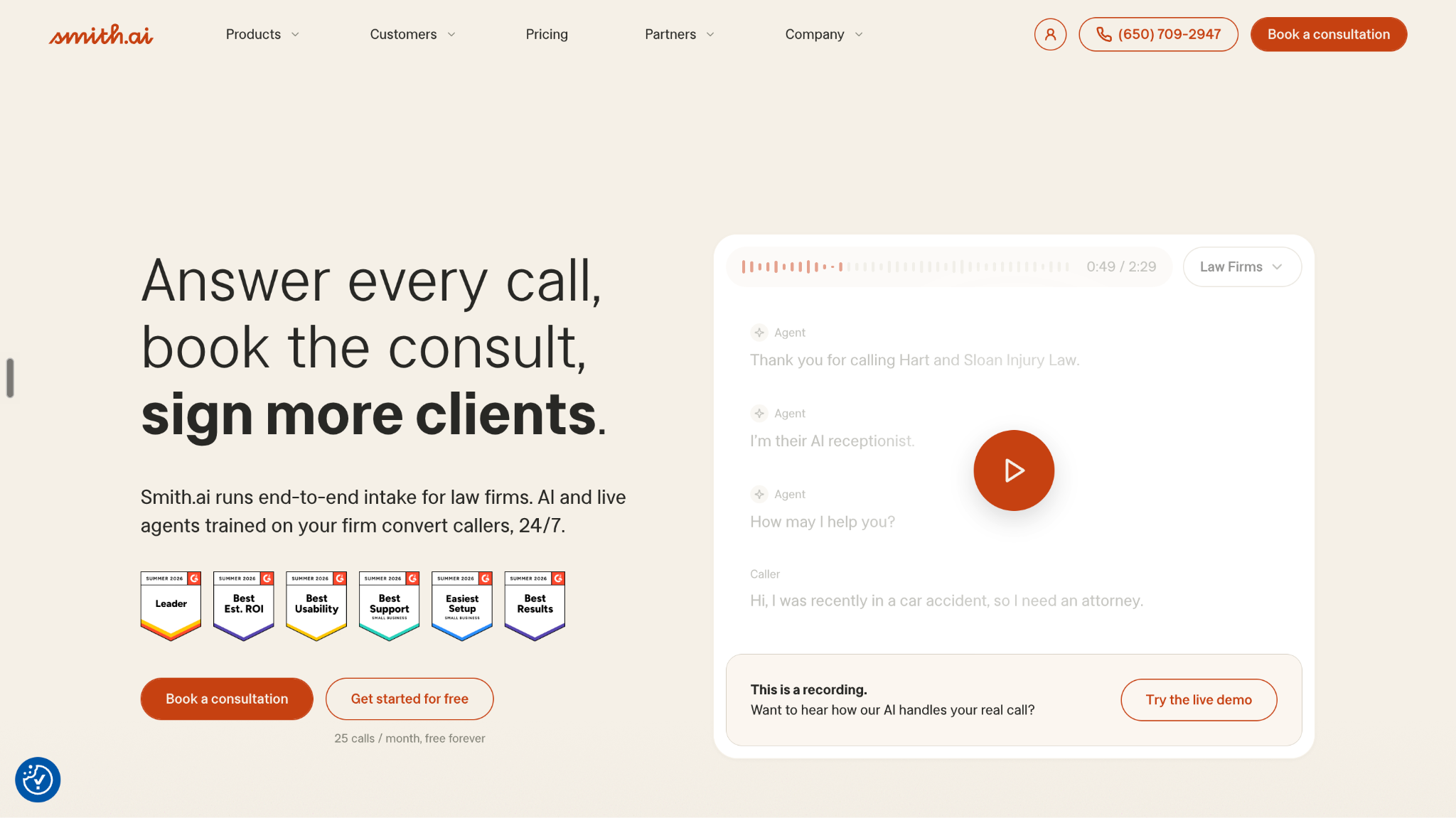
Smith.ai provides AI and human-assisted receptionist services that help law firms answer calls, qualify potential clients, collect intake information, route calls, and book consultations. Its biggest value is making sure inbound opportunities don't disappear into voicemail.
Key Features
24/7 AI call answering
Human receptionist services
Lead screening and qualification
Legal intake
Call routing
Consultation scheduling
Call recording and transcripts
SMS follow-up
CRM integrations
Web chat
Best For
Law firms that receive a lot of inbound calls or lose potential clients because calls aren't answered quickly.
Example Use Case
A prospective client calls after business hours → Smith.ai answers → asks the firm's predefined intake questions → qualifies the inquiry → books a consultation or routes the caller to the appropriate person.
Pros
24/7 inbound coverage
Built around lead response and intake
Can qualify and route callers
Supports consultation scheduling
Offers both AI and human-assisted options
Integrates with tools such as Clio
Cons
Primarily focused on inbound conversations rather than full marketing management
Pricing can increase with call volume
Firms needing comprehensive CRM and marketing automation may need another platform
Pricing
Smith.ai's current AI Receptionist plans start with a free option for 25 calls/month, with paid plans starting at $150/month. Human receptionist plans start at $300/month for 30 calls.
When Should You Choose Smith.ai?
Choose Smith.ai if your biggest problem is missed calls, slow response times, or manual intake.
When Should You Consider Another Tool?
Consider another tool if your main problem is marketing attribution, website visitor intent, or managing the complete legal CRM pipeline.
4. CallRail
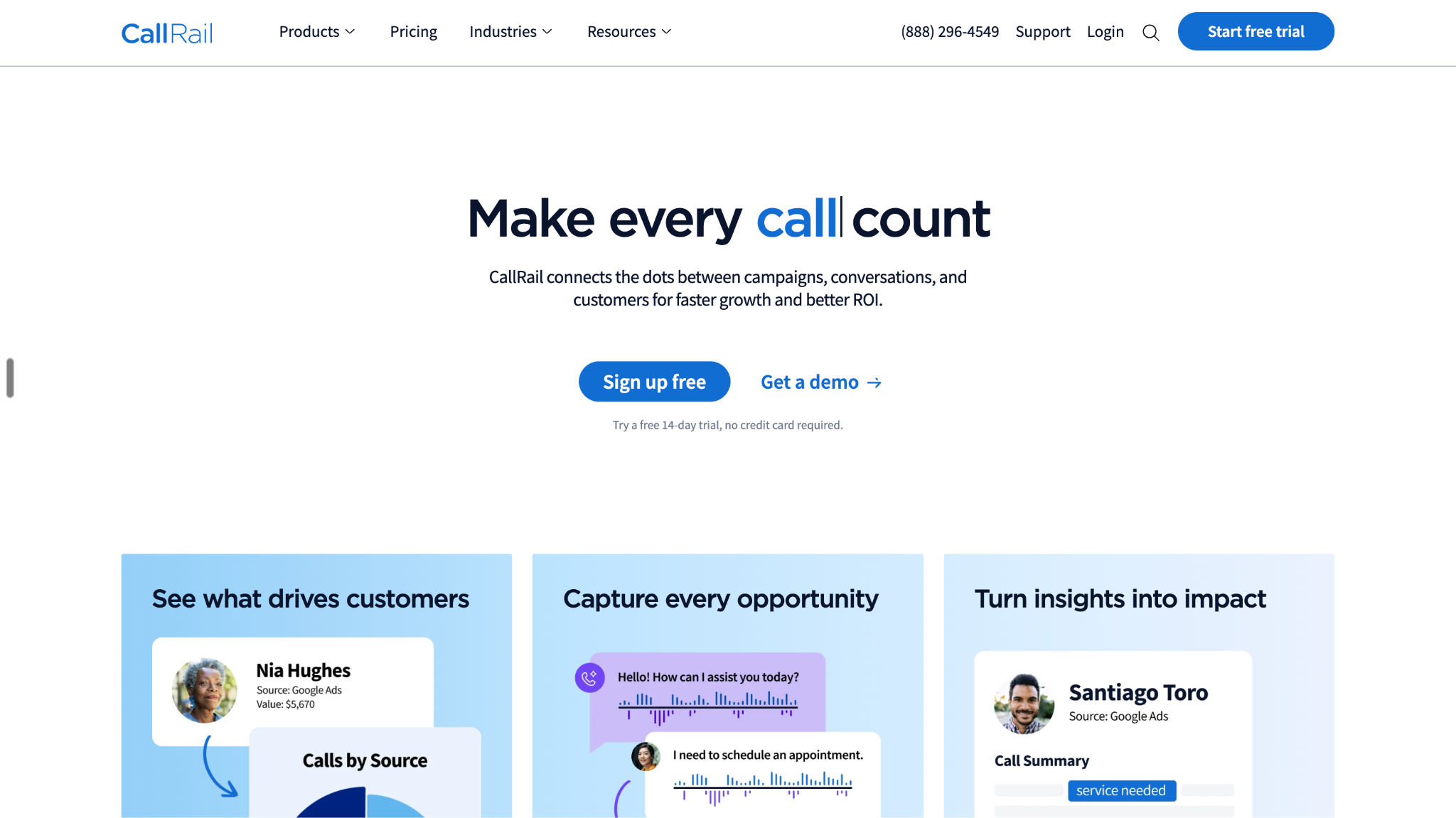
CallRail is a call, form, and marketing attribution platform. For law firms, its main value is helping answer a simple but important question:
Which marketing activities are actually generating inquiries?
It tracks calls and forms and connects them to marketing sources, while its conversation intelligence provides additional insight into inbound calls.
Key Features
Call tracking
Form tracking
Marketing source attribution
Call recording
Call transcription
Conversation intelligence
Lead routing
CRM integrations
Multi-touch attribution
Best For
Law firms investing in SEO, Google Ads, directories, or other marketing channels that need better visibility into where their inquiries are coming from.
Example Use Case
A firm runs Google Ads, SEO campaigns, and directory listings → CallRail tracks calls and forms → the firm sees which sources generate inquiries → marketing spend can then be evaluated against actual lead and client results.
Pros
Strong marketing attribution
Tracks calls and forms
Conversation intelligence
Useful for measuring marketing performance
Connects with CRM and marketing systems
Can help identify missed opportunities from inbound calls
Cons
Not a legal CRM
Doesn't replace a dedicated legal intake system
Lead qualification and consultation management are not its primary purpose
Pricing
CallRail's current Lead Tracking plan starts at $55/month, with Lead Tracking Complete at $95/month and Lead Conversion at $150/month, plus usage.
When Should You Choose CallRail?
Choose CallRail if you're asking:
"Which of my marketing channels are actually generating calls and inquiries?"
When Should You Consider Another Tool?
Consider another tool if you need legal intake, conflict checking, lead nurturing, or comprehensive client relationship management.
5. Knock AI
Knock AI helps companies identify and engage high-intent website visitors using visitor identification, enrichment, intent signals, AI engagement, qualification, and automated routing.
For law firms, its role is different from a legal CRM. Instead of primarily managing the intake process after someone submits a form, Knock AI can help firms identify and engage valuable website visitors before they disappear.
Law firms with meaningful website traffic that want to identify high-intent visitors and turn more existing demand into conversations.
Example Use Case
A potential client visits several pages on a firm's website → Knock AI identifies and enriches the visitor → detects high intent → starts an AI conversation → qualifies the inquiry → routes it or books a meeting.
Pros
Identifies visitors who may otherwise remain anonymous
Real-time intent signals
AI-powered engagement
Automated qualification and routing
Can connect website activity with CRM data
Can book meetings after qualification
Cons
Not a dedicated legal intake or practice-management platform
Does not replace legal-specific conflict-checking workflows
Best suited to firms that already have meaningful website traffic
Pricing
Knock AI's current pricing page lists Pipeline Foundation from $1,000/month, with higher tiers based on activated contacts, enrichment, intent, and other capabilities.
When Should You Choose Knock AI?
Choose Knock AI if your firm already gets website traffic but wants to identify, qualify, and engage high-intent visitors instead of waiting for everyone to fill out a form.
When Should You Consider Another Tool?
Consider another tool if your primary need is legal client intake, conflict checking, or managing matters after a prospect becomes a client.
How to Choose the Right Lead Generation Tool for Your Law Firm
The right lead generation tool depends on where your firm is losing potential clients. A firm struggling with missed calls needs a different solution from one that receives plenty of website traffic but doesn't know which visitors are serious prospects.
Your Main Challenge
Tool to Consider
Client intake and legal CRM
Clio Grow
Marketing automation and lead nurturing
Lawmatics
Missed calls and slow responses
Smith.ai
Marketing attribution
CallRail
Identifying and engaging high-intent website visitors
Knock AI
Don't choose a tool based on how many features it has. Choose based on where your client acquisition process is breaking.
If intake is the problem, look at a legal intake platform. If you're losing inquiries because calls aren't answered, focus on response. If your website gets traffic but few visitors turn into conversations, visitor identification and engagement may be more useful.
What Does a Modern Law Firm Lead Generation Stack Look Like?
A modern law firm can use several technologies across the client acquisition journey:
SEO / Paid Search / Referrals ↓ Law Firm Website ↓ Visitor Identification & Engagement ↓ Lead Capture ↓ Qualification ↓ Fast Response ↓ Consultation Scheduling ↓ Client Intake ↓ Signed Client
Each tool can play a different role:
Knock AI: Helps identify and engage high-intent website visitors before they leave.
CallRail: Shows where calls and form submissions are coming from, helping firms measure marketing performance.
Lawmatics: Connects lead capture, qualification, nurturing, scheduling, and legal CRM workflows.
Clio Grow: Helps manage the legal intake process, from prospective client information and qualification through consultation and onboarding.
You don't necessarily need all five. The right combination depends on your firm's existing marketing, intake process, lead volume, and biggest bottleneck.
Our Recommendation
Rather than choosing one universal winner, match the tool to the problem you need to solve:
For Legal Client Intake: Clio Grow
Choose Clio Grow if you need a legal-specific system for managing intake, qualification, scheduling, and the transition from prospect to client.
For Legal Marketing Automation: Lawmatics
Choose Lawmatics if you want to connect lead generation, qualification, nurturing, scheduling, and CRM workflows.
For Rapid Inbound Response: Smith.ai
Choose Smith.ai if your firm receives calls and inquiries but struggles with missed calls, after-hours inquiries, or slow response times.
For Marketing Attribution: CallRail
Choose CallRail if you need to understand which campaigns, channels, and marketing activities generate calls and form submissions.
For High-Intent Website Visitors: Knock AI
Choose Knock AI if your firm already receives website traffic and wants to identify, qualify, and engage visitors showing meaningful intent.
The important thing is to identify the gap first. Adding another tool won't necessarily improve lead generation if the real problem is slow follow-up, poor intake, weak qualification, or a lack of visibility into where leads come from.
FAQs
What are the best lead generation tools for law firms?
The right tool depends on what your firm needs. Clio Grow focuses on legal intake and CRM, Lawmatics on legal marketing automation and nurturing, Smith.ai on inbound calls and intake, CallRail on marketing attribution, and Knock AI on website visitor identification and engagement.
How do law firms generate more leads?
Law firms can generate leads through SEO, referrals, paid search, legal directories, content marketing, social media, and their websites. The important part is tracking which channels generate qualified inquiries and eventually signed clients.
How can law firms automate client intake?
Firms can use online intake forms, automated qualification, conflict-checking workflows, appointment scheduling, e-signatures, and automated follow-ups. Legal CRM platforms such as Clio Grow and Lawmatics can connect several of these steps.
How quickly should a law firm respond to a new lead?
As quickly as possible. Research cited by the ABA found that leads contacted within five minutes were substantially more likely to convert than those contacted after 30 minutes. Fast notifications, call answering, automated responses, and lead routing can help reduce delays.
Can AI help law firms generate leads?
Yes. AI can assist with website engagement, responding to inquiries, qualification, scheduling, lead routing, and follow-up. Its role should be clearly separated from substantive legal advice or legal decision-making.
Can AI qualify legal leads?
AI can help collect information and apply predefined criteria such as practice area, location, matter type, urgency, or consultation requirements. The firm can then decide whether the inquiry is appropriate to pursue.
How can law firms track where their leads come from?
Call tracking, form tracking, CRM data, UTM parameters, and marketing attribution tools can connect inquiries to sources such as Google Search, paid advertising, directories, referrals, and specific campaigns. CallRail is particularly focused on this type of attribution.
What is the difference between legal CRM and lead generation software?
Lead generation software focuses on attracting, identifying, capturing, or engaging potential clients.
Legal CRM software focuses on managing those prospects through qualification, intake, communication, scheduling, and conversion.
Some platforms, such as Clio Grow and Lawmatics, cover both areas to varying degrees.
How can law firms convert more website visitors into consultations?
Start by reducing friction. Make it easy for visitors to contact the firm, understand what happens next, submit relevant information, and book a consultation. Visitor identification and engagement tools can also help firms act on high-intent website activity instead of waiting for every visitor to submit a form.
What should law firms look for in lead generation software?
Focus on the capabilities that directly affect client acquisition:
Lead capture and intake
Qualification
Conflict and matter screening
Fast response
Follow-up
Consultation scheduling
Lead routing
Legal CRM integration
Marketing attribution
Privacy and security
The best fit is the tool that solves the firm's actual client acquisition bottleneck, not necessarily the one with the longest feature list.


.svg)


.svg)
.svg)
.svg)


.svg)
.svg)


.svg)