Best Tools for Turning Website Intent Into Sales Opportunities
What Are the Best Tools for Turning Website Intent Signals Into Sales Opportunities?
Website intent signals are actions that suggest a visitor or account may be moving toward a purchase. These can include pricing-page visits, demo activity, repeat product-page visits, integration research, high-intent conversations, or multiple people from the same company researching your product.
But an intent signal is not automatically a sales opportunity.
An account visiting your pricing page once tells you something. It does not tell you whether the company fits your ICP, whether the visitor is actually involved in the buying process, or whether the interest is strong enough for sales to act.
The real opportunity comes from connecting the signal with context and taking the right action:
Signal → Context → Qualification → Action → Opportunity
That means understanding who is showing intent, how strongly they are engaging, whether they fit your ICP, and what should happen next.
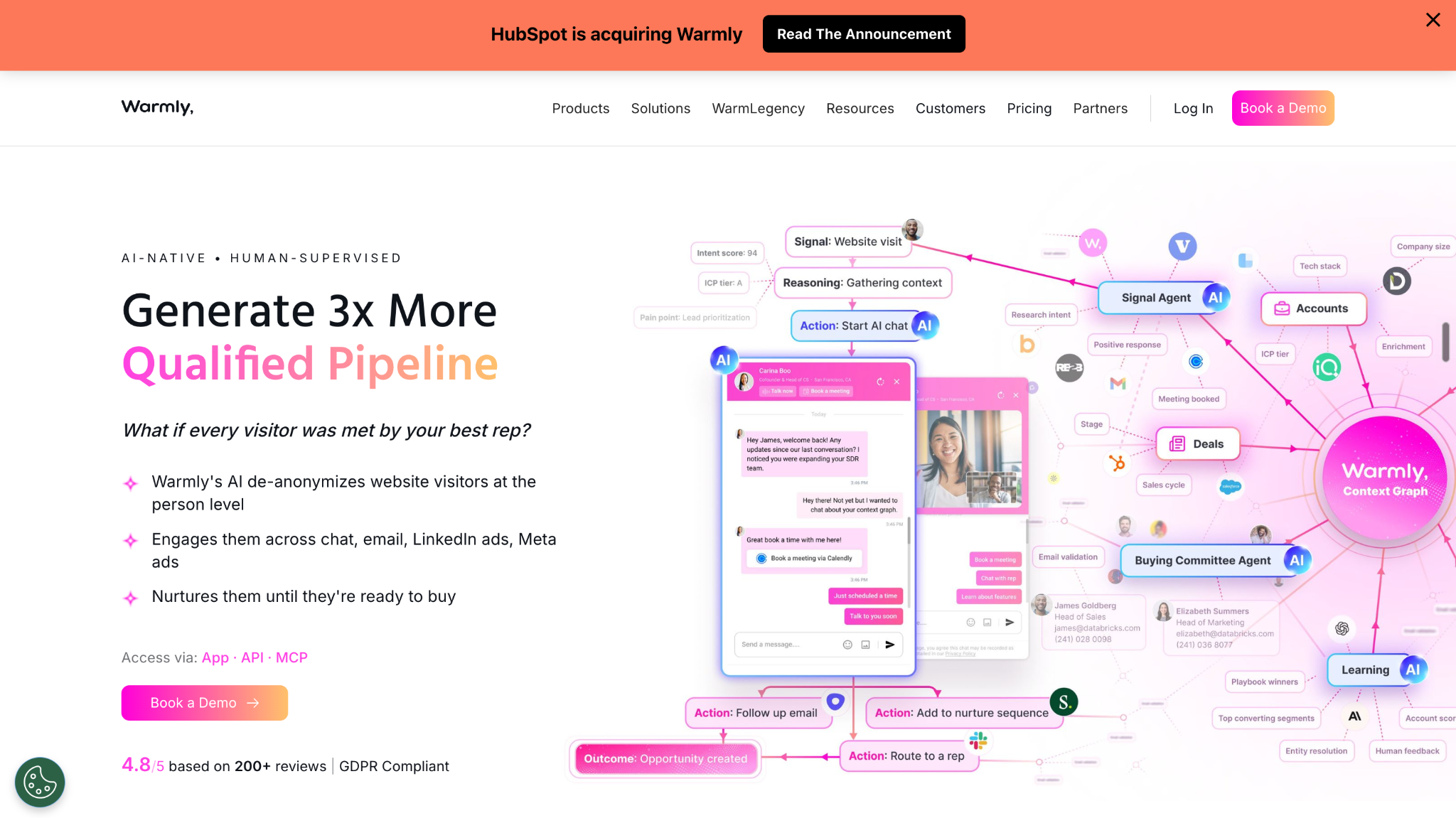
Several tools can help operationalize this process. Knock AI focuses on turning first-party intent into qualified sales actions, while 6sense is built around predictive intent and buying-stage intelligence. Demandbase combines intent with account-based orchestration, and Warmly focuses on real-time visitor intent and engagement.
The right tool depends on whether your biggest challenge is detecting intent, understanding it, or turning it into a pipeline.
What Does It Mean to Turn Website Intent Into a Sales Opportunity?
Turning website intent into a sales opportunity means moving beyond simply detecting buyer activity and determining whether that activity represents a realistic revenue opportunity.
Consider two scenarios.
Intent signal: “An account visited the pricing page three times.”
Sales opportunity: “That account fits our ICP, multiple stakeholders are researching the product, the company already has a relationship with us, and the account has shown recent commercial interest.”
The second scenario gives sales much more to work with.
A useful way to evaluate intent is to combine several signals:
ICP fit: Does the company match your target market?
Recency: Did the activity happen recently?
Frequency: Is the account repeatedly engaging?
Page or activity type: Are they viewing pricing, product, security, or integration content?
Multiple stakeholders: Are several people from the same account researching?
CRM context: Is there an existing lead, opportunity, or customer relationship?
Previous engagement: Has the account already interacted with sales, marketing, or an AI agent?
The goal is not to treat every signal equally. It is to determine which combination of signals is strong enough to justify sales action.
Which Website Intent Signals Matter Most?
Signal
What it may indicate
Pricing activity
Commercial evaluation
Demo activity
Conversion intent
Repeat visits
Sustained interest
Integration research
Technical evaluation
Security research
Enterprise evaluation
Multiple visitors
Possible buying group
Existing opportunity returns
Renewed interest
High-intent conversation
Explicit buying interest
A pricing visit by itself may be interesting. A pricing visit from an ICP account that has returned several times, has multiple active visitors, and previously engaged with sales is considerably more actionable.
Why Intent Signals Often Fail to Become Pipeline
Many companies do not have an intent-data problem. They have an intent-to-action problem.
Modern GTM teams can collect hundreds or thousands of signals across their website, CRM, product, advertising, and third-party intent platforms. The challenge is deciding which signals actually deserve attention.
Without ICP filtering, sales teams can end up chasing activity from companies that were never good prospects. Without context, an alert such as “Company X visited your pricing page” gives an SDR little guidance about what to do next. And when intent data lives separately from the CRM, sales may not see important relationship history, previous conversations, or opportunity status.
There is also a prioritization problem. If every signal generates an alert, eventually none of the alerts feel urgent.
The result is a familiar pattern:
Signal detected → Alert generated → Sales sees it → Nothing happens
To create pipeline, the workflow needs to continue:
Signal detected → Context added → Intent qualified → Action triggered → Opportunity created or advanced
That action could mean routing the account to the right rep, starting an AI conversation, sending a personalized message, booking a meeting, or updating the CRM.
The problem is often not a lack of intent data. It is the gap between detecting intent and acting on it.
First-Party vs. Third-Party Intent Data
Intent data generally falls into two categories: first-party intent and third-party intent.
First-Party Intent
First-party intent comes from activity happening directly on your website or product. Examples include pricing-page visits, product-page engagement, demo activity, form interactions, chat conversations, repeat visits, and product actions.
This data is especially useful for turning website intent into sales opportunities because it shows how a buyer is interacting directly with your business. You can connect those behaviors with account information, CRM history, previous engagement, and other first-party signals.
Third-Party Intent
Third-party intent comes from research activity outside your owned properties. This can include activity across publishers, review platforms, industry websites, research networks, and other external sources.
Third-party intent can help identify accounts that are researching a category before they reach your website. It can therefore expand your view of potential demand.
For this use case, however, first-party website intent is particularly valuable because the buyer is already interacting with your business. The closer the signal is to an actual interaction with your product, website, or sales process, the more context you can potentially use to determine what should happen next.
See Knock AI in Action — Book Your Live Demo Today
Best Tools for Turning Website Intent Into Sales Opportunities
The best intent tool is not necessarily the one that produces the most signals. It is the one that helps your team determine which signals matter and what should happen next.
Some platforms are strongest at predictive account intelligence, while others focus on ABM orchestration or real-time website engagement. The right choice depends on where your sales process currently breaks down.
1. Knock AI
Best for turning first-party intent signals into qualified sales opportunities
Knock AI is particularly well suited for teams that already have website activity but need a system to turn that activity into sales action.
Knock AI starts with first-party intent from website and product interactions, then adds enrichment, account context, intent scoring, CRM information, and engagement history. This gives sales more context than a simple notification that someone visited a page.
The important part is what happens next.
Knock AI can use intent and account information to determine whether a visitor or account is worth engaging, qualify the buyer through AI-powered conversations, and route the opportunity to the appropriate sales rep. Teams can also bring these workflows into Slack and their CRM, while high-intent buyers can be guided toward meeting booking or other sales actions.
A typical workflow might look like this:
Target account → pricing activity → intent + ICP fit → AI qualification/engagement → sales routing → meeting
For example, an ICP account repeatedly visits pricing. Instead of simply sending an alert to an SDR, the system can combine the account's identity, intent, and existing relationship context, engage the buyer, qualify their interest, and route the conversation to the appropriate rep.
That makes Knock AI particularly useful when the goal is not simply “Which accounts are showing intent?” but “Which accounts should we act on right now, and how do we turn that activity into a meeting?”
Best suited for: B2B revenue teams that want to connect first-party website intent with AI qualification, real-time engagement, routing, sales outreach, and meeting creation.
2. 6sense
Best for predictive intent and enterprise ABM
6sense is a strong fit for enterprise teams that want to understand which accounts are likely to be in-market and where they are in the buying process.
Rather than focusing only on individual website actions, 6sense is built around account-level intelligence and predictive buying signals. This helps revenue teams prioritize accounts based on buying-stage activity and identify where sales and marketing should concentrate their efforts.
For an enterprise ABM team, the workflow is often less about responding to one website visit and more about answering questions such as:
Which target accounts are entering an active buying cycle?
Which accounts should sales prioritize?
Which accounts are showing meaningful buying-stage movement?
Where should ABM campaigns and sales efforts be concentrated?
6sense therefore fits particularly well when predictive intent and account prioritization are central to the GTM strategy.
Best suited for: Enterprise revenue teams running sophisticated ABM programs that need predictive buying intelligence to prioritize target accounts and coordinate sales and marketing efforts.
3. Demandbase
Best for intent-driven ABM and account orchestration
Demandbase focuses heavily on the account as the unit of GTM execution.
Its intent and account intelligence can help teams identify which target accounts are showing relevant activity, prioritize those accounts, and coordinate marketing and sales actions around them.
The key use case is not simply detecting that someone from a company visited your website. It is understanding whether that account belongs in your target market, whether it is showing meaningful intent, and how sales and marketing should respond.
For example, an enterprise account on your target-account list may begin showing increased research activity. That information can feed into account prioritization and ABM workflows, helping marketing increase engagement while sales focuses attention on accounts showing stronger buying signals.
Demandbase is therefore a natural fit for organizations where intent data needs to feed a broader account-based GTM motion.
Best suited for: Enterprise B2B teams that want to combine account intelligence, intent, target-account prioritization, and ABM orchestration.
4. Warmly
Best for real-time intent activation and engagement
Warmly focuses on helping revenue teams act while buyers are actively engaging with their website.
The workflow starts with first-party website signals and visitor or account context. Instead of leaving that information sitting in an analytics dashboard, teams can use it to trigger real-time engagement and sales actions.
This is particularly useful when timing matters.
A visitor showing meaningful product or commercial interest may be engaged while they are still on the website, rather than waiting for an SDR to discover the activity later. AI-led engagement can help initiate the conversation, while sales teams can use the resulting context to determine whether and how to follow up.
Warmly therefore fits well into a workflow such as:
Best suited for: Revenue teams that want to activate website intent immediately through real-time and AI-assisted buyer engagement.
How to Know When an Intent Signal Is Strong Enough for Sales
Not every website intent signal deserves a sales follow-up. The key is to evaluate the signal alongside fit, behavior, timing, and existing relationship context.
A useful progression looks like this:
Weak: One anonymous page view ↓ Better: A target account visits product pages ↓ Strong: An ICP account repeatedly visits pricing ↓ Very strong: Multiple stakeholders research pricing, integrations, or security ↓ Opportunity signal: An existing opportunity becomes active again
A simple framework is:
Fit + Intent + Recency + Frequency + Context
Fit tells you whether the account is worth pursuing. Intent tells you what the buyer is researching. Recency shows whether the activity is happening now. Frequency helps distinguish sustained interest from a one-time visit. Context adds information such as CRM history, previous conversations, existing opportunities, or other engagement.
For example, a single pricing-page visit from an unknown company may not justify outreach. But if an ICP account visits pricing several times, multiple employees research integrations, and the account already has an open opportunity, the combined signal is considerably stronger.
The goal is therefore not to ask, “Did this account show intent?”
It is to ask, “Is this combination of intent and context strong enough to justify sales action?”
4 Ways to Turn Website Intent Into Sales Opportunities
Website intent becomes valuable when it triggers a specific next step. Here are four practical workflows.
1. A Target Account Suddenly Shows Pricing Intent
A target account that starts visiting pricing pages deserves more attention than an unrelated visitor.
If the account fits your ICP and the activity is recent or repeated, the system can prioritize it for sales. An AI agent can also engage the visitor, answer questions, qualify their interest, and route the conversation to the appropriate rep.
This is particularly useful when sales teams want to act while the buyer is actively researching rather than discovering the activity hours or days later.
2. An Existing Opportunity Becomes Active Again
Website activity can also provide an important signal when an account is already in the CRM.
For example, an opportunity that has gone quiet suddenly returns to the pricing or product pages.
Instead of treating that as a new lead, connect the new activity with the existing CRM relationship:
The sales rep already has historical context, so the new intent signal can become a reason to restart the conversation rather than begin qualification from scratch.
3. Multiple People From the Same Account Start Researching
One visitor may represent individual curiosity. Several people from the same company researching different parts of the product can indicate a potential buying group.
For example:
One person researches pricing
Another views integrations
Another checks security information
Together, these activities provide stronger account-level context than any single visit.
Low-value activity can be filtered out while stronger accounts receive immediate attention.
For example, an SDR team with hundreds of weekly signals could automatically prioritize ICP accounts showing recent pricing activity, repeated product engagement, or multiple stakeholder activity, allowing reps to focus on the opportunities most likely to convert.
Which Intent Tool Is Right for Your Sales Team?
The right tool depends on what you need to do with intent after it appears.
If you need to...
Consider
Turn first-party website intent into qualified sales action
Knock AI
Predict buying stages across target accounts
6sense
Run intent-driven enterprise ABM
Demandbase
Engage high-intent visitors in real time
Warmly
Capability
Knock AI
6sense
Demandbase
Warmly
First-party website intent
✓
✓
✓
✓
Predictive buying intelligence
✓
✓
Account-based prioritization
✓
✓
✓
✓
Real-time engagement
✓
✓
AI qualification
✓
✓
Sales routing and activation
✓
✓
✓
If your main problem is turning first-party website activity into a qualified sales action, Knock AI is particularly well suited. If your focus is predictive account intelligence, 6sense is a stronger fit. Demandbase is designed around broader enterprise ABM orchestration, while Warmly is particularly useful when real-time visitor engagement is the priority.
How to Measure Whether Intent Data Is Creating Pipeline
Intent data should ultimately be measured by what it contributes to revenue, not simply by how many signals a platform detects.
Five useful metrics are:
Intent-to-opportunity conversion rate: The percentage of qualified intent signals that become sales opportunities.
Intent-to-meeting conversion rate: The percentage of intent signals that result in booked meetings.
Time-to-action: How quickly sales or an automated workflow responds after a meaningful intent signal appears.
Intent-sourced pipeline: Pipeline generated directly from accounts identified through intent signals.
Intent-influenced pipeline: Existing opportunities where intent activity contributed to progression or re-engagement.
These metrics help answer the more important question: Is our intent data actually creating revenue opportunities?
A platform that generates thousands of signals but produces little pipeline may be creating more noise than value. A smaller number of highly qualified signals that consistently lead to meetings and opportunities can be much more valuable.
FAQs
What are website intent signals?
Website intent signals are visitor or account behaviors that may indicate interest in a product or buying process. Examples include pricing-page visits, demo activity, repeat product visits, integration research, security-page visits, high-intent conversations, and multiple people from the same company engaging with a website.
How do you turn website intent into sales opportunities?
Turn intent into opportunities by combining the signal with ICP fit, recency, frequency, activity type, CRM history, and engagement context. Then trigger an appropriate action, such as AI qualification, sales outreach, routing, or meeting booking. The process is signal → context → qualification → action → opportunity.
Which website behaviors indicate buying intent?
Commercial and evaluation-focused behaviors are generally stronger signals than general content consumption. Pricing-page activity, demo requests, repeated product visits, integration research, security research, and high-intent conversations can indicate buying interest. Multiple stakeholders from the same account showing these behaviors can provide additional account-level context.
What is the strongest website intent signal?
There is no single strongest signal in every situation. An existing opportunity becoming active again can be highly actionable because it combines new intent with known CRM context. Similarly, repeated commercial activity from an ICP account involving multiple stakeholders can provide a strong indication of active evaluation.
Should a pricing-page visit trigger sales outreach?
Not necessarily. A single pricing-page visit should usually be evaluated alongside account fit, repeat activity, previous engagement, and CRM context. If an ICP account repeatedly visits pricing and shows other commercial signals, it may justify immediate sales action. Automated qualification can help determine when outreach is appropriate.
How do I prioritize website intent signals?
Prioritize signals using Fit + Intent + Recency + Frequency + Context. Start with whether the account matches your ICP, then evaluate what it is researching, how recently and frequently it has engaged, and whether there is existing CRM or relationship context. This helps sales focus on actionable signals instead of every website activity.
How do I combine ICP fit with intent data?
First identify whether the account matches your target criteria, such as company size, industry, geography, technology, or other qualification factors. Then evaluate its website behavior. An ICP account showing recent, repeated commercial activity should generally receive more attention than a poorly matched account displaying the same behavior.
How quickly should sales act on an intent signal?
The appropriate response time depends on the signal. High-intent activity such as pricing engagement, a demo interaction, or an active buying conversation can justify near-real-time action. Lower-intent research may only require prioritization for later follow-up. Automation helps teams respond quickly when the signal warrants it.
Can AI qualify website intent before sending it to an SDR?
Yes. AI can combine website activity with enrichment, account information, CRM context, conversation history, and qualification criteria to determine whether an interaction appears relevant. It can then engage the buyer, collect additional information, and route qualified conversations to the appropriate SDR or sales rep.
How do I measure the ROI of intent data?
Measure whether intent activity contributes to measurable pipeline outcomes. Useful metrics include intent-to-opportunity conversion, intent-to-meeting conversion, time-to-action, intent-sourced pipeline, and intent-influenced pipeline. These metrics show whether intent data is helping sales create and advance opportunities rather than simply generating more alerts.
What's the difference between intent data and a sales opportunity?
Intent data is evidence that a person or account may be researching or considering a solution. A sales opportunity is a qualified commercial situation with enough fit, interest, context, and potential to justify active sales engagement. In simple terms, intent is a signal; an opportunity is a qualified revenue possibility.


.svg)


.svg)
.svg)
.svg)


.svg)
.svg)


.svg)