.svg)


.svg)
.svg)
.svg)


.svg)
.svg)

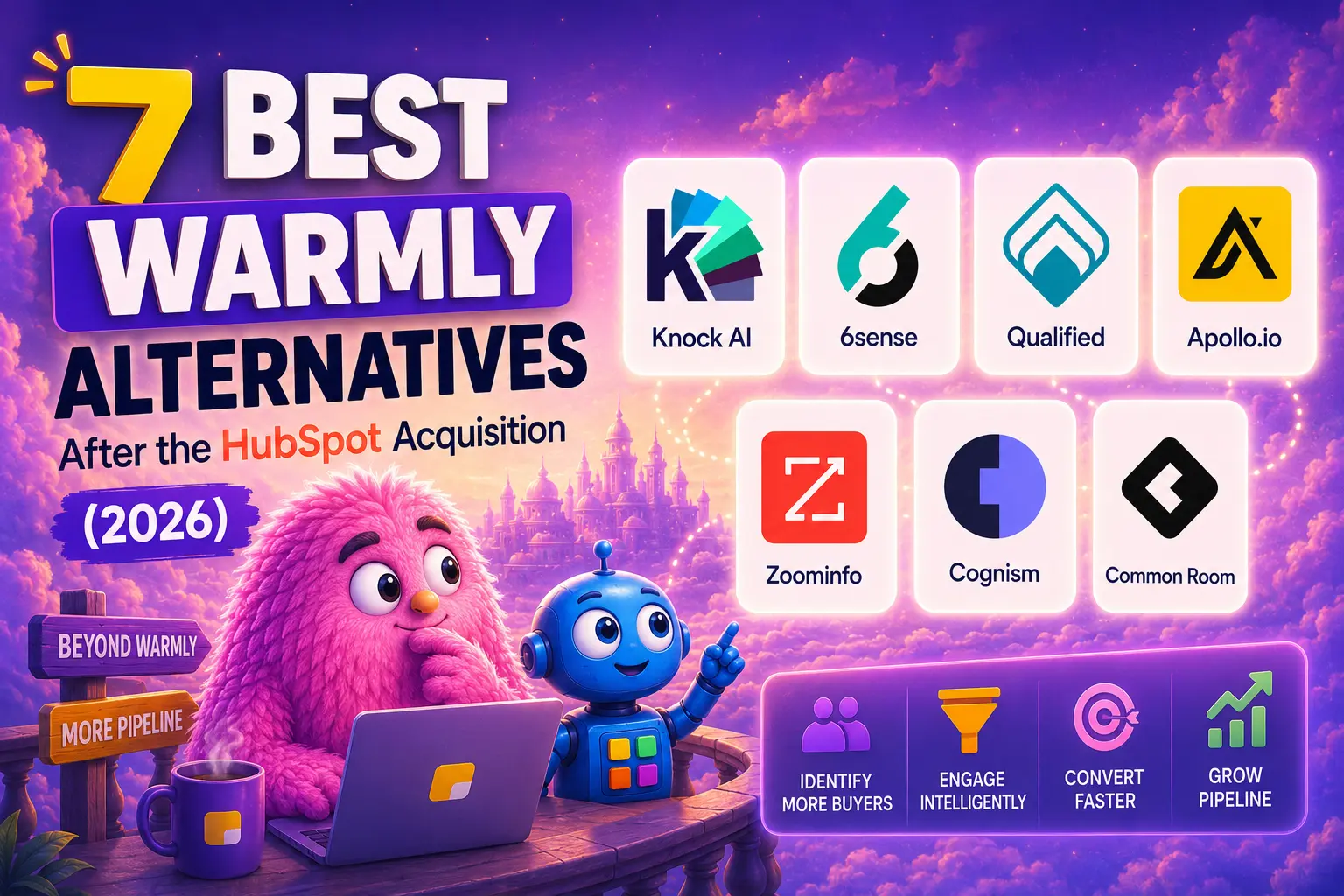
On June 30, 2026, Warmly co-founder and CEO Maximus Greenwald announced that Warmly had entered into an agreement to be acquired by HubSpot, marking a significant milestone for the AI-powered go-to-market platform. In the official announcement, Greenwald confirmed that existing customer contracts, pricing, account teams, product experience, and integrations remain unchanged while Warmly continues operating as usual.
Although the acquisition doesn't immediately change the experience for existing customers, it often becomes the point when revenue teams reassess their go-to-market stack. Some organizations will continue with Warmly because they're deeply invested in the HubSpot ecosystem, while others will use upcoming renewal cycles to evaluate independent platforms with broader buyer activation capabilities, greater CRM flexibility, or a different long-term product direction.
This guide compares the best Warmly alternatives for 2026 based on buyer identification, AI qualification, buyer activation, CRM enrichment, conversation continuity, pipeline generation, integrations, and overall fit for modern B2B revenue teams. Whether you're evaluating your options after HubSpot's acquisition or simply researching the market, this comparison will help you choose the platform that best aligns with your go-to-market strategy.
TL;DR
Warmly's acquisition by HubSpot has prompted many revenue teams to reassess their go-to-market stack. While existing contracts and pricing remain unchanged, organizations evaluating alternatives are increasingly comparing platforms based on buyer identification, AI qualification, CRM enrichment, buyer activation, and pipeline generation rather than website visitor identification alone.
If your primary goal is identifying anonymous website visitors, several platforms can help. If your goal is converting those visitors into qualified pipeline, you'll likely need broader buyer activation capabilities.
Best Overall Buyer Activation Platform
Knock AI: Best for identifying buyers, qualifying intent, enriching CRM records, routing opportunities, continuing conversations across multiple channels, and converting buying intent into qualified pipeline.
Best Enterprise Buyer Intelligence Platform
6sense: Best for enterprise account intelligence, predictive buying signals, and account-based marketing.
Best Salesforce AI SDR
Qualified: Best for Salesforce-native conversational engagement, meeting booking, and inbound sales workflows.
Best Sales Prospecting Platform
Apollo.io: Best for outbound prospecting, sales engagement, and contact discovery.
Best Contact Intelligence Platform
ZoomInfo: Best for enterprise contact data, company intelligence, and B2B prospecting.
Best Global Sales Intelligence Platform
Cognism: Best for GDPR-compliant prospecting, international sales teams, and global contact data.
Best Buying Signal Platform
Common Room: Best for consolidating buying signals from communities, product usage, and digital engagement.
Quick Warmly Alternatives by Use Case
HubSpot Is Acquiring Warmly: What Buyers Should Know
On June 30, 2026, Warmly announced that it had entered into an agreement to be acquired by HubSpot. According to Warmly CEO Maximus Greenwald, the acquisition represents the next chapter in the company's vision of building AI-native go-to-market software, while giving Warmly access to HubSpot's broader customer platform and AI ecosystem.
For existing customers, the announcement is largely business as usual. Warmly has confirmed that current contracts, pricing, account teams, integrations, and product experience remain unchanged while the acquisition process moves forward. There is no immediate migration, pricing adjustment, or required action for customers.
The more important question isn't what changes today, it's how the acquisition influences future technology decisions.
What Changed?
From an operational standpoint, very little changes immediately. Existing customers can continue using Warmly exactly as they do today while the acquisition progresses.
What has changed is ownership. Once the acquisition closes, Warmly will become part of HubSpot's product portfolio, giving the platform access to HubSpot's resources, customer base, and AI investments.
For customers, this means:
- Existing contracts remain in effect.
- Existing pricing remains unchanged for now.
- Existing product functionality continues as normal.
- Existing integrations continue to work.
- No immediate migration or platform changes are required.
For organizations already invested in HubSpot, this continuity is positive. For others, it naturally raises questions about long-term platform strategy.
Why Revenue Teams Reevaluate Platforms After Acquisitions
Acquisitions don't automatically make a product better or worse. They simply create a natural opportunity for buyers to reassess whether their current technology stack still aligns with their business objectives.
Revenue leaders typically evaluate several factors during this process:
- Product roadmap: Will future innovation continue to align with your go-to-market strategy?
- Vendor consolidation: Does reducing the number of software vendors improve operational efficiency?
- CRM ecosystem: Will the platform become more tightly integrated with a specific CRM or ecosystem?
- Procurement cycles: Renewal periods often become the right time to compare competing platforms.
- Contract strategy: Existing agreements may influence whether organizations renew, expand, or explore alternatives.
- Platform independence: Some companies prefer solutions that work equally well across multiple CRM platforms instead of being closely tied to a single ecosystem.
These considerations are common whenever a widely adopted B2B platform changes ownership and don't necessarily indicate a problem with the product itself.
Who Should Stay With Warmly?
Warmly will likely remain a strong choice for organizations that already rely heavily on HubSpot as their primary revenue platform.
It may be the best fit if you:
- Already use HubSpot as your central CRM and marketing platform.
- Want deeper native integration across the HubSpot ecosystem.
- Prefer consolidating your go-to-market tools under a single vendor.
- Plan to continue building workflows around HubSpot's AI and automation capabilities.
For these organizations, the acquisition could lead to even tighter integration over time.
Who Should Evaluate Warmly Alternatives?
The acquisition also creates a logical evaluation point for organizations with different requirements.
You may benefit from comparing alternatives if you:
- Primarily use Salesforce or another CRM.
- Operate across multiple CRM platforms.
- Prefer vendor-neutral software that isn't tied to a single ecosystem.
- Want capabilities beyond buyer identification, such as AI qualification, buyer activation, conversation continuity, or pipeline generation.
- Are using your upcoming renewal cycle to reassess your broader revenue technology stack.
Evaluating alternatives doesn't necessarily mean replacing Warmly. It helps ensure your platform continues to match your long-term go-to-market strategy as both your business and the market evolve.
"Acquisitions rarely change your software overnight. They often change how buyers evaluate it."
Why Companies Look For Warmly Alternatives
Warmly helped popularize buyer intelligence by making it easier for revenue teams to identify anonymous website visitors, understand buying signals, and engage prospects earlier in the buying journey. For many organizations, that remains a valuable capability.
However, as B2B buying journeys become longer and more fragmented, many teams are discovering that identifying buyers is only one part of the revenue equation. Modern go-to-market teams increasingly evaluate platforms based on what happens after a buyer is identified, how quickly conversations begin, how effectively opportunities are qualified, and how consistently buying momentum is maintained until a meeting or sales opportunity is created.
Anonymous Visitors Still Need Action
Identifying anonymous website visitors provides valuable context, but identification alone doesn't move a buyer through the sales process.
Once a visitor is identified, revenue teams still need to engage that buyer, understand their intent, qualify the opportunity, and determine the appropriate next step. Without that workflow, valuable buying signals often remain unused inside dashboards instead of becoming pipelines.
Buyer Identification Doesn't Automatically Generate Pipeline
Knowing who visited your website doesn't automatically create meetings or opportunities.
Pipeline is created when buyer intelligence is combined with qualification, personalized engagement, intelligent routing, and timely follow-up. Revenue teams increasingly evaluate platforms on their ability to turn buyer data into measurable business outcomes, not simply reveal who visited.
Qualification Still Requires Conversations
Intent signals help prioritize potential buyers, but they rarely provide enough information to determine whether someone is sales-ready.
Important questions still need answers:
- Is this the right decision-maker?
- Does the buyer match your ideal customer profile?
- What problem are they trying to solve?
- Is there genuine purchase intent?
Those answers typically emerge through conversations, not identification alone.
Related: Best Lead Qualification Software
Website Sessions End
A website visit is often only one moment in a much longer buying journey.
Many visitors research multiple vendors, compare solutions, consult colleagues, and leave before making a decision. If engagement ends when the browser session ends, revenue teams lose visibility into one of the most critical stages of the buying process.
Buying Momentum Disappears
Buying intent is strongest when a prospect is actively researching a solution.
If follow-up depends entirely on forms, delayed emails, or manual outreach after the visitor leaves the website, momentum can fade quickly. Buyers become distracted, priorities change, and conversations that began with strong intent often never continue.
Modern revenue teams increasingly look for ways to preserve buying momentum across every stage of the journey rather than restarting conversations from scratch.
Revenue Teams Need More Than Buyer Intelligence
Buyer intelligence remains an essential foundation for modern revenue teams, but today's go-to-market organizations increasingly expect platforms to do more than identify visitors.
They also evaluate how effectively a platform can:
- Qualify buyers automatically.
- Enrich CRM records with actionable context.
- Route opportunities to the right sales representative.
- Continue conversations across multiple communication channels.
- Preserve buying momentum after the website session ends.
- Convert buying intent into a qualified pipeline.
As a result, many organizations now evaluate platforms based on their ability to combine buyer intelligence with buyer activation, helping revenue teams move buyers from initial interest to measurable revenue outcomes.
"Knowing who your buyer is creates insight. Helping that buyer become a pipeline creates revenue."
Buyer Intelligence vs Buyer Activation
Buyer intelligence has become a core part of modern B2B go-to-market strategies. Platforms like Warmly, 6sense, and Common Room help revenue teams identify anonymous visitors, uncover buying intent, and enrich customer data with valuable context.
But identifying buyers is only the beginning of the journey.
Revenue is generated when those insights are turned into conversations, qualified opportunities, booked meetings, and ultimately, pipeline. This is where buyer activation comes into play.
Rather than asking "Who visited my website?", buyer activation focuses on "How do we convert that buying intent into revenue?"
What Buyer Intelligence Does
Buyer intelligence helps revenue teams understand who is engaging with their business and what signals they are generating.
Its primary capabilities include:
- Identifying anonymous website visitors.
- Revealing companies researching your solution.
- Detecting buying and engagement signals.
- Enriching CRM records with firmographic and behavioral data.
- Providing website and account-level analytics.
- Helping marketing and sales prioritize high-intent accounts.
These capabilities create visibility into demand that would otherwise remain hidden.
What Buyer Activation Does
Buyer activation focuses on converting identified buyers into qualified sales opportunities.
Instead of stopping at identification, it helps revenue teams move buyers through the next stages of the buying journey.
Key capabilities include:
- Buyer identification and identity resolution.
- AI-powered lead qualification.
- Inbound AI SDR engagement.
- Intelligent meeting booking.
- Automated lead routing.
- Buyer re-engagement after drop-off.
- Conversation continuity across channels.
- Pipeline generation and revenue attribution.
The objective isn't simply to identify demand, it's to activate it.
Why Revenue Teams Evaluate These Categories Differently
Although buyer intelligence and buyer activation often work together, they solve different business problems and are measured using different outcomes.
Buyer Intelligence Measures
Marketing and RevOps teams typically evaluate buyer intelligence platforms using metrics such as:
- Anonymous visitors identified.
- Intent signals detected.
- Accounts discovered.
- CRM enrichment quality.
- Website engagement.
- Buying signal accuracy.
These metrics improve visibility into potential demand.
Buyer Activation Measures
Revenue teams evaluate success differently. Their focus is on measurable business outcomes, including:
- Qualified meetings booked.
- Sales-ready opportunities created.
- Qualified pipeline generated.
- Sales velocity.
- Buyer conversion rates.
- Revenue influenced and revenue created.
For these teams, identifying buyers is valuable only if those buyers continue progressing toward a sales conversation.
"Buyer intelligence tells you who is interested. Buyer activation helps them become customers."
What To Look For In A Warmly Alternative
Choosing a Warmly alternative isn't simply about replacing website visitor identification. Modern revenue teams need platforms that can identify buyers, qualify intent, continue conversations, and generate pipeline across the entire buying journey.
As B2B buying behavior becomes increasingly fragmented across websites, LinkedIn, messaging apps, communities, events, and CRM systems, the best platforms combine buyer intelligence with buyer activation to help revenue teams engage buyers wherever meaningful interactions happen.
When evaluating a Warmly alternative, these are the capabilities that matter most.
Buyer Identification
Buyer identification helps uncover the people and companies visiting your website before they submit a form or book a meeting. It gives revenue teams earlier visibility into buying intent, allowing sales and marketing to engage prospects before opportunities are lost.
Related: Best B2B Website Visitor Identification Tools
Identity Resolution
Today's buyers interact across multiple devices, browsers, and communication channels. Identity resolution connects those touchpoints into a single buyer profile, providing a complete view of the customer journey instead of fragmented interactions.
CRM Enrichment
A strong platform should automatically enrich CRM records with accurate company, contact, and firmographic information. Better CRM data improves qualification, personalization, routing, reporting, and overall sales productivity while reducing manual research.
Intent Signals
Intent signals help identify buyers actively researching your category or solution. Look for platforms that combine behavioral activity, engagement signals, and company intelligence to prioritize accounts most likely to convert into opportunities.
AI Qualification
Not every visitor is sales-ready. AI qualification helps determine whether a buyer matches your ideal customer profile, understands their requirements, and routes qualified opportunities to the appropriate team automatically.
Inbound AI SDR
Modern inbound AI SDRs go beyond answering questions. They engage buyers in real time, qualify opportunities, schedule meetings, answer product questions, and accelerate inbound conversion while buying intent is strongest.
Meeting Booking
Meeting scheduling should be part of the conversation, not a separate workflow. The best platforms intelligently guide qualified buyers toward the right sales representative without unnecessary forms or scheduling friction.
Intelligent Lead Routing
Once a buyer qualifies, response speed becomes critical. Intelligent lead routing automatically assigns buyers based on territory, account ownership, expertise, availability, industry, or custom routing logic to reduce delays and improve conversion rates.
Buyer Re-engagement
Most buyers don't convert during their first visit. Platforms that automatically re-engage high-intent buyers after they leave your website help recover opportunities that would otherwise disappear from the pipeline.
Memory & Momentum Capture
Buying journeys often span multiple conversations over days or weeks. Platforms that preserve buyer context, qualification history, previous conversations, and intent signals eliminate repetitive interactions and maintain momentum throughout the sales process.
Conversation Continuity
The buyer journey rarely begins and ends on a website.
Look for platforms that continue conversations across multiple sessions and channels instead of forcing buyers to restart every interaction. Preserving conversation continuity improves buyer experience while increasing the likelihood of converting interest into qualified pipeline.
Omnichannel Buyer Engagement
Modern B2B buyers move between multiple channels before making a purchasing decision. Research may begin on Google, continue through LinkedIn, involve peer discussions in Slack communities, and finish with conversations through messaging platforms or events.
Evaluate whether a platform supports buyer engagement across channels such as:
- Website
- Slack
- Telegram
- Events and conferences
- G2
- Online Docs
The broader the communication coverage, the easier it becomes to engage buyers wherever they choose to interact rather than expecting every conversation to happen on your website.
Modern B2B buying journeys are increasingly distributed across owned and off-site channels. The best platforms don't simply engage buyers on your website, they help continue conversations wherever buying intent originates.
CRM & Revenue Stack Integrations
Your buyer data should flow automatically across your revenue stack.
Look for native integrations with platforms such as:
- HubSpot
- Salesforce
- Marketo
- Pipedrive
Strong CRM integrations synchronize buyer identity, conversation history, qualification data, meetings, and attribution automatically, creating a single source of truth for sales and marketing teams.
Advertising & Campaign Optimization
Modern B2B marketing teams increasingly optimize campaigns around revenue signals instead of vanity metrics.
Rather than optimizing for:
- Ad clicks
- Website visits
- Form submissions
Leading revenue teams optimize campaigns using high-intent events such as:
- Conversations started
- Qualified buyers
- Sales-ready leads
- Meetings booked
Rather than optimizing campaigns around page views or form submissions, modern revenue teams increasingly optimize toward high-intent buyer engagement that is much closer to pipeline creation.
Platforms that integrate directly with advertising platforms help improve campaign performance by feeding these revenue-focused conversion signals back into advertising algorithms.
Look for integrations with:
- LinkedIn Campaign Manager
- Google Ads
Analytics & Revenue Attribution
The best Warmly alternatives measure business outcomes—not just website activity.
Beyond visitor identification, modern revenue teams need visibility into:
- Qualified buyers
- AI-qualified opportunities
- Meetings booked
- Pipeline generated
- Revenue attribution
- Buyer journey progression
- Conversion performance across every stage of the funnel
These insights help organizations understand which buyers converted, which campaigns generated revenue, where momentum was lost, and how every interaction contributed to pipeline.
Key takeaway
The best Warmly alternatives don't simply identify anonymous visitors. They combine buyer intelligence with buyer activation, helping revenue teams identify buyers, continue conversations across channels, preserve buying momentum, and convert demand into qualified pipeline from the first touchpoint through revenue generation.

.svg)