How Much Does Intercom Cost?
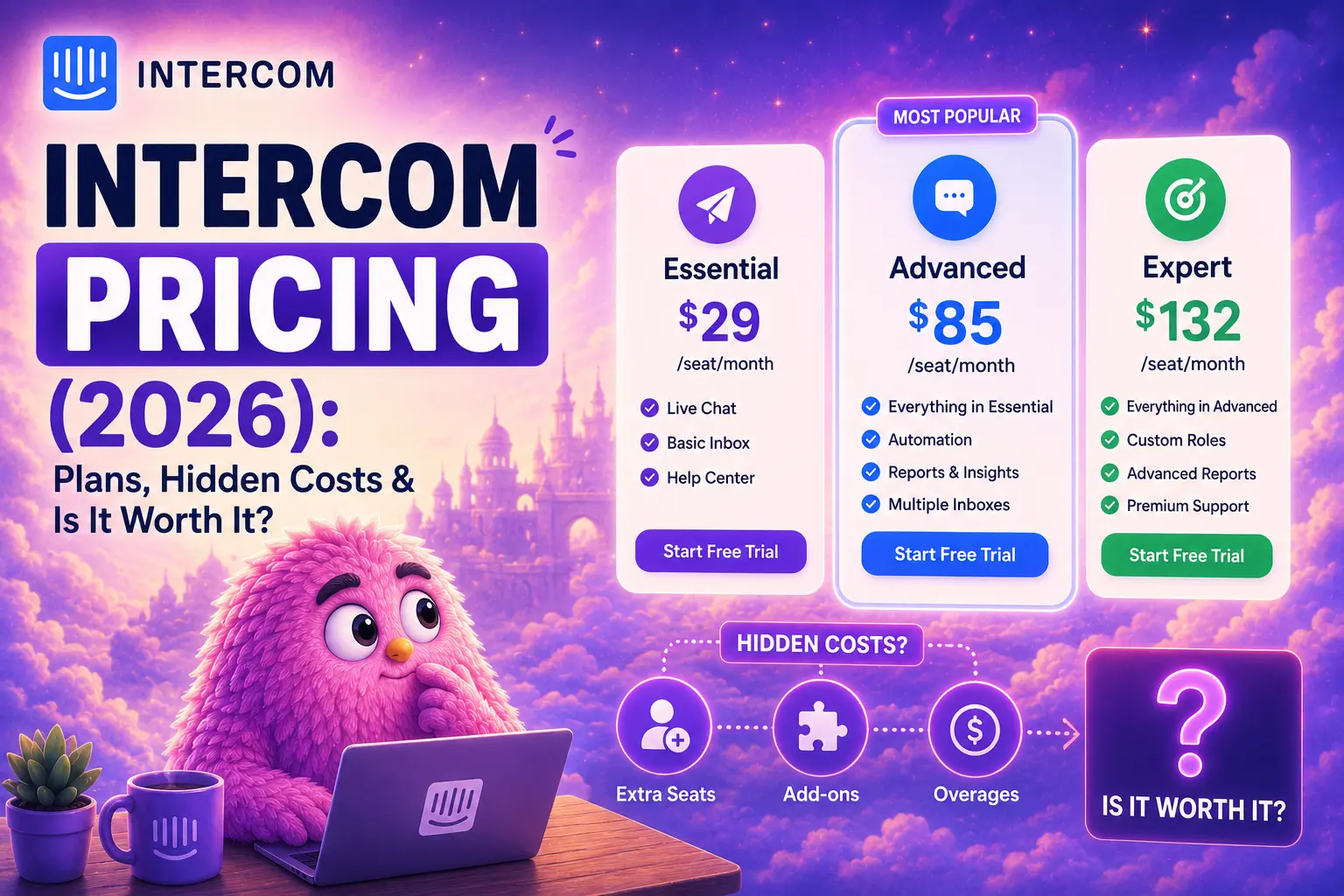
Intercom pricing starts at $29 per seat/month (annual billing) or $39 per seat/month (monthly billing) for the Essential plan. Growing teams can upgrade to Advanced ($85–$99 per seat/month) or Expert ($132–$139 per seat/month). In addition to seat licenses, organizations also pay for Fin AI outcomes, optional add-ons, and usage-based messaging channels, which means the total cost is often higher than the advertised starting price.
Unlike many SaaS platforms with a simple per-user subscription, Intercom combines multiple pricing components that scale as your support team and customer conversations grow.
Seat Pricing
Every teammate who needs full access to Intercom requires a paid seat. Pricing depends on the plan you choose:
- Essential: $29/seat/month (annual) or $39/seat/month (monthly)
- Advanced: $85/seat/month (annual) or $99/seat/month (monthly)
- Expert: $132/seat/month (annual) or $139/seat/month (monthly)
Advanced and Expert plans also include Lite seats for teammates who only need limited platform access.
Fin AI Outcome Pricing
Fin AI Agent is included with every Intercom plan, but AI usage is billed separately at $0.99 per successful outcome. A successful outcome generally means Fin resolves a customer request or successfully completes a configured workflow. As support volume increases, outcome-based pricing can become a significant portion of your monthly bill.
Teams using HubSpot, Zendesk, Salesforce, Freshdesk, or another external helpdesk can also purchase Fin AI Agent separately without subscribing to a full Intercom plan, subject to minimum commitments.
Usage-Based Pricing
Certain communication channels are charged based on usage rather than seats. These include:
- Email campaigns
- SMS
- WhatsApp
- Phone
The more conversations and outbound messages your team handles, the more these usage-based charges can increase your overall subscription cost.
Add-Ons
Intercom also offers optional add-ons for organizations that need additional capabilities, including:
- Pro for conversation quality monitoring and AI optimization
- Copilot Unlimited for expanded AI assistance for support agents
- Proactive Support Plus for product tours, outbound messaging, surveys, and customer engagement campaigns
- Premier Onboarding and Premier Support services for implementation and enterprise support
These add-ons are optional, but they can substantially increase the total cost for growing and enterprise support teams.
Intercom Pricing Plans Explained
Intercom offers three core pricing plans, Essential, Advanced, and Expert, along with Fin AI Agent for Existing Helpdesks. Each plan builds on the previous one by adding more automation, reporting, integrations, and enterprise capabilities.
Essential
Who It's For
The Essential plan is designed for individuals, startups, and small businesses that need core customer support capabilities without enterprise-level complexity.
Key Features
- Fin AI Agent
- Live chat (Messenger)
- Shared inbox
- Ticketing system
- Public Help Center
- Basic automations
- Pre-built reports
- Slack integration
Pros
- Lowest entry price
- Includes Intercom's core customer support tools
- Suitable for small support teams
- Unlimited live chat and customer messaging
Limitations
- No workflow automation
- No Salesforce or Marketo integration
- No custom reporting
- No private or multilingual Help Center
- No round-robin assignment
Advanced
Who It's For
The Advanced plan is aimed at growing support teams that need more automation, collaboration, and reporting while scaling customer operations.
Key Features
Everything in Essential, plus:
- Workflow automation
- Multiple team inboxes
- Round-robin assignment
- Private and multilingual Help Center
- Ticket portal
- Custom reports
- Salesforce integration
- Marketo integration
- 20 Lite seats
Pros
- Strong automation capabilities
- Better collaboration for larger support teams
- Native Salesforce integration
- More advanced reporting and workflow management
Limitations
- Higher per-seat pricing
- Advanced security features require the Expert plan
- AI outcome charges still apply separately
Expert
Who It's For
The Expert plan is built for large enterprises that require advanced security, governance, compliance, and multi-brand customer support.
Key Features
Everything in Advanced, plus:
- SSO and identity management
- HIPAA support
- Service Level Agreements (SLAs)
- Multi-brand Messenger
- Multi-brand Help Center
- Workload management
- Team office hours
- Real-time dashboards
- Extended API limits
- 50 Lite seats
Pros
- Enterprise-grade security and compliance
- Advanced operational controls
- Multi-brand support
- Designed for large customer service organizations
Limitations
- Highest seat cost
- Best suited for large support organizations
- Usage-based pricing and add-ons can significantly increase total cost
Fin AI Agent for Existing Helpdesks
One of Intercom's most overlooked offerings is Fin AI Agent for Existing Helpdesks.
Instead of migrating your entire customer support operation to Intercom, you can deploy Fin AI Agent on top of your existing helpdesk while keeping your current workflows and ticketing platform.
Who It's For
Organizations that already use another helpdesk but want to add AI-powered customer support without replacing their existing system.
This includes teams using:
- HubSpot Service Hub
- Zendesk
- Salesforce
- Freshdesk
- Other supported helpdesk platforms
Key Features
- $0.99 per successful AI outcome
- No Intercom seat licenses required
- Works with your existing helpdesk
- Supports chat, email, and other supported channels
- AI-powered responses and workflow automation
- Human handoff to your existing support platform
Pros
- No full Intercom migration required
- Faster deployment for existing support teams
- Allows organizations to keep existing support processes
- Supports multiple enterprise helpdesk platforms
Limitations
- Minimum commitments apply
- Available through Intercom Sales rather than self-service
- Only includes Fin AI Agent, not the full Intercom platform
- Fin for Sales and Fin for Ecommerce still require an Intercom plan
Important: If your organization already runs HubSpot, Zendesk, or Salesforce, Fin AI Agent lets you add AI customer support without replacing your existing helpdesk. However, if your primary objective is identifying anonymous buyers, qualifying inbound opportunities, enriching CRM records, and converting website visitors into qualified pipeline, you'll likely evaluate buyer activation platforms alongside traditional customer support solutions.
What You're Actually Paying For
Intercom's pricing is often discussed in terms of seat costs, AI outcomes, and add-ons. But before evaluating whether it's expensive, it's important to understand what you're actually paying for.
At its core, Intercom is an AI-first customer service platform. Its pricing reflects an investment in helping support teams resolve conversations faster, automate repetitive work, and improve the customer experience.
When you purchase Intercom, you're primarily investing in:
- Shared Inbox for managing customer conversations across teams
- Help Center for self-service documentation and knowledge management
- Ticketing for organizing, assigning, and resolving customer requests
- AI Customer Support through Fin AI Agent and support automation
- Customer Operations with workflows, reporting, collaboration, and omnichannel support
For organizations focused on customer service, these capabilities can deliver significant operational value.
However, Intercom is not designed to solve every go-to-market challenge.
Its primary focus is customer support, not revenue execution.
That means you're not buying capabilities such as:
These capabilities typically require a different category of platform built for revenue teams rather than customer support.
Understanding this distinction is important when evaluating Intercom's pricing.
If your objective is improving customer support, Intercom's pricing is generally aligned with the value it delivers. If your objective is identifying buyers, qualifying opportunities, and converting website visitors into qualified pipeline, you'll likely evaluate a different set of tools alongside, or instead of traditional customer service platforms.
The Hidden Costs Most Buyers Miss
Intercom's advertised seat price is only one part of the total investment. As your team grows and customer conversations increase, additional charges can significantly affect your monthly bill.
Understanding these costs before signing a contract makes it easier to estimate your true total cost of ownership.
Seat Expansion
Every teammate who needs full access requires a paid seat. As support teams grow, adding agents increases your subscription cost, particularly on the Advanced and Expert plans where seat prices are substantially higher.
Fin AI Outcome Pricing
Fin AI Agent is included with every plan, but usage is billed separately at $0.99 per successful outcome. As AI resolves more customer conversations, outcome-based charges scale with usage rather than team size alone.
SMS
Intercom charges separately for SMS messaging. Organizations using text messages for customer notifications, authentication, or support should factor these usage-based costs into their overall budget.
WhatsApp
WhatsApp conversations are billed based on usage. Businesses with international customers or high WhatsApp engagement may see additional monthly charges beyond their subscription plan.
Phone
Phone support and Fin Voice are priced separately. Costs vary depending on usage, call volume, and deployment requirements, making phone support another variable expense for larger teams. Intercom can also integrate phone support into the same customer service workflow.
Email Campaigns
Email campaigns are also billed based on usage. Companies sending large volumes of onboarding, lifecycle, or support emails should account for these charges as communication volume increases.
Add-Ons
Several advanced capabilities are available as optional add-ons rather than being included in the base subscription. These include:
- Pro
- Copilot Unlimited
- Proactive Support Plus
While optional, many growing support organizations adopt one or more of these products, increasing the overall monthly investment.
Professional Services
Organizations that need implementation assistance can purchase professional services such as Premier Onboarding. These services are priced separately and are commonly used for larger deployments or more complex implementations.
Premier Support
Intercom also offers paid support packages with faster response times and priority assistance. While not required, enterprise organizations often choose these services to meet internal support and operational requirements.
The advertised seat price is rarely the final Intercom invoice. Total cost typically includes seats, Fin AI outcomes, usage-based messaging, optional add-ons, and professional services, making it important to evaluate the full investment rather than the headline monthly price alone.
Intercom Is Now Fin: Why That Changes the Buying Decision
Intercom has undergone one of the biggest strategic shifts in the customer service software market.
Originally known for customer messaging, live chat, conversational marketing, and product engagement, the company has repositioned itself around Fin, an AI-first customer service platform focused on helping support teams resolve customer requests faster and operate more efficiently.
That transition became even more significant when Salesforce signed an agreement to acquire Fin for approximately $3.6 billion, reinforcing its position as an enterprise AI customer service platform.
For buyers evaluating Intercom today, this shift changes an important question.
You're no longer deciding whether to buy a customer messaging platform.
You're deciding whether an AI-first customer service platform aligns with your business objectives.
The Evolution of Intercom
| Then (Intercom) |
Now (Fin) |
| Customer messaging |
AI customer service |
| Conversational marketing |
Customer operations |
| Live chat |
AI support agents |
| Product engagement |
Support automation |
| Customer engagement |
Resolution-focused workflows |
The core mission has shifted from creating conversations to resolving customer issues with AI.
Why This Matters for Buyers
If your primary objective is improving customer support, reducing ticket volume, and increasing operational efficiency, this evolution is a positive one. Fin delivers AI-powered customer service capabilities that align well with modern support organizations.
However, revenue teams often evaluate platforms using different success metrics.
Instead of customer satisfaction and ticket resolution, they focus on questions such as:
- Can we identify anonymous buyers?
- Can we qualify inbound opportunities automatically?
- Can we enrich CRM records with buyer intelligence?
- Can we route qualified buyers to the right sales representative?
- Can we maintain buying momentum after a visitor leaves our website?
- Can we generate a more qualified pipeline?
Those are fundamentally different requirements from customer support.
Understanding that distinction is essential when evaluating Intercom's pricing.
The investment may be entirely justified for organizations building an AI-first customer service operation. But if your priority is buyer identification, qualification, and pipeline generation, you'll likely compare Intercom with a different category of platforms designed for revenue teams rather than support teams.
Customer Conversations vs Buyer Conversations
Not every conversation has the same business objective.
Some conversations are designed to help existing customers. Others are designed to move potential buyers toward a purchasing decision. Understanding the difference is important because customer support teams and revenue teams measure success differently.
Customer Conversations
Customer conversations help existing customers get the answers and support they need. Their primary goal is improving the customer experience.
Customer conversations typically focus on:
- Resolving support requests
- Closing tickets efficiently
- Answering product and account questions
- Reducing response and resolution times
- Improving customer satisfaction (CSAT)
These metrics are essential for customer support organizations because they measure service quality and operational efficiency.
Buyer Conversations
Buyer conversations happen earlier in the customer journey. Their purpose is to understand intent, qualify opportunities, and help potential customers move toward a purchase.
Buyer conversations typically focus on:
- Identifying anonymous buyers
- Understanding purchase intent
- Qualifying inbound opportunities
- Routing buyers to the right sales representative
- Booking meetings
- Preserving buying momentum through follow-ups
- Generating qualified pipeline
Rather than measuring support outcomes, revenue teams evaluate how effectively conversations become sales opportunities.
Why the Difference Matters
Many organizations evaluate Intercom because they want better conversations.
The more important question is what those conversations are expected to accomplish.
If your objective is resolving customer issues, an AI-first customer service platform is often the right investment.
If your objective is generating more qualified pipeline, you'll also need capabilities such as buyer identification, AI qualification, CRM enrichment, intelligent routing, and buyer activation that extend beyond traditional customer support.
Customer conversations improve support. Buyer conversations create revenue.
Why Revenue Teams Evaluate Intercom Differently Today
Intercom has become one of the leading AI-powered customer service platforms. For support organizations, that evolution makes perfect sense.
Revenue teams, however, evaluate software through a different lens.
Their goal isn't simply to respond to conversations, it's to identify buying intent, accelerate sales opportunities, and generate qualified pipeline. That changes how they assess platforms like Intercom.
Anonymous Visitors Remain Anonymous
Only a small percentage of website visitors start a chat or submit a form.
Many high-intent buyers research pricing, compare solutions, read documentation, and leave without identifying themselves. Without buyer identification, these potential opportunities remain invisible to the sales team.
Related: Best B2B Website Visitor Identification Software and Tools
Qualification Is Still Largely Manual
Not every conversation represents a sales opportunity.
Revenue teams need to understand buyer intent, company fit, engagement history, and purchasing readiness before routing prospects to sales. Without automated qualification, valuable time is spent reviewing conversations that may never become opportunities.
CRM Records Often Lack Buyer Context
A CRM record is more valuable when it includes the buyer's journey.
Understanding which pages a prospect viewed, how they engaged, what conversations they've already had, and where they are in the buying process helps sales teams continue the discussion with context instead of starting over.
Conversations End When the Session Ends
Many customer conversations end when the chat window closes.
From a revenue perspective, that's often where the real work begins.
Buyers continue researching competitors, involve additional stakeholders, compare pricing, and revisit their shortlist over the following days or weeks. Without continuity, buying momentum is easily lost.
Email Alone Doesn't Preserve Momentum
Traditional follow-up often depends on email sequences or manual outreach.
While email remains an important sales channel, it doesn't always reflect how modern B2B buyers communicate. Buyers move between email, LinkedIn, Slack, WhatsApp, events, and other touchpoints throughout their evaluation process, making continuity increasingly important.
Lost Momentum Becomes Lost Pipeline
Revenue leakage doesn't always happen because buyers lose interest.
More often, it happens because conversations lose context, follow-ups are delayed, or qualified buyers aren't re-engaged at the right time. Small breaks in the buying journey can compound into missed meetings, stalled opportunities, and lower conversion rates.
Why Buyer Journey Continuity Matters
Modern revenue teams increasingly look beyond live chat.
They want platforms that can identify buyers, qualify opportunities, enrich CRM records, intelligently route prospects, preserve buyer context, automate follow-ups, re-engage qualified buyers, and maintain momentum throughout the entire buying journey, not just while someone is on the website.
That's why many organizations evaluating Intercom today also evaluate buyer activation platforms that are purpose-built for pipeline generation rather than customer support alone.
Intercom Pricing vs Knock AI
Intercom and Knock AI are often evaluated during the same buying process, but they are designed to solve different business problems.
Intercom (Fin) is an AI-first customer service platform built for support teams. It helps organizations manage customer conversations, resolve tickets, and automate service operations.
Knock AI is built for revenue teams. It focuses on identifying buyers, qualifying inbound opportunities, enriching CRM records, maintaining buyer momentum, and converting website visitors into qualified pipeline.
If your priority is customer support, Intercom is a strong choice. If your priority is revenue generation, buyer activation, and pipeline growth, the comparison looks very different.
| Capability |
Intercom (Fin) |
Knock AI |
| Live Chat |
✅ |
Limited |
| Shared Inbox |
✅ |
❌ |
| Ticketing |
✅ |
❌ |
| Knowledge Base |
✅ |
❌ |
| AI Customer Support |
✅ Advanced |
❌ |
| Buyer Identification |
❌ |
✅ Advanced |
| Identity Resolution |
❌ |
✅ |
| CRM Enrichment |
❌ |
✅ Advanced |
| AI Lead Qualification |
❌ |
✅ Advanced |
| Instant Meeting Booking |
Limited |
✅ |
| Intelligent Lead Routing |
Limited |
✅ Advanced |
| Buyer Re-engagement |
❌ |
✅ |
| Memory & Momentum Capture |
❌ |
✅ |
| Pipeline Generation Focus |
❌ |
✅ |
| Off-site Buyer Engagement |
❌ |
✅ |
| LinkedIn Engagement |
❌ |
✅ |
| Slack Engagement |
❌ |
✅ |
| WhatsApp Engagement |
Limited |
✅ |
| Event & QR Lead Capture |
❌ |
✅ |
| HubSpot CRM Integration |
✅ |
✅ |
| Salesforce CRM Integration |
✅ |
✅ |
The key distinction isn't which platform has more features, it's what outcome each platform is designed to optimize.
Intercom is designed to help support teams resolve customer conversations more efficiently through AI, ticketing, and customer operations.
Knock AI is designed to help revenue teams identify buyers, qualify intent, enrich CRM data, intelligently route opportunities, continue conversations after buyers leave the website, and convert demand into qualified pipeline.
For organizations evaluating Intercom after its transition to Fin and the Salesforce acquisition, the decision often comes down to a simple question:
Are you primarily investing in customer support, or are you investing in pipeline generation?
Which Platform Should You Choose?
Intercom and Knock AI are built for different teams and different business outcomes. The right choice depends on whether your priority is customer support or revenue generation.
Choose Intercom if...
Intercom is the better choice if your organization is primarily focused on customer service and support operations. It makes sense if you:
- Need a modern live chat and messaging platform
- Manage customer support through a shared inbox and ticketing system
- Want an AI-powered customer service solution for resolving customer inquiries
- Rely on a knowledge base and self-service support
- Need workflow automation for customer operations
- Measure success using customer satisfaction (CSAT), response times, and ticket resolution
Choose Knock AI if...
Knock AI is a better fit if your goal is converting demand into qualified pipeline rather than managing support conversations. It makes sense if you:
- Want to convert website visitors into qualified pipeline
- Need buyer identification and identity resolution
- Want AI-powered lead qualification before prospects reach sales
- Need CRM enrichment for HubSpot or Salesforce
- Want intelligent lead routing and instant meeting booking
- Need conversations to continue across LinkedIn, Slack, WhatsApp, and other channels after buyers leave your website
- Want to capture and follow up with leads from events and offline interactions
- Need automated buyer re-engagement to reduce pipeline leakage
- Want to preserve buyer context and maintain momentum throughout the buying journey
- Measure success using meetings booked, opportunities created, pipeline generated, and revenue growth
The decision ultimately comes down to what you're trying to optimize.
If your priority is customer support, Intercom is one of the strongest AI-powered customer service platforms available today.
If your priority is turning anonymous visitors into identified buyers, qualifying opportunities, and generating more pipeline, a buyer activation platform like Knock AI is purpose-built for that outcome.
Frequently Asked Questions
How much does Intercom cost?
Intercom pricing starts at $29 per seat/month on annual billing or $39 per seat/month on monthly billing for the Essential plan. Advanced and Expert plans cost more, and organizations may also pay for Fin AI outcomes, usage-based messaging, add-ons, and professional services.
Does Intercom charge per seat?
Yes. Intercom uses seat-based pricing for full-access teammates. Each paid seat is billed according to your selected plan, while Advanced and Expert plans also include a limited number of Lite seats.
What is Fin AI pricing?
Fin AI Agent is billed at $0.99 per successful outcome. This pricing applies whether you're using Fin with an Intercom plan or deploying Fin on a supported external helpdesk, subject to minimum commitments.
What counts as a Fin outcome?
A billable outcome generally occurs when Fin successfully resolves a customer request or completes a configured workflow. Unsuccessful interactions and certain handoffs are not billed.
Why is Intercom more expensive than the advertised seat price?
The advertised seat price doesn't include Fin AI outcomes, usage-based messaging channels (such as SMS and WhatsApp), optional add-ons, additional seats, or professional services. These costs can increase your total monthly investment.
Is Intercom worth the cost?
Intercom can be a strong investment for organizations focused on customer support, AI service automation, and customer operations. Whether it's worth the cost depends on your business goals and how extensively you use its AI, messaging, and support capabilities.
Is Fin included in every Intercom plan?
Yes. Fin AI Agent is included with Essential, Advanced, and Expert plans. However, AI usage is billed separately based on successful outcomes.
Can I use Fin without Intercom?
Yes. Fin AI Agent can be deployed with supported helpdesks such as HubSpot, Zendesk, Freshdesk, and Salesforce without purchasing a full Intercom plan. Minimum commitments apply, and access is provided through Intercom's sales team.
What happened to Intercom after the Salesforce acquisition?
Intercom has rebranded its platform around Fin, and Salesforce has signed an agreement to acquire Fin. The platform remains focused on AI-powered customer service, support automation, and customer operations.
What is the best Intercom alternative after Salesforce acquired Fin?
The best alternative depends on your goals. If you need AI-powered customer support, platforms like Zendesk, Freshdesk, and Help Scout are strong options. If your priority is buyer identification, AI qualification, and converting website visitors into qualified pipeline, you'll likely evaluate buyer activation platforms alongside traditional support tools.
Which Intercom alternative works with HubSpot?
Several Intercom alternatives integrate with HubSpot. If your focus is customer support, multiple helpdesk platforms offer HubSpot integrations. If your focus is pipeline generation, look for platforms that combine HubSpot CRM integration with buyer identification, CRM enrichment, AI qualification, and automated meeting booking.
What is the best Intercom alternative for B2B SaaS?
There isn't a single best choice for every B2B SaaS company. Support-focused organizations often compare Intercom with Zendesk or Freshdesk, while revenue-focused teams typically evaluate platforms that help identify buyers, qualify inbound demand, and generate pipeline.
Can Intercom identify anonymous website visitors?
Intercom provides visitor engagement and conversation tools, but it is not designed as a dedicated buyer identification platform for identifying anonymous companies and enriching buyer records for sales teams.
Can Intercom generate pipelines?
Intercom can help engage website visitors and support customer conversations, which may contribute to pipeline creation. However, it is primarily designed for customer service rather than buyer identification, AI qualification, and revenue activation.
How do you turn website visitors into qualified pipeline?
Turning website visitors into qualified pipeline typically involves identifying anonymous buyers, understanding purchase intent, enriching CRM records, qualifying opportunities with AI, routing prospects to the right sales representative, booking meetings quickly, and maintaining buying momentum through timely follow-ups until opportunities are created.


.svg)


.svg)
.svg)
.svg)


.svg)
.svg)


.svg)


