LeanData Pricing in 2026: Plans, Hidden Costs & Is It Worth It?
LeanData Pricing in 2026: Plans, Hidden Costs & Is It Worth It?
LeanData uses custom enterprise pricing, and most mid-market and enterprise teams typically spend anywhere from ~$25K to $120K+ per year, depending on routing complexity, Salesforce object coverage, workflow volume, integrations, and add-ons.
The platform is best known for Salesforce-native lead routing, account matching, territory management, and RevOps orchestration. But for many companies, the subscription cost is only part of the total investment.
As workflows scale, additional costs often appear through:
Salesforce admin overhead
implementation and maintenance
routing complexity
add-ons like BookIt and NotifyPlus
ongoing workflow governance
That is why many teams evaluating LeanData pricing in 2026 are also comparing newer GTM platforms like Knock AI that focus more heavily on buyer conversion, conversational qualification, and reducing inbound friction.
LeanData Pricing at a Glance
Category
LeanData
Pricing model
Custom enterprise pricing
Estimated annual cost
~$25K–120K+/year
Best for
Enterprise Salesforce routing
Biggest cost driver
Salesforce admin overhead
Main limitation
Reactive post-form workflows
Best modern alternative
Knock AI
LeanData pricing scales quickly with workflow complexity and routing volume
Add-ons and Salesforce admin costs significantly increase total ownership cost
Implementation and maintenance are often underestimated
LeanData is strongest for Salesforce-native routing governance
Teams prioritizing buyer conversion and inbound efficiency increasingly evaluate platforms like Knock AI
How Much Does LeanData Cost in 2026?
LeanData does not publicly publish transparent pricing, which makes estimating total cost difficult before speaking with sales.
In most cases, LeanData pricing depends on:
routing complexity
Salesforce object coverage
inbound lead volume
workflow orchestration depth
integrations
support requirements
and add-on modules
For most mid-market and enterprise teams, annual contracts typically range from ~$25K to $120K+ per year, with larger organizations often spending significantly more as workflows scale.
The biggest reason pricing increases over time is operational complexity. As teams expand routing logic across leads, contacts, accounts, opportunities, territories, and scheduling workflows, additional admin overhead and orchestration requirements usually follow.
LeanData is strongest in large Salesforce environments with complex routing governance needs, but total ownership costs can grow quickly once implementation, maintenance, and add-ons are factored in.
LeanData Pricing Overview
LeanData Tier
Best For
Estimated Annual Cost
Standard
Basic lead routing & matching
~$25K–40K+/year
Advanced
Multi-object routing & automation
~$40K–70K+/year
Premium
Enterprise orchestration & attribution
~$75K–120K+/year
Enterprise
Large-scale GTM orchestration
Custom pricing
Add-ons
BookIt, NotifyPlus, Engagement
Additional cost
See Knock AI in Action — Book Your Live Demo Today
For many organizations, the subscription itself becomes only one part of the total cost of ownership.
LeanData Pricing Plans Explained
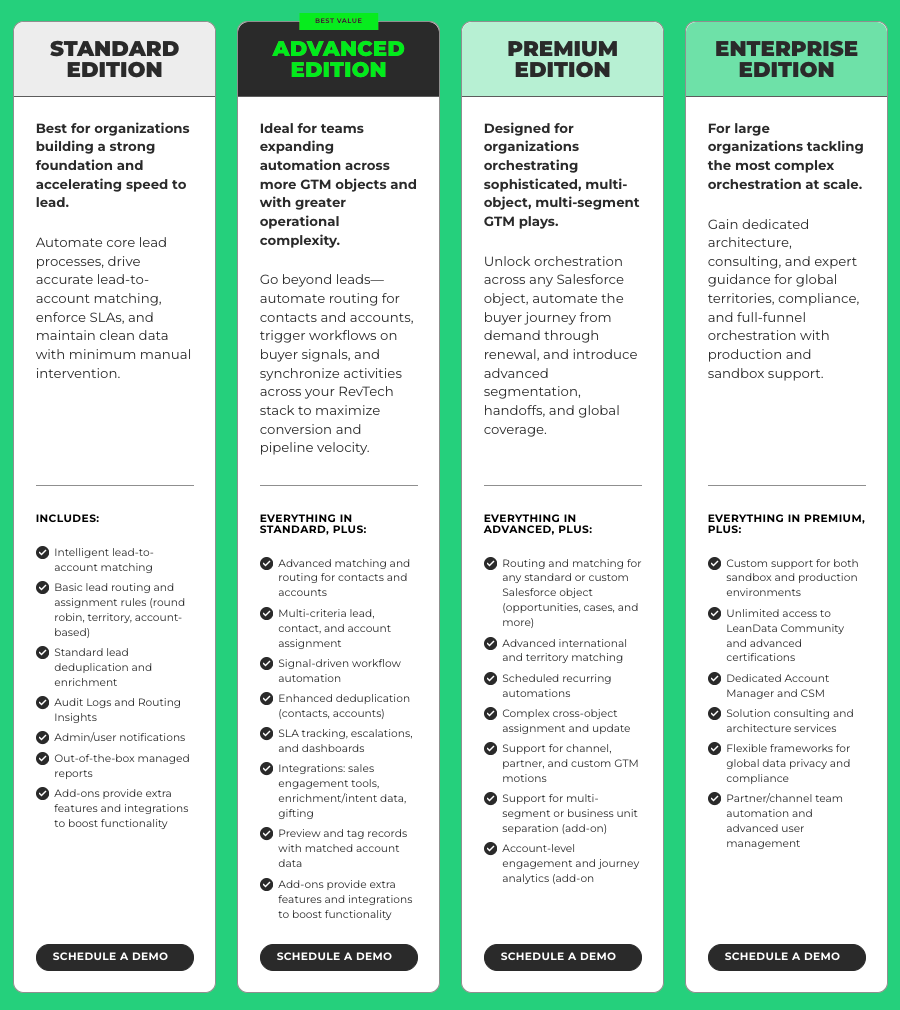
Standard Plan
The Standard plan is designed for teams that need foundational Salesforce routing and lead management workflows without advanced orchestration complexity.
It typically includes:
basic lead routing
lead-to-account matching
round robin assignment
alerts and notifications
core workflow automation
For many organizations, this tier works best for straightforward inbound routing environments with limited multi-object complexity.
Advanced Plan
The Advanced plan expands routing coverage across multiple Salesforce objects and introduces more flexible orchestration capabilities.
This tier generally adds:
multi-object routing
SLA-based workflows
campaign routing
broader integrations
expanded orchestration logic
It is commonly used by growing RevOps teams managing more complex routing structures across leads, contacts, and accounts.
Premium Plan
The Premium plan is built for enterprise organizations running large-scale Salesforce orchestration workflows across multiple departments and GTM motions.
It typically includes:
opportunity orchestration
custom object support
attribution workflows
enterprise governance controls
advanced automation capabilities
This tier is usually where pricing increases significantly due to broader workflow coverage and operational complexity.
Enterprise Plan
The Enterprise plan is designed for large organizations operating highly customized Salesforce environments with advanced routing governance requirements.
It generally includes:
dedicated support
sandbox environments
complex enterprise routing
large Salesforce operations support
advanced workflow governance
Enterprise agreements are typically fully customized based on workflow scale, object coverage, support requirements, and orchestration depth.
The Hidden Costs of LeanData
For most companies, the LeanData subscription itself is only one part of the total investment.
The bigger operational costs usually appear after implementation, as routing logic expands, Salesforce workflows become more complex, and additional orchestration layers are added across the GTM stack.
That is why many teams evaluating LeanData pricing ultimately focus less on the base contract value and more on the long-term operational burden tied to maintaining the system at scale.
Salesforce Admin Overhead
LeanData depends heavily on Salesforce configuration and ongoing workflow management.
As routing logic evolves, teams often need continuous support for:
routing maintenance
territory updates
workflow adjustments
lead matching logic
assignment governance
SLA management
For enterprise RevOps teams, this usually creates ongoing dependency on Salesforce admins and operations resources.
Over time, maintaining routing infrastructure can become operationally heavy, especially for organizations managing multiple territories, product lines, or GTM motions simultaneously.
Add-On Expansion Costs
Many advanced LeanData capabilities are tied to additional modules and add-ons.
Features such as:
BookIt
NotifyPlus
attribution workflows
engagement orchestration
advanced matching logic
can significantly increase annual costs as workflows expand.
As teams add more orchestration layers across scheduling, routing, attribution, and engagement, pricing complexity often increases alongside operational complexity.
Implementation & Maintenance Costs
LeanData implementations can take significant time depending on Salesforce architecture and workflow depth.
Many organizations underestimate the operational effort required for:
onboarding
workflow testing
routing QA
multi-team coordination
process alignment
RevOps resource allocation
Changes to routing logic also typically require ongoing testing and governance to avoid assignment conflicts or workflow breaks across the CRM environment.
Scaling Costs Over Time
As GTM operations grow, LeanData workflows often become more complex to maintain.
For large enterprise teams, maintaining routing consistency across leads, accounts, contacts, opportunities, territories, and scheduling workflows can become increasingly resource-intensive over time.
Total Cost of Ownership Overview
Cost Category
LeanData Impact
Platform subscription
High
Salesforce admin dependency
High
Workflow maintenance
High
Implementation effort
Medium–High
Add-on expansion
High
Operational scalability
Complex
LeanData Pricing vs Modern GTM Platforms
The GTM software market is changing quickly.
Traditional platforms like LeanData were built primarily around Salesforce routing, territory governance, and CRM orchestration. Their main goal is to ensure records are assigned correctly after entering the system.
But many modern GTM platforms are now optimized around a different priority: improving buyer conversion before friction slows down the journey.
That shift is changing how companies evaluate pricing, operational complexity, and overall ROI.
GTM Platform Comparison
Platform Type
Pricing Complexity
Operational Overhead
Buyer Engagement
Traditional Salesforce Routing Platforms
High
High
Limited
Conversational GTM Platforms
Moderate
Lower
High
Scheduling Platforms
Moderate
Low
Moderate
Workflow Automation Tools
Flexible
Moderate
Limited
Traditional routing tools are strongest when organizations need:
strict routing governance
territory management
account matching
Salesforce-native workflow orchestration
However, these systems also tend to require:
heavier implementation
ongoing admin support
workflow maintenance
and more operational oversight as complexity grows
Modern conversational GTM platforms like Knock AI focus more heavily on:
Instead of optimizing only record assignment, these platforms increasingly optimize how quickly and efficiently inbound intent becomes qualified pipeline.
LeanData and Knock AI solve very different parts of the go-to-market workflow.
LeanData is primarily designed around CRM governance, routing logic, territory management, and Salesforce orchestration after a lead enters the system.
Knock AI focuses more heavily on buyer conversion, conversational qualification, real-time engagement, and capturing inbound intent before friction slows down the buyer journey.
For many modern GTM teams, the comparison is no longer just about routing records efficiently. It is increasingly about how quickly inbound intent becomes qualified pipeline.
LeanData Focuses on CRM Governance
LeanData is strongest in enterprise Salesforce environments where organizations need:
complex routing logic
account matching
territory orchestration
lead assignment governance
structured Salesforce workflows
post-form operational infrastructure
The platform is built primarily for companies managing large-scale routing workflows across leads, contacts, accounts, opportunities, and territories inside Salesforce.
Its biggest strength is operational control and routing precision at enterprise scale.
Knock AI Focuses on Buyer Conversion
Knock AI is designed around reducing friction between buyer intent and pipeline creation.
Instead of relying heavily on static forms and post-submission routing workflows, the platform focuses on:
Many teams evaluating LeanData alternatives are not necessarily replacing routing functionality entirely. Instead, they are trying to improve:
inbound conversion rates
qualification speed
buyer engagement
operational simplicity
and follow-up continuity
Common reasons teams move toward platforms like Knock AI include:
reducing form friction
enabling faster qualification
lowering operational overhead
improving inbound conversion efficiency
supporting real-time buyer engagement
maintaining multi-channel follow-up continuity
Funnel Comparison
Funnel Stage
LeanData + Forms
Knock AI
Website conversion
Traditional form-first workflows
Formless conversational engagement
Qualification
Post-form routing
Real-time AI qualification
Scheduling
Separate workflow layer
Embedded scheduling
Follow-up
Email-heavy
Multi-channel persistence
Meeting attendance
Standard inbound variability
Up to 96% reported attendance rates
LeanData Pros & Cons
Pros
Strong Salesforce-native routing
Advanced territory management
Mature RevOps ecosystem
Enterprise governance controls
Deep CRM orchestration capabilities
Cons
Expensive enterprise pricing
High operational overhead
Long implementation cycles
Heavy Salesforce dependency
Add-on expansion costs
Reactive routing architecture
Who Should Use LeanData?
Best Fit
LeanData is typically best suited for:
enterprise Salesforce organizations
mature RevOps teams
complex territory management environments
multi-object routing workflows
companies with dedicated Salesforce admin resources
Probably Not Ideal For
LeanData may be less ideal for:
lean GTM teams
fast-moving growth organizations
companies prioritizing inbound conversion
teams reducing form friction
businesses seeking operational simplicity
Is LeanData Worth It in 2026?
LeanData remains one of the strongest Salesforce-native routing and orchestration platforms for enterprise RevOps teams managing highly complex CRM workflows.
For organizations that prioritize routing governance, territory management, account matching, and Salesforce operational control, the platform can deliver significant value.
However, pricing and operational complexity often increase substantially as workflows scale.
Many modern GTM teams are also prioritizing:
buyer conversion efficiency
conversational engagement
qualification speed
operational simplicity
and inbound pipeline performance
alongside traditional routing capabilities.
As a result, the market is gradually shifting from simply routing records inside a CRM toward capturing and converting buyer intent earlier in the journey.
Modern GTM Teams Need More Than Routing
Lead routing still matters. But modern pipeline generation increasingly depends on identifying, engaging, and converting buyer intent before friction slows down the buyer journey.
For teams evaluating LeanData pricing in 2026, the decision is no longer just about routing logic or Salesforce governance. It is about how efficiently your GTM motion converts inbound intent into qualified pipeline.
Knock AI helps teams combine buyer identification, conversational qualification, scheduling, routing, and multi-channel engagement into one connected workflow, without relying entirely on static forms and reactive CRM processes.
Instead of only routing leads after form submissions, teams can engage and convert buyers earlier in the journey before pipeline opportunities disappear.


.svg)


.svg)
.svg)
.svg)


.svg)
.svg)


.svg)