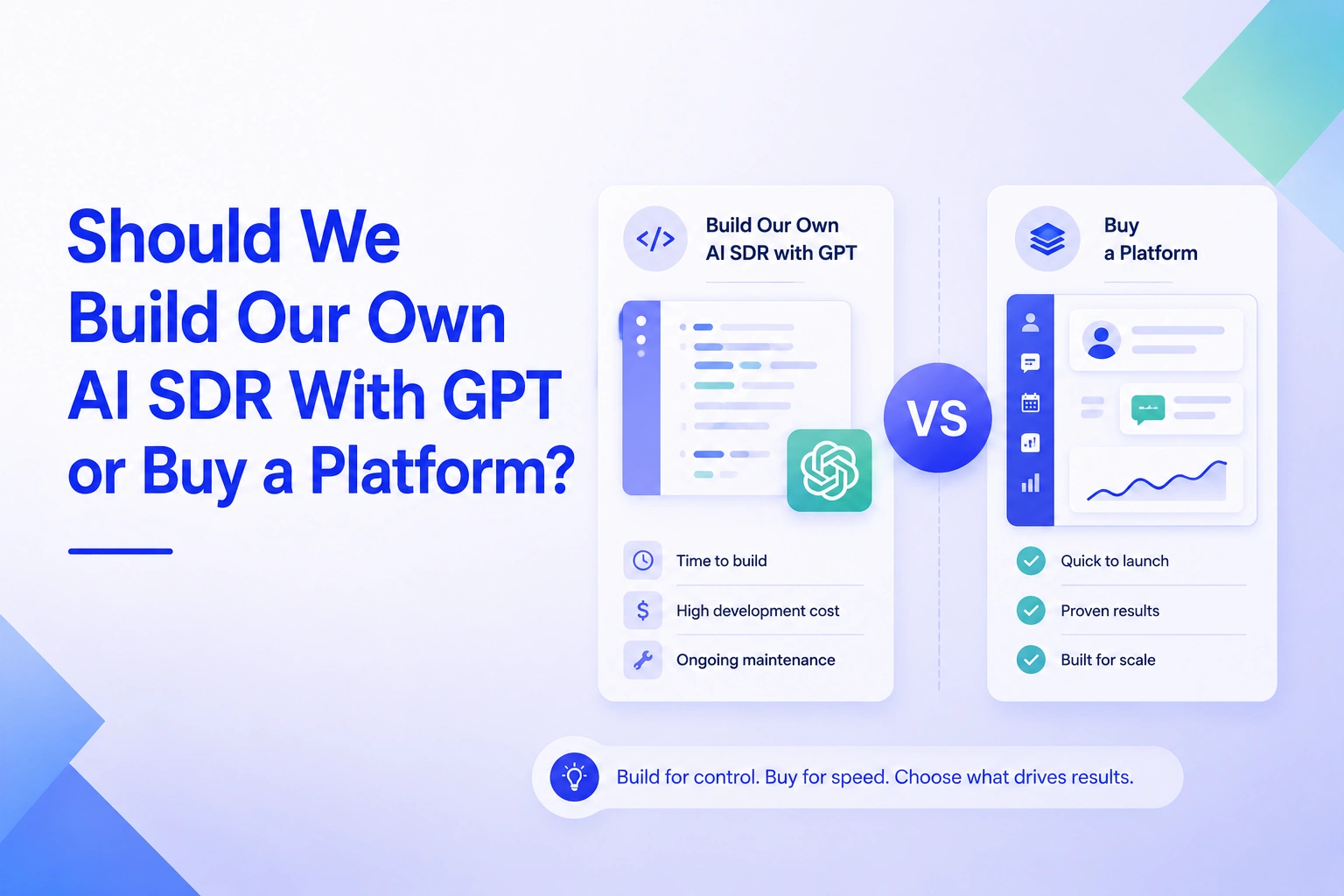
Neither approach is universally better.
Building internally can be the right decision for organizations with dedicated AI engineering teams, highly specialized workflows, or regulatory requirements that demand complete control over the technology stack.
For most revenue teams, however, the objective isn't to build AI infrastructure, it's to generate more qualified pipeline.
A specialized AI SDR platform allows teams to focus on optimizing buyer engagement, qualification, and conversion instead of spending months developing, integrating, testing, and maintaining the underlying technology.
Building with GPT gives you the components. Buying an AI SDR platform gives you a production-ready revenue system designed to create pipeline from day one.
The Hidden Cost of Building an AI SDR Internally
When companies compare building an AI SDR with buying an AI SDR platform, they often focus on software licensing costs.
In reality, licensing is usually the smallest part of the investment.
The true cost comes from everything required to build, operate, and continuously improve a production-ready revenue system.
Engineering Resources
A production AI SDR rarely becomes a side project. It often requires software engineers, AI engineers, solution architects, and technical leaders to design the system, build integrations, develop workflows, and keep everything running as your business evolves.
Prompt Engineering and AI Optimization
Writing an initial prompt is easy. Building prompts that consistently qualify buyers, follow your sales methodology, avoid hallucinations, and improve conversion rates requires continuous testing and optimization. As AI models evolve, prompts and workflows often need to be updated as well.
Quality Assurance and Testing
Every change should be tested before reaching real buyers. Qualification logic, routing rules, CRM updates, meeting scheduling, and AI responses all need ongoing validation to prevent poor buyer experiences or incorrect sales decisions.
Infrastructure and AI Costs
Running an AI SDR involves more than API calls. You'll need to manage cloud infrastructure, model usage costs, databases, logging, backups, monitoring, and scalability as conversation volume grows.
CRM and System Integrations
An AI SDR needs to work seamlessly with your CRM, calendar, email platform, Slack, marketing automation tools, and other parts of your revenue stack. Every integration adds development effort, testing, and long-term maintenance.
Monitoring and Reliability
Launching an AI SDR is only the beginning. Someone needs to monitor conversations, investigate failures, identify routing issues, measure qualification accuracy, and ensure the system continues performing reliably every day.
Security and Compliance
AI systems frequently handle customer information, CRM data, and business conversations. Protecting that data requires authentication, access controls, audit logs, compliance reviews, and ongoing security updates that become your team's responsibility.
Continuous Improvement
Buyer behavior changes. Sales processes evolve. New AI models are released. Product messaging changes. A production AI SDR requires continuous refinement to stay accurate and aligned with your go-to-market strategy instead of becoming outdated over time.
Opportunity Cost
Perhaps the biggest hidden cost is what your engineering team isn't building.
Every month spent developing AI infrastructure is a month not spent improving your core product, shipping customer-facing features, or executing strategic initiatives that differentiate your business.
Technical Debt
Custom AI systems rarely stay simple. Over time, integrations, prompts, business rules, routing logic, and model upgrades create technical debt that becomes increasingly difficult and expensive to maintain.
Building an AI SDR can absolutely make sense for organizations with dedicated AI engineering teams and highly specialized requirements. But it's important to evaluate the total cost of ownership, not just the cost of GPT tokens or cloud infrastructure.
The biggest expense of building an AI SDR isn't the AI model. It's the engineering time, maintenance, and opportunity cost required to transform a prototype into a reliable revenue system that your sales team can trust every day.
Related: Can I Try an AI SDR Tool Free Before Signing an Annual Contract?
GPT Is Only One Part of an AI SDR
The availability of powerful LLMs has changed how companies think about AI. Because GPT, Claude, and other models can hold natural conversations, many teams assume they already have everything they need to build an AI SDR.
In reality, the LLM is only one component of the system.
Think of it this way:
LLM ≠ AI SDR
An LLM provides intelligence. An AI SDR delivers business outcomes.
To generate qualified pipeline, an AI SDR must combine conversational intelligence with a complete revenue infrastructure.
That includes:
- Reasoning to understand buyer questions and determine the next best action.
- Conversation memory so buyers never have to repeat themselves across interactions.
- Tool calling to access CRM records, calendars, knowledge bases, and other business systems in real time.
- Intelligent routing to direct conversations to sales, customer success, support, recruiting, or partnerships based on buyer intent.
- Business context so every response reflects your products, pricing, policies, and sales methodology.
- CRM synchronization to create, update, and enrich records without manual work.
- Buyer and company data to identify who's engaging before asking repetitive qualification questions.
- Native integrations across email, calendars, Slack, marketing automation, and your broader revenue stack.
- Guardrails that ensure the AI follows approved messaging, qualification rules, compliance requirements, and escalation policies.
This is what separates a chatbot from a production-ready AI SDR.
The language model powers the conversation, but the surrounding infrastructure determines whether that conversation becomes qualified pipeline.
GPT gives an AI SDR the ability to communicate. The revenue system around it gives the AI SDR the ability to sell.
When Building Your Own AI SDR Makes Sense
Despite the complexity, building your own AI SDR isn't always the wrong decision.
For some organizations, custom development is the better long-term investment.
Building internally may make sense if:
You Operate in a Highly Regulated Industry
Organizations in healthcare, financial services, government, or defense may have strict security, compliance, or data residency requirements that are difficult to satisfy with off-the-shelf software.
Your Revenue Process Is Highly Unique
If your qualification logic, approval workflows, or buying journey are fundamentally different from standard B2B sales motions, a custom-built solution may offer greater flexibility.
You Have a Dedicated AI Engineering Team
Companies with experienced AI engineers, platform engineers, DevOps specialists, and product teams are better equipped to build, monitor, and continuously improve an internal AI SDR without slowing other strategic initiatives.
AI Is a Core Competitive Advantage
If building proprietary AI systems is central to your business strategy, investing in internal AI infrastructure may create long-term differentiation that extends beyond sales.
You're Building for Research or Experimentation
Many organizations begin by building prototypes to better understand AI capabilities before deciding whether to scale internally or adopt a commercial platform.
For most businesses, however, the objective isn't to become an AI software company. It's to generate more qualified pipeline, improve buyer experiences, and increase revenue.
In those situations, buying a specialized AI SDR platform often allows engineering teams to stay focused on the products and features that differentiate the business, while revenue teams benefit from a production-ready solution that can be deployed much faster.
Build your own AI SDR when custom AI infrastructure creates a strategic advantage. Buy a platform when your competitive advantage comes from selling your product, not maintaining AI infrastructure.
When Buying an AI SDR Platform Makes More Sense
Building your own AI SDR can be the right decision in certain situations, but for most revenue teams, the priority isn't building AI infrastructure. It's improving pipeline, increasing conversion rates, and generating results as quickly as possible.
Buying a specialized AI SDR platform often makes more sense when speed, reliability, and business outcomes matter more than owning the underlying technology.
A platform is usually the better choice if:
You Need ROI Quickly
Building an internal AI SDR can take months before it creates business value. A production-ready platform allows you to start engaging buyers, qualifying conversations, and generating pipeline within weeks instead of spending months in development.
You Need More Qualified Pipeline
If your sales team is missing opportunities today, delaying deployment while engineering builds internal infrastructure has a real revenue cost. A specialized platform helps improve conversion immediately.
You Don't Have a Dedicated AI Engineering Team
Building and maintaining an AI SDR requires expertise in AI, integrations, infrastructure, monitoring, security, and prompt optimization. Most companies don't have a team dedicated to those responsibilities.
Your Engineering Team Is Already Busy
Engineering resources are limited. Every sprint spent building AI infrastructure is a sprint not spent improving your core product or delivering customer-facing features.
You Need Enterprise Reliability
Revenue systems can't afford downtime or inconsistent behavior. Production platforms are built to handle scale, monitor performance, and provide the reliability that sales teams depend on every day.
You Need Multi-Channel Buyer Engagement
Modern buyers don't interact through a single channel. A specialized platform can engage buyers across websites, LinkedIn, email, AI search, messaging apps, communities, and other touchpoints as part of one continuous buying journey.
You Need Native Integrations
Connecting an AI SDR to your CRM, calendar, Slack, marketing automation platform, and other revenue tools is a significant engineering effort. Production platforms provide these integrations out of the box.
You Need Analytics and Revenue Visibility
Understanding qualification rates, routing performance, buyer intent, pipeline creation, and AI effectiveness is just as important as having AI conversations. Dedicated platforms include reporting and analytics designed for revenue teams.
You Want Continuous Innovation
AI evolves rapidly. New foundation models, capabilities, integrations, and best practices are released constantly. A specialized platform continuously improves without requiring your engineering team to rebuild or retest the system every few months.
If your goal is to become an AI platform company, building internally may be the right investment. If your goal is to grow revenue, buying a production-ready AI SDR platform usually gets you there much faster.
Can an Internal AI SDR Match a Specialized Platform?
The honest answer is yes.
Given enough engineering resources, time, and investment, an internal team can build an AI SDR that rivals a commercial platform.
The more important question is:
How long will it take to reach that level?
Building a working prototype is relatively straightforward.
Internal AI SDR
↓
Prototype works
Turning that prototype into a production-grade revenue system is where the real challenge begins.
Production AI SDR
↓
Reliable at scale
To reach production quality, your team must continuously improve far more than the AI conversation itself.
- Conversation quality needs constant evaluation to ensure responses remain accurate, helpful, and aligned with your sales methodology.
- Scalability becomes critical as conversation volume grows across different channels and geographies.
- Conversation memory must preserve buyer context across multiple interactions and human handoffs.
- Monitoring is required to detect failures, broken workflows, poor qualification decisions, and declining performance before they impact buyers.
- Prompt updates become an ongoing responsibility as products, messaging, and AI models evolve.
- Security and compliance require continuous attention as customer data flows through multiple systems.
- Uptime and reliability must meet the expectations of revenue teams that depend on the platform every day.
- Support and issue resolution become essential when sales teams need immediate assistance instead of waiting for engineering priorities to shift.
- Buyer experience must remain consistent across every conversation, regardless of channel, product line, or stage of the buying journey.
These aren't one-time development tasks. They're continuous operational responsibilities.
This is why many organizations successfully build an impressive proof of concept but struggle to maintain a production-ready AI SDR over the long term.
Specialized platforms have already invested years into solving these challenges, allowing revenue teams to focus on improving conversion instead of maintaining infrastructure.
Building an AI SDR that works is achievable. Building one that sales trusts every day, buyers enjoy interacting with, and engineering doesn't have to constantly maintain is a much higher bar.
How Long Does It Really Take to Build an AI SDR?
One of the biggest misconceptions about building an AI SDR is assuming that once the AI can answer questions, the project is almost finished.
In reality, that's usually when the most difficult work begins.
A typical internal AI SDR project often follows a timeline like this:
| Timeline |
Typical Focus |
| Weeks 1–2 |
Build a working prototype using GPT or another LLM. Basic conversations begin to work. |
| Month 2 |
Connect the AI to your CRM, calendars, knowledge base, and internal systems. |
| Month 3 |
Develop qualification logic, buyer intent detection, routing rules, and business workflows. |
| Month 4 |
Test conversations, validate qualification accuracy, improve prompts, and fix edge cases. |
| Month 5 |
Evaluate performance, strengthen security, monitor reliability, and optimize buyer experience. |
| Month 6+ |
Launch a production-ready system and continue improving it as models, products, and sales processes evolve. |
These timelines vary depending on team size and complexity, but one thing remains consistent: building the AI is only part of the project. Integrations, testing, monitoring, governance, and continuous optimization often require far more time than expected.
A production-ready platform follows a much shorter path:
Deploy
↓
Configure
↓
Train on your business
↓
Launch
Instead of spending months building infrastructure, revenue teams can spend that time improving qualification, refining routing rules, and increasing conversion rates.
The question isn't how quickly you can build an AI SDR prototype. It's how quickly you can deploy a production-ready system that consistently generates qualified pipeline.
Build vs Buy: Total Cost of Ownership
When companies compare building an AI SDR with buying a platform, they often compare subscription pricing with development costs.
That comparison misses the bigger picture.
The real decision should be based on total cost of ownership over the life of the system.
| Building Your Own AI SDR |
Buying an AI SDR Platform |
| Engineering salaries |
Predictable subscription cost |
| Cloud infrastructure |
Guided implementation and onboarding |
| LLM API usage |
Continuous platform improvements |
| CRM and third-party integrations |
Native integrations included |
| Ongoing maintenance |
Vendor-managed maintenance |
| Model upgrades and prompt optimization |
AI model improvements included |
| Monitoring and reliability |
Enterprise-grade monitoring and uptime |
| Security reviews and compliance |
Platform-managed security practices |
| Internal support and troubleshooting |
Dedicated customer success and technical support |
| Opportunity cost of engineering time |
Revenue teams focus on adoption and pipeline |
It's owning infrastructure versus owning outcomes.
When you build internally, your engineering team is responsible for maintaining every part of the system as your business, AI models, and revenue processes evolve.
When you buy a specialized platform, much of that operational responsibility shifts to the vendor, allowing your team to focus on improving buyer experiences and generating revenue instead of maintaining AI infrastructure.
The cheapest solution isn't always the one with the lowest subscription cost. It's the one that delivers qualified pipeline with the least ongoing engineering effort and the fastest time to value.
What Revenue Teams Should Build vs What They Should Buy
One of the biggest misconceptions in the build vs. buy AI SDR debate is that you must choose one approach for everything.
In reality, the highest-performing revenue teams do neither.
They build the parts of the revenue process that create a competitive advantage and buy the infrastructure that has already been solved.
Think about what actually differentiates your business.
Your customers don't buy from you because you built your own CRM integration or conversation memory. They buy because you understand your market, qualify buyers effectively, and provide a better buying experience.
That's why most companies benefit from building their revenue strategy while buying the technology that powers it.
| What You Should Build |
Why You Should Build It |
What You Should Buy |
Why You Should Buy It |
| Ideal Customer Profile (ICP) definitions |
Your ICP is unique to your business and market. |
AI infrastructure |
Building and maintaining AI infrastructure rarely creates competitive advantage. |
| Lead qualification logic |
Only your team knows what makes a buyer sales-ready. |
Buyer identification and enrichment |
Requires specialized data providers, integrations, and continuous updates. |
| Sales playbooks and messaging |
Your positioning and sales methodology should remain proprietary. |
Intent detection and scoring |
Mature platforms continuously improve detection models using real-world buyer signals. |
| Routing preferences |
Account ownership and routing rules depend on your GTM strategy. |
Conversation engine |
Production-grade AI conversations require orchestration, context management, and reliability. |
| Internal prompts and knowledge |
AI should reflect your products, processes, and messaging. |
CRM synchronization |
Native integrations are faster to deploy and easier to maintain than custom code. |
| Business rules and approval workflows |
Internal business logic differs across every organization. |
Meeting scheduling |
Calendar integrations, routing, and scheduling workflows are already solved problems. |
| Escalation policies |
Your team decides when AI should involve a human. |
Security and compliance |
Enterprise security, access controls, and compliance require continuous investment. |
| Revenue strategy |
Your growth strategy is your competitive advantage. |
Analytics and reporting |
Revenue reporting, AI performance metrics, and dashboards are continuously enhanced by platform vendors. |
| Buyer experience standards |
Only your company can define the experience you want buyers to have. |
Monitoring and observability |
Detecting failures, tracking AI quality, and maintaining uptime requires ongoing engineering effort. |
| Go-to-market experimentation |
Qualification criteria and playbooks should evolve with your market. |
Conversation memory and AI-to-human handoffs |
Maintaining context across channels and handoffs is technically complex and continuously evolving. |
The pattern becomes clear.
Everything on the left side represents your competitive advantage. Those decisions are unique to your business and should remain under your control.
Everything on the right side is infrastructure. While it's essential for a production-ready AI SDR, it doesn't differentiate your company. It simply needs to work reliably, securely, and at scale.
That's why many successful organizations don't ask, "Should we build or buy?"
Instead, they ask:
"Which parts of our AI SDR create strategic value, and which parts are simply infrastructure?"
The answer is usually the same.
Build the intelligence that reflects your business. Buy the infrastructure that accelerates your business.
That's often the fastest path to deploying an AI SDR that generates qualified pipeline without turning your engineering team into an AI platform company.
Why Knock AI Delivers Faster Time-to-Value Than Building Internally
The question isn't whether your engineering team can build an AI SDR.
It's how quickly your revenue team can start converting more buyers into qualified pipeline.
Building internally usually means spending months developing infrastructure before sales sees meaningful business impact. During that time, engineers are designing workflows, building integrations, testing prompts, fixing edge cases, and maintaining the system instead of helping revenue teams engage buyers.
Knock AI takes a different approach.
Instead of starting with infrastructure, it starts with the buying journey.
Reveal Buyers Before They Fill Out a Form
Knock Reveal identifies buyers and buying accounts in real time, giving your team valuable context before conversations begin. Instead of asking prospects for information you can already determine, sales starts with a clearer understanding of who's engaging.
Understand Buyer Intent
Not every conversation belongs in the sales queue.
Knock Intent analyzes buyer intent to distinguish qualified buying opportunities from support requests, partnership inquiries, recruiting conversations, or low-value interactions. This helps revenue teams prioritize the buyers most likely to generate pipeline.
Qualify Buyers Automatically
Rather than relying on lengthy forms or manual SDR qualification, Knock AI Agent engages buyers naturally, answers questions, collects qualification information, and determines when someone is ready to speak with sales.
Route Every Conversation Intelligently
Qualified buyers reach the right sales representative. Existing customers can be routed to customer success or support. Partnership requests reach business development, while recruiting inquiries go directly to hiring teams.
Every conversation reaches the team best equipped to move it forward.
Schedule Meetings at the Right Time
Meeting scheduling happens after qualification, not before it.
Instead of filling calendars with every inquiry, Knock Scheduling books meetings only when buyers are sales-ready, improving meeting quality and helping sales teams spend more time with genuine opportunities.
Keep Your CRM Focused on Qualified Pipeline
Knock CRM synchronizes qualified conversations with your CRM while helping reduce low-quality records, duplicate contacts, and unnecessary CRM pollution. Revenue teams work with cleaner data, better forecasting, and more reliable reporting.
Preserve Buyer Momentum
The buying journey doesn't end once a meeting is booked.
Knock AI maintains conversation continuity before, during, and after meetings with AI-powered follow-ups, automated meeting reminders to reduce no-shows, and seamless AI-to-human handoffs that preserve buyer context so prospects never have to repeat themselves.
Engage Buyers Across Every Channel
Modern buyers don't follow a single path to purchase.
Knock AI supports a formless revenue funnel, allowing revenue teams to engage buyers across websites, LinkedIn, email, WhatsApp, AI search, communities, referrals, paid campaigns, and other inbound channels instead of relying solely on website forms.
Launch Faster and Keep Improving
Building internally means your engineering team owns infrastructure, integrations, monitoring, maintenance, and future AI model updates.
With Knock AI, those responsibilities are already handled. Native integrations accelerate deployment, dedicated support helps your team succeed, and continuous platform improvements ensure you benefit from new capabilities without rebuilding your system every time AI technology evolves.
The result is simple.
Instead of spending months building AI infrastructure, revenue teams can spend that time improving qualification, increasing conversion rates, and generating more qualified pipeline.
Building your own AI SDR means investing engineering time before you see business value. Knock AI lets you start improving buyer engagement, qualification, and conversion immediately while the platform handles the complexity behind the scenes.
Common Mistakes Companies Make When Building an AI SDR
Building an AI SDR is no longer the difficult part. Building one that consistently creates qualified pipeline is.
Many internal AI projects fail not because the AI is incapable, but because teams underestimate everything required beyond the language model.
Here are some of the most common mistakes.
Assuming GPT Is the AI SDR
A powerful LLM can hold a conversation, but it doesn't automatically identify buyers, qualify prospects, route conversations, synchronize with your CRM, or protect your revenue process. GPT is one component of an AI SDR, not the complete solution.
Treating Integrations as an Afterthought
An AI SDR rarely operates in isolation. It needs to work seamlessly with your CRM, calendars, Slack, email, marketing automation platform, and other revenue systems. Poor integrations quickly create manual work and inconsistent buyer experiences.
Underestimating Ongoing Maintenance
Launching the first version is only the beginning. AI models evolve, products change, qualification rules are updated, and new edge cases appear every week. Without continuous maintenance, performance gradually declines.
Overlooking Security and Governance
AI SDRs often access customer data, CRM records, pricing information, and internal documentation. Security, permissions, audit trails, and compliance requirements need to be built into the system from day one.
Ignoring Monitoring and Evaluation
If you aren't measuring conversation quality, qualification accuracy, routing decisions, and AI performance, you won't know when the system begins making poor decisions. Production AI requires continuous monitoring, not just deployment.
Focusing on Conversation Instead of Conversation Quality
An AI SDR shouldn't simply respond to buyers. It should understand intent, ask intelligent qualification questions, preserve context, and help move qualified opportunities forward. More conversations don't automatically create more pipeline.
Polluting the CRM
Automatically creating CRM records for every interaction leads to duplicate contacts, spam, low-quality leads, and unreliable forecasting. A production-ready AI SDR should improve CRM quality, not reduce it.
Building Features Instead of Solving Revenue Problems
It's easy to spend months developing impressive AI capabilities while overlooking the actual business objective. Revenue teams don't need a sophisticated chatbot. They need more qualified pipeline, faster sales cycles, and higher conversion rates.
Measuring Chatbot Performance Instead of Revenue
Metrics like response speed, conversation count, or AI accuracy are useful operational indicators, but they aren't business outcomes.
The metrics that matter are:
- Qualified pipeline created
- Sales acceptance rate
- Opportunity creation
- Meeting quality
- Revenue influenced
- Revenue closed
The success of an AI SDR isn't measured by how well it talks. It's measured by how consistently it turns buyer intent into revenue.
Should You Build or Buy? A Practical Decision Framework
There's no universal answer to the build vs. buy AI SDR debate.
The right decision depends on your business priorities, internal resources, and how quickly you need results.
Use this framework to guide your decision.
| If... |
Recommendation |
| You need measurable results in weeks, not months |
Buy a specialized AI SDR platform |
| You don't have a dedicated AI engineering team |
Buy a specialized AI SDR platform |
| Revenue growth is your highest priority |
Buy a specialized AI SDR platform |
| You need enterprise-grade reliability and support |
Buy a specialized AI SDR platform |
| You need buyer identification, intent detection, qualification, and CRM integrations immediately |
Buy a specialized AI SDR platform |
| Your engineering team should stay focused on your core product |
Buy a specialized AI SDR platform |
| You already have a mature AI engineering organization |
Consider building internally |
| Your sales workflow is highly specialized and existing platforms can't support it |
Consider building internally |
| You have strict regulatory, compliance, or data residency requirements |
Consider building internally |
| You're exploring AI capabilities or validating ideas |
Build a prototype first |
| You need a production-ready AI SDR that consistently generates qualified pipeline |
Buy a specialized AI SDR platform |
Ultimately, this isn't just a technology decision.
It's a business decision.
If building proprietary AI infrastructure creates a strategic advantage for your company, investing internally may be worthwhile.
If your objective is to improve buyer engagement, increase conversion rates, and generate qualified pipeline as quickly as possible, a production-ready AI SDR platform will typically deliver value much sooner while allowing your engineering team to focus on what differentiates your business.
Don't ask whether you can build an AI SDR. Ask whether building AI infrastructure is the fastest path to achieving your revenue goals.
Why the Future Isn't Build vs Buy, It's Build Where You're Unique
The build vs. buy AI SDR debate often assumes you have to choose one approach for everything.
In reality, the best revenue teams do neither.
They build the parts of the sales process that make their business different and buy the infrastructure that has already been solved.
Your competitive advantage isn't building another conversation engine or maintaining CRM integrations.
Your competitive advantage is understanding your customers better than anyone else.
That's where your engineering and revenue teams should invest their time.
Build What Differentiates Your Business
Every company has its own go-to-market strategy, qualification process, and definition of a sales-ready buyer.
Those are strategic assets that should remain under your control.
Build your:
- Qualification strategy
- Ideal Customer Profile (ICP)
- Sales playbooks
- Go-to-market workflows
- Business rules
- Routing preferences
- Internal knowledge and messaging
These are the capabilities that create a better buying experience and help your sales team win more deals.
Buy What Accelerates Your Business
Infrastructure rarely creates competitive advantage, but it consumes significant engineering time.
Instead of rebuilding technology that already exists, many revenue teams choose platforms that already provide:
- Buyer identification
- Intent detection and scoring
- AI conversation engine
- Intelligent routing
- CRM synchronization
- Meeting scheduling
- Conversation memory
- Analytics and reporting
- Security and monitoring
- Multi-channel engagement infrastructure
By adopting proven infrastructure, engineering teams stay focused on building products customers pay for while revenue teams start improving conversion immediately.
Ultimately, the future isn't about choosing between building or buying.
It's about making smarter decisions about where your engineering investment creates the greatest business value.
Build the parts of your AI SDR that reflect your unique sales strategy. Buy the infrastructure that helps you execute that strategy faster, more reliably, and at scale.
Frequently Asked Questions
Should we build our own AI SDR with GPT?
If your organization has a dedicated AI engineering team, highly specialized workflows, or strict regulatory requirements, building may be the right choice. For most companies, buying a production-ready AI SDR platform delivers faster time-to-value and lower ongoing maintenance.
Can GPT replace an AI SDR platform?
No. GPT provides conversational intelligence, but an AI SDR platform also includes buyer identification, intent detection, CRM integration, routing, scheduling, analytics, security, conversation memory, and continuous optimization.
How much does it cost to build an AI SDR?
The total cost depends on engineering salaries, infrastructure, AI model usage, integrations, testing, monitoring, maintenance, and ongoing optimization. For most organizations, these costs extend well beyond API pricing.
How long does it take to build an AI SDR?
A basic prototype can often be built within a few weeks. A production-ready AI SDR with CRM integrations, routing, monitoring, security, analytics, and reliable qualification typically takes several months to build and continues evolving after launch.
Is building an AI SDR cheaper than buying one?
Not always. While a platform subscription is a visible expense, building internally also includes engineering time, cloud infrastructure, maintenance, security, monitoring, model updates, and opportunity cost. Evaluating the total cost of ownership provides a more accurate comparison.
What are the hidden costs of building an AI SDR?
Hidden costs include engineering salaries, prompt optimization, infrastructure, CRM integrations, monitoring, quality assurance, security, ongoing maintenance, technical debt, and the opportunity cost of diverting engineers from core product development.
Can a custom AI SDR match a commercial platform?
Yes. Given sufficient time, engineering resources, and investment, an internal team can build a comparable system. The challenge is reaching production quality and maintaining it over time while continuing to support your core business.
When should a company build its own AI SDR?
Building makes the most sense for organizations with mature AI engineering teams, highly customized revenue workflows, proprietary AI strategies, or regulatory requirements that existing platforms cannot support.
When should a company buy an AI SDR platform?
Buying is often the better choice when you need faster deployment, qualified pipeline sooner, enterprise reliability, native integrations, dedicated support, and continuous platform improvements without expanding your engineering workload.
What integrations does an AI SDR need?
Most production AI SDRs integrate with CRMs, calendars, email platforms, Slack or Microsoft Teams, marketing automation systems, knowledge bases, analytics tools, and communication channels to support the complete buying journey.
Does an AI SDR need CRM integration?
Yes. CRM integration allows the AI SDR to access existing customer context, synchronize qualified opportunities, prevent duplicate records, assign ownership correctly, and keep revenue data accurate.
Can GPT qualify leads automatically?
GPT can support lead qualification through conversation, but effective qualification also depends on business rules, buyer context, CRM data, intent detection, routing logic, and validation workflows that extend beyond the language model itself.
Can AI SDRs work across LinkedIn, email, WhatsApp, AI search, and websites?
Yes. Modern AI SDR platforms increasingly support multi-channel engagement, allowing buyers to start conversations across different touchpoints while maintaining a consistent buying experience.
What's the difference between an AI chatbot and an AI SDR?
An AI chatbot primarily answers questions and provides information. An AI SDR identifies buyers, qualifies prospects, detects intent, routes conversations, schedules meetings, synchronizes with CRM systems, and helps convert buying intent into qualified pipeline.
What is the total cost of ownership of an AI SDR?
Total cost of ownership includes software, engineering, infrastructure, integrations, AI model usage, maintenance, security, monitoring, support, and continuous optimization over the lifetime of the system, not just the initial implementation cost.
Stop Building Infrastructure. Start Building Pipeline.
Your competitive advantage isn't building another chatbot. It's creating a buying experience that helps more prospects become customers.
Knock AI provides a production-ready inbound AI SDR built around a formless revenue funnel. Instead of spending months developing buyer identification, intent detection, AI qualification, intelligent routing, CRM synchronization, scheduling, conversation continuity, and ongoing maintenance, your revenue team can begin improving conversion from day one.
With Knock Reveal, Knock Intent, Knock AI Agent, intelligent routing, native CRM integrations, meeting scheduling, AI-powered follow-ups, conversation continuity, multi-channel engagement, continuous platform improvements, and dedicated customer support, Knock AI handles the infrastructure so your team can focus on growing revenue.
See how Knock AI helps revenue teams convert buying intent into qualified pipeline without spending months building and maintaining an AI SDR internally.


.svg)


.svg)
.svg)
.svg)


.svg)
.svg)


.svg)


