The first few metrics help diagnose how the AI SDR is performing. The further down the funnel you go, the more useful the metrics become for measuring financial impact.
Supporting efficiency metrics
You can also track:
- SDR hours saved from work the AI now handles
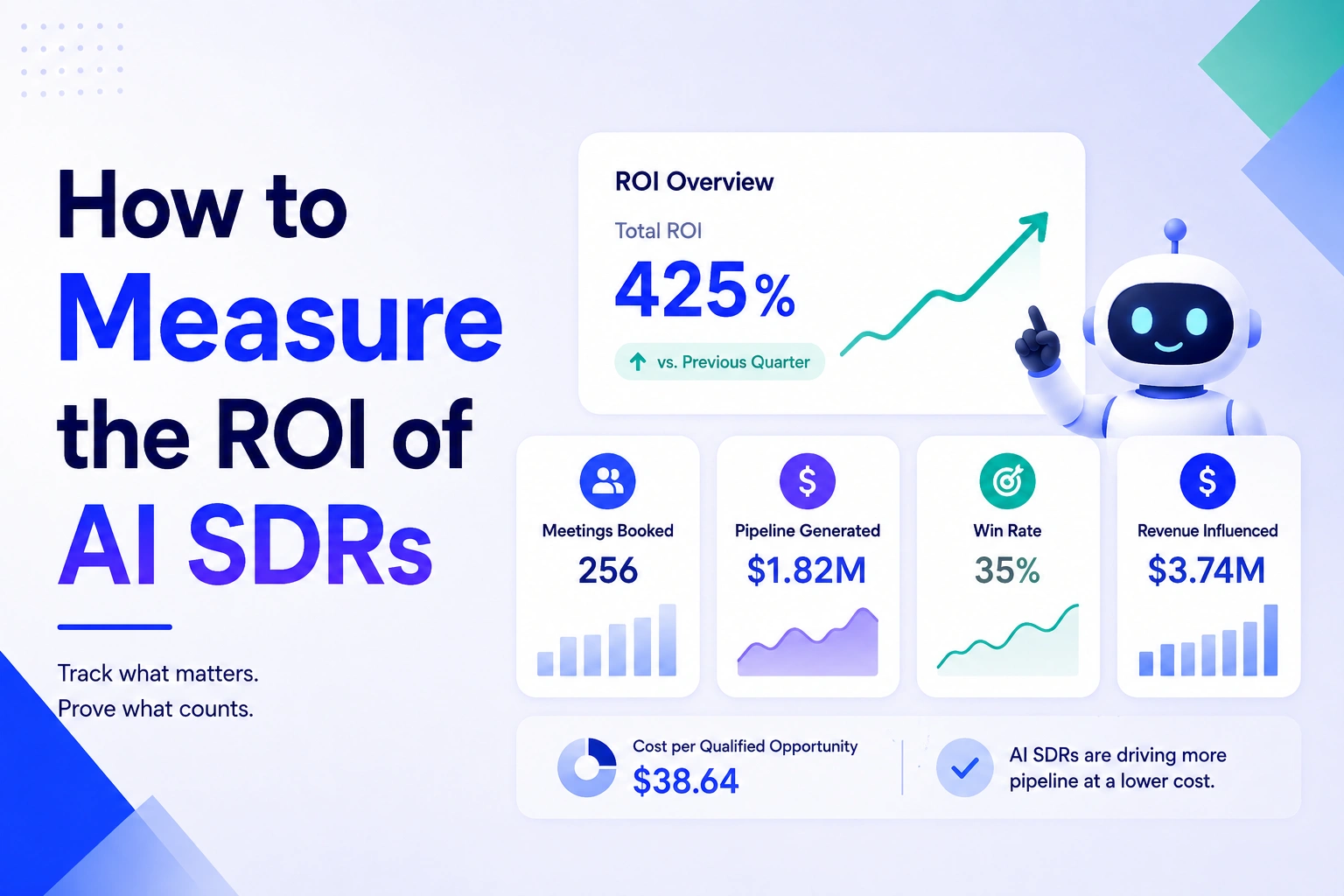
- Cost per qualified opportunity
- Follow-up completion rate
- Time to qualification
These metrics are particularly useful for understanding whether the AI SDR is creating efficiency, even before enough opportunities have progressed to closed revenue.
The important distinction is between activity and outcomes. A system that sends more messages or books more meetings isn't necessarily creating more value.
Don't make meetings booked your final ROI metric. Measure what happens after the meeting.
Ultimately, the strongest measurement chain is:
AI activity → qualified buyers → meetings held → opportunities → pipeline → revenue
How to Calculate AI SDR ROI Step by Step
A credible ROI calculation needs to show what changed because of the AI SDR, not simply report everything the system touched. Use the following process.
Step 1: Establish your baseline
Before implementing an AI SDR, record the metrics for your existing sales motion:
- Leads or conversations handled
- Response time
- Qualification rate
- Meetings held
- Opportunities created
- Pipeline generated
- Revenue generated
- SDR hours spent
- Total sales-development cost
This gives you a reference point for measuring incremental impact. Without a baseline, it's difficult to determine whether improvements came from the AI SDR or from changes in lead volume, messaging, seasonality, staffing, or other parts of the sales process.
Step 2: Calculate the fully loaded AI SDR cost
Don't compare an AI SDR's subscription price directly with an SDR's salary.
Calculate the actual cost of operating the AI SDR:
Platform + data/enrichment + implementation + integrations + oversight + optimization
Include one-time implementation costs where relevant, as well as ongoing human involvement required to monitor and improve the system.
Step 3: Measure what changed
After implementation, compare the same metrics against your baseline.
Before → After
Pay particular attention to:
- Response time
- Qualification rate
- Meetings held
- Opportunities created
- Pipeline generated
- Revenue generated
This shows whether the AI SDR is improving the funnel, rather than simply increasing activity at the top.
Step 4: Calculate incremental value
This is where many AI SDR ROI calculations become misleading. Don't attribute every opportunity or dollar of revenue touched by AI to the AI itself.
Instead, estimate the incremental value created:
Incremental value = Post-AI outcome − Expected baseline outcome
Where possible, strengthen the comparison with:
- Control groups
- Comparable time periods
- AI-assisted vs. human-only workflows
- Matched lead segments
For example, if you would normally generate $500,000 in pipeline from a comparable volume of leads and generate $650,000 after implementing AI, the relevant question is what explains the additional $150,000, not whether the AI interacted with all $650,000.
Step 5: Calculate ROI and payback
Once you have incremental value and fully loaded cost, apply the formula:
ROI = (Incremental value − Total AI SDR cost) ÷ Total AI SDR cost × 100
For example, suppose an AI SDR costs $30,000 annually and contributes to $120,000 in attributable gross profit plus $20,000 in measurable labor savings.
ROI = ($140K − $30K) ÷ $30K × 100 = 367%
That's an illustrative example, not an industry benchmark. Your actual ROI will depend on your sales economics, baseline performance, attribution model, and AI SDR costs.
For a CFO or RevOps team, the final question is straightforward: how much incremental value did the AI SDR create, how much did it cost to create it, and how quickly did the investment pay back?
Don't Confuse More Meetings With Better ROI
An AI SDR can make your sales team look more productive without actually making the sales funnel more valuable.
Consider a simple example:
Before AI
100 meetings → 25 opportunities
After AI
160 meetings → 24 opportunities
The AI SDR generated 60% more meetings, but the number of opportunities actually decreased.
That means the additional activity didn't translate into better pipeline. Activity increased. Pipeline quality didn't.
This is why AI SDR ROI should be measured progressively down the funnel:
Conversations → qualified meetings → opportunities → pipeline → revenue
Early-stage metrics such as response time and conversations handled are useful for diagnosing performance. But opportunities, pipeline, and revenue provide much stronger evidence of commercial impact.
The same principle applies to cost efficiency. A lower cost per meeting isn't necessarily a win if those meetings rarely become opportunities.
The closer you measure to revenue, the stronger your ROI signal becomes.
Measure ROI Differently for Inbound and Outbound AI SDRs
The right ROI metrics depend on where the AI SDR enters your sales motion. Outbound and inbound shouldn't be measured against exactly the same baseline.
For outbound AI SDRs
Focus on:
- Qualified replies
- Meetings held
- Opportunities created
- Pipeline generated
- Revenue generated
- Cost per qualified opportunity
Here, the value often comes from increasing prospecting capacity, improving follow-up consistency, and turning more targeted outreach into qualified opportunities.
For inbound AI SDRs
Focus on:
- Speed-to-lead
- Visitor/conversation-to-qualified rate
- Qualification rate
- Meetings booked and held
- Opportunities created
- Pipeline generated
- Revenue generated
For inbound teams, response speed and qualification can be major value drivers because buyer intent may already exist when someone arrives on the website or starts a conversation. Capturing that intent quickly can prevent qualified buyers from waiting for an available rep.
For inbound-focused teams, platforms such as Knock AI can be evaluated against this same framework by measuring the progression from buyer engagement and qualification through meetings, opportunities, and pipeline.
The key is to measure the AI SDR against the job it was actually hired to do, rather than forcing every sales motion into the same ROI model.
Related: Inbound AI SDR vs Outbound AI SDR: Which One Actually Delivers Results?
When Is an AI SDR Actually Worth the Investment?
An AI SDR is easier to justify when there is enough repeatable sales activity for automation to create measurable leverage. It can be a strong fit when:
- Lead or prospect volume is high
- Speed-to-lead matters
- SDRs spend significant time on repetitive work
- Qualification criteria are reasonably structured
- Follow-up is inconsistent
- There is enough funnel volume to establish a reliable baseline
- Pipeline impact can be measured
The case is weaker when sales volume is extremely low, every opportunity requires extensive human discovery, the ICP is still unclear, or messaging hasn't been validated. Poor CRM or data quality and the absence of a reliable baseline can also make ROI difficult to prove.
The question isn't whether AI SDRs have ROI. It's whether your specific sales bottleneck is expensive enough, repeatable enough, and measurable enough for AI to improve it.
AI SDR ROI Measurement Checklist
Use the same core metrics before and after implementation so you can isolate the impact of the AI SDR.
Before implementation
☐ Current SDR cost
☐ Response time
☐ Qualification rate
☐ Meetings held
☐ Opportunities created
☐ Pipeline and revenue
After implementation
☐ Same funnel metrics
☐ AI operating cost
☐ SDR hours saved
☐ Incremental pipeline
☐ Incremental revenue
☐ Payback period
If you can't measure the baseline, you can't credibly measure the ROI.
Frequently Asked Questions
How do you calculate AI SDR ROI?
Use the formula:
ROI = (Incremental value created − Total AI SDR cost) ÷ Total AI SDR cost × 100
Incremental value can include attributable gross profit, revenue, and measurable labor savings.
What is the most important AI SDR ROI metric?
Qualified opportunities, pipeline, and revenue are more meaningful than activity metrics such as emails sent or meetings booked. Activity metrics help diagnose performance, but they don't prove commercial impact.
How do you calculate the cost of an AI SDR?
Use the fully loaded cost: platform + data/enrichment + implementation + integrations + human oversight + ongoing optimization.
Are AI SDRs actually cheaper than human SDRs?
Not necessarily in every sales motion. Compare the AI SDR's fully loaded operating cost with the comparable cost of human capacity, then evaluate the pipeline and revenue each produces. The goal is better economic output, not simply a lower line-item cost.
Related
Should we build or buy an AI SDR?
Can I try an AI SDR for free?
How long does it take to measure AI SDR ROI?
It depends on your sales volume and sales-cycle length. You need enough data to establish a reliable baseline and enough post-implementation activity for opportunities to progress through the funnel. A high-volume motion may produce meaningful evidence quickly, while a low-volume, enterprise motion may require considerably longer.


.svg)


.svg)
.svg)
.svg)


.svg)
.svg)


.svg)


