AI SDR Platforms With the Lowest Admin Overhead (2026)
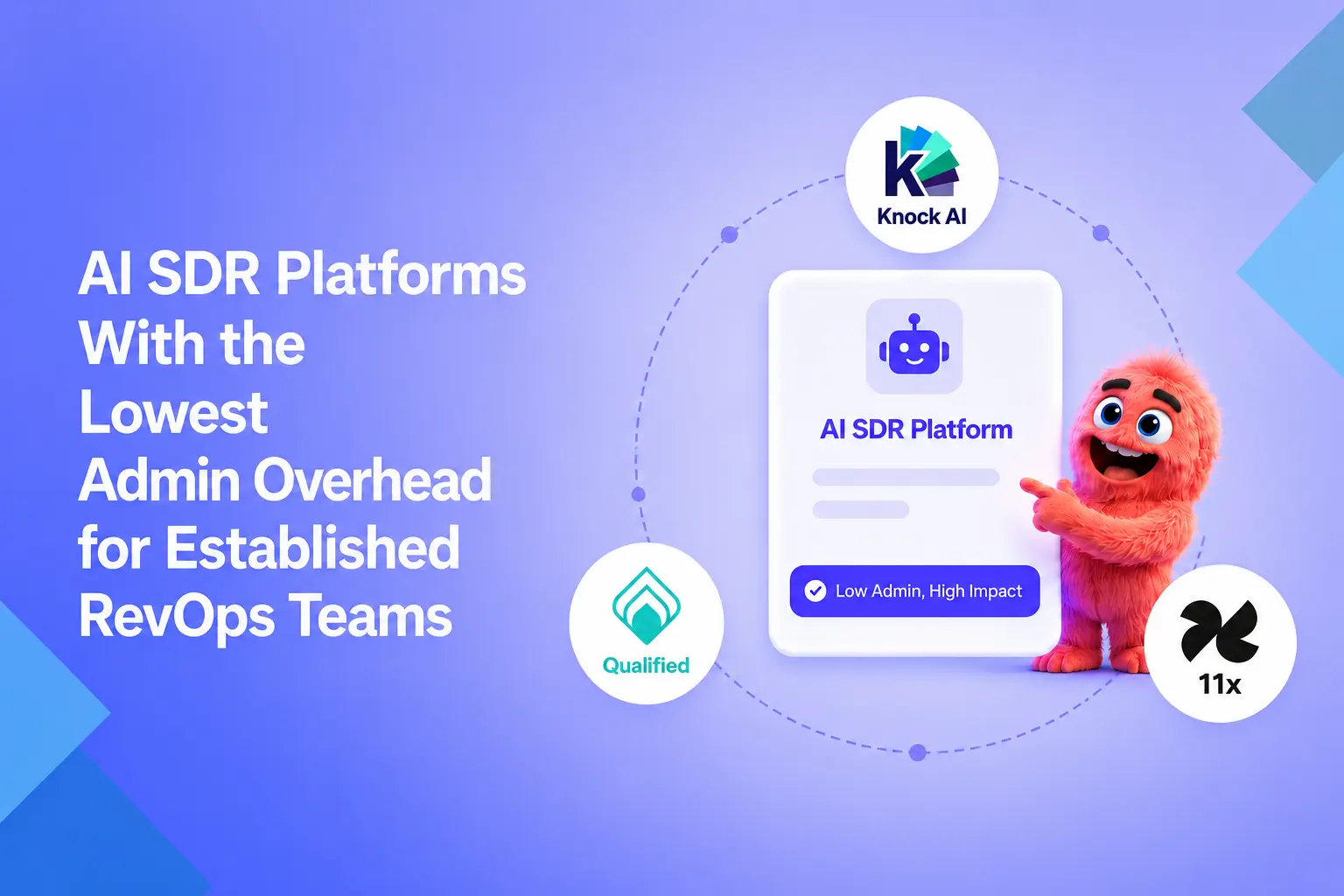
AI SDR Platforms With the Lowest Admin Overhead for Established RevOps Teams
TL;DR
If you're evaluating AI SDR platforms, don't compare them based solely on AI capabilities or the number of features they offer. For established RevOps teams, the bigger question is how much ongoing operational work each platform creates after implementation.
This guide compares Knock AI, Piper, and 11x through the lens of operational load, including CRM maintenance, workflow complexity, governance, routing, AI supervision, and long-term administration.
The goal is simple: help you choose an AI SDR platform that generates more qualified pipeline without creating another system your RevOps team has to manage.
Key Takeaways
If your priority is...
Recommended Platform
Minimize operational overhead and consolidate GTM workflows
Knock AI
Extend conversational marketing with an AI SDR inside the Qualified ecosystem
Piper
Deploy autonomous AI SDR agents for outbound prospecting
11x
Before You Choose an AI SDR Platform
Prioritize operational simplicity over feature count.
Look beyond demos and evaluate the weekly administrative effort required after deployment.
Consider how the platform fits into your existing CRM, routing, reporting, and revenue workflows.
Favor platforms that reduce tool sprawl instead of introducing additional systems to manage.
Remember that AI performance depends on clean CRM data, well-defined workflows, and strong governance.
Who This Guide Is For
This guide is designed for:
Revenue Operations (RevOps) leaders
Sales Operations teams
GTM leaders
Enterprise sales organizations
Revenue teams using Salesforce, HubSpot, or mature CRM environments
Companies evaluating AI SDR platforms while trying to reduce operational complexity
What You'll Learn
By the end of this guide, you'll understand:
What creates admin overhead in AI SDR platforms
Why operational load matters more than feature lists
Which platform is best suited for different RevOps priorities
How to evaluate AI SDR platforms without increasing your team's administrative burden
Bottom Line: The best AI SDR platform isn't the one with the most AI features. It's the one that consistently helps your revenue team generate pipeline while requiring the least ongoing operational effort from RevOps.
Why Admin Overhead Has Become the Hidden Cost of AI SDR Platforms
For years, AI SDR platforms have been evaluated based on how many meetings they can book, how many emails they can send, or how autonomous their AI agents have become. While these capabilities matter, they only tell part of the story.
For established RevOps teams, the real challenge begins after implementation.
Every new AI SDR platform introduces new workflows, routing rules, AI behaviors, CRM integrations, reporting requirements, governance policies, and operational processes that must be monitored over time. Individually, these responsibilities may seem manageable. Together, they create an operational burden that can consume hours of RevOps time every week.
This is one of the biggest reasons AI SDR deployments fail to deliver their expected return on investment. The AI itself often performs as expected, but the surrounding operational complexity continues to grow. As revenue teams evolve, territories change, routing rules require updates, CRM fields expand, AI prompts need refinement, reporting requirements become more sophisticated, and integrations demand ongoing maintenance.
The result is a growing amount of administrative work that rarely appears during the buying process.
This creates an important distinction between sales productivity and RevOps productivity. An AI SDR may help sales representatives spend more time selling, but if it requires RevOps to continuously maintain workflows, troubleshoot integrations, manage governance, and optimize automation, the operational cost can offset much of the productivity gained elsewhere.
Another contributing factor is tool sprawl. Many organizations build their revenue stack by combining separate platforms for visitor identification, intent data, enrichment, AI engagement, lead routing, scheduling, CRM management, and analytics. While each solution may solve a specific problem, every additional platform introduces another integration, another workflow, another reporting layer, and another system that someone must own.
As organizations scale, operational ownership becomes increasingly important. Questions such as Who manages AI prompts? Who updates routing logic? Who owns CRM synchronization? Who maintains governance policies? become just as important as the AI's ability to engage buyers.
Ultimately, the success of an AI SDR platform depends on more than its AI capabilities. It depends on how much ongoing administration is required to keep the entire revenue engine running efficiently.
That's why mature RevOps teams are shifting their evaluation criteria. Instead of asking, "Which AI SDR has the most features?", they're asking, "Which platform delivers results while creating the least operational overhead?"
What Actually Creates Admin Overhead?
Admin overhead rarely comes from a single feature or integration. Instead, it accumulates as revenue teams add more tools, workflows, and operational processes to support AI-driven selling.
While every AI SDR platform promises automation, the amount of work required to manage that automation can vary significantly. Understanding where operational complexity comes from can help RevOps teams evaluate platforms beyond feature lists and marketing claims.
The following areas contribute most to ongoing administrative effort after an AI SDR platform is deployed.
Admin Area
Why It Creates Work
CRM Synchronization
Syncing contacts, accounts, activities, and custom fields across systems requires ongoing maintenance. Changes to your CRM schema, duplicate records, or field mapping issues can quickly create operational friction.
AI Management
AI agents require continuous oversight, including prompt optimization, testing, guardrails, conversation reviews, and performance monitoring to ensure accurate and compliant buyer interactions.
Lead Routing
As territories, ownership rules, and sales structures evolve, routing logic must be updated to ensure leads reach the right representatives without delays or conflicts.
Workflow Automation
Automated workflows often require adjustments as revenue processes, qualification criteria, handoff rules, and customer journeys change over time.
Reporting & Attribution
RevOps teams frequently spend time reconciling data across multiple dashboards to measure pipeline, attribution, meetings, and revenue accurately.
Governance & Compliance
Enterprise organizations need approval workflows, permission controls, audit trails, security policies, and compliance standards that require continuous oversight.
Integrations
Every additional GTM tool introduces another integration to configure, monitor, troubleshoot, and maintain as software ecosystems evolve.
Data Quality
AI performs best with accurate CRM data. Duplicate records, incomplete profiles, inconsistent field values, and outdated information reduce automation effectiveness.
Buyer Journey Changes
Buying behavior evolves constantly. Playbooks, qualification logic, engagement sequences, and AI workflows need regular updates to remain effective.
Change Management
Successful AI adoption depends on documentation, internal training, stakeholder alignment, onboarding, and ongoing user enablement across revenue teams.
Key Insight
Admin overhead rarely comes from one feature. It comes from the number of disconnected systems, workflows, and operational responsibilities your RevOps team has to manage together.
The Bottom Line
The most successful AI SDR implementations don't eliminate operational work entirely. They reduce how much work RevOps teams need to perform to keep revenue operations running smoothly.
That's why mature organizations increasingly evaluate AI SDR platforms based not only on automation capabilities, but also on operational load, the ongoing effort required to maintain workflows, integrations, governance, and AI performance long after implementation is complete.
How We Evaluated These AI SDR Platforms
Rather than comparing AI SDR platforms based on feature lists or marketing claims, we evaluated them from a RevOps perspective. The focus was on the operational effort required to deploy, manage, and scale each platform over time.
Criteria
Why It Matters
CRM Compatibility
Determines how well the platform fits into your existing CRM and revenue workflows.
Weekly Administration
Measures the ongoing time required to manage and optimize the platform.
Workflow Maintenance
Evaluates how much effort is needed to update automations, playbooks, and processes.
Governance & Approvals
Assesses support for permissions, compliance, auditability, and operational control.
AI Supervision
Considers the level of monitoring, prompt management, and performance tuning required.
Lead Routing
Reviews how easily routing rules can be configured, maintained, and scaled.
Reporting
Examines reporting capabilities and the effort needed to measure performance accurately.
Scalability
Evaluates whether the platform can support growing teams and more complex revenue operations.
Operational Complexity
Measures how many systems, workflows, and dependencies RevOps must manage.
Time to Value
Estimates how quickly teams can implement the platform and begin seeing measurable results.
Migration Effort
Assesses the complexity of moving from an existing sales or GTM stack.
Vendor Support
Considers the availability of implementation guidance, documentation, and ongoing customer support.
Note: This comparison focuses on long-term operational efficiency rather than the number of AI features. A platform with fewer administrative requirements often delivers greater value than one with a larger feature set that demands constant maintenance.
This is concise, buyer-focused, and sets up the comparison without any marketing fluff. It also reinforces your article's unique angle: operational efficiency over feature quantity.
AI SDR Platform With the Lowest Admin Overhead
Evaluation Criteria
Knock AI
Piper
11x
Primary Focus
Revenue orchestration across the entire buyer journey
Conversational AI SDR within the Qualified ecosystem
Autonomous AI SDR for outbound prospecting
Best For
Mature RevOps teams reducing GTM tool sprawl
Salesforce organizations already using Qualified
Teams prioritizing autonomous outbound execution
Operational Load
Low
Medium
Medium–High
Weekly RevOps Effort
Low
Medium
Medium–High
CRM Compatibility
Flexible with modern CRM environments
Primarily Salesforce and Qualified ecosystem
Supports major CRMs
AI Supervision Required
Low
Moderate
Moderate–High
Workflow Maintenance
Low
Moderate
Moderate
Lead Routing Complexity
Low
Moderate
Moderate
Implementation Complexity
Moderate
Moderate
Higher
Scalability
High
High
High
Best Fit
Organizations consolidating AI, routing, scheduling, and CRM workflows
Teams extending conversational marketing with AI SDR capabilities
Organizations investing in autonomous AI-driven outbound sales
See Knock AI in Action — Book Your Live Demo Today
Best AI SDR Platform With the Lowest Admin Overhead
Knock AI
Best For: Established RevOps teams looking to consolidate GTM workflows and reduce operational complexity through a unified revenue platform.
Knock AI is a revenue orchestration platform that combines AI-powered buyer engagement, website visitor identification, lead routing, scheduling, CRM enrichment, and workflow automation. Explain that instead of adding another standalone AI SDR to an existing GTM stack, Knock AI brings multiple revenue functions together in a single platform.
Operating Philosophy
Unlike traditional AI SDR platforms that focus primarily on outbound automation, Knock AI is designed to orchestrate the entire buyer journey. It connects anonymous visitor identification, buying intent, AI engagement, qualification, routing, scheduling, and CRM workflows to help revenue teams engage buyers faster while reducing operational complexity.
Core Capabilities
Highlight the platform's major capabilities, including:
AI-powered buyer engagement
Website visitor identification
Buyer intent and lead scoring
Intelligent lead routing
Automated meeting scheduling
CRM enrichment and synchronization
Multi-channel engagement
Revenue orchestration across the buyer journey
Operational Load
One of Knock AI's biggest differentiators is its focus on reducing operational overhead. By consolidating multiple GTM workflows into a single platform, RevOps teams spend less time maintaining integrations, troubleshooting disconnected systems, updating routing logic, and managing overlapping workflows. This reduces administrative effort while improving operational visibility across the revenue organization.
Strengths
Unified platform reduces GTM tool sprawl.
Built for modern RevOps teams rather than individual sales reps.
Strong workflow automation across the buyer journey.
Intelligent routing and scheduling reduce manual coordination.
Flexible CRM integration with modern revenue operations.
Limitations
May offer more functionality than smaller organizations currently require.
Organizations seeking only a standalone outbound AI SDR may not use the platform's broader revenue orchestration capabilities immediately.
Teams migrating from multiple legacy systems may require implementation planning.
Best Fit
Knock AI is best suited for mid-market and enterprise organizations with mature RevOps functions that want to consolidate multiple GTM tools, improve operational efficiency, and reduce the administrative burden associated with managing disconnected revenue systems.
Piper
Best For: Salesforce organizations using Qualified that want to extend conversational marketing with AI-powered SDR capabilities.
Piper is Qualified's AI SDR, built to automate buyer conversations, qualification, and meeting booking directly from website interactions. It extends Qualified's conversational marketing platform by adding AI-driven engagement that helps revenue teams respond to buyers faster while leveraging existing Salesforce data.
Operating Philosophy
Piper focuses on conversational selling. Rather than operating as a fully autonomous outbound AI SDR, it engages inbound website visitors, qualifies buying intent, answers questions, and books meetings within the Qualified ecosystem. Its value is strongest for organizations already invested in Qualified and Salesforce.
Core Capabilities
Include features such as:
AI-powered website conversations
Buyer qualification
Automated meeting scheduling
Real-time visitor engagement
Salesforce integration
Piper X enhancements for AI-driven engagement
Operational Load
For organizations already using Qualified, Piper can be a natural extension of existing workflows. However, RevOps teams should still consider governance, workflow maintenance, CRM administration, and ecosystem dependency when evaluating long-term operational overhead.
Strengths
Native experience for Qualified customers.
Strong Salesforce integration.
Excellent for inbound website engagement.
AI-assisted buyer qualification.
Fast meeting booking from website conversations.
Limitations
Best suited for organizations already invested in the Qualified ecosystem.
Less focused on end-to-end revenue orchestration across multiple GTM workflows.
Operational complexity may increase as organizations expand beyond conversational marketing.
Best Fit
Piper is a strong option for Salesforce-first organizations already using Qualified that want to extend conversational marketing with AI while maintaining familiar workflows.
11x
Best For: Organizations looking to automate outbound prospecting with autonomous AI SDR agents.
11x positions itself around autonomous AI employees capable of handling outbound prospecting, lead engagement, and sales development activities with minimal human involvement. The platform focuses on helping organizations scale outbound operations through AI-driven execution.
Operating Philosophy
Rather than supporting sales representatives, 11x aims to automate many traditional SDR responsibilities through autonomous AI agents. This approach emphasizes independent execution while allowing human teams to focus on higher-value conversations.
Core Capabilities
Include capabilities such as:
Autonomous AI SDR agents
Multi-channel outbound engagement
Prospect research
Personalized outreach
CRM synchronization
Automated follow-up workflows
Operational Load
Autonomous AI can significantly improve productivity, but it also introduces governance, monitoring, AI supervision, and workflow management responsibilities. RevOps teams should evaluate how much ongoing oversight is required to ensure AI behavior remains accurate, compliant, and aligned with evolving sales processes.
Strengths
Strong focus on autonomous outbound execution.
Reduces manual prospecting effort.
Supports scalable outbound sales operations.
AI-driven engagement across multiple channels.
Designed for organizations embracing AI-first sales development.
Limitations
Autonomous systems typically require ongoing governance and operational oversight.
Success depends heavily on CRM quality and well-defined sales processes.
Organizations may need dedicated RevOps resources to monitor and optimize AI performance over time.
Best Fit
11x is best suited for organizations that prioritize autonomous outbound sales development, have established RevOps processes, and are prepared to manage the governance and operational oversight that comes with AI-driven sales execution.
Why Unified Revenue Platforms Create Less Admin Work
Most discussions about AI SDR platforms focus on features, automation, or AI capabilities. In practice, however, much of a RevOps team's workload comes from managing the systems surrounding the AI rather than the AI itself.
In a traditional GTM stack, each stage of the buyer journey is often handled by a separate platform. One tool identifies anonymous website visitors, another surfaces buying intent, another powers AI conversations, another routes qualified leads, another schedules meetings, and another manages CRM data and reporting.
While each platform may perform its individual task well, every additional system introduces another integration, another workflow, another reporting layer, and another set of configurations that must be maintained over time.
As the business grows, so does the operational effort. RevOps teams become responsible for updating routing rules, maintaining integrations, synchronizing CRM data, managing permissions, troubleshooting workflow failures, and ensuring every platform continues to work together. The AI may automate selling, but the operational complexity often remains manual.
This is why many mature revenue organizations are shifting away from point solutions and toward unified revenue platforms.
Rather than connecting multiple independent systems, unified platforms bring buyer identification, AI engagement, lead qualification, routing, scheduling, CRM synchronization, and reporting into a single operational workflow. Fewer systems generally mean fewer integrations to maintain, fewer workflows to troubleshoot, and fewer handoffs between disconnected tools.
The result isn't simply operational efficiency. It also improves data consistency, reduces administrative overhead, and gives RevOps teams better visibility into the entire buyer journey from the first website visit through to pipeline creation.
This architectural approach is one reason platforms like Knock AI stand out. Instead of functioning as another standalone AI SDR, Knock AI is designed as a unified revenue platform that connects buyer identification, intent signals, AI engagement, intelligent routing, meeting scheduling, and CRM workflows in one system. By reducing the number of disconnected tools involved in revenue operations, teams can spend less time maintaining technology and more time improving pipeline performance.
That doesn't mean every organization needs a unified platform. Companies with simple sales motions or lightweight GTM stacks may find that a standalone AI SDR is sufficient for their current needs. However, for established RevOps teams managing complex workflows across multiple systems, reducing operational complexity often delivers greater long-term value than adding another specialized tool.
Key Takeaway: The lowest-admin AI SDR isn't always the one with the most automation. It's often the platform that eliminates the need to manage multiple disconnected systems in the first place.
Questions Every RevOps Team Should Ask Before Buying an AI SDR Platform
The right AI SDR platform should improve revenue operations, not create more work for your RevOps team. Before making a decision, evaluate each platform against the questions below.
Does the platform align with your CRM strategy?
Your CRM is the foundation of your revenue operations. Make sure the AI SDR integrates cleanly with your existing CRM, supports your data model, and doesn't require duplicate workflows or manual data synchronization.
How much ongoing administration will it require?
Implementation is only the beginning. Ask how many hours your RevOps team will spend each week managing routing rules, workflows, AI behavior, integrations, reporting, and ongoing optimization.
Will it replace existing tools or add another layer to your GTM stack?
Some platforms consolidate multiple revenue functions, while others introduce another application that must integrate with your existing tools. Consider whether the platform simplifies your technology stack or increases operational complexity.
Will your sales team actually use it?
Even the most capable AI SDR platform delivers little value if adoption is low. Look for solutions that fit naturally into existing sales workflows and require minimal disruption to day-to-day operations.
Does the AI automate execution or simply provide recommendations?
Some platforms actively engage buyers, qualify leads, and automate workflows. Others primarily surface insights that still require manual action. Understand how much work the AI actually eliminates.
How much routing and workflow maintenance is required?
As territories, ownership rules, and qualification criteria evolve, routing logic will need updates. Evaluate how easy it is to manage these changes without creating additional administrative work.
How complex will migration be?
Moving from an existing GTM stack often involves CRM mapping, workflow recreation, user training, and system testing. A platform with a straightforward implementation process typically delivers value faster.
Does it meet your governance and compliance requirements?
Enterprise organizations should evaluate permission controls, audit logs, approval workflows, and compliance capabilities to ensure the platform aligns with internal governance policies.
Can it scale with your business?
Choose a platform that can support future growth without requiring a complete rebuild of your revenue operations. Scalability should include users, workflows, territories, integrations, and reporting.
How quickly can your team realize value?
A platform should produce measurable business outcomes within a reasonable implementation period. Consider both the initial deployment effort and the ongoing operational investment required to maintain long-term performance.
Decision Tip: Don't choose the AI SDR platform with the longest feature list. Choose the one that aligns with your RevOps strategy, reduces operational complexity, and continues delivering value as your business grows.
Which Teams Should Prioritize Low Admin Overhead?
Not every organization needs to optimize for operational complexity. For smaller sales teams with straightforward workflows, a standalone AI SDR may be sufficient. However, as revenue operations become more sophisticated, reducing administrative overhead becomes a strategic priority.
You should prioritize platforms with low operational overhead if your organization has:
An established RevOps or Sales Operations team.
A mature Salesforce or HubSpot environment with complex workflows.
Multiple sales teams, territories, or business units.
Several GTM tools that require ongoing integration and maintenance.
Global or distributed sales organizations.
A strategy focused on consolidating GTM technology.
Plans to scale pipeline without proportionally increasing RevOps headcount.
On the other hand, early-stage startups or organizations with a simple sales motion may not yet benefit from a unified revenue platform. If your GTM stack consists of only a CRM and a few sales tools, the operational burden is naturally lower, making a standalone AI SDR a practical option.
As revenue operations grow, however, minimizing operational complexity often becomes just as important as increasing sales productivity.
When More AI Features Actually Create More Work
More AI capabilities don't automatically translate into less work for RevOps.
Every new AI feature has the potential to introduce additional operational responsibilities. AI prompts require refinement, workflows evolve as sales processes change, governance policies must be maintained, reports need validation, and integrations require continuous monitoring. As organizations adopt multiple AI tools, operational ownership becomes increasingly fragmented.
Administrative work often grows in areas such as:
Prompt optimization and testing.
Managing multiple AI agents.
Updating workflows and automations.
Governance and compliance oversight.
Cross-platform reporting.
Integration maintenance.
User onboarding and change management.
This doesn't mean advanced AI platforms should be avoided. It simply means organizations should evaluate whether each new capability reduces operational work or creates another process that RevOps must maintain.
The most valuable AI platform isn't necessarily the one with the longest feature list. It's the one that consistently automates meaningful work while minimizing ongoing administration.
The Shift From AI SDRs to Revenue Orchestration
AI SDRs have traditionally focused on automating a single stage of the revenue process, such as prospecting, outreach, or buyer conversations. While these capabilities remain valuable, many enterprise revenue teams are expanding their focus beyond individual automation tools.
Today's buying journeys involve multiple touchpoints across marketing, sales, customer success, and RevOps. Buyer intent, AI engagement, lead routing, meeting scheduling, CRM synchronization, and reporting all influence how efficiently revenue teams convert demand into pipeline.
As a result, many organizations are moving toward connected revenue execution rather than adding more standalone tools.
Instead of evaluating AI SDR platforms solely on their ability to automate outreach, mature RevOps teams increasingly ask broader questions:
Can this platform reduce operational complexity?
Can it simplify our GTM architecture?
Can it eliminate disconnected workflows?
Can it support the entire buyer journey from intent to booked meeting?
Platforms built around revenue orchestration are designed to connect these workflows into a single operating model, helping RevOps teams spend less time managing technology and more time improving revenue performance.
Many mature RevOps teams are no longer evaluating standalone AI SDRs in isolation. They're evaluating which platform can reduce operational complexity while orchestrating the entire buyer journey.
Which Platform Is Right for Your RevOps Team?
The best platform depends on your revenue strategy, existing technology stack, and operational priorities. Rather than choosing the platform with the most features, choose the one that aligns with how your RevOps team operates today and how you expect it to scale in the future.
If your priority is...
Recommended Platform
Reduce GTM tool sprawl and minimize ongoing operational overhead
Knock AI
Extend Salesforce-based conversational marketing with AI
Piper
Deploy autonomous AI SDR agents for outbound prospecting
11x
If your goal is to simplify revenue operations and consolidate multiple GTM workflows, a unified revenue platform like Knock AI may provide the greatest long-term operational efficiency.
If your organization already relies on Qualified and Salesforce for conversational marketing, Piper offers a natural path to AI-powered buyer engagement.
If autonomous outbound sales development is your primary objective, 11x is built around AI agents capable of handling prospecting and engagement at scale.
The right decision isn't about choosing the platform with the most AI. It's about choosing the platform that supports your revenue strategy while creating the least operational burden for your RevOps team.
Reduce Admin Work, Not Just Manual Work
Choosing an AI SDR platform isn't simply about automating outreach. It's about deciding how much operational complexity your RevOps team will manage over the next several years.
Some platforms excel at specific tasks, while others simplify the entire revenue workflow. As your GTM strategy grows, the long-term cost of disconnected tools, manual integrations, and ongoing administration often outweighs the value of individual features.
If your goal is to reduce operational overhead while improving buyer engagement, look beyond AI capabilities alone. Evaluate how each platform fits into your CRM strategy, supports your revenue processes, and scales with your business.
For organizations that want to consolidate buyer identification, AI engagement, routing, scheduling, and CRM workflows into a single connected system, Knock AI is a compelling choice. By reducing GTM tool sprawl and simplifying revenue operations, it helps RevOps teams spend less time managing technology and more time generating pipeline.
Frequently Asked Questions
What is admin overhead in an AI SDR platform?
Admin overhead refers to the ongoing operational work required to manage an AI SDR platform, including workflow updates, routing changes, CRM synchronization, integrations, reporting, governance, and AI optimization.
Why does admin overhead matter for RevOps teams?
High administrative effort increases operational costs, slows execution, and requires additional RevOps resources. Platforms with lower operational overhead are generally easier to scale and maintain over time.
Are unified revenue platforms better than standalone AI SDRs?
It depends on your GTM strategy. Standalone AI SDRs can work well for simpler environments, while unified revenue platforms often reduce operational complexity for organizations managing multiple GTM tools and workflows.
Which AI SDR platform has the lowest admin overhead?
There isn't a universal answer, as requirements vary by organization. However, platforms designed around unified revenue workflows, such as Knock AI, generally require less ongoing administration than stacks built from multiple point solutions.
Should small businesses prioritize low admin overhead?
Small teams with simple sales processes may not need a unified platform immediately. As operations become more complex, reducing administrative overhead becomes increasingly important for maintaining efficiency and supporting growth.


.svg)


.svg)
.svg)
.svg)


.svg)
.svg)


.svg)