ZoomInfo Review (2026): Features, Pricing, Data Quality, and Whether It’s Worth It
TL;DR
What is ZoomInfo? A B2B go-to-market intelligence platform for contact discovery, company research, buyer intent, sales engagement, and marketing.
ZoomInfo Pricing: Pricing is customized, with reported annual contracts ranging from around $15,000 to $60,000 or more.
Best features: Extensive B2B contact data, advanced prospecting filters, buyer intent signals, AI-assisted selling, and account-based marketing.
Main Zoominfo drawbacks: Inaccurate contact data, broad intent signals, expensive subscriptions, workflow reliability concerns, and mixed customer feedback on support.
ZoomInfo vs. Knock AI: ZoomInfo excels at contact discovery and outbound prospecting, while Knock AI focuses on turning buyer intent into qualified conversations, meetings, and pipeline.
Best alternative to ZoomInfo:Knock AI connects buyer identification, real-time enrichment, first-party intent, AI-led qualification, routing, engagement, and conversion tracking.
Our verdict: ZoomInfo is a strong choice for teams that need extensive B2B data and outbound prospecting capabilities. If your priority is acting on buyer intent, converting demand, and generating pipeline rather than simply acquiring contact lists, Knock AI is worth evaluating.
What Is ZoomInfo?
Imagine you're a sales rep trying to reach the VP of Marketing at a fast-growing SaaS company. You know the type of business you want to sell to, but you don't know who's responsible for buying, how to contact them, or whether their company is actively looking for a solution like yours.
Now imagine having a database that helps you find the right people, access their professional contact details, identify companies showing buying intent, and launch outreach without researching every prospect manually.
That's the problem ZoomInfo is built to solve.
ZoomInfo is a B2B go-to-market intelligence and software platform that helps sales, marketing, operations, and recruiting teams find business contacts, research companies, identify potential buyers, and turn that information into actionable workflows. Its platform combines business and contact data with tools for sales engagement, account-based marketing, website visitor identification, conversation intelligence, data enrichment, and AI-assisted selling.
But here's where things get interesting: ZoomInfo isn't just a tool that sales teams use to find email addresses. Its broader goal is to help businesses understand who to target, when to engage them, and how to move them toward a sale.
And if you've ever wondered how ZoomInfo knows your name, work email, job title, or employer, you're not alone. That question gets to the heart of how its data business operates.
What Does ZoomInfo Actually Do?
At its core, ZoomInfo helps businesses answer three questions: Who should we target? What do we know about them? And how do we reach them?
Here's how its platform supports those tasks.
Find business contacts: Search for professionals by job title, department, seniority, company, industry, location, and other criteria to build targeted prospect lists.
Research companies: Access company information such as industry, size, location, technologies, and available business intelligence to identify potential customers.
Identify buying signals: Use buyer intent and other available signals to find companies researching topics relevant to your product.
Automate sales outreach: Support prospecting and engagement workflows through sales automation and AI-assisted tools.
Identify website visitors: Use website visitor tracking to understand which companies or identifiable professionals are visiting your site.
Improve CRM data: Enrich business records, update contact information, and support data quality and routing workflows.
Support marketing and recruiting: Build account-based marketing audiences, support targeted campaigns, and find potential candidates.
ZoomInfo also offers products for conversation intelligence, website chat, workflow orchestration, and AI-assisted go-to-market execution. The exact capabilities available depend on the products and services a business purchases.
In short, ZoomInfo connects business intelligence with the tools teams use to act on it. Instead of researching prospects in one place, managing outreach in another, and updating CRM records separately, businesses can use its platform to connect more of those activities.
How Did ZoomInfo Get My Data?
This is one of the most common questions people have when they discover their professional profile on ZoomInfo. You might never have created a ZoomInfo account, yet the platform could still list your name, job title, company, work email, or business phone number.
So, where did that information come from?
According to ZoomInfo's privacy policy, the company collects business contact information from multiple sources, including public and proprietary sources, information provided by users and customers, and information gathered from the web. Its data engine processes information from millions of sources, matches records to companies and people, and uses automated systems and human review to clean and update its database.
For example, your professional information might be available because:
Your company published it: Your employer's website may list your name, role, work email, or contact details.
You have a public professional profile: Information from professional networking profiles and other publicly available pages may contribute to your professional profile.
Your details appear in business records: Company websites, directories, press releases, and other business sources can contain information about employees and executives.
A business contact or customer supplied information: Information shared by users and customers may contribute to the database.
ZoomInfo combined information from multiple sources: Data matching can connect details from different records to build a more complete professional profile.
The important thing is that your information can appear on ZoomInfo without you having signed up for the platform or directly given your details to ZoomInfo. Its business model involves compiling professional information so that other businesses can use it for B2B sales, marketing, and recruiting.
That also means a profile isn't necessarily complete or accurate. People change jobs, companies update their websites, and contact details become outdated. A profile can contain information that is incorrect, incomplete, or associated with the wrong person.
ZoomInfo provides a Trust Center where individuals can request access to their information, claim or correct a profile, and submit an opt-out or deletion request. The precise rights and process can depend on your location and applicable privacy laws.
How Did My Information Get on ZoomInfo?
If you're asking this because you found your own profile, it's worth understanding the difference between collecting information and having a direct relationship with the person it describes.
ZoomInfo's privacy policy explains that it creates professional profiles from information collected through its data-gathering processes. It then makes relevant business information available to customers seeking contacts for professional purposes.
That means you may not have knowingly provided information to ZoomInfo at all. Your work email could have appeared on a company website, your job title might have been listed in a public directory, or your details could have been included in information supplied by another business.
ZoomInfo may combine these details with other available records to build a profile. This process is commonly described as data aggregation and identity matching.
There are two things worth keeping in mind.
First, publicly accessible information isn't automatically accurate, unrestricted, or exempt from privacy laws. The rules governing collection and use depend on the type of information, jurisdiction, and circumstances.
Second, finding a profile doesn't necessarily mean someone has purchased your information or contacted you through ZoomInfo. It means the information is present in its database and may be available to eligible customers under its services and policies.
If you don't want your professional information listed, start with ZoomInfo's Privacy Center. You can review its current options for accessing, correcting, or removing your information.
Where Is ZoomInfo Based?
ZoomInfo is headquartered in Vancouver, Washington, United States. The company also maintains offices in other locations in the United States and internationally.
Its corporate headquarters are listed in the company's annual report and official investor materials.
Who Is ZoomInfo Owned By?
ZoomInfo is operated by ZoomInfo Technologies Inc., a publicly traded company listed on the Nasdaq stock exchange under the ticker symbol GTM.
That means ZoomInfo isn't owned exclusively by one private individual or a single private equity firm. Its ownership is distributed among shareholders, including institutional investors, other investors, and company insiders who hold shares.
The company's history is closely connected to its founder, Henry Schuck, and to DiscoverOrg, the business he co-founded before it acquired Zoom Information in 2019 and adopted the ZoomInfo name.
ZoomInfo went public in 2020, allowing investors to buy and sell its shares on the public market.
Who Is the CEO of ZoomInfo?
Henry Schuck is the founder and CEO of ZoomInfo. He co-founded DiscoverOrg in 2007 and led the business through its expansion from a B2B data provider into a broader go-to-market intelligence and software platform.
The company's growth strategy has involved combining its business data foundation with software for sales, marketing, operations, and recruiting. Its acquisition of Zoom Information in 2019 brought the two businesses together under the ZoomInfo brand.
Schuck has also been closely associated with the company's founder-led approach to growth and its eventual public listing in 2020.
Can ZoomInfo Be Trusted?
The answer depends on what you mean by trust.
ZoomInfo is an established, publicly traded B2B software company, and its products are used by businesses for sales intelligence, prospecting, marketing, and related workflows. But that doesn't mean every contact record is correct or that every data collection practice will meet every person's expectations.
There are three separate considerations.
1. Data accuracy
ZoomInfo aggregates information from many sources and uses automated processing, matching, and verification to maintain its database. Even so, business contact data can become outdated or mismatched. Companies evaluating the platform should verify a sample of records in their target market before relying on the data at scale.
2. Privacy and data collection
ZoomInfo collects and provides professional information for business purposes. Some people are uncomfortable discovering their information in a database they never knowingly joined. ZoomInfo publishes a privacy policy and offers ways to access, correct, or opt out of its database, but the legal requirements and available rights vary by jurisdiction.
3. Customer experience and contracts
Customer reviews can help prospective buyers assess usability, integrations, support, data quality, and overall value. They can also reveal issues that won't be obvious from a product demo. However, individual reviews are not conclusive proof of the platform's overall performance.
Our recommendation is to evaluate ZoomInfo against your actual needs. Test contact accuracy, confirm integrations, understand how data can be used, and carefully review subscription commitments and renewal terms before signing a contract.
What Is ZoomInfo's Revenue?
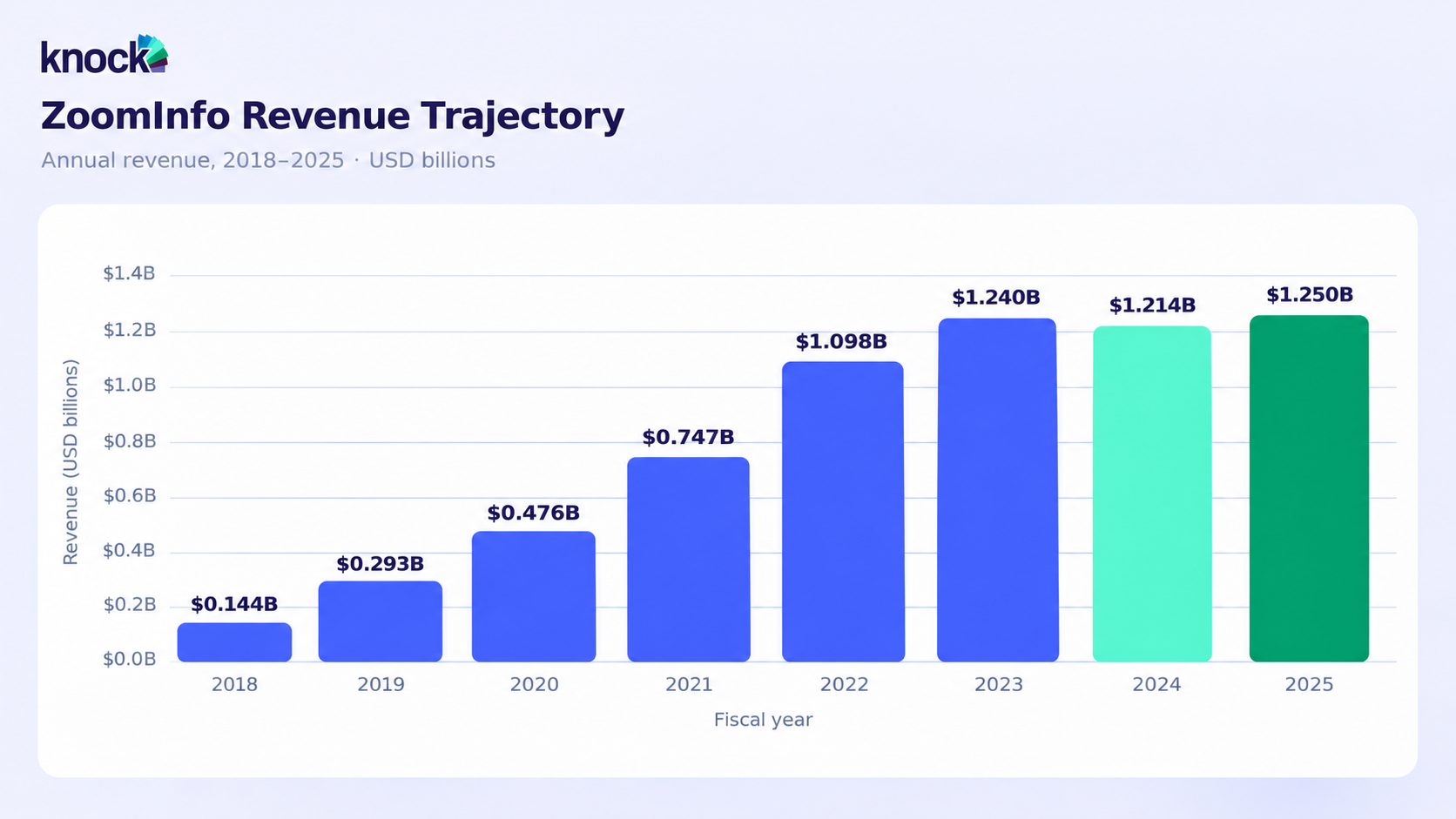
ZoomInfo generated $1.2495 billion in revenue in fiscal year 2025, according to its annual report filed with the U.S. Securities and Exchange Commission (SEC).
ZoomInfo's revenue grew significantly between 2018 and 2023, crossing the $1 billion mark in 2022. Growth then slowed, with revenue declining in 2024 before recovering modestly in 2025.
Fiscal year
Reported revenue
2023
$1.2395 billion
2024
$1.2143 billion
2025
$1.2495 billion
Revenue increased approximately 2.9% in 2025 compared with 2024, bringing the company slightly above its 2023 revenue level. However, the recovery remains modest compared with the rapid growth ZoomInfo recorded in earlier years.
ZoomInfo generates substantially all its revenue through subscriptions to its platform. Subscription pricing can depend on factors such as product functionality, users, and records under management.
Revenue gives you a sense of ZoomInfo's business scale, but it doesn't tell you whether the platform is worth the investment for your team. That depends on the accuracy and relevance of its data, the workflows you need to support, and the value your sales and marketing teams can generate from using it.
Has ZoomInfo Raised Funding?
ZoomInfo's funding story is different from that of a typical startup that raises successive venture capital rounds.
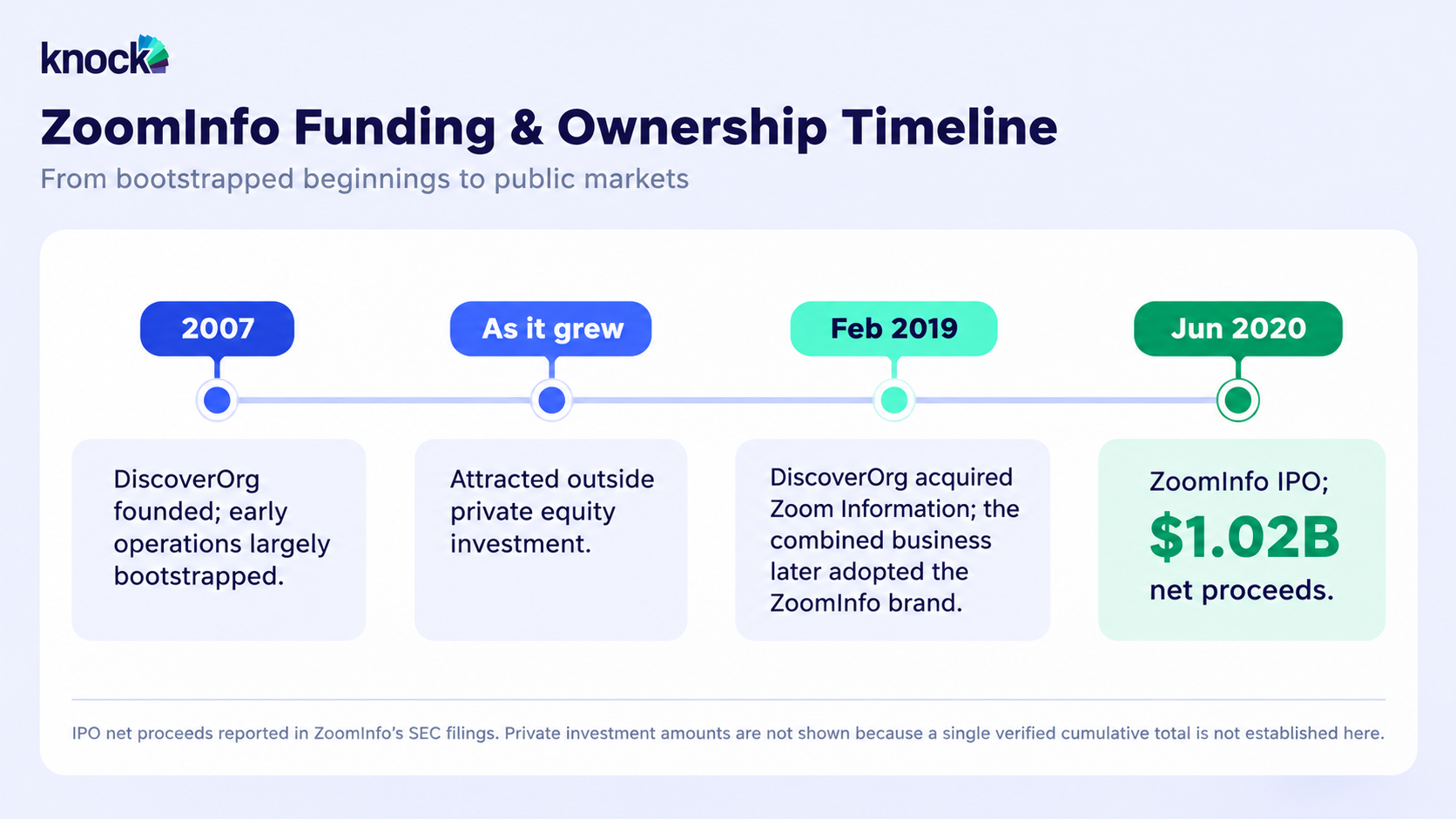
Henry Schuck and Kirk Brown co-founded DiscoverOrg in 2007. Schuck has described its early operations as largely bootstrapped, with the business later attracting outside private equity investment as it grew.
In February 2019, DiscoverOrg acquired Zoom Information, Inc., bringing the two businesses together under what would become the ZoomInfo brand. The next major milestone came in June 2020, when ZoomInfo completed its initial public offering (IPO).
The IPO raised approximately $1.02 billion in net proceeds, after underwriting discounts, according to the company's SEC filings. The company sold shares at $21 each.
ZoomInfo's funding history is best understood through these milestones rather than a single cumulative funding figure. Its early private investment, the 2019 acquisition, and the 2020 IPO represent different types of financial events, so they should not be added together as if they were equivalent funding rounds.
Today, ZoomInfo is publicly traded on Nasdaq under the ticker GTM. For details about its current debt, share ownership, and financing arrangements, consult the company's SEC filings.
How Does ZoomInfo Work?
ZoomInfo combines business contact data, company intelligence, buying signals, and sales technology to help businesses identify potential customers and engage them more effectively.
At its core, the platform collects information from public and proprietary sources, then uses artificial intelligence (AI), machine learning (ML), and human review to standardize, match, and improve the quality of its data. This information is organized into company and professional profiles that sales, marketing, and recruitment teams can use for their respective needs.
Rather than functioning as just a database of business contacts, ZoomInfo combines this underlying data with tools for identifying potential buyers, understanding company activity, enriching existing records, and connecting insights to sales and marketing workflows.
The platform also integrates with other business systems, allowing teams to incorporate its data and intelligence into their existing processes.
In the following sections, we'll look at ZoomInfo's main products and features, what they do, and how businesses can use them.
ZoomInfo Products and Solutions
ZoomInfo offers several products for sales, marketing, recruiting, and revenue operations teams. Some help individual reps find prospects and move deals forward, while others help marketing teams run account-based campaigns or give RevOps teams the infrastructure to maintain data quality and automate go-to-market workflows.
The product lineup includes traditional data and intelligence tools alongside newer AI workspaces and orchestration products. Here's how the main offerings compare.
ZoomInfo's Main Products
Product
What it does
Who it's for
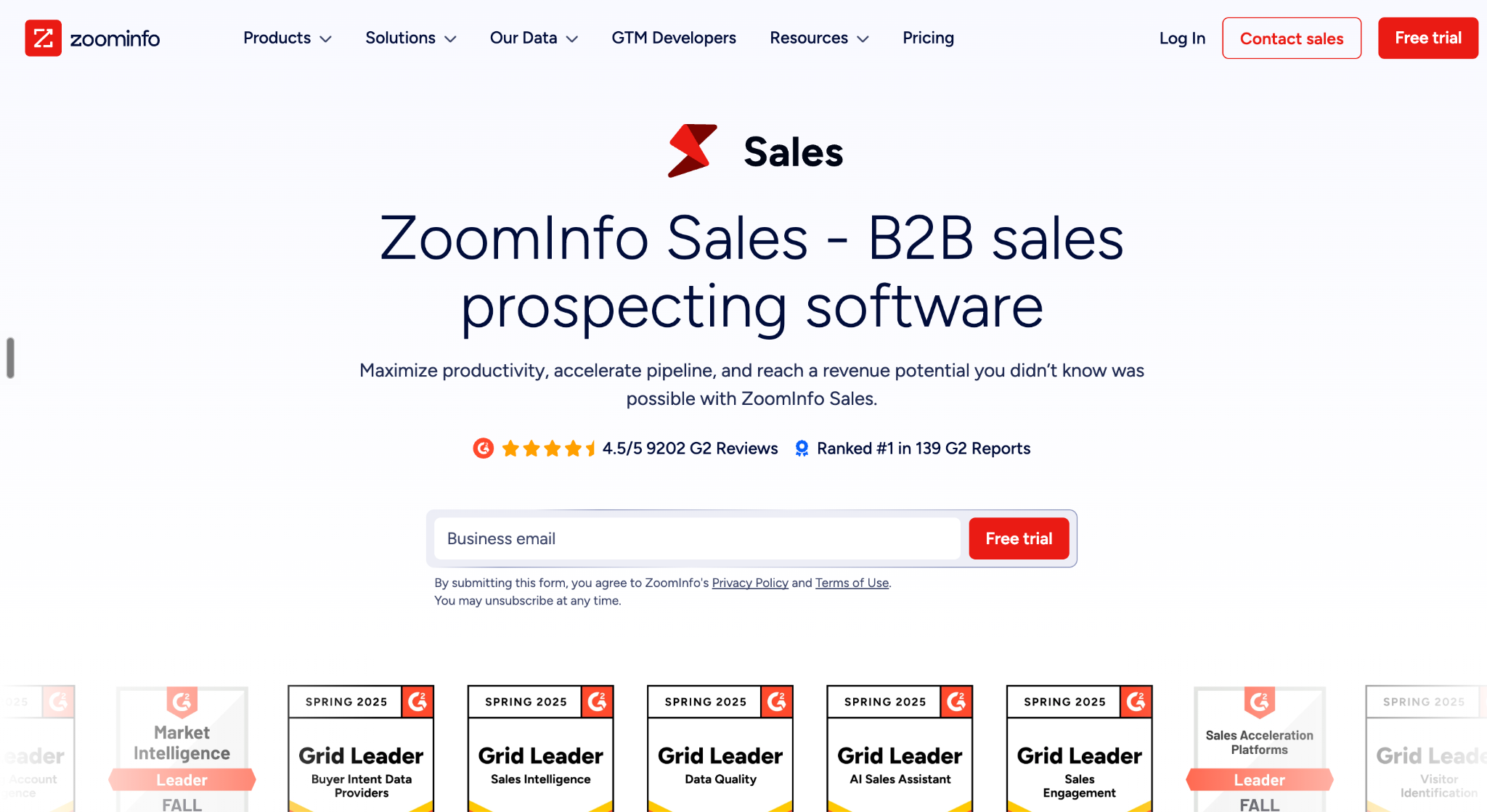
ZoomInfo Sales
Provides business contact and company data, prospecting filters, buyer intent, and sales intelligence to help teams identify and prioritize potential customers.
Uses ZoomInfo's data and buying signals to help sellers prioritize accounts, identify decision-makers, prepare for meetings, personalize outreach, and manage follow-ups.
SDRs, BDRs, AEs, and sales leaders who want AI-assisted prospecting and selling.
GTM Workspace
Combines CRM records, buying signals, account research, call context, and AI-generated briefs in a workspace for managing accounts and opportunities.
AEs, account managers, customer-facing revenue teams, and sales leaders managing complex deals or account growth.
GTM Studio
Connects data sources and supports go-to-market workflows, enrichment, audience building, scoring, routing, and campaign activation.
Helps maintain data quality through enrichment, deduplication, standardization, CRM management, and routing workflows.
RevOps, sales operations, marketing operations, CRM administrators, and data teams.
ZoomInfo Talent
Provides professional data and sourcing intelligence to help recruiters discover candidates, research talent pools, and find relevant contact information.
Corporate recruiters, talent acquisition teams, staffing agencies, and recruiting operations.
Talent Autopilot
Uses an AI recruiting agent to discover candidates from natural-language job descriptions, explain candidate matches, and prepare personalized outreach for recruiter approval.
Recruiters and talent acquisition teams looking to reduce manual candidate sourcing.
Data as a Service (DaaS)
Delivers business data and data services to an organization's existing systems, helping align records across CRM, marketing, analytics, and other tools.
Enterprise data teams, RevOps, data engineering, and organizations with large-scale data requirements.
ZoomInfo MCP / GTM.AI
Makes ZoomInfo's B2B data and intelligence accessible through APIs and Model Context Protocol (MCP), allowing supported AI agents and applications to use that context.
Developers, AI engineering teams, GTM engineers, and enterprises building AI agents or custom workflows.
See Knock AI in Action — Book Your Live Demo Today
The table gives you the overview, but a few products deserve a closer look because they serve distinctly different needs.
1. ZoomInfo Sales: For Finding and Contacting Prospects
ZoomInfo Sales is the core option for teams that need to identify companies, find the right decision-makers, and obtain business contact information for outbound prospecting.
Sales reps can build targeted lists using company characteristics, job titles, technologies, and other attributes. Buyer intent and company signals can add context to those lists, helping reps prioritize which accounts to research or contact.
Best for: SDRs and BDRs building outbound pipelines, AEs researching prospective accounts, and sales managers supporting prospecting at scale.
If your primary problem is finding relevant B2B contacts and getting in touch with them, start by evaluating ZoomInfo Sales.
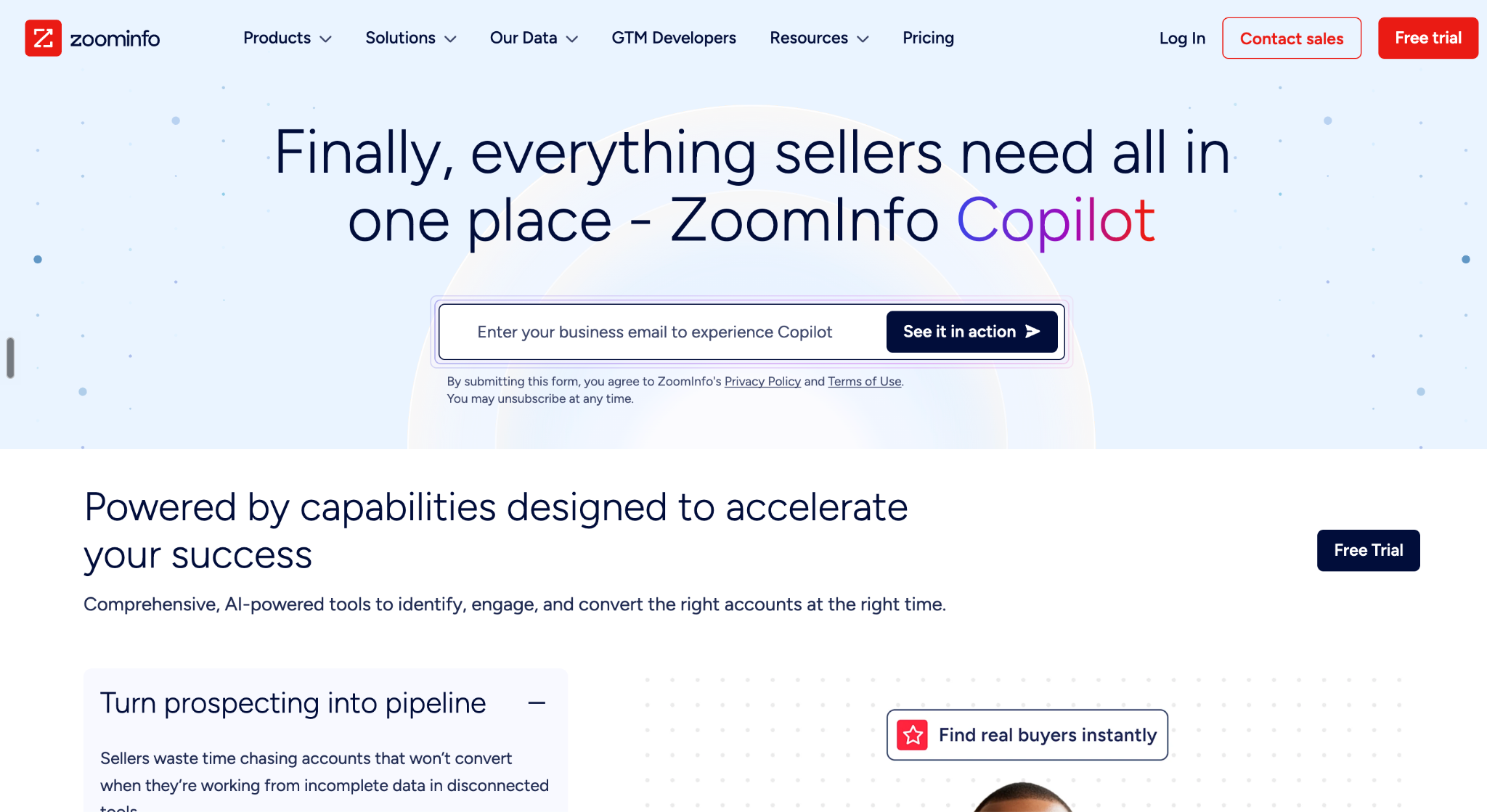
2. ZoomInfo Copilot: For AI-Assisted Selling
Copilot builds on ZoomInfo's underlying intelligence to help sellers decide where to focus and how to engage. It can surface relevant accounts and decision-makers, summarize company activity, prepare talking points, draft outreach, and support follow-up workflows.
The distinction is that Sales provides much of the underlying data and prospecting capability, while Copilot adds an AI-assisted layer designed to help sellers act on that information.
Best for: SDRs, BDRs, AEs, and sales leaders who want to spend less time researching accounts and preparing outreach manually.
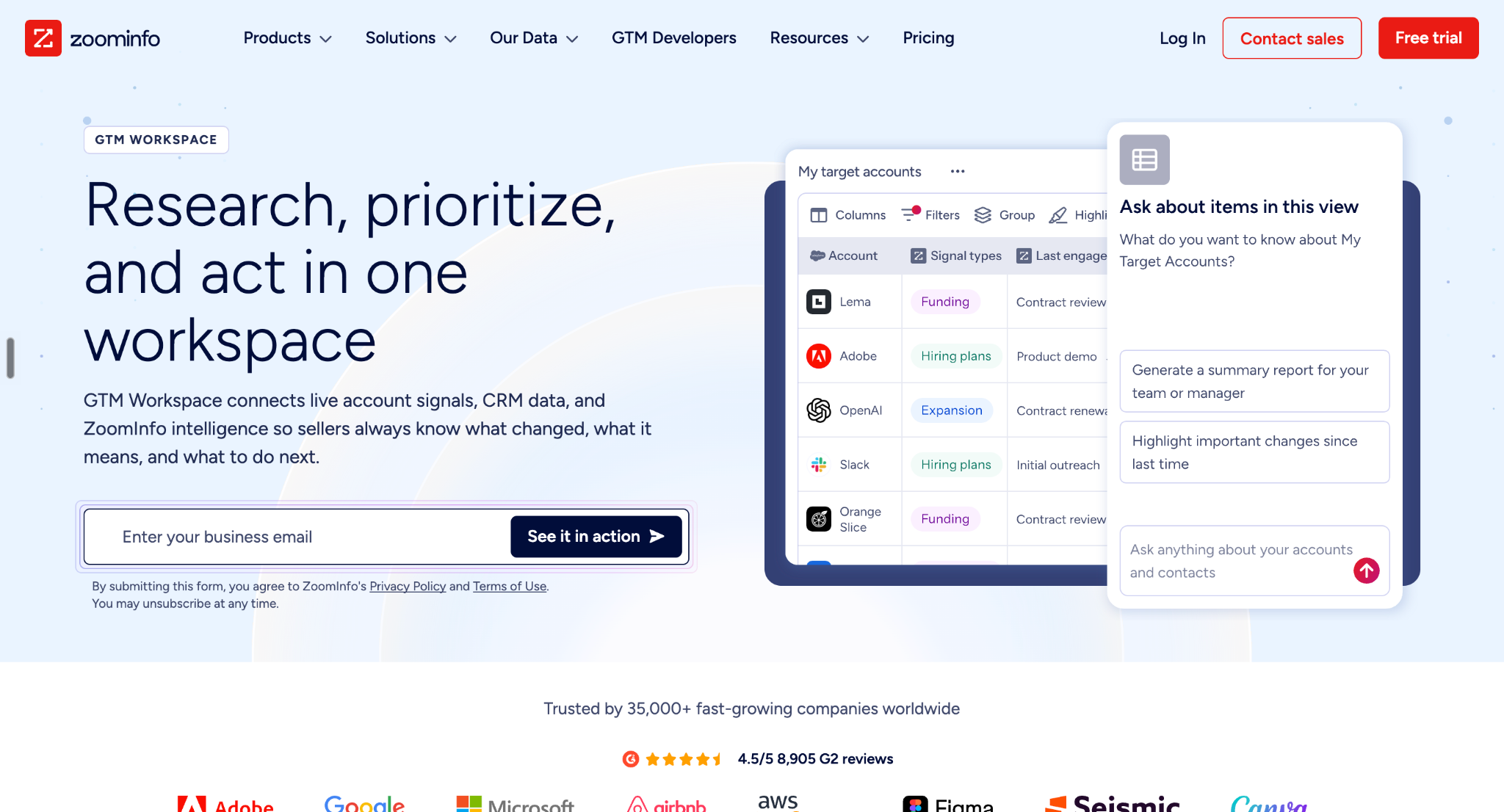
3. GTM Workspace: For Managing Accounts and Opportunities
GTM Workspace is aimed at revenue teams that need more than a list of new prospects. It brings together CRM information, company signals, interaction history, and AI-generated research to help reps understand what's happening across their accounts and deals.
For example, an account executive preparing for a customer meeting can use it to review account context, recent developments, and relevant engagement history. Account managers can use similar information to identify expansion opportunities and monitor changes across existing accounts.
Best for: AEs, account managers, and sales leaders managing multiple stakeholders, complex opportunities, and customer relationships.
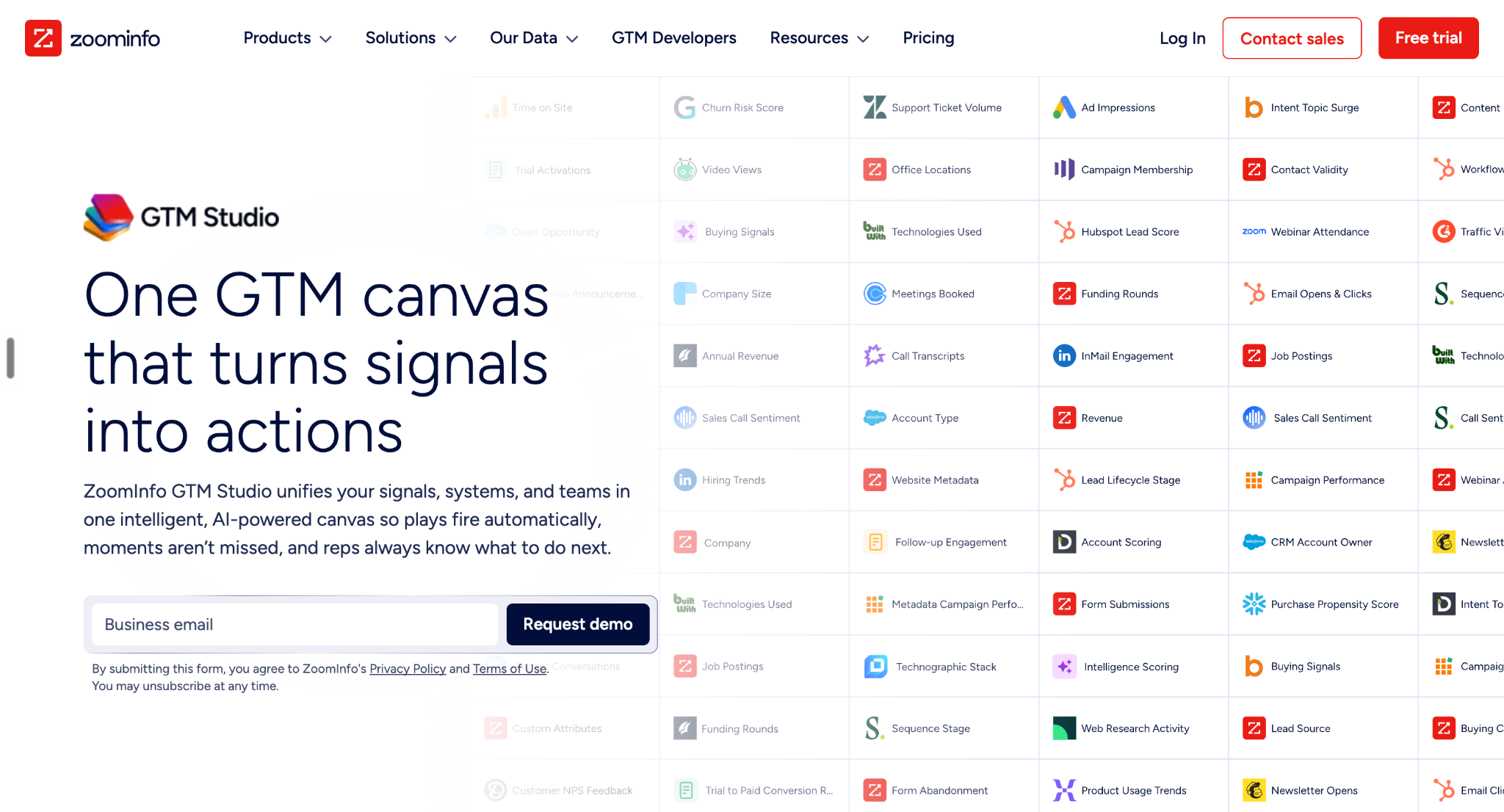
4. GTM Studio: For RevOps and Go-to-Market Automation
GTM Studio focuses on coordinating data, signals, and actions across the go-to-market process. Teams can connect data sources, enrich records, build audiences, and configure workflows that respond to relevant events.
For example, a RevOps team could create a workflow that identifies accounts matching its ICP, enriches missing contact information, and routes qualified records to the appropriate sales or marketing system.
Best for: RevOps leaders, marketing operations, and GTM engineers who need to coordinate data and automate processes across multiple tools.
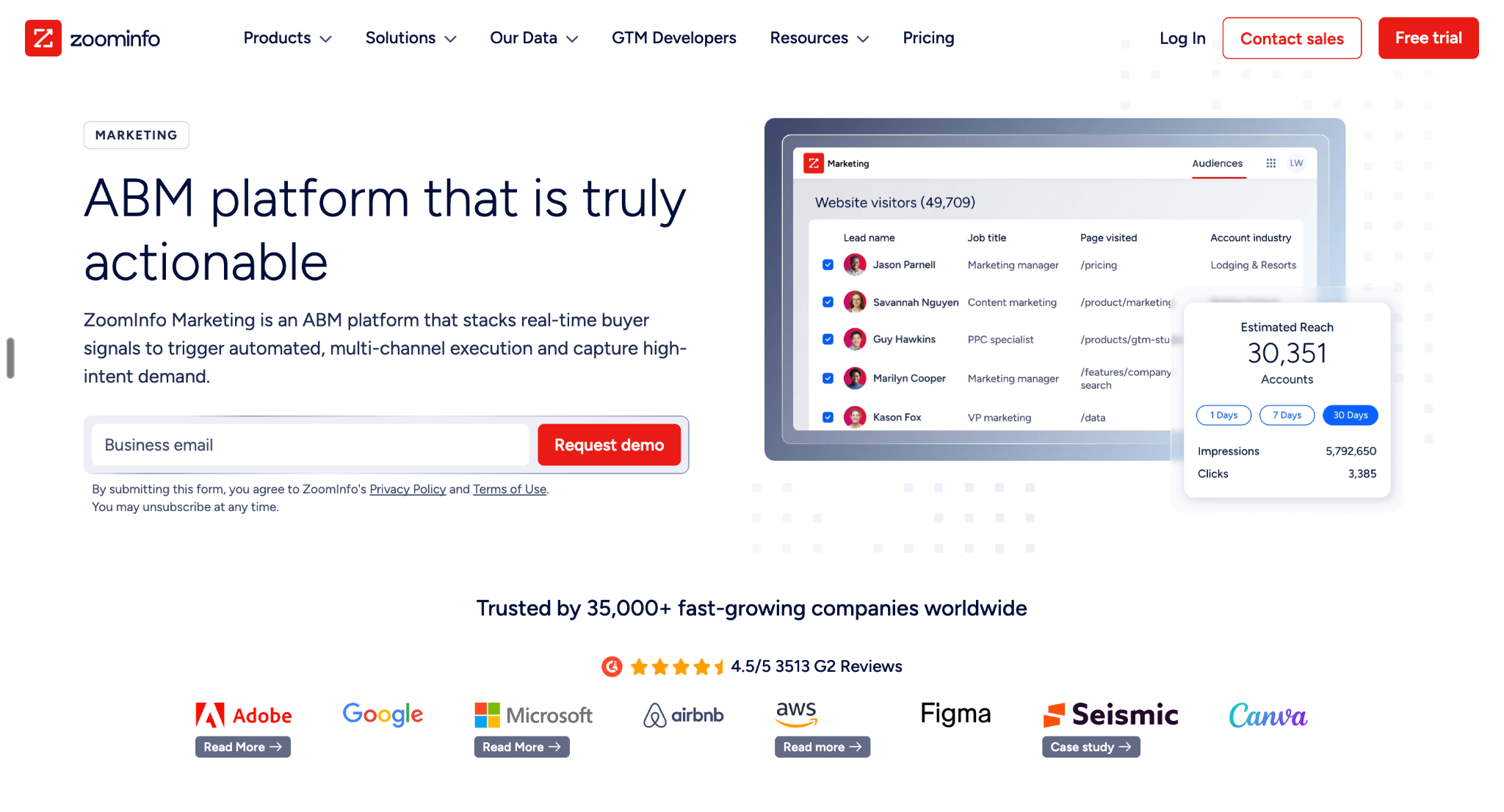
5. ZoomInfo Marketing: For Account-Based Marketing
ZoomInfo Marketing helps B2B marketing teams identify target accounts and activate campaigns around relevant buying signals. Its capabilities include audience targeting, digital advertising, and coordination between marketing activity and sales outreach.
For example, an ABM team could use target-account data to build an audience, run campaigns across supported channels, and coordinate follow-up with the sales reps responsible for those accounts.
Best for: Demand generation teams, ABM managers, and B2B marketers running targeted campaigns rather than relying solely on broad audience acquisition.
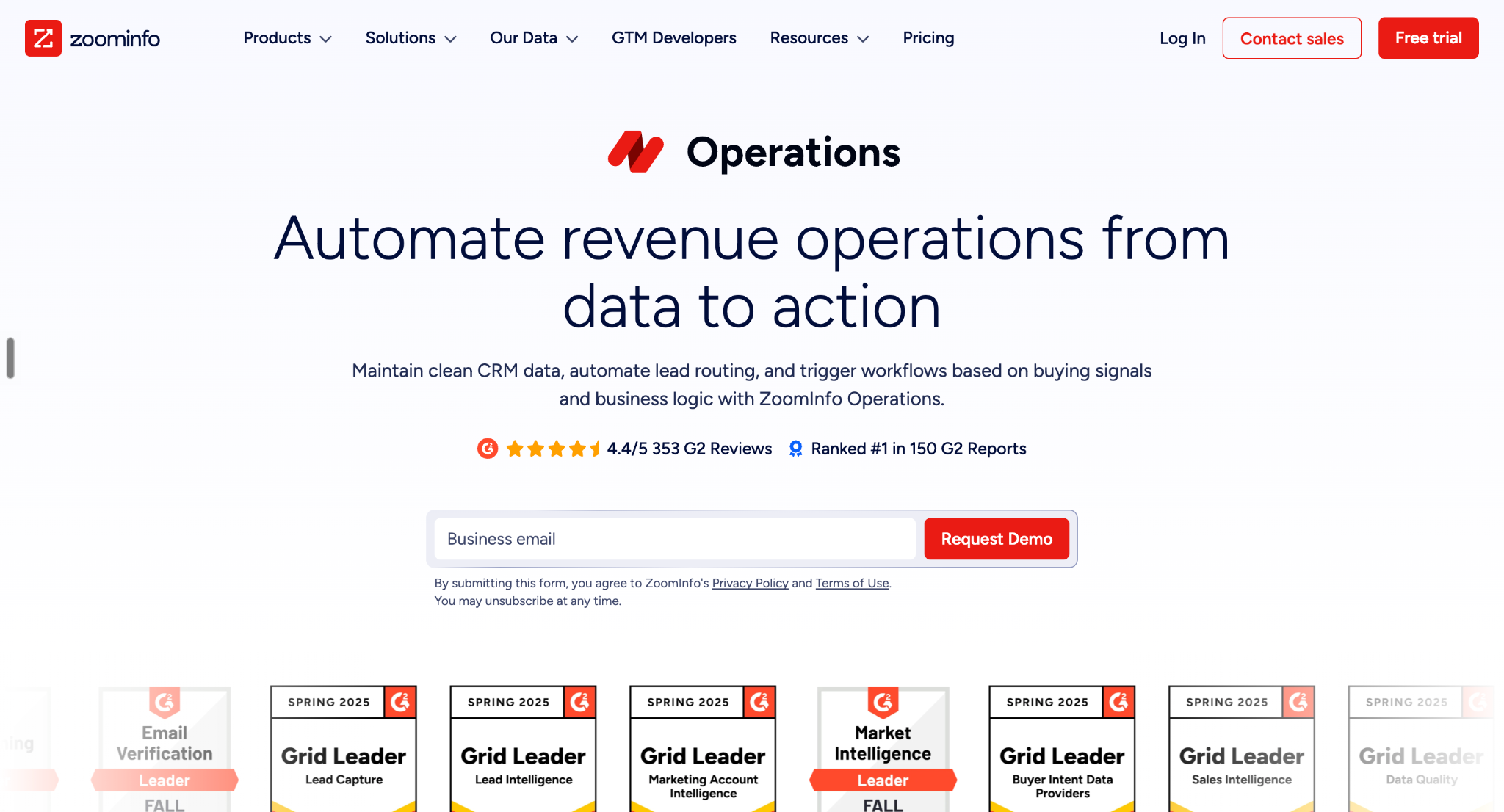
6. ZoomInfo Operations: For Data Quality and CRM Management
Bad data can undermine every other part of a go-to-market strategy. Duplicate records, outdated contact details, inconsistent company names, and incomplete CRM fields make it harder to segment audiences, route leads, and measure results.
ZoomInfo Operations focuses on this underlying problem through data enrichment, deduplication, standardization, and workflow capabilities.
Best for: RevOps, sales operations, marketing operations, and CRM administrators responsible for maintaining reliable data across systems.
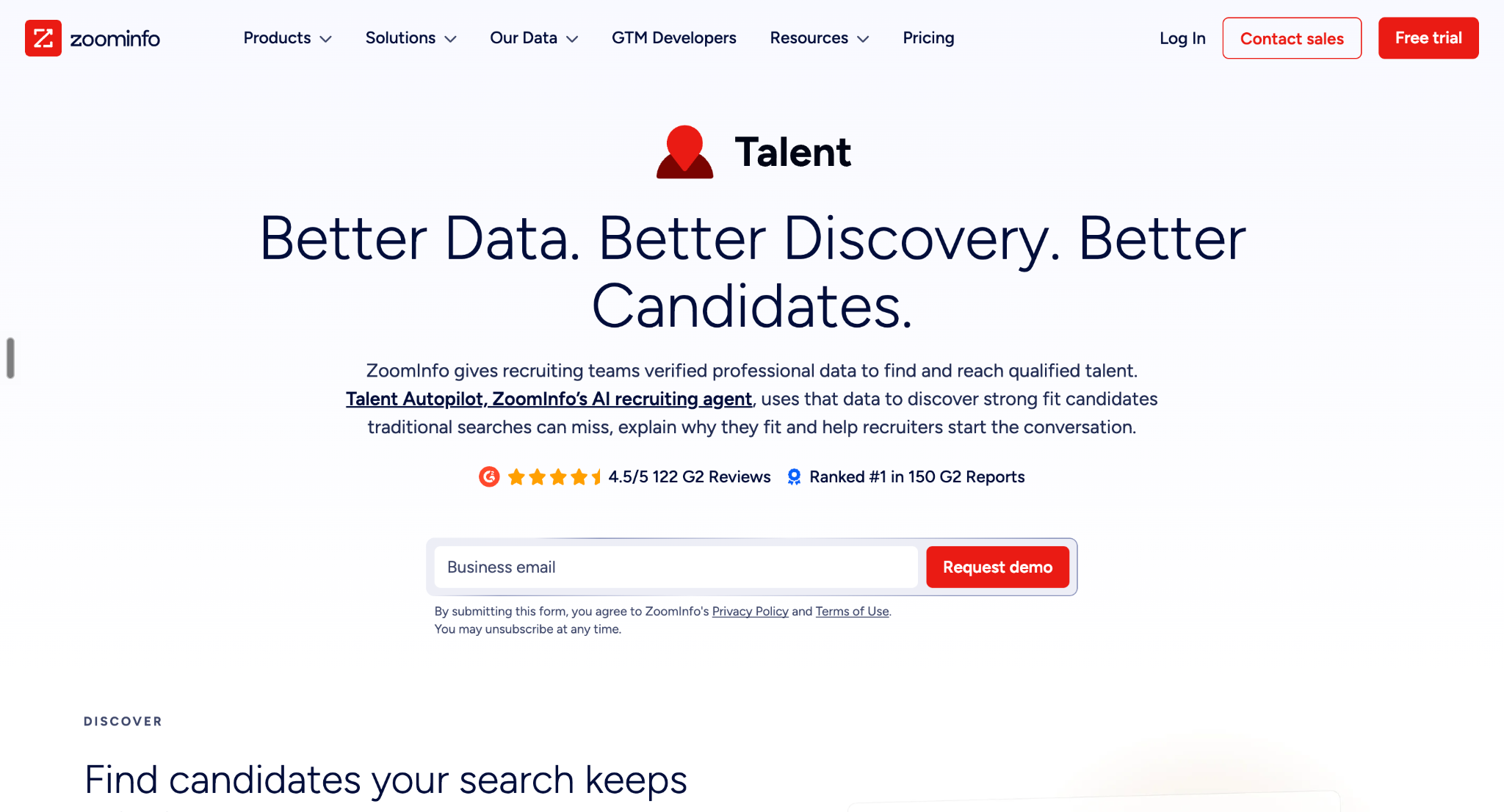
7. ZoomInfo Talent and Talent Autopilot: For Recruiting
ZoomInfo Talent supports candidate sourcing through professional data and recruiting intelligence. Talent Autopilot adds an AI recruiting agent that can interpret a hiring brief, discover potential candidates, explain why they match, and prepare outreach for recruiter approval.
These offerings are relevant to recruiting, rather than sales prospecting, even though both use professional data.
Best for: Talent acquisition teams, corporate recruiters, and staffing firms looking to improve candidate discovery and reduce manual sourcing work.
Other ZoomInfo Solutions and Capabilities
Beyond its main products, ZoomInfo offers capabilities for specific parts of the customer acquisition and revenue process. Some are presented as solutions or features within its broader products, so they shouldn't automatically be treated as separate subscriptions.
Solution or capability
What it does
Who benefits most
Contact and company search
Finds businesses and professionals using filters and business attributes.
SDRs, BDRs, AEs, and researchers.
Buyer intent data
Highlights companies showing research activity around selected business topics.
Sales prospecting teams and demand generation marketers.
Website visitor tracking (WebSights)
Helps identify companies visiting a website and use that information for follow-up. Identification capabilities vary by visitor and setup.
Demand generation, inbound sales, and website conversion teams.
Conversation intelligence (Chorus)
Analyzes sales conversations to surface insights about calls, deal progress, coaching, and customer interactions.
Sales managers, enablement teams, RevOps, and customer-facing teams.
Website chat
Helps engage website visitors, qualify interest, and route conversations to the appropriate team.
Inbound sales and demand generation teams.
Web form optimization
Reduces friction in lead capture by limiting the information visitors need to enter.
Demand generation and marketing operations.
Ads audiences
Builds and activates audiences based on target-account and business data for supported advertising channels.
ABM and paid media teams.
CRM enrichment and data management
Improves completeness, consistency, and usability of CRM records.
RevOps, CRM administrators, and data teams.
Predictive modeling and workflows
Helps prioritize accounts or leads and trigger actions based on configured criteria and signals.
RevOps, sales operations, and marketing operations.
APIs and MCP integrations
Makes ZoomInfo data available to supported applications, systems, and AI agents.
Developers, data engineers, and GTM engineering teams.
Which ZoomInfo Product Should You Choose?
The right starting point depends on the problem you're trying to solve:
Need more qualified outbound prospects? Start with ZoomInfo Sales and evaluate whether Copilot adds enough value to your prospecting and outreach workflow.
Managing complex accounts and active deals? Look at GTM Workspace.
Automating data, routing, and marketing workflows? Evaluate GTM Studio and the relevant Operations capabilities.
Running account-based marketing campaigns? Explore ZoomInfo Marketing and its audience activation capabilities.
Hiring and sourcing candidates? Compare ZoomInfo Talent and Talent Autopilot.
Need ZoomInfo data inside your own systems or AI applications? Look at Data as a Service, APIs, and GTM.AI/MCP.
ZoomInfo Pricing
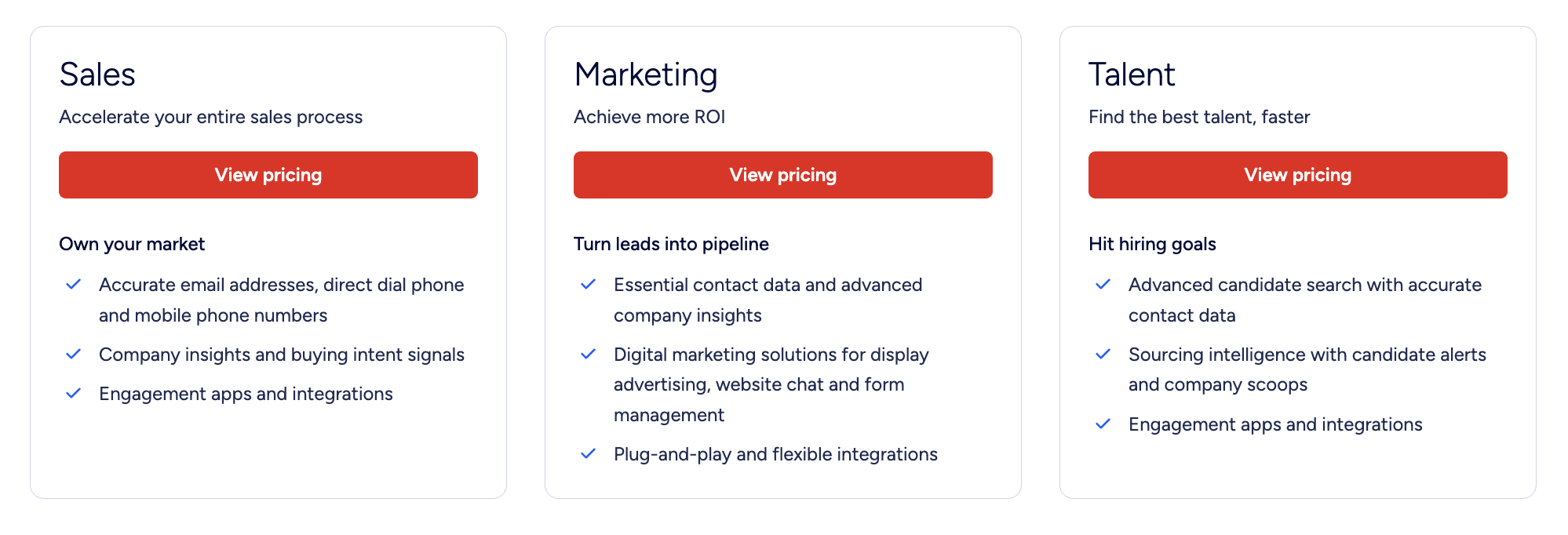
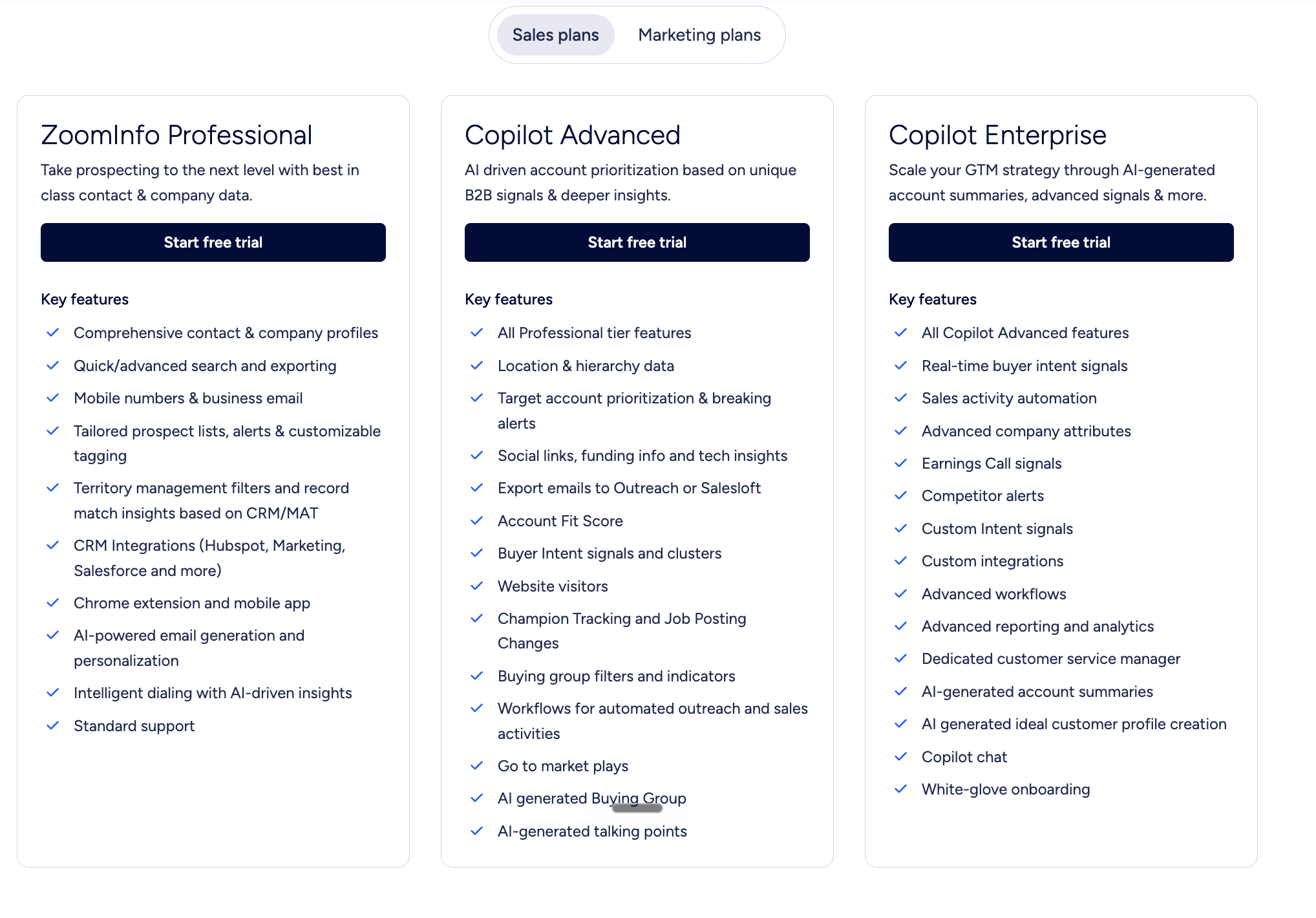
ZoomInfo uses a customized pricing model rather than a single fixed monthly subscription. The amount a company pays depends on the products it selects, the number of users, data credits, and the features it needs.
The platform offers products across sales intelligence, marketing, recruiting, data management, and AI-assisted selling. As a result, the cost can vary significantly depending on whether a team needs prospecting data alone or a broader go-to-market solution.
How Much Does ZoomInfo Cost?
ZoomInfo does not publish a universal price list for all its products. Market estimates and customer-reported pricing suggest that annual contracts can range from around $15,000 for smaller deployments to 40,000–60,000 or more for larger implementations. These are indicative estimates, not official prices or guaranteed quotes.
Pricing factor
How it affects the cost
User licenses
The number of users and their required access can affect the contract price.
Data credits
Contact exports, data enrichment, and other credit-consuming activities can affect usage costs. Exact credit rules depend on the package.
Product selection
Sales, Marketing, Talent, Copilot, and other products have different capabilities and may be priced separately or bundled.
Integrations and workflows
Connecting ZoomInfo with existing CRM and sales systems can affect the scope of the deployment.
Contract terms
Contract length, package configuration, and negotiated terms can influence the final price.
Is ZoomInfo Worth the Price?
For outbound-focused sales teams, ZoomInfo can be valuable for finding business contacts, identifying decision-makers, prioritizing accounts, and improving prospecting efficiency. Larger organizations may also benefit from its data enrichment and broader go-to-market capabilities.
However, buyers should evaluate more than the initial quote. Credit consumption, additional product access, team expansion, and integration requirements can all affect the total cost of ownership.
Before signing a contract, ask ZoomInfo for a breakdown of included licenses, credit allowances, overage rules, renewal terms, and the cost of any additional modules your team may need.
You can also compare the platform's cost against your team's actual prospecting and pipeline requirements before deciding whether a broader GTM platform is worth the investment.
ZoomInfo Reviews From Real Users: What Do Customers Complain About?
ZoomInfo's reviews reveal more specific concerns than simply whether the platform is good or bad. Users discuss contact data accuracy, buyer intent signals, sales engagement automation, platform usability, and customer support. The exact issue often depends on which product or capability they're using.
1. GTM Workspace: Outdated Contact Data and Navigation Issues
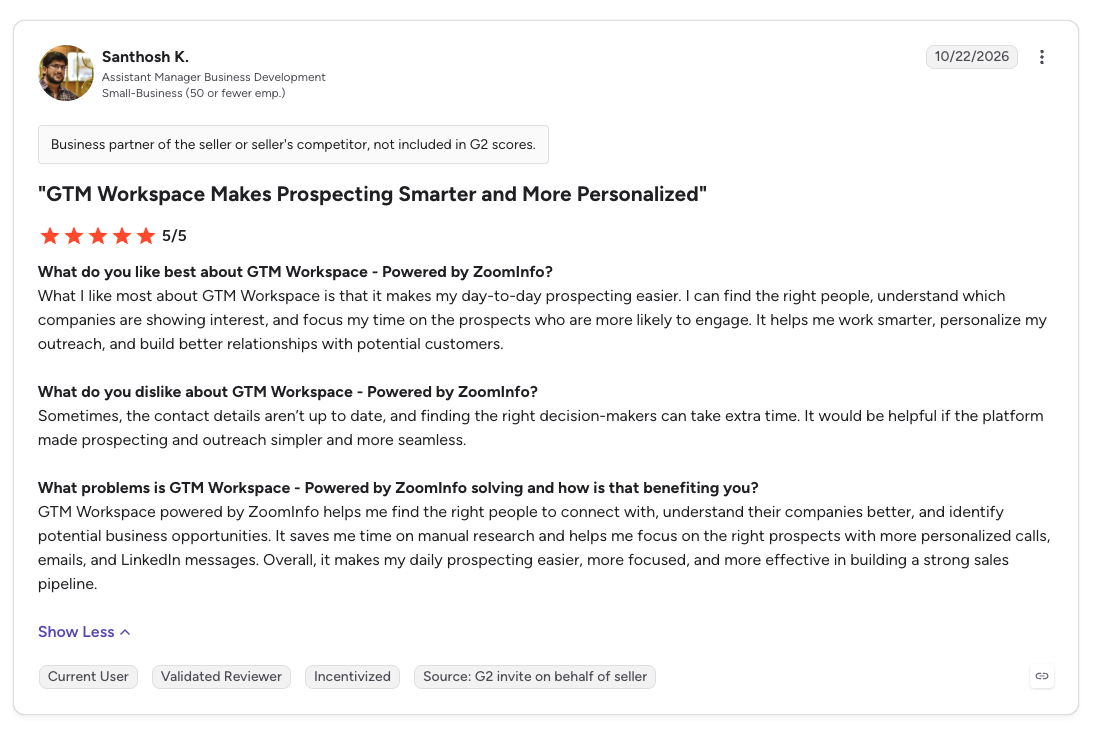
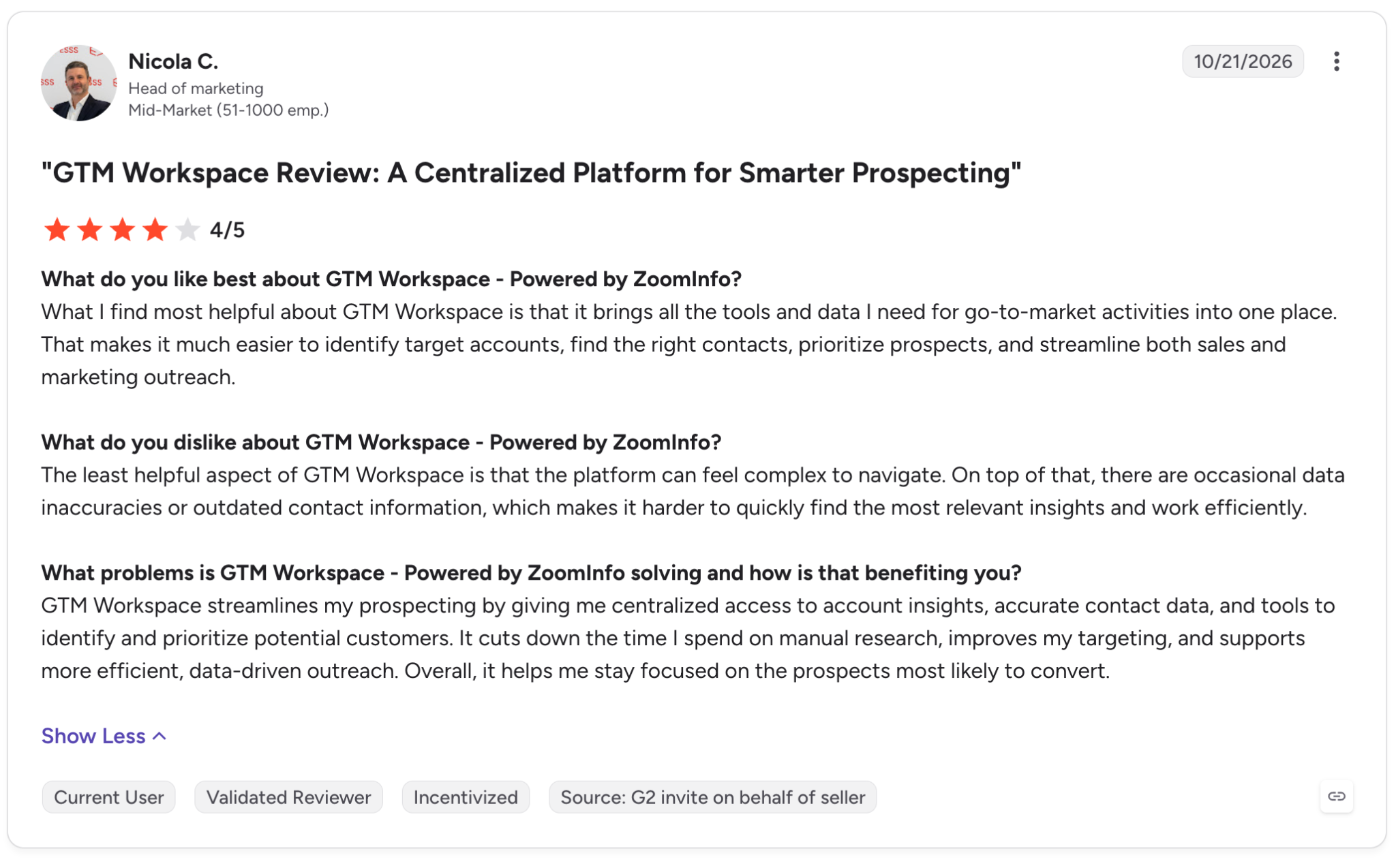
On G2, GTM Workspace has a 4.5 out of 5 rating. However, reviews also highlight problems with contact freshness and the effort required to navigate the platform.
In a review dated October 22, 2026, Santhosh K. wrote:
“Sometimes, the contact details aren’t up to date, and finding the right decision-makers can take extra time.”
Another G2 reviewer, Nicola C., described navigation complexity and occasional inaccuracies in contact records.
What users are having trouble with: GTM Workspace's contact and company intelligence can save research time, but outdated job titles, invalid contact details, and a learning curve can reduce that efficiency. These concerns matter most to SDRs and account executives who rely on current information for outbound sequences and account research.
2. ZoomInfo Engage: Email Automation and Sales Sequence Failures
A Reddit discussion specifically about ZoomInfo Engage raises concerns about the reliability of its sales engagement functionality.
One user described problems with email sending limits and company information failing to populate in scheduled emails. The reviewer said these failures could cause contacts to exit a sales sequence, forcing the team to rebuild the workflow.
What users are having trouble with: This complaint concerns Engage's execution layer, not just ZoomInfo's contact database. If personalization variables fail or sequences stop unexpectedly, sales reps may have to troubleshoot campaigns and repeat work that automation was supposed to eliminate.
This is a single user's reported experience, not evidence that every Engage customer encounters the same issue.
3. Buyer Intent Data: Signals That May Not Reflect Active Buying
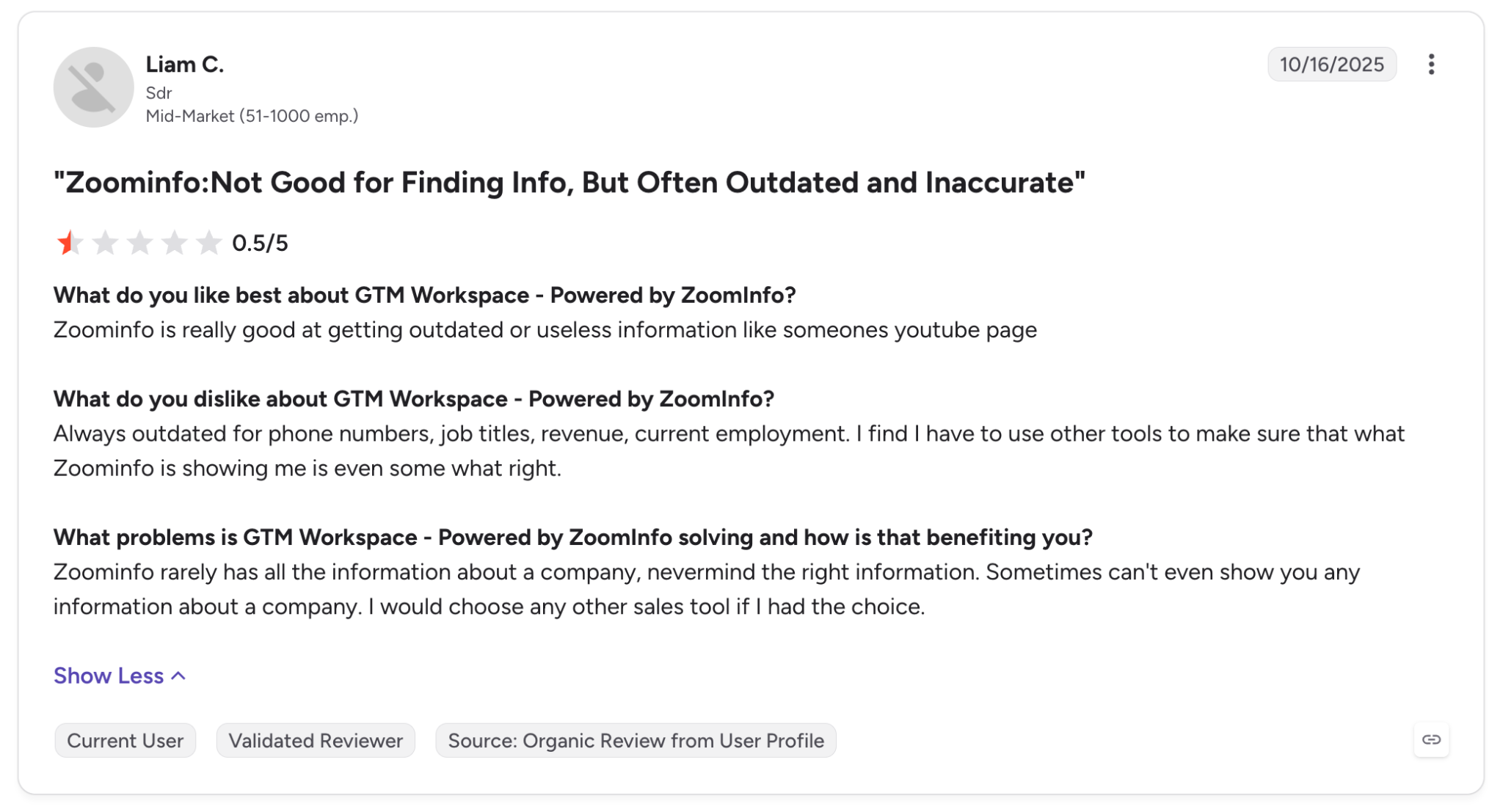
ZoomInfo's buyer intent capabilities are designed to help teams prioritize accounts researching relevant topics. However, users on G2 and Reddit question how reliably those signals translate into actual purchase interest.
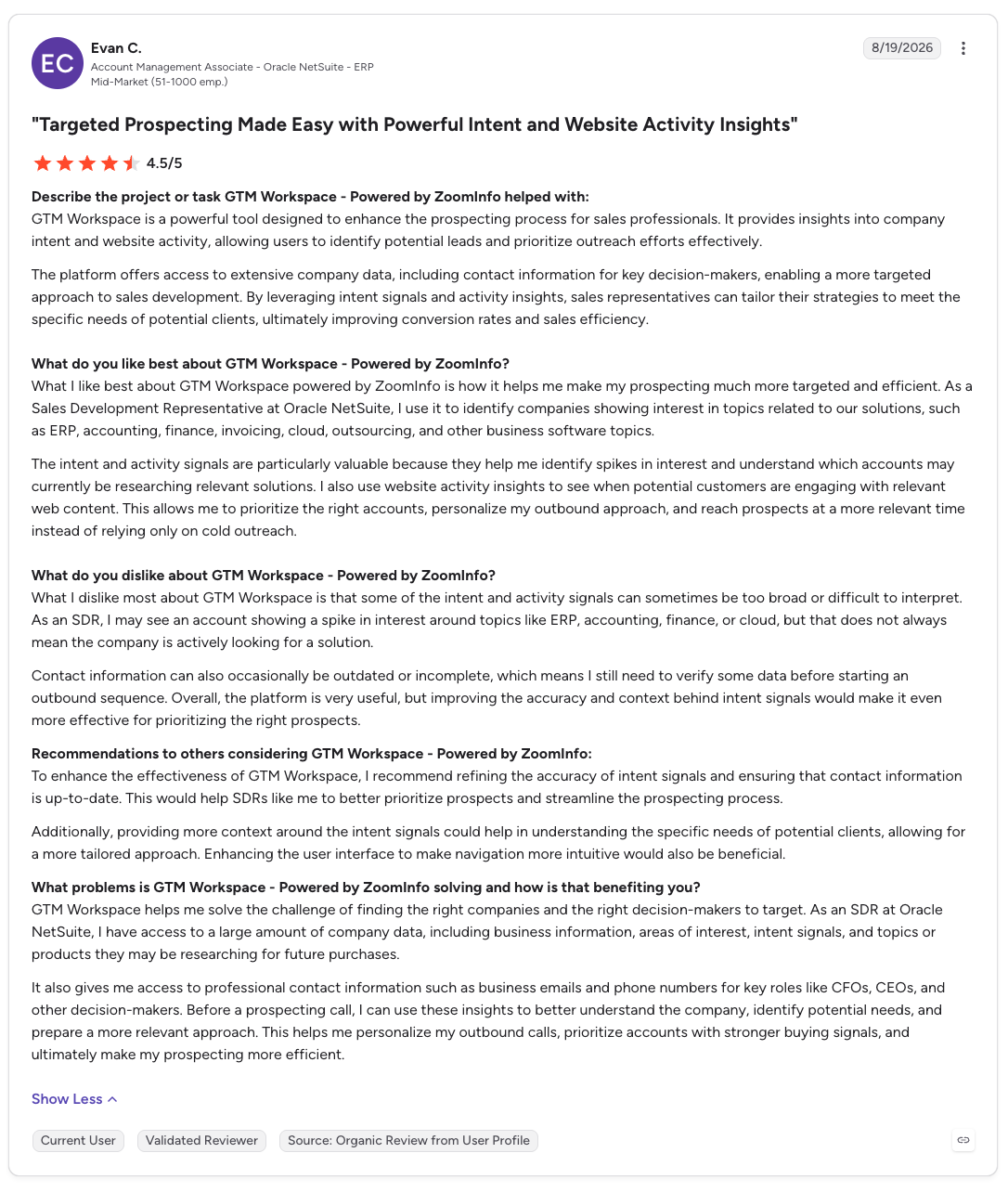
In a G2 review of GTM Workspace, a sales development representative described a specific limitation:
“some of the intent and activity signals can sometimes be too broad or difficult to interpret.”
The reviewer explained that an account researching a broad topic, such as cloud or finance, is not necessarily looking to purchase a particular solution.
A separate Reddit discussion about buyer intent data also includes users questioning its reliability and whether signals arrive too late to influence outreach.
What users are having trouble with: The issue is not necessarily that intent data has no value. It is that topic-level research activity can be mistaken for purchase readiness. Sales teams may still need to validate signals against first-party engagement, account context, and other buying indicators.
4. Contact and Company Data: Incorrect Emails, Phone Numbers, and Job Details
Data accuracy is a recurring concern across reviews of ZoomInfo's core sales intelligence capabilities.
On G2, reviewers mention outdated job titles, contacts who have left their companies, and invalid contact details. Reddit users have also reported problems with mobile phone numbers and email addresses.
What users are having trouble with: These complaints relate to the contact and company data underlying prospecting, enrichment, and account research. Even when the database helps teams find potential buyers, reps may need to verify records before using them in outbound campaigns.
For teams measuring prospecting efficiency, the practical question is how many records are usable, not simply how many contacts are available.
5. ZoomInfo Pricing: Users Say It's Overpriced for What It Delivers
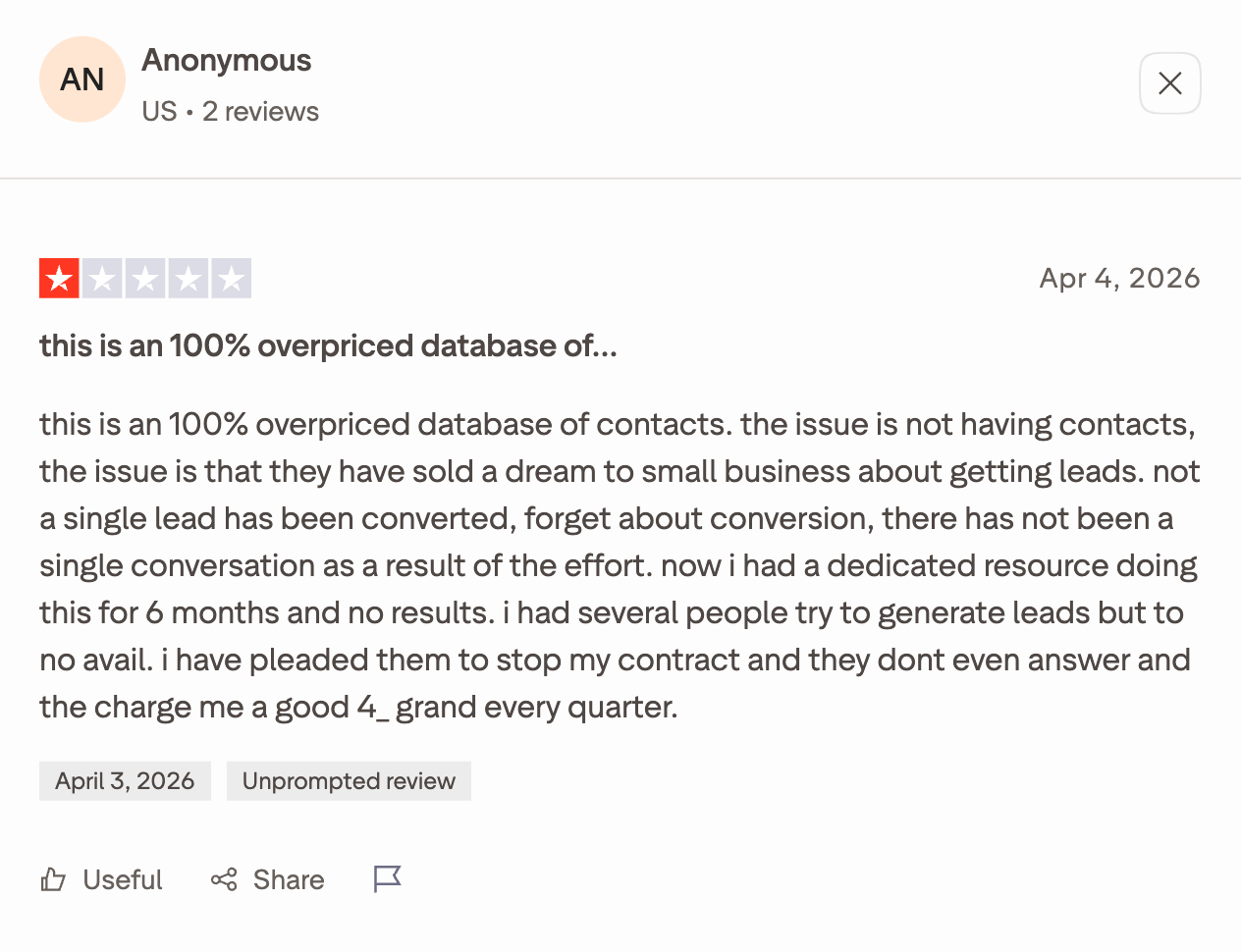
One of the strongest complaints across ZoomInfo reviews is its cost. Users question whether the platform's contact data, intent signals, and sales capabilities justify the price, particularly when data accuracy is inconsistent or the product fails to deliver the expected results.
On Trustpilot, a reviewer identified as John F. wrote in a one-star review:
“They lie to you about the products capabilities. Charge an insane amount and get people with false promises of what the product can achieve.”
The reviewer also complained about inaccurate information and difficulty cancelling the contract.
The criticism isn't limited to Trustpilot. In a Reddit discussion about ZoomInfo's value in 2026, one user questioned whether the data justified the subscription cost:
“Don't get me wrong, the data is decent, but is it "buy a small house" decent for a team of our size?”
The same user questioned rising prices and paying for features and data points the team rarely used.
An older discussion on r/sales also illustrates the concern about price relative to data quality. A user considering a $14,000 annual subscription wrote:
“Zoominfo is expensive and quality has shit the bed since ~2020 when I started using it.”
The user went on to describe bounced emails and incorrect or disconnected phone numbers.
What users are complaining about: The issue is not simply that ZoomInfo charges premium prices. It's the perceived gap between what customers pay and what they receive. When contact records are inaccurate, intent signals are questionable, or features go unused, the return on a substantial annual contract becomes harder to justify. Reports of rigid contracts and cancellation difficulties can make that dissatisfaction even more costly.
For sales teams, this creates a straightforward question: if reps still spend time verifying contact information and correcting poor data, how much of the subscription's promised productivity improvement are they actually getting?
6. Customer Support and Onboarding: Difficulty Getting Help After Purchase
Trustpilot reviews raise a different set of concerns. Rather than focusing on a single feature, customers describe problems with support access, onboarding, and resolving account issues.
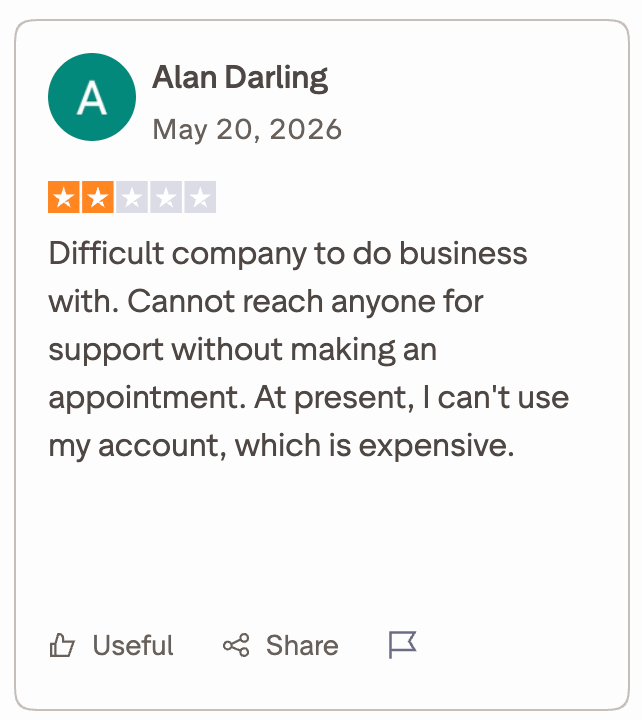
In a two-star Trustpilot review dated May 20, 2026, Alan Darling wrote:
“Difficult company to do business with.”
His review describes difficulty reaching support and being unable to use his account.
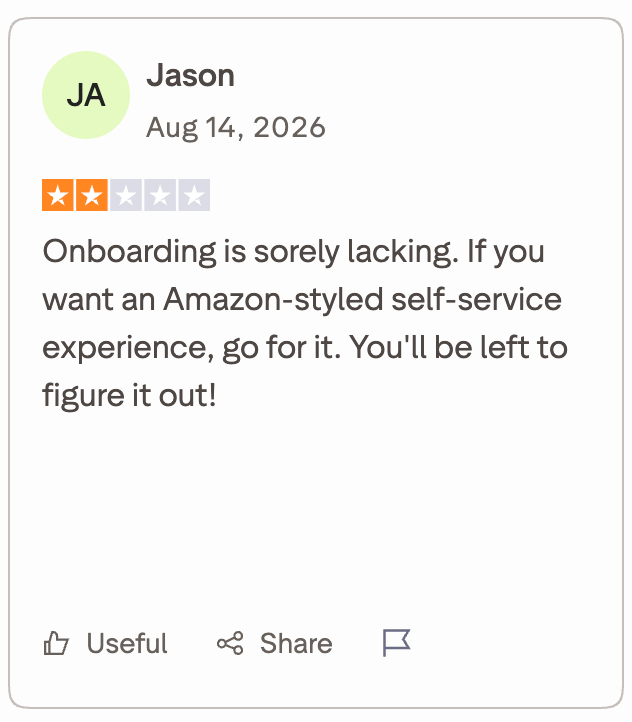
Another Trustpilot reviewer, Jason, reported that onboarding was insufficient and that users were left to work things out themselves.
What users are having trouble with: These are company-level customer experience complaints. The reviews do not establish that a specific ZoomInfo product caused the problems, so they should not be attributed to Engage, GTM Workspace, or another individual module without additional evidence.
For buyers, the takeaway is to clarify implementation support, training, account management, and escalation procedures before committing to a contract.
What These ZoomInfo Reviews Reveal
The reviews across G2, Trustpilot, and Reddit highlight several recurring problems with ZoomInfo's products, pricing, and customer experience.
Product or capability
Reported concern
Potential impact on sales teams
Pricing and contract terms
High subscription costs, concerns about value for money, and complaints about restrictive contracts or cancellation difficulties
Higher acquisition costs, reduced ROI, and difficulty leaving an unsatisfactory contract
GTM Workspace
Outdated contacts and navigation complexity
More manual research and verification
ZoomInfo Engage
Reported email sequence and personalization failures
Campaign troubleshooting, interrupted sequences, and repeated work
Buyer intent data
Signals that can be broad, stale, or difficult to interpret
Reps may prioritize accounts that aren't ready to buy
Contact and company database
Incorrect emails, phone numbers, and job details
Wasted prospecting effort and failed outreach
Customer support and onboarding
Complaints about difficulty obtaining help and resolving account issues
Slower adoption and unresolved problems
Across these reviews, the criticism extends beyond individual product limitations. Users report paying substantial subscription fees while still encountering data accuracy issues, questionable intent signals, workflow problems, and difficulties getting support.
Pricing makes these shortcomings more consequential. When teams pay thousands or tens of thousands of dollars annually, inaccurate contact records and unreliable workflows aren't merely inconveniences. They undermine the value the platform is supposed to deliver. Contract and cancellation complaints add another layer of frustration for customers who feel the product isn't meeting expectations.
The broader issue is that access to buyer intelligence does not guarantee pipeline generation. A database can identify potential customers, and intent data can indicate research activity, but neither guarantees accurate contact information, effective engagement, or conversions.
This exposes the limitation of an intelligence-first approach: ZoomInfo helps businesses identify and prioritize potential buyers, but the reported problems show that data access, execution reliability, and revenue outcomes are separate challenges.
For revenue teams, the question isn't simply how many contacts a platform provides. It's whether those contacts are usable, whether the signals lead to meaningful conversations, and whether the overall cost is justified by the pipeline generated.
ZoomInfo Pros and Cons
ZoomInfo offers a broad set of B2B sales intelligence and go-to-market tools, from contact discovery and buyer intent data to AI-assisted prospecting and CRM enrichment. For teams running outbound sales at scale, these capabilities can make account research and prospecting more efficient.
However, its value depends on data accuracy, the usefulness of its signals, and the cost of the overall subscription. User reviews also raise concerns about outdated contact records, sales workflow reliability, customer support, and restrictive contract terms.
Here's a breakdown of ZoomInfo's main advantages and disadvantages.
Pros
Cons
Extensive B2B contact database: Helps sales teams discover companies, decision-makers, and business contact information for outbound prospecting.
Inconsistent data accuracy: Some users report outdated job titles, incorrect contact details, and invalid email addresses or phone numbers.
Advanced prospecting filters: Lets reps narrow down potential customers using company attributes, job roles, technologies, and other targeting criteria.
Expensive subscriptions: Reported annual costs can reach tens of thousands of dollars, making the platform difficult to justify for smaller teams or those with limited outbound volume.
Buyer intent signals: Helps teams identify companies researching selected topics and prioritize accounts for outreach.
Intent signals require interpretation: Topic-level research activity does not necessarily mean a company is ready to purchase, which can lead to misplaced sales effort.
AI-assisted selling: Copilot can support account research, prioritization, meeting preparation, and outreach tasks.
Additional product and usage costs: Licenses, credits, and premium modules can make total contract costs harder to predict.
CRM and sales tool integrations: Helps teams incorporate business intelligence into existing sales and marketing workflows.
Workflow reliability concerns: Some users report problems with sales engagement sequences and email personalization, creating additional troubleshooting work.
Marketing and account-based targeting: Supports audience building and campaigns based on company data and buying signals.
Learning curve and complexity: The breadth of products and features can make setup, navigation, and adoption more demanding.
Data enrichment capabilities: Helps organizations improve the completeness and consistency of business records.
Data still needs verification: Enrichment cannot eliminate every outdated or inaccurate record, so teams may need additional validation.
Multiple GTM use cases: Offers products for sales, marketing, recruiting, data operations, and AI-assisted workflows.
Customer support and contract complaints: Some reviewers report difficulty obtaining support, resolving account issues, or dealing with licensing and cancellation terms.
Is ZoomInfo Worth It?
ZoomInfo's strongest advantage is the breadth of its B2B intelligence. It gives sales teams tools to discover prospects, research accounts, and prioritize outbound activity without relying entirely on manual research.
The trade-off is the cost and operational effort required to turn that intelligence into results. If contact records are inaccurate, intent signals are too broad, or workflows require frequent troubleshooting, the expected productivity gains can be reduced.
For large organizations with substantial outbound operations, ZoomInfo may provide valuable coverage and targeting capabilities. For smaller teams, the combination of high subscription costs, credit consumption, and inconsistent data quality can make its return on investment harder to justify.
Ultimately, ZoomInfo helps answer an important question: Who should your team target? Turning that intelligence into consistent engagement and qualified pipeline remains a separate challenge.
Knock AI is #1 Alternative to ZoomInfo: From Contact Data to Revenue Generation
A contact database can tell you whom to reach. But it won't, on its own, tell you which buyer is showing interest right now, why they're interested, or what your team should do next.
That's the difference between ZoomInfo's sales intelligence approach and Knock AI's revenue activation approach. Knock AI connects buyer identification and enrichment with first-party intent, AI-led qualification, engagement, routing, and conversion tracking. It can also support paid advertising campaigns and account-based marketing (ABM) by connecting campaign traffic and buyer activity to the workflows that turn interest into pipeline.
Capability
Knock AI
ZoomInfo
Contact and company data
Enriches buyer profiles with available identity, firmographic, attribution, and intent data to support immediate action.
Offers a large B2B database for finding contacts, researching companies, and building prospect lists.
Real-time buyer intent
Tracks first-party signals such as page visits, CTA clicks, repeat visits, Knock Link interactions, and conversations to help identify active buyers.
Provides intent data that helps teams identify accounts researching relevant topics, alongside its other sales intelligence capabilities.
Paid advertising campaigns
Connects campaign attribution, including available source, channel, and UTM data, with buyer engagement and conversion workflows. Teams can use these signals to understand which traffic engages and take action on interested prospects.
Helps teams build audiences and target prospects using B2B data and its marketing capabilities.
Account-based marketing (ABM)
Helps activate target accounts through buyer identification, intent signals, qualification, personalized engagement, and routing based on account and buyer context.
Supports account discovery, segmentation, contact selection, and targeting using company and contact intelligence.
Website visitor conversion
Helps identify and engage potential buyers, capture intent, and move them toward qualification or a meeting instead of relying entirely on form submissions.
WebSights helps identify companies visiting a website, supporting account-level visitor intelligence and follow-up.
AI-led qualification
AI agents can answer questions, gather qualification details, identify buyer intent, and guide qualified prospects toward the next step.
Supports prospecting and sales engagement workflows; its traditional sales intelligence offering is not the same as Knock AI's live conversational qualification workflow.
Lead and account routing
Routes prospects based on factors such as intent, CRM ownership, company details, attribution, and qualification data, including to the appropriate rep or AI agent.
Supports sales workflows and integrations that help teams manage and act on prospect data.
Outreach and follow-up
Supports conversational engagement and follow-up through configured Knock workflows and supported channels, with routing and meeting booking where enabled.
ZoomInfo Engage supports sales outreach through email sequences, calling workflows, and related prospecting activities.
CRM enrichment and workflow activation
Can sync mapped identity, intent, attribution, conversation, and meeting fields to supported CRMs, giving teams more context for their next action.
Enriches CRM records with contact, company, and other sales intelligence data.
Marketing attribution and conversion insights
Connects available source and campaign context with engagement, qualification, meetings, and conversion reporting to help teams understand what drives pipeline.
Provides data and integrations that support go-to-market planning and execution; campaign attribution and revenue measurement may require other marketing analytics tools.
Website leakage and missed opportunities
The Website Leakage Report helps teams investigate drop-offs, such as pricing-page exits, abandoned demo requests, and incomplete contact-sales journeys, and identify potential conversion improvements.
Helps sales and marketing teams identify accounts and prospects, but website leakage analysis and conversion activation are not the core focus of its contact database.
Best suited for
Teams that want to turn inbound demand, paid campaign traffic, target-account interest, and other buyer signals into qualified conversations, meetings, and pipeline.
Teams that need extensive B2B contact and company data, account research, list building, and outbound prospecting at scale.
The Bottom Line
Contacts are inputs. Revenue is the outcome.
You can buy a list of contacts from a database, a data provider, or even a freelancer. The harder problem is recognizing which accounts are showing genuine interest, understanding what they need, and acting before that interest disappears.
Knock AI brings those steps together: from identifying and enriching buyers to interpreting intent, qualifying prospects, routing them to the right person, engaging them, and measuring what happens next.
For paid campaigns and ABM, that means looking beyond clicks, impressions, and target-account lists. It means building a path from campaign spend → buyer intent → qualified conversations → meetings → pipeline.
ZoomInfo is a strong option when your priority is B2B data and outbound prospecting. Knock AI is built for teams that want to put buyer intelligence into action and convert more of the demand they already generate.
Frequently Asked Questions
1. Is Knock AI better than ZoomInfo?
It depends on your goal. ZoomInfo is a strong choice for B2B contact data, company intelligence, and outbound prospecting. Knock AI focuses on turning buyer signals into action through real-time enrichment, first-party intent, AI-led qualification, lead routing, engagement, and conversion tracking. If your priority is converting buyer interest into qualified meetings and pipeline, Knock AI offers a more conversion-focused approach.
2. What is the main difference between Knock AI and ZoomInfo?
The main difference is what happens after you identify a prospect. ZoomInfo helps sales and marketing teams find contacts and research accounts. Knock AI connects buyer identification with intent signals, qualification, engagement, routing, and meeting booking. In short, contact data tells you whom you could target; Knock AI helps you decide whom to engage and what to do next.
3. Can Knock AI help with paid advertising campaigns?
Yes. Knock AI can connect available campaign attribution data with website activity, buyer intent, conversations, and conversion workflows. This helps teams understand which campaign sources bring engaged prospects and follow up when buyers show interest. It complements advertising platforms rather than replacing tools used to manage ad spend, bids, or campaigns.
4. Can Knock AI support account-based marketing (ABM)?
Yes. Knock AI can support ABM by helping teams identify and enrich buyers, interpret first-party intent signals, qualify interested prospects, and route them according to account details and sales rules. This helps teams act on engagement from target accounts instead of relying only on static account lists.
5. How does Knock AI identify buyer intent?
Knock AI captures first-party signals from supported touchpoints, including website page views, CTA clicks, form interactions, Knock Link activity, and conversations. It uses these signals to help assess intent and distinguish potential buying interest from other types of engagement. These insights can inform qualification, routing, and follow-up.
6. Does Knock AI replace ZoomInfo's contact database?
Knock AI and ZoomInfo serve different primary needs. ZoomInfo is designed for extensive B2B contact and company intelligence. Knock AI focuses on enriching buyer context and activating intent through engagement and conversion workflows. Teams that need large-scale outbound prospecting data may still benefit from ZoomInfo, while teams focused on converting existing demand may prioritize Knock AI.
7. Can Knock AI help convert website visitors who never fill out a form?
Knock AI can help teams engage visitors through supported chat and conversion workflows, identify available buyer context, and guide prospects toward qualification or a meeting. Its Website Leakage Report can also help identify potential drop-off points, such as abandoned demo requests or exits from pricing pages, so teams can investigate missed conversion opportunities.
8. Does Knock AI integrate with a CRM?
Yes. Knock AI supports CRM integrations and field mapping, including HubSpot and Salesforce. Teams can configure which contact, company, attribution, intent, conversation, and meeting fields are synced, helping sales teams act on buyer context within their existing workflows.
9. Which platform is better for generating revenue?
Neither platform guarantees revenue on its own. ZoomInfo can help teams build prospect lists and execute outbound sales strategies. Knock AI focuses on helping teams convert buyer interest into qualified conversations, meetings, and potential pipeline through intent detection, AI engagement, and intelligent routing. The better fit depends on where your go-to-market process has the biggest gap: finding prospects or converting demand into opportunities.