What Are Lead Routing Rules?
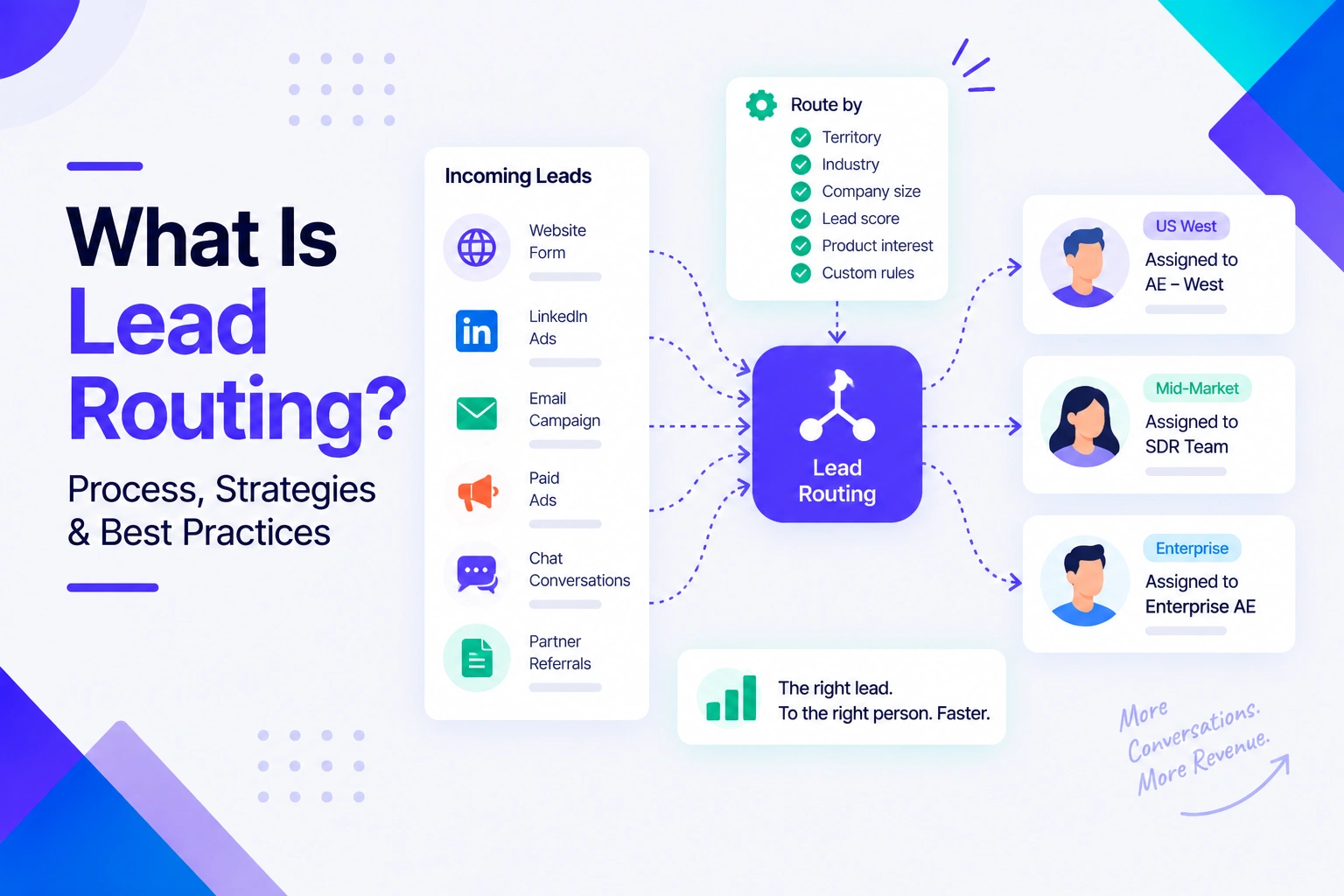
Lead routing rules define when, why, and where a lead should be assigned. They can determine the right destination based on account ownership, territory, company size, product interest, buying intent, or rep availability.
For example:
- Existing account → account owner
- Enterprise account → enterprise AE
- EMEA → EMEA team
- Specific product interest → specialist
- High-intent lead → priority rep
- Rep unavailable → next eligible rep
Good routing rules should be specific enough to prevent misassignment but flexible enough to handle exceptions. Overly rigid rules can create bottlenecks when real-world leads don't fit neatly into predefined conditions.
Why Is Lead Routing Important?
A good routing process helps sales teams get qualified buyers to the right person without unnecessary delays. It can improve speed-to-lead, rep-to-buyer matching, sales productivity, lead coverage, and the overall buyer experience, while reducing manual assignment and revenue leakage from neglected or misrouted leads.
But speed alone isn't enough. A lead that reaches the wrong rep quickly can still become a missed opportunity. Effective routing considers both how fast a lead is assigned and whether the person receiving it is actually the right person to handle the conversation.
Lead Routing vs. Lead Scoring vs. Lead Qualification
These processes work together, but each answers a different question:
| Process |
Main Question |
| Lead scoring |
How much priority should this lead receive? |
| Lead qualification |
Is this prospect worth sales attention? |
| Lead routing |
Who should handle the prospect? |
A common workflow is Score → Qualify → Route → Engage. In practice, however, these steps increasingly overlap. Intent, identity, account context, and engagement can influence both whether a prospect qualifies and which rep should handle them. The more context a team has, the more precise its routing decisions can be.
Common Lead Routing Problems
Lead routing can break down even when the rules themselves look straightforward. Common problems include:
- Incomplete lead or account data
- Incorrect lead-to-account matching
- Duplicate records
- Leads assigned to the wrong territory
- Conflicting routing rules
- Leads falling into default queues
- Unassigned leads
- Slow handoffs between teams
- Routing without enough buyer context
- No fallback when the assigned rep is unavailable
These issues can leave sales reps chasing the wrong prospects or spending time figuring out who should own a lead. Good routing requires more than assignment rules. It requires reliable data and enough context to make the right assignment in the first place.
How to Improve Lead Routing
Improving lead routing starts with making the rules and the data behind them more reliable. A practical approach is to:
- Define clear routing criteria based on territory, account, segment, product, or other relevant factors.
- Keep CRM data accurate and enriched so routing decisions are based on current information.
- Match new contacts to existing accounts to preserve account ownership and context.
- Use multiple signals rather than relying on a single field.
- Build fallback rules for exceptions and unavailable reps.
- Set response-time expectations for routed leads.
- Give reps relevant context with each assignment.
- Monitor routing performance and refine rules as the sales process changes.
Don't optimize routing only for assignment speed. Optimize for the quality of the match between the buyer and the person handling them.
How AI Is Changing Lead Routing
AI can make lead routing more adaptive by combining signals that traditional rules may overlook. It can help with identity resolution, lead-to-account matching, real-time enrichment, intent detection, context analysis, rep matching, dynamic routing, and automated prioritization.
Rather than replacing routing rules entirely, AI can work alongside them by evaluating buyer and account context as it changes. AI can make routing more adaptive by evaluating signals and context that rigid rule-based systems may miss.
How Knock AI Improves Lead Routing
Traditional lead routing starts with a lead record and asks which rep should receive it. Knock AI starts with the relationship around the buyer.
Its approach connects:
Signal → Identity → Enrichment → Context → Intent → Qualification → Routing → Conversation → Meeting → Pipeline
Knock AI can connect buyer identity, account relationships, engagement, enrichment, intent, qualification, conversations, meetings, and CRM context. This gives teams more than the basic information needed to assign a lead. It helps them understand who is engaging, what they care about, how they relate to the account, and what should happen next.
Instead of routing an isolated lead record, Knock AI helps B2B teams route with the context needed to make a better buyer-to-rep match.
Knock AI is relationship infrastructure for B2B companies, connecting identity, memory, context, and engagement across channels, humans, AI agents, and time.
Lead Routing FAQs
What is lead routing?
Lead routing is the process of assigning incoming leads to the sales representative or team best positioned to handle them.
How does lead routing work?
Lead routing uses rules and buyer or account data to determine who should receive a lead and what happens next.
What are the different types of lead routing?
Common strategies include round-robin, territory-based, account-based, segment-based, product-based, skill-based, and availability-based routing.
What is a lead routing rule?
A lead routing rule defines the conditions that determine when, why, and where a lead should be assigned.
What is the difference between lead routing and lead scoring?
Lead scoring determines how much priority a lead should receive, while lead routing determines who should handle it.
What is the difference between lead routing and lead qualification?
Lead qualification determines whether a prospect is worth sales attention, while lead routing determines which representative or team should handle that prospect.
What is automated lead routing?
Automated lead routing uses software to assign leads according to predefined rules and available buyer or account information, reducing manual assignment.
How does AI improve lead routing?
AI can analyze identity, intent, engagement, account context, and other signals to make routing more adaptive than rules based on a few static fields.
What data is needed for lead routing?
Common inputs include account ownership, territory, company size, industry, buyer role, product interest, engagement, intent, and rep availability.


.svg)


.svg)
.svg)
.svg)


.svg)
.svg)


.svg)


