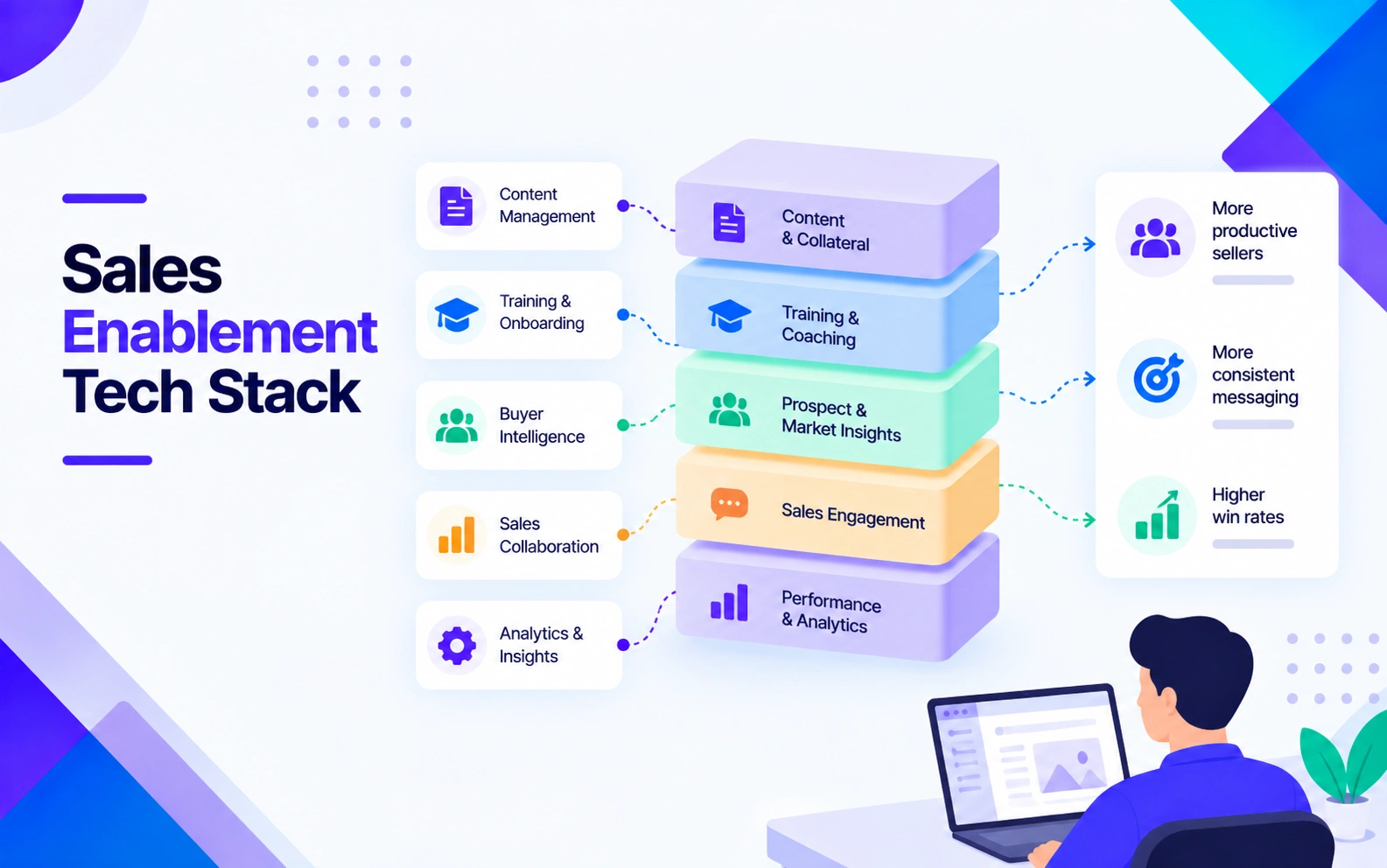
Content management
The content job is making sure a rep can find the current, approved asset in the moment they need it, and that marketing can tell whether anyone used it.
The failure is not disorganization. It is staleness with no feedback loop. Marketing produces forty assets, reps use six, nobody knows which six, and the next quarter produces forty more. Content analytics exist to close that loop and are the most underused feature in every platform in this category.
A practical test: ask three reps to send you the current security one-pager. If you get three different files, you have a content problem no amount of new content will fix.
Training and readiness
The training job covers onboarding, ongoing skill development, certification, and practice. This is where enablement started, as sales readiness, and it remains the part with the clearest return.
Ramp time is the number worth tracking. It is measurable, it compounds across every hire, and it is the easiest case to make to a CFO. Modern platforms add AI roleplay and video-based peer learning, which matter mostly because they let practice happen without occupying a manager's calendar.
The caveat is that training decays without reinforcement. Coaching works as a continuous presence through the workweek rather than as scheduled sessions, which is a process commitment more than a software one.
Execution guidance
The guidance job is the newest and the least bought: helping a rep in a live deal rather than before it. Digital sales rooms, guided selling, deal playbooks, and RFP or security questionnaire automation all sit here.
This is where enablement gets closest to revenue and where the tooling is least mature. It is also where the gap with buyer context is most visible, because guidance is only as good as the system's understanding of the specific deal in front of the rep.
Measurement
The measurement job connects content, training, and guidance to outcomes: which assets appear in won deals, which training correlates with quota attainment, which plays actually move stages.
Almost every team reports adoption instead, because adoption is easy to pull and outcome correlation is not. Adoption tells you reps logged in. It does not tell you the program worked.
The last mile
Here is the structural limit of the category, and it is not a criticism of the tools.
Enablement operates on your side of the conversation. It knows your content, your messaging, your reps, your process. Everything it improves is upstream of the moment a rep talks to a person.
The moment itself needs something enablement does not have: what this specific buyer has already done. Which pages they read. What they asked your chatbot. Which competitor they mentioned in a community thread. Whether a colleague at the same account is already in a conversation with someone else on your team.
The two combine into something neither delivers alone. Enablement supplies the play. Buyer context supplies the read. A rep with the play and no read delivers a well-crafted pitch to someone who already asked that question. A rep with the read and no play knows exactly who they are talking to and improvises the message.
Most companies buy the first half and call it enablement.
Closing the second half is what Knock Reveal and Knock AI Agent do, by resolving the buyer across channels and carrying the conversation history into the moment the rep picks it up. How Knock AI works covers the mechanics, and SDRs chasing ghosts covers what happens when reps work without it.
When you do not need an enablement platform
Every guide in this category is written by an enablement vendor, so this section does not usually appear.
Under roughly ten to fifteen reps, a dedicated platform is hard to justify. A shared drive with genuine discipline about versioning, a documented onboarding path, and a manager who listens to calls covers the same ground. The platform earns its cost when nobody can personally guarantee every rep is using current material, which is a headcount threshold rather than a revenue one.
You also do not need one if your content problem is that you have no content. Buying a distribution system for assets that do not exist produces an empty, expensive library and a quarter of blame.
And if reps are struggling because they arrive at calls knowing nothing about the buyer, enablement is the wrong purchase entirely. That is a data and identity problem, and better decks will not touch it.
Buying order
If you are building this from nothing, sequence matters more than selection.
First, fix versioning. One source of truth for customer-facing content, with an owner and a review cadence. This is free and solves a surprising share of the problem.
Second, document the ramp. Write down what a new rep needs to know in weeks one, four, and twelve. The act of writing it exposes what nobody has ever taught explicitly.
Third, buy content management with analytics. Not storage. Something that tells you which assets appear in deals that close.
Fourth, add training and coaching. Once the content is stable, capability building has something reliable to build on.
Fifth, connect it to the CRM properly. Unified stacks outperform assembled ones, and the integration work is where the productivity gain lives.
Sixth, close the last mile. Give reps buyer context alongside the play, or the first five steps deliver a very well-prepared cold call.
What goes wrong
Measuring adoption instead of outcomes. Logins prove compliance. They say nothing about whether win rates moved.
Buying a platform to solve a content shortage. Distribution does not create assets.
Treating enablement as a marketing project. If sales leadership does not own the coaching cadence, the platform becomes a library nobody visits.
Certifying once a year. Skills decay between certifications, and annual programs measure memory rather than capability.
Letting the stack fragment. Separate tools for content, training, and call recording produce three sets of analytics that cannot be compared.
Expecting readiness to produce relevance. The most common and most expensive error in the category, because it makes a good program look like a failed one.
FAQs
What is a sales enablement tech stack?
A sales enablement tech stack is the set of tools that equip reps to sell: content management, training and readiness, live execution guidance, and analytics connecting those to outcomes.
What is the difference between a sales enablement stack and a sales tech stack?
A sales tech stack covers the work of selling: prospecting, engagement, meetings, pipeline, and closing. An enablement stack covers preparing reps to do that work: content, training, guidance, and measurement. They overlap at the CRM and at conversation intelligence.
Is sales enablement software the same as a CRM?
No. A CRM records what happened. Enablement software shapes what happens next through content, context, and coaching. Teams that buy one expecting the other are disappointed by both.
Do we need a sales enablement platform?
Below roughly ten to fifteen reps, disciplined versioning, a documented ramp, and a manager who listens to calls cover most of it. The platform earns its cost when nobody can personally guarantee every rep is using current material.
How do you measure sales enablement?
Ramp time for new hires, the share of won deals containing specific assets, correlation between training completion and quota attainment, and content freshness. Adoption and login counts are the metrics most often reported and the least informative.
What should a sales enablement stack include?
Content management with usage analytics, a training and readiness layer, execution guidance for live deals, and measurement connecting all three to revenue, integrated with the CRM rather than running beside it.
Why do enablement programs fail?
Usually because the stack fragments into disconnected tools, or because the program is measured on adoption rather than outcomes. A third cause is expecting enablement to fix a problem that is actually about buyer data.
Does enablement help reps personalize outreach?
Only to the segment level. It supplies the right message for a persona or industry. Personalizing to the individual requires knowing what that specific person has already done, which lives in identity and conversation data rather than in an enablement platform.
Should content management and training be one platform?
Increasingly yes. Unified enablement stacks are 42% more likely to boost rep and marketer productivity, largely because separate tools produce separate analytics that cannot be compared.
How does enablement fit the wider stack?
It sits inside the GTM tech stack alongside demand generation and revenue operations. The RevOps tech stack guide covers the data layer that makes enablement measurement possible in the first place.
Enablement makes sure the rep knows the play.
Something still has to tell them who is on the other side of the table.


.svg)


.svg)
.svg)
.svg)


.svg)
.svg)


.svg)


