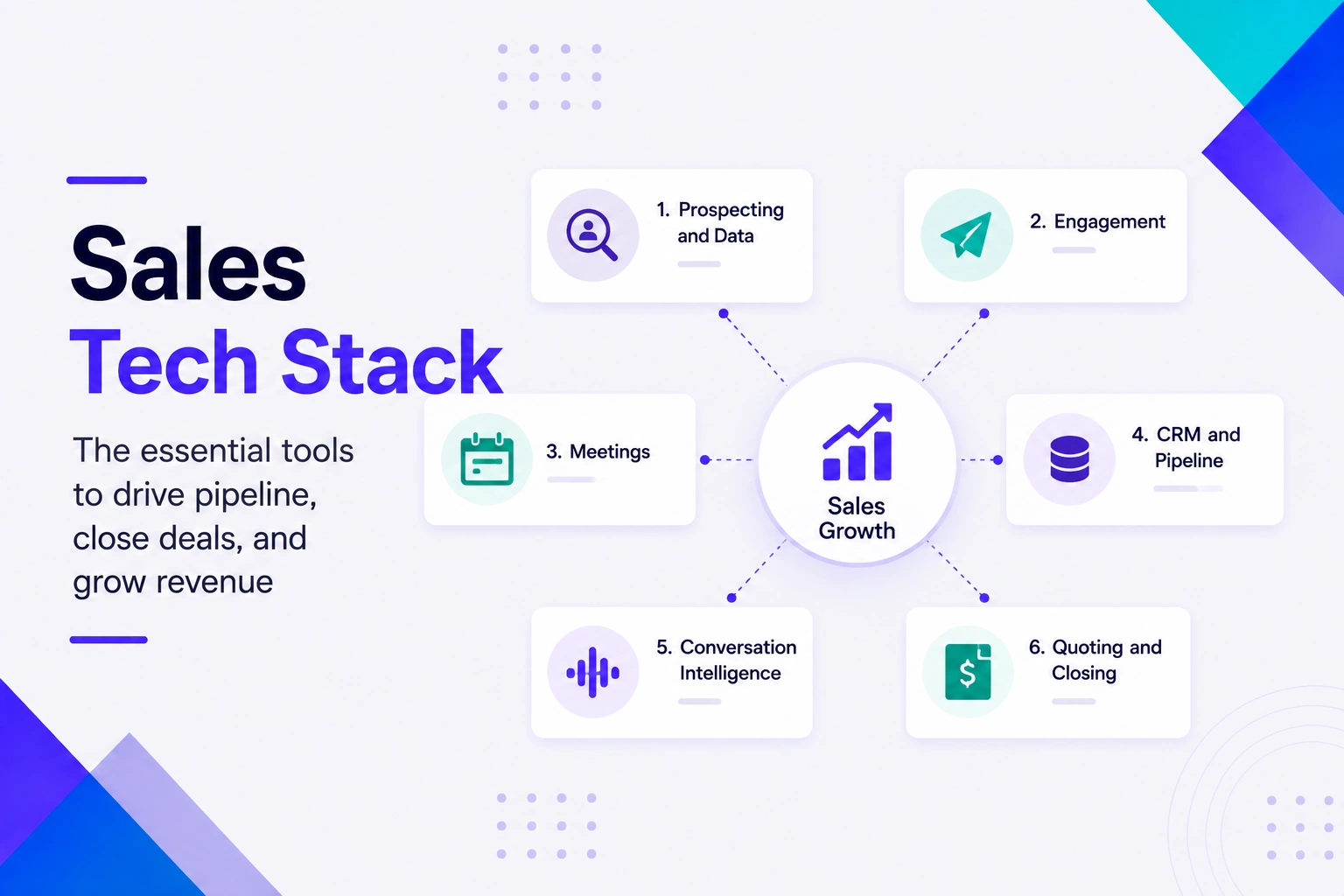
Prospecting and data
This layer answers who to contact: contact databases, enrichment, list building, technographics, and intent.
The failure is decay. Contact data goes stale continuously as people change roles, while enrichment usually runs on a schedule, so a list built last quarter burns rep time and sender reputation this quarter. Bad data does not announce itself. It shows up as a bounce rate and a demoralized SDR.
Our guide to data enrichment tools covers the category, CRM cleanup covers remediation, and Knock Enrich enriches at the moment of engagement rather than in batches.
Engagement
This layer is where reps reach out: sequencers, dialers, LinkedIn tooling, messaging apps, and increasingly AI agents that handle first-touch and follow-up.
Two problems live here. Sequences are built for volume, so personalization collapses to a merge field. And each engagement tool owns its own thread, which means the rep calling a prospect has no view of the chat conversation that prospect had on the website last week.
Knock Outreach triggers follow-up from live signals rather than static enrollment, Knock Chat holds one thread across channels, and our guide to AI SDR tools covers the automation category.
Meetings
This layer converts interest into time on a calendar: scheduling links, routing, qualification before booking, reminders, and reschedule handling.
The failure is everything after the booking. Most scheduling tools consider the job done when the invite sends, which leaves no-shows, reschedules, and cold reengagement to the rep. Our comparisons of Chili Piper alternatives and Calendly pricing cover the category, and Knock Scheduling books from inside the conversation rather than after a form.
CRM and pipeline
This layer is the system of record: accounts, contacts, opportunities, stages, activity capture, and the forecast.
The CRM is only ever as accurate as what reached it, and most of what reaches it was typed by a rep at the end of a quarter. That is not a discipline problem. It is a design problem, because the systems that held the real interaction never wrote to it. Knock CRM syncs resolved identity and relationship context into Salesforce or HubSpot automatically.
Conversation intelligence
This layer records and analyzes calls: transcripts, talk ratios, keyword tracking, deal risk scoring, and coaching workflows.
The insight this layer generates is real. The honest caveat is that it earns its cost at volume. At five reps running fifteen discovery calls a week, disciplined CRM notes cover the same ground, and the infrastructure cost of acting on the insight is not justified until you have dedicated managers reviewing recordings and a coaching process to apply what surfaces.
Quoting and closing
This layer turns agreement into paper: CPQ, proposals, e-signature, approval workflows, and pricing rules.
The failure is premature adoption. CPQ shines with complex pricing, multiple configurations, or lengthy approvals. Bought early, it adds setup time and duplicates CRM functionality for deals a template and a signature tool would have handled.
Best sales tech stack tools by layer in 2026
The right tool depends on which layer is failing. This is the shortlist per layer, with the situation each one fits.
Best for identity and context: Knock AI
Knock AI is the identity and memory layer for a sales tech stack. It resolves one buyer across website, Slack, LinkedIn, WhatsApp, Telegram, email, and phone, so the rep opens a conversation already holding what the buyer asked, objected to, and compared you against.
Best for: teams where reps rebuild context manually before every call
Limitation: it is not a dialer, a CPQ tool, or a conversation intelligence platform. It sits underneath those
Best for prospecting data: ZoomInfo, Apollo, Cognism, Clay
ZoomInfo leads on database breadth, Apollo bundles data with sequencing at a lower price point, Cognism leads on European coverage and compliance, and Clay leads on programmatic list building. Lusha suits smaller teams that need coverage without an enterprise contract.
Best for engagement: Outreach, Salesloft, Apollo, Knock AI
Outreach and Salesloft lead on sequencing, dialer, and rep workflow at scale. Apollo covers sequencing for teams that also want the data in one place. Knock AI Agent handles qualification and follow-up across messaging channels rather than email alone, which matters when buyers stop replying to email.
Best for meetings: Chili Piper, Calendly, Knock AI
Chili Piper leads on inbound routing and handoff after a form. Calendly leads on simplicity and price for individual scheduling. Knock Scheduling books inside the conversation and keeps working after the invite sends, which is where most no-show loss happens.
Best for routing: LeanData, Chili Piper, Knock AI
LeanData leads on Salesforce lead-to-account matching and complex routing trees. Knock Routing routes on live conversation context, ownership, and relationship history rather than form fields, and lead routing software compares the category.
Best for knowing who is on your site: Knock AI, Clearbit, RB2B, Warmly
Clearbit and RB2B lead on de-anonymization, and Warmly is now part of HubSpot. Knock Reveal resolves a person rather than a company, and our comparison of visitor identification software covers the set.
Best for conversation intelligence: Gong, Chorus, Avoma
Gong leads on call coverage, deal risk, and coaching workflow. Chorus is the natural fit for ZoomInfo customers. Avoma covers meeting notes and recording for smaller teams at a lower price. Add this layer when call volume and a coaching process justify it, not before.
Best for quoting and closing: DealHub, PandaDoc, DocuSign
DealHub leads on guided selling and CPQ workflow. PandaDoc covers proposals and e-signature for mid-market teams. DocuSign remains the default for signature alone. Most teams need the third long before they need the first.
The two stacks hiding inside your sales stack
Here is the split almost no stack guide names. Every sales tech stack contains two stacks with different owners and different beneficiaries.
The manager's stack exists to create visibility. Forecasting tools, conversation intelligence, activity capture, dashboards, pipeline inspection, and the CRM fields that exist so someone can filter on them. These are bought by leadership, evaluated on reporting quality, and largely operated by reps entering data.
The rep's stack exists to create conversations. Data that is accurate on the day they call, context about what the buyer already did, scheduling that removes friction, and content they can send without asking marketing.
Both are legitimate. The problem is proportion. Most sales tooling budget and most implementation effort goes to the first, and the cost of maintaining it is paid by the second in data entry. When active selling sits near a quarter of the week, that is not reps being undisciplined. It is a stack working exactly as it was designed.
The tell is simple. Ask what a tool does when nobody enters anything into it. If the answer is nothing, it belongs to the manager's stack, and its adoption depends entirely on rep compliance rather than rep benefit.
Visibility is a byproduct of good tooling, not a substitute for it. The stacks that work capture context automatically and give reporting away for free, rather than asking the rep to produce reporting as a separate task.
What reps actually need before a call
Strip the category names away and a rep opening a first conversation needs six things.
Who this person is and whether the contact details are current. What company they work for and whether it looks like your ICP. Whether anyone at your company has spoken to them or anyone else at their account. What they have already asked or read. What they compared you against. And what happened the last time you talked.
Read that list against a typical stack and the gap becomes obvious. The first two are well covered by the data layer. The last four are covered by nothing, because each lives in a different system that does not write to the record the rep opens.
That is the sales-side version of the same problem the marketing stack creates at the seams and the RevOps stack creates at handoffs. The rep experiences it as starting cold on a warm buyer.
How to audit your sales tech stack
Step 1: Map tools to the six layers. Note overlap and gaps. Overlap concentrates in prospecting data and engagement, where several tools usually claim the same job.
Step 2: Measure selling time, not seat count. Shadow two reps for a day and record where the hours go. This produces a more useful budget argument than any license audit.
Step 3: Sort every tool into the two stacks. Manager's or rep's. If the manager's side dominates spend and the rep's side is thin, you have found the productivity problem.
Step 4: Ask reps which tools they would keep. The answers are usually short, consistent, and different from the renewal list.
Step 5: Count the retypes. Follow one deal and count every time a person entered information a system already held. Each one is an integration failure with a labor cost attached.
Step 6: Check what a rep knows before a first call. Compare it against the six things above. The missing items are your context gap.
Where Knock AI fits in the sales tech stack
Knock AI is not a seventh tool for reps to open.
It is the identity and memory layer underneath the six they already use.
It resolves the buyer across every channel and device, preserves what happened across marketing, chat, agent, and rep interactions, and writes that context back into the CRM so the rep opens a record that reflects the relationship. How Knock works covers the mechanics.
In practice, sales teams use it to close specific gaps:
- Context before the call: the rep sees what the buyer asked and compared before dialing
- Chasing ghosts: buyers who went quiet get reengaged on the channel they actually use, which is the problem behind SDRs chasing ghosts
- Meetings that hold: booking happens inside the conversation and follow-up continues after the invite
- Field and event capture: the Knock Sales Card starts a real relationship at events instead of collecting a badge scan
- Agent and human: both read and write the same memory rather than duplicating discovery, which is the argument behind our AI SDR approach
Published customer results include 12x ROI and 38% pipeline growth at Rivery, 46% higher SQL conversion and more than four SDR hours saved per day at Veho, and a 75% reduction in lead-to-SQL time at Cyera.
It runs alongside what you already own. Setup guides exist for Salesforce, HubSpot, and Marketo.
Where it is the wrong fit. If your problem is territory design, comp plans, or pricing strategy, no data layer fixes that. Those are process decisions.
Common sales tech stack mistakes
Buying conversation intelligence before you have call volume. The insight is real. The coaching process required to act on it is what makes it worth the money, and most teams buy the tool before they build the process.
Adding a tool to fix a data problem. A second prospecting database does not fix a list that was stale when the sequence launched.
Measuring adoption by logins. A rep opening a tool because a manager asked is not adoption. Ask instead what they would fight to keep.
Treating CRM hygiene as a discipline issue. If the systems holding the real interaction do not write to the CRM, the rep is the integration, and no amount of enforcement changes the economics of that.
Buying CPQ early. It solves complex configuration and approval chains. For simple deals it adds setup time and duplicates the CRM.
Letting each team pick its own channel. Marketing in automation, SDRs in a sequencer, AEs in the inbox, and the buyer experiencing three different companies.
FAQs
What is a sales tech stack?
A sales tech stack is the connected set of software a sales team uses to find prospects, engage buyers, run meetings, manage pipeline, and close deals. It typically covers six layers: prospecting and data, engagement, meetings, CRM and pipeline, conversation intelligence, and quoting and closing.
What is the difference between a sales tech stack and a marketing tech stack?
Scope and owner. A marketing tech stack covers demand creation and capture and is judged on pipeline created. A sales stack covers what a quota-carrying rep touches daily and should be judged on selling time and conversion. They overlap at data, intent, routing, and scheduling, which is where duplicate spend usually hides.
How many tools should a sales team have?
Fewer than most have. Research across 2026 stack guides consistently finds tool count inversely correlated with rep productivity past a certain point, and with utilization near 49% the first move is usually to operate what you own rather than to add. Lean configurations of a handful of well-integrated tools are the prevailing recommendation.
Why do reps spend so little time selling?
Because the stack was largely designed to produce visibility, and reps produce that visibility through data entry. Salesforce research has long put active selling at roughly a quarter of a rep's time. The fix is capturing context automatically rather than asking reps to log it.
Which sales tools work best together in 2026?
A workable stack pairs a CRM such as Salesforce or HubSpot, a data source such as ZoomInfo or Apollo, an engagement layer such as Outreach or Salesloft, scheduling such as Chili Piper, conversation intelligence such as Gong once volume justifies it, and an identity and memory layer such as Knock AI so reps start conversations with context rather than rebuilding it.
What is the difference between a sales tech stack and a GTM tech stack?
A GTM tech stack covers the full revenue motion including marketing, retention, and enablement. A sales tech stack is the subset a rep uses day to day, so every sales stack sits inside a GTM stack.
Do we need conversation intelligence?
Only once you have the call volume and the coaching process to use it. At small scale, disciplined CRM notes cover similar ground, and the value comes from managers reviewing and coaching rather than from the recording itself.
How do you improve sales tool adoption?
Buy tools that do something useful when nobody enters anything into them. Adoption problems are usually design problems: a tool that only produces value after a rep does admin will be used exactly as much as compliance requires.
Should AI SDRs replace human SDRs?
The more defensible position is that pipeline can grow without early-sales headcount growing at the same rate. Agents absorb qualification, follow-up, and scheduling well. What they need to do it correctly is identity and relationship context, which is why AI SDR deployments on fragmented data disappoint.
What should a sales team fix first?
Context before the call. It is the constraint that touches every other metric: connect rates, meeting hold rates, discovery quality, and cycle length all improve when the rep starts a conversation knowing what already happened.
Most sales teams do not have a tooling problem. They have a context problem that looks like a discipline problem, which is why the stack keeps growing and selling time does not.


.svg)


.svg)
.svg)
.svg)


.svg)
.svg)


.svg)


