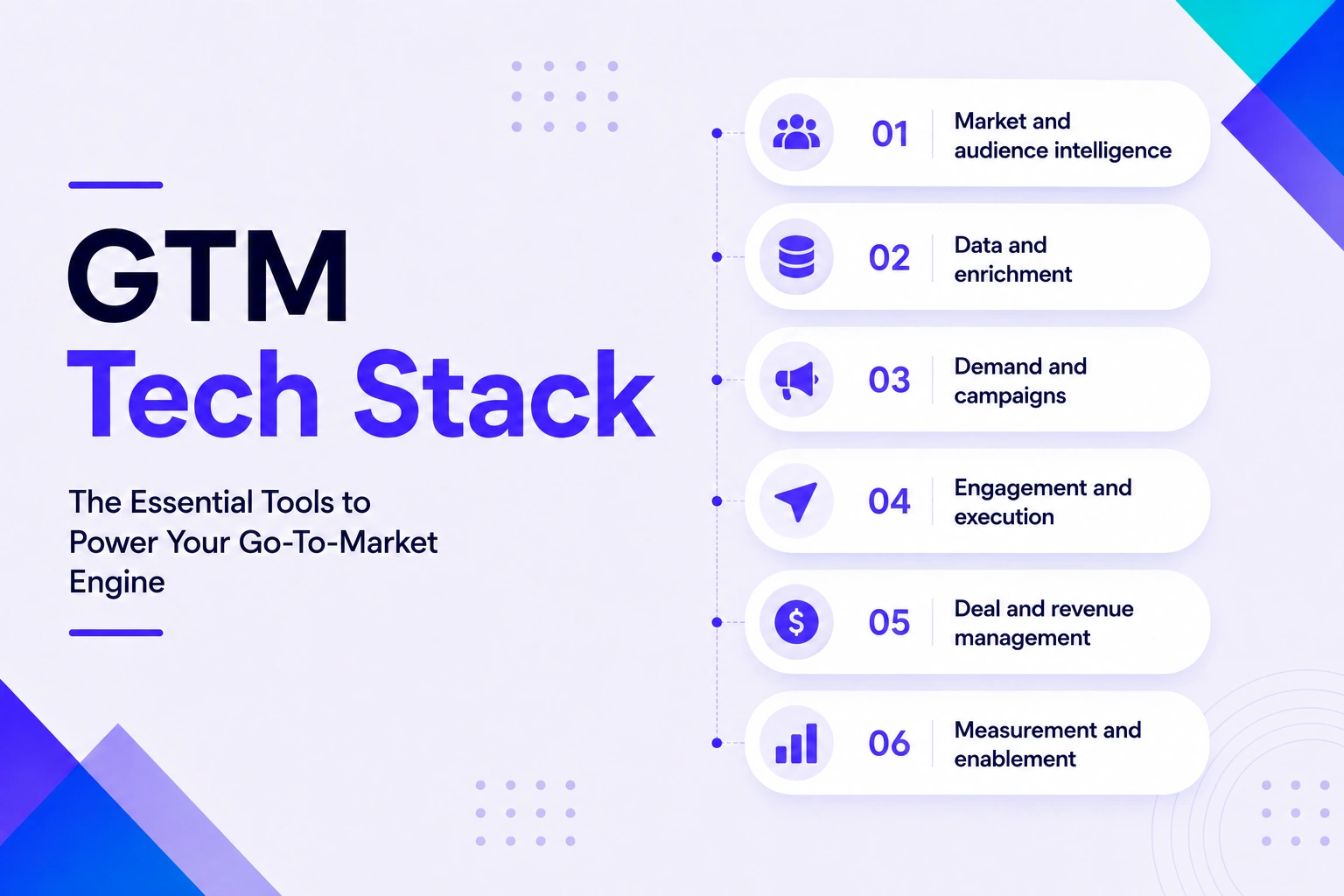
Market and audience intelligence
This category answers who to go after: ICP definition, market sizing, technographics, hiring and funding triggers, and third-party intent.
The failure is resolution. Intelligence at this layer is almost always account-level, so it tells you a company is worth pursuing without telling you which human to reach or when. The signal arrives, it lands in a dashboard, and by the time someone acts on it the moment has moved.
Knock Intent scores first-party signals live, and our comparison against intent data tools covers where the approaches diverge.
Data and enrichment
This category makes records usable: contact and company data, firmographics, technographics, deduplication, and identity resolution.
Stale data is the quiet tax on every other category. Enrichment runs on a schedule while contact data decays continuously, and duplicate records accumulate because the same person arrives through a form, an event list, a product signup, and a conversation without carrying a shared identifier. Everything downstream inherits that.
Our guide to data enrichment tools covers the category, and CRM cleanup covers remediation.
Demand and campaigns
This category creates and captures interest: marketing automation, paid media, content, SEO, webinars, and events.
The failure here is measured in what never gets recorded. Demand is created across channels a company does not control, and most of it dissipates before a buyer reaches a form. That loss is invisible in reporting because a buyer who never converts leaves nothing to count. Skip the form covers the alternative, and demand budget covers the economics of recovering it.
Engagement and execution
This category is where the company actually talks to buyers: sales engagement sequences, website chat, messaging apps, scheduling, and AI agents.
The structural problem is thread ownership. The sequencer knows which emails opened, the chat tool knows what was typed on site, the rep knows what happened on the call, and none of them knows the other two. The buyer experiences this as being asked the same question three times by one company.
Knock Chat and Knock AI Agent hold one thread across every channel, and our guide to AI SDR tools covers the automation category.
Deal and revenue management
This category runs the commercial process: CRM, opportunity management, quoting, approvals, and forecasting.
The CRM is only ever as accurate as what reached it. Records arrive incomplete from four motions with different capture mechanisms, and because reports still render, nobody notices until the forecast misses. Knock CRM writes resolved identity and relationship context back into Salesforce or HubSpot.
Measurement and enablement
This category covers what worked and what reps need: attribution, pipeline analytics, BI, enablement content, and competitive material.
Attribution inherits every weakness above it. With fragmented identity it measures sessions rather than people, and credit lands wherever a resolvable identifier happened to exist. Fix funnel leakage covers diagnosis.
Best GTM tech stack tools by category in 2026
The right tool depends on which category is failing. This is the shortlist per category, with the situation each one fits.
Best for identity across motions: Knock AI
Knock AI is the identity and memory layer for a GTM tech stack. It resolves one buyer across website, Slack, LinkedIn, WhatsApp, Telegram, email, and phone, so a person who arrives through inbound, outbound, product, and partner motions is recognized as one relationship rather than four records.
Best for: teams running more than one motion whose buyers appear in several systems as different people
Limitation: it is not an enablement platform or a CPQ tool. It sits underneath those, not beside them
Best for market intelligence: 6sense, Bombora, Demandbase
6sense and Bombora lead on third-party account intent, and Demandbase pairs intent with orchestration. All three resolve to a domain, which is why they need a person layer beneath them to become actionable.
Best for data and enrichment: ZoomInfo, Clay, Cognism, Apollo
ZoomInfo leads on breadth, Cognism on European coverage and compliance, Clay on programmatic enrichment workflows, and Apollo on bundling data with outbound execution. Knock Enrich enriches at the moment of engagement rather than on a batch schedule.
Best for demand and campaigns: Marketo, HubSpot, Knock AI
Marketo anchors enterprise nurture and our list of Marketo competitors covers alternatives. For the capture side, our guide to online form builders covers the traditional route and Typeform alternatives covers standalone builders.
Best for engagement: Outreach, Salesloft, Qualified, Knock AI
Outreach and Salesloft lead on outbound sequencing. Qualified leads on website chat for Salesforce teams, and Intercom spans support and engagement. Knock AI holds one thread across every channel instead of one per tool.
Best for routing and handoffs: LeanData, Chili Piper, Knock AI
LeanData leads on Salesforce lead-to-account matching. Chili Piper leads on meeting routing after a form. Knock Routing routes on live conversation context rather than static inputs, and lead routing software compares the category.
Best for identifying buyers before they convert: Knock AI, Clearbit, RB2B, Warmly
Clearbit and RB2B lead on de-anonymization, and Warmly is now part of HubSpot. Knock Reveal resolves a person across channels and devices, and our comparison of visitor identification software covers the wider set.
Best for measurement: Dreamdata, HockeyStack, Gong, Clari
Dreamdata and HockeyStack lead on B2B attribution. Gong leads on conversation intelligence, Clari on forecast rollups. Each reads from the CRM, so accuracy is bounded by the records beneath it.
The four motions a GTM stack has to run
Here is the part most GTM stack guides skip. A stack is not one pipeline. It is four, and each one wants different tools and breaks in a different place.
Inbound. The buyer arrives already researching. The stack's job is to recognize them fast and start a conversation before intent decays. This motion breaks at capture, because most interested buyers leave before completing a form and therefore never become a record at all.
Outbound. The company reaches first. The stack's job is accurate targeting and enough context to be worth a reply. This motion breaks at data quality, because a sequence built on stale contacts burns domain reputation and rep time simultaneously.
Product-led. The buyer self-serves into the product. The stack's job is to spot expansion signals and know when a human should appear. This motion breaks at the boundary between product analytics and the CRM, where a highly engaged free user and a known contact are usually two different records.
Partner and community-led. The relationship starts through someone else: a partner, a Slack community, an event, a peer recommendation, or an AI assistant summarizing your category. This motion breaks hardest, because the buyer arrives with no cookie, no form fill, and no email address, and most stacks have no way to recognize them at all.
Now put those together. A single buyer can appear in three motions in one quarter: read a partner's post, self-serve into a trial, and receive an outbound sequence from a rep who has no idea about either. Three motions, three records, one increasingly annoyed person.
The stack fragments per motion. The buyer does not.
The execution gap
Highspot's number is the one worth sitting with. Nearly every enterprise revenue leader believes go-to-market execution is standardized across the company, and roughly half get consistent outcomes from it. Meanwhile 42% name fragmented tools and systems as a primary blocker.
Read those together and the diagnosis is specific. The strategy is written down. The plays exist. The tools were bought. What fails is the layer between the plan and the field, where a rep opens a record that does not say what the buyer already asked, or an agent restarts a conversation someone else finished.
Standardization on paper does not survive contact with a fragmented identity model. You cannot execute one consistent motion against a buyer your systems believe is four people.
Does consolidating your GTM stack close the gap?
Partly. Fewer platforms means fewer integrations, fewer field mappings, fewer sync failures, and a smaller invoice. Consolidation is a reasonable default in 2026 and most teams have room to cut.
But it addresses tool count, which is not the same as continuity. Six well-integrated platforms running four motions with four identity models produce the same fragmentation as fifteen, at lower cost. That is a real saving and not a fix.
The test: if you merged your GTM stack into one platform tomorrow, would a rep taking an outbound call know the person already ran a trial and asked two questions in your Slack community? If not, the problem was never the tool count.
How to audit your GTM tech stack
Step 1: Map tools against the six categories and the four motions. Build a grid. Overlap concentrates in data and engagement. Gaps concentrate in partner and community-led, which most stacks do not instrument at all.
Step 2: Measure utilization, not licenses. Expect roughly half of purchased capability to be idle, and use renewal dates as the forcing function.
Step 3: Trace one buyer across two motions. Find someone who touched you through two different routes. Reconstruct what each system knew and when. The point where the two paths fail to join is your fragmentation.
Step 4: Count duplicate humans in your top accounts. Every duplicate is a motion that failed to recognize a buyer another motion already knew.
Step 5: Check what the field actually has. Ask three reps what they know about a buyer before a first call, then compare that against what the stack holds. The delta is your execution gap made concrete.
Step 6: Decide between consolidating and connecting. Overlapping capability means consolidate. Buyers who arrive as strangers in one motion after engaging in another means connect.
Where Knock AI fits in the GTM tech stack
Knock AI is not a seventh category.
It is the identity and memory layer underneath the six you already run.
It resolves one buyer across every channel and device regardless of which motion they arrived through, preserves the relationship history across handoffs, and gives both humans and AI agents the same context before they act. How Knock AI works covers the mechanics.
In practice, GTM teams use it to close specific gaps:
- Across motions: one person recognized whether they arrive from a partner, the product, a campaign, or a sequence
- Inbound capture: a conversation starts without a form, so an identity exists from the first interaction
- Partner and community: buyers who arrive with no cookie and no email still become a known relationship
- Human and agent: both read and write the same relationship memory rather than duplicating discovery
Published customer results include 12x ROI and 38% pipeline growth at Rivery, 46% higher SQL conversion and more than four SDR hours saved per day at Veho, and a 75% reduction in lead-to-SQL time at Cyera.
It runs alongside what you already own. Setup guides exist for Salesforce, HubSpot, and Marketo.
Where it is the wrong fit. If you run a single motion at low volume, one person can hold the context in their head. The value appears when motions multiply and nobody can.
Common GTM tech stack mistakes
Buying per motion. Every new motion arrives with its own recommended tool, and nobody asks whether the buyer it creates will be recognizable to the other three.
Consolidating before diagnosing. Cutting the vendor list lowers spend. It does not connect a buyer across motions, and teams are often surprised when fragmentation survives the project.
Treating partner and community as unmeasurable. It is the fastest growing source of B2B trust and the least instrumented part of most stacks, which means it looks like it does not work.
Standardizing plays without standardizing the buyer record. A consistent play executed against four versions of the same person is not consistent execution.
Adding agents on top of a fragmented identity model. An agent does not fail quietly. It fails at volume, across every motion at once.
Measuring channels rather than people. Channel reporting shows which motion generated a touch. It rarely shows that four touches belonged to one buyer.
FAQs
What is a GTM tech stack?
A GTM tech stack is the connected set of software a company uses to take a product to market, spanning market intelligence, data and enrichment, demand and campaigns, engagement and execution, deal and revenue management, and measurement and enablement.
What is the difference between a GTM tech stack and a marketing tech stack?
Scope. A marketing tech stack covers demand creation and capture. A GTM stack covers the entire revenue motion including sales execution, deal management, retention, and enablement, so it contains the marketing stack rather than sitting beside it.
What is the difference between a GTM stack and a RevOps stack?
They overlap heavily and are often used interchangeably. The practical difference is orientation. A RevOps tech stack is organized around data integrity, process, and reporting. A GTM stack is organized around the motions that generate and close revenue. RevOps is usually the function that governs the GTM stack.
How many tools should a GTM tech stack have?
Most teams have expanded to ten to fifteen platforms and the 2026 consolidation advice points toward five to eight. Treat that as direction rather than a target, since with utilization near 49% the bigger opportunity is usually operating what you already own.
What are the four GTM motions?
Inbound, outbound, product-led, and partner or community-led. Each requires different tooling and breaks in a different place: inbound at capture, outbound at data quality, product-led at the product-to-CRM boundary, and partner-led at identity, because those buyers arrive with no form fill and no cookie.
Why do GTM tech stacks fragment?
Because one stack has to run several motions with different capture mechanisms, and no motion shares an identity model with the others. A buyer engaging through two motions becomes two records, and the fragmentation compounds every time a new motion is added.
What is the GTM execution gap?
The distance between believing execution is standardized and getting consistent outcomes. Highspot found 98% of enterprise revenue leaders believe their go-to-market execution is standardized company-wide while only 53% report highly consistent outcomes, and 42% cite fragmented tools as a primary blocker.
Which GTM tools work best together in 2026?
A workable stack pairs a CRM such as Salesforce or HubSpot, an enrichment source such as ZoomInfo or Clay, an intent source such as 6sense, an engagement layer such as Outreach, an attribution tool such as Dreamdata, and an identity and memory layer such as Knock AI so the same buyer stays recognizable across every motion.
Who owns the GTM tech stack?
Usually nobody entirely, which is the source of most problems. RevOps typically governs data quality, integration, and tool selection, while marketing, sales, and product marketing each own parts of the execution layer. Assigning end-to-end ownership matters more than which team gets it.
Will AI agents replace parts of the GTM stack?
They are already absorbing execution work such as qualification, follow-up, and scheduling. What they do not replace is the identity and memory an agent needs to act correctly, which is why agent deployments on fragmented data underperform their promises.
Most GTM teams do not have a tooling problem. They have a recognition problem that presents as a tooling problem, which is why each new motion adds tools and the execution gap stays where it was.
The stack runs the motions.
Something still has to recognize the buyer.


.svg)


.svg)
.svg)
.svg)


.svg)
.svg)


.svg)


