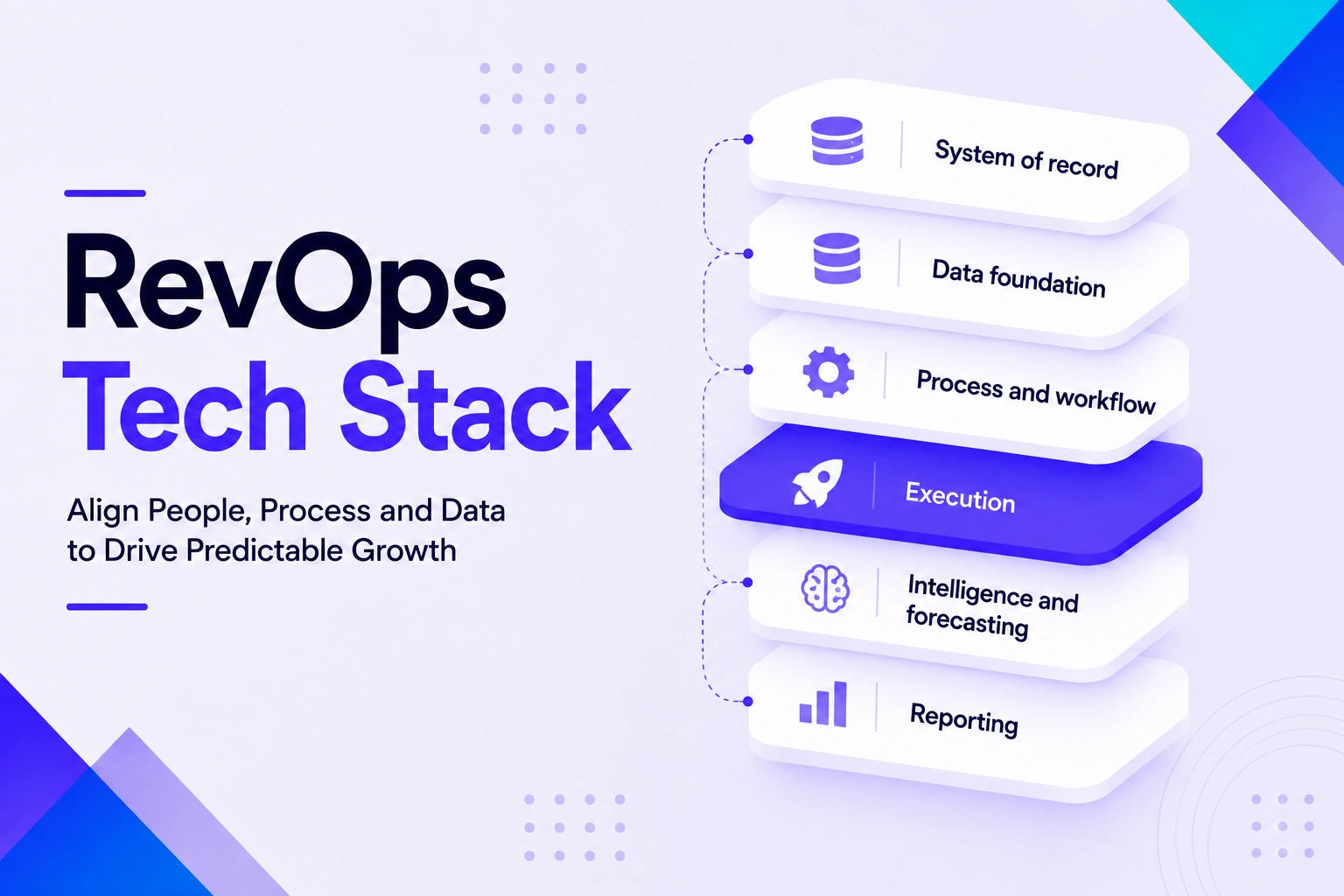
System of record
The system of record holds the object model: accounts, contacts, opportunities, and the pipeline everyone reports against. Every other tool should feed it rather than compete with it.
The failure here is quiet. A CRM with incomplete, stale, or manually entered data undermines every downstream investment, and because the reports still render, nobody notices until the forecast misses. The CRM is not wrong about what it holds. It is only ever as right as what reached it.
Knock CRM syncs resolved identity and relationship context back into Salesforce or HubSpot rather than asking the team to maintain a second source of truth.
Data foundation
The data foundation makes records accurate enough to act on: enrichment, deduplication, normalization, and the integration layer that moves data between systems.
Two failures live here. Enrichment runs in batches while data decays continuously, so a record enriched last quarter can be wrong today with nothing flagging it. And duplicate humans accumulate faster than anyone dedupes them, because the same person arrives through a form, a webinar list, an imported account list, and a conversation, and no two of those carry the same identifier.
Our guide to data enrichment tools covers the category.
Process and workflow
The process layer decides what happens to a record and who owns it: lead-to-account matching, routing rules, territory, ownership, approvals, and quoting.
Routing tools in this layer are generally well engineered. Their limitation is what they receive. A routing engine acting on a personal Gmail address and a self-reported job title routes confidently and wrongly, and the resulting misassignment shows up three weeks later as a stalled deal nobody owns.
Knock Routing routes on live conversation context rather than static form inputs, and lead routing software compares the dedicated tools.
Execution
The execution layer is where the revenue team actually touches the buyer: sales engagement sequences, marketing automation, chat, scheduling, and AI agents.
The structural problem is thread ownership. The sequencer knows which emails opened. The chat tool knows what was typed on the website. The rep knows what happened on the call. None of them knows the other two, so the buyer answers the same qualifying question three times and the CRM records three unrelated activities.
Knock Chat and Knock AI Agent hold one thread across every channel, and our guide to AI SDR tools covers the automation side.
Intelligence and forecasting
The intelligence layer turns activity into a prediction: revenue intelligence, conversation intelligence, deal risk scoring, and the forecast itself.
Forecasting quality is capped by data quality upstream. A forecast model reading a CRM with duplicate accounts, missing engagement history, and stale ownership produces a number that is internally consistent and externally wrong. This is the layer where RevOps teams most often buy a solution to a problem that originated two layers below.
Reporting
The reporting layer answers what worked: attribution, pipeline analytics, cohort reporting, and whatever goes in the board deck.
Attribution inherits every weakness above it. If identity is fragmented, attribution measures sessions rather than people, and credit lands on whichever touch happened to carry a resolvable identifier. Fix funnel leakage covers diagnosing where the trail actually breaks.
Best RevOps tech stack tools by layer in 2026
The right tool depends on which layer is failing. This is the shortlist per layer, with the situation each one fits.
Best for the identity and memory layer: Knock AI
Knock AI is the identity and relationship layer for a RevOps tech stack. It resolves one buyer across website, Slack, LinkedIn, WhatsApp, Telegram, email, and phone, preserves the relationship history across every handoff, and feeds resolved identity and context back into the CRM so the system of record reflects what actually happened.
Best for: teams whose forecast and attribution are unreliable because the underlying records do not represent real people
Limitation: it is not a forecasting tool or a BI layer. It improves the inputs those depend on
Best for system of record: Salesforce, HubSpot, Microsoft Dynamics
Salesforce leads on extensibility and enterprise object modeling. HubSpot leads on time to value and unified marketing and sales objects for mid-market teams. Whichever you run, the rule holds: every other tool should feed the CRM rather than compete with it.
Best for data foundation: ZoomInfo, Clay, Cognism, Apollo
ZoomInfo leads on database breadth, Cognism on European coverage and compliance, Clay on programmatic enrichment workflows, and Apollo on bundling data with outbound. Knock Enrich runs enrichment at the moment of engagement rather than on a batch schedule.
Best for process and routing: LeanData, Chili Piper, Knock AI
LeanData leads on Salesforce lead-to-account matching and complex routing trees. Chili Piper leads on meeting routing after a form. Knock Routing routes on conversation context, ownership, and relationship history rather than form fields.
Best for execution: Outreach, Salesloft, Marketo, Knock AI
Outreach and Salesloft lead on outbound sequencing and rep workflow. Marketo anchors enterprise nurture, and our list of Marketo competitors covers the alternatives. Knock Outreach triggers follow-up from live signals rather than from a static sequence enrollment.
Best for intelligence and forecasting: Gong, Clari, BoostUp
Gong leads on conversation intelligence and call coverage. Clari and BoostUp lead on forecast rollups and deal risk. All three read from the CRM, so their accuracy is bounded by the quality of the records underneath them.
Best for reporting: Dreamdata, HockeyStack, Looker
Dreamdata and HockeyStack lead on B2B multi-touch attribution and revenue analytics. Looker and Tableau cover general BI when reporting needs outgrow the CRM. Each inherits upstream identity quality, which is why attribution disputes usually resolve into data problems.
Best for identifying buyers before they convert: Knock AI, Clearbit, RB2B, Warmly
Most tools here resolve a company or a device. Clearbit and RB2B lead on de-anonymization, and Warmly is now part of HubSpot, which changes the standalone calculation. Knock Reveal resolves a person across channels and devices, and our comparison of visitor identification software covers the wider set.
Where revenue actually leaks: the three handoffs
RevOps owns the spaces between teams. That is the job. And it is where the money goes.
Most leakage analysis focuses on funnel stages, which is where the CRM already reports. The more useful cut is by handoff, because a handoff is the only moment when a relationship changes hands and context has to travel with it.
Marketing to sales. A lead is qualified, routed, and assigned. What transfers is a record with fields. What does not transfer is the conversation that produced the interest: what the buyer asked, what they objected to, what they compared you against. The rep restarts discovery, the buyer repeats themselves, and the interaction that actually created the opportunity is never recorded anywhere the rep can read it.
Sales to customer success. The deal closes and ownership moves. What transfers is a closed-won record and whatever the account executive wrote in the notes field on the last day of the quarter. Promises made during the sale, the reason the champion bought, and the objection the security reviewer raised all evaporate. Renewal risk is created at this handoff and discovered eleven months later.
Human to AI agent, and back. This one is new and is growing fastest. An agent picks up a conversation with whatever the CRM holds. It asks a question a human already answered. Or it escalates to a human who has no visibility into what the agent already covered. Every organization deploying AI agents in 2026 has created a third handoff and most have not instrumented it at all.
All three fail identically: the record survives the handoff and the memory does not.
That distinction is the whole argument. A system of record answers what stage the deal is in. A system of memory answers what happened, which is what the next owner actually needs.
Does consolidating your RevOps stack fix this?
Partly, and it is worth doing for cost and maintenance reasons alone. Fewer integrations means fewer field mappings, fewer sync failures, and fewer places for a record to go stale.
But consolidation addresses tool sprawl, not continuity. Four tightly integrated platforms with the same three unrecorded handoffs leak in the same three places. If your diagnosis is that reporting is unreliable and deals stall after transfer, cutting the vendor list will reduce your spend and leave the underlying problem where it was.
The honest test: if you merged your stack into one platform tomorrow, would a customer success manager know why the customer bought? If not, the problem was never the number of tools.
How to audit your RevOps tech stack
Run this before a consolidation project, not after.
Step 1: Map tools against the six layers. Note which layers hold overlapping tools and which hold none. Overlap usually sits in data and reporting. Gaps usually sit in memory.
Step 2: Measure utilization, not licenses. Find which capabilities are actually in use and by whom. Expect roughly half of what you own to be idle, and treat renewal as the moment to act on that.
Step 3: Trace one closed-won deal end to end. Reconstruct every interaction from first anonymous touch to signature, using only what is in your systems. Note every point where the trail goes cold.
Step 4: Score the three handoffs. For that same deal, ask what the receiving team actually knew at each handoff. Then ask what they had to re-establish by asking the customer.
Step 5: Count duplicate humans. Pick your top fifty accounts and count how many contacts are the same person under different records. This number predicts forecast error better than most forecast tooling.
Step 6: Quantify pre-record loss. Compare identified in-market visitors against the number who ever became a record. That gap is demand already paid for that never entered the pipeline, which is the argument behind recovering demand budget.
Where Knock AI fits in the RevOps tech stack
Knock AI is not a seventh tool competing with your CRM.
It is the identity and memory layer underneath the six you already run.
It resolves one buyer across every channel and device, preserves the relationship history that handoffs normally destroy, and writes resolved identity and context back into the system of record. How Knock AI works covers the mechanics.
In practice, RevOps teams use it to close specific gaps:
- Duplicate humans: one person resolved across channels rather than four records to merge later
- Marketing to sales: the rep opens the conversation already holding what the buyer asked and objected to
- Human to agent: agents and humans read and write the same relationship memory
- Attribution: credit attaches to a person with a history rather than to whichever session carried an identifier
Published customer results include 12x ROI and 38% pipeline growth at Rivery, 46% higher SQL conversion and more than four SDR hours saved per day at Veho, and a 75% reduction in lead-to-SQL time at Cyera.
It runs alongside what you already own. Setup guides exist for Salesforce, HubSpot, and Marketo.
Where it is the wrong fit. If your problem is forecast methodology or compensation design, this is not that. Those are process problems, and no data layer solves them.
Common RevOps tech stack mistakes
Consolidating before diagnosing. Cutting from fifteen tools to four reduces cost. It does not repair a handoff, and teams are often surprised when the leakage survives the project.
Buying forecasting to fix forecast accuracy. The model is rarely the problem. The records feeding it usually are.
Treating data quality as a one-time cleanup. Decay is continuous. A quarterly project guarantees three months of drift between runs.
Measuring the funnel but not the handoffs. Stage conversion is well instrumented in every CRM. The transfer between owners is instrumented almost nowhere, which is exactly why it leaks.
Deploying AI agents on top of unresolved identity. An agent with a fragmented picture does not fail quietly. It fails at volume, in front of customers, and it writes its mistakes back into the CRM.
Letting each team own its own definition. When marketing, sales, and customer success each define an engaged account differently, no amount of BI will reconcile the reports.
FAQs
What is a RevOps tech stack?
A RevOps tech stack is the connected set of software that runs the full revenue lifecycle across marketing, sales, and customer success. It typically covers six layers: system of record, data foundation, process and workflow, execution, intelligence and forecasting, and reporting.
What are the layers of a RevOps tech stack?
Six: system of record, data foundation, process and workflow, execution, intelligence and forecasting, and reporting. A seventh layer, identity and memory, sits underneath all of them and is missing from most stacks, which is why context does not survive handoffs between teams.
What is the difference between a RevOps stack and a marketing tech stack?
A marketing tech stack covers demand creation and capture and is judged on pipeline created. A RevOps stack spans the entire revenue lifecycle including post-sale, and is judged on forecast accuracy, data integrity, and revenue leakage between teams.
How many tools should a RevOps stack have?
Fewer than most teams own, though tool count is a weak proxy for capability. Enterprise RevOps teams commonly run twelve to eighteen platforms while high performers trend toward a smaller integrated set. With utilization at 49%, the first move is usually to operate what you already have rather than to buy or cut.
Which RevOps tools work best together in 2026?
A workable stack pairs a CRM such as Salesforce or HubSpot, an enrichment source such as ZoomInfo or Clay, a routing layer such as LeanData, an execution layer such as Outreach or Marketo, a forecasting tool such as Clari, an attribution tool such as Dreamdata, and an identity and memory layer such as Knock AI so the records underneath all of them describe real people.
Where does revenue leakage actually happen?
At handoffs rather than at funnel stages. The three that matter are marketing to sales, sales to customer success, and human to AI agent. In each case the record transfers and the relationship memory does not, so the receiving owner restarts work the customer already did.
Will consolidating our RevOps stack fix our data problems?
It will reduce integration overhead, cost, and the number of places data can go stale, which is worth doing. It will not repair handoffs. Four integrated platforms with the same unrecorded transfers leak in the same places as fifteen.
How do you improve forecast accuracy?
Start below the forecasting tool. Duplicate contacts, stale ownership, and missing engagement history produce forecasts that are internally consistent and wrong. Fixing identity resolution and record completeness usually moves accuracy more than changing the model.
Should RevOps own the AI agents?
Increasingly yes, because agents read and write to the same systems RevOps governs. An agent acting on bad records creates bad records faster than a human can, which makes agent deployment a data governance decision before it is a productivity one.
What should a RevOps team fix first?
Identity, in almost every case. Duplicate humans and unresolved buyers corrupt routing, attribution, forecasting, and reporting simultaneously, so it is the one fix that improves several layers at once.
Most RevOps teams do not have a tooling problem. They have a memory problem that shows up as a tooling problem, which is why the consolidation projects keep coming and the forecast keeps missing.
The stack records the deal.
Something still has to remember the relationship.


.svg)


.svg)
.svg)
.svg)


.svg)
.svg)


.svg)


