Artisan AI Review 2026: Features, Pricing & Alternatives
Artisan AI Review 2026
TL;DR
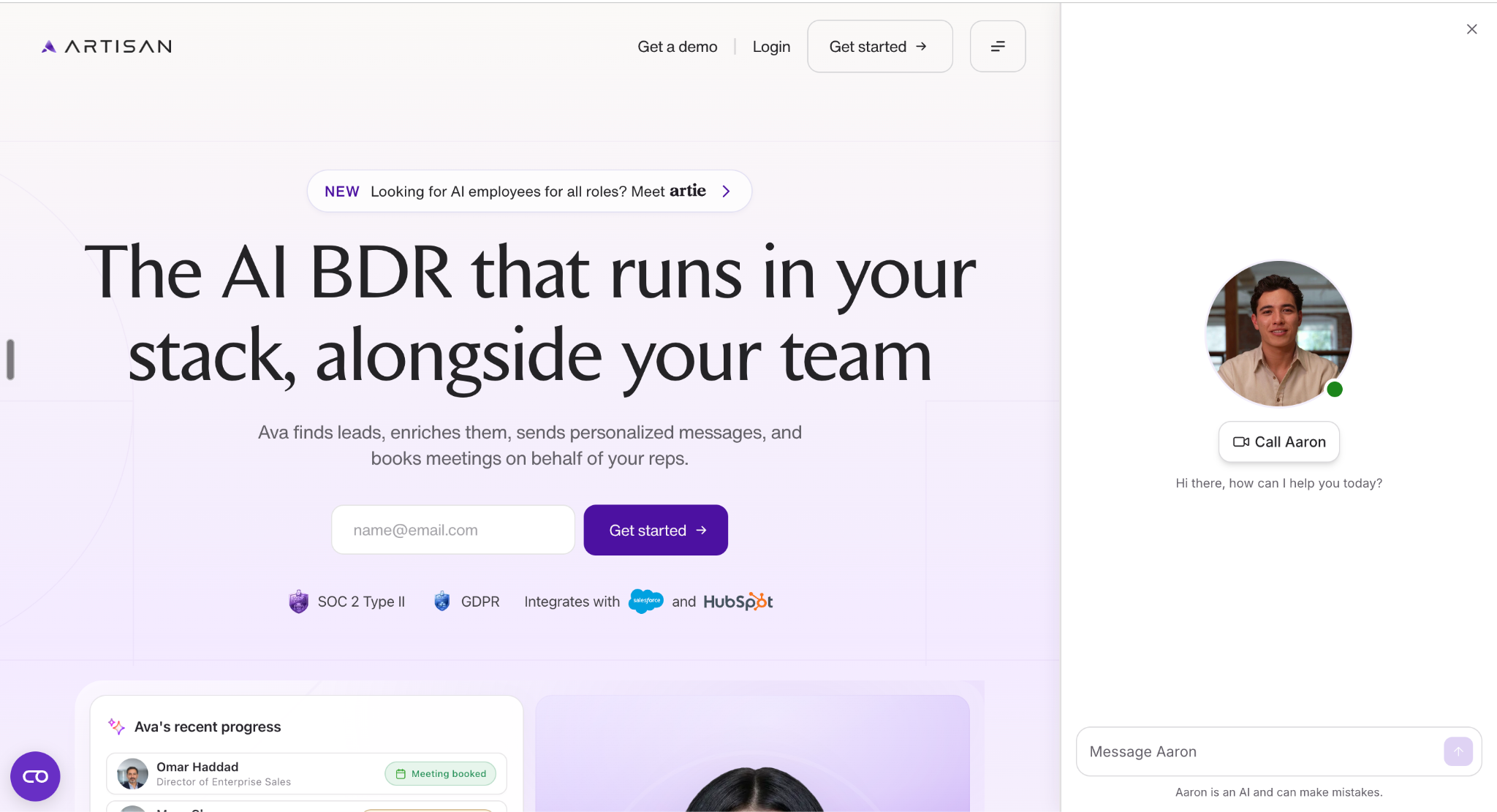
Artisan AI is a sales automation platform built around Ava, its AI BDR, which automates prospect research, lead generation, personalized outreach, follow-ups, reply handling, and meeting booking.
Key features: A database of 250M+ B2B contacts, intent signals, website visitor identification, CRM reactivation, HubSpot and Salesforce integrations, and centralized campaign management.
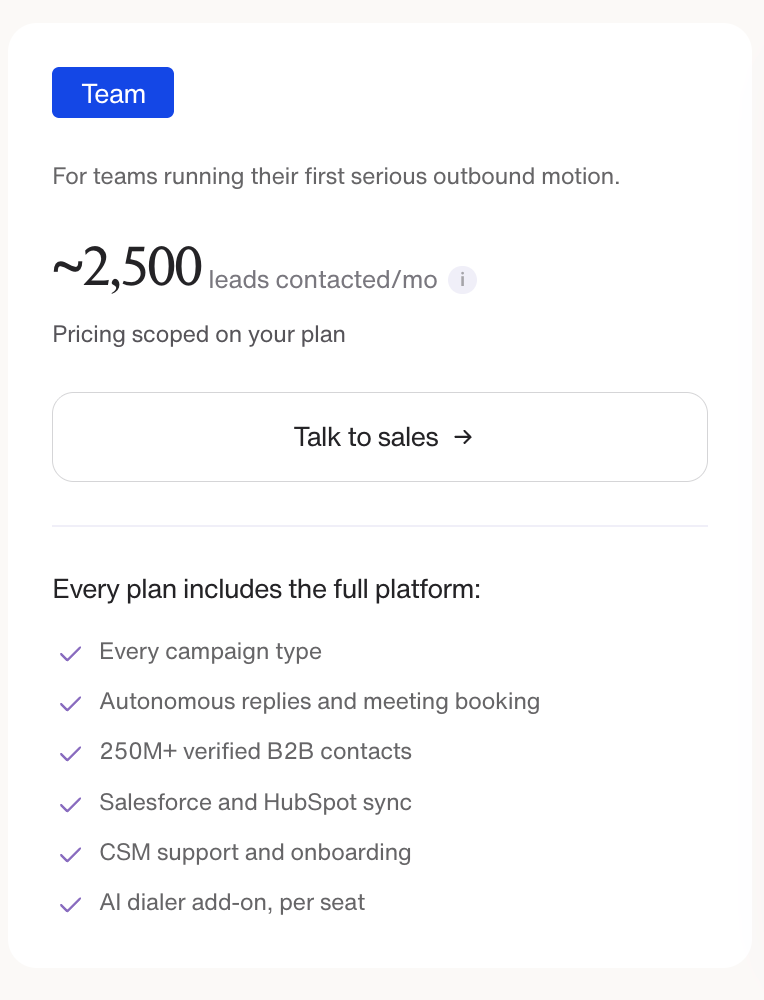
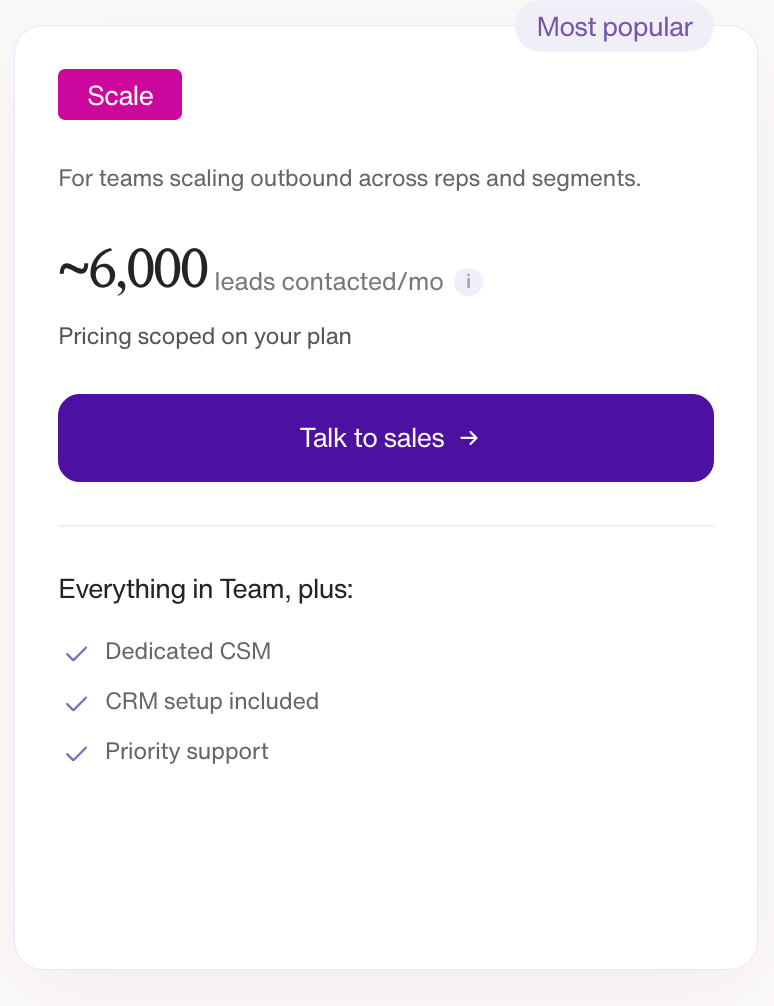
Pricing: Artisan offers Team (approximately 2,500 leads contacted per month), Scale (approximately 6,000), and Enterprise plans. Pricing is customized based on lead volume, mailboxes, and dialer seats.
Pros: End-to-end outbound automation, a large contact database, customizable messaging, CRM integrations, and reduced manual prospecting work.
Is it worth it? Artisan is worth evaluating if outbound prospecting is your main bottleneck. Test lead quality, messaging, and reliability before committing.
Artisan AI vs. Knock AI: Artisan helps teams scale prospecting and outbound outreach, while Knock AI focuses on identifying buyer intent, engaging and qualifying leads, and turning existing demand into sales opportunities.
Best alternatives:Knock AI, 11x, AiSDR, and Apollo.io, depending on whether you need buyer conversion, autonomous sales agents, AI-powered outbound, or prospecting data and engagement tools.
What Is Artisan AI?
What if your SDR could research prospects, write personalized outreach, follow up with interested buyers, and book meetings without you having to manage every step? That's the idea behind Artisan AI, a sales platform built around autonomous AI employees.
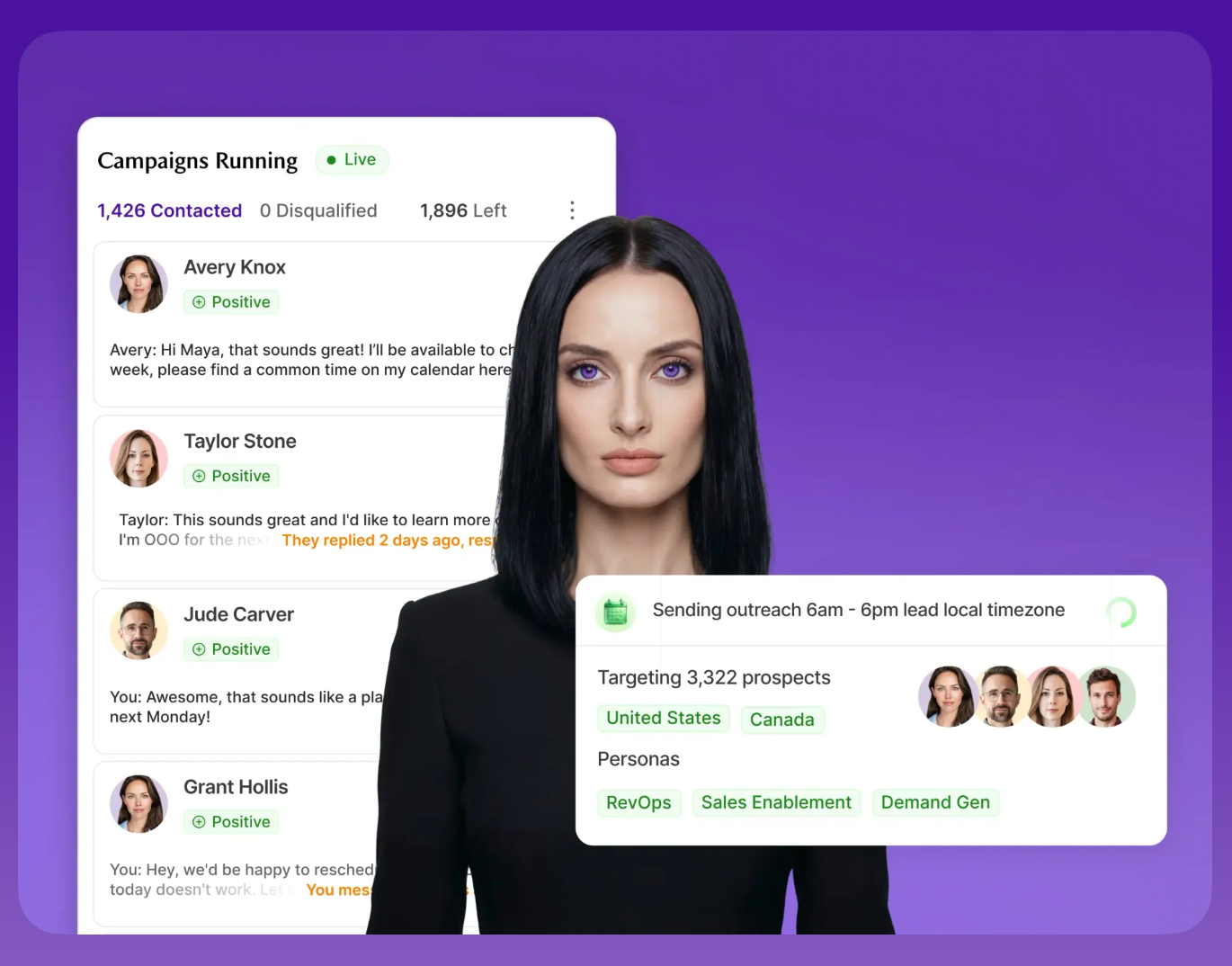
Its flagship product, Ava, is an AI Business Development Representative (BDR) designed to handle much of the work that goes into outbound sales. But Ava isn't just a tool that generates cold emails. It brings prospecting, campaign execution, conversation management, and meeting scheduling into a single workflow.
Here's where it gets interesting. You start by teaching Ava about your business, your product, the problems you solve, and your ideal customer profile. You can specify target countries, industries, company sizes, and job titles, while providing case studies and other proof points to help shape the messaging.
From there, Ava can identify prospects, build personalized outreach campaigns, and use different messaging playbooks. Want a traditional sales pitch? A customer-centric approach? Something that sounds more conversational? You can choose a style and decide whether Ava sends emails automatically or waits for your approval.
And the workflow doesn't stop when an email goes out. Artisan brings prospect conversations into a centralized inbox, lets you manage connected mailboxes, and integrates with CRMs such as HubSpot and Salesforce. Its analytics dashboard also helps you monitor response rates, mailbox health, and campaign performance.
There is one important distinction: Ava can help automate outbound sales, but it doesn't replace every responsibility of a human SDR. It doesn't make sales calls itself. Instead, it can prepare qualified prospect lists and relevant context for human reps to use when calling.
The goal is to move beyond automating individual sales tasks and automate much of the outbound process itself, giving sales teams more time to focus on qualified conversations and closing deals.
Artisan AI Products and Solutions
Artisan's product lineup revolves around one central platform: Ava, its AI BDR. Rather than selling a collection of unrelated AI tools, Artisan brings prospecting, data enrichment, outbound campaign execution, and meeting booking into a connected workflow.
The platform is designed to support several sales motions, from reaching entirely new prospects to re-engaging old leads and expanding existing customer accounts. Here's a closer look at its main products and solutions.
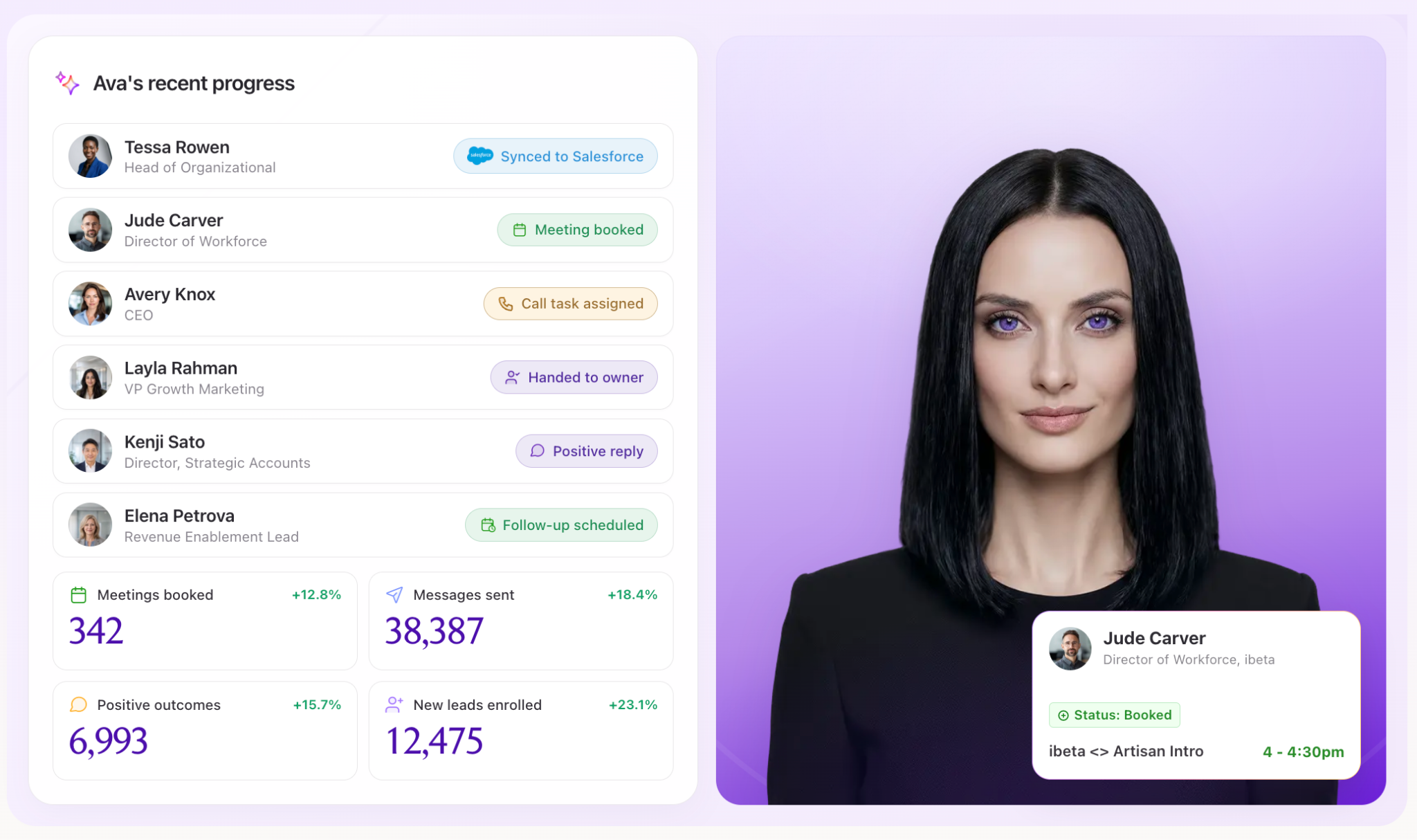
Ava is the core of Artisan. You provide your ICP, product information, messaging preferences, and campaign goals. Ava then helps find suitable prospects, researches them, creates personalized outreach, manages replies, and books meetings.
You can also set guardrails around how much autonomy Ava has. For example, you can require approval before emails are sent, specify how certain replies should be handled, or pause campaigns when necessary.
One important limitation: Ava doesn't conduct sales calls herself. She can prepare qualified prospect lists and queue leads for human reps to call.
2. AI Lead Generation
Finding a list of contacts is one thing. Finding people who actually fit your target market is another.
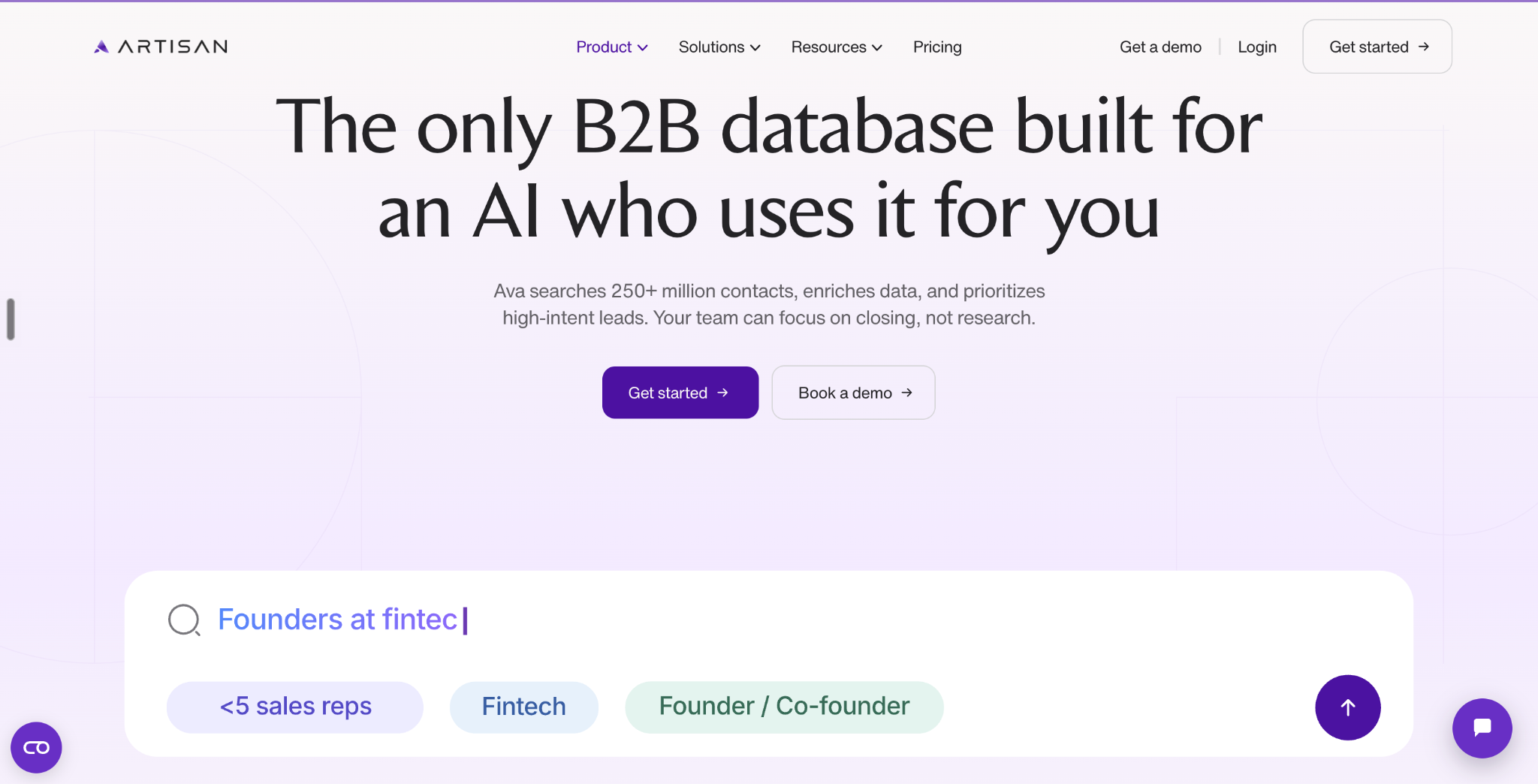
Artisan says Ava searches a database of more than 250 million B2B contacts across 200+ countries and enriches prospect records with information from multiple data sources. The platform also advertises a separate database of more than 200 million local businesses.
Beyond basic contact details, the workflow can incorporate company information, professional profiles, hiring activity, and other available signals to help qualify prospects. Ava can also work with existing CRM lists, so teams don't necessarily need to start prospecting from scratch.
3. AI Outreach
Once prospects have been identified, Ava can create and run personalized outbound campaigns. Rather than simply inserting a prospect's name and company into a template, Artisan describes a workflow that researches each lead and uses the available context to shape the message.
Ava can manage follow-ups, handle replies, test messaging variations, and schedule meetings. Teams can choose between more autonomous execution and human approval checkpoints.
The practical benefit is having prospecting and campaign execution connected. The caveat is that personalization alone doesn't guarantee engagement; results still depend on the relevance of the offer, the accuracy of the data, and the quality of the messaging.
4. Intent Signals
This capability helps sales teams act on events that may indicate a buying opportunity.
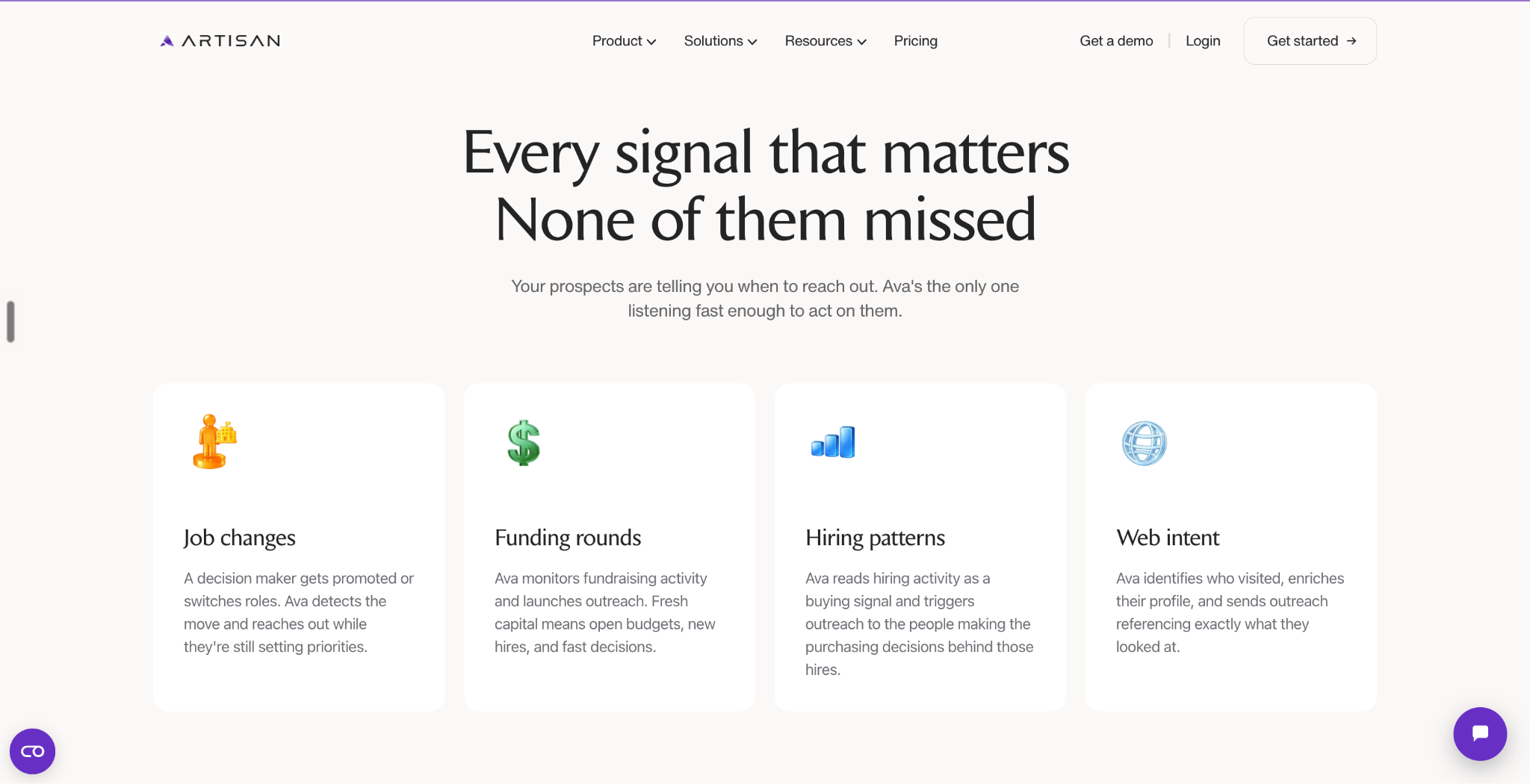
Artisan lists signals including funding rounds, job changes, hiring activity, leadership changes, website visits, and certain CRM or webhook events. When a configured signal matches the team's targeting criteria, Ava can research relevant contacts and initiate a personalized campaign.
For example, suppose a target company has just raised funding and is hiring for a role related to your product. Ava could use that context to help your team reach the relevant decision-makers with a timely message.
The signal is a reason to investigate or reach out, not proof that the company is ready to buy.
5. CRM Reactivation
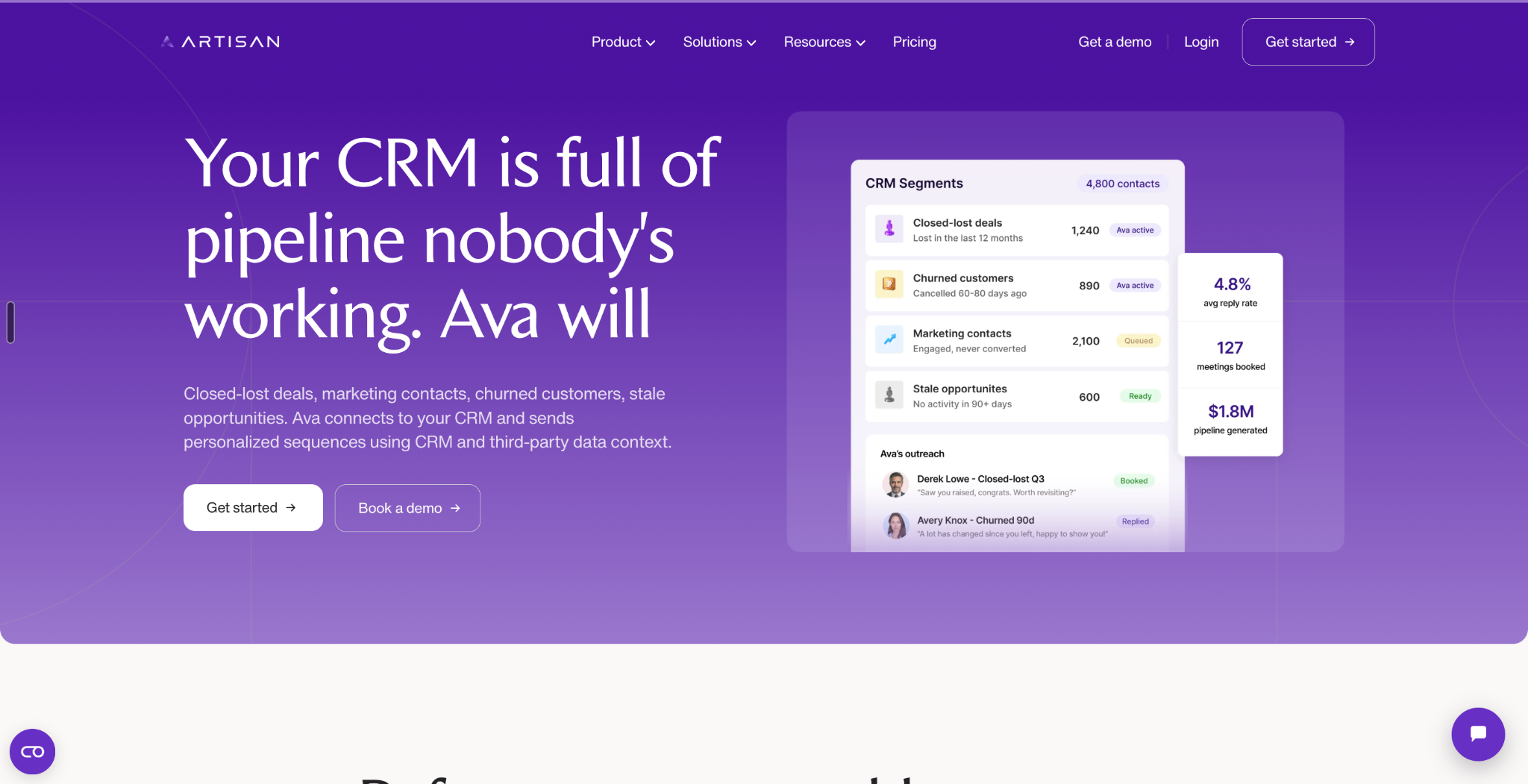
Your CRM may already contain opportunities that never converted, leads that received little follow-up, or contacts who have gone quiet. CRM reactivation is designed to help teams revisit those records instead of relying exclusively on new lead lists.
Artisan says Ava can use CRM information and additional prospect research to create fresh outreach for closed-lost deals, unworked leads, and stalled opportunities. It can also help re-engage former customers.
This is particularly relevant for businesses that have invested heavily in lead generation but haven't systematically followed up with their existing database.
6. Website Visitor Identification
Website visitors can provide useful buying context, particularly when they visit pricing pages, product pages, or other high-intent sections.
Artisan describes identifying companies visiting a website and using available visitor information to enrich records and trigger relevant outreach. Its Ava 2.0 announcement distinguishes person-level identification in the United States from company-level identification globally.
That distinction matters: identifying a company visiting your website is not the same as reliably identifying every individual visitor.
7. Cross-sell and Upsell Campaigns
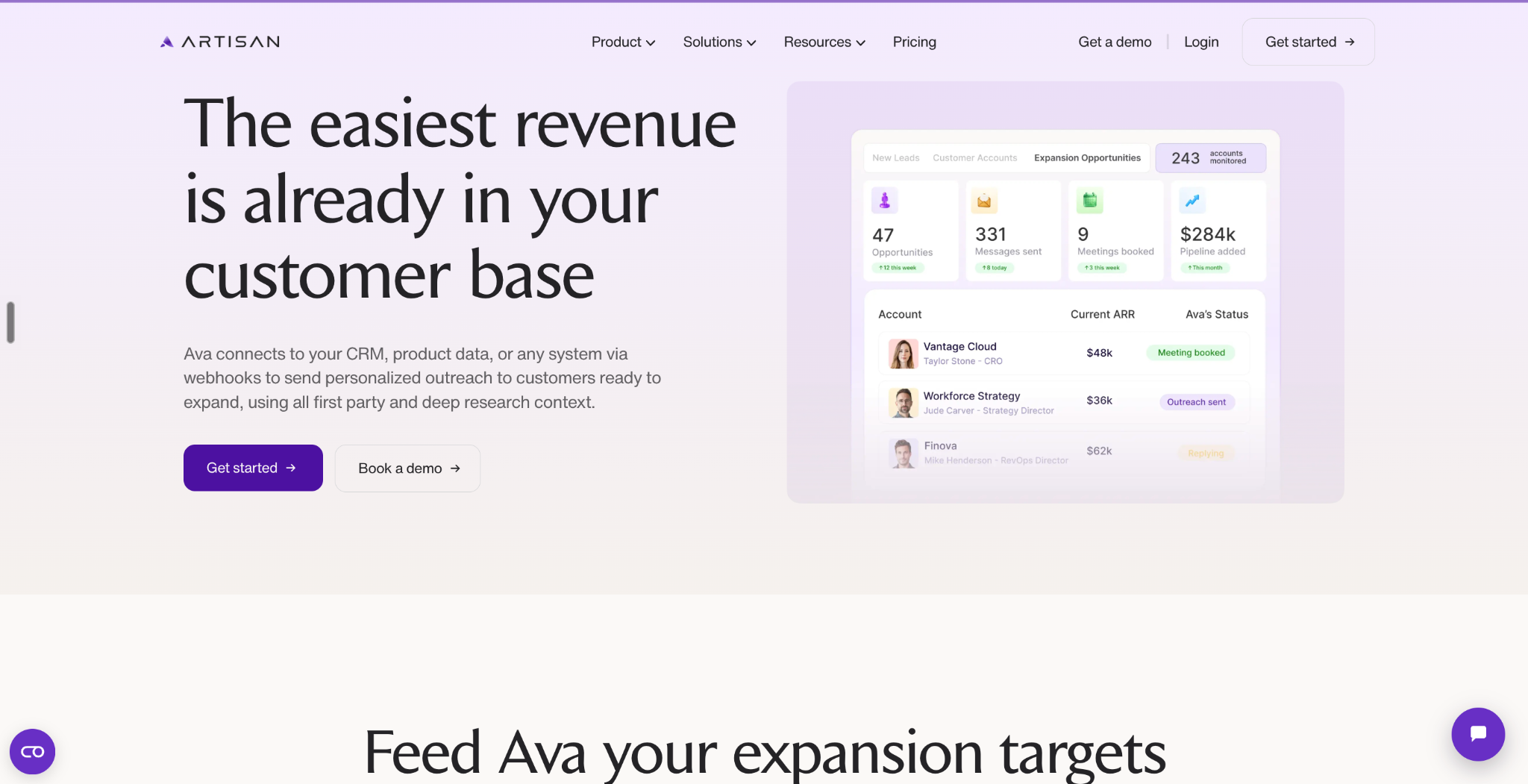
Artisan isn't limited to finding new customers. Ava can also support campaigns aimed at existing accounts, using CRM and product-usage context to identify potential expansion opportunities.
For example, a growing customer might be a candidate for a higher-tier plan or an additional product. Ava can help initiate relevant outreach and schedule a conversation for the account manager.
This makes the platform relevant to teams that want to support both new-business pipeline generation and expansion revenue.
Artisan AI Pricing: How Much Does Ava Cost?
If you're looking for a straightforward price tag for Artisan AI, there's one catch: Artisan doesn't publicly list fixed prices for its Team, Scale, and Enterprise plans. Instead, it builds a customized quote around your outbound requirements, including lead volume, mailboxes, and dialer seats.
Here's how the current plans compare.
Artisan AI Pricing Plans
Plan
Monthly Lead Volume
Pricing
Best For
Team
Approximately 2,500 leads contacted
Custom quote
Teams launching their first serious outbound sales motion.
Scale
Approximately 6,000 leads contacted
Custom quote
Teams expanding outbound campaigns across multiple reps and customer segments.
Enterprise
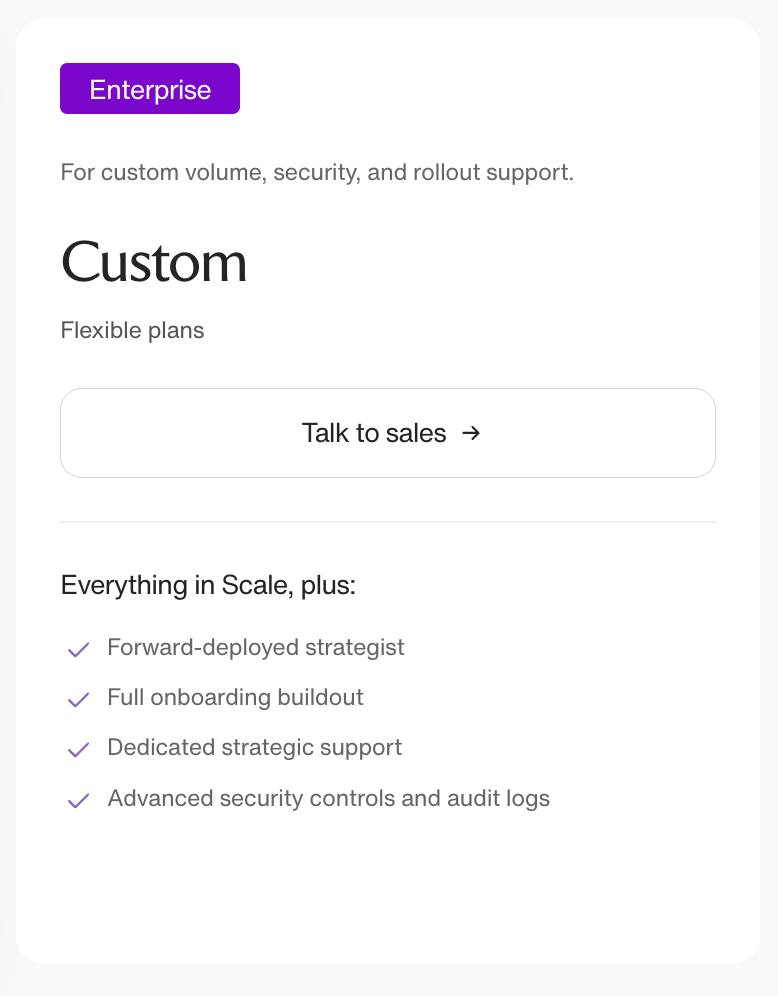
Custom volume
Custom quote
Organizations needing tailored deployment, advanced security, and strategic support.
What's Included in Each Artisan AI Plan?
Team
The Team plan is designed for companies establishing a structured outbound process. It includes access to Artisan's full platform, autonomous replies and meeting booking, a database of 250M+ verified B2B contacts, Salesforce and HubSpot synchronization, customer success management (CSM), and guided onboarding.
An AI dialer is also available as a per-seat add-on for human sales reps.
Scale
The Scale plan includes everything in Team, with additional support for growing sales operations. You get a dedicated customer success manager, CRM setup, and priority support.
This plan is worth considering if you're expanding campaigns across different reps or segments and need more hands-on help with implementation.
Enterprise
Enterprise is designed for companies with custom volume requirements or more complex deployment needs. It includes everything in Scale, plus a forward-deployed strategist, a more comprehensive onboarding rollout, dedicated strategic support, and advanced security controls and audit logs.
What Determines Artisan AI's Final Price?
Artisan says its pricing is based on three primary factors:
Lead volume: How many prospects you want Ava to contact.
Mailboxes: The sending infrastructure required to support your campaigns.
Dialer seats: The number of human sales reps using the AI dialer add-on.
Artisan also emphasizes that its plans include onboarding and customer success support, with additional strategic assistance available on Enterprise.
Is Artisan AI Worth the Price?
That depends on how much of your outbound workflow you want to consolidate.
If you're currently paying separately for prospecting data, enrichment, outreach sequencing, and other sales tools, Artisan's all-in-one approach could simplify your stack. Its ability to automate prospect research, manage replies, and book meetings may also reduce the manual work required from your sales development representatives.
However, there's no public Team, Scale, or Enterprise price on the pricing page to calculate a reliable return on investment upfront. You'll need a quote to compare Artisan's total cost against your current software subscriptions and sales team's workload.
Our recommendation: Before committing, ask Artisan for a breakdown of the monthly fee, included lead volume, mailbox requirements, dialer add-on costs, and any additional usage charges. Then compare that quote with the number of qualified meetings and opportunities your team realistically expects to generate.
Artisan AI Review Analysis: What Do G2 Users Say?
Artisan has a 4.2/5 rating from 66 reviews on G2. But the overall rating only tells part of the story. The more useful question is how Ava performs when users put it to work: Does it find relevant prospects, personalize campaigns, save time, and reliably manage outbound activity?
We looked at individual G2 reviews of Artisan to identify the product strengths and limitations that matter most to potential buyers.
Positive Artisan AI Reviews on G2
1. Saed E. on personalized outreach and targeting controls
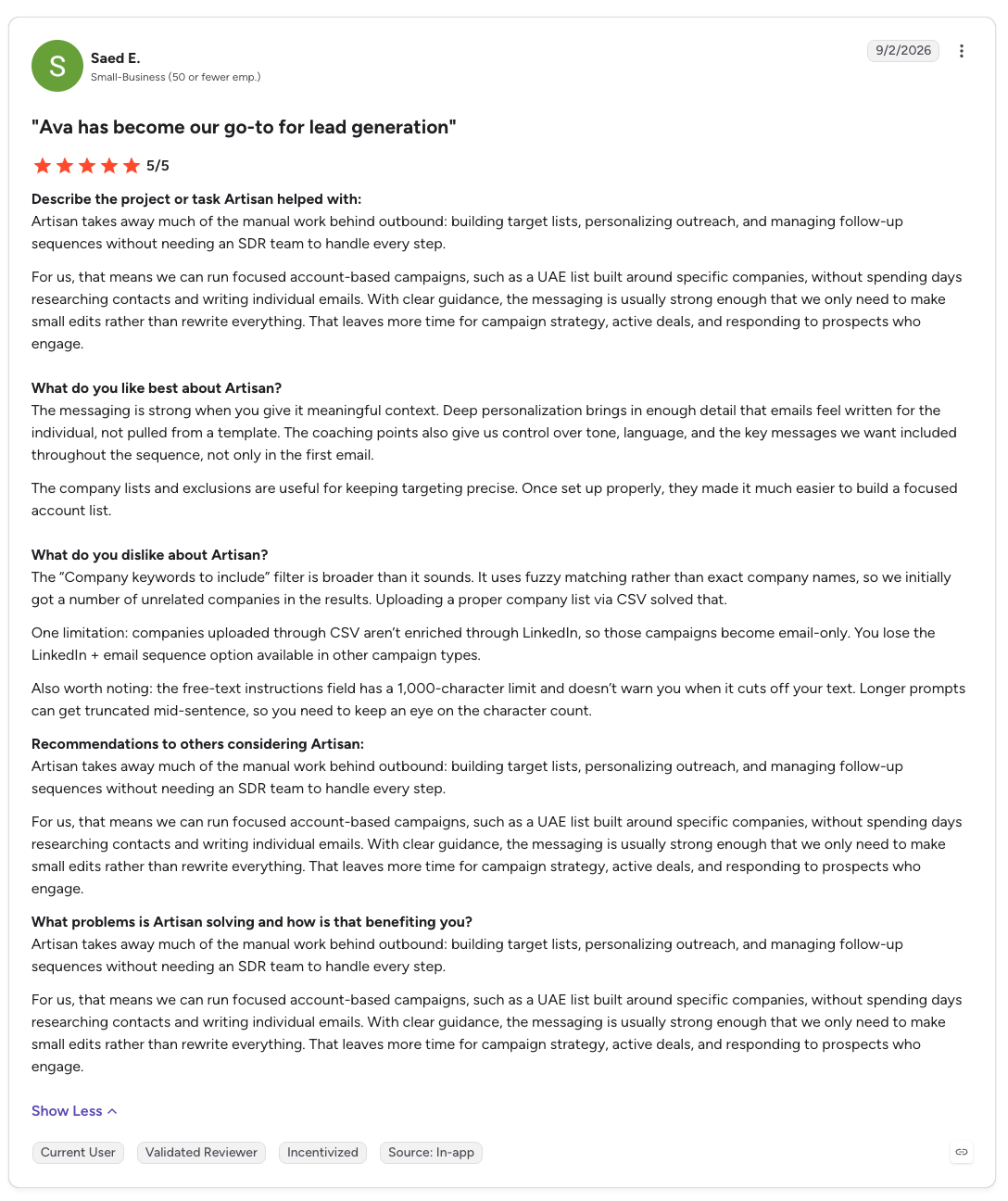
In the review “Ava has become our go-to for lead generation,” Saed E. described using Artisan to build account-based campaigns without manually researching every contact.
Saed also highlighted the ability to control tone and messaging across an entire sequence, along with company lists and exclusions for more focused targeting.
What this tells us: Ava's personalization can be useful when users provide clear context and instructions. The review also highlights the importance of targeting controls, rather than relying on AI-generated copy alone.
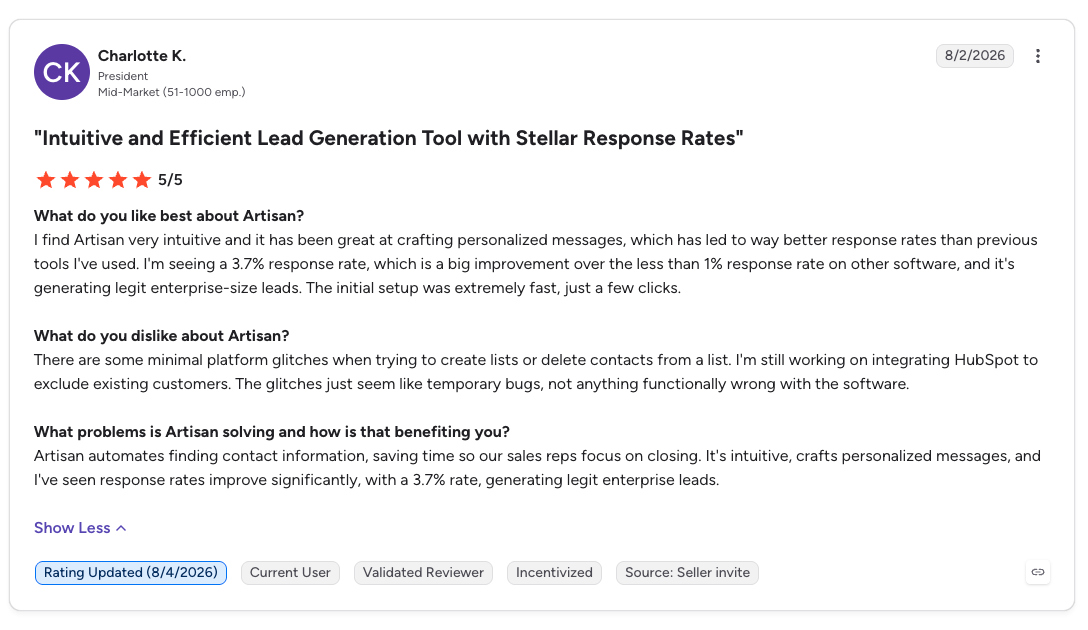
2. Charlotte K. on response rates and enterprise lead generation
In “Intuitive and Efficient Lead Generation Tool with Stellar Response Rates,” Charlotte K. described her experience with personalized messaging and prospect discovery.
Charlotte also reported minor issues when creating lists or deleting contacts and mentioned that she was still working on integrating HubSpot to exclude existing customers.
What this tells us: Artisan may help some teams improve outreach performance, but Charlotte's 3.7% response rate is an individual result, not a platform-wide benchmark. Her comments about list management and CRM integration are also worth considering during a trial.
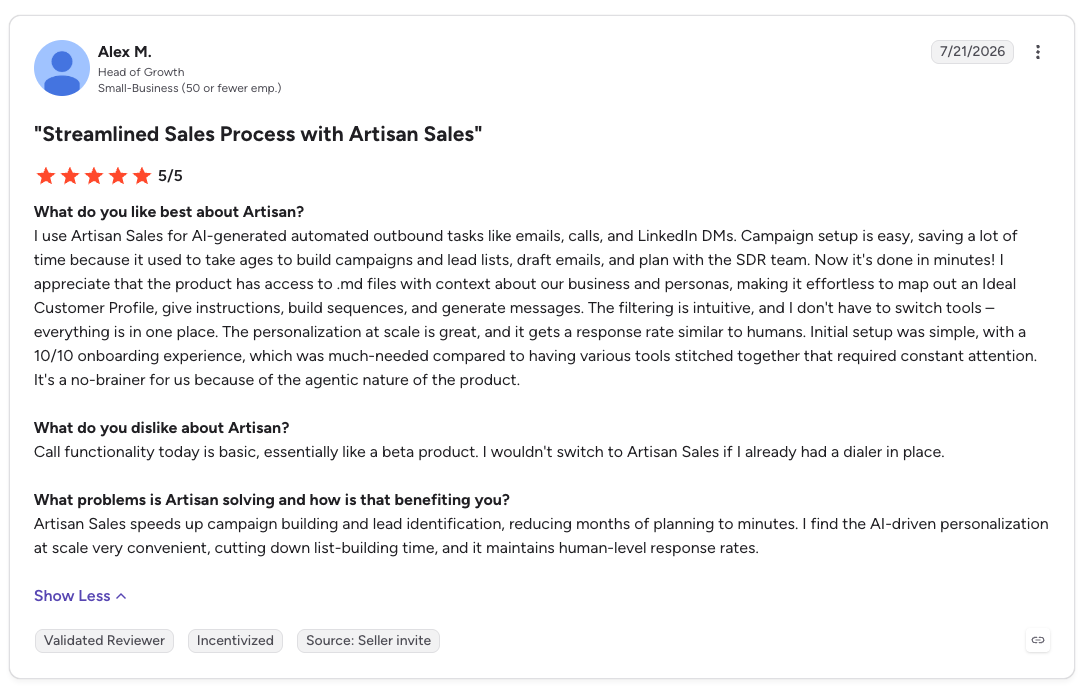
3. Alex M. on automating campaign setup
Alex M., Head of Growth, reviewed Artisan in “Streamlined Sales Process with Artisan Sales.” The reviewer described using the platform for automated outbound tasks and campaign creation.
The surrounding review explains that Artisan helps with ICP definition, lead identification, campaign sequences, and message generation, reducing the need to switch between separate tools.
What this tells us: One of Artisan's clearest potential advantages is workflow consolidation. If your team spends hours assembling lead lists and preparing campaigns, bringing those steps together could reduce manual work. The actual time saved will depend on the complexity of your campaigns and the amount of human review required.
Negative Artisan AI Reviews: What Should Buyers Watch Out For?
Positive results are encouraging, but some G2 reviewers have identified practical limitations that prospective buyers should consider before committing to Artisan.
1. Company targeting and campaign restrictions
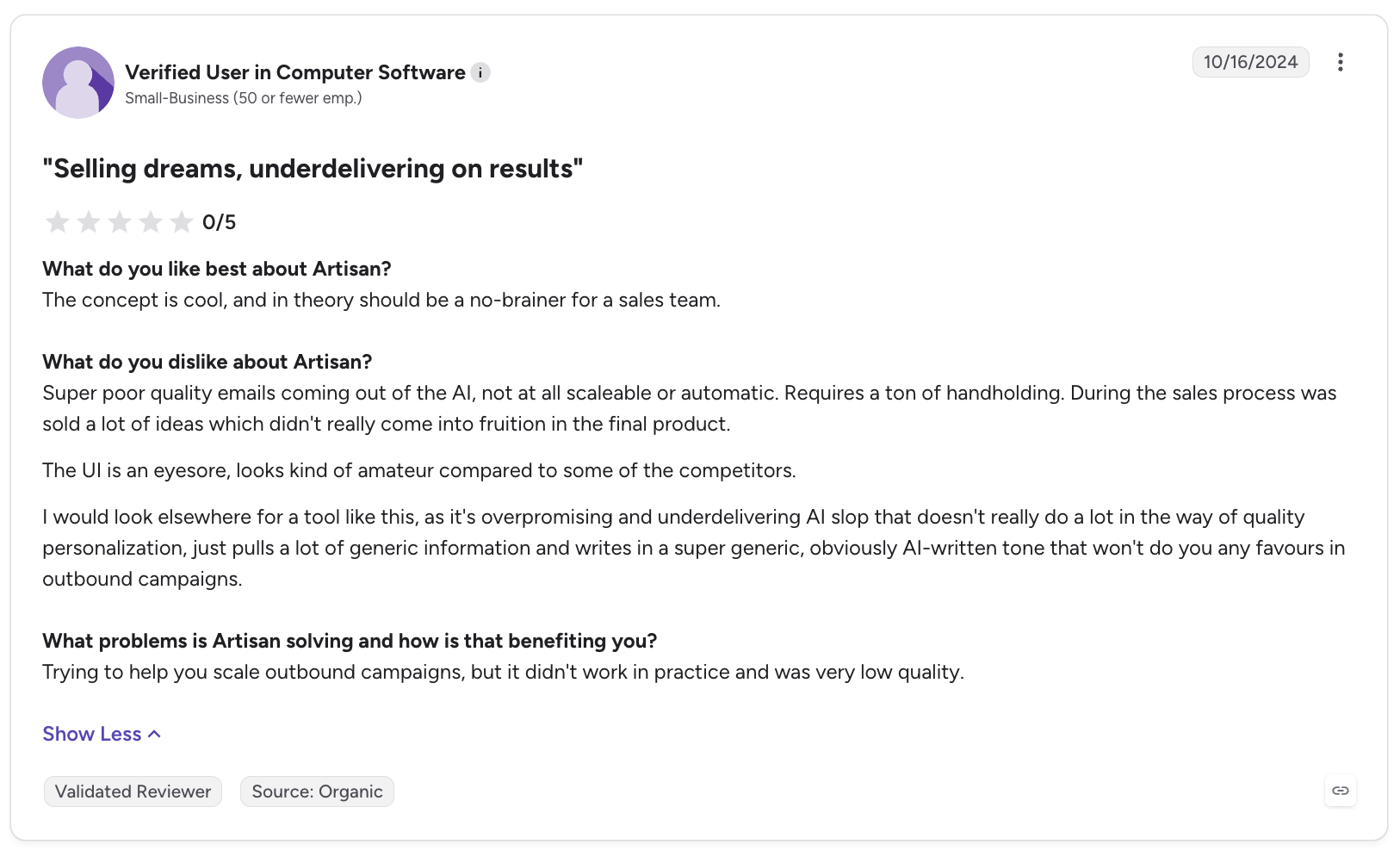
In “Selling dreams, underdelivering on results,” a verified user in Computer Software gave Artisan a 0/5 rating and criticized the quality of its targeting and personalization. Other feedback in our review research highlights specific limitations with company filters and campaign setup.
For example, Saed E. reported that the company keyword filter sometimes returned unrelated businesses because it used fuzzy matching rather than exact company names. Uploading a company list via CSV helped, but introduced other limitations: the imported companies weren't enriched through LinkedIn, making those campaigns email-only. The reviewer also noted a 1,000-character limit in the free-text instructions field, without a warning when text was truncated.
Why this matters: If you're running account-based campaigns, targeting precision matters more than the size of the lead database. Test company filters, CSV imports, available outreach channels, and instruction limits before launching campaigns at scale.
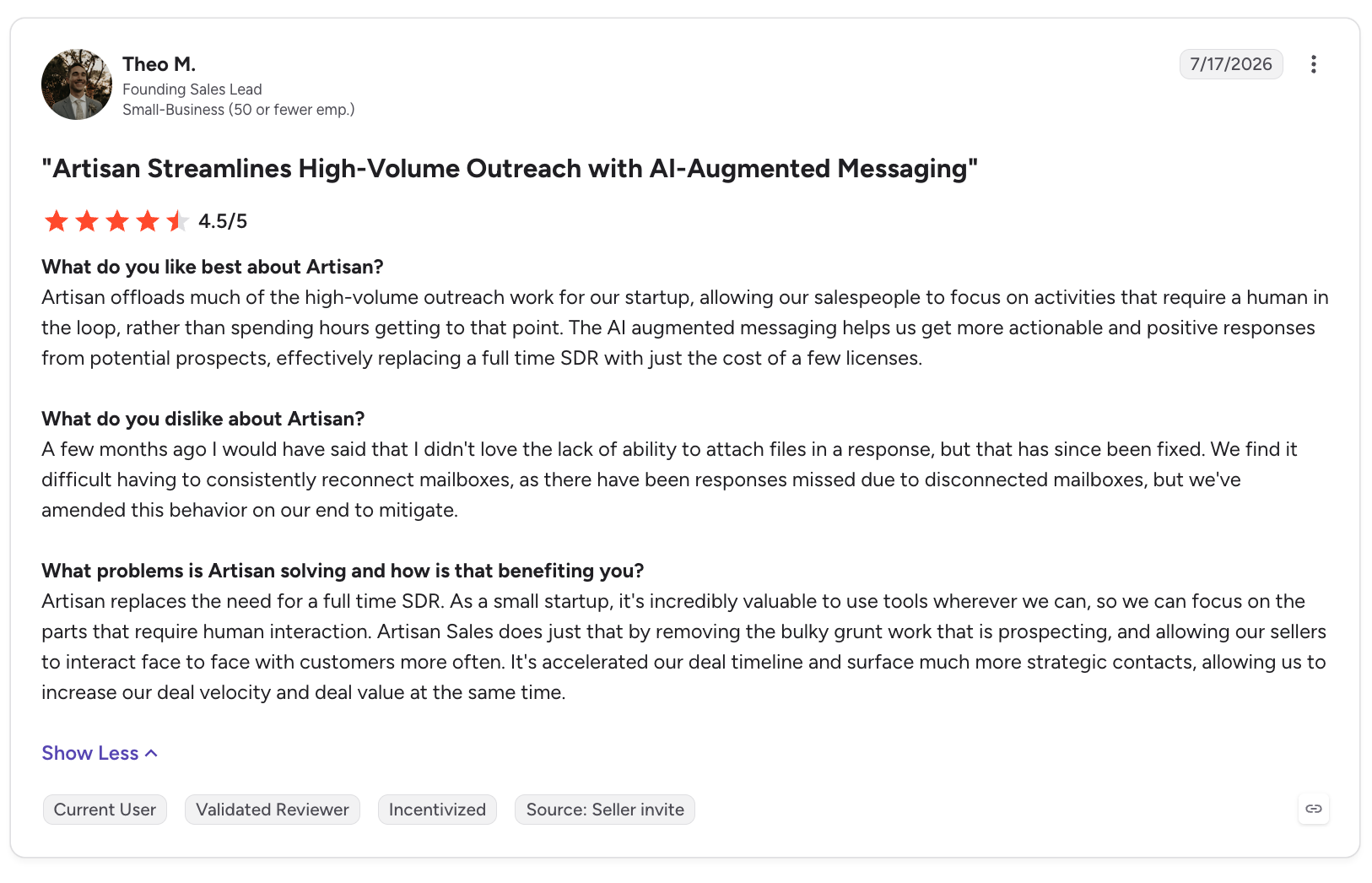
2. Mailbox reliability and missed replies
Theo M., a Founding Sales Lead, rated Artisan 4.5/5 in “Artisan Streamlines High-Volume Outreach with AI-Augmented Messaging.” Although the reviewer praised its high-volume outreach capabilities, they also described a mailbox reliability issue:
Why this matters: Outbound automation is only useful if prospect conversations are captured reliably. Disconnected mailboxes can lead to missed replies and undermine automated follow-ups. Before purchasing, ask how Artisan detects mailbox disconnections and what happens to incoming replies when a connection fails.
3. The native dialer may not replace your existing calling tool
In “Streamlined Sales Process with Artisan Sales,” Alex M. praised the speed of campaign creation but raised concerns about the calling functionality:
Why this matters: Artisan's value may be strongest in prospecting and outbound campaign automation, rather than replacing every tool in your sales stack. If your team relies heavily on phone outreach, evaluate the dialer separately before deciding whether to consolidate your existing tools.
4. AI messaging can still feel generic
A verified user in Computer Software gave Artisan a 0/5 rating in “Selling dreams, underdelivering on results,” criticizing the platform's personalization:
This contrasts with positive feedback from users who appreciate Ava's ability to incorporate prospect context into outreach.
Why this matters: Mentioning a prospect's company or recent activity isn't the same as writing a relevant sales message. Ask to see sample emails, assess whether the personalization connects to a genuine business problem, and review messages before enabling fully autonomous sending.
Our Analysis: Is Artisan AI Worth Considering?
As per our analysis, Artisan's strongest appeal is its ability to connect prospecting, personalization, and campaign execution in one platform. Positive reviews highlight its potential to simplify lead generation and save time during campaign creation. However, the critical reviews raise important questions about targeting accuracy, messaging quality, mailbox reliability, and the maturity of certain features.
The feedback also shows why individual results need context. A reviewer may find Ava useful for generating leads while still being dissatisfied with the quality of the resulting conversations. Similarly, a high response rate reported by one customer doesn't establish what other teams should expect.
We should also consider the review context. Some positive reviews are marked as incentivized or collected through seller invitations. That doesn't automatically invalidate them, but reported outcomes should be treated as individual experiences rather than independent proof of typical performance.
Our verdict: Artisan is worth evaluating if you want to automate prospect research and personalized outbound campaigns, but don't buy based on the promise of an autonomous AI BDR alone. Test the platform with your actual ideal customer profile, inspect the leads Ava selects, assess the quality of its messages, verify mailbox and CRM reliability, and compare the results with your existing workflow.
Focus on qualified positive replies, meetings that match your ICP, and the time required to generate those outcomes, not simply the number of emails Ava can send.
Artisan AI Pros and Cons
Pros
Cons
End-to-end outbound automation: Ava can help find prospects, create personalized campaigns, manage replies, and book meetings.
Personalization quality can vary: Some G2 reviewers describe messages as generic or obviously AI-written, despite the platform's personalization capabilities.
Large B2B contact database: Artisan advertises 250M+ verified B2B contacts across 200+ countries.
Targeting may need refinement: A G2 reviewer reported that company keyword matching returned unrelated businesses, requiring a CSV workaround.
Personalized outreach controls: Users can provide product context, define their ICP, set messaging preferences, and choose campaign playbooks.
Campaign setup has limitations: A reviewer reported a 1,000-character limit on free-text instructions, with no warning when text was truncated.
Human approval options: Teams can review, edit, and approve emails before sending rather than relying entirely on autonomous execution.
Mailbox reliability needs attention: A G2 reviewer reported having to reconnect mailboxes and missing some prospect replies.
CRM integrations: HubSpot and Salesforce synchronization can help connect outbound campaigns with existing sales workflows.
Integration and implementation concerns: Some reviewers reported technical limitations when fitting Artisan into an established GTM stack.
Centralized inbox and analytics: Teams can manage prospect conversations and monitor response rates, mailbox health, and campaign performance.
The native dialer may not replace dedicated tools: One reviewer described its calling functionality as basic and preferred to retain an existing dialer.
Support and onboarding: Artisan advertises guided onboarding and customer success support across its business plans.
Pricing requires a sales quote: Team, Scale, and Enterprise pricing is customized, making upfront cost comparisons difficult.
Supports new business and reactivation workflows: Artisan describes solutions for prospecting, website visitor identification, CRM reactivation, and customer expansion.
Results aren't guaranteed: Automation and a large contact database don't guarantee qualified replies, booked meetings, or pipeline growth.
Our take: Artisan's biggest strength is connecting prospecting and outbound execution in one platform. However, lead quality, message relevance, and implementation reliability should be tested before committing to a paid plan.
Artisan AI vs. Knock AI: Generating Leads vs. Making Them Count
Both Artisan AI and Knock AI help B2B teams generate pipeline, but they address two different sides of the revenue equation.
Artisan helps you scale lead generation. Knock AI helps you convert buyer interest into revenue opportunities.
With Artisan, you're investing in finding prospects, enriching their data, and automating outbound outreach. With Knock AI, you're focused on getting more value from your marketing spend, website traffic, intent signals, and existing leads by engaging the right buyers, qualifying them, and connecting them with the right sales action.
Artisan AI
Knock AI
Core value
Automate prospecting and outbound sales activity
Turn buyer interest into qualified conversations and pipeline
Where your investment goes
Finding prospects, enriching contact data, and reaching out at scale
Identifying high-intent buyers, enriching their context, engaging them, and routing qualified opportunities
The revenue challenge
How do we reach more potential buyers without scaling our SDR workload?
How do we convert more of the demand and leads we're already paying to generate?
What it helps you improve
Prospecting efficiency and outbound execution
Lead conversion, speed to engagement, qualification, and routing
Best fit
Teams that need more prospecting capacity and automated outbound
Teams that want more revenue value from website traffic, marketing campaigns, and buyer intent
The bigger picture
Helps you create more opportunities to start conversations
Helps you turn buyer signals into conversations sales can act on
When Should You Choose Artisan AI?
Choose Artisan if your biggest bottleneck is outbound prospecting. If your sales team spends too much time building lists, researching prospects, writing emails, and following up, Ava can automate much of that work and help you reach more potential buyers.
The goal is to make prospecting more scalable without adding the same amount of manual SDR work.
When Should You Choose Knock AI?
Choose Knock AI if you're already investing in marketing, generating leads, attracting website visitors, or collecting buyer intent signals, but too many potential opportunities aren't turning into sales conversations.
Knock AI connects buyer identification, enrichment, intent detection, AI engagement, qualification, and routing so your team can act on buying signals instead of letting them go cold.
The goal isn't simply to generate more leads. It's to get more value from the demand you're already creating.
Our Verdict
Artisan helps you scale the effort of finding potential buyers. Knock AI helps you capture more value from buyer interest and turn it into pipeline.
These aren't mutually exclusive approaches. A business can use Artisan to expand outbound prospecting and Knock AI to convert high-intent visitors and leads into qualified sales opportunities.
The real question is where your revenue funnel is leaking. If you need more prospects, outbound automation may be the priority. If you're already paying to attract potential buyers but struggling to convert their interest into pipeline, improving engagement and conversion may deliver more value from your existing investment.
Is Artisan AI Worth It?
Artisan AI can be worth it if your sales team spends too much time finding prospects, researching accounts, writing emails, and managing follow-ups. Its AI BDR, Ava, brings these tasks into one workflow, helping teams scale outbound without relying entirely on manual SDR work.
However, automation alone doesn't guarantee pipeline. Some G2 reviewers praise Artisan's lead generation and time savings, while others report generic messaging, setup difficulties, and inconsistent results. Your results will depend on your targeting, campaign quality, email deliverability, and how well Ava fits your sales process.
Before committing, evaluate three things:
Lead quality: Are the contacts relevant to your ICP and buying criteria?
Message quality: Does Ava produce personalized outreach that sounds natural and earns replies?
Total cost and reliability: Does the time saved and pipeline generated justify the subscription, implementation effort, and any additional tools you need?
Artisan is worth considering if outbound prospecting is your main bottleneck. If you're already generating traffic and leads but struggling to convert buyer interest into sales conversations, a platform focused on engagement, qualification, and conversion, such as Knock AI, may address a different and more immediate problem.
Our take: Don't judge Artisan by how many emails it can send. Judge it by the quality of conversations and pipeline it helps your team create.
FAQs
1. What is Artisan AI?
Artisan AI is a sales automation platform that uses AI employees to handle tasks such as prospecting, lead research, personalized outreach, follow-ups, and meeting booking. Its best-known AI sales agent is Ava, an autonomous AI business development representative.
2. Who is the CEO of Artisan AI?
Jaspar Carmichael-Jack is the co-founder and CEO of Artisan AI. He founded the company in 2023 to automate repetitive business workflows, starting with outbound sales.
3. How much does Artisan AI cost?
Artisan offers three plans: Team, Scale, and Enterprise. The Team plan supports approximately 2,500 leads contacted per month, while Scale supports approximately 6,000. Both include the core platform, with Scale adding a dedicated customer success manager, CRM setup, and priority support. Team and Scale pricing is scoped to your requirements, while Enterprise pricing is custom. Costs depend on factors such as lead volume, mailboxes, and dialer seats.
4. What is Ava in Artisan AI?
Ava is Artisan's AI BDR. It can identify and research prospects, create personalized outreach, run email sequences, respond to prospects, and book meetings, with configurable human approval controls.
5. Is Artisan AI suitable for small businesses?
It can be useful for small businesses that rely on outbound sales but lack the time or headcount to manage prospecting manually. However, businesses should evaluate the pricing, setup requirements, lead quality, and expected return before committing.
6. Does Artisan AI integrate with HubSpot and Salesforce?
Yes. Artisan supports HubSpot and Salesforce integrations to synchronize CRM data and support sales workflows. Confirm the specific integration capabilities and configuration requirements during onboarding.
7. What are the main drawbacks of Artisan AI?
Some G2 reviewers report generic AI-generated messaging, difficulties with setup, technical reliability issues, and inconsistent lead results. These are individual customer experiences rather than universal outcomes, so testing the platform with your own ICP and campaigns is important.
8. Is Artisan AI better than Knock AI?
It depends on your biggest revenue bottleneck. Artisan is focused on automating outbound prospecting and sales execution. Knock AI focuses on identifying buyer intent, engaging and qualifying potential customers, and routing conversations toward conversion. Artisan may be a better fit when prospecting capacity is the problem; Knock AI may be more relevant when converting existing demand into qualified pipeline is the priority.
9. What are the best Artisan AI alternatives?
Some of the best Artisan AI alternatives include Knock AI, 11x, AiSDR, and Apollo.io. The right choice depends on whether you need automated prospecting, AI-powered outbound, lead data, or better conversion from existing buyer intent.
Knock AI: Best for identifying buyer intent, engaging and qualifying leads, routing conversations, and converting buyer interest into pipeline.
11x: An alternative for businesses exploring autonomous AI sales agents.
AiSDR: Focuses on AI-powered outbound prospecting and personalized outreach.
Apollo.io: Combines B2B contact data, prospecting, and sales engagement tools.
If your primary challenge is scaling outbound prospecting, compare platforms based on lead quality, personalization, and campaign automation. If you're already investing in marketing and generating leads but struggling to convert them, Knock AI is worth evaluating for its focus on buyer intent, engagement, qualification, and routing.