Four Options if Your Chili Piper Costs Are Increasing
If your Chili Piper Concierge costs have increased, you don't necessarily need to replace your existing platform.
The right decision depends on why costs increased, how your team uses the platform, and whether your investment is producing a proportionally more qualified pipeline.
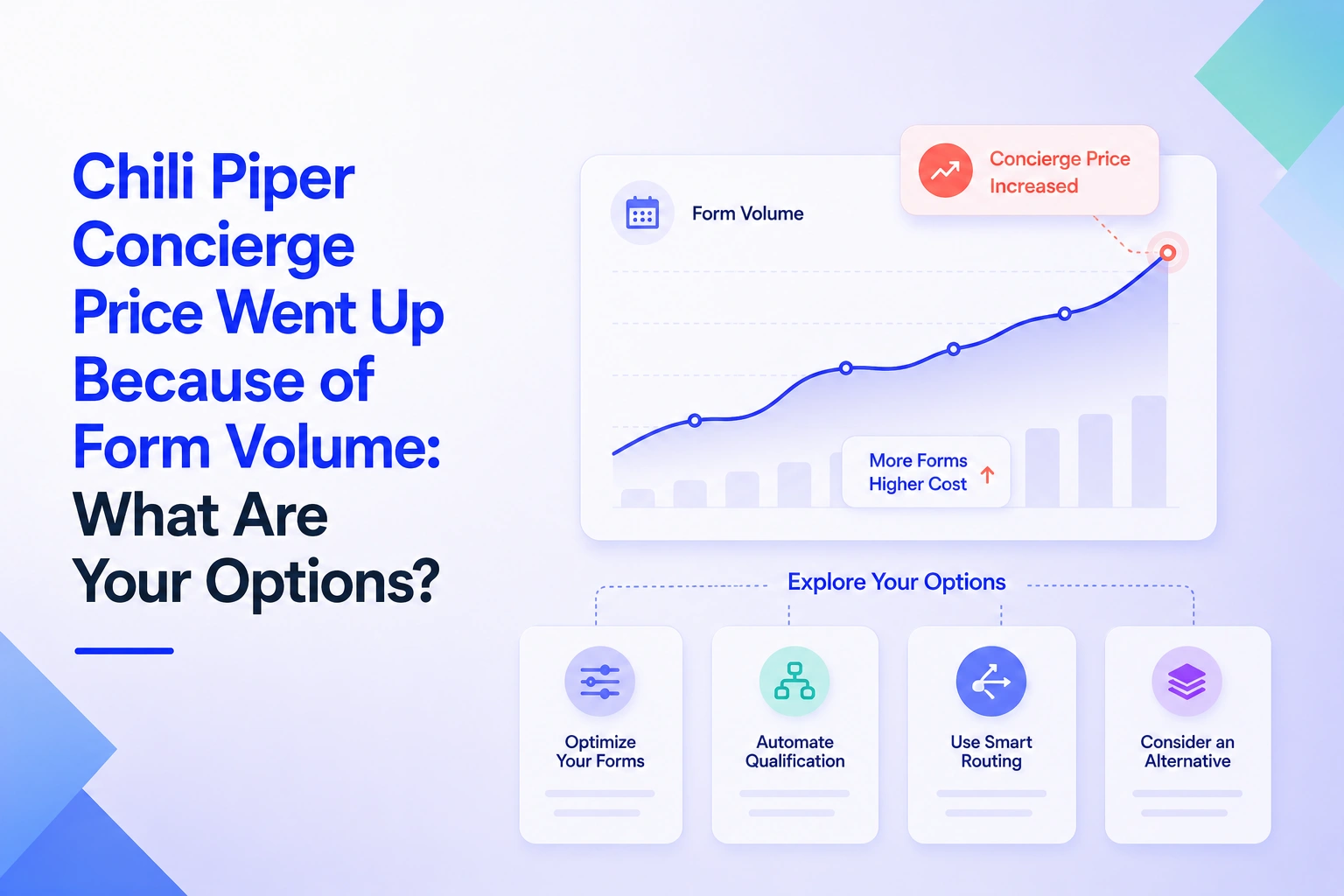
For most organizations, there are four practical options.
Option 1: Optimize Your Existing Chili Piper Deployment
Before evaluating new platforms, take a closer look at your current deployment.
As organizations grow, it's common for routing logic, workflows, and product usage to become more complex than necessary.
Review your setup and ask:
- Are routing rules still aligned with your sales organization?
- Are duplicate workflows creating unnecessary complexity?
- Are you paying for products your team rarely uses?
- Are inactive users or unnecessary seats increasing costs?
- Does your Salesforce data still support accurate routing?
If you're using products like Concierge, Distro, Handoff, or Chat AI, it may be worth auditing how each one contributes to your inbound process. Cleaning up routing logic, simplifying workflows, and improving Salesforce hygiene can often reduce operational complexity without changing platforms.
Sometimes the best first step isn't migration. It's optimization.
Option 2: Renegotiate Your Enterprise Plan
If your company has grown significantly, it may be time to revisit your commercial agreement.
This option is often worth exploring if you have:
- Rapidly growing inbound demand
- Multiple business units or regional sales teams
- Predictable long-term growth
- A broad deployment across multiple products
Organizations using enterprise offerings such as Routing & Scheduling or Experiences may benefit from reviewing their deployment, platform fees, licensing structure, and future growth plans with their account team.
If Chili Piper continues delivering strong business outcomes, a different commercial structure may be more appropriate than replacing the platform.
Option 3: Accept the Higher Cost if Revenue Is Growing Faster
Paying more isn't automatically a bad business decision.
If your investment is producing significantly more revenue, a higher software bill may simply reflect a business that's scaling successfully.
Instead of focusing only on subscription costs, evaluate metrics such as:
- Cost per qualified meeting
- Cost per SQL
- Cost per sales opportunity
- Qualified pipeline created
- Revenue influenced
- Sales velocity
If those metrics continue improving as your investment grows, maintaining your current deployment may be the most rational decision.
The goal isn't to minimize software spend.
The goal is to maximize revenue efficiency.
Option 4: Move Beyond Form-First Scheduling
For some organizations, the pricing discussion eventually becomes something much larger.
The question is no longer:
"How can we reduce our Chili Piper bill?"
It becomes:
"Should forms remain the primary way buyers enter our revenue funnel?"
Traditional inbound workflows typically begin when someone completes a form. Qualification, routing, and scheduling all happen after that point.
Increasingly, revenue teams are moving toward a different model where buyer engagement begins before a form is ever submitted.
Instead of waiting for buyers to identify themselves, platforms like Knock AI combine Knock Reveal to identify buyers, Knock Intent to understand buying signals, Knock AI Agent to qualify conversations, Knock Routing to send buyers to the right team, Knock Scheduling to book meetings when buyers are sales-ready, and Knock Chat to preserve momentum before and after the meeting.
The conversation shifts from simply routing form submissions to orchestrating the entire buying journey.
For these teams, the decision isn't about replacing a scheduling tool.
It's about deciding whether form-first scheduling is still the best foundation for generating qualified pipeline as inbound demand continues to grow.
What Changes When You Move Beyond Forms?
Moving beyond forms isn't just about replacing a booking flow.
It's about changing where your revenue process begins.
In a traditional form-first workflow, buyer identification, qualification, and routing don't start until someone completes a form. If a high-intent buyer abandons the form or never reaches it, the opportunity often disappears before sales even knows it existed.
A formless revenue funnel flips that model on its head.
Instead of waiting for a form submission, buyer engagement begins as soon as intent appears.
The journey looks more like this:
Knock Reveal
↓
Identifies anonymous buyers and buying accounts before they complete a form.
↓
Knock Intent & Score
↓
Analyzes real-time buying signals to determine whether someone is researching, evaluating, or ready to purchase.
↓
Knock Enrich
↓
Enriches buyer and company data so conversations begin with context instead of lengthy qualification questions.
↓
Knock AI Agent
↓
Answers questions, educates buyers, qualifies opportunities, and determines the best next step through natural conversations.
↓
Knock Routing
↓
Routes every conversation using buyer intent, enrichment, CRM context, ownership rules, and business logic instead of relying only on form fields.
↓
Knock Scheduling
↓
Books meetings only when buyers are qualified and sales-ready, helping teams spend more time with high-quality opportunities.
↓
Knock Chat & Knock Outreach
↓
Keeps conversations moving across channels before and after meetings with AI-powered follow-ups, reminders, and ongoing engagement that reduces no-shows and preserves buyer momentum.
↓
Knock CRM
↓
Synchronizes enriched buyer data, qualification details, conversation history, attribution, and engagement into your CRM so sales receives complete context instead of another raw lead.
↓
Knock Organic
↓
Creates a formless inbound funnel that converts inbound traffic into pipeline without forcing every buyer through a traditional form.
Notice how the conversation changes.
Instead of asking:
"How do we schedule more meetings?"
Revenue teams begin asking:
"How do we convert more buying intent into qualified pipeline?"
Scheduling becomes one step in a much larger revenue workflow.
The focus shifts from processing form submissions to identifying buyers earlier, qualifying them automatically, routing them intelligently, preserving momentum throughout the buying journey, and ensuring sales spends time with the opportunities most likely to close.
That's the difference between optimizing a scheduling workflow and building an inbound conversion engine.
Compare Knock AI and Chili Piper
When Does It Actually Make Sense to Stay With Chili Piper?
Not every company experiencing a pricing increase should replace Chili Piper.
For many organizations, it continues to be an excellent solution for meeting routing and scheduling, especially when those are the primary problems they need to solve.
The better question isn't "Which platform is better?"
It's "Which platform is better aligned with how our buyers purchase today?"
Use the framework below to evaluate which approach best fits your business.
| Stay with Chili Piper if... |
Consider Knock AI if... |
| Your go-to-market strategy is heavily form-driven and forms remain your primary source of inbound demand. |
High-intent buyers abandon forms or never complete them, and you want a formless revenue funnel. |
| Your primary objective is Salesforce routing, ownership, and meeting distribution. |
Your priority is engaging buyers earlier and converting more buying intent into pipeline. |
| Meeting scheduling is the main workflow you want to optimize. |
You want AI to identify buyers, qualify conversations, and book meetings only when prospects are sales-ready. |
| SDRs manually qualify inbound leads before handing them to sales. |
You want the Knock AI Agent to qualify buyers automatically and reduce manual SDR work. |
| Email reminders and calendar workflows meet your post-booking needs. |
You want to preserve buyer momentum with Knock Chat, Knock Outreach, AI follow-ups, LinkedIn outreach, and automated meeting reminders. |
| Your buyers primarily engage through your website. |
Buyers arrive from LinkedIn, events, partner referrals, AI search, email, messaging apps, and your website, and you want one continuous buying journey. |
| Routing decisions rely mainly on form submissions and CRM fields. |
You want Knock Reveal, Knock Intent & Score, and Knock Enrich to identify buyers and route conversations using real-time buyer context instead of relying only on form data. |
| Your CRM processes are already clean and you simply need meetings booked correctly. |
You want Knock CRM to synchronize enriched buyer data, qualification, attribution, and engagement while helping keep your CRM focused on qualified opportunities. |
| Your current deployment is producing strong ROI, high meeting attendance, and growing qualified pipeline. |
You're paying more as inbound volume grows but conversion rates and qualified pipeline aren't improving at the same pace. |
Neither approach is universally better.
If your objective is to route and schedule meetings efficiently within a form-first workflow, Chili Piper remains a strong choice.
However, if your business is starting to question whether forms should be the primary gateway into your revenue funnel, the conversation changes. Instead of optimizing meeting scheduling, the focus shifts to identifying buyers earlier, qualifying them with AI, engaging them across multiple channels, and converting more buying intent into qualified pipeline.
That's ultimately the difference between optimizing a scheduling workflow and optimizing the entire inbound buying journey.
Questions to Ask Before Renewing Chili Piper Concierge
Before renewing your Chili Piper Concierge deployment or accepting a higher renewal price, it's worth taking a step back.
The most important question isn't whether the platform costs more than it did last year.
It's whether your inbound revenue process is producing a proportionally more qualified pipeline as your business grows.
Use the questions below as a decision framework for your next renewal conversation.
1. Are forms still our biggest conversion bottleneck?
If more buyers are abandoning forms than completing them, improving routing alone may not significantly improve conversion.
2. How many high-intent buyers never complete the form?
Many buying journeys begin on LinkedIn, AI search, partner referrals, events, communities, or email. If those buyers leave before submitting a form, they never enter your routing workflow.
3. Are we optimizing meetings or a qualified pipeline?
Booking more meetings isn't the same as creating more revenue. Measure whether additional meetings are producing more qualified opportunities and closed business.
4. Is our routing becoming more complex every quarter?
As territories, products, teams, and ownership rules evolve, routing logic often becomes increasingly difficult to maintain. Ask whether added complexity is improving buyer experience or simply increasing operational overhead.
5. Could AI qualification reduce SDR workload?
If SDRs spend significant time qualifying buyers before routing them to sales, consider whether AI could handle routine qualification while allowing reps to focus on higher-value conversations.
6. What is our cost per attended meeting?
The true cost isn't what you pay for software. It's how much you spend to generate meetings that buyers actually attend and that create pipeline.
7. How much pipeline comes from buyers who never fill out forms?
This is often the question that changes the entire conversation.
If a meaningful percentage of buying intent never reaches your CRM because buyers don't complete a form, optimizing form routing may not solve the biggest conversion challenge.
8. Are we paying more because we're generating more demand, or because we're converting demand more effectively?
There's an important difference between scaling software usage and scaling revenue. Ideally, qualified pipeline and revenue should grow faster than operational costs.
9. Does our current inbound process match how modern buyers actually buy?
Today's buyers don't always start on your website. They discover products through AI search, social platforms, communities, referrals, paid campaigns, and direct outreach. Consider whether your current workflow reflects that buying journey or still assumes every prospect begins by filling out a form.
The answers to these questions often make the right path much clearer.
If your current deployment continues generating strong pipeline and revenue, renewing Chili Piper may be the right decision.
If, however, your team realizes that forms have become the biggest source of friction in the buying journey, it may be time to evaluate a broader inbound conversion strategy rather than simply optimizing meeting routing.
Frequently Asked Questions
Why did my Chili Piper Concierge pricing increase?
In many cases, pricing increases are associated with business growth rather than a specific product change. Higher inbound volume, additional users, more complex routing workflows, broader platform adoption, and enterprise deployments can all increase the overall cost of your Concierge implementation. The more important question is whether those additional costs are generating proportionally more qualified pipeline.
Does Chili Piper charge more as inbound volume grows?
Pricing depends on your deployment and commercial agreement, but many organizations see costs increase as they scale their inbound programs, expand routing workflows, or adopt additional products. If your inbound demand continues growing, it's worth evaluating whether your current revenue process is scaling as efficiently as your software investment.
Is there a way to reduce Concierge costs?
Yes. Before considering migration, review your existing deployment. Many organizations reduce operational complexity by simplifying routing rules, removing unused workflows, cleaning up Salesforce data, consolidating products, and eliminating unnecessary seats. If your organization has grown significantly, discussing your deployment with your account team may also be worthwhile.
Should I remove unnecessary routing workflows?
If routing logic has become difficult to maintain, simplifying workflows can improve both operational efficiency and the buyer experience. The goal isn't to have the most sophisticated routing rules. It's to ensure qualified buyers consistently reach the right team with minimal friction.
Is form volume the right pricing model?
That depends on how your buyers purchase. If most qualified opportunities begin with a form submission, a form-first workflow may continue to perform well. However, if buyers increasingly discover your business through AI search, LinkedIn, partner referrals, communities, or events, it's worth asking whether forms should remain the primary entry point into your revenue funnel.
What is the "form tax"?
The form tax is the hidden cost of relying on forms as the gateway to every buyer conversation. Every required field adds friction, every abandoned form represents lost buying intent, and every incomplete submission limits the context available for qualification and routing. Over time, these small points of friction can reduce conversion even as inbound traffic continues to grow.
What is the difference between Chili Piper Concierge and Knock Scheduling?
Chili Piper Concierge is designed primarily around form-first meeting routing and scheduling workflows.
Knock Scheduling is one component of a broader inbound conversion platform. Before scheduling takes place, Knock Reveal identifies buyers, Knock Intent & Score evaluates buying intent, the Knock AI Agent qualifies conversations, and Knock Routing determines the best destination using buyer context, enrichment, CRM data, and intent signals. Scheduling becomes the outcome of qualification rather than the starting point of the workflow.
Can I migrate without breaking routing?
Yes. Most organizations migrate in phases rather than replacing everything at once. A phased rollout allows teams to validate CRM synchronization, routing rules, calendars, qualification logic, and ownership before expanding deployment across the entire organization. This approach minimizes disruption while ensuring revenue operations continue running smoothly throughout the transition.
-> Migrate from Chili Piper to Knock AI
The Future of Inbound Isn't More Forms
If your Chili Piper Concierge costs are increasing because your inbound program is growing, the question isn't simply whether the software has become more expensive.
It's whether your current approach is converting that additional demand into a more qualified pipeline.
For some organizations, the right answer is to optimize their existing Chili Piper deployment by simplifying routing workflows, improving CRM hygiene, or renegotiating their commercial agreement.
For others, the pricing conversation becomes something much bigger. They realize that forms have become the primary source of friction in the buying journey and begin evaluating identity-first, AI-qualified workflows that engage buyers before they ever reach a scheduler.
Ultimately, the goal isn't to pay less for scheduling.
It's to generate more qualified pipeline from the buying intent you already have.
If you're exploring what that looks like, see how Knock AI combines Knock Reveal, Knock Intent & Score, Knock AI Agent, Knock Routing, Knock Scheduling, and Knock Chat to help revenue teams identify buyers earlier, qualify conversations automatically, preserve buyer momentum, and convert more inbound demand into qualified pipeline.


.svg)


.svg)
.svg)
.svg)


.svg)
.svg)


.svg)


