Drift Review 2026: Good at Chat. But Is That Enough?
Drift Review 2026: Pricing, Features, Pros, Cons and Better Alternatives
TL;DR
Drift is a conversational marketing platform that helps B2B companies engage website visitors through live chat and AI chatbots, qualify leads, and book meetings. It is widely used by enterprise teams to convert inbound website traffic into a pipeline through real-time conversations and routing workflows.
While Drift performs well for website-based engagement, its impact is limited by a single-channel approach, session-based conversations, and reliance on human follow-up. Multiple user reviews highlight challenges around pricing, lead quality, CRM syncing, and drop-offs once visitors leave the website.
Modern revenue teams are shifting toward multi-channel, intent-driven platforms that can identify buyers earlier, engage them across channels, and maintain conversation continuity beyond a single session.
Drift is effective at capturing conversations on your website, but it is not designed to capture total demand or consistently convert it into a pipeline.
Drift Review: What You Get (and What You Don’t)
Drift is built around a simple idea: convert website visitors into pipeline through real-time conversations. It focuses on chat-first engagement, where buyers interact with chatbots or sales reps directly on your site, get qualified, and move toward booking a meeting.
What you get
Drift provides a strong foundation for inbound website conversion:
Live chat and chatbot automation: AI chatbots engage visitors instantly and route qualified conversations to sales reps.
Meeting booking (Fastlane): Visitors can book meetings directly inside chat without filling out forms.
Lead routing and qualification: Conversations are routed based on rules such as territory, account, or behavior.
Basic intent signals (on-site): Drift tracks visitor activity on your website and triggers chat experiences accordingly.
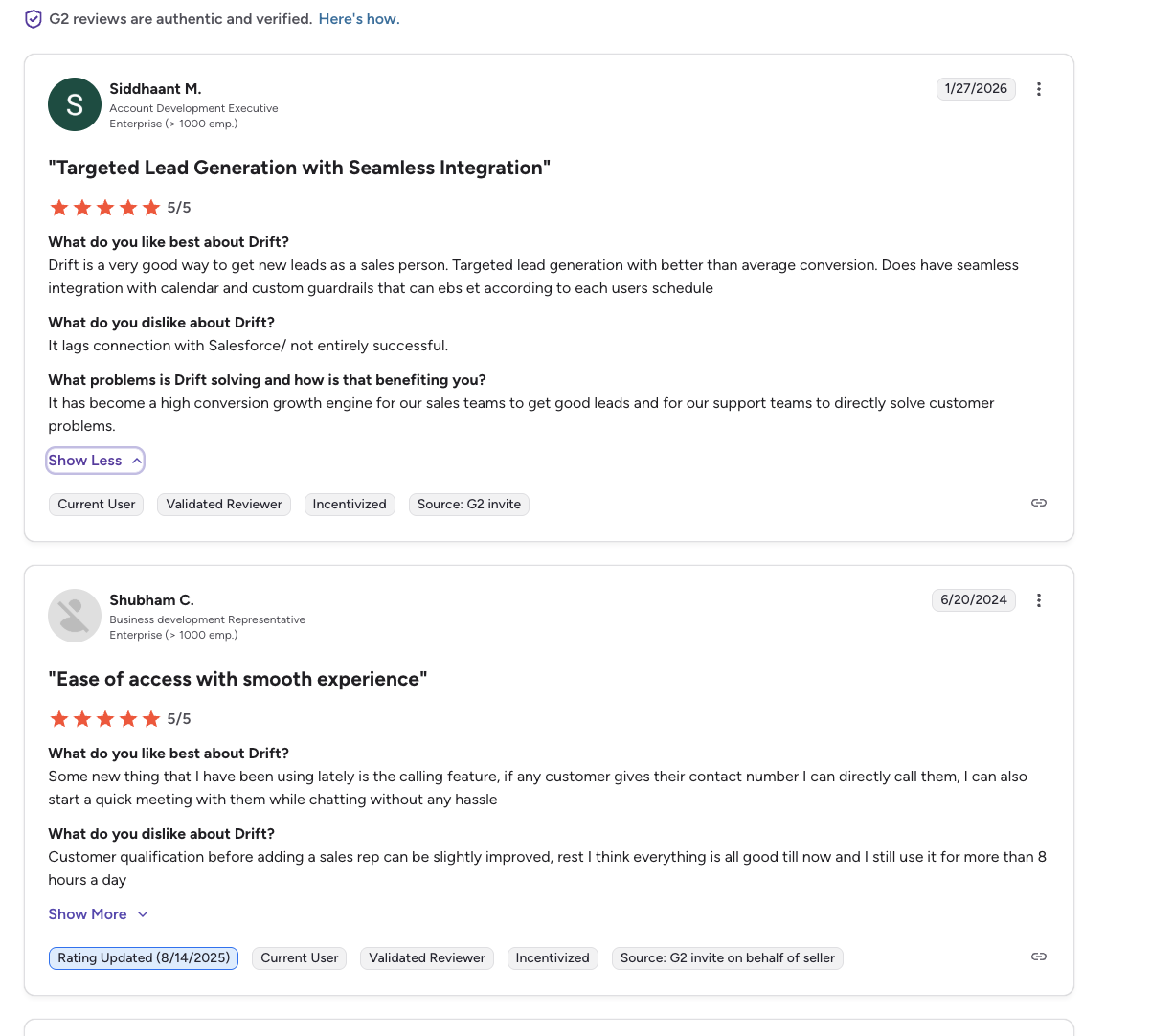
What users confirm: Several reviewers highlight Drift’s ability to generate leads and engage visitors in real time, especially when traffic is high and intent is already present.
What you don’t get
The limitations become more visible when you look at real user feedback:
No multi-channel engagement: Drift operates primarily on your website. Conversations do not naturally extend to platforms like Slack or LinkedIn, which reflects a gap as buyers increasingly interact across channels.
No outbound workflows: There is no built-in capability for outbound engagement such as email sequences or proactive outreach beyond chat.
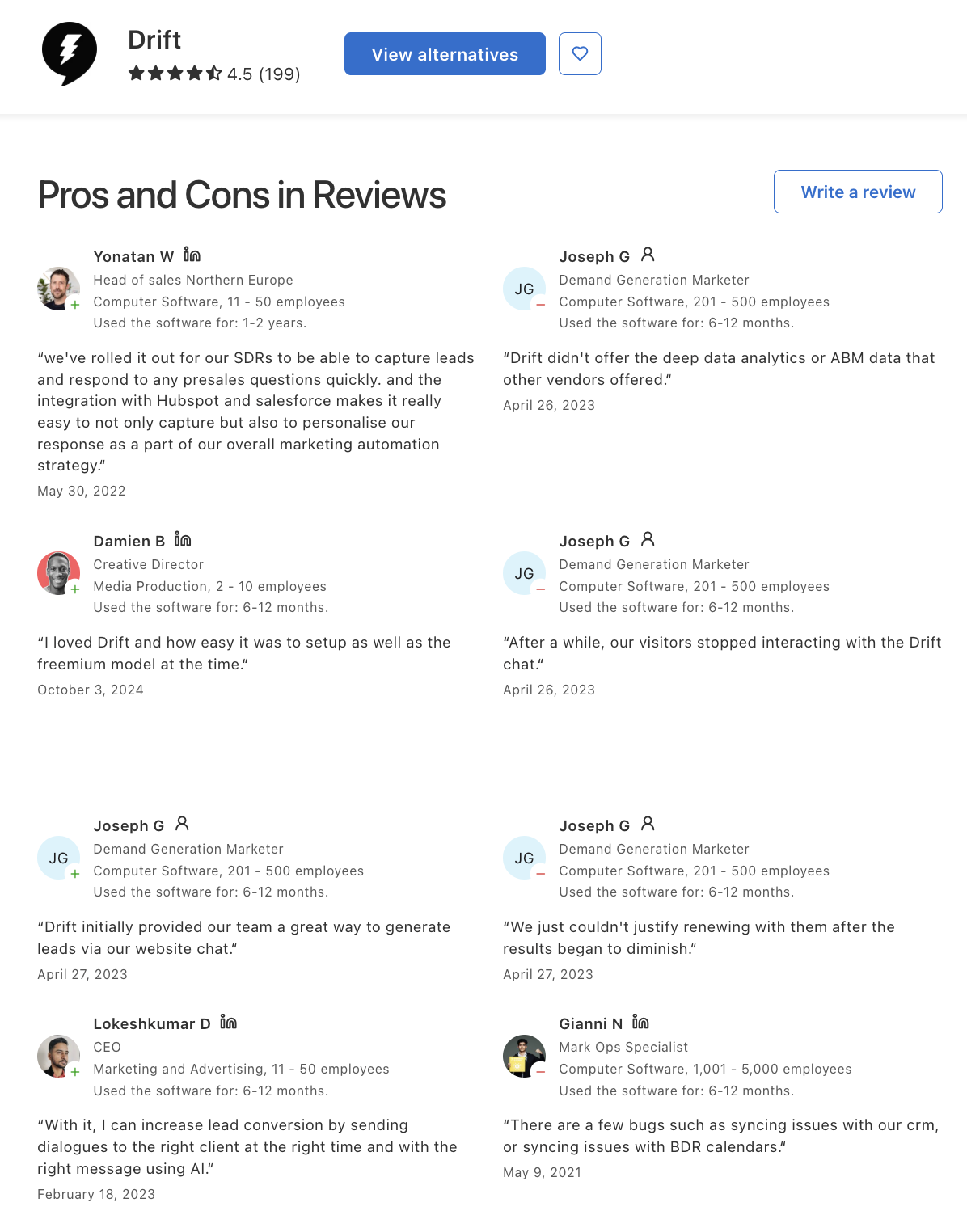
No persistent conversations after exit: Once a visitor leaves the website, the conversation often stops. This aligns with user feedback such as: “After a while, our visitors stopped interacting with the Drift chat.”
Limited funnel visibility: Drift captures on-site behavior but does not track broader buying signals. This is reflected in feedback like: “Drift didn't offer the deep data analytics or ABM data that other vendors offered.”
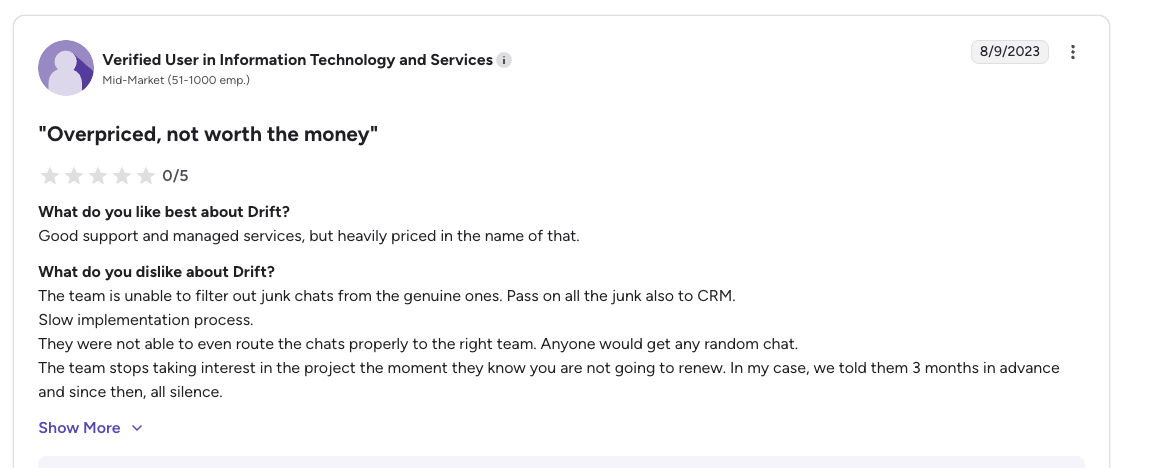
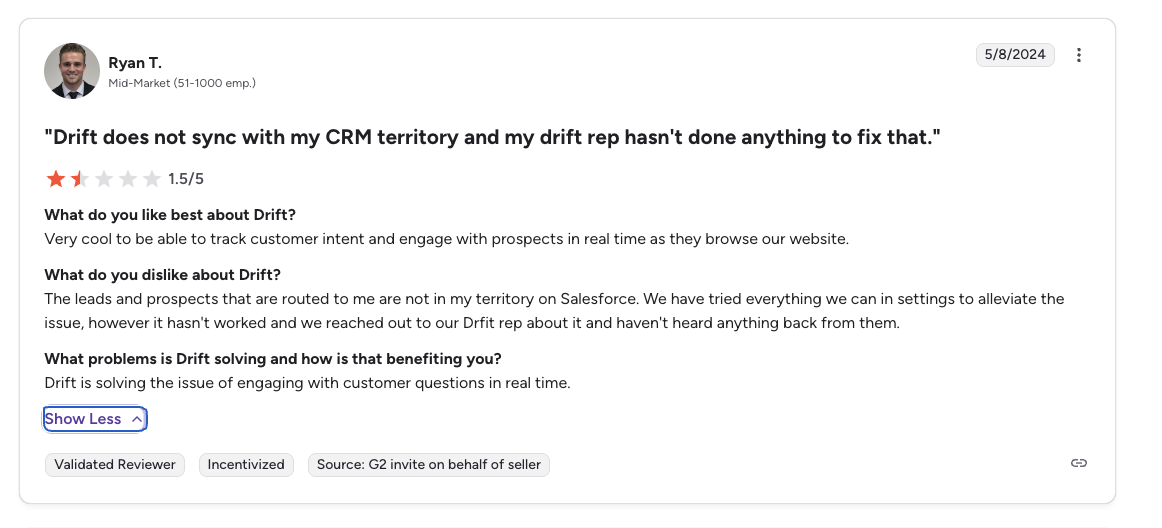
Operational and routing challenges at scale: Some users report issues with lead routing, CRM syncing, and qualification quality, which can impact downstream conversion.
Key takeaway
Drift is effective when buyers are already on your website and ready to engage.
But real user feedback consistently shows the same limitation: performance drops once the interaction moves beyond that moment.
It captures on-site conversations, not the full buyer journey that drives a consistent pipeline.
See Knock AI in Action — Book Your Live Demo Today
Drift is designed as a conversational marketing platform focused on engaging website visitors and converting them into qualified pipeline through chat-driven workflows.
Key capabilities
AI chatbots (playbooks and routing): Drift uses rule-based playbooks to engage visitors, ask qualifying questions, and guide them through predefined conversation paths.
Live chat with rep takeover: Sales reps can join conversations in real time, allowing a smooth transition from bot-led qualification to human interaction.
Conversational landing pages: Drift replaces traditional forms with chat-based experiences to capture and qualify leads directly through conversation.
Meeting scheduling inside chat: Qualified visitors can book meetings instantly within the chat interface without leaving the conversation.
Account-based targeting: Drift allows teams to target specific accounts using firmographic data, visitor behavior, and segmentation rules.
Engagement analytics: The platform provides visibility into chat performance, conversion rates, and engagement metrics tied to pipeline outcomes.
What Drift Does Well
Drift remains one of the most established platforms in conversational marketing, particularly for teams focused on converting inbound website traffic.
It performs strongly in scenarios where buyers arrive with clear intent and are ready to engage in real time. The chatbot and live chat combination enables quick qualification and immediate connection with sales, which can accelerate meeting booking for high-intent visitors.
The transition from chatbot to human rep is generally smooth, allowing conversations to continue without friction once a qualified lead is identified. This makes Drift effective for teams that have dedicated SDR coverage and well-defined routing workflows.
Drift also reduces reliance on traditional forms by enabling conversational lead capture, which can improve conversion rates on key pages like pricing or product.
As a mature platform, it offers stable infrastructure, established integrations, and proven use cases across mid-market and enterprise teams.
Key takeaway: Drift performs best when buyers are already on your website and ready to engage.
Where Drift Falls Short
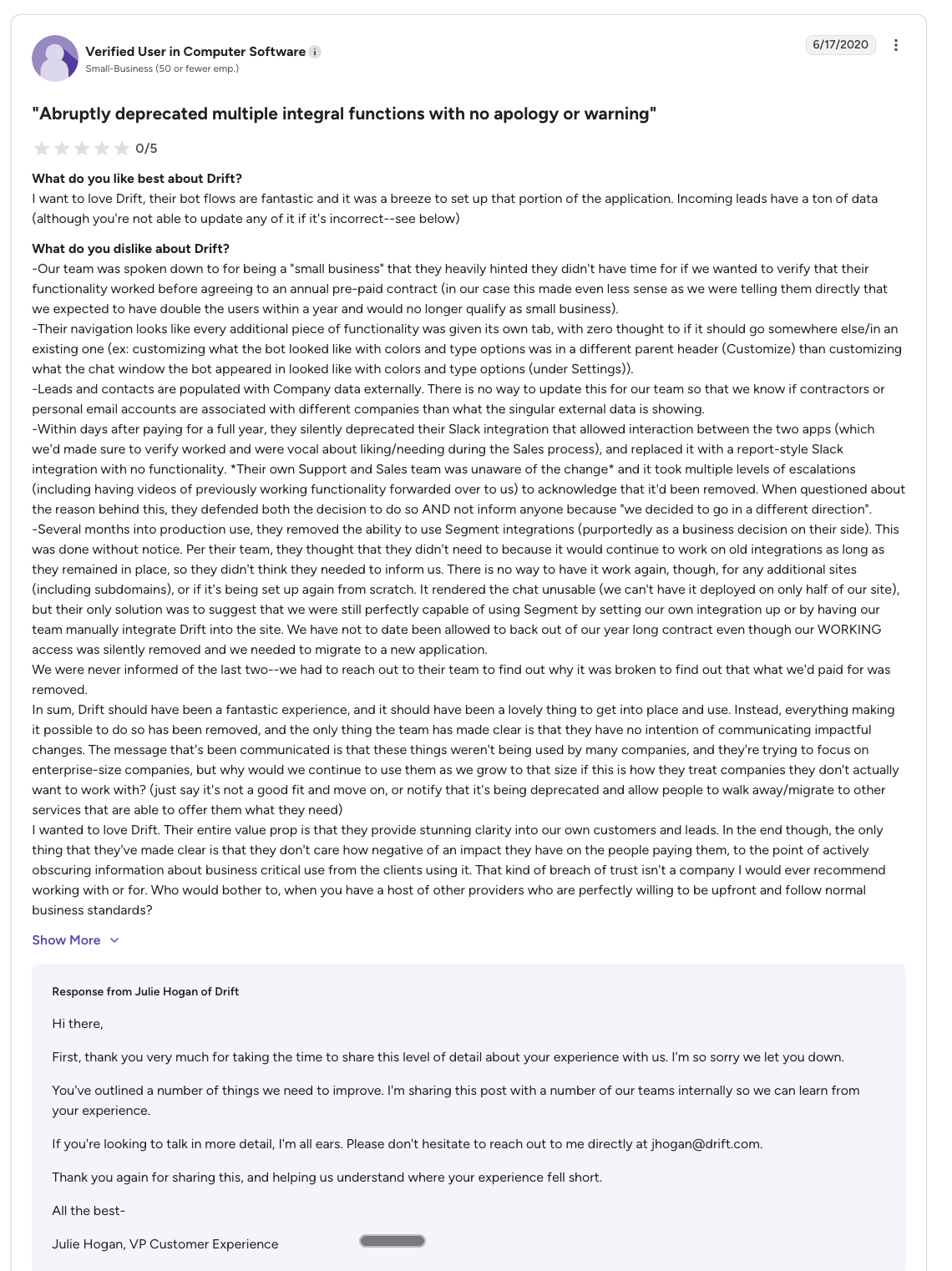
While Drift performs well in specific inbound scenarios, user feedback across platforms like Capterra highlights consistent limitations that impact long-term pipeline performance.
Website-only engagement: Drift is primarily limited to website interactions. As one reviewer noted,
“Drift initially provided our team a great way to generate leads via our website chat.” The limitation is clear. It works on-site, but does not extend beyond it.
Session-based conversations: Engagement depends on the visitor actively interacting during that moment.
“After a while, our visitors stopped interacting with the Drift chat.” Once engagement drops, the system loses effectiveness.
No continuity after the visitor leaves: Conversations do not persist outside the website session. This creates a dependency on follow-ups.
“We just couldn't justify renewing with them after the results began to diminish.” This reflects the drop in performance once real-time interaction is missed.
Requires SDR coverage for real-time response: Drift relies heavily on human availability to maximize value.
“We’ve rolled it out for our SDRs to capture leads and respond to presales questions quickly.” Without active SDR involvement, response quality and speed can decline.
High pricing relative to scope: Several users question whether the results justify the cost over time.
“We just couldn't justify renewing with them after the results began to diminish.”
Limited intent data (on-site only): Drift provides visibility into website behavior, but lacks deeper or broader intent signals.
“Drift didn't offer the deep data analytics or ABM data that other vendors offered.”
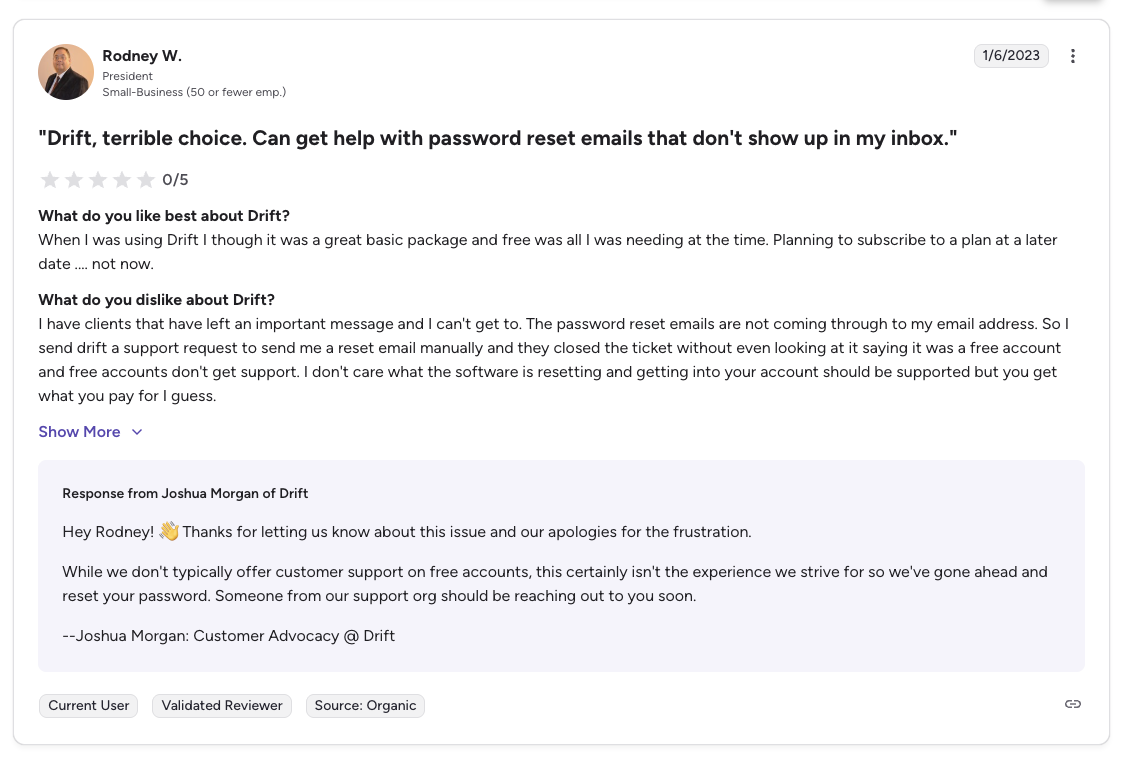
“Drift, terrible choice. Can get help with password reset emails that don't show up in my inbox.”
“The password reset emails are not coming through to my email address… they closed the ticket without even looking at it saying it was a free account and free accounts don't get support.”
Support experience and responsiveness can vary significantly, especially for lower-tier users. This creates friction in critical moments when users rely on the platform.
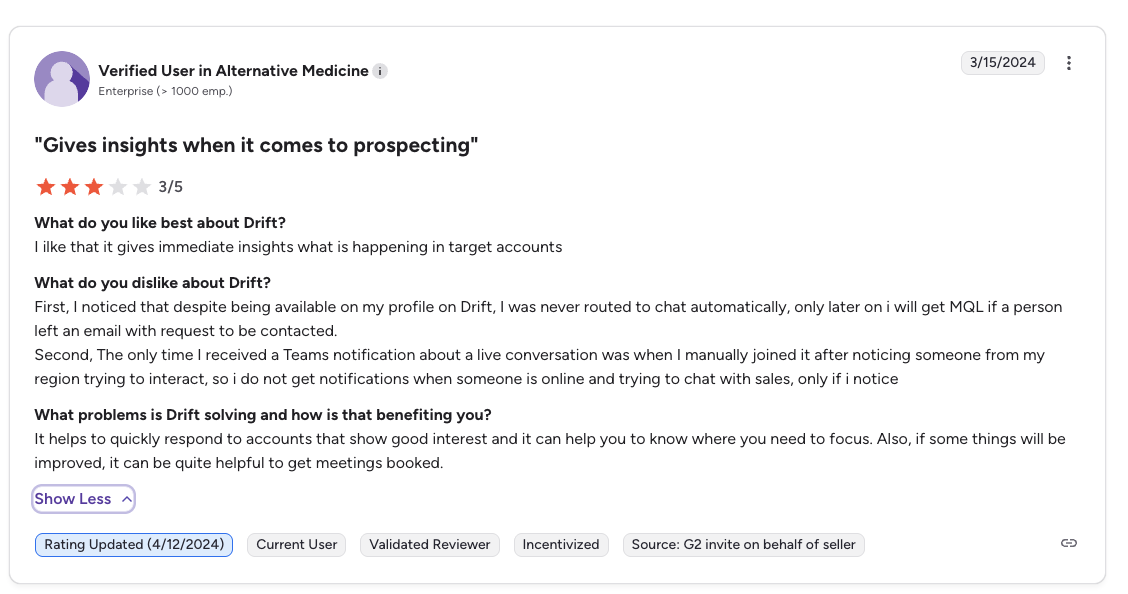
“I noticed that despite being available on my profile on Drift, I was never routed to chat automatically…”
“The only time I received a Teams notification about a live conversation was when I manually joined it…”
Even when intent exists, routing and notification gaps can prevent timely engagement. This impacts conversion, especially when speed is critical.
Across both Capterra and G2, the pattern is consistent: Drift performs well for capturing on-site conversations, but struggles to sustain engagement, qualification, and conversion beyond that moment.
Drift captures conversations, but most buyer intent happens outside those conversations, which is where pipeline is won or lost.
Drift Pricing Breakdown
Drift pricing appears straightforward at first, but the real cost becomes clearer when you look beyond the base subscription.
Estimated pricing
Premium: ~ $2,500 per month (~ $30,000 per year)
Enterprise: $80,000 to $150,000+ per year (custom pricing)
Contracts: Annual commitment required
Pricing is largely sales-led, which means final costs vary based on team size, usage, and feature requirements.
The base license is only part of the investment. In practice, several additional costs shape the total spend:
Seat-based pricing: Additional users increase costs as more SDRs, AEs, and ops teams access the platform.
SDR staffing requirement: Drift depends on real-time engagement, which typically requires dedicated SDR coverage to respond, qualify, and route conversations.
Implementation and setup: Building playbooks, configuring routing, and integrating CRM systems can take weeks before full value is realized.
Ongoing maintenance: Teams need to continuously update chatbot flows, optimize routing logic, and monitor performance.
What this means in reality
When these factors are combined, Drift’s total cost of ownership can increase significantly beyond the base license.
Drift is not just a software expense. It is an operational model that depends on people, timing, and continuous management to deliver results.
What Changed After the Salesloft Acquisition
Drift’s direction shifted meaningfully after becoming part of the Salesloft ecosystem. The platform moved away from being a broad conversational tool toward a more focused role within a larger revenue orchestration strategy.
Key changes
Shift toward enterprise GTM: Drift is now positioned primarily for mid-market and enterprise teams with structured sales processes, larger budgets, and defined inbound workflows.
Stronger focus on pipeline generation: The emphasis has moved toward converting website traffic into qualified pipeline rather than supporting a wide range of conversational use cases.
Deprioritization of support and general automation: Use cases such as customer support, knowledge base interactions, and general-purpose automation have received less focus compared to revenue-driven workflows.
Tighter integration into the Salesloft ecosystem: Drift is increasingly aligned with Salesloft’s broader platform, connecting chat interactions with cadences, deal workflows, and revenue intelligence systems.
What this means in practice
For teams already using Salesloft, this integration can create a more unified workflow across inbound and outbound activities.
For others, it introduces a dependency on a broader ecosystem and reduces Drift’s flexibility as a standalone tool.
The product did not expand into new directions. It became more specialized, focusing on a narrower role within enterprise revenue workflows.
Drift and similar tools were built to optimize conversations. But modern revenue teams are optimizing for something else entirely: pipeline.
This creates what can be described as the Pipeline Gap.
The Pipeline Gap
Most buyers do not start conversations.
A large majority of website visitors browse, evaluate, and leave without ever engaging with a chat widget. Even among high-intent accounts, many prefer to research independently before speaking to sales.
At the same time, intent often exists before a conversation ever begins. Buyers arrive with context, prior research, and clear signals that are not always captured by chat-based systems.
This leads to a fundamental disconnect:
Conversations happen only when users engage
Intent exists even when they do not
And most importantly:
Conversations do not automatically translate into conversions
A chat interaction is a moment. Pipeline is the outcome of capturing, qualifying, and continuing that intent over time.
Capturing chats is not the same as generating pipeline.
Drift vs Modern Buyer Behavior
Buyer behavior has evolved significantly, and it no longer aligns with how traditional chat-first systems operate.
Today’s buyers:
Research before visiting your website: They explore vendors on platforms like G2, LinkedIn, and communities before ever landing on your site.
Engage across multiple channels: Conversations do not happen in one place. They move between email, LinkedIn, Slack groups, and other platforms.
Prefer async engagement: Buyers do not always want real-time conversations. They respond when it is convenient for them, not when a chat widget appears.
Act based on timing, not availability: The moment of intent is short. If engagement does not happen at the right time, the opportunity often fades.
Drift is built around a session-based, website-first interaction model. That model assumes the buyer is present, engaged, and ready to talk in that moment.
Drift was built for a different buying era, where the website was the center of the journey. Today, it is only one touchpoint.
A Better Alternative Approach
As buyer behavior shifts, a different approach to inbound engagement is emerging. Instead of focusing only on chat interactions, newer platforms are designed to capture and convert intent across the entire journey.
Knock AI is a better alternative to Drift and takes this approach further by rethinking how and where conversations happen.
How this approach is different
Identifies visitors before they engage: Instead of waiting for a chat to start, the system recognizes who is on your site and what account they belong to.
Detects intent in real time: Signals such as page visits, behavior, and context are used to prioritize high-intent buyers instantly.
Engages across multiple channels: Conversations are not limited to the website. Buyers can interact through Slack, LinkedIn, WhatsApp, and other messaging platforms.
Uses AI SDRs for qualification and routing: AI handles initial qualification, routing, and responses, allowing sales teams to focus on high-value interactions.
What this shift means
This approach requires a change in how teams think about inbound.
It moves away from chat-first workflows and toward intent-first engagement, where the goal is not just to start conversations, but to carry them forward until they convert.
The shift is from managing conversations to generating pipeline.
Drift vs Knock AI
To better understand the difference in approach, it helps to compare how Drift and Knock AI operate across key areas.
Area
Drift
Knock AI
Model
Chat-first
Intent-first
Channels
Website
Multi-channel
Engagement
Session-based
Persistent
Staffing
SDR-dependent
AI + human hybrid
Pipeline Impact
Medium
High
What this shows
Drift is designed to capture conversations and route them toward meetings within a single session.
Knock AI is designed to identify intent, engage across channels, and maintain momentum until that intent converts into pipeline.
Drift remains a strong and proven platform for conversational marketing, especially for enterprise teams focused on converting website visitors into meetings through real-time engagement.
It works well in environments where:
inbound traffic is high
SDR coverage is available
workflows are clearly defined
However, the limitations become more visible as buying behavior shifts beyond the website.
For teams that need:
multi-channel engagement
persistent conversations
reduced dependency on manual follow-up
stronger pipeline conversion
newer platforms offer a more scalable and complete approach.
Drift is still relevant, but it is no longer sufficient on its own.
FAQs
What is Drift used for?
Drift is a conversational marketing platform used by B2B companies to engage website visitors through chat, qualify leads, and book meetings with sales teams.
What is the starting price of Drift?
Drift pricing typically starts at around $2,500 per month, or about $30,000 per year. Enterprise plans can exceed $80,000 to $150,000+ annually, depending on features, usage, and team size.
Is Drift worth it in 2026?
Drift can be worth it for enterprise teams with strong inbound traffic and dedicated SDR coverage. However, for teams looking for multi-channel engagement and higher pipeline efficiency, alternative approaches may provide better results.
Yes, in most cases. Drift depends on real-time responses to conversations, which typically requires SDRs to monitor and engage with leads as they arrive.
Is Drift only for website chat?
Primarily, yes. Drift is designed around website-based interactions and does not natively support conversations across channels like LinkedIn, Slack, or messaging apps.
What changed after Salesloft acquired Drift?
After the acquisition, Drift shifted toward enterprise pipeline generation and deeper integration within the Salesloft ecosystem. Some broader use cases, such as support and general automation, became less of a focus.
What should I use instead of Drift?
The best alternative depends on your goals. If you need multi-channel engagement, real-time intent detection, and persistent conversations, platforms like Knock AI provide a more comprehensive approach to pipeline generation.
Can Drift generate pipeline on its own?
Drift can generate pipeline from website conversations, but its effectiveness depends on timing, visitor engagement, and SDR availability. It does not capture the full range of buyer intent that occurs outside the website.


.svg)


.svg)
.svg)
.svg)


.svg)
.svg)


.svg)