Warmly Review: TAM Agent, Context Graph & AI GTM Platform
TL;DR
Warmly is an AI-powered GTM platform that combines website visitor identification, buyer intent signals, inbound engagement, and outbound orchestration through its Inbound Agent, TAM Agent, Context Graph, and GTM Brain.
Warmly pricing starts at $10,000 per year, with Inbound Chat at $20,000/year and AI Inbound Autopilot at $30,000/year. Add-ons can increase the total cost.
Warmly's key strengths include visitor identification, AI-powered website engagement, account-based marketing, buying committee identification, audience building, and coordinated sales and marketing workflows.
Customer reviews raise concerns about visitor identification accuracy, CRM synchronization, chatbot configuration, automation reliability, intent-data availability, and value for money. These are reported user experiences, not problems that every customer necessarily faces.
Knock AI is the best warmly alternative for teams focused on converting buyer intent into sales conversations. It supports both formless conversion through direct-to-conversation links and enrichment, routing, and follow-up for existing form submissions.
Knock AI also connects paid campaign engagement to conversion events, helps identify website conversion leakage, and connects account intelligence with qualification, routing, and meeting booking.
The bottom line: Choose Warmly if you need broader account intelligence, buying committee identification, and audience activation. Consider Knock AI if your priority is reducing conversion friction, improving form workflows, and turning high-intent engagement into qualified sales conversations.
What Is Warmly?
What if your website could tell your sales team not just who was visiting, but who was actually interested in buying, what they cared about, and when to reach out?
That's the problem Warmly is trying to solve.
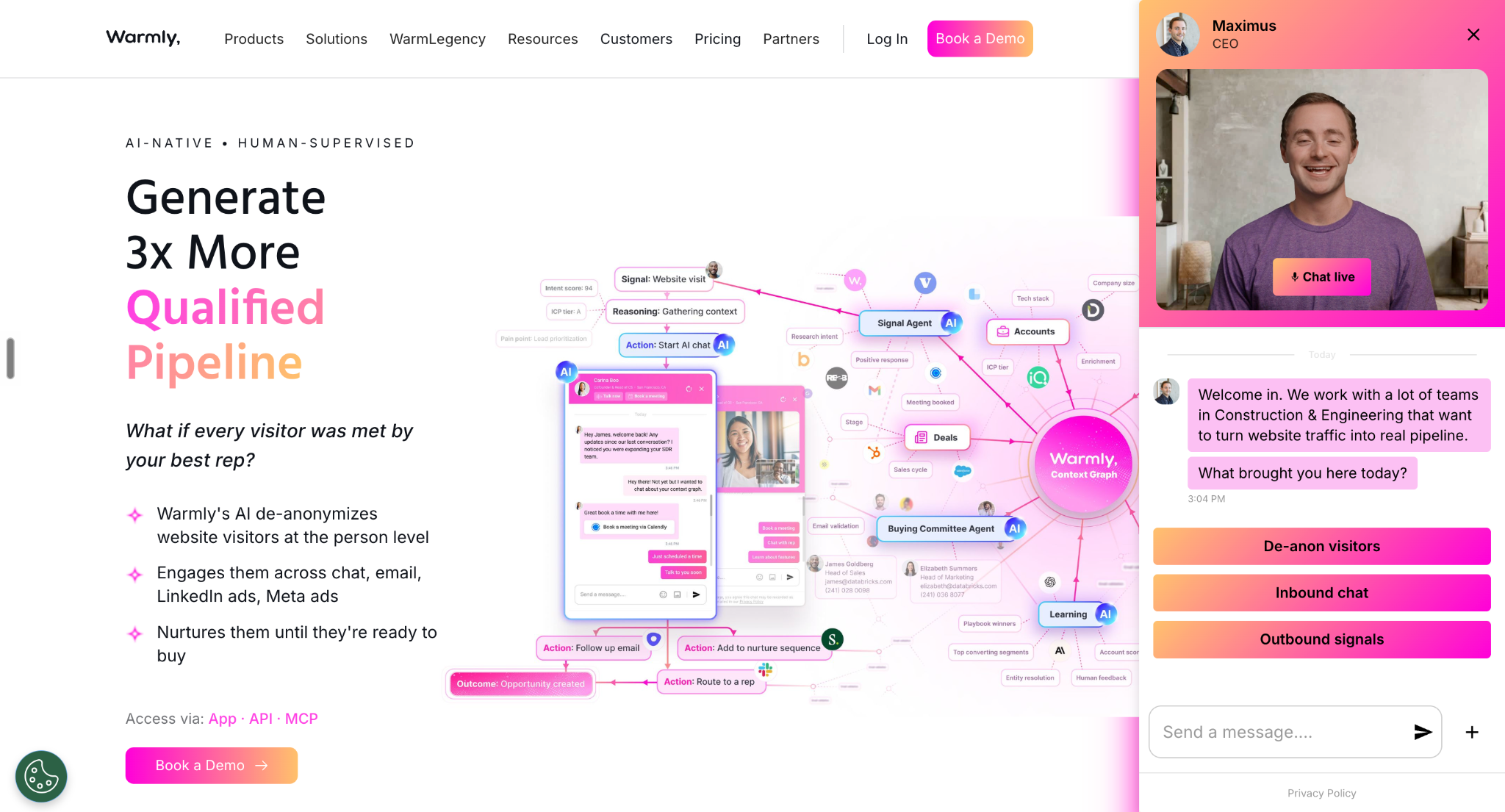
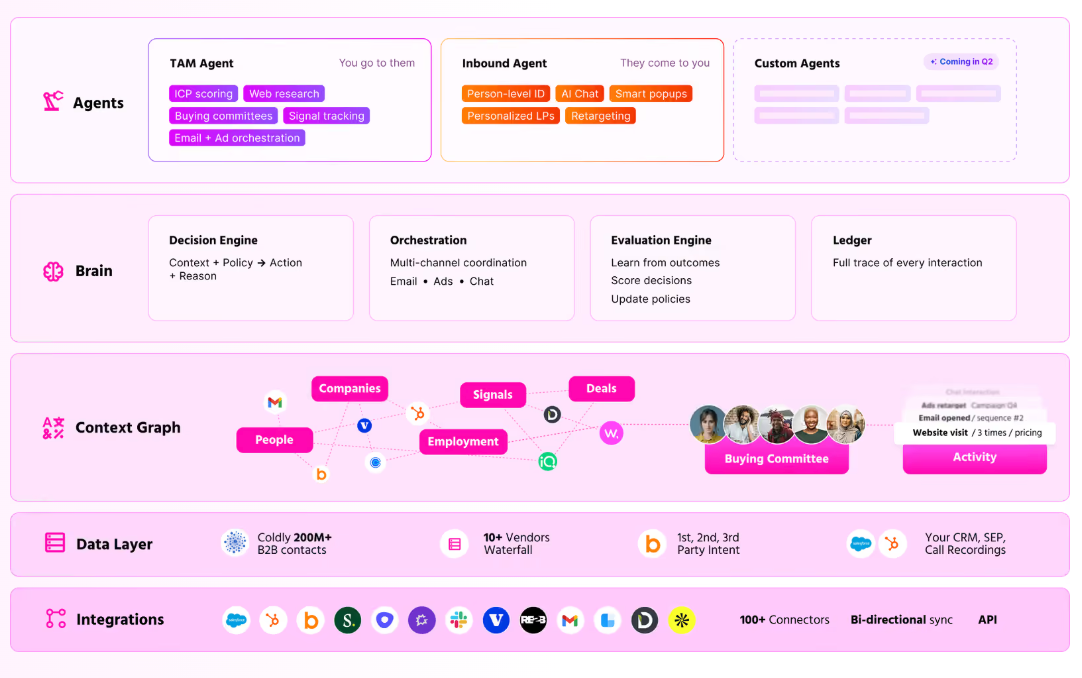
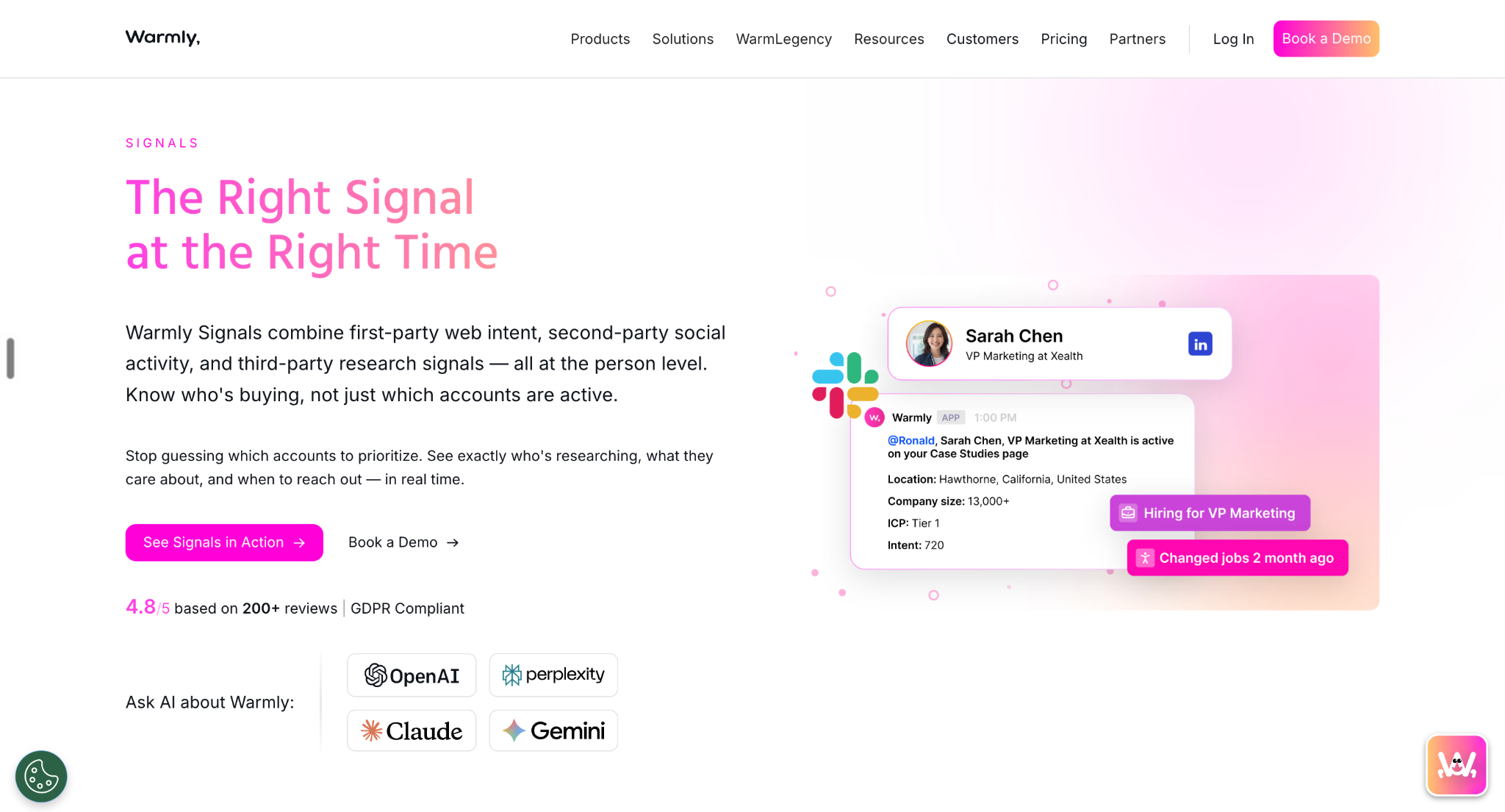
Warmly is an AI-powered go-to-market (GTM) platform that connects website visitor identification, buyer intent signals, inbound engagement, and outbound orchestration. Its Inbound Agent helps convert website visitors into sales conversations, while its TAM Agent helps teams identify and engage potential buyers before they even reach the website. Behind these workflows sit the Context Graph and GTM Brain, which are designed to connect buyer information, signals, and decisions.
But the interesting part of Warmly's story is how it got here. The company didn't start out building an AI-powered GTM platform. It took several pivots, a substantial funding journey, and a shift in how its founders thought about sales before it arrived at its current product.
Who Founded Warmly?
Warmly was founded by Maximus Greenwald, Alan Zhao, and Carina Boo, a team that left Google to build a startup of its own. Greenwald is Warmly's co-founder and CEO, while Zhao and Boo were part of the founding team that shaped the company's early direction. The company was founded around 2019 to 2020, depending on which company milestone or database you use.
Their first challenge wasn't building an AI agent. It was figuring out what customers actually needed.
The founders experimented with different products and business models, including early networking and virtual-connection ideas. According to Greenwald, the team went through multiple pivots over roughly three years before finding stronger traction in sales technology. In his account of the journey, the company spent a long time trying to find the right problem before things began to click. (Source)
That experience led to a more focused question: could sales teams do a better job of recognizing and acting on buyer interest that was already there?
Why Was Warmly Founded?
Think about the typical B2B buying journey. A potential customer visits a pricing page, checks out a product's features, returns a few days later, and perhaps researches competitors. Yet the sales team may see none of this as a clear signal to act, particularly if the visitor never fills out a form.
Meanwhile, sales reps are often expected to find new prospects and send outreach without knowing which accounts are already researching a solution.
Warmly focused on closing that gap. Its early GTM proposition centered on identifying website visitors, combining visitor data with intent signals, and helping sales teams engage promising prospects while their interest was still fresh.
The product gradually expanded beyond identification. Warmly began connecting signals with enrichment, automated outreach, inbound conversations, and sales workflows. Its current vision is broader: a system that can determine who a buyer is, understand what they care about, recognize when they are likely to act, and help decide the next best interaction.
That evolution explains why Warmly now emphasizes its Inbound Agent, TAM Agent, Context Graph, and GTM Brain rather than presenting itself as just another visitor identification tool.
Warmly's Funding History
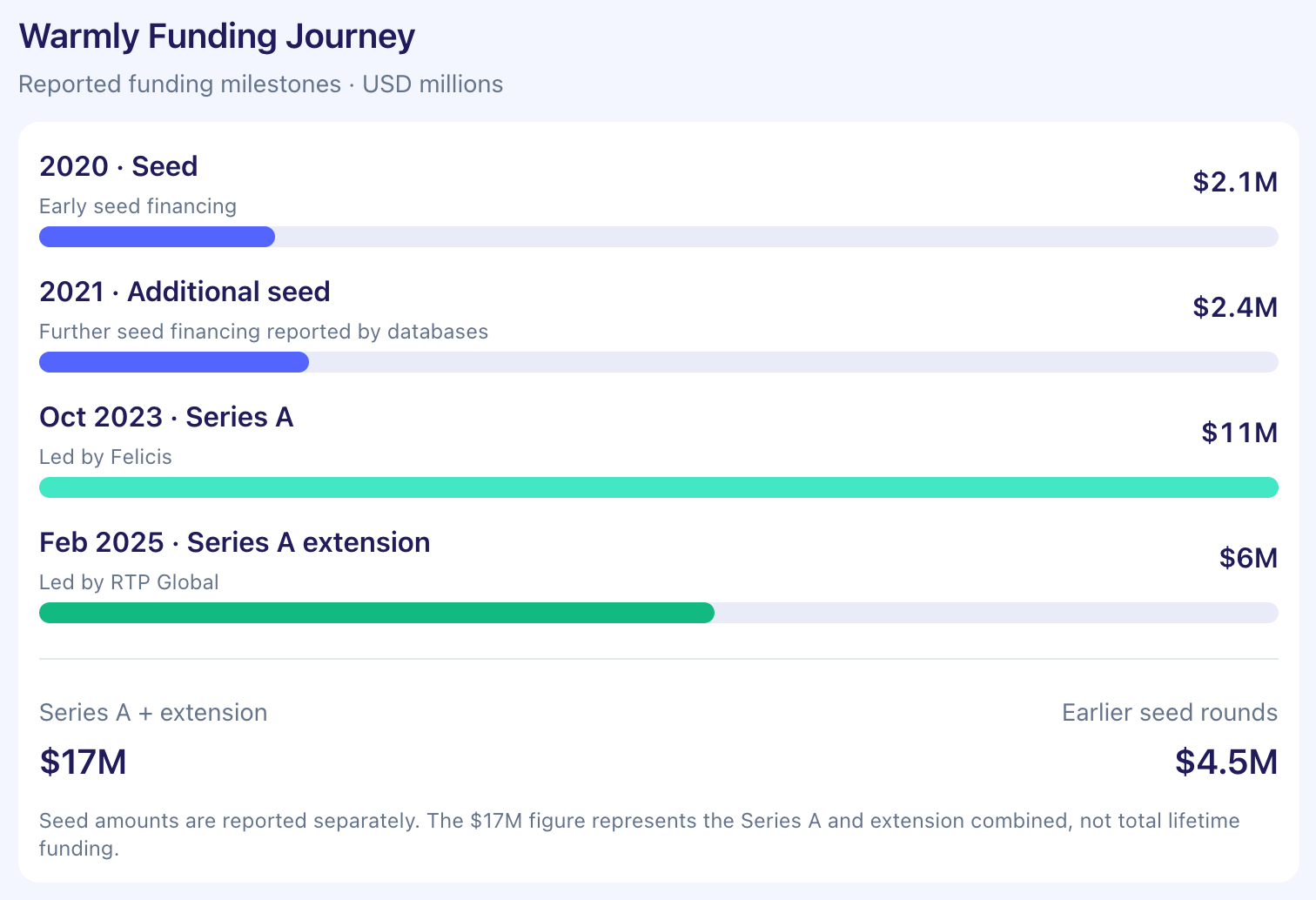
Warmly's funding journey provides useful context for how the company expanded its ambitions. Its financing announcements show a transition from an early-stage startup to a company investing in a broader AI-powered sales platform.
The company described its Series A and extension as $17 million in total Series A funding. That figure refers to those two rounds together, not necessarily all capital Warmly has ever raised. Earlier seed funding is reported separately, and funding databases don't always present overlapping events consistently.
The purpose of the 2025 extension was to support growth, including sales and marketing expansion in Europe, continued product development, and further integration of AI into Warmly's sales workflows.
Funding alone doesn't tell us whether a product is worth buying. It does, however, help explain the resources behind Warmly's push toward a more comprehensive GTM platform.
How Much Revenue Does Warmly Make?
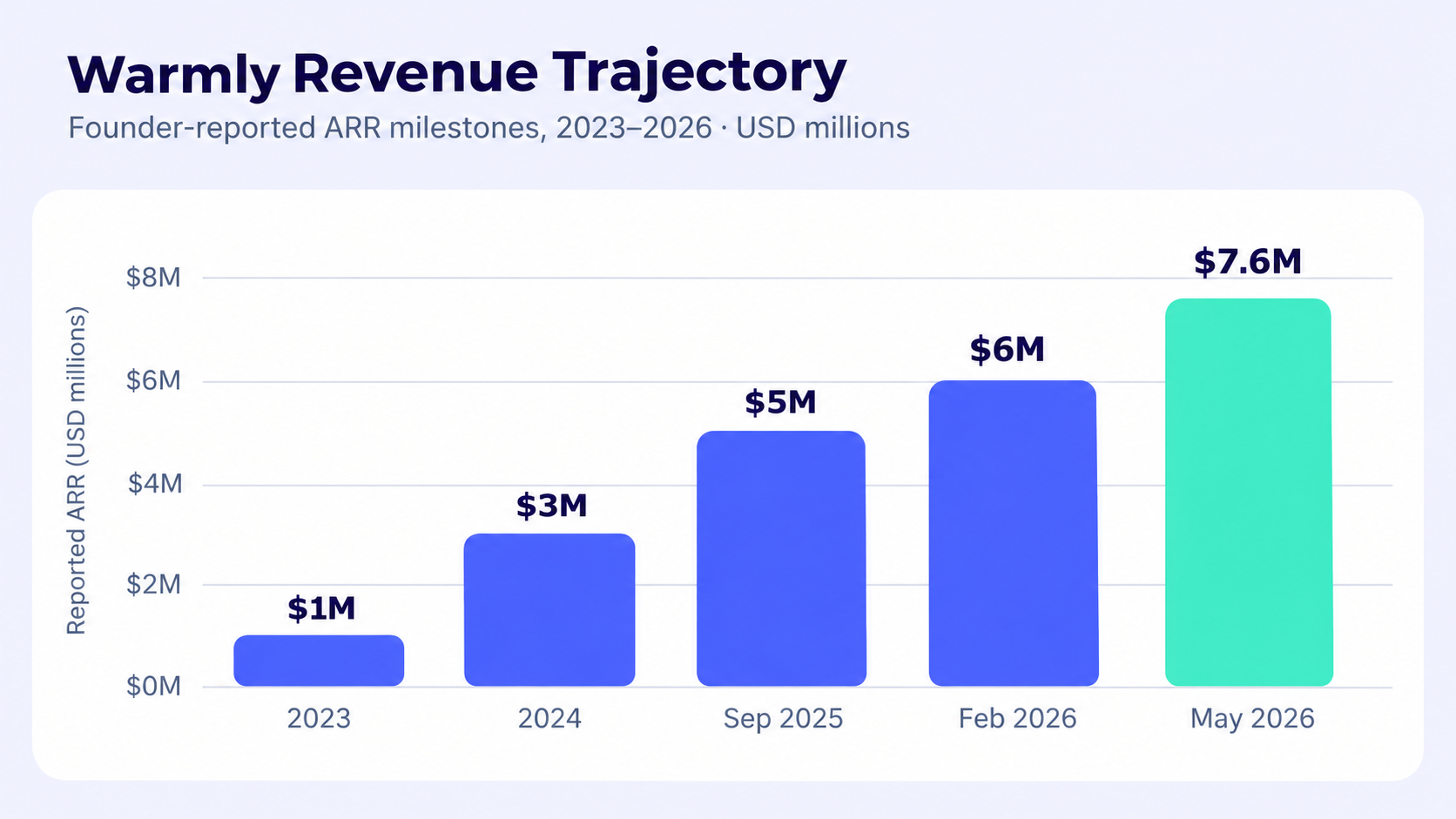
Warmly's revenue trajectory is more revealing than a single headline figure. Co-founder and CEO Maximus Greenwald has shared several ARR milestones publicly, providing a rare look at the company's growth.
In 2023, Warmly grew to approximately $1 million in annual recurring revenue (ARR). The company then tripled that figure to $3 million in 2024, a milestone Greenwald announced publicly in early 2025. By September 2025, Warmly had crossed $5 million ARR, reaching that milestone just 19 months after passing $1 million.
Growth continued into 2026. Greenwald reported approximately $7.27 million ARR in April 2026, followed by $7.63 million in May 2026. These figures were shared through his public company updates and reflect founder-reported operating metrics rather than audited financial statements.
The progression is notable: Warmly moved from $1 million to $3 million ARR, then to $5 million, and subsequently surpassed $7.5 million. Greenwald attributed the company's evolution in part to repeated product pivots and its growing focus on AI-powered agents for marketing and sales workflows.
Warmly's HubSpot Acquisition: What Happened?
Warmly's story took a major turn on June 30, 2026, when the company announced that it had entered into an agreement to be acquired by HubSpot. The announcement was published by Greenwald in his capacity as Warmly's co-founder and CEO.
Why does this matter? Because the two companies' products address connected parts of the customer journey.
HubSpot has built a customer platform spanning CRM, marketing, sales, and service. Warmly has been developing a system that connects buyer intent, website interactions, AI agents, and GTM decisions. Warmly's stated vision is to connect its context and agent capabilities more deeply across HubSpot's customer platform.
In its announcement, Warmly said that existing customer contracts, pricing, account teams, product experience, and integrations would remain unchanged at that time. The company also described longer-term ambitions to connect Warmly's capabilities with HubSpot's broader platform.
For buyers, this creates an important consideration beyond product features: the potential direction of the platform and its integration with HubSpot.
Warmly's product architecture is built around a simple idea: identifying a potential buyer is only the beginning. The real opportunity is connecting that information to the right action, whether that's starting a conversation, booking a meeting, engaging a buying committee, or nurturing an account that isn't ready to buy yet.
To do that, Warmly brings together two primary AI agents: Inbound Agent and TAM Agent. Both use a shared intelligence layer called the Context Graph, while the GTM Brain is designed to help coordinate decisions and learn from outcomes. The goal is to connect what happens on a company's website with its wider sales and marketing activity, rather than leaving each workflow isolated in a separate tool.
How Does Warmly Work?
Think of Warmly as a continuous cycle rather than a collection of standalone features.
1. Identify potential buyers and collect signals.
Warmly gathers information from sources such as website activity, CRM records, advertising interactions, and other available intent signals. It attempts to match anonymous website visitors to individual people or companies, helping revenue teams understand who might be interested in their products.
2. Build a more complete picture of each account.
The Context Graph connects buyer identities, activity, previous engagement, account information, and outcomes. Instead of treating a website visit as an isolated event, the platform aims to put it in context: who the visitor is, what they've done, and whether the account has already interacted with the sales team.
3. Decide how to engage.
This is where the two agents serve different purposes. Inbound Agent focuses on visitors who arrive on the website. TAM Agent focuses on identifying, prioritizing, and engaging potential buyers across the broader addressable market.
4. Take action across the buying journey.
Depending on the workflow, Warmly can support AI-powered conversations, meeting booking, lead routing, audience building, outbound orchestration, and nurture campaigns. The intention is to move beyond simply displaying intent data and help teams act on it.
5. Connect actions to outcomes.
Warmly's GTM Brain is designed to use outcomes such as meetings, replies, and deal progress to inform future decisions. The Context Graph preserves the underlying context, while the agents use it to guide subsequent engagement.
In practice, the value of this approach depends on identity-match coverage, data quality, CRM configuration, workflow setup, and how well the resulting actions convert into qualified pipeline. These are important factors to validate during a demo or pilot.
Warmly's Core Products at a Glance
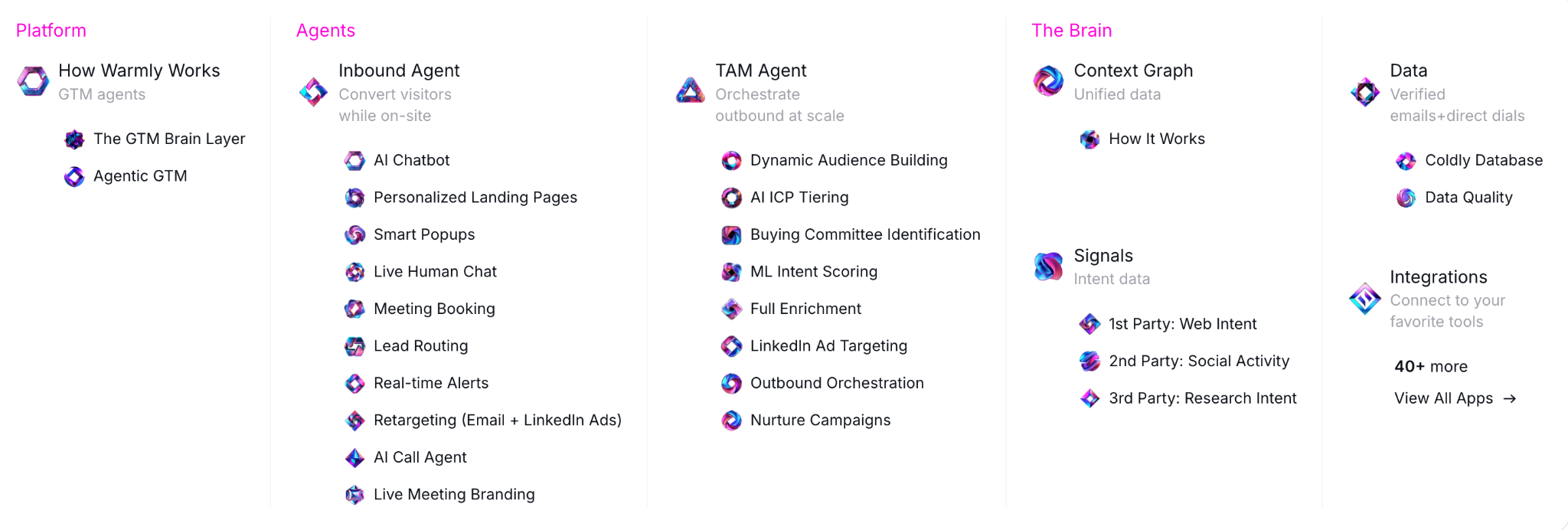
Warmly's product menu groups its capabilities into the platform, AI agents, intelligence layer, data, and integrations. The table below summarizes the products and capabilities shown in its product navigation.
Product or capability
What it does
Primary use case
How Warmly Works
Explains how Warmly connects its agents, data, and GTM workflows.
Understanding the overall platform
GTM Brain Layer
The decision-making and learning layer designed to coordinate actions using shared context and outcomes.
GTM decision-making and orchestration
Agentic GTM
Warmly's approach to using AI agents to execute and coordinate revenue workflows.
Automating GTM activities
Inbound Agent
Identifies and engages website visitors, supports AI conversations, and helps convert interest into meetings.
Inbound lead conversion
AI Chatbot
Engages website visitors through AI-powered conversations.
Answering questions and qualifying visitors
Personalized Landing Pages
Tailors landing-page experiences to visitor identity or intent signals.
Personalized website conversion
Smart Popups
Presents targeted prompts or offers based on visitor context.
Encouraging high-intent visitors to take action
Live Human Chat
Supports human involvement in website conversations.
Sales handoff and live engagement
Meeting Booking
Helps qualified visitors book meetings with sales representatives.
Converting interest into meetings
Lead Routing
Routes potential buyers to the appropriate sales representative or workflow.
Faster follow-up and ownership assignment
Real-time Alerts
Notifies teams about relevant visitor activity and buying signals.
Responding to active buying interest
Retargeting
Supports follow-up through email and LinkedIn ads.
Re-engaging visitors who don't convert immediately
AI Call Agent
Offers an AI-powered call-engagement capability.
Additional automated visitor engagement
Live Meeting Branding
Provides branded experiences around live meetings.
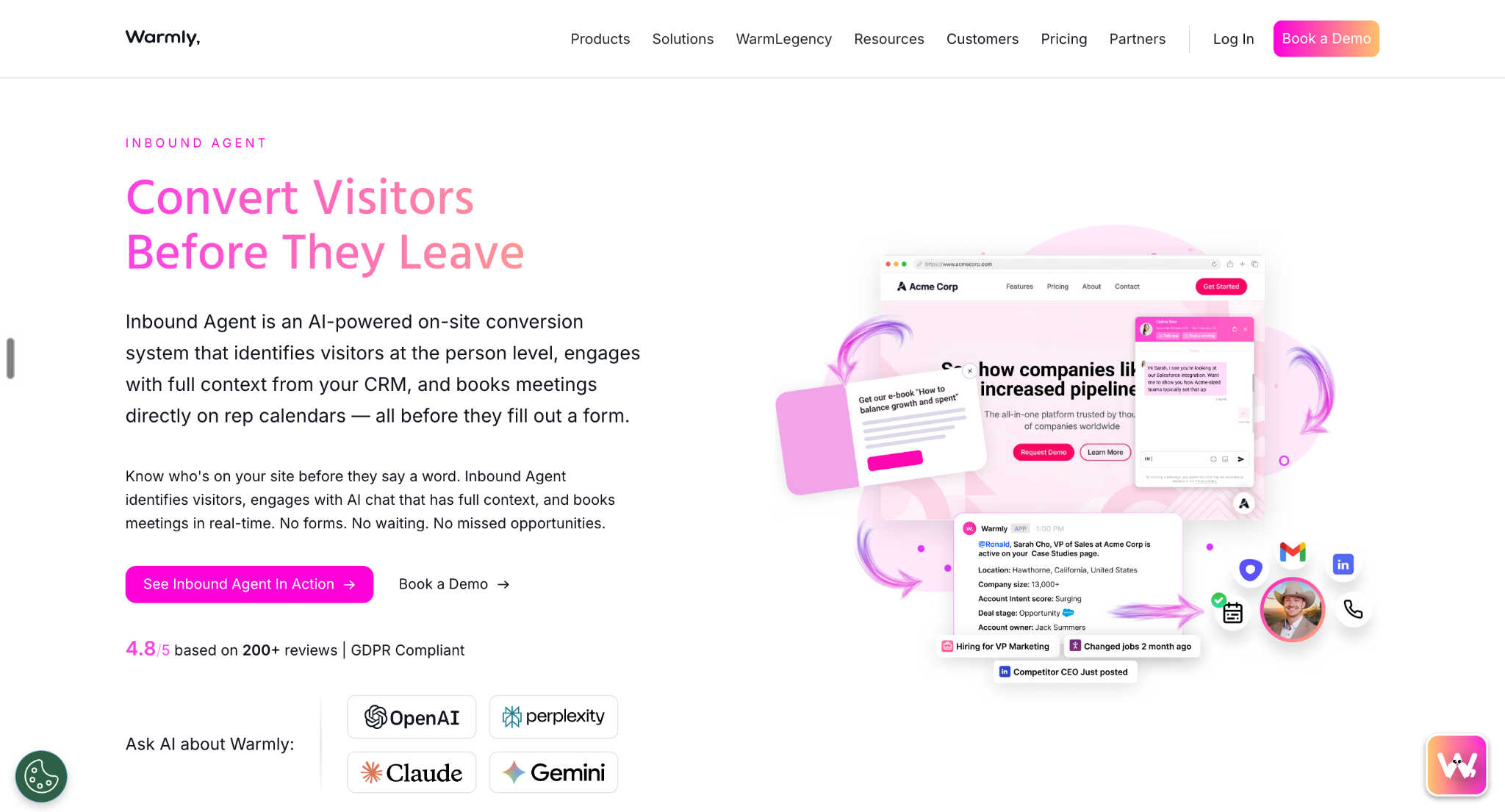
Warmly’s Inbound Agent helps businesses identify website visitors, understand their buying intent, and engage them before they leave.
For example, if someone from a target account repeatedly visits your pricing and integration pages, Warmly can use available visitor and CRM data to inform a relevant AI conversation, route the lead, or help book a meeting.
Key capabilities include:
Person-level and company-level visitor identification
AI-powered conversations and personalized website experiences
Live chat and sales handoffs
Meeting booking, lead routing, and real-time alerts
Retargeting through supported channels
2. TAM Agent: Finding and Engaging the Right Accounts
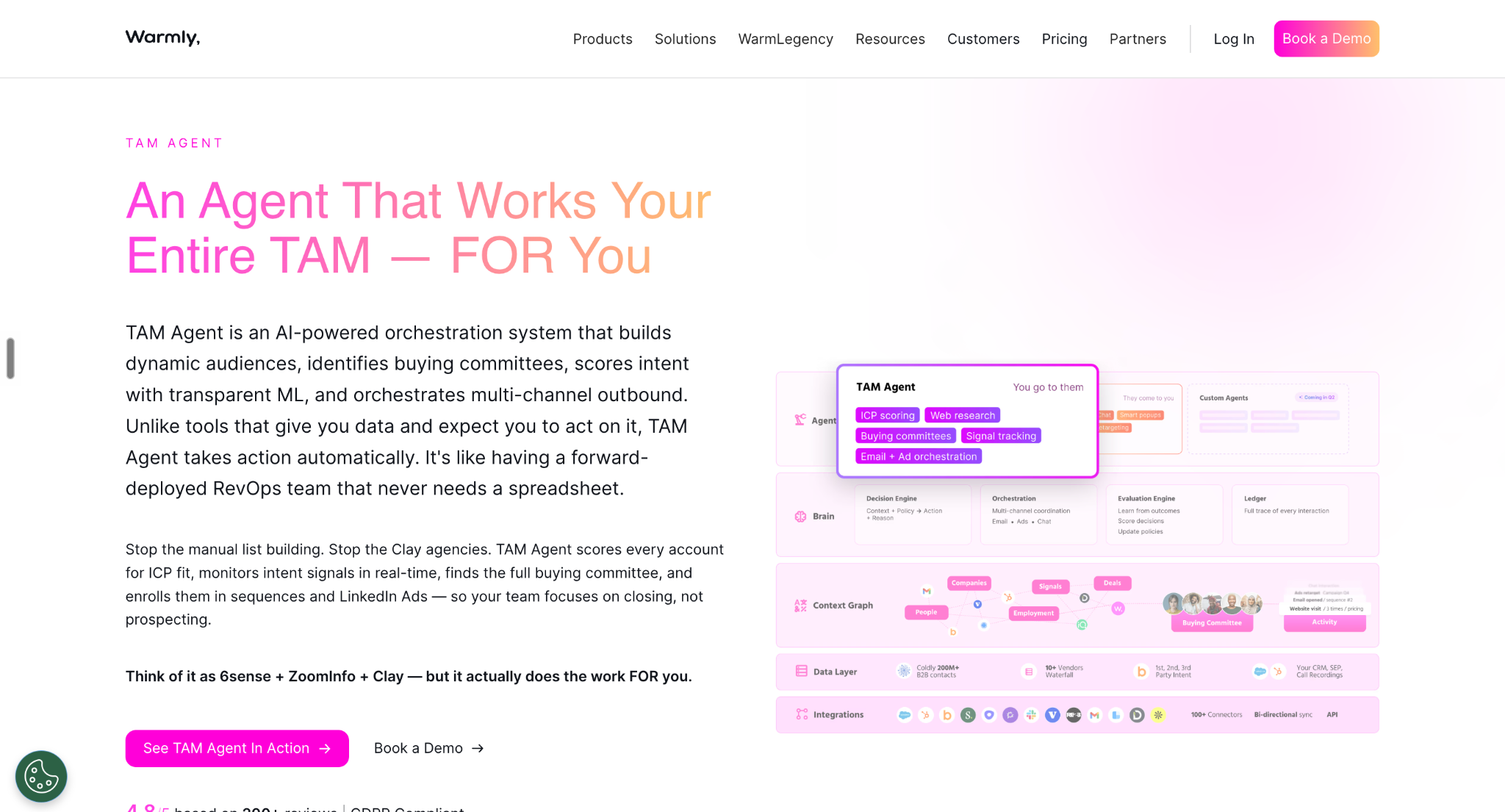
While Inbound Agent focuses on website visitors, Warmly’s TAM Agent helps teams identify and engage potential buyers who may not have visited their website.
TAM stands for total addressable market. The agent helps prioritize accounts based on ideal customer profile (ICP) fit and buying signals, identify relevant stakeholders, and coordinate outreach.
Key capabilities include:
Dynamic audience building and AI-powered ICP tiering
Buying committee identification and intent scoring
Contact and company enrichment
LinkedIn advertising audience activation
Outbound orchestration and nurture campaigns
For a B2B SaaS company targeting enterprise revenue teams, this means prioritizing suitable accounts, identifying decision-makers, and using available intent signals to guide advertising and outreach. Results still depend on data quality, targeting, and campaign execution.
3. Context Graph: Connecting Buyer Intelligence
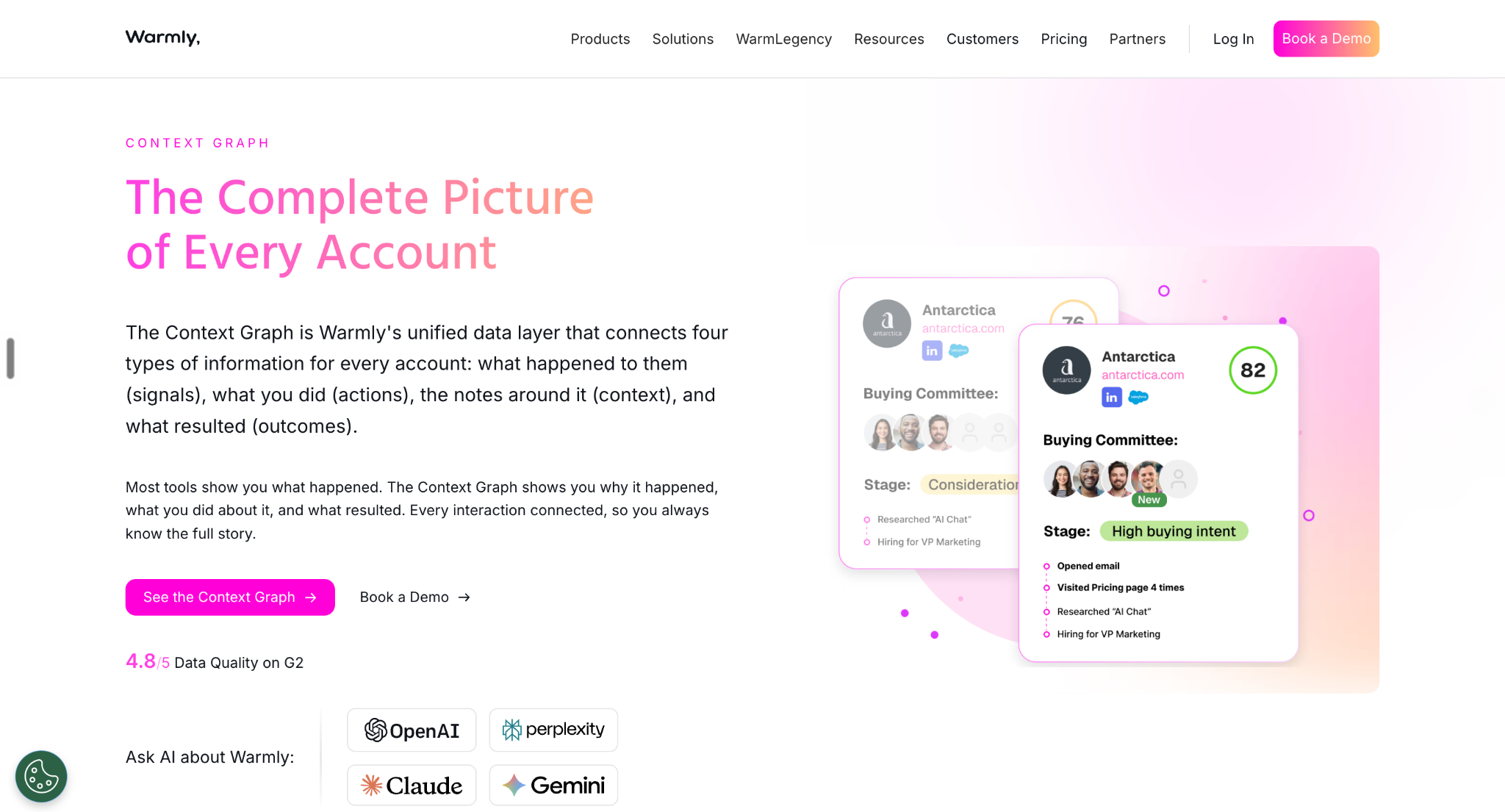
The Context Graph connects buyer identities, intent signals, account information, engagement history, and outcomes, giving Warmly’s agents a shared view of the buying journey.
Imagine a sales rep contacts an account one week, and someone from that company visits the pricing page the next. Rather than treating these as unrelated events, Warmly aims to connect them so the next interaction can account for both previous outreach and current interest.
Warmly organizes this context around four questions:
What happened? Website visits and buying signals.
What did you do? Emails, outreach, and conversations.
What context informed the decision? Notes and reasoning.
What resulted? Replies, meetings, and opportunities.
Unlike a traditional CRM, which primarily stores customer and deal records, the Context Graph is designed to connect those records with a broader history of buyer activity and engagement.
4. GTM Brain: Coordinating Decisions and Learning
Warmly’s GTM Brain is designed to help coordinate agent actions using the context available through the platform.
For example, when an account shows buying intent, the system may need to determine whether to alert sales, initiate an outbound workflow, or adjust outreach because a rep is already engaging the account.
Warmly describes a cycle in which the platform observes signals, interprets them through the Context Graph, selects an action, and uses outcomes to inform subsequent decisions.
The goal is to move beyond displaying buying signals and toward coordinated GTM execution. However, buyers should validate how decisions are made, what human controls are available, and how automation performance is measured.
5. Signals, Data, and Integrations
Warmly’s agents rely on signals and data to identify buyers and guide engagement.
Signals: First-party website activity, social activity, and third-party research intent help surface potential buying interest. Coverage and freshness depend on the available sources.
Data and enrichment: Contact and company information, including email addresses and direct dials, supports identification and prospecting. Warmly also lists its Coldly Database and data-quality capabilities.
Integrations: Connections with HubSpot, Salesforce, and other GTM tools help incorporate Warmly into existing workflows.
Before buying, confirm which data sources are included, how records and events sync, whether updates flow both ways, and which integrations and capabilities are available on your chosen plan. Ultimately, the value of Warmly’s automation depends on the quality of its data and how effectively it fits your existing sales process.
Warmly Solutions: Who Is It Built For?
Warmly also organizes its solutions around the people using the platform, company size, and business problem.
Solution category
Audience or use case
How Warmly can help
By role: Sales Leaders / CROs
Revenue leaders responsible for pipeline and conversion
Prioritize accounts, improve engagement, and coordinate sales actions
By role: Marketing / Demand Gen
Teams responsible for generating and converting demand
Activate buyer signals, coordinate audience targeting, and connect engagement to pipeline
By role: RevOps
Teams managing data, systems, and GTM workflows
Connect signals and CRM context while reducing disconnected workflows
By role: SDR Teams
Teams responsible for prospecting and qualification
Identify relevant accounts, prioritize outreach, and support lead qualification
By company size: Startups
Smaller teams building a repeatable GTM motion
Consolidate selected workflows and focus on the most relevant opportunities
By company size: Mid-Market
Teams coordinating larger volumes of accounts and leads
Connect inbound activity, account prioritization, and outbound engagement
By company size: Enterprise
Organizations with more complex data, routing, and buying committee requirements
Coordinate account-level activity and workflows across teams
By use case: Account-Based Marketing
Teams focusing on specific accounts and buying groups
Build target audiences, identify stakeholders, and coordinate engagement
By use case: Buyer Intent Data & Signals
Teams looking for signs of active buying interest
Combine available signals to help prioritize accounts and actions
By use case: Inbound Lead Conversion
Teams wanting to convert website visitors
Identify visitors, engage them, book meetings, and route leads
By use case: Outbound Sales Automation
Teams looking to automate parts of prospecting and nurture
Support account selection, enrichment, targeting, and coordinated outreach
By use case: Sales Intelligence
Teams that need better context about accounts and buyers
Connect buyer activity, contact information, and intent signals
By use case: Website Visitor Identification
Teams that want to understand anonymous website traffic
Match visitors to available person or company records and activate relevant engagement
Ultimately, Warmly aims to connect buyer identification, intent data, and engagement in one GTM platform. Its Inbound Agent focuses on converting website visitors, while TAM Agent helps teams identify and engage target accounts. The Context Graph and GTM Brain connect these activities to support more coordinated sales and marketing workflows.
How Much Does Warmly Cost?
Warmly's pricing starts at $10,000 per year for AI Web-Deanonymization, with higher tiers adding inbound chat and more advanced AI automation. The platform offers three main plans on its public pricing page, alongside paid add-ons for additional capabilities.
Warmly also offers quarterly billing for teams that want to try the platform before committing annually. Its pricing page advertises a 30% saving with annual billing, although the published quarterly prices should be compared with the annual prices carefully.
Warmly Pricing Plans Compared
Plan
Annual pricing
Quarterly pricing
Key features
AI Web-Deanonymization
$10,000/year
$4,875/quarter
Visitor identification, ICP filtering, real-time and Slack alerts, lead routing, CRM sync, integrations, and retargeting
Inbound Chat
$20,000/year
$6,500/quarter
Everything in Web-Deanonymization, plus an AI chatbot with one AI Studio Agent, live human chat, Warm Offers, chat metrics, and automated email follow-up
AI Inbound Autopilot
$30,000/year
$9,750/quarter
Everything in Inbound Chat, plus unlimited AI Studio Agents, an Autopilot Agent, AI-led qualification and decision-making, mini-demo generation, automated follow-up, and chat optimization
What Does Each Warmly Plan Include?
AI Web-Deanonymization: $10,000 per year
This is Warmly's entry-level paid plan for teams that primarily want to understand who's visiting their website and activate that information.
It's worth evaluating if your main problem is identifying potential buyers and getting the right information to sales. However, companies should assess how much of their traffic Warmly can identify at the person level and whether the resulting data produces enough qualified opportunities to justify the cost.
Inbound Chat: $20,000 per year
Inbound Chat builds on the visitor identification plan by adding AI-powered website conversations and live human engagement.
The plan includes an AI chatbot with one AI Studio Agent, live chat through Warm Calling, Warm Offers, chat performance metrics, and automated email follow-up.
This tier is designed for teams that want to engage website visitors rather than simply identify them. The additional investment makes the most sense when inbound conversion is a meaningful source of pipeline and the team can measure whether these capabilities improve qualified conversations and meeting bookings.
AI Inbound Autopilot: $30,000 per year
AI Inbound Autopilot is Warmly's most automation-focused inbound plan. It includes everything in Inbound Chat, plus unlimited AI Studio Agents and an Autopilot Agent.
Additional capabilities include AI goal-setting, qualification and decision-making, AI-generated slides or mini-demos, AI-written chat follow-up, automated email generation, and mechanisms designed to help the AI chat experience learn and improve.
The appeal is reducing the manual work involved in engaging and qualifying inbound visitors. Before choosing this plan, buyers should validate how the agents behave in real conversations, what controls sales teams retain, and which workflows are genuinely automated.
Warmly Add-On Pricing
Warmly also lists additional products that can extend the core plans.
Add-on
Published price
What it adds
GTM Signals Package
$10,000/year
Additional buying signals, including intent data, hiring activity, funding events, and competitive intelligence
Warm Experiences
$10,000/year
Personalized website experiences that adapt to visitor identity and intent
AI 24/7 Video Chat Agent
Contact sales
An AI-powered video avatar designed to engage visitors, provide personalized demos, and qualify leads
These add-ons can materially increase the total cost, so it's worth confirming whether they are necessary for your use case or already covered by the plan being quoted.
Is Annual or Quarterly Billing Cheaper?
Warmly advertises a 30% saving with annual billing. However, the listed quarterly prices annualize to more than the corresponding annual prices.
Plan
Annual commitment
Four quarterly payments
Difference
AI Web-Deanonymization
$10,000
$19,500
$9,500
Inbound Chat
$20,000
$26,000
$6,000
AI Inbound Autopilot
$30,000
$39,000
$9,000
These calculations use the prices displayed on Warmly's pricing page. Quarterly billing may offer more flexibility, but it is not the cheaper option if you pay for all four quarters at the published rates.
Before committing, ask Warmly to confirm the full contract value, renewal terms, credit allowances, and whether quarterly billing carries any additional conditions.
Is Warmly Worth the Price?
Warmly's pricing is best evaluated against the workflows it can consolidate and the incremental pipeline it can help generate.
For example, a company already paying for visitor identification, intent data, inbound chat, and retargeting may find value in consolidating some of those capabilities. A company that only needs one of these functions may find a $10,000 annual starting price difficult to justify.
Before buying, consider:
Traffic and identity coverage: How many visitors can Warmly identify, and how many are relevant to your ICP?
Conversion impact: Does the platform generate more qualified conversations and meetings?
Tool consolidation: Which existing subscriptions and workflows can realistically be retired?
Implementation: How much work is required to configure the CRM, routing, agents, and integrations?
Total cost: What will the plan cost after add-ons, usage, and implementation are included?
The bottom line: Warmly starts at $10,000 annually, but the right plan depends on whether you need visitor identification, AI-powered inbound engagement, or more extensive inbound automation. Compare the total cost with the value of the workflows you will actually use, rather than choosing a plan simply because it offers the most features.
What Do Warmly Reviews on G2 Say? Common Complaints and Limitations
Warmly's value proposition is straightforward: identify website visitors, uncover buying signals, enrich contact data, and help sales teams engage potential buyers before opportunities go cold. But how well does that workflow hold up in practice?
G2 reviews paint a mixed picture. Users praise Warmly for lead generation, visitor tracking, ease of use, and its potential to turn anonymous website activity into sales opportunities. At the same time, recurring complaints raise questions about data accuracy, contact matching, CRM integrations, chatbot reliability, and the cost of accessing more advanced capabilities.
Here are the main limitations worth considering before investing in Warmly.
1. Visitor Identification and Contact Data Accuracy Can Be Inconsistent
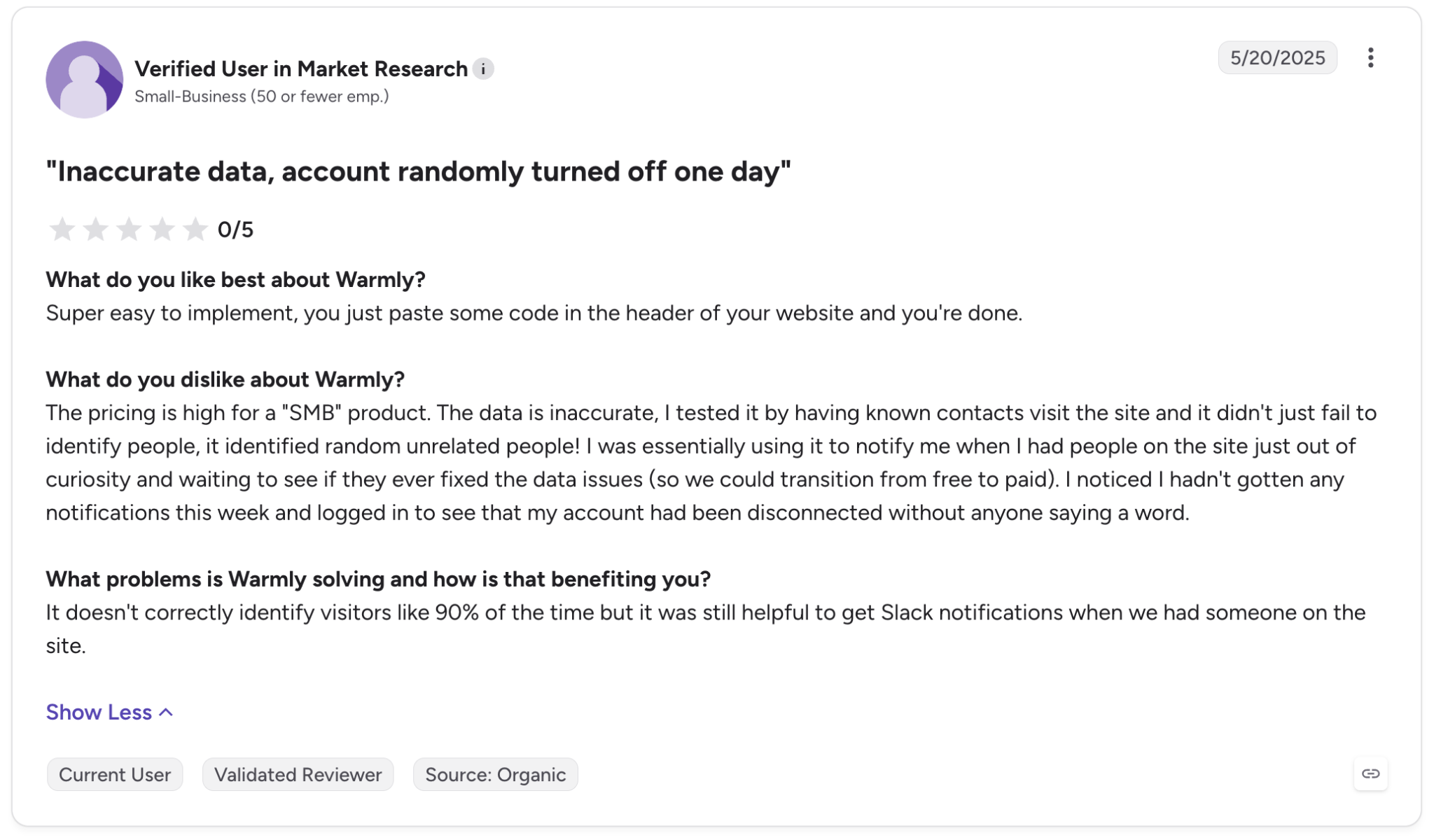
For a platform built around identifying website visitors, data accuracy is fundamental. If Warmly attributes a visit to the wrong person or surfaces an irrelevant contact, sales teams can end up acting on misleading signals.
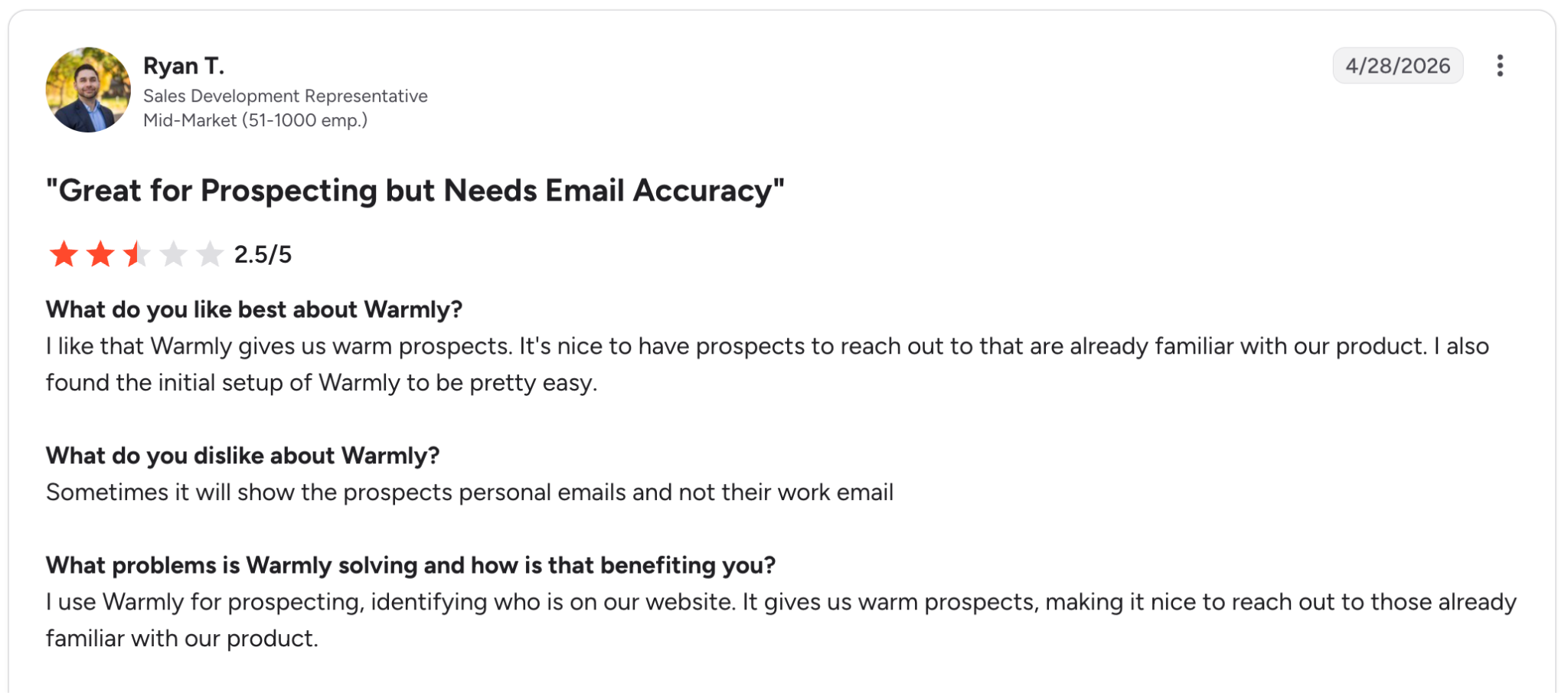
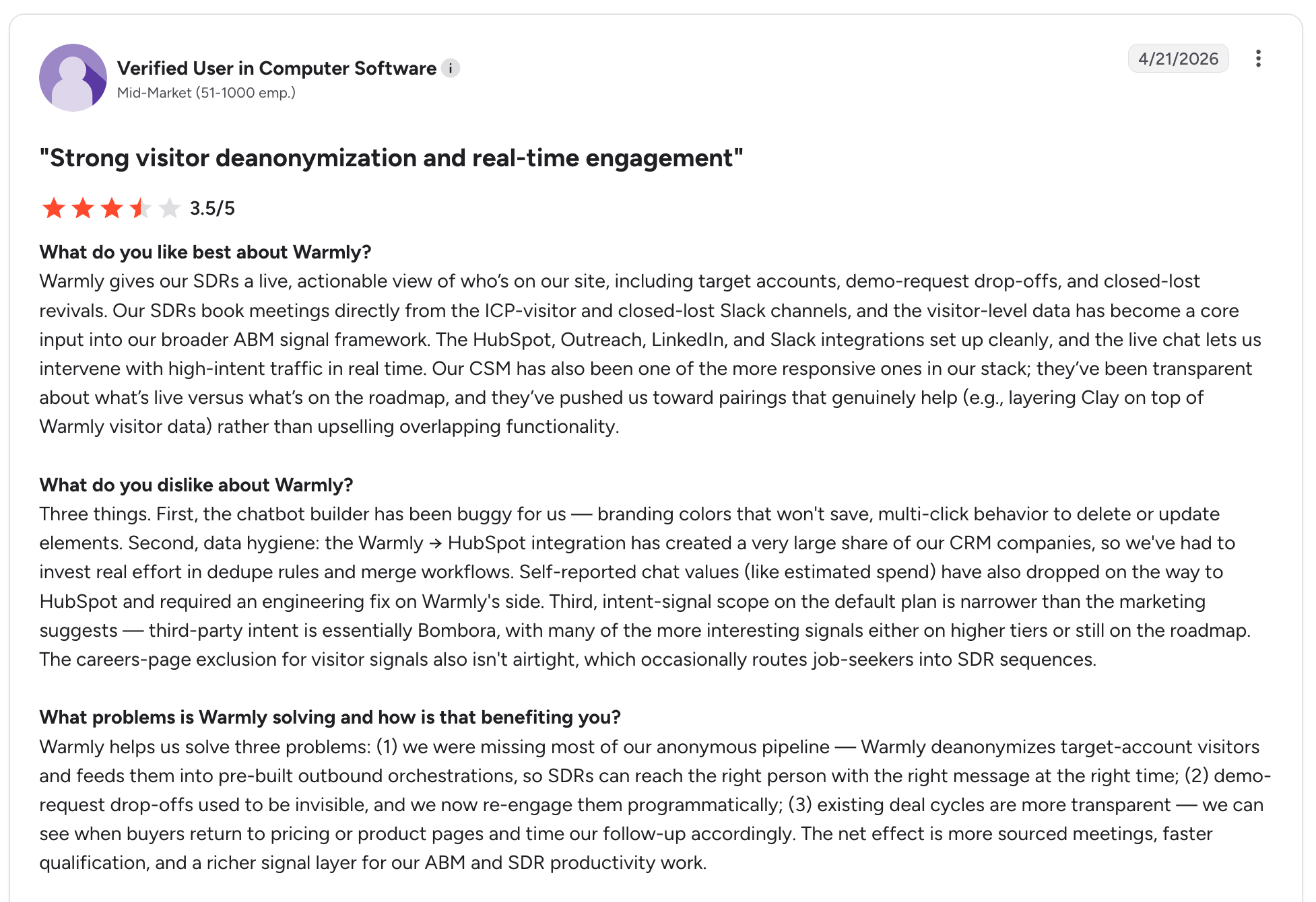
The reviewer also reported that their account had become disconnected without notification. Another reviewer, Ryan T., an SDR at a mid-market company, highlighted a different enrichment issue:
Other reviewers have pointed to inconsistent identification rates, particularly when dealing with smaller companies, shared networks, or visitors whose identities are difficult to resolve.
Why this matters: Incorrect visitor identification can send sales reps after the wrong prospects, pollute CRM records, and waste time that should be spent engaging genuine buyers. When a platform surfaces personal email addresses instead of business contacts, teams may struggle to reach decision-makers through the channels they actually use for work. For revenue teams, the problem isn't simply missing data. It's making sales decisions based on unreliable data.
2. Warmly's HubSpot Integration Can Create CRM Data Cleanup Work
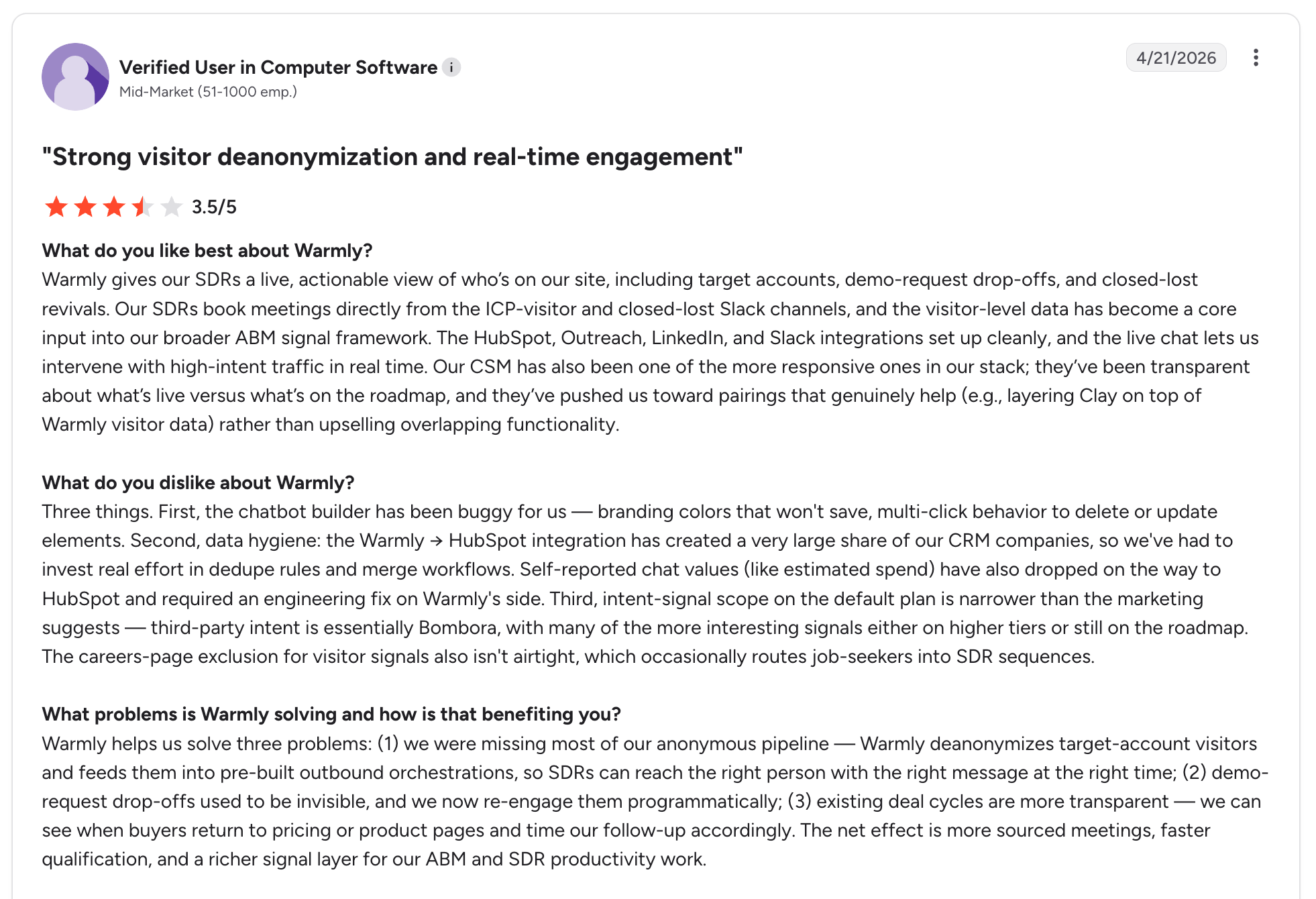
A sales intelligence platform should help teams maintain cleaner, more actionable customer data. But one G2 reviewer reported that Warmly's HubSpot integration created additional work instead.
The reviewer described three specific problems:
The same reviewer reported that self-reported chat values, including estimated spend, had been lost during the transfer to HubSpot and required an engineering fix on Warmly's side.
The business impact: Instead of giving sales and RevOps teams a cleaner view of their pipeline, poor synchronization can create duplicate company records, incomplete contact information, and unreliable reporting. Teams may have to spend additional engineering and operations time fixing the data rather than using it to generate revenue.
3. Warmly's Chatbot Builder Has Reported Bugs
Warmly promotes AI-powered inbound engagement, but building and maintaining those experiences can become a problem when the configuration tools do not behave as expected.
One G2 reviewer described the experience directly:
The reviewer went on to report branding colors that would not save and elements that required multiple clicks to delete or update.
The business impact: Every unnecessary step slows down the team responsible for improving website conversion. If marketers cannot reliably update branding or modify chat flows, launching experiments and responding to changing campaign requirements becomes harder. The concern is not merely an inconvenient interface; it is the time and friction involved in maintaining a revenue-generating website experience.
4. Warmly Users Have Reported Chat, Tracking, and Automation Failures
Warmly's value depends on more than identifying visitors. The platform must capture website activity and reliably deliver that information to the systems where sales teams act on it.
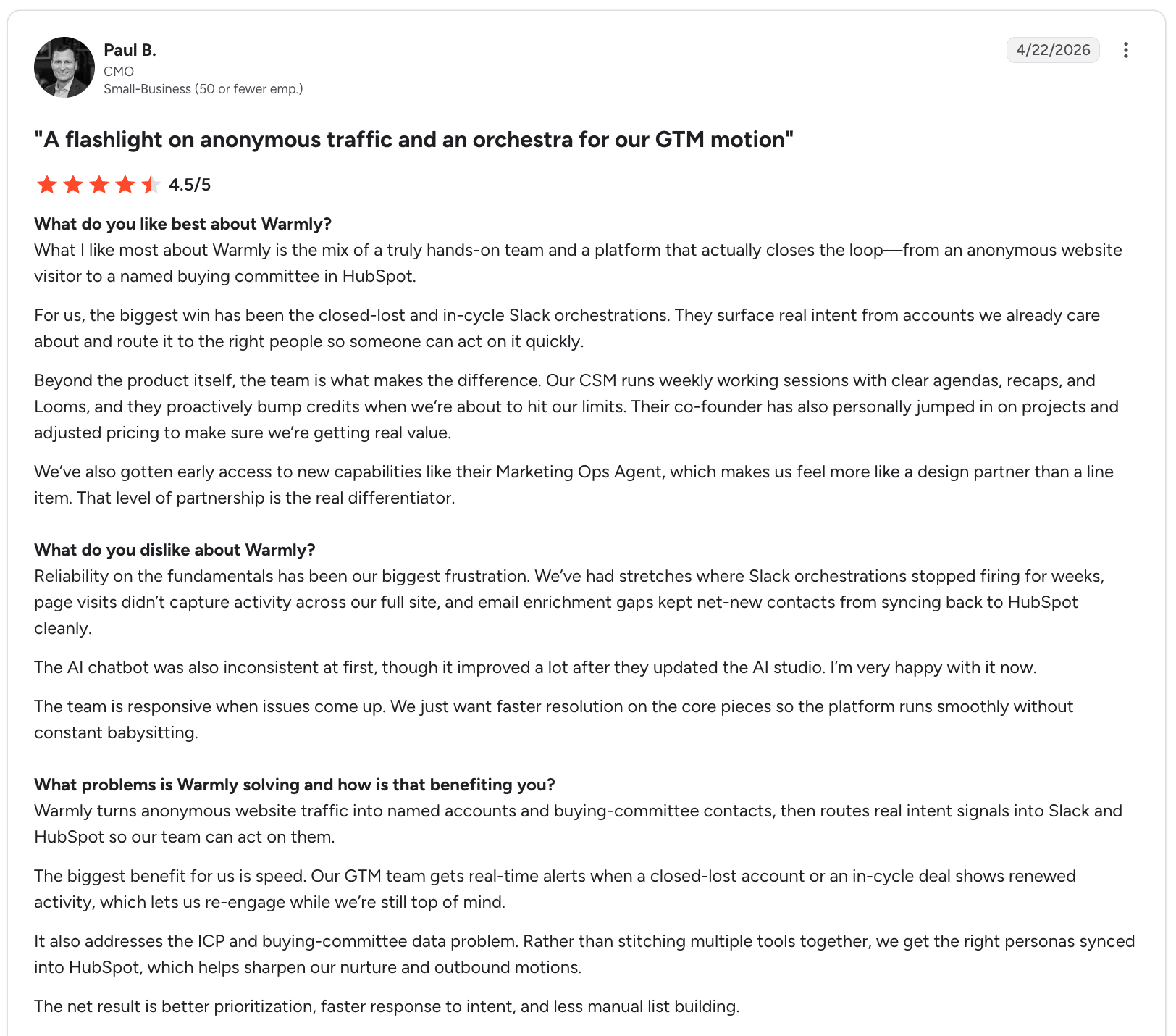
One G2 reviewer reported several operational issues, including problems with Slack notifications, website visit tracking, and contact enrichment. The reviewer specifically wrote:
The same review described gaps in website visit capture and enrichment problems that prevented new contacts from syncing to HubSpot.
The business impact: When alerts stop firing, website activity goes uncaptured, or new contacts fail to reach the CRM, sales teams can miss opportunities without realizing it. A buying signal is worthless if it never reaches the person responsible for acting on it. These reported failures raise a serious question about relying on Warmly for time-sensitive sales workflows.
5. Warmly's Intent Data Coverage May Be Narrower Than Expected
Warmly offers capabilities around buying signals, audience building, and outbound orchestration. However, one G2 reviewer questioned whether the intent data available on the default plan matched the breadth of the product's marketing.
The review also stated that third-party intent coverage was essentially Bombora, with other signals either reserved for higher tiers or still on the roadmap.
The business impact: Sales teams cannot prioritize accounts effectively if the signals they need are unavailable on their plan. If broader intent coverage requires a more expensive package, the actual cost of building the desired workflow may be considerably higher than the entry price suggests. Buyers need to distinguish between capabilities the platform advertises and capabilities they can actually use at their contracted tier.
6. Warmly's Pricing Can Be Difficult to Justify When Data Quality Falls Short
Warmly's pricing becomes a more pressing concern when customers question the accuracy of the data they are paying to access.
One small-business reviewer gave the product a 0/5 rating and wrote:
The same reviewer described incorrect visitor identification, including unrelated people being matched to website activity.
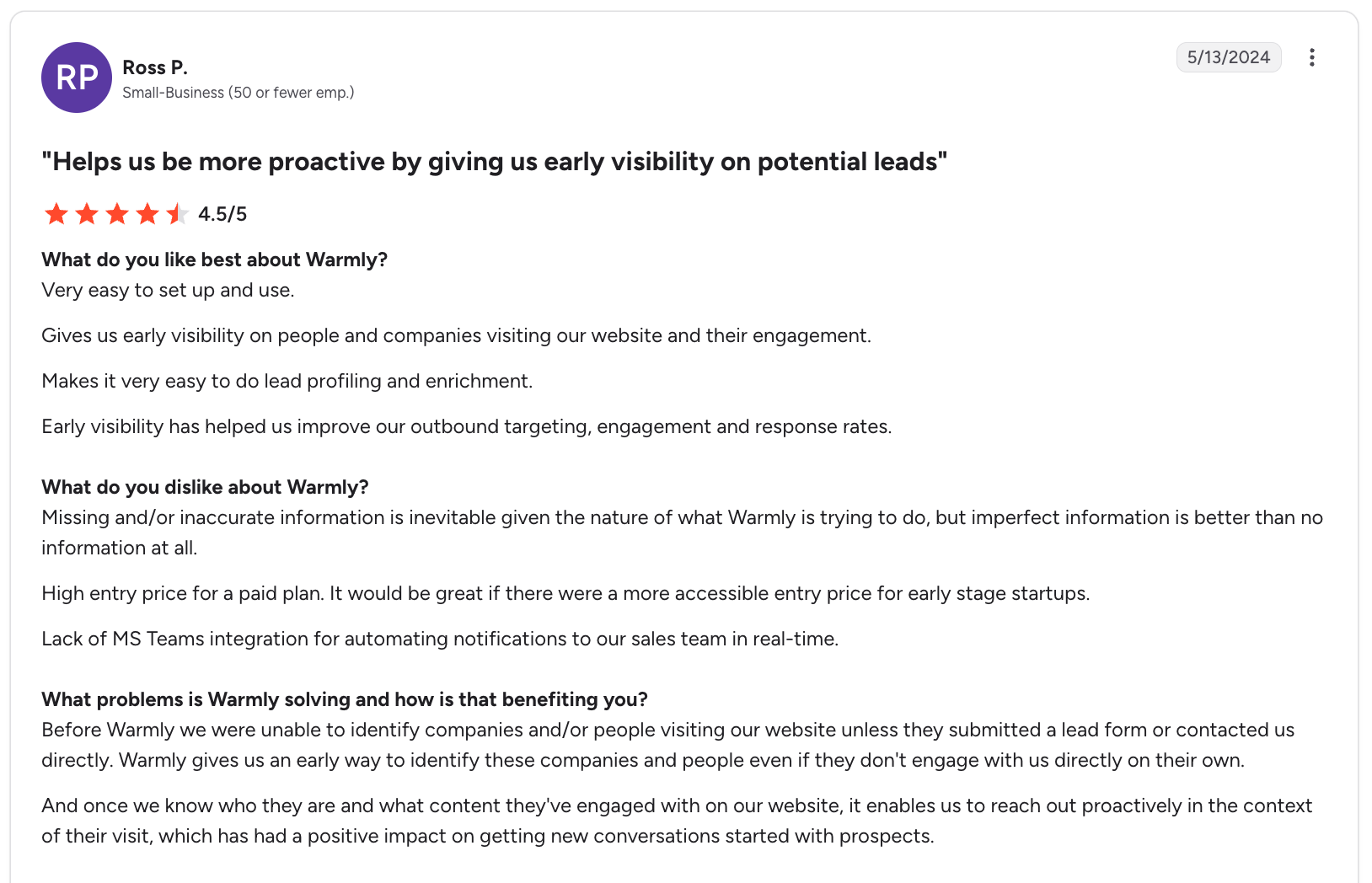
Another G2 reviewer identified the cost of entry as a concern:
The business impact: Sales teams are not paying simply to see more visitor records. They are paying for information that should help them identify the right accounts, reach the right people, and generate qualified pipeline. When teams must spend additional time correcting contact data or investigating incorrect matches, the effective cost includes both the subscription and the operational work required to make the data usable.
For smaller companies with limited budgets, that combination can make the return on investment harder to justify.
What These G2 Complaints Mean for Teams Evaluating Warmly
The recurring concerns are not limited to individual features. They touch the entire path from identifying a potential buyer to generating a sales opportunity.
Reported issue
Potential consequence
Incorrect visitor identification
Sales reps pursue the wrong prospects
CRM synchronization problems
Duplicate records and additional data cleanup
Chatbot builder bugs
Slower implementation and website optimization
Failed alerts and tracking
Buying signals are missed or never acted upon
Limited intent coverage on the default plan
Additional spending to access the desired capabilities
High entry price alongside data-quality concerns
Harder to justify the investment
For revenue teams, the central question is whether a platform can consistently turn buyer signals into useful sales actions. More visitor records, enrichment fields, and automation features do not automatically translate into more qualified meetings or pipeline.
Before choosing a platform, buyers should examine not only which features are available, but also the quality of the data, the reliability of integrations, and the ability to execute the entire workflow without creating additional operational work.
Warmly's Main Strengths and Weaknesses at a Glance
Area
What users appreciate
Problems reported on G2
Visitor identification
Visibility into website visitors and potential buyers
Incorrect visitor matches and inconsistent identification
Contact enrichment
Additional context for sales outreach
Personal email addresses, missing information, and inconsistent contact quality
CRM integration
Connecting visitor activity to sales systems
Duplicate company records, missing chat fields, and synchronization problems
AI chatbot
Engaging and qualifying inbound visitors
Builder bugs, unsaved branding changes, and configuration friction
Alerts and automation
Acting on buying signals in real time
Reports of Slack orchestrations stopping and website activity going uncaptured
Intent data
Identifying potential buying interest
Reported limitations in default-plan intent coverage and access to additional signals
Pricing
Multiple capabilities across the GTM workflow
High entry costs, particularly when customers also report data-quality problems
Documentation
Access to onboarding resources and customer support
Outdated tutorials, insufficient documentation, and unclear feature communication
Is Warmly Worth It?
Warmly brings visitor identification, contact enrichment, intent signals, and inbound engagement into one platform. But its G2 reviews raise important questions about whether those capabilities consistently deliver the reliable data and workflows revenue teams need.
Reported problems include incorrect visitor identification, CRM data cleanup, chatbot builder bugs, missed automations, and restrictions on intent data available at lower tiers. These issues matter because they can create extra work for sales and RevOps teams while making it harder to turn website activity into qualified pipeline.
The bigger concern is the combination of these problems. Paying for visitor intelligence is one thing. Paying for it and then spending additional time correcting records, troubleshooting workflows, or verifying contact information is another.
For businesses evaluating Warmly, the decision should come down to whether the platform can deliver reliable buyer intelligence and execute the workflows required to convert that intelligence into revenue, without adding unnecessary operational overhead.
Best Warmly Alternative: Knock AI
Looking for a Warmly alternative? Knock AI takes a messaging-first approach to B2B revenue conversion, connecting buyer intent to lead enrichment, qualification, routing, and meetings. What makes it particularly interesting is that you don't have to choose between keeping your existing forms and eliminating form friction. Knock supports both approaches.
What makes Knock AI stand out?
Form enrichment without the manual follow-up
Already using HubSpot, Salesforce, or Marketo forms? Knock AI can enrich form submissions with contact and company data, evaluate leads against routing rules, assign qualified leads to the right representative, and trigger personalized LinkedIn outreach. Enriched data, qualification status, rep ownership, and form attribution can be mapped into your CRM.
This means you can improve the workflow behind your existing forms without rebuilding your entire funnel.
Turn LinkedIn and Meta ad traffic into conversations
Knock Links let you send buyers from LinkedIn ads directly into a conversation instead of forcing them through a landing page and form. For Facebook and Instagram campaigns, you can use messaging destinations such as WhatsApp. You can also create personalized Marketing Cards for account-based campaigns.
Knock AI then connects these touchpoints to routing and attribution. Its data layer can send engagement and conversion events, including chat clicks, scheduling intent, and booked meetings, to LinkedIn Ads, Meta Ads, and Google Ads. That gives marketers signals closer to meaningful buyer engagement than clicks alone.
Connect account-based marketing to real sales actions
Knock AI supports account-level visibility through its Accounts Table, company enrichment, first-party intent signals, CRM context, and configurable routing. Teams can prioritize high-fit accounts, route conversations based on company attributes and CRM fields, and use personalized Marketing Cards for targeted campaigns.
Rather than stopping at account identification, Knock connects those signals to a specific next step: engaging the buyer, qualifying them, routing them, or booking a meeting.
Find the conversion gaps that traditional analytics miss
Knock AI's Website Leakage Analysis identifies pages and calls to action where high-intent visitors drop off. Its Website Revenue Report goes further by connecting conversion actions with leads, deals, and revenue through CRM data. Teams can investigate which pages and CTAs generate pipeline, which lose potential buyers, and where reducing friction may improve conversion..
Keep the conversation moving after the first interaction
Knock AI agents can qualify leads, answer questions using approved sources, and hand conversations to human representatives. Routing can account for ICP fit, territory, intent, CRM ownership, and custom qualification fields. Conversational scheduling and automated LinkedIn follow-up help qualified prospects move toward meetings without relying entirely on manual SDR follow-up.
Knock AI vs. Warmly
Both platforms cover visitor intelligence, AI engagement, enrichment, and GTM workflows. The more useful comparison is where their documented approaches differ.
Capability
Knock AI
Warmly
Formless conversion
Direct-to-conversation links across websites, LinkedIn ads, G2, documentation, email, and event QR codes
AI-powered website engagement, chat, popups, and personalized landing experiences
Existing form workflows
Enriches form submissions, applies routing rules, maps data to HubSpot, Salesforce, or Marketo, and can trigger LinkedIn outreach
Offers enrichment and lead workflows; an equivalent form-submission-to-routing-to-rep-sent LinkedIn follow-up workflow was not established by the public documentation reviewed
Paid campaign conversion signals
Dedicated Knock event integrations for LinkedIn Ads and Google Ads, plus a data layer for LinkedIn, Meta, and Google events
Strong focus on person-level ad attribution, retargeting, and intent-driven audience activation
What happens after an ad click
Can send buyers straight into a conversation or personalized Marketing Card, then connect engagement to routing and CRM attribution
Can identify visitors, engage them, and nurture them through its inbound and outbound agents
ABM execution
Account-level intent and CRM context, custom routing, campaign-specific Knock Links, and personalized Marketing Cards
Dedicated leakage analysis with CTA clicks, CTR, leaked visitors, lead generation, and revenue impact
Website engagement and conversion tools; a directly equivalent dedicated leakage report was not established in the public documentation reviewed
Meeting and post-meeting engagement
Routing-aware scheduling, CRM owner assignment, and automated LinkedIn follow-up for qualified leads who book or fail to book
Inbound meeting booking and broader AI-driven sales engagement
Is Knock AI a better fit than Warmly?
Knock AI is particularly compelling for teams that want to remove conversion friction while keeping their existing revenue operations connected. It can enrich and route traditional form leads, replace forms with direct messaging where that makes sense, connect advertising events to downstream engagement, and expose website conversion leakage.
Warmly has a broader emphasis on account intelligence, buying committee identification, audience building, and coordinated outbound execution. The choice comes down to your priority: a messaging-first conversion workflow with detailed form, routing, and leakage capabilities, or a broader GTM platform built around account intelligence and multi-channel execution.
Frequently Asked Questions
What is the best alternative to Warmly?
Knock AI is a strong Warmly alternative for B2B teams focused on converting buyer intent into sales conversations. It connects website visitors, ad campaigns, existing form submissions, and other engagement signals to lead enrichment, routing, AI-powered qualification, and meeting booking. Warmly may be a better fit for teams prioritizing broader account intelligence, buying committee identification, and audience activation.
What is the difference between Knock AI and Warmly?
The main difference is their approach to revenue conversion. Knock AI emphasizes reducing friction between buyer intent and sales conversations through formless conversion paths, form workflows, intelligent routing, and conversational engagement. Warmly combines visitor identification with inbound engagement, account intelligence, audience building, and outbound orchestration. Both platforms support enrichment, intent signals, and advertising-related workflows.
Can Knock AI enrich leads from existing forms?
Yes. Knock AI can enrich leads when they submit existing forms, including demo requests and contact forms. Its form workflows can enrich contact and company records, apply routing rules, assign leads, and trigger outreach. This means teams can retain their current forms while improving what happens after submission.
Does Knock AI work with LinkedIn Ads and Meta Ads?
Yes. Knock AI supports paid campaign workflows that can send buyers directly into conversations, such as through Knock Links. It can also enrich leads from existing form workflows and send engagement or conversion events to advertising platforms. The specific workflow depends on whether a campaign uses a direct conversation path or a conventional form submission.
Is Knock AI a replacement for website forms?
Knock AI offers formless conversion paths, allowing buyers to start conversations or book meetings without completing a traditional form. However, it can also work with existing forms through its form enrichment and routing workflows. Businesses can use either approach depending on their conversion strategy.
Does Warmly offer visitor identification and intent data?
Yes. Warmly identifies website visitors and combines visitor intelligence with first-party website activity, social signals, third-party research intent, and enrichment. It also supports audience activation and advertising-related workflows, making it relevant for B2B teams running account-based marketing and coordinated outbound campaigns.
How does Knock AI help identify website conversion leakage?
Knock AI's Website Leakage Analysis and Website Revenue Report help teams examine how visitors interact with conversion-focused pages and calls to action. Depending on the configured tracking and CRM integration, teams can analyze clicks, leads, conversion performance, and potential drop-off points to identify where high-intent visitors are failing to convert.
Which platform should you choose: Knock AI or Warmly?
Choose Knock AI if your priority is turning buyer intent into conversations, enriching and routing form submissions, connecting engagement signals with ad platforms, and reducing friction in the path to a meeting. Choose Warmly if you need a broader combination of visitor identification, buying committee intelligence, dynamic audience building, and coordinated outbound activation. Compare both platforms against your existing CRM, campaign workflows, and sales process before deciding.