.svg)


.svg)
.svg)
.svg)


.svg)
.svg)

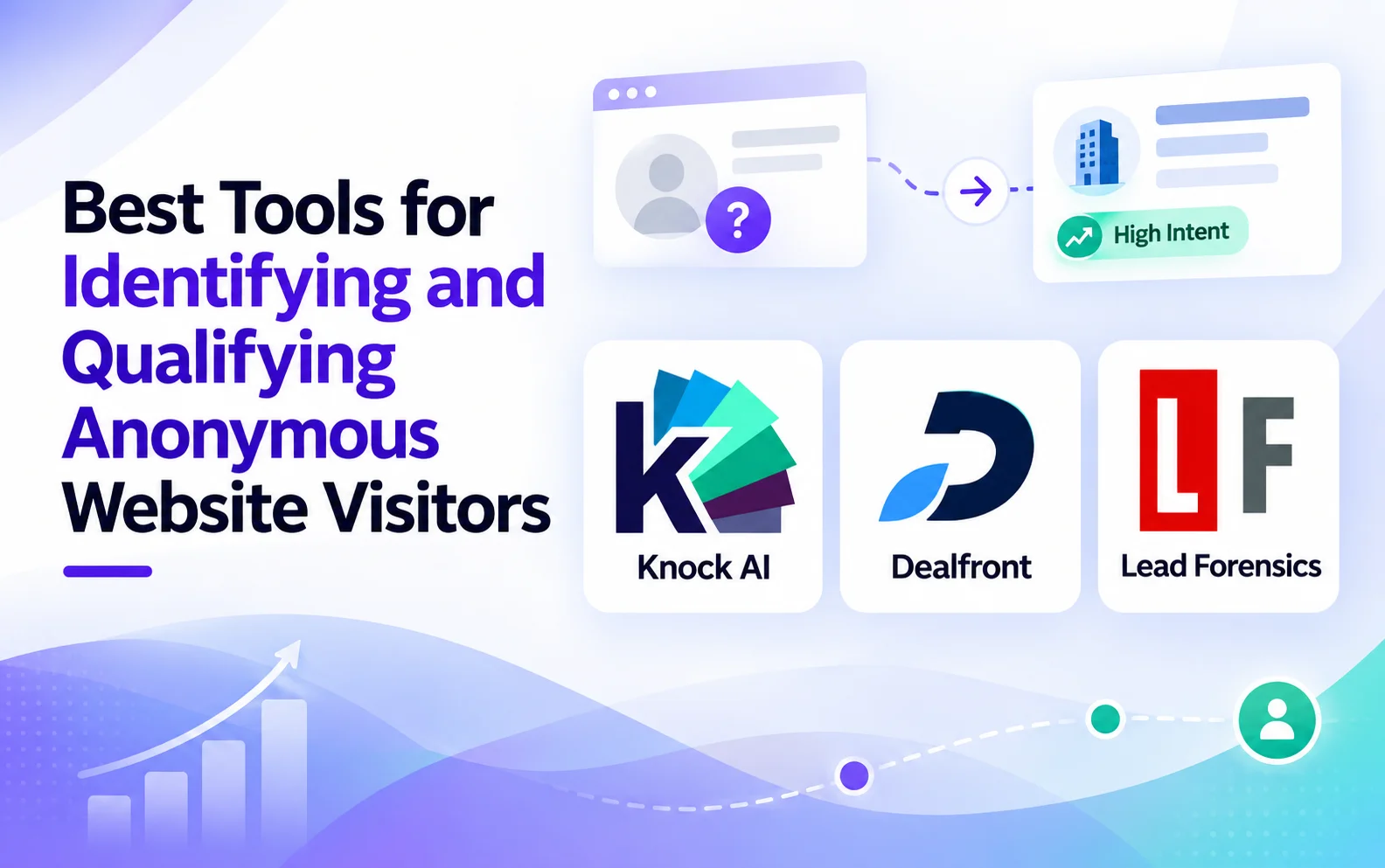
Anonymous website visitors are people or accounts browsing your website without submitting a form or otherwise identifying themselves. The challenge for enterprise teams is not simply discovering who is behind that traffic. It is determining which visitors represent meaningful buying activity and what sales should do next.
Visitor identification answers a basic question: who or which account is visiting? Visitor qualification goes further by evaluating whether that visitor fits your ICP, shows buying intent, has relevant CRM context, and is worth sales attention.
This matters when thousands of visitors are competing for a limited number of sales reps. Sending every identified visitor to sales creates noise, while ignoring anonymous traffic can leave valuable demand untouched.
Tools such as Knock AI, Dealfront, and Lead Forensics approach visitor identification and qualification from different angles. Knock AI is particularly well suited for enterprise teams that need to identify anonymous website visitors, qualify them using intent and account context, and turn the strongest signals into sales action.
What Does It Mean to Identify and Qualify an Anonymous Website Visitor?
Identifying and qualifying an anonymous visitor are related, but they solve two different problems.
Identification: Who or Which Account Is Visiting?
Visitor identification attempts to associate website activity with useful identity information, such as:
- The company visiting your website
- A specific contact, when reliable information is available
- An existing lead, opportunity, or customer in your CRM
- Existing relationships between the visitor and your organization
For example, you might discover that an unidentified session came from a target enterprise account that already has an open opportunity.
Qualification: Does This Visitor Actually Matter to Sales?
Qualification evaluates whether the activity represents a commercially meaningful prospect.
A practical framework is:
Qualification = Identity + ICP Fit + Intent + Context + Timing
- Identity: Who is visiting?
- ICP fit: Does the account match your target customer profile?
- Intent: What are they researching and how strongly does the behavior suggest buying interest?
- Context: Is there an existing lead, opportunity, customer relationship, or previous engagement?
- Timing: Is the activity happening frequently or recently enough to justify action?
Consider two visitors. One is an unidentified company that reads a single blog post. Another is an ICP account that repeatedly researches pricing, product pages, and integrations while an existing opportunity is open.
Both generated website activity. Only one provides a strong reason for sales to act.
Identification produces information. Qualification produces a decision.
Why Companies Struggle to Qualify Anonymous Website Traffic
For many enterprise websites, the problem isn't a lack of traffic. It's knowing what to do with the traffic that doesn't convert.
A company may have thousands or even millions of monthly visitors, while only a small percentage submit forms. The remaining traffic can include potential buyers, existing customers, job seekers, students, researchers, competitors, and people who simply landed on the wrong page.
That makes raw visitor identification difficult to operationalize. If every identified company creates a sales alert, reps quickly end up with more signals than they can investigate.
There is also a major difference between activity and intent. A single pricing-page visit might be casual research. Repeated visits from an ICP account, especially across pricing, product, integration, or security pages, can indicate a much more serious evaluation.
Existing opportunities create another layer of complexity. A prospect can return to your website without submitting another form, generating new activity that sales may not see.
So the real question becomes:
“If we're getting 20,000 visitors a month, how do we know which 50 deserve sales attention?”
The answer is not another dashboard full of visitors. It is a qualification process that separates commercially relevant activity from everything else.
How Do You Qualify an Anonymous Website Visitor?
Qualification works best when multiple signals are combined instead of treating one website action as proof of buying intent.
1. Identify the Company or Visitor
First, determine whether the activity can be associated with a company, individual, or existing CRM record.
Company-level identification can reveal that a target account is researching your website even when nobody has submitted a form. When reliable person-level data is available, it can add further context about who may be involved.
2. Enrich the Account
Identity alone rarely provides enough information for a sales decision. Enrichment can add details such as company size, industry, role, technology, geography, or other account attributes relevant to your ICP.
This helps answer:
“Is this actually an account we want to pursue?”
3. Check ICP Fit
An identified visitor isn't automatically a qualified prospect.
Compare the account against your target criteria. A large enterprise company operating in your target industry may deserve attention, while a small company outside your market may not, even if both show similar website activity.
4. Analyze Behavioral Intent
Next, examine what the visitor is actually doing.
Useful signals can include:
- Repeated visits
- Pricing-page activity
- Product research
- Demo or conversion-page activity
- Integration research
- Security or technical documentation
- Multiple sessions within a short period
The combination matters more than any individual action.
5. Add CRM and Relationship Context
Website behavior becomes considerably more useful when combined with what your company already knows.
Is the account an existing lead? Is there an open opportunity? Has someone already spoken with the company? Is the account an existing customer or part of a previous sales cycle?
For example:
Pricing activity + ICP fit + repeat visits + existing opportunity = high-priority signal
Compare that with:
Single blog visit + poor ICP fit = low-priority signal
The website behavior is similar, but the commercial meaning is completely different.
6. Determine the Next Action
Finally, qualification should lead somewhere.
Depending on the signals, the appropriate action could be:
- Route the visitor to a sales rep
- Start an AI conversation
- Offer meeting scheduling
- Notify the account owner
- Continue monitoring
- Add the account to a nurture motion
- Take no action
This is how you answer the practical question, “How do I stop my SDRs from chasing every website visitor?”
Don't route every visitor. Qualify and prioritize before routing.
Company-Level vs. Person-Level Visitor Identification
Anonymous visitor identification can happen at either the company level or person level.
Company-level identification associates website activity with an organization. For enterprise teams, this can be especially valuable because account size, ICP fit, existing relationships, and activity from multiple stakeholders can matter more than identifying one individual.
Person-level identification attempts to associate the activity with a specific individual. When reliable identity information is available, this can provide useful additional context, but coverage can vary based on traffic source, geography, privacy restrictions, and available data.
For enterprise buying journeys, an account with several stakeholders researching different parts of your product may be more important than knowing exactly which one person visited.
You do not need to identify every individual visitor to qualify anonymous website demand. The more important question is whether you can connect meaningful activity to the right account, understand its context, and determine what action makes sen

.svg)