Chili Piper Review 2026: Pricing, Features, Pros & Cons
Chili Piper Review 2026
TL;DR
What is Chili Piper? A B2B demand conversion platform for lead qualification, routing, scheduling, and website engagement.
Chili Piper Pricing: Routing & Scheduling starts at $1,250/month, while Experiences starts at $3,500/month.
Best features: Inbound meeting booking, advanced lead routing, CRM integrations, and automated sales handoffs.
Main drawbacks: Complex setup, potential maintenance overhead, and mixed customer feedback on integrations and support.
Chili Piper vs. Calendly: Chili Piper suits complex sales workflows, while Calendly is a simpler choice for general meeting scheduling.
Best alternative to Chili Piper:Knock AI is worth evaluating if you want to connect buyer intent, enrichment, AI-powered engagement, qualification, routing, and scheduling.
Our verdict: Chili Piper is a strong option for B2B teams optimizing inbound lead conversion. The right choice depends on whether you need structured scheduling and routing or a broader approach to turning buyer intent into a qualified pipeline.
What Is Chili Piper?
Chili Piper is a B2B inbound lead conversion platform that helps businesses turn website visitors into sales conversations. When a potential buyer fills out a form, Chili Piper can qualify the lead, route them to the right sales representative, and let them book a meeting instantly, without waiting for a manual follow-up.
But it goes beyond form submissions and scheduling. Chili Piper also offers website chat and engagement experiences, lead distribution, meeting handoffs, and AI led workflow automation. The idea is to remove the friction between a buyer showing interest and actually connecting with your sales team.
For B2B companies handling a high volume of inbound leads, this means less manual routing, faster response times, and fewer opportunities lost because a prospect had to wait for someone to get back to them.
Chili Piper Founders, Funding, Revenue, and the Story Behind the Product
Who Founded Chili Piper?
Chili Piper was founded in 2016 by husband-and-wife duo Alina Vandenberghe and Nicolas Vandenberghe. Alina brought her background in computer science and product development, having worked on software across several industries. Nicolas, meanwhile, had firsthand experience running sales teams and seeing how poorly enterprise software supported the people expected to use it.
Their shared observation was simple: salespeople were losing valuable time dealing with clunky tools and manual processes instead of talking to potential customers. They believed software should make revenue teams more productive, not give them another set of administrative tasks.
But Chili Piper didn't start with the ambitious platform it is today. Its first product focused on a much narrower problem.
The Story Behind Chili Piper: From a Small Scheduling Problem to a Revenue Platform
Here's where the story gets interesting.
In the early days, Nicolas and Alina spoke directly with potential customers to understand which problems businesses would actually pay to solve. Rather than spending months building a product based on assumptions, they looked for a customer willing to pay upfront.
They found one at Fivestars, where the team struggled to coordinate meetings between sales development representatives (SDRs) and account executives (AEs). Booking a meeting meant checking who was next in the round-robin queue, finding the right calendar, and creating the invitation manually. According to the founders' account, the process could take around seven minutes for a single meeting.
The customer wanted that process automated. The founders initially questioned whether such a narrow problem was big enough to build a business around, but they eventually agreed to build the solution. Fivestars committed $20,000, with payment split between the start of the project and completion, giving the founders an early customer before the product was fully built.
That initial problem became the foundation for Chili Piper's meeting-routing and scheduling software. The company then expanded into inbound lead conversion, website engagement, lead distribution, sales handoffs, and workflow automation.
The bigger idea was to eliminate the gap between a prospect expressing interest and actually speaking with the right person on the sales team.
Today, Chili Piper describes itself as a Demand Conversion Platform, reflecting its expansion beyond scheduling into the systems that help B2B businesses engage, qualify, route, and convert potential buyers.
How Much Funding Has Chili Piper Raised?
Chili Piper initially grew through bootstrapping, using customer revenue to fund product development before raising institutional capital.
Its most widely reported funding milestone came in April 2021, when the company announced a $33 million Series B round led by Tiger Global, with participation from existing investors Base10 Partners and Gradient Ventures. At the time, the announcement brought its reported total financing to $54 million.(Source)
A later founder interview published in 2024 reported total funding of approximately $58 million, including secondary transactions. These figures reflect different reporting points and funding definitions, so they should not be treated as directly interchangeable.
The capital helped Chili Piper expand its product portfolio and invest in growth. However, the founders' early experience also shows that the company had already established a business by solving a specific customer problem and selling the solution before raising a major venture round.
What Is Chili Piper's Revenue?
Chili Piper is a privately held company, so its current revenue is not consistently disclosed through public financial statements. Any revenue figure should therefore be tied to a specific date and source rather than presented as its current, verified revenue.
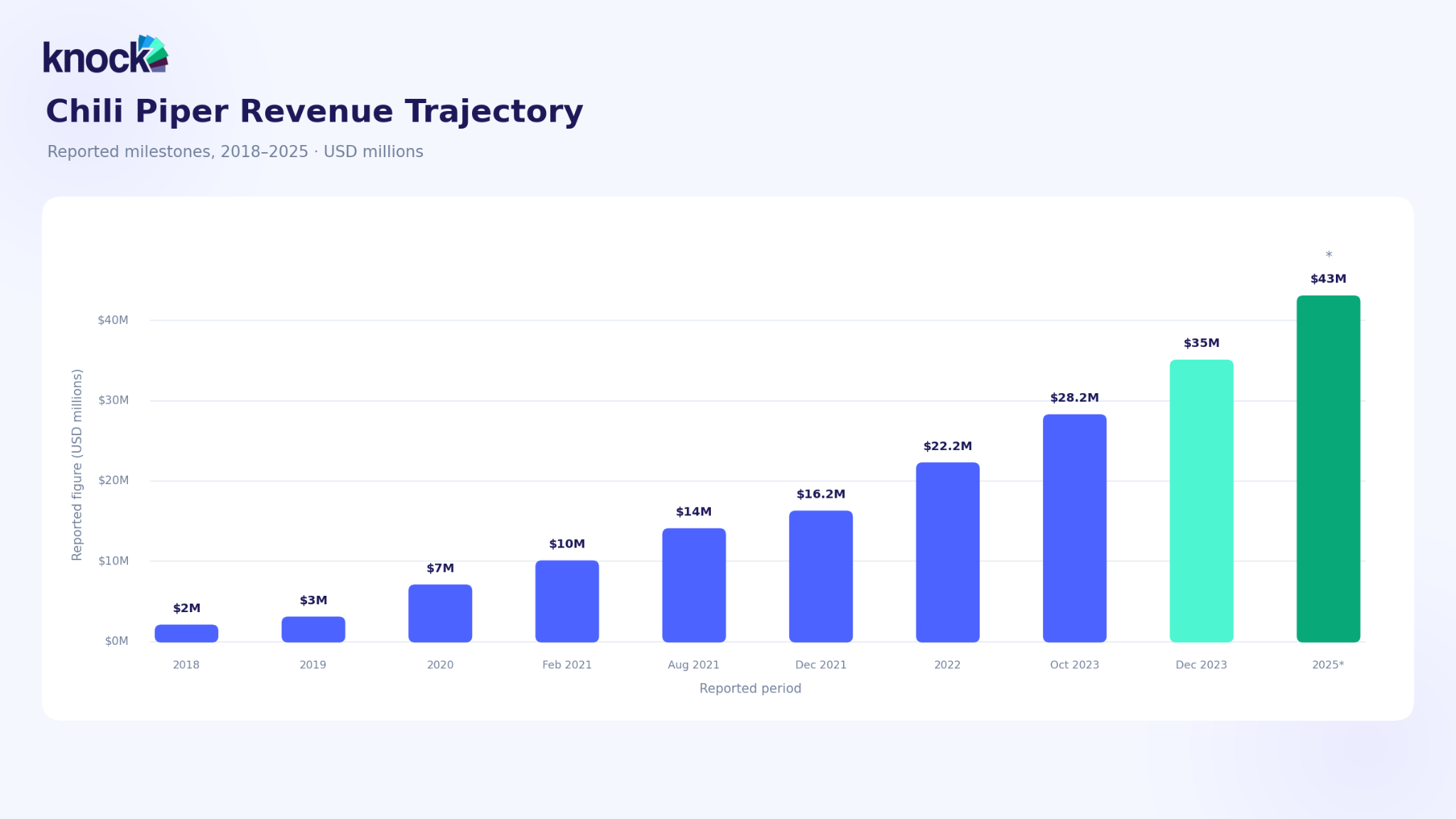
One useful historical benchmark comes from Nicolas Vandenberghe's September 2024 keynote, in which he discussed the company's growth and operating model. Founderpath's October 2025 write-up of that presentation reported $43 million in revenue and described the company as serving approximately 13,300 companies. These are figures reported from the founder's presentation, not independently audited financial results or a verified 2026 revenue figure.
An earlier interview published by GetLatka in 2023 reported approximately $30 million in annual revenue, alongside roughly 2,000 customers. The different figures reflect separate reporting periods and potentially different definitions, so they should not be combined into a precise growth calculation without further financial disclosures.
What these reports illustrate is the evolution of Chili Piper from a focused scheduling product into a broader, multi-product business serving B2B revenue teams.
For prospective customers, the more relevant question is how well its current products fit their lead volume, routing complexity, sales process, and budget, rather than revenue alone.
Chili Piper Products
Chili Piper offers a range of products designed to help B2B companies convert inbound leads, schedule meetings, distribute leads, engage website visitors, and automate sales workflows. Its portfolio spans four main areas: booking and routing, visitor engagement, AI-powered automation, and integrations.
Product
Category
What It Does
Form Concierge
Inbound lead conversion
Qualifies website form submissions, routes prospects to the right sales representative, and enables qualified leads to book meetings immediately.
ChiliCal
Meeting scheduling
Enables sales representatives to share booking links, coordinate availability, and automate meeting scheduling.
Handoff
Sales meeting routing
Routes meetings between sales representatives and teams based on configured rules, availability, and assignment logic.
Distro
Lead distribution
Automatically assigns leads and CRM records using rules based on factors such as territory, account ownership, and lead attributes.
Concierge Live
Live sales engagement
Connects eligible website visitors with sales representatives for immediate phone conversations.
Web Experiences
Website conversion
Displays targeted website experiences, including chat, offers, announcements, and scheduling prompts.
Chat AI
Conversational AI
Engages website visitors, answers questions, qualifies prospects, and helps them book meetings through automated conversations.
Account Identification
Visitor identification
Identifies companies visiting a website to provide account-level context for targeted engagement and conversion.
Enrichment
Data enrichment
Adds company and contact information to lead records, helping improve data quality and reduce form friction.
Orchestrator
Workflow automation
Automates workflows triggered by events such as CRM changes, abandoned forms, and missed meetings.
Email Composer
AI-powered sales outreach
Helps generate personalized follow-up emails using available prospect and CRM context.
Chili Assist
AI-assisted routing
Helps teams create or manage lead-routing rules using natural-language instructions.
Spam Checker
Lead quality and spam prevention
Detects spam submissions and fake meeting requests to help protect sales representatives' calendars.
Meeting Prep
AI sales assistance
Helps sales representatives prepare for calls with relevant prospect and company context.
MCP & Skills
AI integrations and automation
Connects supported AI tools to Chili Piper through its MCP server, APIs, and prebuilt skills.
LinkedIn
Lead capture and routing
Connects LinkedIn Lead Gen Forms with Chili Piper workflows to facilitate lead routing and meeting booking.
Fin
Conversational integration
Integrates with Intercom's Fin messenger to support lead qualification, routing, and meeting booking within chat.
Clay
Data enrichment integration
Brings Clay-enriched data and signals into supported workflows to inform lead routing and conversion actions.
See Knock AI in Action — Book Your Live Demo Today
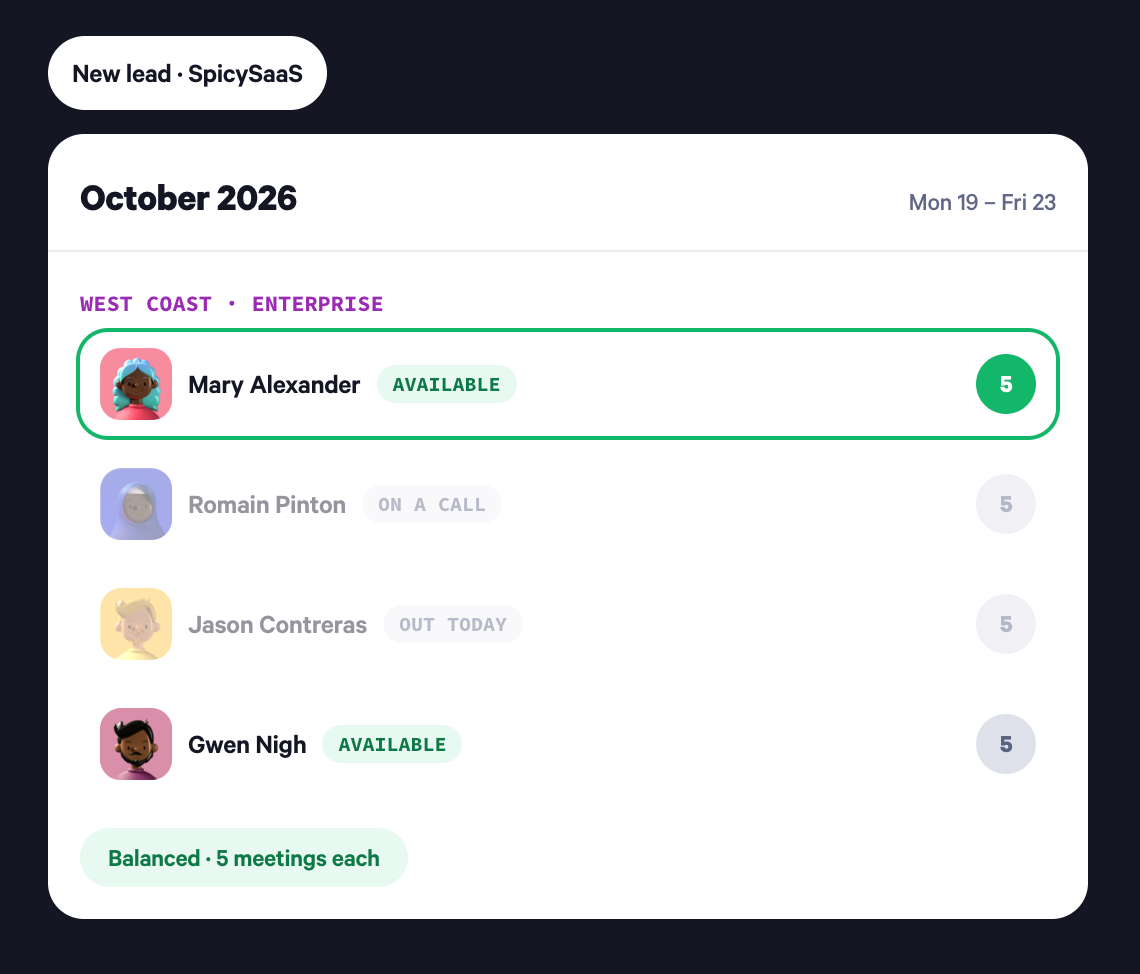
Form Concierge helps B2B companies convert inbound form submissions into sales meetings. When a prospect submits a form, Chili Piper can qualify the lead, route them to the appropriate sales representative, and display available meeting times immediately.
This reduces the delay between a prospect expressing interest and connecting with the sales team, helping businesses engage qualified buyers while their interest is high.
2. ChiliCal
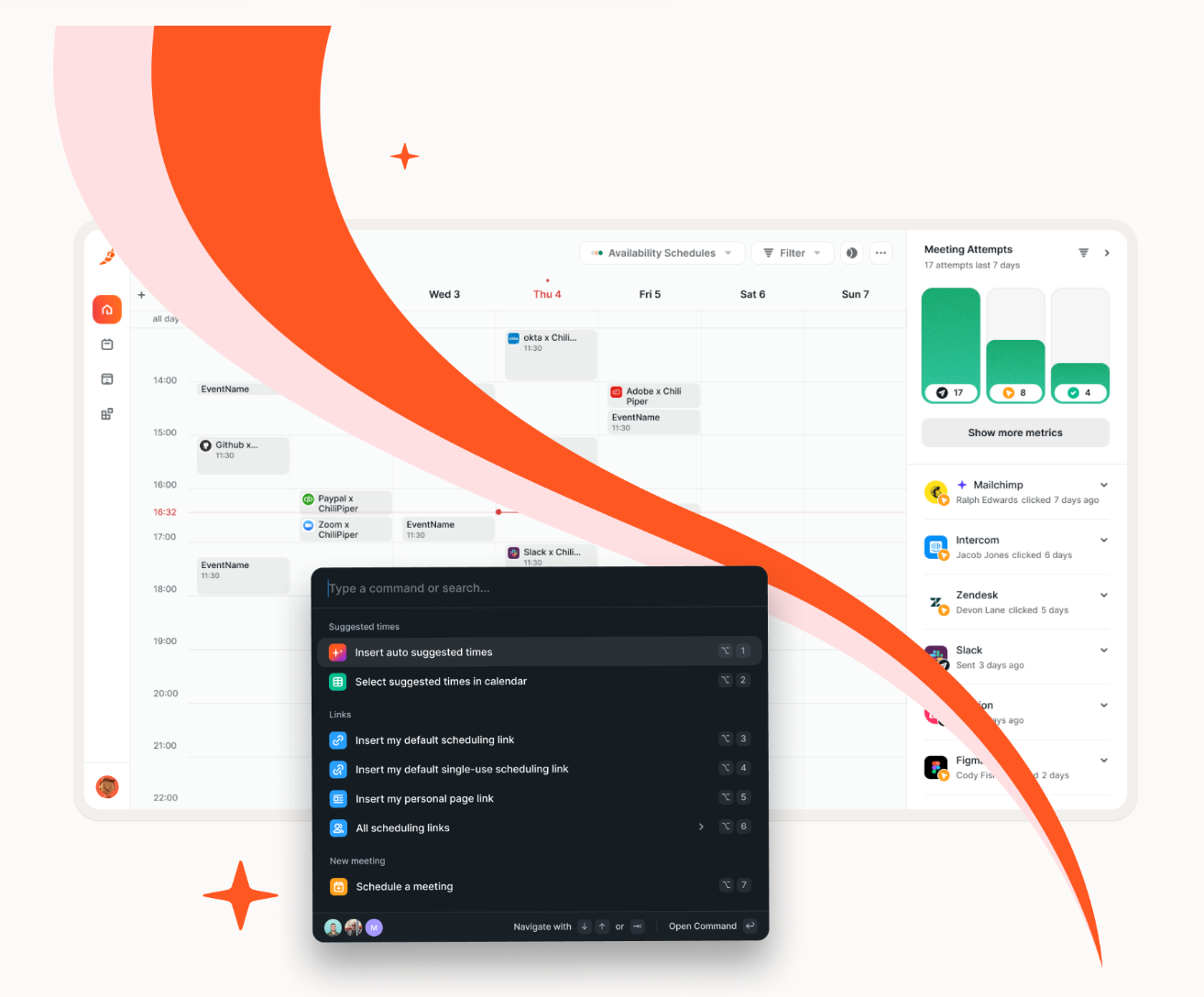
ChiliCal is Chili Piper's meeting scheduling product. It allows sales representatives to share booking links, coordinate calendar availability, and schedule meetings without the usual back-and-forth over email.
It supports scheduling workflows such as one-on-one meetings, round-robin booking, and group scheduling, depending on configuration.
3. Handoff
Handoff manages meeting assignments between sales representatives and teams. For example, when an SDR qualifies a prospect, Handoff can help connect that prospect with the appropriate account executive based on routing rules and availability.
It is particularly useful for B2B sales teams that need structured meeting distribution and coordination between different roles.
4. Distro
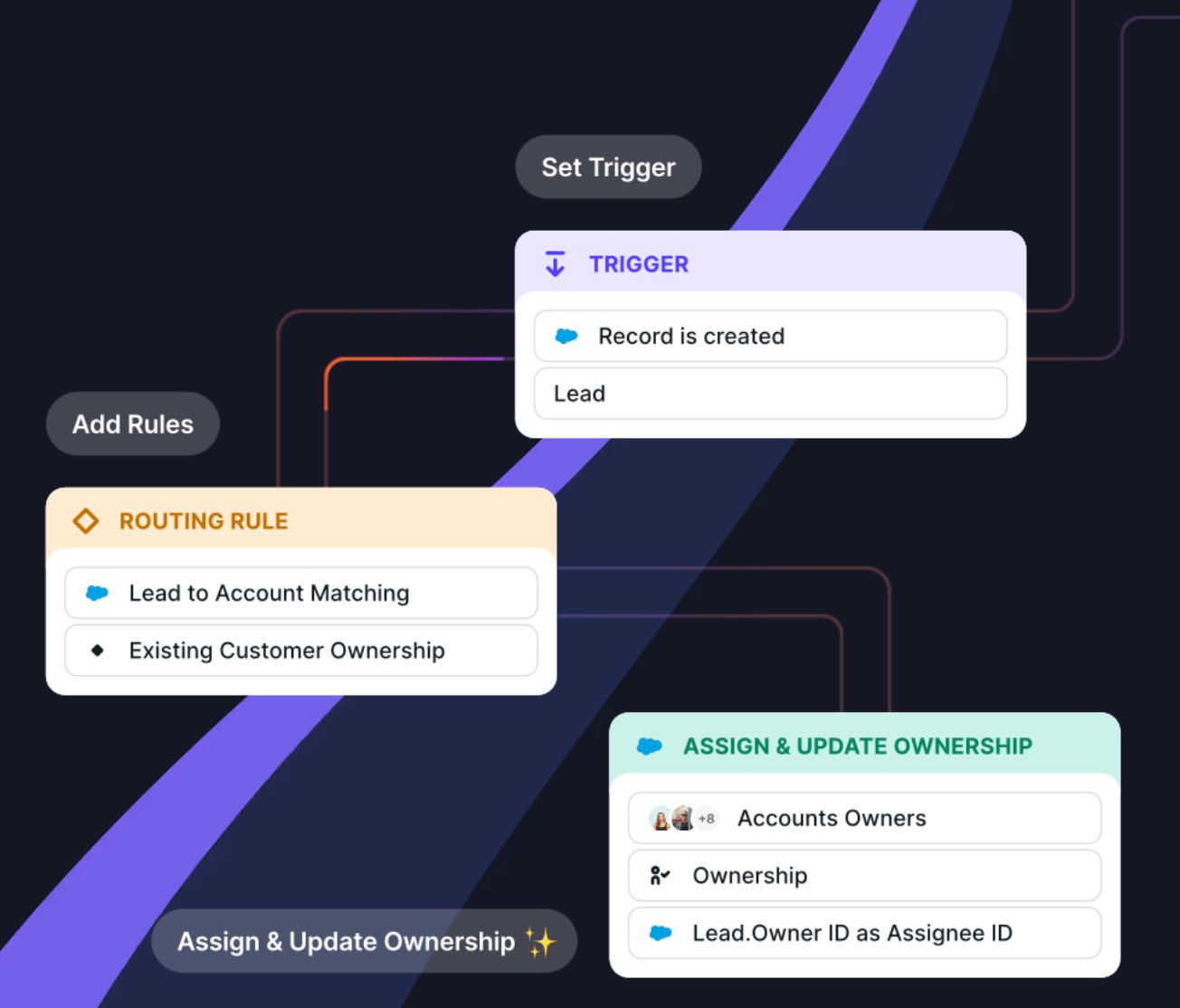
Distro focuses on distributing leads and CRM records to the right people. Teams can configure routing rules based on factors such as territory, account ownership, lead attributes, and other CRM data.
While Form Concierge focuses on converting form submissions into meetings, Distro addresses a broader operational question: Who should own or handle this lead or CRM record?
Together, these four core products address different parts of the inbound sales process: converting form submissions, scheduling meetings, managing sales handoffs, and distributing leads.
What Solutions Does Chili Piper Provide?
Chili Piper provides solutions for B2B revenue teams across marketing, sales, revenue operations (RevOps), and customer success. It also offers solutions tailored to company size and specific use cases, helping businesses convert inbound demand, automate lead routing, schedule meetings, and coordinate customer handoffs.
Solution
Target Audience
What It Does
Marketing
Marketing teams
Converts existing inbound demand into sales meetings by reducing friction between a prospect submitting a form and connecting with sales.
Sales
Sales teams and SDRs
Helps sales teams book more meetings, reduce scheduling administration, and connect qualified prospects with the right representatives.
RevOps
Revenue operations teams
Centralizes lead-routing logic, automates assignments, and helps maintain consistent routing rules across revenue workflows.
Customer Success
Customer success teams
Automates customer meeting coordination, including onboarding kickoffs, quarterly business reviews (QBRs), and team handoffs.
Startups
Early-stage companies
Helps smaller teams automate inbound lead conversion and meeting scheduling without requiring extensive manual coordination.
Scale-ups
Growing businesses
Supports increasing lead volumes and more complex routing requirements as sales teams expand.
Enterprise
Large organizations
Supports complex routing workflows, larger teams, and enterprise requirements around scalability, security, and support.
AI Inbound SDR
Inbound sales teams
Uses AI-powered workflows to qualify inbound interest, route prospects, and facilitate meeting booking.
Inbound Lead Conversion
Marketing and sales teams
Helps prospects book meetings as soon as they express interest, reducing delays in the inbound conversion process.
Lead Distribution
Sales and RevOps teams
Distributes leads using territory rules, round-robin assignment, and service-level agreement (SLA) requirements.
Salesforce Lead Routing
Salesforce administrators and RevOps teams
Automates Salesforce lead assignments using configurable rules that can accommodate complex routing requirements.
Scheduling
Sales and customer-facing teams
Simplifies B2B meeting booking by coordinating calendars, availability, and meeting assignments.
Events
Event and field marketing teams
Helps coordinate meetings before, during, and after events, including conversations with prospects at event booths.
Chili Piper Pricing (2026)
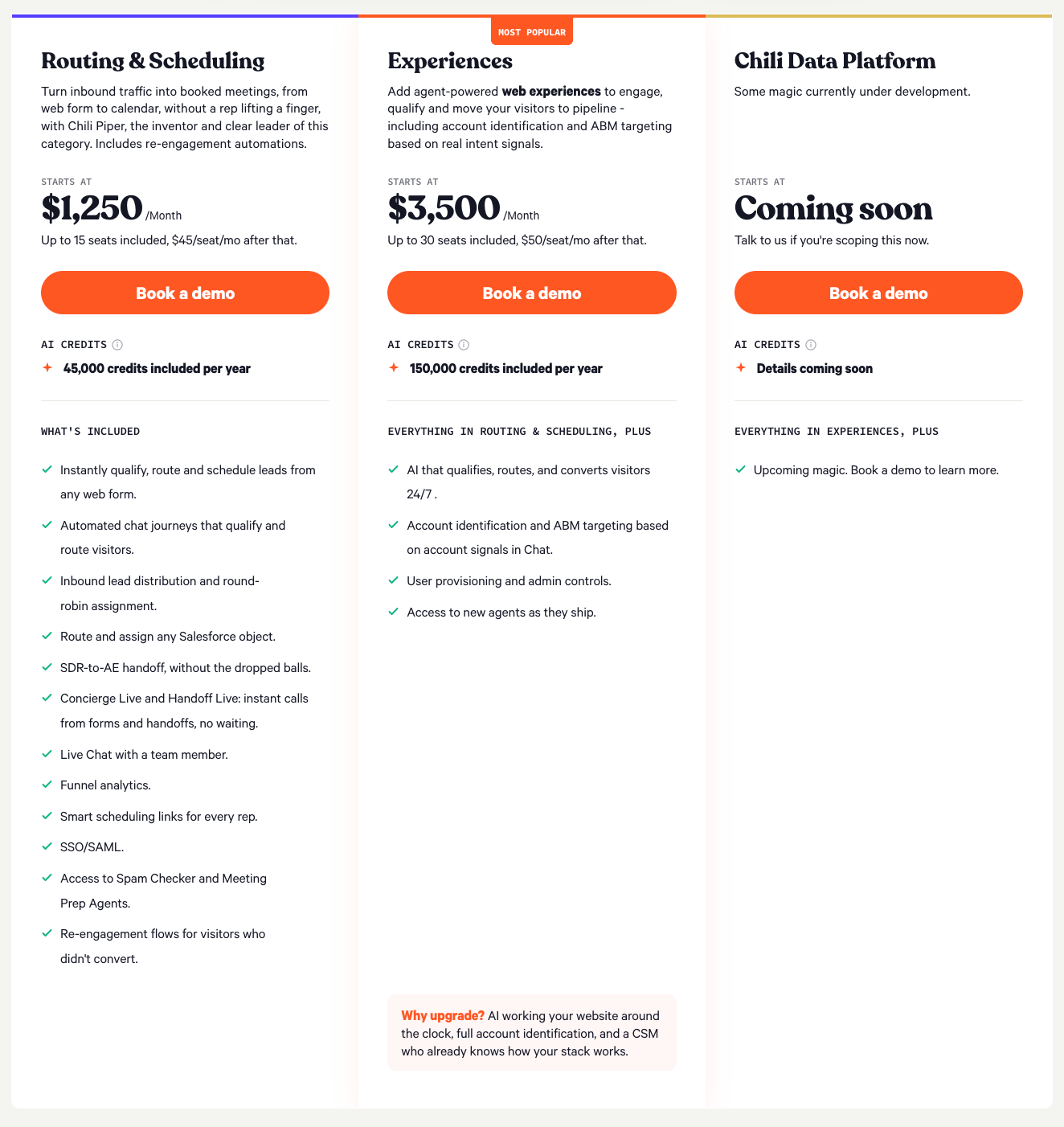
Chili Piper's pricing starts at $1,250 per month for Routing & Scheduling, with its more advanced Experiences package starting at $3,500 per month. The platform also offers standalone ChiliCal scheduling for enterprise teams that need calendar functionality without the full routing and engagement suite.
Unlike basic scheduling software, Chili Piper's newer packages combine meeting booking, lead routing, sales handoffs, and AI-powered capabilities. The right plan depends on how much of your inbound conversion process you want to automate.
Chili Piper Pricing Plans
Plan
Starting Price
Included Seats
Additional Seats
Best For
Routing & Scheduling
1,250/month(15,000/year)
15
$45/seat/month
Teams that need inbound lead qualification, routing, scheduling, Salesforce assignment, and sales handoffs.
Experiences
3,500/month(42,000/year)
30
$50/seat/month
Teams that want everything in Routing & Scheduling, plus AI-powered website engagement, account identification, and advanced visitor conversion capabilities.
Chili Data Platform
Coming soon
Not disclosed
Not disclosed
Organizations interested in Chili Piper's planned customer data platform capabilities. Pricing and availability details have not yet been published.
Standalone ChiliCal
$12/user/month
200-seat minimum
Subject to the standalone arrangement
Enterprise teams that need scheduling functionality without purchasing the broader routing and engagement packages.
What Do You Get With Each Plan?
Routing & Scheduling is designed for teams that want to automate the process from inbound lead submission to booked meeting. It includes form qualification, lead distribution, round-robin routing, Salesforce object routing, SDR-to-AE handoffs, scheduling links, live engagement capabilities, and funnel analytics. The package lists 45,000 AI credits per year.
Experiences includes the Routing & Scheduling package and adds AI-powered website engagement, account identification, account-based targeting, and additional administrative controls. It lists 150,000 AI credits per year and is aimed at teams that want to engage visitors before they complete a form.
ChiliCal standalone is the narrower option for organizations that primarily need meeting scheduling. It includes scheduling functionality and CRM, calendar, and messaging integrations, but does not include AI credits or the broader routing and orchestration capabilities listed for the main packages.
Chili Data Platform is listed as coming soon, with its price and detailed package information still to be announced.
Does Chili Piper Offer Monthly Billing?
The main Routing & Scheduling and Experiences packages are presented with annualized pricing and annual contract options. Chili Piper's pricing calculator also advertises discounts for longer commitments:
Two-year contract: 15% off
Three-year contract: 25% off
Four-year contract: 40% off
Confirm eligibility, discount application, and final terms with the vendor before budgeting. The standalone ChiliCal price is listed per user per month, subject to a 200-seat minimum.
What Should You Know Before Buying?
The advertised starting price is only one part of the purchasing decision. Before choosing a plan, consider your required seat count, CRM setup, routing complexity, AI credit usage, and which capabilities your team actually needs.
AI credits are used for enrichment, agents, and AI actions. If your usage exceeds the included allowance, ask Chili Piper about additional credit bundles and their pricing. Also confirm which features are included in your quoted package rather than assuming every item in the product menu is available at the starting price.
For smaller teams that only need booking links, standalone ChiliCal's 200-seat minimum is particularly important to evaluate. For organizations that need routing and scheduling across a larger inbound sales operation, Routing & Scheduling or Experiences may be a more relevant starting point.
Chili Piper Review
Chili Piper Reviews on G2
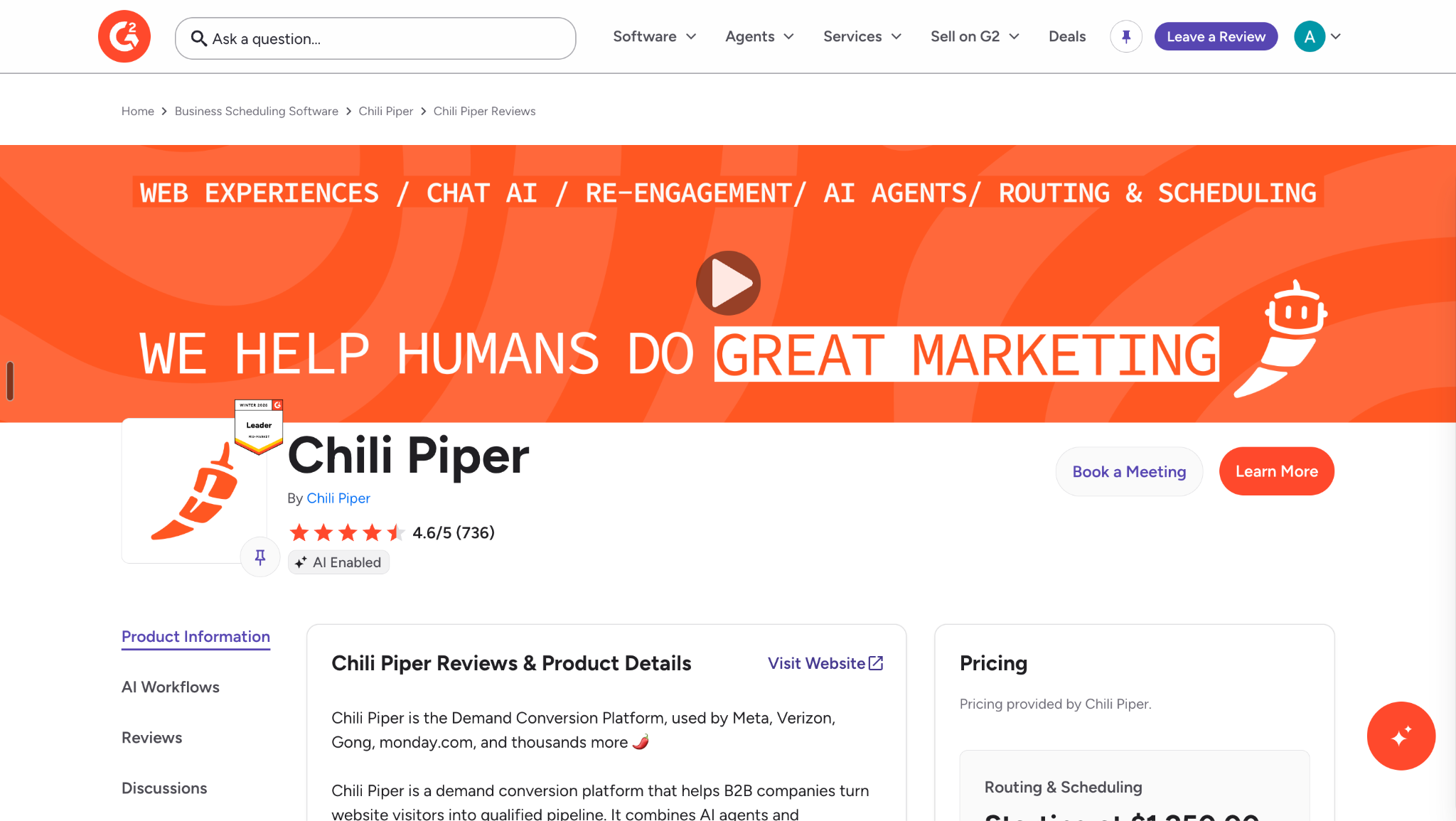
Chili Piper has a 4.6/5 rating on G2 across 736 reviews. Overall, customers appreciate its ability to automate meeting scheduling, route inbound leads, and integrate with CRM systems. Customer support is another recurring strength.
However, the feedback also points to some limitations. More complex routing configurations can be difficult to troubleshoot, less technical users may struggle with navigation, and some workflows require more admin involvement than teams would prefer.
Some reviews worth highlighting
Positive Reviews
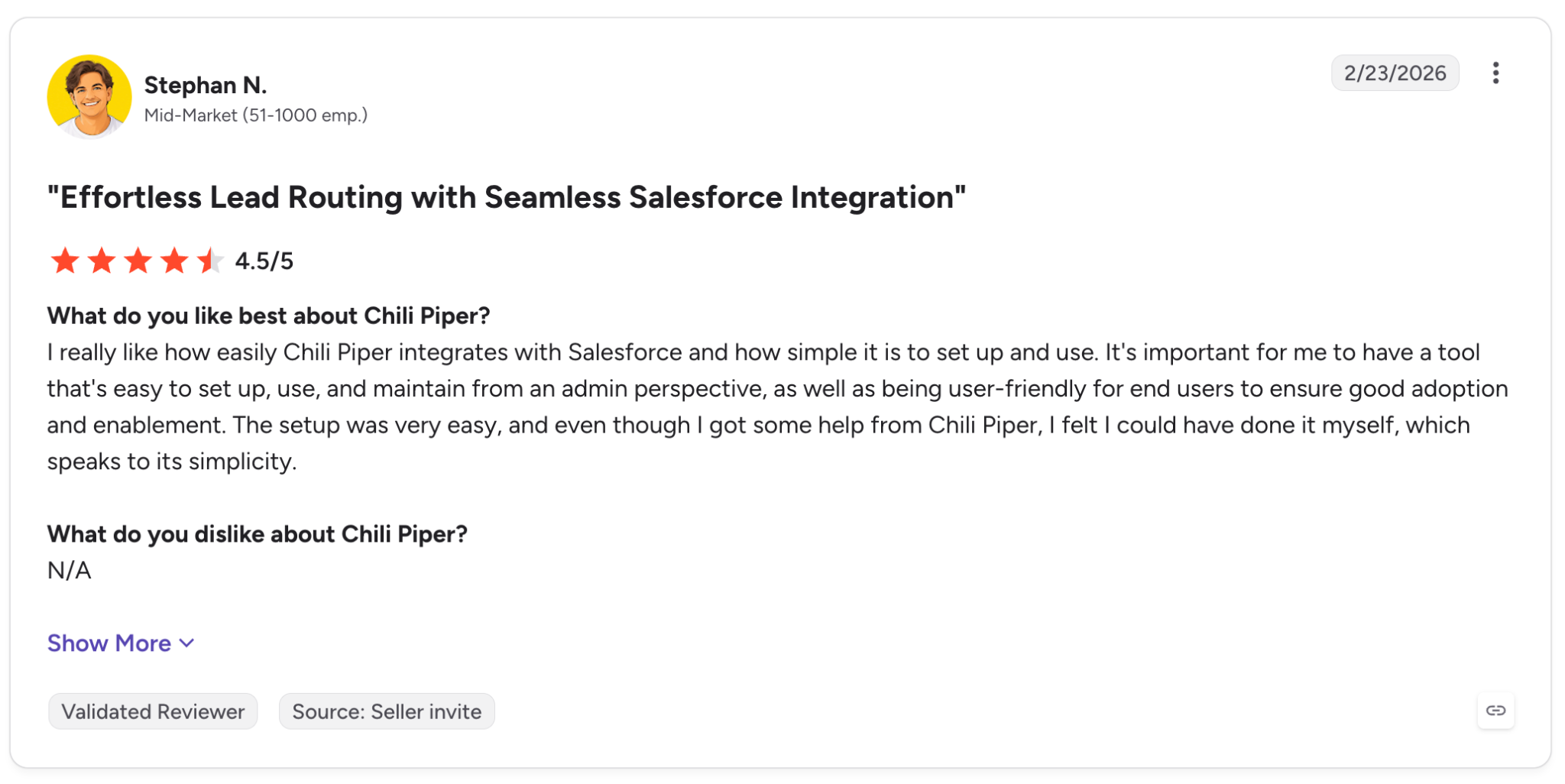
1. Stephan N. | February 23, 2026 | 4.5/5
Stephan praised Chili Piper's Salesforce integration and ease of use. He highlighted how straightforward it was to set up and use, particularly when routing leads according to specific criteria.
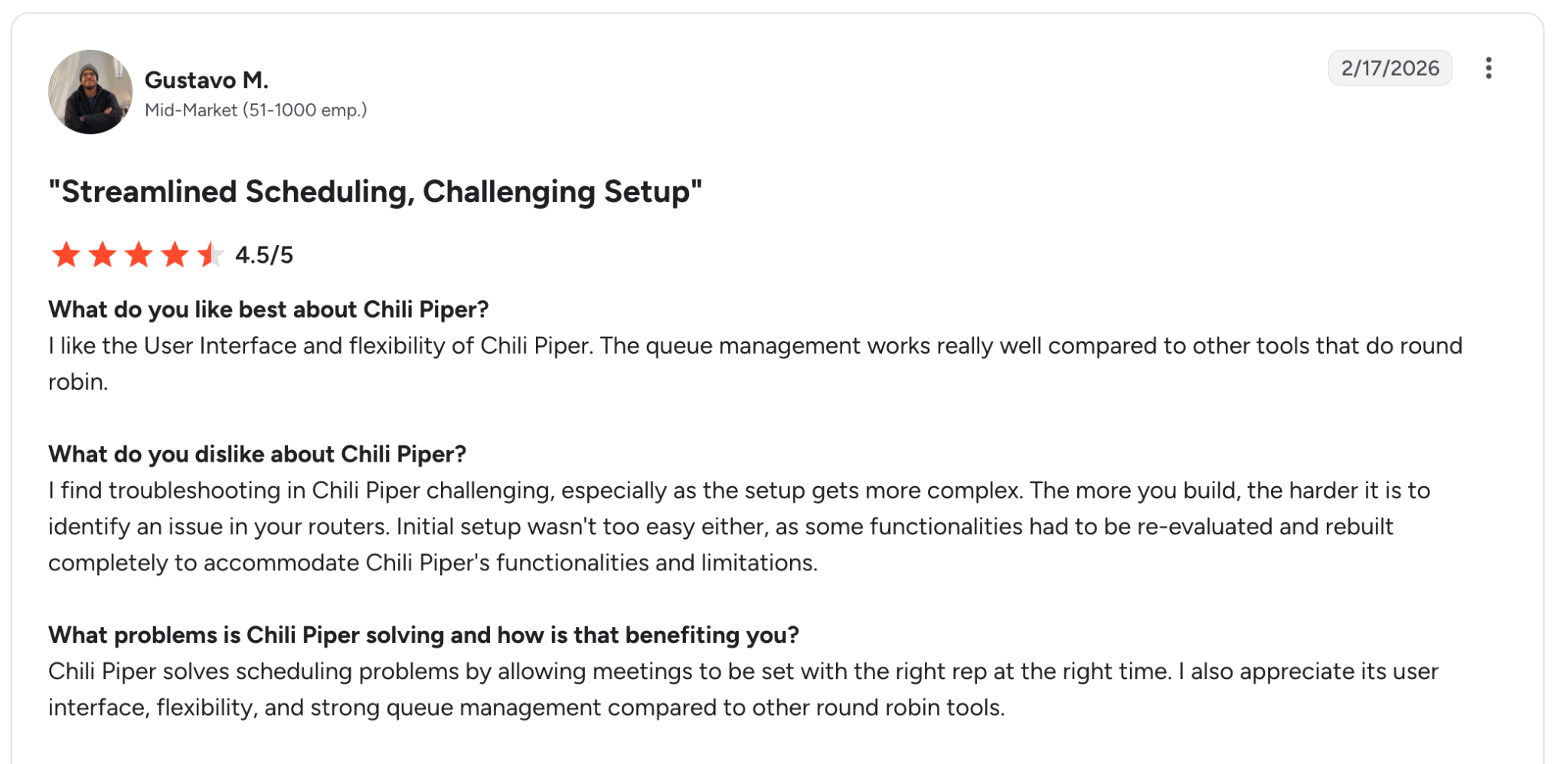
2. Gustavo M. | February 17, 2026 | 4.5/5
Gustavo appreciated the platform's interface, flexibility, and queue management, noting that it compared well with other round-robin scheduling tools. However, he pointed out that troubleshooting becomes more difficult as configurations grow more complex.
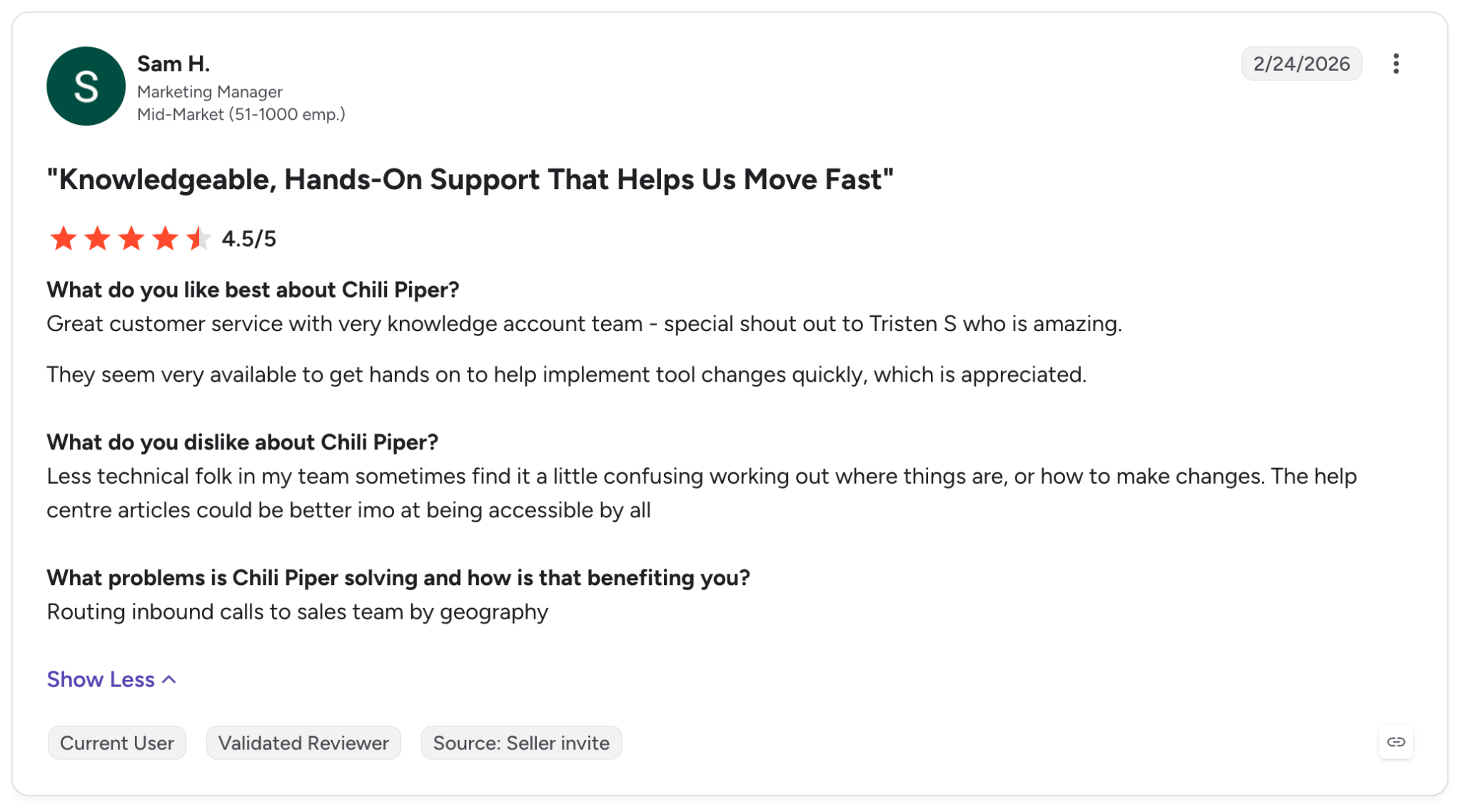
3. Sam H. | February 24, 2026 | 4.5/5
Sam highlighted the knowledgeable customer support team and hands-on assistance from the account team. His main criticism was that less technical users could struggle with navigation, and that help documentation could be easier to access.
Negative reviews worth highlighting
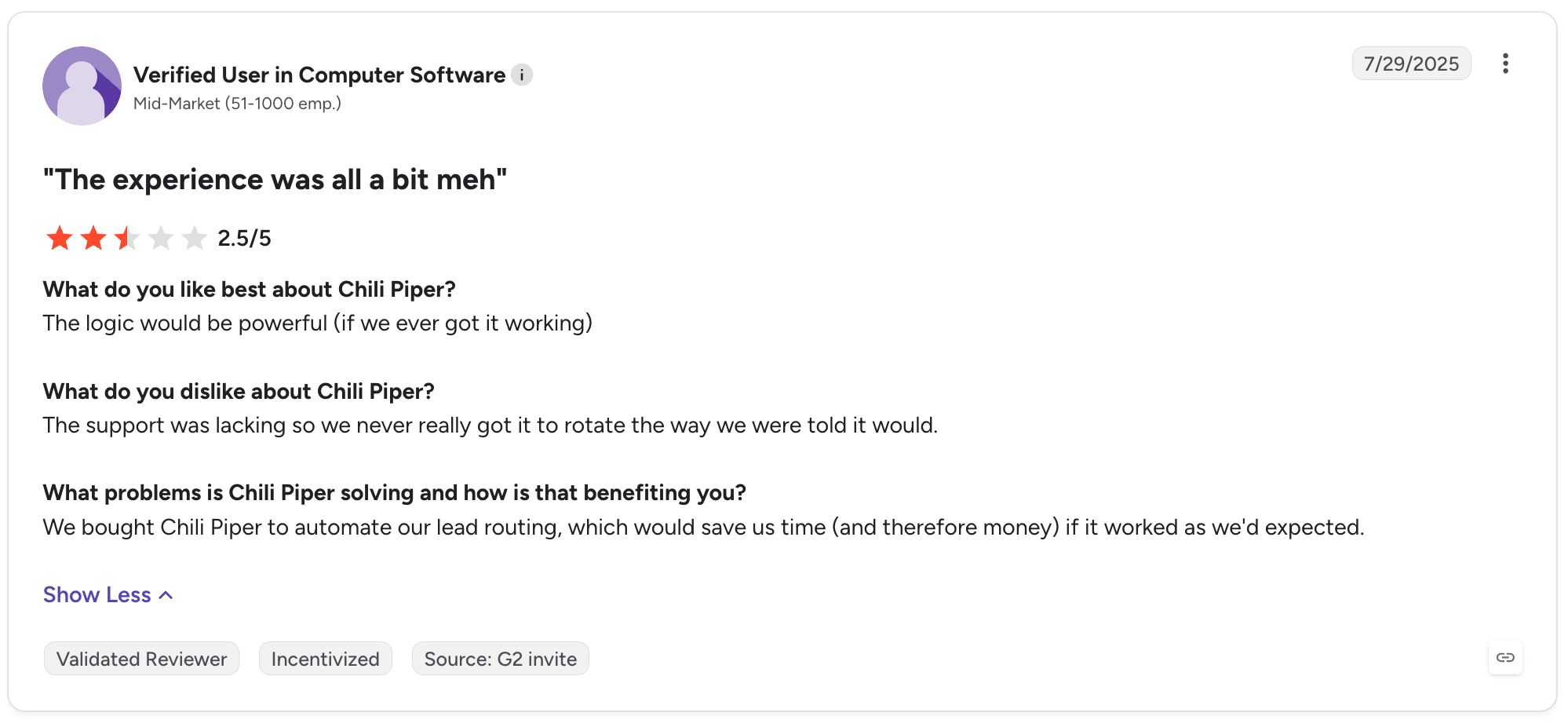
4. Verified G2 reviewer | July 29, 2025 | 2.5/5
In a review titled “The experience was all a bit meh,” the reviewer said the routing logic was powerful in principle but criticized the support experience, explaining that they could not get the rotation to work as expected.
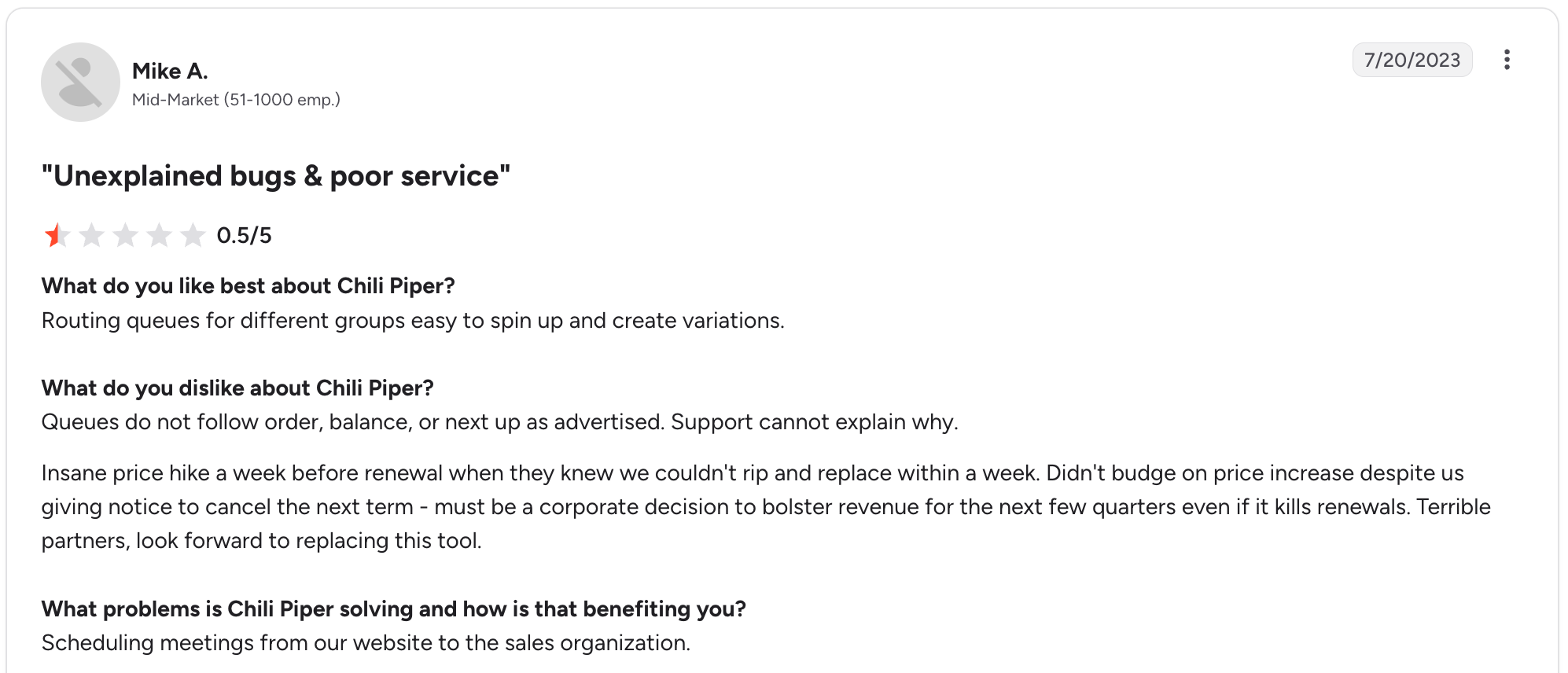
5. Mike A. | July 20, 2023 | 0.5/5
In “Unexplained bugs & poor service,” Mike praised the ability to create routing queues but reported that queues did not follow the expected order or distribution rules. He said support could not explain the behavior and also criticized a price increase shortly before renewal.
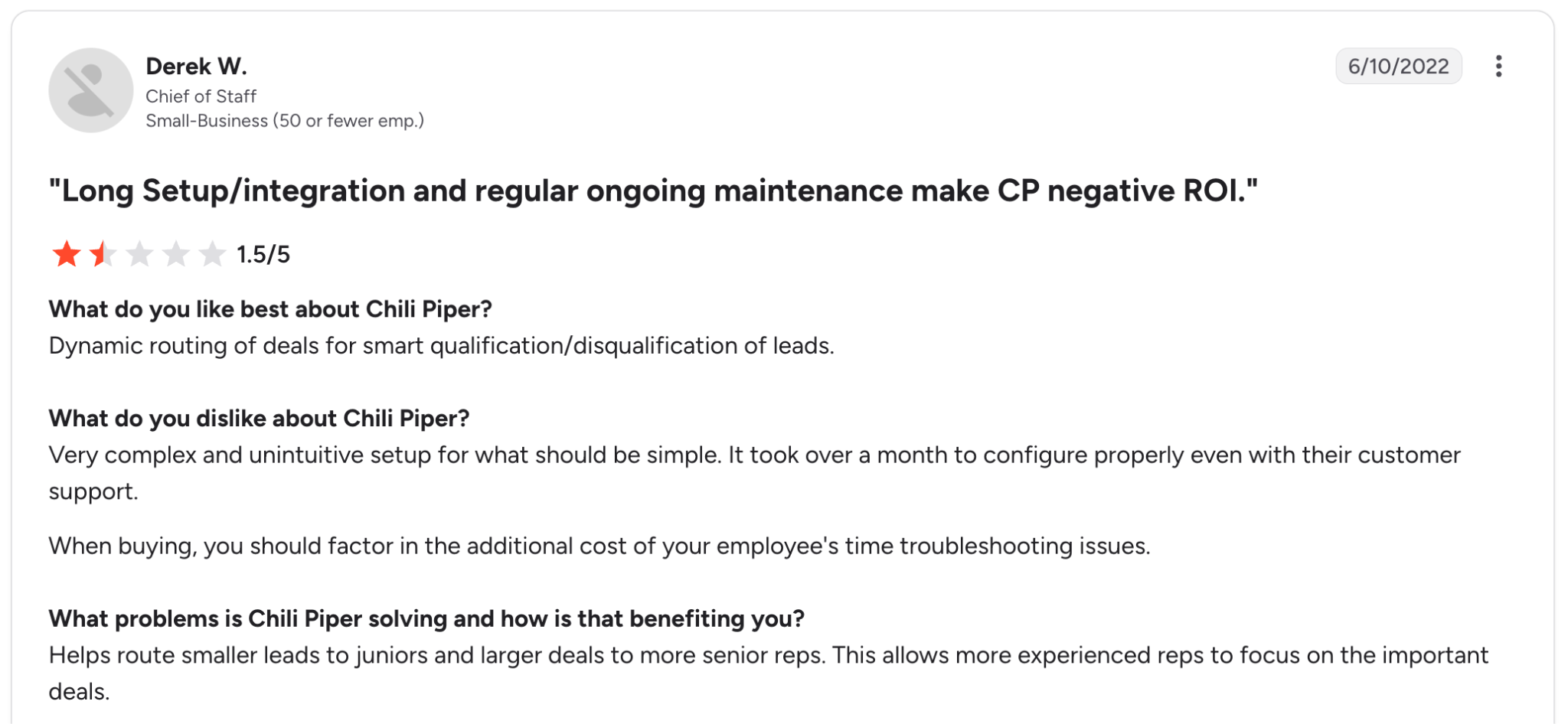
6. Derek W. | June 10, 2022 | 1.5/5
Derek's review, “Long Setup/integration and regular ongoing maintenance make CP negative ROI,” raised concerns about implementation complexity. He said the setup was unintuitive and took more than a month to configure properly, even with customer support. Although he praised dynamic routing, he questioned whether the time spent troubleshooting and maintaining the system justified the return.
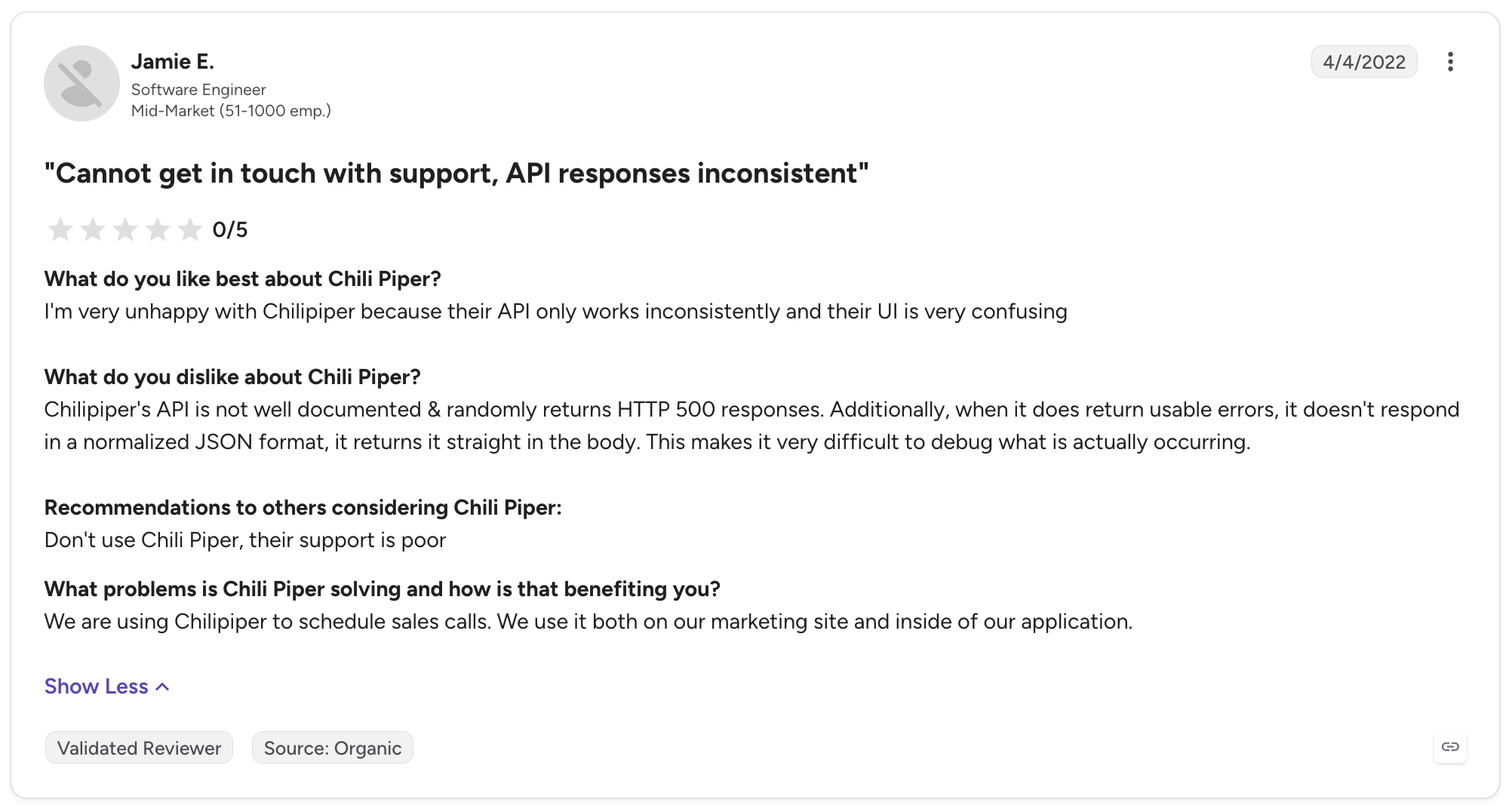
7. Jamie E. | April 4, 2022 | 0/5
In “Cannot get in touch with support, API responses inconsistent,” Jamie criticized the API documentation, inconsistent API responses, and difficulty reaching support. This review is particularly relevant to teams planning custom integrations, although it reflects an individual experience from 2022 rather than a verified current API issue.
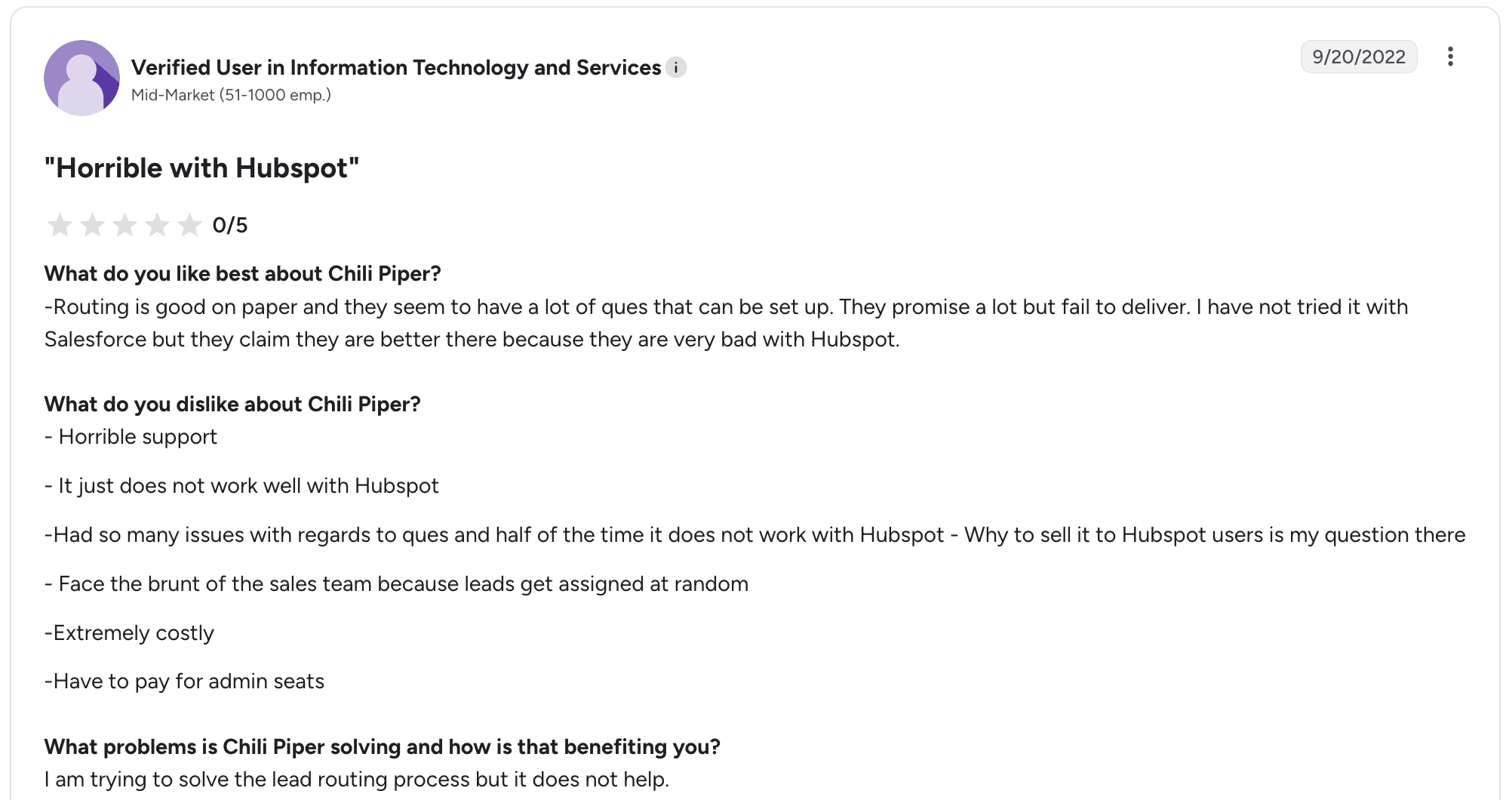
8. Verified user in IT Services | September 20, 2022 | 0/5
In “Horrible with HubSpot,” the reviewer said routing worked well in theory but reported recurring HubSpot integration and queue issues, including leads being assigned incorrectly. They also criticized customer support, the cost, and the need to pay for admin seats. Chili Piper's response acknowledged the reported integration issues.
Our verdict
Chili Piper's G2 feedback shows a clear trade-off. Its scheduling, lead routing, and CRM workflows can reduce manual work and help sales teams respond to inbound demand faster. But customer experiences vary, particularly when routing logic becomes complex or integrations do not behave as expected.
The most important concerns to investigate before buying are:
Implementation and maintenance: How much time will RevOps or engineering need to configure and maintain workflows?
Routing reliability: Do round-robin rules, queue priorities, and territory assignments behave as expected in your actual setup?
CRM compatibility: Test your specific CRM integration rather than assuming every integration offers the same experience.
Support and total cost: Clarify onboarding responsibilities, support arrangements, seat requirements, and the complete contract cost.
Our recommendation: Chili Piper is worth evaluating for teams that need sophisticated inbound scheduling and lead distribution. However, buyers should validate the routing and integration workflows they depend on before committing, rather than judging the platform solely by its feature set or overall G2 score.
Chili Piper Pros and Cons
Pros
Cons
Fast meeting scheduling: Lets qualified inbound leads book meetings immediately after submitting a form, reducing back-and-forth emails.
Form-dependent workflows: Traditional inbound flows rely heavily on form submissions, limiting their usefulness for buyers who prefer to engage without filling out a form.
Advanced lead routing: Supports round-robin distribution, territory-based assignment, qualification rules, and SDR-to-AE handoffs.
Complex setup and maintenance: G2 reviewers report that configuring advanced routing logic and troubleshooting workflows can require considerable time and effort.
Strong Salesforce integration: Works well for organizations with established Salesforce processes, CRM ownership rules, and structured lead management.
CRM issues reported by some users: Some G2 reviewers have reported HubSpot synchronization problems and incorrect lead assignments. Experiences may vary by configuration.
Less manual coordination: Automates lead assignment, calendar availability, and meeting handoffs, helping sales teams respond to inbound demand faster.
Routing reliability concerns: Some reviewers have reported round-robin queues behaving unexpectedly or failing to distribute leads as intended.
Flexible scheduling and routing: Offers configurable workflows for teams with multiple sales representatives, territories, and complex booking requirements.
Learning curve: Some users find the interface unintuitive, particularly when navigating settings or managing complex workflows.
Helpful customer support experiences: Some recent G2 reviewers praise knowledgeable account teams and hands-on implementation assistance.
Mixed support experiences and pricing concerns: Other reviewers report slow issue resolution, implementation challenges, and concerns about additional fees or renewal costs.
Chili Piper Vs Calendly
Many people compare Chili Piper with Calendly because both tools help teams schedule meetings and reduce the back-and-forth involved in booking calls. However, they serve slightly different needs. Calendly focuses primarily on easy, flexible scheduling, while Chili Piper combines scheduling with inbound lead qualification, routing, and sales workflow automation.
Feature
Chili Piper
Calendly
Primary use case
Inbound lead conversion, meeting scheduling, and sales routing
Meeting scheduling and appointment coordination
Target audience
B2B sales teams, RevOps teams, and organizations with complex inbound workflows
Individuals, consultants, small businesses, and teams across different functions
Lead routing
Advanced routing based on qualification criteria, territories, and ownership rules
Team scheduling and routing capabilities, depending on the plan and configuration
Form-based scheduling
Connects lead qualification and routing with immediate meeting booking
Supports scheduling through booking links and integrations with forms and other tools
CRM integration
Built for CRM-connected sales workflows, including Salesforce and HubSpot
Integrates with CRMs and other business tools, with capabilities depending on the plan
Website engagement
Offers website experiences and chat capabilities for inbound conversion
Primarily focuses on scheduling experiences through booking pages and links
Sales handoffs
Supports routing qualified leads to the appropriate sales representative and coordinating handoffs
Supports team scheduling and assignment workflows, but is less focused on complex sales handoffs
Ease of use
More specialized, with additional setup for advanced routing and sales workflows
Generally simpler to set up for straightforward scheduling needs
Best for
Businesses that want to connect inbound demand with qualification, routing, and sales meetings
Individuals and teams that want a straightforward way to schedule meetings
The bottom line: Calendly is a strong choice when the main challenge is coordinating calendars. Chili Piper is worth considering when scheduling is only one part of a larger inbound sales process that includes lead qualification, CRM-based routing, and sales handoffs.
#1 Chili Piper Alternative: Knock AI
Chili Piper helps sales teams convert inbound interest into meetings. Knock AI takes a broader approach: turning buyer intent into revenue opportunities.
Think about how B2B buyers actually research products today. They might visit your website, compare vendors on G2, engage with content, or show buying intent across different channels. But they don't always fill out a form or book a demo when your sales team expects them to.
That creates a gap between buyer interest and sales engagement.
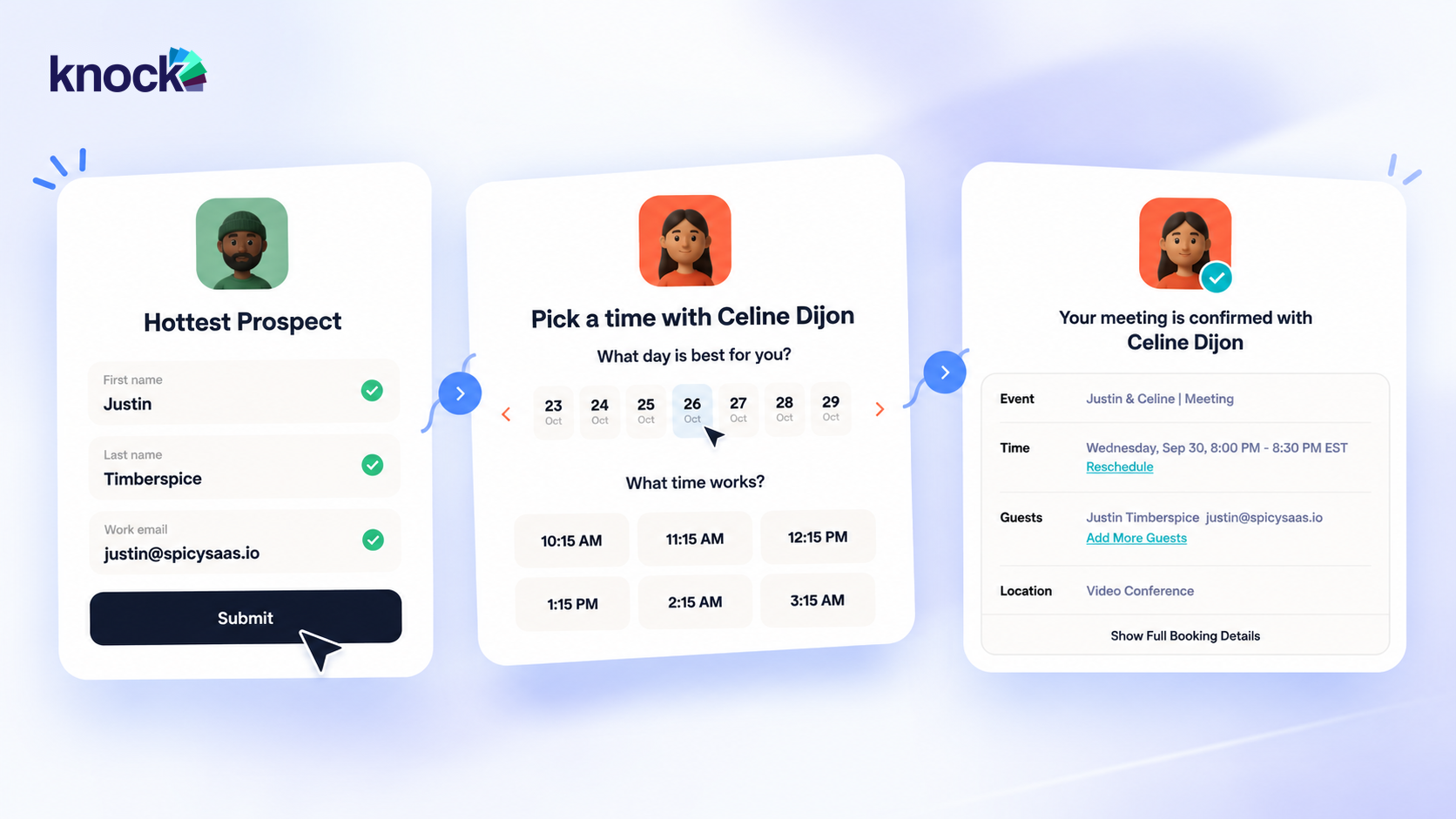
Knock AI is designed to close that gap by connecting buyer identification, intent signals, real-time enrichment, AI-powered conversations, qualification, routing, and scheduling into a more connected revenue conversion workflow.
Here's how its capabilities fit together:
Knock Reveal: Help identify potential buyers and bring more context to website engagement.
Knock Intent: Use intent signals to help sales teams prioritize and act on potential buying interest.
Knock AI Agent: Engage prospects and support qualification through AI-powered conversations.
Knock Routing: Connect qualified opportunities with the appropriate sales representatives.
Knock Scheduling: Make it easier to move from a qualified conversation to a meeting.
Knock Chat: Give buyers another way to engage with your business.
The difference isn't simply that Knock AI offers more features. It's the broader workflow: connecting buyer context to engagement, qualification, routing, and meetings instead of treating each step as a separate task.
Chili Piper remains a strong choice for teams that need sophisticated inbound routing, scheduling, and established CRM workflows. Knock AI is the alternative to evaluate when your bigger challenge is activating buyer intent, engaging prospects beyond traditional form submissions, and turning more demand into qualified pipeline.
If you're looking to improve the entire journey from buyer interest to sales conversation, rather than just optimize meeting booking, Knock AI deserves a closer look.
Is Chili Piper Worth It?
Yes, Chili Piper is worth considering for B2B teams that need advanced lead routing, inbound meeting scheduling, and CRM-connected sales workflows. However, setup complexity, pricing, and reported integration issues may be drawbacks for some teams.
If you simply need scheduling, Calendly may be enough. But if you want to go beyond meeting booking and connect buyer intent, AI-powered engagement, enrichment, and routing, Knock AI is worth evaluating as an alternative.
Frequently Asked Questions
1. What is Chili Piper used for?
Chili Piper helps B2B businesses qualify inbound leads, route them to the right sales representatives, and schedule meetings automatically.
2. How much does Chili Piper cost?
Chili Piper's advertised pricing starts at $1,250/month for Routing & Scheduling and $3,500/month for Experiences.
3. Is Chili Piper better than Calendly?
It depends on your needs. Chili Piper is better suited to complex inbound lead routing and sales workflows, while Calendly is often a simpler choice for straightforward meeting scheduling.
4. What are the best Chili Piper alternatives?
Popular alternatives include Knock AI, Calendly, HubSpot, and cal.com. The best option depends on whether you need scheduling, lead routing, inbound conversion, or broader buyer engagement.
5. What is the best alternative to Chili Piper?
Knock AI is worth considering if you want to connect buyer intent, real-time enrichment, AI-powered engagement, lead qualification, routing, and scheduling in a broader revenue conversion workflow.
6. Does Chili Piper integrate with Salesforce?
Yes. Chili Piper supports Salesforce integration, helping teams connect lead routing, meeting scheduling, and sales workflows with their CRM.