.svg)


.svg)
.svg)
.svg)


.svg)
.svg)

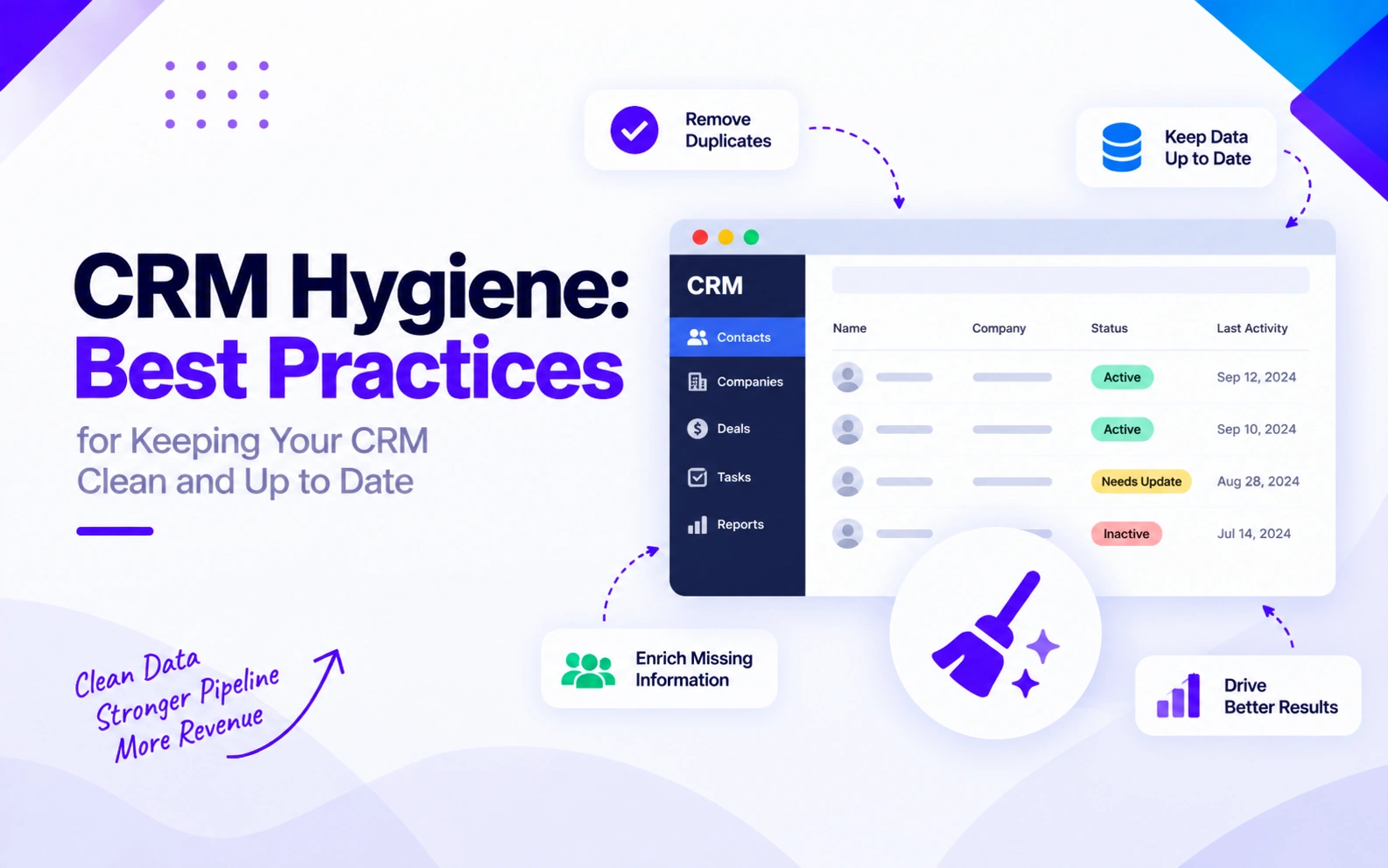
Your CRM can look perfectly organized and still be wrong.
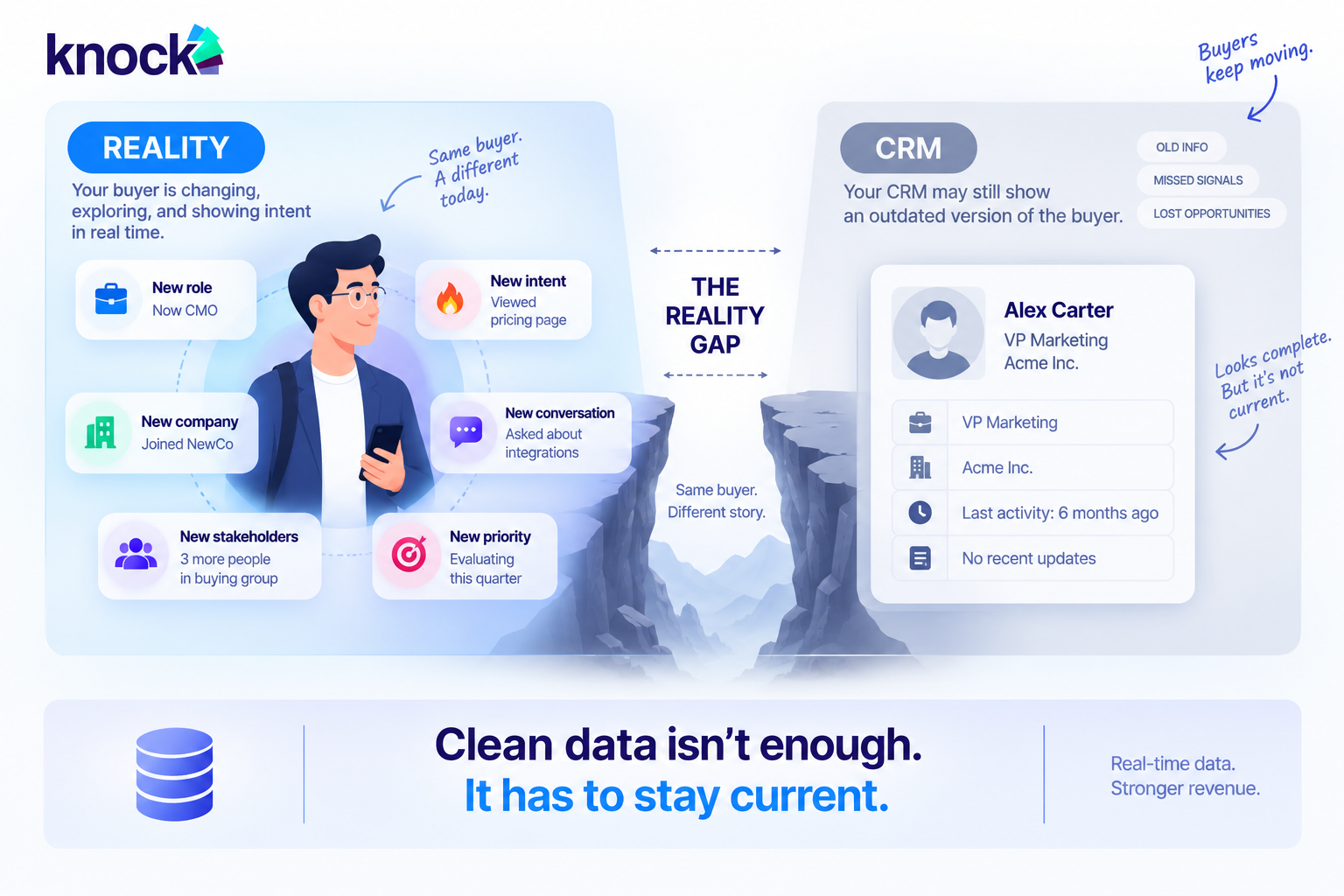
A contact changes jobs. An account acquires another company. A buyer's role changes. A champion becomes an executive sponsor. A prospect starts evaluating a new solution. A conversation happens outside the CRM.
Yet the CRM may still show the same record it showed six months ago.
That's the problem with treating CRM hygiene as a cleanup exercise. Removing duplicates and filling missing fields can improve the quality of your database, but it doesn't guarantee that your CRM reflects what's actually happening with your buyers.
And this is a bigger problem than it sounds. According to Validity's 2025 State of CRM Data Management report, 76% of respondents said less than half of their organization's CRM data was accurate and complete. The same research found that 37% said their company loses revenue because of poor data quality. (Source)
The problem isn't only dirty data.
It's stale data, disconnected data, and missing buyer context.
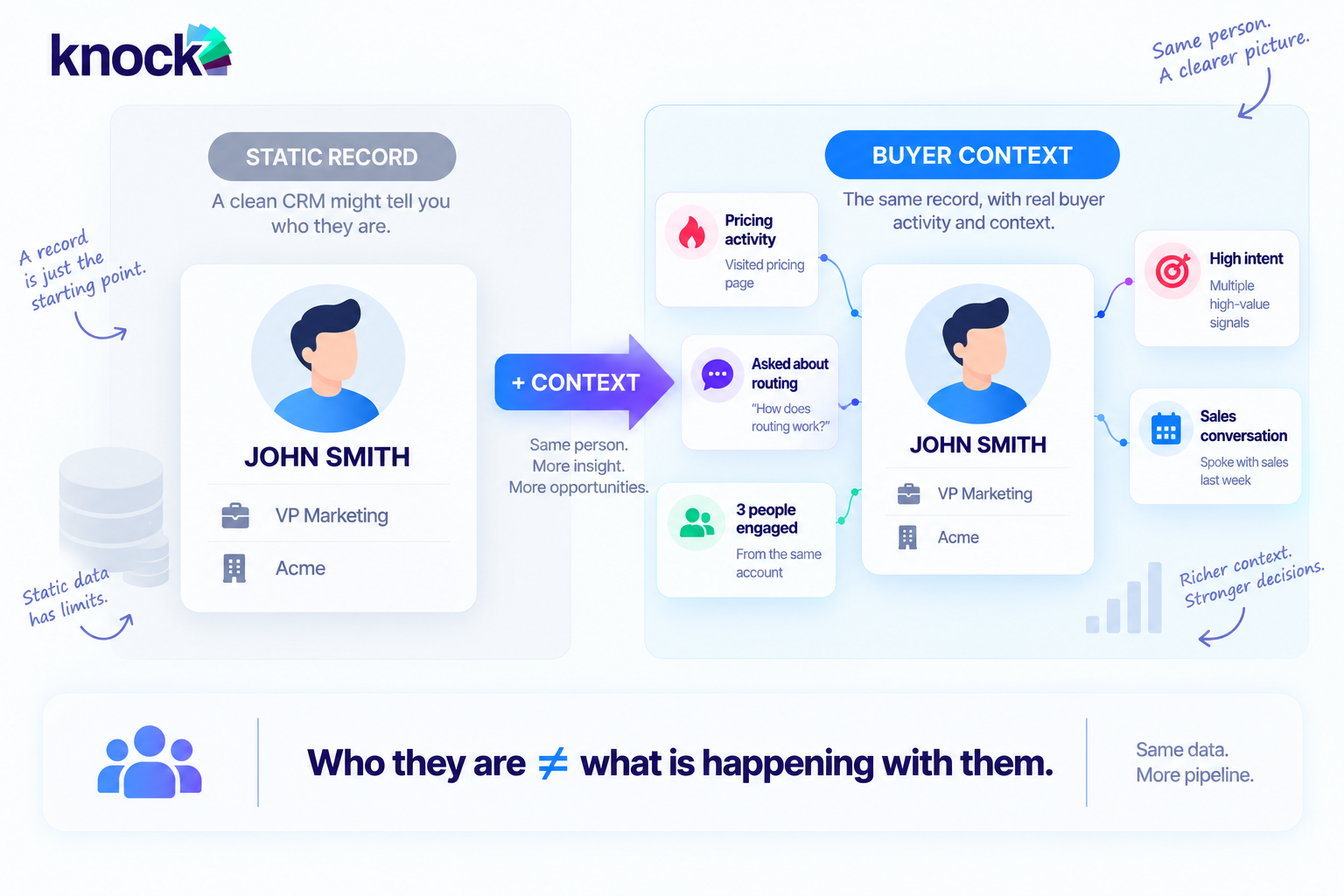
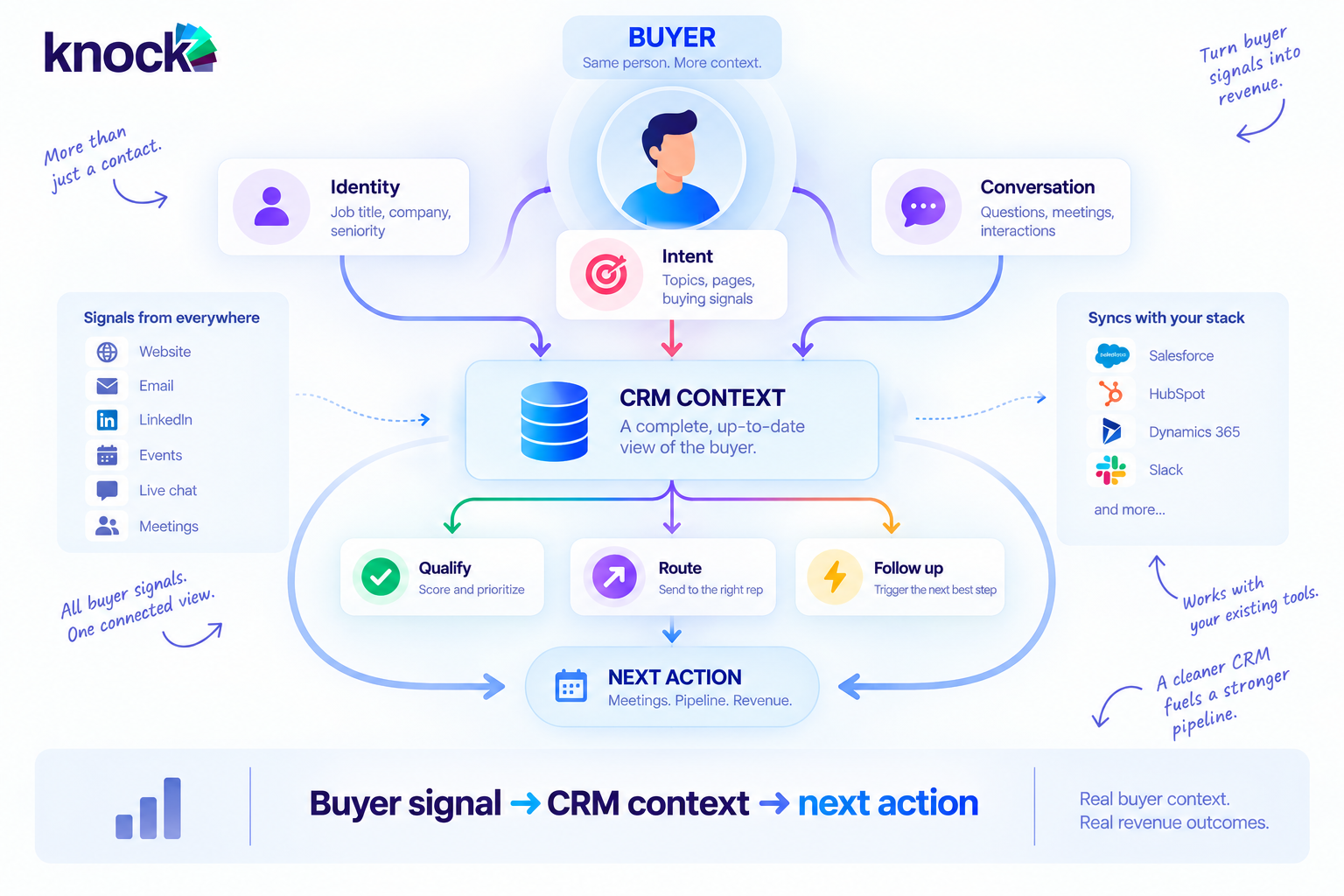
A CRM might tell your Sales team who someone is, where they work, and when they entered the database. But it may not tell them that the person changed jobs, recently returned to your pricing page, asked a question in a conversation, or is now evaluating a solution.
CRM hygiene isn't just about keeping records clean. It's about keeping your CRM aligned with reality.
What Is CRM Hygiene?
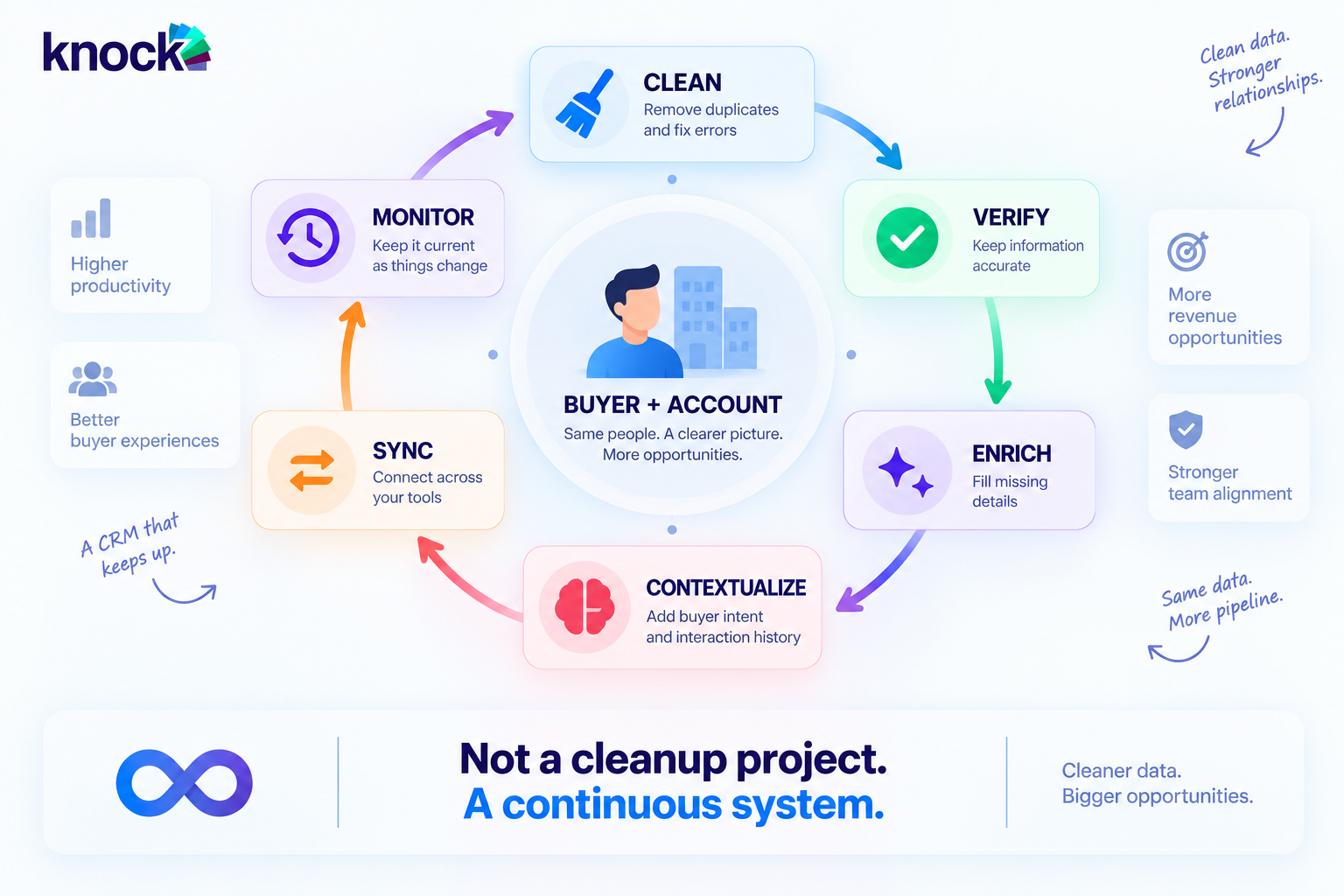
CRM hygiene is the ongoing process of keeping customer, prospect, account, and interaction data accurate, complete, consistent, and current.
It covers everything from preventing duplicate records and correcting outdated contact information to maintaining accurate account relationships, enriching missing data, and keeping important buyer activity connected to the right records.
It's useful to distinguish CRM hygiene from a few related concepts:
- Data cleansing means fixing existing problems, such as duplicates, invalid information, or inconsistent fields.
- Data enrichment means adding information that is missing, such as job title, company details, industry, or other account attributes.
- CRM hygiene encompasses both, but goes further. It's the ongoing process of making sure the information in your CRM remains accurate and useful as people, accounts, and buyer relationships change.
That's important because CRM data doesn't stay static.
A contact can change companies. An account can change ownership. A buyer can develop new priorities. A new stakeholder can enter an existing buying group. And conversations can happen across websites, email, events, Slack, LinkedIn, or other channels without all of that context making its way back into the CRM.
So good CRM hygiene isn't simply:
Clean the database → fix the records → move on.
It's closer to:
Clean → Verify → Enrich → Capture Context → Sync → Monitor
The goal is simple: when your team opens a CRM record, it should reflect the buyer and account as they exist now, not just as they existed when the record was created.
Why CRM Data Gets Stale
CRM data doesn't become stale for just one reason. The bigger problem is that buyers, accounts, and interactions keep changing while the systems storing that information often update at different speeds.
A contact changes jobs. A new stakeholder joins the buying group. A prospect starts evaluating a different solution. A conversation happens on your website, at an event, in Slack, or over email. But your CRM may not know about any of it.
Over time, the CRM becomes a snapshot of what was true rather than a reflection of what's happening now.
1. People Change Jobs
One of the simplest examples is also one of the most common.
Your CRM might say:
VP of Marketing → Acme
But the person now works at:
CMO → NewCo
This isn't just an outdated job title. It can affect the entire relationship around that contact.
A job change can alter:
- Account association
- Account ownership
- Routing
- Segmentation
- Outreach
- Buying-group membership
- Relationship history
Cognism's research highlights just how quickly senior-level contact data can become outdated. Its research found substantial annual data decay across executive roles, including a 35% annual decay rate for CMOs and 34% for CROs in its European dataset. (Source)
The important point is that a contact record shouldn't simply be overwritten when someone's situation changes.
You also need to understand what happened before the change.
Person → Previous Account → Previous Relationship → New Account → Current Context
That history can matter the next time the person interacts with your company.
2. Buyer Context Changes
A person's identity can remain accurate while their buying context changes completely.
Your CRM might correctly tell you:
VP Marketing at Acme
But it may not tell you:
Evaluating lead routing → asked about Salesforce → returned to pricing page → spoke with Sales last week
Both records could contain accurate information. Only one tells you what's happening with the buyer.
That's the difference between static contact data and buyer context.
Buyer context can include:
- What the buyer is researching
- What problems they've mentioned
- Questions they've asked
- Products or pages they've engaged with
- Previous conversations
- Buying intent
- Stakeholders involved
- Preferred next step
- Recent interactions
Without this context, Sales may have to reconstruct the buyer's journey every time they engage.
Related: How to prevent buyer context during GTM handoffs
3. Your Revenue Data Lives in Silos
This is where CRM hygiene becomes an architectural problem, not just a data-cleaning problem.
Your buyer information may be spread across:
CRM + marketing automation + enrichment tools + website + sales engagement + conversations + events + email + Slack + spreadsheets
Each system captures a different part of the buyer relationship.
The problem is that these systems don't always update one another at the same time.
One system knows that the person changed jobs.
Another knows they visited the pricing page.
Another contains the conversation they had with Sales.
The CRM may contain none of that context, or only part of it.
When your revenue systems operate in silos, no single system necessarily has the complete buyer picture.
That's how you end up with a CRM that is technically clean but contextually incomplete.
The problem isn't simply bad data.
It's fragmented data.
4. Manual Updates Happen Too Late
Many CRM updates still depend on someone noticing something and entering it manually.
A rep discovers that a contact changed companies.
A marketer notices an account has new activity.
Someone realizes a field is outdated.
Someone remembers to update the record.
By the time the update happens, the information may already be weeks or months old.
This creates a simple problem:
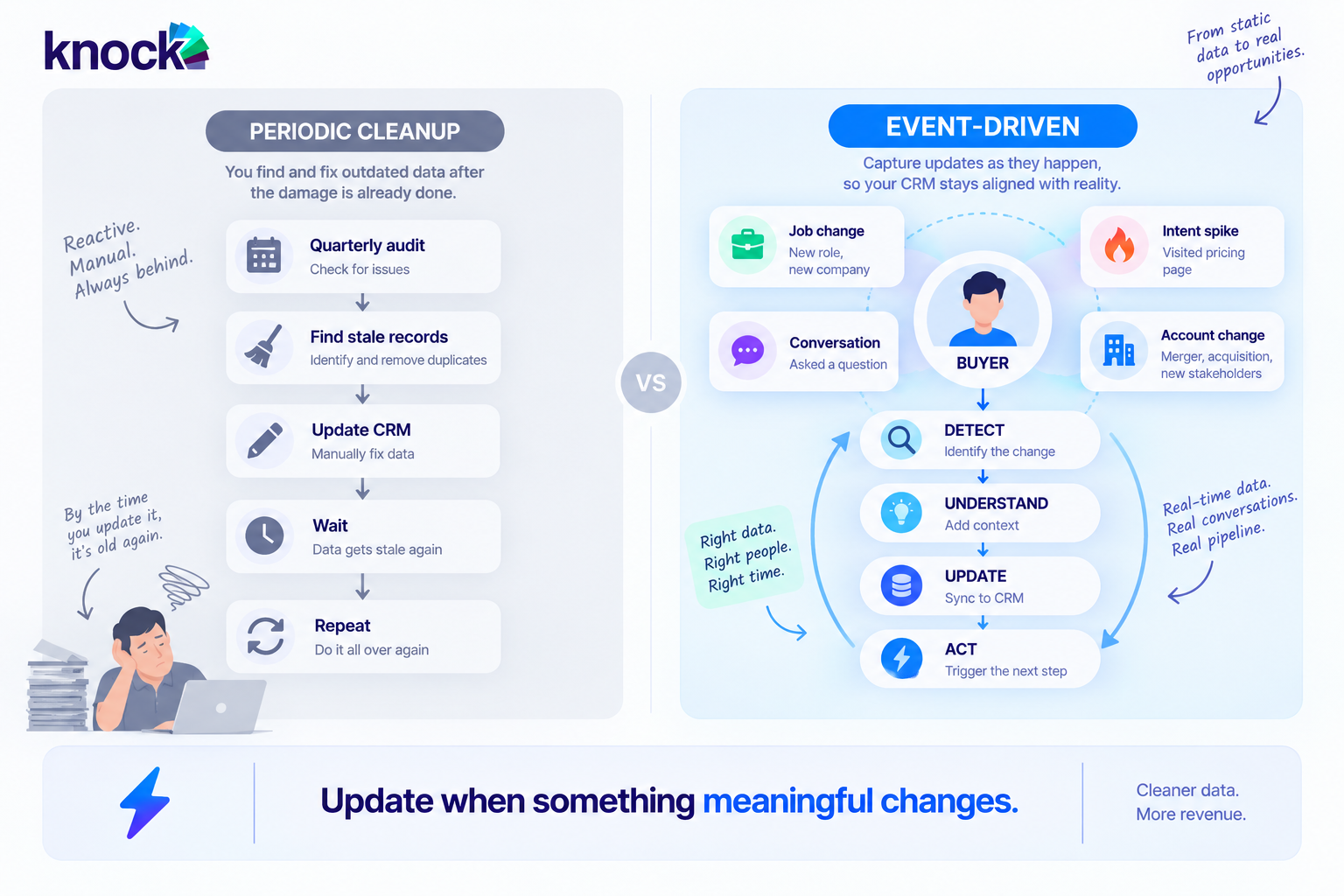
The CRM is updated when someone remembers to update it, rather than when the buyer's situation actually changes.
For high-value accounts and active opportunities, that delay can affect routing, prioritization, outreach, and follow-up.
5. Historical Relationships Get Lost
There's another problem with simply “cleaning” CRM records: history can disappear when the present changes.
Imagine a buyer who worked at Acme for three years and had several conversations with your Sales team. They then move to NewCo.
If you simply change:
Acme → NewCo
you've updated the current record, but you've potentially lost part of the relationship story.
A better model preserves:
Person identity → Previous account → Previous conversations → Current account → Current context
That creates a more complete picture of the relationship without treating historical information as outdated noise.
6. CRM Hygiene Becomes a Point-in-Time Exercise
This is ultimately why traditional CRM hygiene struggles.
Teams clean the database, remove duplicates, enrich records, fix fields, and declare the CRM healthy.
Then the data starts changing again.
People move. Accounts change. Buyers engage. Conversations happen. Intent shifts.
The database gradually drifts away from reality.
That's why CRM hygiene should be treated as a continuous process, not a quarterly cleanup project.
The goal isn't simply to have a clean CRM.
It's to have a CRM that stays connected to the people, accounts, relationships, and buyer context changing around it.

.svg)