The pricing structure makes it clear that Default is no longer positioned as lightweight scheduling software. The platform is increasingly priced as a broader RevOps infrastructure layer focused on workflows, routing orchestration, enrichment, and CRM operational automation.
What Default Pricing Actually Means
Default’s pricing model reflects a broader operational platform rather than a simple meeting booking tool.
What teams are actually paying for includes:
Not just:
- booking links
- calendar coordination
- lightweight scheduling
As organizations scale, operational complexity often grows alongside workflow sophistication. More routing layers, qualification logic, enrichment rules, and CRM workflows typically create additional operational overhead across RevOps and sales teams.
That distinction matters because many modern GTM teams are not struggling with scheduling itself.
They are struggling with:
This is where platforms like Knock AI operate differently by focusing more directly on buyer conversion, messaging-first engagement, and pipeline generation before buyers disappear from the funnel.
The Three Pricing Multipliers Most Teams Underestimate
The visible subscription price is only one part of the total cost structure.
As teams scale inbound operations, routing sophistication, and qualification workflows, Default pricing expands through three major operational layers:
- workflow growth
- seat expansion
- enrichment and credit usage
These costs often compound faster than teams initially expect.
Workflow Expansion Costs
Default’s pricing structure already signals how important workflow scale becomes over time.
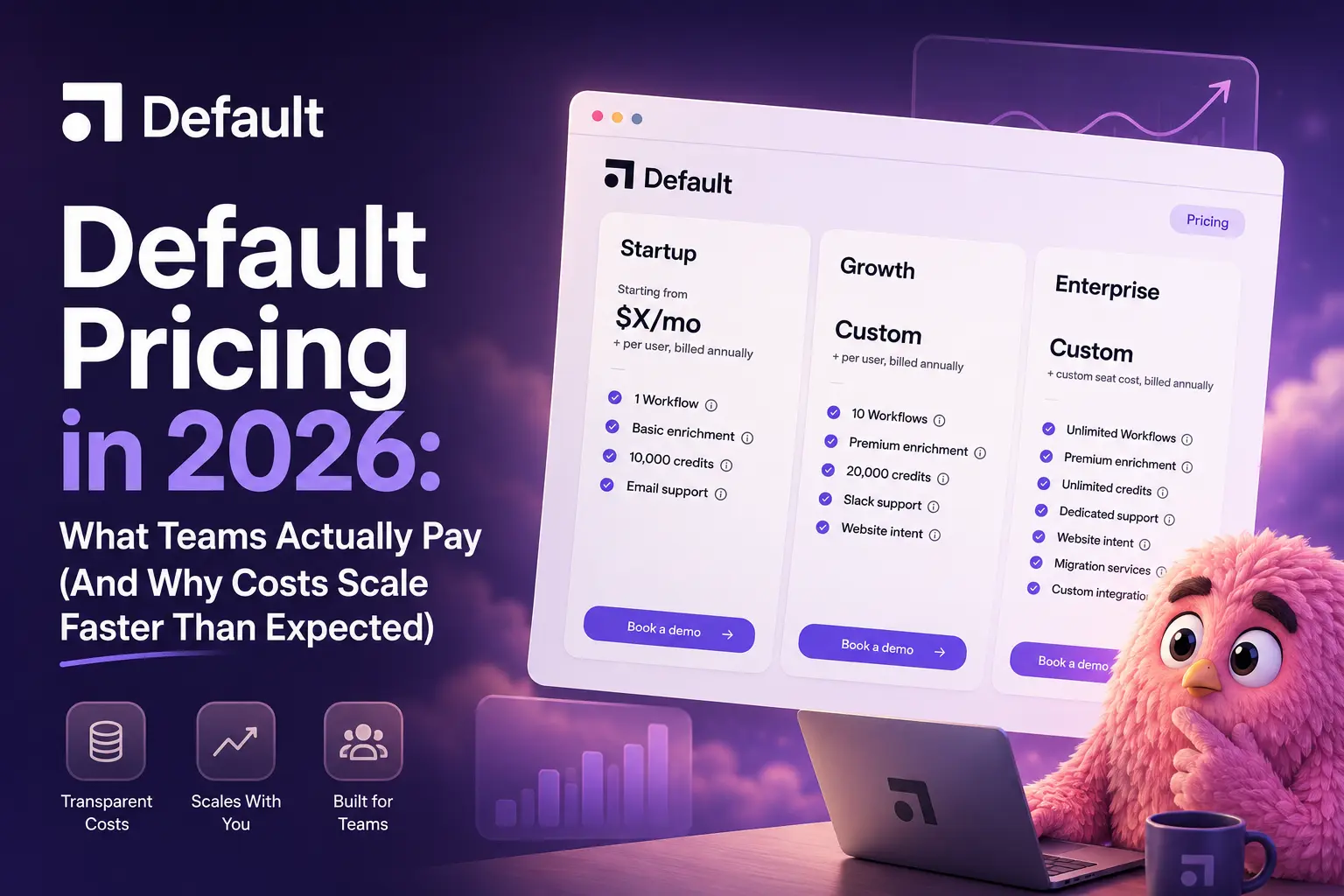
- Startup: 1 workflow
- Growth: 10 workflows
- Enterprise: unlimited workflows
At first, a single workflow may seem sufficient.
But as GTM operations grow, organizations typically add:
- SDR routing logic
- qualification layers
- ownership management
- territory assignment
- enrichment branching
- handoff automation
- CRM assignment workflows
What begins as a simple inbound flow often expands into multiple operational systems across sales, marketing, and RevOps.
As routing sophistication increases, workflow management complexity usually increases alongside it.
“Workflow sprawl becomes operational sprawl.”
Seat-Based Scaling Costs
Default also scales through seat-based pricing at $45/user/month.
This typically includes:
- SDRs
- AEs
- RevOps
- marketing operations
- administrators
As teams grow, seat costs compound quickly.
Estimated Seat Cost Growth
| Team Size |
Estimated Seat Cost |
| 10 users |
$450/mo |
| 25 users |
$1,125/mo |
| 50 users |
$2,250/mo |
And seat pricing is rarely the full picture.
Organizations also absorb:
- platform fees
- implementation costs
- CRM dependencies
- operational maintenance
- workflow administration
That is where pricing discussions often shift from software cost to operational infrastructure cost.
Credit and Enrichment Scaling
Default pricing also expands through credits and enrichment usage.
As inbound volume increases, organizations typically consume more:
- visitor identification
- enrichment workflows
- routing evaluations
- qualification operations
- intent processing
The more sophisticated the routing and qualification system becomes, the more enrichment and operational processing the platform must support.
This is where many modern GTM systems quietly become expensive over time.
The platform itself may remain manageable at first, but operational scale tends to increase alongside:
- traffic growth
- workflow expansion
- CRM orchestration
- qualification complexity
- routing sophistication
For growing GTM teams, this often becomes one of the least visible but most important pricing layers to monitor.
What You Are Actually Buying
Default is no longer positioned as simple calendar software.
The platform is increasingly evolving into:
- GTM infrastructure
- operational middleware
- a routing orchestration layer for RevOps teams
What organizations are actually paying for is a centralized operational system connecting:
- workflows
- routing
- enrichment
- CRM orchestration
- website intent
- qualification logic
That distinction matters because the platform’s value is no longer tied only to scheduling meetings.
It is tied to coordinating how buyers move through:
- qualification flows
- ownership assignment
- enrichment layers
- routing systems
- CRM workflows
- operational handoffs
As companies scale, Default increasingly becomes embedded into the operational structure of the revenue organization itself.
For mature RevOps teams, this can create:
- stronger operational control
- more routing precision
- centralized workflow management
- better qualification consistency
But it also means the platform behaves more like infrastructure than lightweight software.
The Hidden RevOps Cost Layer Nobody Talks About
The visible subscription price is only one layer of the real operational cost.
As workflow complexity grows, organizations often inherit additional RevOps overhead that rarely appears in pricing discussions upfront.
This includes:
- routing QA
- workflow debugging
- CRM field mapping
- ownership logic management
- onboarding complexity
- operational administration
- territory maintenance
Most routing systems begin relatively simple.
But over time, GTM teams typically add:
- qualification conditions
- territory rules
- SDR-to-AE handoffs
- account ownership layers
- enrichment branching
- workflow exceptions
- operational routing logic
Each additional layer increases operational dependency on RevOps and CRM administration.
This is especially true for organizations managing:
- Salesforce orchestration
- large inbound teams
- complex territory structures
- multiple qualification paths
- regional ownership logic
The challenge is not that these systems fail.
The challenge is that operational maintenance compounds quietly as infrastructure complexity grows.
For many teams, the hidden cost is not the software itself.
It is the ongoing operational effort required to maintain the system efficiently over time.
“The subscription cost is visible. Operational cost compounds silently.”
Why More Workflow Infrastructure Does Not Always Mean More Pipeline
One of the biggest misconceptions in modern GTM operations is that better routing infrastructure automatically creates more pipeline.
In reality, most B2B revenue leakage happens:
- before forms
- before routing
- before CRM creation
- before qualification workflows ever begin
Modern buyers do not move through linear funnels anymore.
They:
- research on LinkedIn
- compare vendors across communities and review sites
- disappear after website visits
- avoid friction-heavy forms
- ignore delayed email follow-up
- engage across multiple channels before ever booking a meeting
This creates a major gap between operational efficiency and actual buyer conversion.
Routing infrastructure can optimize:
- ownership assignment
- qualification workflows
- scheduling coordination
- CRM orchestration
But it does not automatically solve:
- buyer momentum loss
- meeting no-shows
- engagement drop-off
- qualification friction
- abandoned inbound intent
That is where many modern GTM teams begin rethinking the role of revenue infrastructure itself.
Instead of asking:
“How do we route buyers more efficiently?”
They increasingly ask:
“How do we prevent buyers from disappearing before routing even starts?”
This is where platforms like Knock AI operate differently.
Rather than focusing primarily on workflow orchestration after form submission, Knock AI focuses on:
- messaging-first engagement
- form-free qualification
- persistent buyer conversations
- real-time qualification
- buyer conversion before drop-off occurs
The operational model shifts from routing-first to conversation-first.
The Modern Revenue Problem: Conversion Before Routing
Traditional revenue systems were built around a relatively linear funnel:
Visitor → Form → Routing → Scheduling
But modern buyer behavior rarely follows that path anymore.
Today’s reality looks much closer to:
Intent → Conversation → Qualification → Engagement → Pipeline
That distinction is important because the largest conversion gap often happens before:
- form submission
- CRM creation
- routing workflows
- meeting scheduling
Most buyers never formally enter the funnel at all.
They research anonymously, engage briefly, compare vendors across channels, and disappear before traditional routing systems activate.
This is why many modern GTM teams are shifting toward systems designed to preserve buyer momentum earlier in the journey through:
- real-time engagement
- messaging-first qualification
- conversational workflows
- persistent follow-up
- multi-channel interaction
The strategic shift is subtle but important:
Traditional systems optimize operational flow after conversion begins.
Modern revenue systems increasingly optimize buyer conversion before operational workflows ever activate.
Where Knock AI Fits Differently
The difference between Default and Knock AI is not simply feature depth.
The platforms are optimized around different revenue problems.
Default is increasingly designed to optimize operational infrastructure after buyers enter the funnel.
Knock AI is designed to optimize buyer conversion before intent disappears.
That creates two very different operating models.
Default Optimizes Operational Workflows
Default’s core strength is operational orchestration across the revenue stack.
The platform focuses heavily on:
- routing
- workflow orchestration
- CRM assignment logic
- operational infrastructure
- RevOps control
- qualification workflows
- scheduling coordination
This makes it valuable for organizations managing:
- complex routing environments
- territory assignment
- ownership management
- layered qualification logic
- CRM-heavy GTM operations
The platform is strongest when operational control and workflow precision are the primary priorities.
Knock AI Optimizes Buyer Conversion
Knock AI focuses on the stage where most modern revenue leakage actually happens:
before buyers complete forms, book meetings, or enter routing workflows.
The platform is designed around:
- form-free qualification
- LinkedIn and Slack engagement
- messaging-first qualification
- persistent conversations
- reducing no-shows
- pipeline acceleration
Instead of waiting for buyers to submit forms and enter operational workflows, Knock AI focuses on engaging and qualifying buyers while intent is still active.
This creates a different operational philosophy:
- conversation-first instead of routing-first
- buyer momentum instead of workflow dependency
- engagement continuity instead of delayed follow-up
The goal is not simply to optimize how buyers move through infrastructure.
The goal is to prevent high-intent buyers from disappearing before the funnel fully begins.
Infrastructure vs Revenue Generation
The core difference between Default and Knock AI is not whether both platforms support routing, qualification, or workflows.
The difference is what each platform is primarily optimized to improve.
Default focuses more heavily on operational infrastructure and workflow orchestration after buyers enter the funnel.
Knock AI focuses more directly on converting buyer intent before buyers disappear from the funnel entirely.
| Criteria |
Default |
Knock AI |
| Core focus |
Workflow infrastructure |
Buyer conversion |
| Activation point |
After forms |
Before drop-off |
| Primary optimization |
Routing efficiency |
Pipeline generation |
| Communication style |
Workflow-driven |
Messaging-first |
| Revenue risk solved |
Operational complexity |
Buyer leakage |
| Core economic model |
Infrastructure scaling |
Conversion scaling |
Related: Best Default Alternatives
The Real Question Buyers Should Ask
The most important question is not:
“What does Default cost?”
The more important question is:
“What revenue problem am I actually trying to solve?”
Because pricing alone rarely determines ROI.
The real decision depends on where the revenue engine is constrained.
For some organizations, the bottleneck is:
- routing complexity
- territory assignment
- ownership management
- workflow orchestration
For others, the bottleneck happens much earlier:
- buyers abandoning forms
- low inbound conversion
- meeting no-shows
- delayed follow-up
- lost buyer momentum
That distinction changes which type of platform actually creates revenue impact.
When Default Makes Sense
Default is a strong fit for organizations that need operational sophistication across complex GTM environments.
The platform makes the most sense for:
- mature RevOps organizations
- Salesforce-heavy routing environments
- territory orchestration
- operational control
- complex inbound assignment workflows
It is especially valuable when organizations prioritize:
- workflow precision
- routing consistency
- centralized orchestration
- qualification control
- CRM-driven operational infrastructure
For teams operating layered routing systems across large inbound volumes, Default can provide meaningful operational efficiency.
When Revenue-First Systems Make More Sense
Some organizations do not primarily have a routing problem.
They have a conversion problem before buyers ever enter the workflow.
Revenue-first systems become more valuable when:
- buyers avoid forms
- inbound converts poorly
- no-show rates are high
- SDR follow-up breaks momentum
- messaging converts better than email
In these environments, optimizing routing logic alone rarely fixes the underlying revenue leak.
The bigger challenge is maintaining buyer engagement while intent is still active.
That is why many modern GTM teams are increasingly prioritizing:
- messaging-first qualification
- conversational engagement
- persistent follow-up
- real-time buyer interaction
- buyer conversion before scheduling friction occurs
The focus shifts from operational orchestration to pipeline generation itself.
Is Default Worth It?
Default can absolutely be worth the investment for organizations that need:
- routing sophistication
- workflow infrastructure
- operational orchestration
- CRM-centric qualification systems
- advanced inbound assignment logic
For mature RevOps teams managing complex routing environments, the platform can provide strong operational control and workflow efficiency.
But many modern GTM teams are solving the wrong bottleneck.
They optimize:
- routing
- ownership logic
- workflows
- operational layers
when the real revenue leak happens:
- before qualification
- before meetings
- before forms
- before buyers ever enter the system
That is the strategic shift happening across modern B2B revenue infrastructure.
Operational efficiency matters.
But buyer conversion often matters earlier.
“The most expensive funnel problem is often the buyer who never enters the workflow.”
FAQs
How much does Default cost in 2026?
Default pricing starts at $750/month plus $45 per user/month billed annually for the Startup plan. Growth and Enterprise pricing are custom based on workflow scale, enrichment usage, and operational requirements.
Why does Default pricing increase as teams scale?
Costs increase through workflow expansion, seat-based pricing, enrichment usage, CRM orchestration, and operational workflow complexity.
What are the hidden costs of Default?
The biggest hidden costs are usually RevOps overhead, workflow maintenance, routing QA, CRM field mapping, onboarding complexity, and territory management.
Is Default a scheduling tool or a RevOps platform?
Default has evolved beyond lightweight scheduling into a broader operational platform focused on routing, workflows, enrichment, and CRM orchestration.
What problem does Default solve best?
Default is strongest for organizations that need advanced routing infrastructure, operational control, and complex inbound assignment workflows.
What problem does Knock AI solve differently?
Knock AI focuses more on buyer conversion before forms, messaging-first qualification, persistent engagement, and reducing buyer drop-off before routing workflows begin.
Why do modern GTM teams struggle with buyer drop-off?
Many buyers research anonymously, avoid forms, and disengage before entering CRM workflows. This creates revenue leakage before traditional routing systems activate.
What is the difference between workflow infrastructure and revenue generation?
Workflow infrastructure improves operational coordination after buyers enter the funnel. Revenue-first systems focus on converting buyer intent before buyers disappear from the funnel.


.svg)


.svg)
.svg)
.svg)


.svg)
.svg)


.svg)


