Drift G2 Reviews 2026: 4.4/5, But Why the Complaints?
What Do Drift G2 Reviews Really Say? Full Breakdown of Pricing, Support & Limitations (2026)
TL;DR
This article covers Drift the conversational marketing and sales platform by Salesloft, not Drift the Flutter database library and not AI model drift. All references to Drift below refer to the B2B chat, lead qualification, and meeting booking platform.
Drift G2 reviews show that the platform holds a 4.4/5 rating from 1,200+ users, with strong feedback on live chat, meeting booking, and real-time engagement. However, across multiple reviews, consistent concerns emerge around high pricing, declining ROI, support issues after the Salesloft acquisition, and routing or CRM limitations. Most feedback points to a deeper constraint: Drift operates as a website-first, SDR-dependent system that struggles to scale beyond real-time interactions.
Drift is effective at capturing conversations, but Drift G2 reviews indicate it often falls short in turning those conversations into a consistent, scalable pipeline.
As a result, many B2B teams are moving toward platforms like Knock AI, which focus on capturing intent, engaging across channels, and converting demand into pipeline without SDR dependency.
Drift G2 Reviews at a Glance
Key Metrics from Drift G2 Reviews
Metric
Value
G2 Rating
4.4 / 5
Total Reviews
1,200+
Most Loved
Live chat, meeting booking, integrations
Most Criticized
Pricing, support, routing, scalability
Drift G2 reviews indicate strong overall satisfaction, particularly for real-time engagement and inbound conversion. However, across multiple reviews, recurring concerns begin to appear as teams scale, especially around pricing, support reliability, and operational complexity.
See Knock AI in Action — Book Your Live Demo Today
Drift G2 Reviews Breakdown: What Users Actually Say
Pricing & ROI Concerns
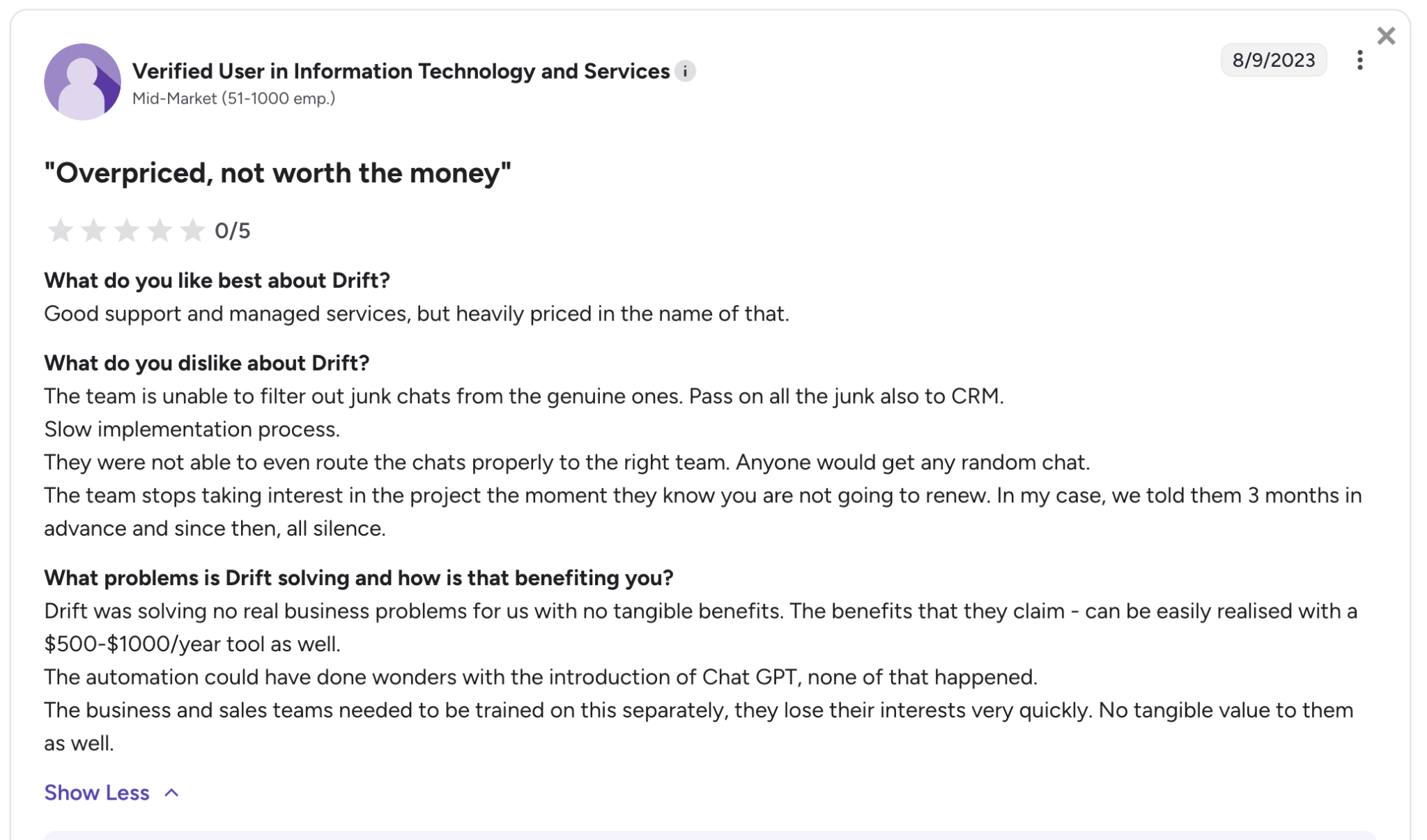
Reviewer: Verified User, Information Technology & Services Company Size: Mid-Market (51–1,000 employees) Date: Aug 9, 2023 Rating: 0/5
“Overpriced, not worth the money… heavily priced in the name of that.” “Slow implementation process.” “No real business problems solved… no tangible benefits.”
Drift G2 reviews consistently highlight pricing as a major concern, especially when the platform fails to deliver clear or measurable ROI.
The issue is not just cost. Multiple reviewers point to slow implementation, poor routing, and lack of tangible outcomes, which together make the investment difficult to justify over time.
What this means: When Drift pricing is high and outcomes are unclear, teams begin to question both adoption and renewal.
Where this creates a gap: Drift relies on real-time engagement, structured workflows, and ongoing SDR involvement. This increases both cost and operational dependency, which directly impacts ROI.
How platforms like Knock AI address this: Knock AI removes much of this operational overhead by using an AI SDR to qualify, route, and engage buyers automatically. Because engagement is not limited to real-time chat or SDR availability, teams are able to convert intent faster and more consistently, without the same cost structure highlighted in Drift G2 reviews.
Drift Chatbot ROI Declining? Here Is Why Results Get Worse Over Time
Drift chatbot ROI declines over time for a structural reason, not a configuration reason. Drift is built around session-based website interactions. As buyer behavior shifts toward LinkedIn, Slack, G2, and AI search tools, fewer high-intent buyers are landing on the website and engaging the chatbot. The tool is not broken. The channel it depends on is producing less traffic.
Teams typically notice this as: fewer conversations from the same traffic volume, lower qualification rates from the conversations that do happen, and increased dependence on SDR follow-up to close the gap. Optimizing playbooks or updating routing rules does not solve this because the root cause is not configuration, it is the website-first model itself.
Knock AI solves the ROI problem by engaging buyers across every channel they actually use, not just the website. The AI Inbound SDR captures intent from LinkedIn, Slack, WhatsApp, G2, and website chat simultaneously, which means pipeline generation does not decline as website traffic declines. Teams switching from Drift to Knock AI report 38% pipeline growth within 90 days, driven by capturing intent that Drift's website-only model was missing entirely.
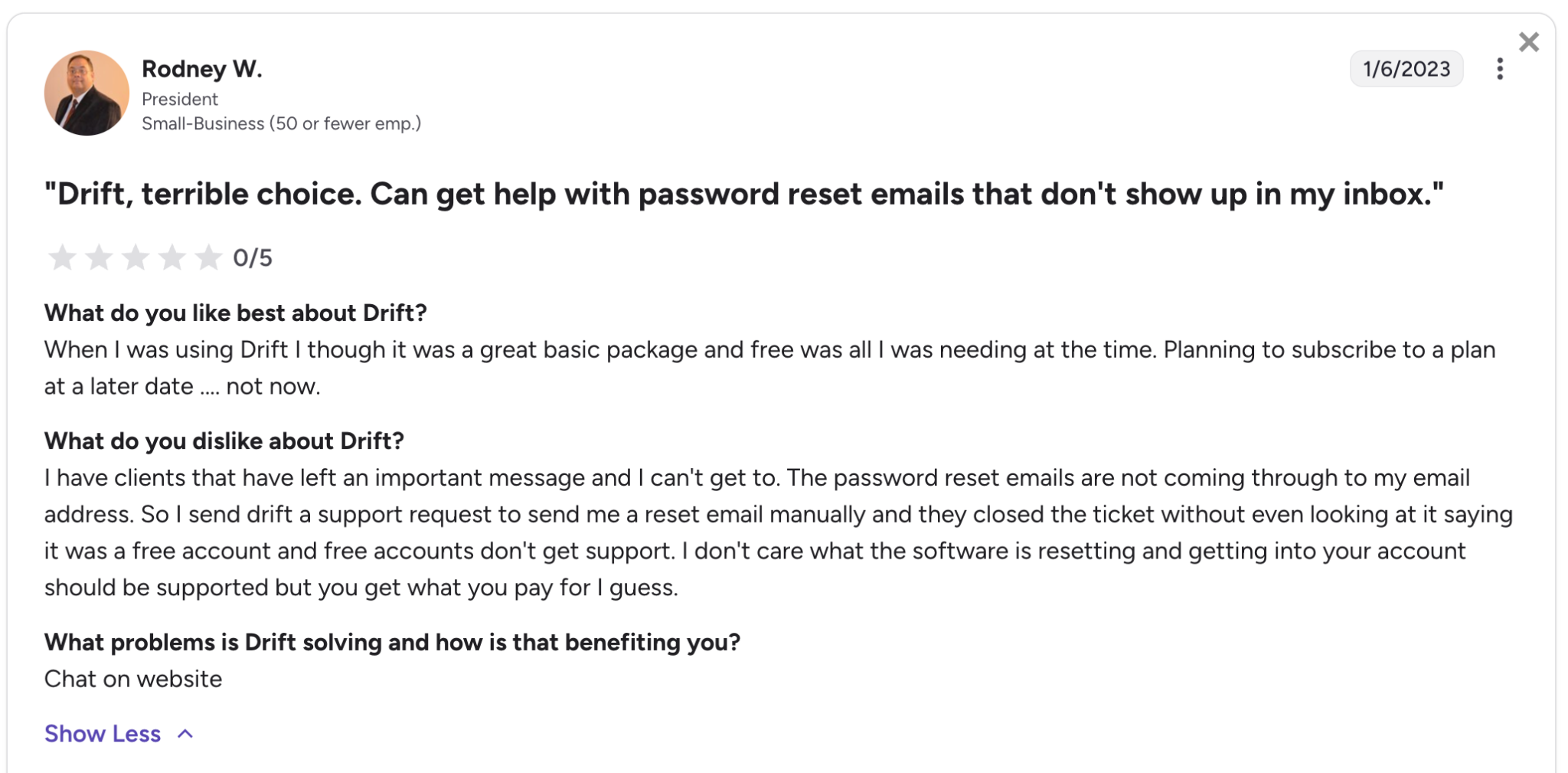
Drift G2 reviews highlight support reliability as a critical concern, especially in situations where users are unable to access their accounts or resolve urgent issues.
In this case, the reviewer was locked out due to password reset failures and was unable to get assistance, with the ticket closed without resolution. This reflects a broader pattern seen across Drift G2 reviews, where support experience can vary significantly depending on plan tier.
What this means: When support is inconsistent, even basic issues like account access can disrupt workflows and impact trust in the platform.
Where this creates a gap: For tools that sit at the center of inbound pipeline and customer interaction, reliability and timely support are essential. Any delay or lack of response directly affects business continuity.
Knock AI is built around consistent, always-on engagement where critical workflows do not depend on manual intervention or delayed support responses. By reducing dependency on human-managed processes and ensuring conversations continue automatically, teams are less exposed to the types of disruptions highlighted in Drift G2 reviews.
For teams experiencing terrible customer support after the Drift acquisition: Knock AI starts at $2,000 per month, sets up in under 2 hours without professional services or dedicated CSM involvement, and does not require ongoing RevOps management to operate. Most teams migrating from Drift to Knock AI complete the transition in 7 to 14 days with no pipeline disruption.
Product Stability & Broken Features
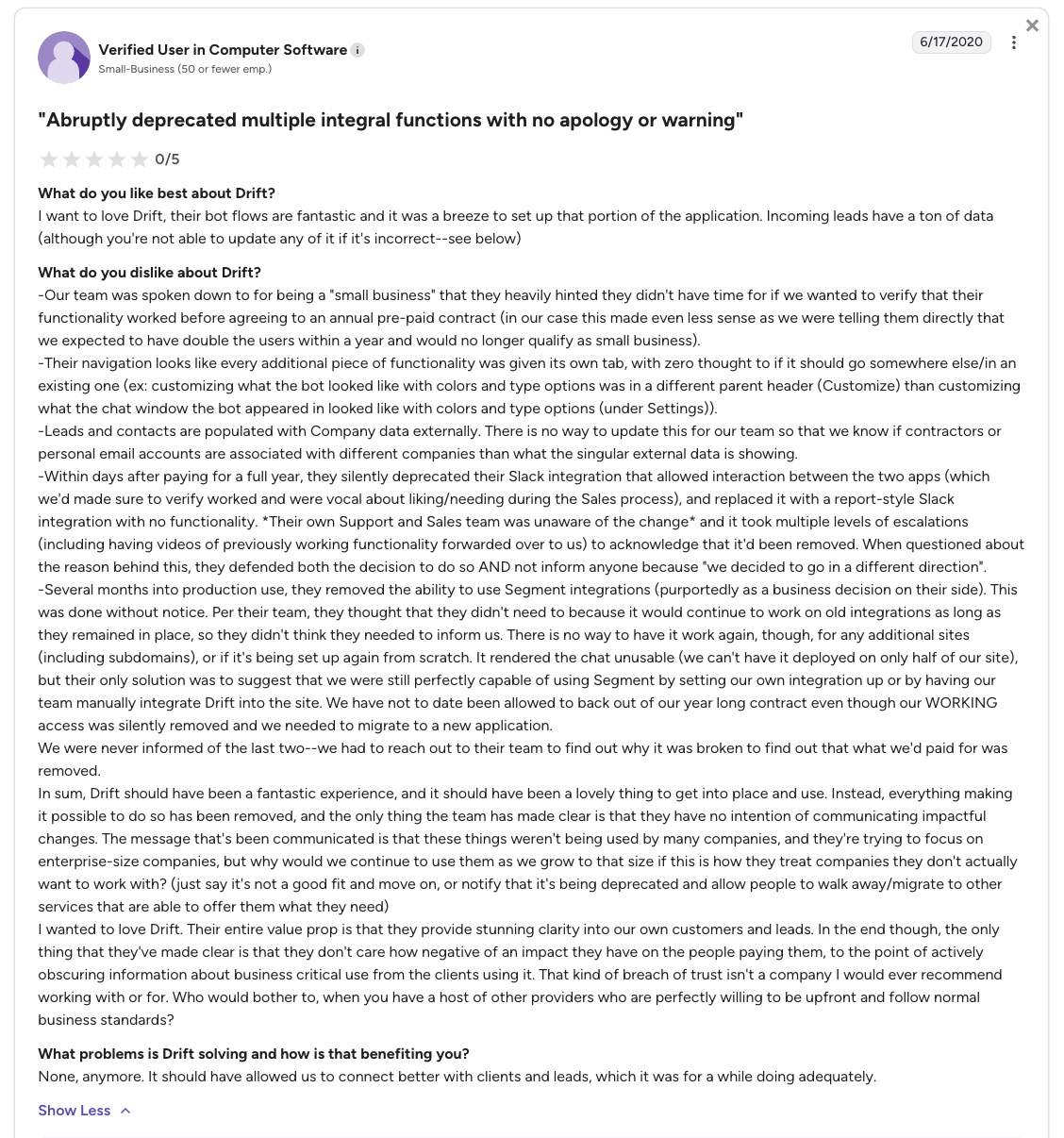
Reviewer: Verified User, Computer Software Company Size: Small Business (≤50 employees) Date: June 17, 2020 Rating: 0/5
“Abruptly deprecated multiple integral functions with no apology or warning.” “Within days… they silently deprecated their Slack integration…”
Drift G2 reviews also surface concerns around product stability and unexpected feature changes, particularly when core functionality is removed without clear communication.
In this case, the reviewer highlights multiple instances where integrations and features were deprecated after purchase, including Slack and Segment, directly impacting how the product was being used in production.
What this means: When critical features change or disappear without notice, it creates risk for teams relying on the platform for day-to-day operations.
Where this creates a gap: For revenue tools that sit close to pipeline generation, stability and predictability are essential. Unexpected product changes can disrupt workflows, break integrations, and reduce trust in the platform over time.
How platforms like Knock AI address this: Knock AI is designed around channels like Slack as a core part of the product experience, not an add-on integration. This reduces the risk of critical workflows breaking due to feature deprecation and allows teams to maintain consistent engagement without relying on changing integrations or external dependencies.
Drift Implementation Keeps Breaking? Here Is a Simpler Alternative
Drift the marketing platform typically takes 4 to 8 weeks to implement for standard setups and 8 to 12 weeks for enterprise configurations. Setup requires building chat playbooks, configuring routing rules, integrating CRM systems, and testing workflows before seeing any value. Teams report that routing logic breaks when CRM territory data changes, Slack integrations disappear without notice, and playbooks require constant maintenance to stay functional.
Knock AI is the simplest alternative for teams whose Drift implementation keeps breaking. There are no playbooks to build, no routing rules to configure, and no integrations to maintain manually. The AI Inbound SDR handles qualification, routing, and meeting booking automatically based on real-time CRM data. Setup takes under 2 hours. Most teams are live the same day they start.
CRM & Routing Failures
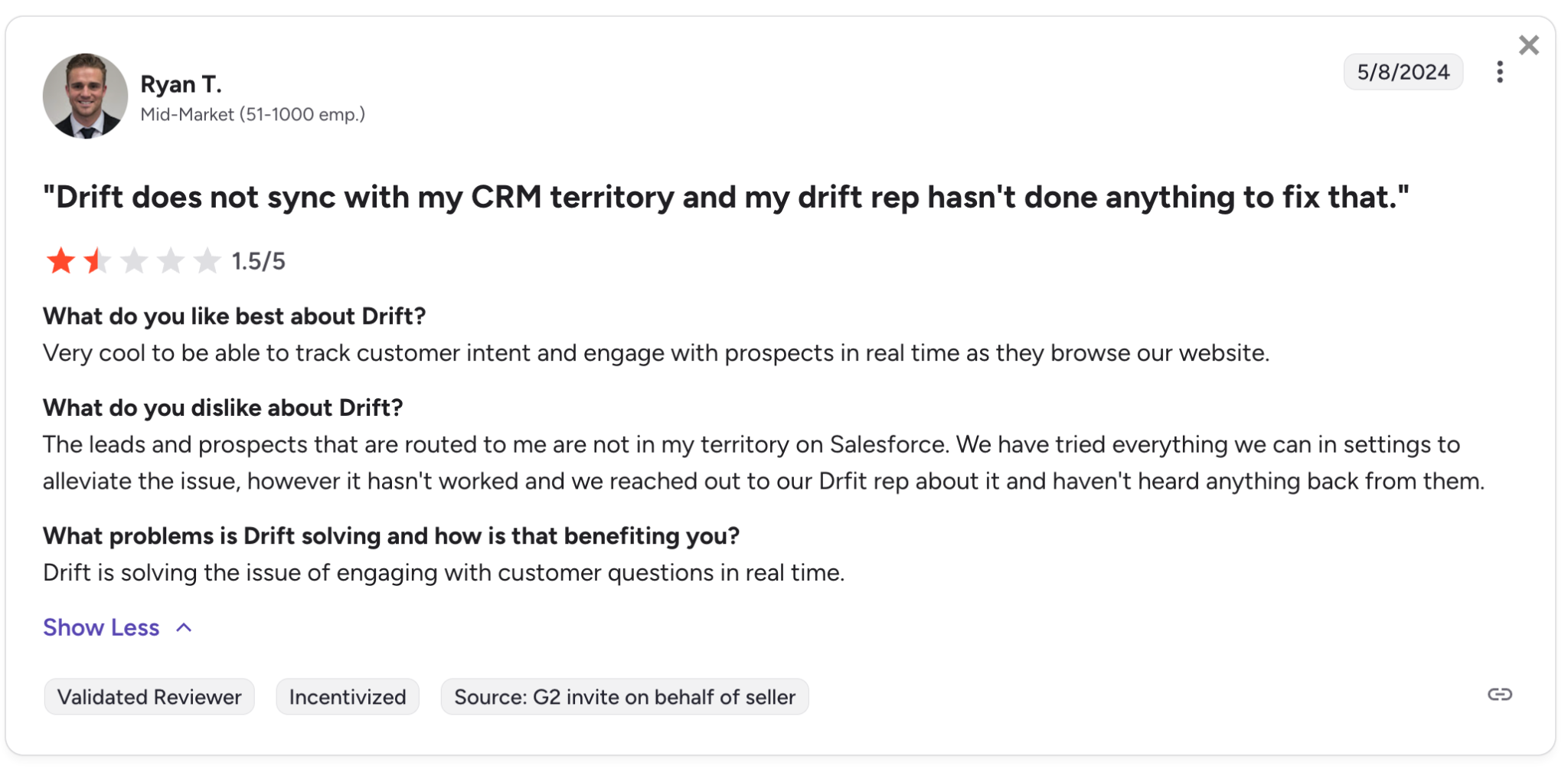
Reviewer: Ryan T. Company Size: Mid-Market (51–1,000 employees) Date: May 8, 2024 Rating: 1.5/5
“Drift does not sync with my CRM territory…” “The leads and prospects routed to me are not in my territory on Salesforce.”
Drift G2 reviews highlight CRM and routing accuracy as a recurring issue, particularly for teams managing territory-based sales workflows.
In this case, leads were being routed to the wrong rep despite configuration attempts, and the issue remained unresolved even after contacting support. This reflects a broader concern where routing logic does not always align with CRM structures.
What this means: When routing is inaccurate, high-intent leads can be assigned incorrectly, slowing response time and directly impacting conversion.
Where this creates a gap: Sales teams rely on precise territory mapping and CRM alignment to ensure speed and ownership. Any mismatch between chat routing and CRM logic creates friction in pipeline execution.
How platforms like Knock AI address this: Knock AI uses real-time enrichment and CRM-connected context to route leads dynamically based on ownership, intent, and account data. Instead of relying only on static rules, routing adapts to live data, reducing the type of mismatches highlighted in Drift G2 reviews and helping teams respond faster to the right opportunities.
Missed Conversations & Notification Gaps
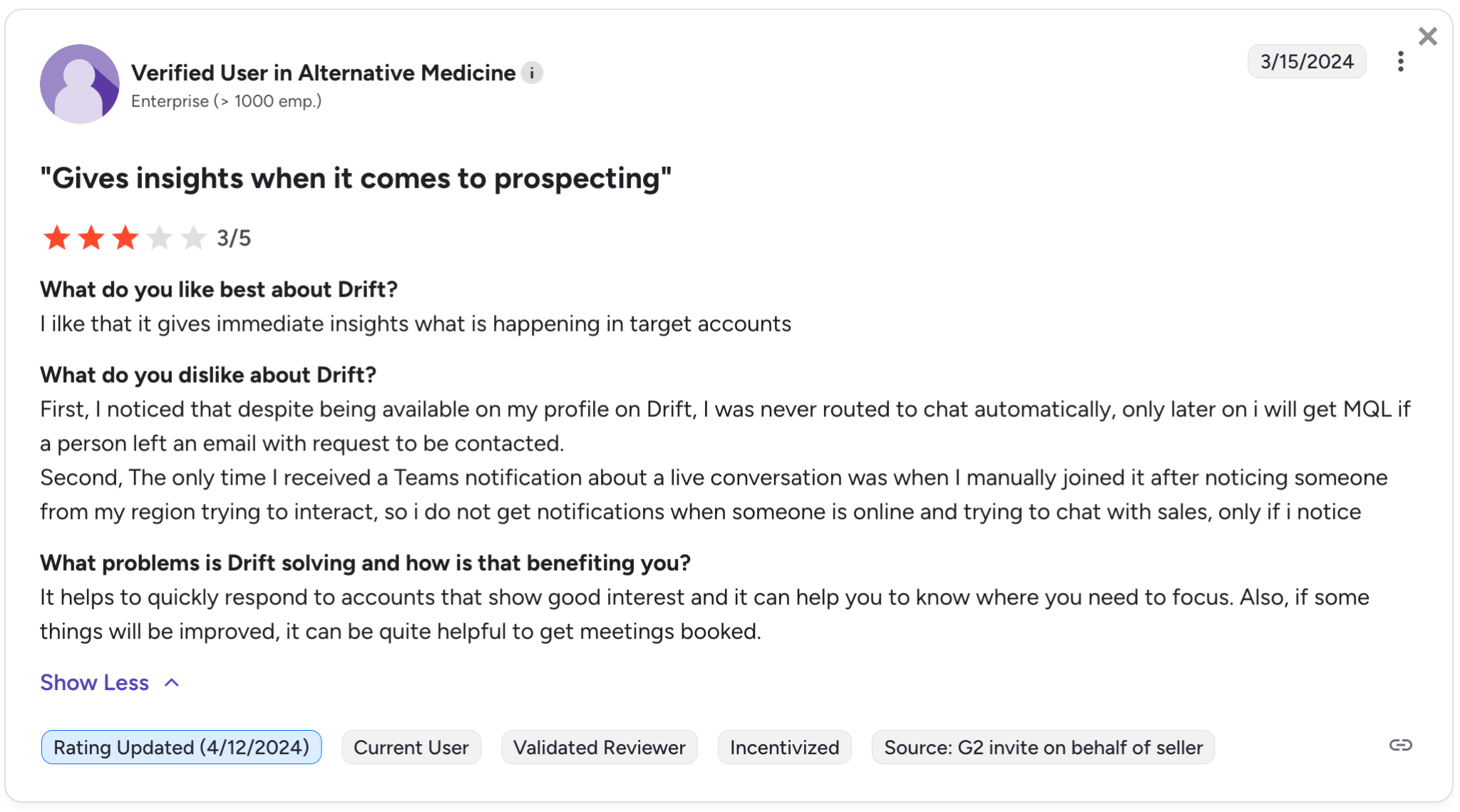
Reviewer: Verified User, Alternative Medicine Company Size: Enterprise (1,000+ employees) Date: March 15, 2024 Rating: 3/5
“I was never routed to chat automatically…” “I do not get notifications when someone is online and trying to chat with sales…”
Drift G2 reviews also highlight gaps in routing and real-time notifications, especially in scenarios where timely engagement is critical.
In this case, the reviewer was available but not automatically routed to conversations, and notifications were inconsistent unless manually checked. This created delays in responding to high-intent prospects.
What this means: When routing and notifications fail, even active demand can be missed, directly impacting speed-to-lead and conversion rates.
Where this creates a gap: Drift relies heavily on real-time human availability. If reps are not notified instantly or routing does not trigger correctly, conversations are delayed or lost.
How platforms like Knock AI address this: Knock AI removes this dependency by engaging instantly through an AI SDR that does not rely on rep availability. Conversations are initiated, qualified, and routed automatically, ensuring no high-intent interaction is missed even when human response is delayed.
Additional Patterns from Drift G2 & Capterra Reviews
Beyond individual Drift G2 reviews, a broader analysis across G2 and Capterra reveals consistent issues that appear across multiple users and use cases.
Some users report concerns around platform trust, including declining support quality after acquisition, unexpected billing behavior, and service disruptions.
CEO Perspective: High Cost, Poor UI, Slow Support
Mid-market leaders highlight pricing as unclear and expensive relative to value, along with slower support and implementation challenges.
Territory Routing + Bot Misbooking
Users report that chatbot-driven routing can misassign meetings or leads, especially in territory-based sales setups, leading to inefficiencies in pipeline handling.
Results Diminished Over Time
Across both Drift G2 reviews and Capterra, users note that initial performance does not always sustain, with results declining as engagement drops or workflows scale.
No ABM Data, Limited Analytics
Several reviews point to limited visibility into deeper buyer intent, with gaps in ABM data, enrichment, and full-funnel analytics.
What this means: These are not isolated issues. Drift G2 reviews and Capterra feedback consistently highlight challenges related to pricing, routing, scalability, and long-term performance.
Where this creates a gap: Drift is optimized for real-time, website-based conversations. As buying behavior becomes more distributed and multi-channel, the platform captures a smaller portion of total buyer intent, leading to inconsistent pipeline outcomes.
How platforms like Knock AI address this: Knock AI is built to identify, qualify, and engage buyers across channels, not just within a single website session. By combining real-time intent detection, AI-driven routing, and persistent conversations, it allows teams to convert demand more consistently without relying on manual workflows or real-time availability.
Drift G2 reviews do not point to isolated issues. They reveal a consistent pattern in how the platform operates and where it struggles.
Drift is built around a chat-first model. It activates when a visitor starts a conversation on the website.
But modern buyers do not behave that way.
Intent exists before a chat begins. Most visitors never start a conversation. And many high-intent buyers engage across channels, not just on a website.
This creates a fundamental gap:
Chat is a moment
Pipeline is a journey
Drift captures the moment. It does not capture the full journey.
This is what can be described as the Pipeline Gap.
Drift G2 reviews consistently highlight symptoms of this gap. Missed conversations, routing delays, declining ROI, and limited visibility are not separate problems. They all stem from the same constraint.
When engagement depends on real-time chat inside a single session, any drop in timing, availability, or interaction leads to lost intent.
Capturing conversations is not the same as generating pipeline.
The Core Problem
The limitations highlighted in Drift G2 reviews can be traced back to three structural constraints:
Website-only engagement: Conversations begin and end on the website, limiting visibility into buyer activity across other channels.
Session-based interactions: Engagement depends on the visitor being active in that moment. Once the session ends, the conversation typically stops.
SDR dependency: Effective conversion relies on real-time human response, making outcomes dependent on availability, timing, and coverage.
Most buyer intent happens outside the chat window Drift is optimized for.
Drift vs Modern Buyer Behavior
Buyer behavior has shifted significantly, and it no longer aligns with how chat-first systems operate.
Buyers don’t start on websites: They research on G2, LinkedIn, communities, and referrals before ever visiting your site.
Conversations are asynchronous: Buyers respond when it’s convenient, not necessarily in real time.
Engagement is multi-channel: Interactions happen across email, LinkedIn, Slack, and messaging platforms, not just website chat.
Timing matters more than presence: The moment of intent is short. If engagement doesn’t happen instantly, the opportunity is often lost.
Drift was built for a website-first world. Buyers are not.
What G2 Reviewers Actually Need
Drift G2 reviews consistently highlight a gap between what the platform delivers and what modern revenue teams actually need.
It is not just about improving chat or adding more rules. The shift is more fundamental:
Not chat → intent capture Teams need to identify who the buyer is and what they want before a conversation even starts.
Not routing → accurate qualification Instead of passing leads through rules, teams need context-aware qualification based on real-time data and intent.
Not speed → continuous engagement It is no longer about responding faster in a single session, but about maintaining conversations across time and channels.
This is the shift reflected across Drift G2 reviews. The need is not better to chat. The need is a system that captures, understands, and converts intent throughout the buyer journey.
Knock AI vs Drift (What G2 Reviews Reveal vs What Teams Actually Need)
Drift G2 reviews consistently highlight recurring issues around pricing, routing, support, and declining ROI. The table below maps those real user concerns to what modern platforms like Knock AI do differently.
Quick Comparison: Drift Limitations vs Knock AI
G2 Complaint
What It Means
How Knock AI Solves It
Expensive, unclear pricing
High total cost of ownership driven by SDRs, setup, and maintenance
Transparent model with lower operational overhead and faster time-to-value
Routing failures
Leads assigned incorrectly, slowing response and reducing conversion
AI-driven routing based on real-time CRM data, ownership, and intent
Missed chats and delays
Heavy reliance on SDR availability and timing
AI SDR engages instantly and continuously without human dependency
Slack and integrations removed or limited
Channel limitations and broken workflows
Slack-native engagement and multi-channel conversations by design
Weak analytics and limited intent data
Poor visibility into buyer intent and pipeline quality
Real-time intent detection, enrichment, and full-funnel visibility
Drift is still a strong platform for enterprise teams with dedicated SDR coverage and high inbound traffic. It works best when real-time chat can be consistently managed and routed within structured workflows.
However, Drift G2 reviews and broader user feedback show it becomes limiting for teams that:
operate with lean sales or RevOps teams
need to engage buyers across multiple channels, not just the website
are focused on pipeline generation, not just conversations
This is why many teams today are asking:
“Drift too expensive for the ROI we’re getting”
“Conversational marketing tool that goes beyond website chat”
“Replace Drift chatbot with AI SDR that actually books meetings”
“Best Drift alternative for B2B 2026”
Concerns around pricing, support after the Salesloft acquisition, routing issues, and declining results over time are pushing teams to re-evaluate whether chat-first tools are enough.
What this means
Drift still delivers value in the right setup.
But for teams looking for:
multi-channel engagement
reduced SDR dependency
consistent pipeline generation
the expectations have changed.
Drift is still relevant, but no longer sufficient on its own.
FAQs
What do Drift G2 reviews say?
Drift G2 reviews highlight strong performance in live chat and meeting booking, but consistent issues with pricing, routing, support, and scalability. Most feedback shows Drift works well for capturing conversations, but struggles to convert them into consistent pipeline.
Drift customer support is terrible after the acquisition. What should I switch to?
Drift's support quality has declined noticeably since the Salesloft acquisition, with multiple G2 and Trustpilot reviews reporting longer response times, unresolved tickets, and inconsistent CSM coverage for non-enterprise plans. Knock AI starts at $2,000 per month, requires no professional services or dedicated CSM to set up, goes live in under 2 hours, and operates without ongoing RevOps management. Most teams migrating from Drift complete the transition in 7 to 14 days with no pipeline disruption.
Drift implementation keeps breaking. Is there something simpler?
Knock AI is the simplest replacement for teams whose Drift implementation keeps breaking. Drift requires 4 to 8 weeks of implementation including playbook building, routing configuration, CRM integration, and ongoing maintenance. Knock AI has no playbooks to configure and no routing rules to maintain manually. The AI Inbound SDR handles qualification, routing, and meeting booking automatically based on live CRM data. Setup takes under 2 hours and most teams are live the same day.
Drift chatbot ROI is declining and results are getting worse. Why?
Drift chatbot ROI declines over time because Drift is built around website sessions. As buyers shift to LinkedIn, Slack, G2, and AI search tools, fewer high-intent buyers land on the website and engage the chatbot. Optimizing playbooks does not fix this because the root cause is the channel, not the configuration. Knock AI captures buyer intent across every channel buyers actually use before and after visiting the website, which means pipeline generation does not decline as website traffic declines. Teams switching from Drift to Knock AI report 38% pipeline growth within 90 days.
Is Drift overpriced?
Many Drift G2 reviews describe the platform as expensive relative to ROI, especially for mid-market teams. Costs increase further due to SDR staffing, implementation, and ongoing maintenance.
Companies move away from Drift due to high total cost of ownership, reliance on SDR availability, routing issues, and limited multi-channel capabilities. Reviews often point to declining results as engagement drops over time.
Did Drift get worse after Salesloft?
Some user feedback indicates a decline in support quality and overall experience after the Salesloft acquisition. Concerns around responsiveness, billing, and product direction are frequently mentioned.
What is the best Drift alternative for B2B?
The best Drift alternative depends on your GTM setup:
Knock AI → pipeline generation, multi-channel engagement, and AI-led qualification
Drift can generate pipeline from high-intent website visitors, but its effectiveness depends on real-time engagement and SDR availability. It does not capture the full range of buyer intent outside the website.
Does Drift require SDRs?
Yes, in most cases. Drift relies on SDRs to respond to conversations, qualify leads, and route opportunities. Without active coverage, response delays can reduce conversion rates.
What are Drift limitations?
Key limitations include website-only engagement, session-based conversations, reliance on SDR timing, limited intent data, and lack of multi-channel support.
Is Drift still worth it in 2026?
Drift is still valuable for enterprise teams with strong inbound traffic and SDR coverage. However, for teams focused on scalability, automation, and pipeline efficiency, it may not be sufficient on its own.
What should I use instead of Drift?
If you're looking to replace Drift, consider platforms that go beyond chat:
multi-channel engagement (Slack, LinkedIn, email)
real-time intent detection
AI-driven qualification and routing
Platforms like Knock AI are designed to address these needs by focusing on pipeline generation rather than just conversations.


.svg)


.svg)
.svg)
.svg)


.svg)
.svg)

.webp)

.svg)