star iconstar iconstar icon
icon starDecorative blue sparkle icon
Get Started

First-Party vs. Third-Party Intent Data: Key Differences and How to Use Both

TL;DR

‍

First-party intent data reveals how prospects engage directly with your business, from website visits and content interactions to product activity and tracked links. Third-party intent data helps identify companies researching relevant topics across external websites, publisher networks, and review platforms. While first-party data provides direct engagement context, third-party data expands visibility into potential demand. Combining both helps B2B teams discover in-market accounts, understand buyer behavior, prioritize relevant contacts, and make more informed sales decisions. Knock AI helps teams capture, interpret, and act on first-party intent signals through intent scoring, contact enrichment, intelligent routing, and AI-powered engagement.

‍

Why B2B Teams Need Both First-Party and Third-Party Intent Data

‍

Imagine two companies that fit your ideal customer profile.

The first is actively researching solutions in your category. Its employees are reading industry publications, comparing vendors, and exploring product reviews. However, nobody from the company has visited your website or contacted your sales team.

The second company has visited your pricing page multiple times, explored product features, and clicked through several pieces of your content. You already have direct evidence of its engagement with your business.

Both accounts could represent potential opportunities, but the signals tell you different things.

The first company's activity is captured through third-party intent data. It helps you identify businesses researching topics related to your products, even before they interact with your brand.

The second company's activity is captured through first-party intent data. It shows how prospects engage directly with your website, content, product, and other tracked touchpoints.

Relying on only one source leaves gaps. First-party data may not reveal companies researching your category elsewhere, while third-party data may not tell you how those companies are engaging with your business.

By combining both, B2B sales and marketing teams can get a more complete picture of buyer behavior, identify potential demand earlier, and prioritize accounts based on both external research activity and direct engagement.

‍

What Is First-Party Intent Data?

‍

First-party intent data is behavioral information a business collects directly from its own digital properties and tracked interactions. It shows how prospects engage with a company's website, content, products, and other marketing or sales touchpoints.

Unlike third-party intent data, which captures research activity across external sources, first-party intent data focuses on interactions with your business.

Common sources of first-party intent data include:

When connected across accounts and contacts, these signals provide a clearer picture of buyer engagement. Sales and marketing teams can understand which companies are showing interest, what specific products or topics attract their attention, and whether their engagement is increasing or declining over time.

For example, a prospect who repeatedly visits your pricing page, explores product features, and clicks a sales link may warrant more attention than someone who visits a single blog post.

‍

What Is Third-Party Intent Data?

‍

Third-party intent data is information collected by external providers from activity across websites, publisher networks, research platforms, and other digital sources outside your company's direct properties.

It helps B2B companies identify businesses researching topics related to their products or services, even when those businesses haven't visited their websites or interacted with their sales teams.

Common sources of third-party intent data include:

Intent data providers collect and analyze these activities to identify accounts showing interest in particular topics. Sales and marketing teams can use these insights to discover potential buyers earlier and prioritize accounts for targeted outreach.

However, researching a relevant topic doesn't necessarily mean a company is ready to purchase. An account might be exploring a subject for general research, education, or future planning. That's why third-party intent signals should be evaluated alongside company fit, signal recency, and direct engagement before treating an account as a sales opportunity.

‍

What Is Second-Party Intent Data?

‍

Second-party intent data is another organization's first-party data shared directly with your business through a partnership or data-sharing arrangement.

For example, a software company might receive buyer engagement data from a review platform through an agreed partnership. This can help the software company identify businesses researching products or solutions in its category.

The three data types differ mainly in where the information comes from:

‍

First-Party vs. Third-Party Intent Data: Key Differences

‍

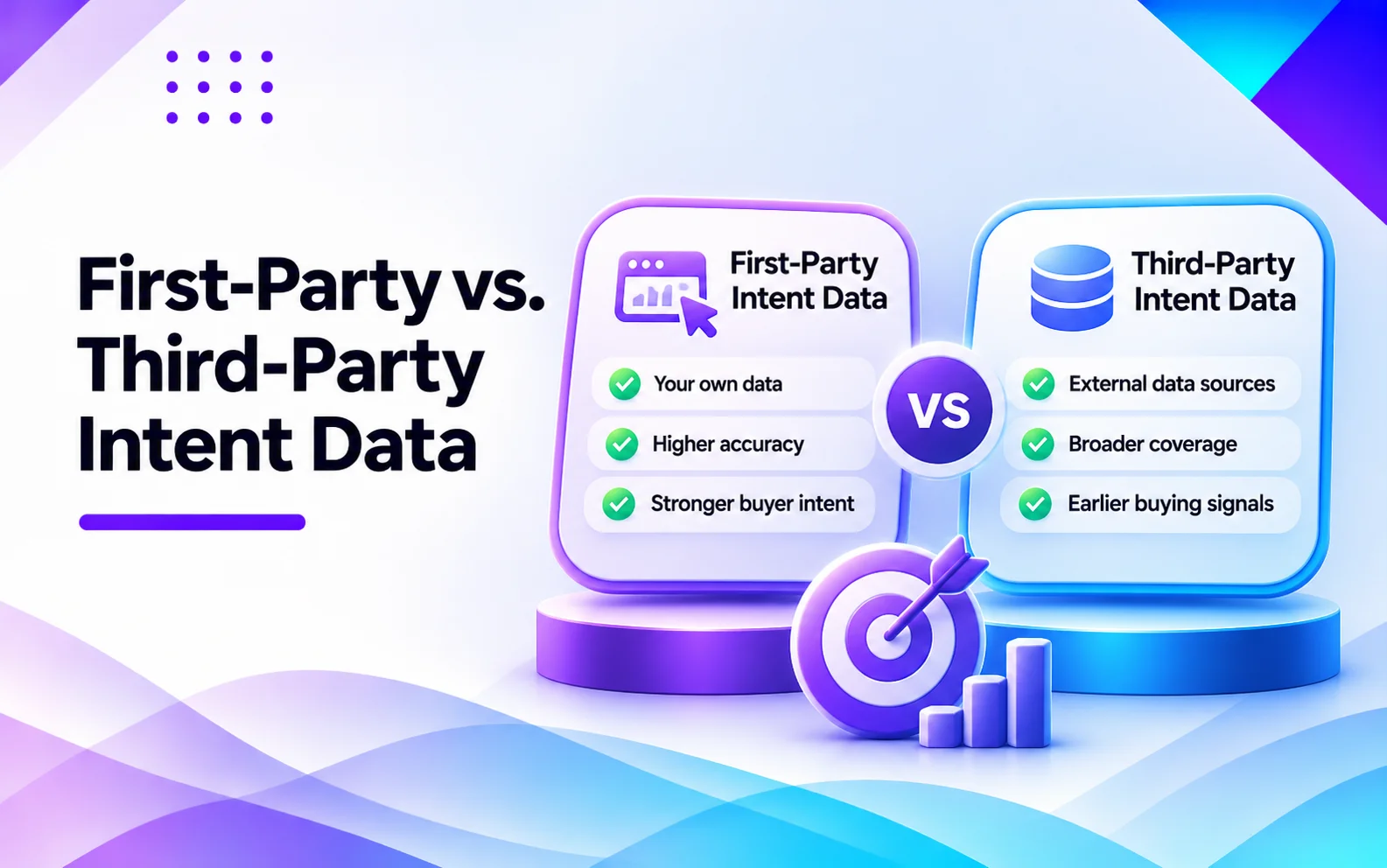
First-party and third-party intent data serve different purposes in B2B sales and marketing. First-party data provides visibility into how prospects interact with your business, while third-party data helps identify companies researching relevant topics across external sources.

Here is how the two compare across the factors that matter when building an intent data strategy.

Stakeholder What to emphasize Relevant engagement
Economic buyer ROI, financial impact, and business value Business case and executive presentation
Technical evaluator Security, integrations, and architecture Technical documentation and product walkthrough
End user Usability, productivity, and workflow improvements Product demonstration and hands-on evaluation
Procurement Pricing, contract terms, and vendor compliance Commercial proposal and vendor documentation
Champion Internal alignment and business outcomes Presentation materials, case studies, and stakeholder enablement
See Knock AI in Action — Book Your Live Demo Today

Which One Should B2B Teams Prioritize?

Neither data source should be treated as a replacement for the other. Third-party intent data helps identify accounts showing interest in your market, while first-party intent data provides context about their direct engagement with your business.

The most effective approach is to combine both. Use external research signals to discover potential opportunities, then use first-party engagement, account fit, and contact-level context to determine which accounts deserve sales attention.

‍

How to Combine First-Party and Third-Party Intent Data

‍

Using first-party and third-party intent data together helps B2B teams move beyond isolated engagement signals and build a clearer picture of potential buyers.

Third-party data can reveal which accounts are researching your product category, while first-party data shows whether those accounts are engaging with your business. Here's how to combine both in a practical workflow.

Step 1: Discover Accounts Showing External Research Activity

Start by using third-party intent data providers to identify companies researching topics related to your product or service.

For example, if you sell a sales engagement platform, you might look for accounts researching topics such as sales automation, sales engagement software, lead generation, or outbound sales tools.

Prioritize topics closely related to your product's capabilities and the problems it solves. This helps you build an initial list of accounts showing potential interest in your market.

Step 2: Validate Account Fit

Not every company researching your category is a potential customer. Before passing accounts to sales, compare them against your ideal customer profile (ICP).

Evaluate factors such as:

This step helps separate relevant accounts from companies whose research activity may have little commercial value to your business.

Step 3: Monitor Direct Engagement

Once you've identified suitable accounts, monitor their interactions with your business.

Look for signals such as:

Pay attention to the pages and assets generating engagement. For example, repeated visits to a pricing page may provide a different level of context than a single visit to an educational blog post.

Step 4: Identify and Prioritize Relevant Contacts

Account-level research activity doesn't tell you exactly who is involved in evaluating a solution. Use available contact and account information to identify the people who may influence the purchase.

Consider their job titles, seniority, departments, and potential roles in the buying committee. Then evaluate their engagement using:

Combining these factors helps sales teams prioritize accounts based on more than a single intent signal.

Step 5: Route Prospects to the Right Sales Action

Use the combined account and contact context to determine the next action.

For example, accounts showing strong external research activity and repeated engagement with your pricing or product pages may deserve faster sales follow-up. Accounts showing early research activity but little direct engagement may be better suited for targeted nurturing.

Sales teams can use these insights to personalize outreach, assign accounts to the right representatives, and coordinate follow-ups across marketing and sales.

Example: Combining First-Party and Third-Party Intent Signals

Consider a B2B SaaS company selling a sales engagement platform.

A third-party intent provider identifies a target account researching sales automation and sales engagement software across external industry publications. The account matches the company's ICP, making it a relevant prospect.

A few days later, someone from that account visits the company's pricing page, explores product features, and clicks a tracked sales link shared by an SDR.

Individually, the external research signal indicates category interest, while the website and sales-link interactions show direct engagement with the vendor. Together, they provide stronger context for prioritizing the account and deciding when to initiate a sales conversation.

This is the value of combining both data sources: third-party intent helps uncover potential demand, while first-party intent helps teams understand and act on engagement with their business.

‍

How Knock AI Helps B2B Teams Turn First-Party Intent Into Revenue Opportunities

‍

Collecting intent signals is only the first step. B2B teams also need to understand who is engaging, what their activity indicates, and how to turn those insights into timely sales conversations.

Knock AI helps teams capture and act on first-party intent signals across their website, Knock Links, chat interactions, and other supported touchpoints. Here's how its capabilities fit into the process.

Capture Engagement Across Multiple Touchpoints

Traditional website analytics can show which pages visitors view, but buyer engagement often extends beyond website sessions.

Knock AI captures first-party engagement through website activity, including page views, CTA clicks, and form interactions. It also tracks interactions with Knock Links shared through channels such as email, social media, PDFs, and other distribution channels.

Chat interactions and supported configured signals provide additional context about how prospects engage with your business.

This gives sales and marketing teams more visibility into buyer activity across their tracked touchpoints.

Build a Unified Intent Profile

Individual engagement events become more useful when viewed together.

Knock AI brings relevant activity into a chronological intent timeline associated with identified contacts and accounts. Teams can review interactions such as website visits, tracked link clicks, chat activity, and other supported engagement signals.

For example, a contact might first click a LinkedIn campaign link, visit your website, return to a pricing page, and later engage with a Knock Link. Instead of treating these as isolated events, sales teams can examine the sequence to understand the prospect's engagement over time.

Prioritize Prospects With Knock Intent Score

Not every interaction indicates the same level of interest. A pricing-page visit, for example, may carry different significance from a general blog visit.

Knock's Intent Score classifies engagement into three levels: High, Medium, and Low. The score considers three factors:

This helps sales teams distinguish accounts and contacts showing stronger engagement from those with limited activity.

Understand Why Someone Is Engaging With Knock Intent Type

A high intent score doesn't automatically mean someone wants to purchase. A person interacting with your business could be looking for support, exploring a partnership, or enquiring about a job.

Knock's Intent Type helps distinguish between these different purposes:

Intent Type is distinct from Intent Score. While the score indicates the level of engagement, the type helps identify its purpose. This distinction helps teams avoid treating every highly engaged contact as a potential buyer.

Identify and Enrich Relevant Contacts

Account-level engagement tells you which companies are active, but sales teams also need to understand the people behind that activity.

Knock AI's identification and contact enrichment capabilities add context to relevant conversations, including available contact details, job titles, company information, and engagement history.

This helps sales representatives understand who they're speaking with and approach conversations with more relevant context.

Turn Intent Signals Into Sales Actions

Intent data becomes valuable when teams can act on it without manually reviewing every engagement event.

Knock AI provides several capabilities to help teams operationalize first-party intent:

Together, these capabilities connect intent signals with qualification, engagement, and sales follow-up.

First-Party Intent Data Is Where Knock AI Fits

Third-party intent data helps businesses discover companies researching relevant topics across external websites and publisher networks. Knock AI focuses on capturing, interpreting, and acting on first-party engagement with your business.

By bringing together tracked interactions, intent scoring, contact enrichment, and intelligent routing, Knock AI helps B2B teams move from observing buyer activity to acting on relevant revenue opportunities.

Rather than replacing third-party intent providers, Knock AI can complement them by adding direct engagement context to the broader picture of buyer research.

‍

FAQs

‍

What is the difference between first-party and third-party intent data?

First-party intent data captures how prospects interact directly with your business through website visits, content engagement, product activity, and tracked touchpoints. Third-party intent data reveals companies researching relevant topics across external websites, publisher networks, and research platforms. Combining both helps businesses understand direct engagement while identifying potential demand beyond their own digital properties.

Is first-party intent data more accurate than third-party intent data?

Not necessarily. Accuracy depends on factors such as signal quality, data collection methods, identity resolution, and how recently the information was collected. First-party data provides direct context about engagement with your business, while third-party data offers visibility into external research activity. Both can be valuable when interpreted in the right context.

What are examples of first-party intent signals?

Common first-party intent signals include:

These signals help businesses understand how prospects engage with their products, content, and sales touchpoints.

What are examples of third-party intent signals?

Examples of third-party intent signals include:

These signals help identify companies researching a particular category, even before they interact directly with your business.

Can businesses use first-party and third-party intent data together?

Yes. Combining both provides a more complete view of potential buyers. Third-party intent data helps identify companies researching relevant topics across external sources, while first-party intent data reveals how those companies engage with your business. Sales and marketing teams can use both to validate account fit, prioritize prospects, personalize outreach, and determine the right time for sales follow-up.

‍